Category Archives: Bible Study

Shepherd One?

While working in my study this morning I noted that the news media is giving much attention to the visit of Benedict XVI to the USA. It is difficult to tell if the head of the Roman Catholic Church is the head of a political state or a spiritual leader.

I was surprised to hear that the jet that the pope flies on is called Shepherd One. Makes me wonder. If Jesus got a jet what would it be called. Maybe Servant One.

Jesus said,

“I am the good shepherd; the good shepherd lays down His life for the sheep.” (John 10:11)

Peter is the supposed first pope according to Catholic theology. This is a claim not sustained by the Bible. Peter claimed to be a fellow shepherd, but that Jesus is the chief shepherd.

Therefore, I exhort the elders among you, as your fellow elder and witness of the sufferings of Christ, and a partaker also of the glory that is to be revealed, shepherd the flock of God among you, exercising oversight not under compulsion, but voluntarily, according to the will of God; and not for sordid gain, but with eagerness; nor yet as lording it over those allotted to your charge, but proving to be examples to the flock. And when the Chief Shepherd appears, you will receive the unfading crown of glory. (1 Peter 5:1-4)

The photo below, taken at the Nazareth Village, shows a shepherd tending his flock.
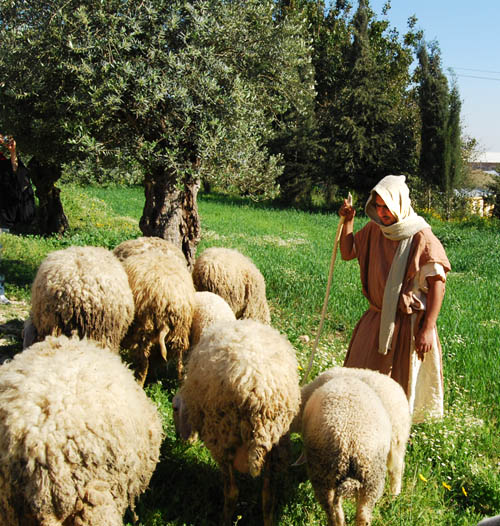
Shepherd tends his flock at the Nazareth Village. Photo by Ferrell Jenkins.

Home safely, and on time

I am thankful to report that I arrived home safely last evening from Amman, Jordan. Every flight was on time, and the flights from Amman and Frankfurt had a few seat available; there was no one sitting next to me. What a joy!

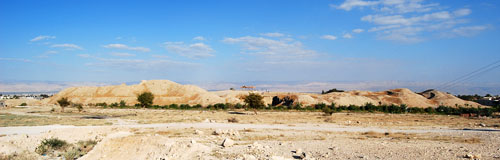
Lots to do to catch up. Uploads to WordPress are working correctly from my home computer, so I am posting this composite panorama of the site of ancient Jericho. The view is toward the east. The mountains of transjordan can be seen to the left of the tell. I hope to have more photos and information to share in the days to come.

Site of ancient Jericho. View toward the east. Photo by Ferrell Jenkins.

Visting the land of Moab

Today we visited Heshbon, Tell Al, Dibon, and Macherus. Tell Al is thought to be the biblical site of Elealeh, a site always mentioned (Numbers 32:3). Macherus is the site of a fortress built by Herod the Great overlooking the Dead Sea on the east side. It is sort of a companion site to Masada on the western side of the sea. According to Josephus this is where John the Baptist was put to death by the order of Herod Antipas.

He sent and had John beheaded in the prison. (Matthew 14:10).

As a photo for today I want to share a picture I made at Heshbon in the ancient land of Moab. When we arrived the shepherd was beginning to lead his sheep out to pasture. Note the large number of lambs among the flock. Another interesting observation is that the shepherd is behind the flock. This is a something we see often in this part of the world.

The shepherd leads his flock out to green pastures. Photo by Ferrell Jenkins.

The LORD used this illustration many times to show His ooncern for His people. His appointed leaders were likened to shephers who would lead the flock. The text below speaks of the appointment of Joshua to take the place of Moses.

“May the LORD, the God of the spirits of all flesh, appoint a man over the congregation, who will go out and come in before them, and who will lead them out and bring them in, so that the congregation of the LORD will not be like sheep which have no shepherd.” (Numbers 27:16-17)

This will likely be the last post of the current trip until I am back in the comfort of my study. Prayers of the faithful are always appreciated.

Intermediate stop for Jacob and his family

Yesterday we were disappointed that we could not locate the road to the tell (Tell Dhahab west) that is thought (by some at least) to be the site of Penuel. Not wishing to be defeated, this morning I contacted the Department of Antiquities and inquired about how to reach the site from Deir Allah. I was given the mobile (cell in the USA) number for the Inspector for the area. When I called he said he would be delighted to assist.

When we arrived at Deir Allah (likely the site of biblical Succoth), we went to the Inspector’s office and visited a while. After tea, he went with us to the sites. Some of the road was very difficult, but we followed his pickup and made it in our rental car. This site is a few miles east of the Plains of the Jordan.

The site of Penuel with the Jabbok River below. Photo by Ferrell Jenkins.

The photo above shows Tell Dhahab (West) on the left. I put a white dot on the impressive tell. You can see the Jabbok River below on the right. It was in terrain like this where Jacob crossed the Jabbok after wrestling with an angel.

So Jacob named the place Peniel, for he said, “I have seen God face to face, yet my life has been preserved.” Now the sun rose upon him just as he crossed over Penuel, and he was limping on his thigh. (Genesis 32:30-31)

Jeroboam fortified Penuel at the beginning of his reign as king of the northern kingdom of Israel (shortly after 931 B.C.).

Then Jeroboam built Shechem in the hill country of Ephraim, and lived there. And he went out from there and built Penuel. (1 Kings 12:25).

For one who loves traveling in the land of the Bible as much as I do, this was an exciting day. Maybe even better than finding the Roman road north of Tarsus last summer. The bus could not have made it to this place.

A day in Perea (Jordan Valley)

Yesterday we spent a large part of the day in the Jordan Valley. This area was called Perea by the Romans. We typically divide the ministry of Jesus into the Early Judean, Galilean, Perean, and Later Judean. You probably will not find the word Perea in an English translation of the Bible. The Greek word peran is translated “beyond” in passages such as Matthew 19:1 and Mark 10:1.

We visited mostly Old Testament sites, but there is considerable disagreement among scholars about the precise identification of most of these sites. Here are some possible sites we saw: Abel-Shittim, Succoth, Zarethan (or Zaphon). We also visited Tell Mazar, and the area of Tell Dhahab (possible sites of Penuel, and nearby Mahanaim). There are no road signs to these places and the locals in the nearby villages provided little help. This is the vicinity where Jacob settled for a while on his trek from Padan-Aram to Shechem.

One of our most interesting stops was at Tell Kafrein. This site had not yet been identified, but a team of archaeologists from a Greek university were working there. We met the director and received a good tour of the site and of the pottery lab.

Today we will probably go to the area south of Amman, including Heshbon, Dibon, and other sites.

Group arrived in New York

I just had word from Elizabeth that the group arrived safely at JFK in New York.

David, Lowell, and I had a good day here in Jordan. We saw the following sites: Ramoth Gilead, Pella, Deir Alla (possibly Succoth), and some other places.

As time permits I will try to post a few more photos. The smoke is so bad in the hotel lobby that I can’t take much more of it.

Watching the Roman soldiers at Jerash

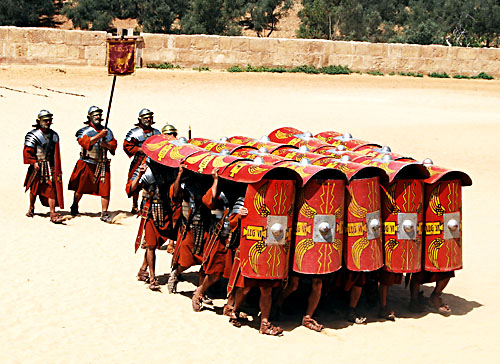
Jerash was one of the cities of the Decapolis during the time of Christ. Today we visited the ruins of that city. It is an impressive site, and I think I have worked through the problem I was having in uploading photos from here. At least I have discovered one way it can be done.

Here is a small photo of the Roman soldiers of the 6th Legion demonstrating the formation used in protecting the banner of the Legion.

Arrival in Amman

We had a wonderful evening at the Dead Sea, and a good day with a visit to the Roman city of Jerash. We also saw the RACE show. This is the Roman Army and Chariot Experience. I will try to post some photos later.

The group will be leaving the hotel about 11:15 p.m. to go to the airport for the first stretch of the flight home. I am sure that everyone would appreciate your prayers for a safe return to family and friends.

Please excuse group members if they seem a little excited about what they have seen, learned, and experienced in the past two weeks.

Hazor, Dan, Caesarea Philippi, Golan Heights

Today we visited sites north of the Sea of Galilee. We began at Hazor, a site overlooking the Hulah Valley. The Israelites came to this large city and defeated the inhabitants and burned the city.

However, Israel did not burn any cities that stood on their mounds, except Hazor alone, which Joshua burned. (Joshua 11:13)

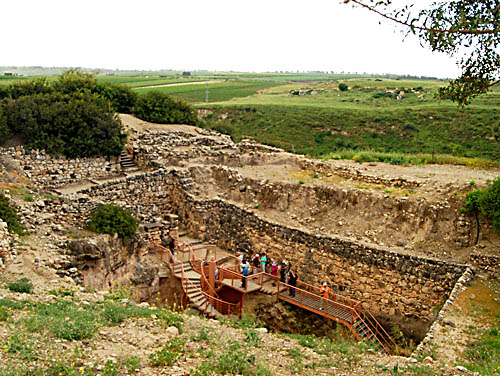
This photo shows the water shaft due in the days of King Ahab of Israel. Gates and walls were for protection, and food and water were a necessity for survival.

The water shaft at Hazor. Photo by

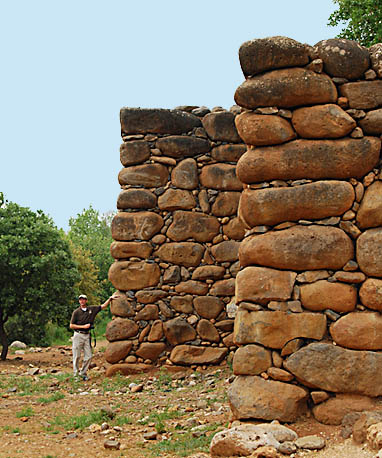
We continued north to the Israeli-Lebanese border at Metulla. Afterwards we went to Tel Dan. In order to get to the tel it is necessary to walk through a nature park, much of it along the Dan River, the strongest source of the Jordan River. Here is a photo of a stretch of reconstructed wall near the city gate.

Reconstruction of the City Wall at Tel Dan. Photo by Ferrell Jenkins.

We continued a short distance east to Banias, the biblical Caesarea Philippi, where Jesus made His promise to build the church upon His own deity.

Now when Jesus came into the district of Caesarea Philippi, He was asking His disciples, “Who do people say that the Son of Man is?” And they said, “Some say John the Baptist; and others, Elijah; but still others, Jeremiah, or one of the prophets.” He said to them, “But who do you say that I am?” Simon Peter answered, “You are the Christ, the Son of the living God.” And Jesus said to him, “Blessed are you, Simon Barjona, because flesh and blood did not reveal this to you, but My Father who is in heaven. “I also say to you that you are Peter, and upon this rock I will build My church; and the gates of Hades will not overpower it. “I will give you the keys of the kingdom of heaven; and whatever you bind on earth shall have been bound in heaven, and whatever you loose on earth shall have been loosed in heaven.” (Matthew 16:13-19)

We made a short stop at Birket Ram, a lake in an extinct crater below Mount Hermon. There was almost no snow on the mountain today. Often a small amount of snow can still be seen by this time of year. We continued to Tiberias through the Golan Heights (biblical Bashan), where one of the cities of refuge was located (Joshus 20:8).

We closed the tour day with a short visit to Mount Arbel for a view of the Sea of Galilee.

The Shabat (Sabbath) has begun in Israel. Jews pour into the hotels for the Shabat to have their meal prepared for them by someone else. We are near a pedestrian street with a number of restaurants. The music is loud, indicating very little in the way of a spiritual significance to the Sabbath. A far cry from the commands of the Torah.

Caesarea Maritima, Mount Carmel, and Nazareth

After a good night of rest along the beautiful Mediterranean we left Netanya and headed a few miles north to Caesarea Maritima. Caesarea was a first century Roman capital and seaport. The gospel was first preached to the Gentiles here when Peter came from Joppa to Caesarea to tell Cornelius words by which he could be saved (Acts 10, 11).

Herod the Great built a city on the site of Strato’s Tower and named it Caesarea in honor of Caesar Augustus. It became a certer of Roman provincial government in Judea. The city had a harbor and was located on the main caravan route between Tyre and Egypt. This city is called Caesarea Maritima (on the sea) to distinguish it from Caesarea Philippi.

Paul used the harbor at Caesarea several times. He was imprisoned here for two years before departing for Rome (Acts 24:27; 27:1). This photo shows the area of Herod’s Palace with the replica of the Pilate inscription. This inscription was found in the theater in 1961. Pilate was the Roman procurator of Judea from A.D. 26-36.

Caesarea. Palace of Herod. Pilate Inscription. Photo by Ferrell Jenkins.

After visiting other sites of the city we continued north to Mount Carmel to visit the site associated with Elijah and the prophets of Baal (1 Kings 18). We crossed the Valley of Jezreel (the Armageddon of Rev. 16:16), and came to Nazareth, the boyhood home of Jesus. One of the highlights of the day was a visit to the Nazareth Village. This is a wonderful place to see authentic illustrations of life in the time of Jesus.

Nazareth Village is built on the site of a first century farm. We saw a wine press cut into rock, a watchtower, a carpenter at work a woman spinning wool, a reconstructed synagogue, etc. I would encourage anyone coming to this area to visit Nazareth Village. I keep a link to their web site at Biblical Studies Info Page. Here is a direct link to Nazareth Village. This beautiful photo shows the shepherd with his sheep.

Nazareth Village - Sheperd with sheep. Photo by Ferrell Jenkins.

Tonight we are at Tiberias on the shores of the Sea of Galilee.