Category Archives: Bible Study

The church as a solid bulwark

The apostle Paul wrote these words to the saints at Colossae:

For though I am absent in body, yet I am with you in spirit, rejoicing to see your good order and the firmness of your faith in Christ. (Colossians 2:5 ESV)

J. B. Lightfoot suggested that the term stereoma [firmness] was a military metaphor. He says that Paul’s companionship with soldiers of the praetorian guard (Philippians 1:13) might have suggested the image.

I always enjoy William Barclay’s comments on words. He makes the following comments on order and firmness.

These two words present a vivid picture, for they are both military words. The word translated order is taxis, which means a rank or an ordered arrangement. The Church should be like an ordered army, with every man in his appointed place, ready and willing to obey the word of command. The word translated firmness is stereoma, which means a solid bulwark, an immovable phalanx. It describes an army set out in an unbreakable square, solidly immovable against the shock of the enemy’s charge. Within the Church there should be disciplined order and strong steadiness, like the order and steadiness of a trained and disciplined body of troops.

These soldiers from the Roman Army and Chariot Experience at Jerash, Jordan, demonstrate what is meant by the term firmness (stereoma).
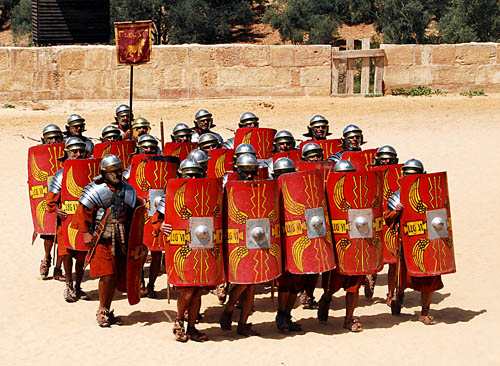
Soldiers in formation as a solid bulwark. Photo by Ferrell Jenkins.
Soldiers in formation as a solid bulwark. Photo by Ferrell Jenkins.
Dog River in Lebanon

The Nahr el Kelb, the River of the Dog, flows into the Mediterranean Sea about nine miles north of Beirut, Lebanon. In antiquity the river was known as the Lycus. Many important armies have traveled through this pass in the Lebanon mountains leaving their inscriptions on the cliffs.

There are inscriptions or reliefs from the following ancient rulers:

  • Egyptian Pharaoh Ramses II.
  • Assyrian kings Shalmaneser III and Esarhaddon.
  • Babylonian king Nebuchadnezzar.

Shalmaneser III took tribute from Jehu, the king of Israel,  841 B.C. Wright says,

“The tribute was evidently received after Shalmaneser’s fifth attack on Damascus, following which he had marched his army into Phoenicia. While there he says that he received the tribute of Tyre, Sidon, and Jehu, and placed his portrait on the cliff of Ba’ lira’ si. This portrait, along with those of other kings, including Rameses II of Egypt…” is located at Dog River, north of Beirut. (Biblical Archaeology, 158-159).

Jehu was king of Israel in the 9th century B.C. (2 Kings 9). The Bible does not record this event, but the annals of Shalmaneser III record the following information:

“…I (also) marched as far as the mountains of Ba’li-ra’si which is a promontory (lit.: at the side of the sea) and erected there a stela with my image as king. At that time I received the tribute of the inhabitants of Tyre, Sidon and of Jehu, son of Ornri.” (ANET, 280)

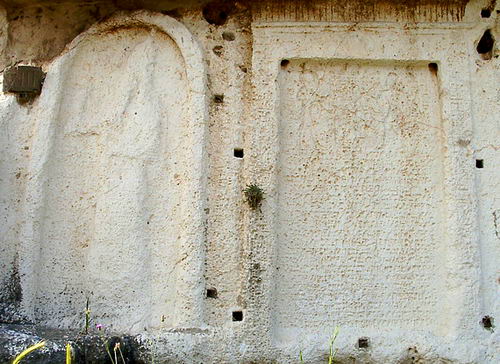
This photo, made in 2002, shows the reliefs left by Salmaneser III and Ramses (right).

Reliefs of Shalmaneser III and Pharaoh Ramses at Dog River. Photo by Ferrell Jenkins.

Reliefs of Shalmaneser III and Pharaoh Ramses at Dog River. Photo by Ferrell Jenkins.

Byblos in Lebanon

Byblos is located on the Mediterranean Sea about 25 miles north of Beirut, Lebanon.The ancient Phoenician city of Gebal (modern Arabic Jbeil) was called Byblos by the Greeks because they saw scrolls there made from imported papyrus sheets. The Greek word byblos is translated book in our English versions of the Bible. In fact, our word Bible is derived from the work byblos.

The Gebalites worked with the builders of  Solomon and Hiram to fashion and prepare timber and stone to build the temple (1 Kings 5:17-18). The old men of Gebal are mentioned in the lamentation over Tyre.

The elders of Gebal and her skilled men were in you, caulking your seams; all the ships of the sea with their mariners were in you to barter for your wares. (Ezekiel 27:9 ESV)

Byblos is now designated as a UNESCO World Heritage Site. The history of Byblos is revealed in the excavated ruins.

  • Canaanite or Phoenician ruins as early as 3000 B.C.
  • Egyptian ruins from about 1300 B.C. Rib Addi, king of Byblos wrote letters to Pharaoh Amenophis III to request reinforcements against his neighbors. These letters are part of the collection of letters found at Amarna.
  • Roman ruins from the time of Pompey, about 65 B.C.
  • Crusader ruins from the 12th century A.D.

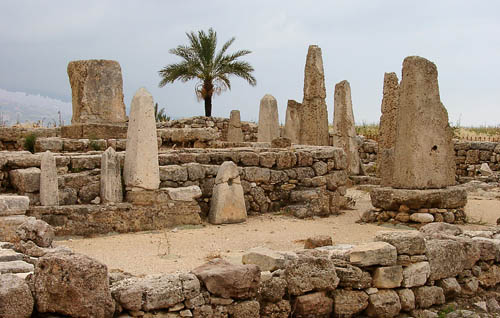
My last visit to Byblos was in 2002. This is a photo I took of the Egyptian Temple of Obelisks which was dedicated to the Egyptian god Reshef.

The Temple of Obelisks at Byblos. Photo by Ferrell Jenkins.

The Temple of Obelisks at Byblos. Photo by Ferrell Jenkins.

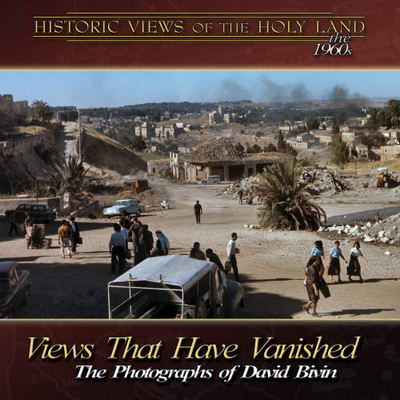
Review: Views That Have Vanished

Todd Bolen, BiblePlaces.com, has released an extremely valuable CD that will be helpful to all students of the Bible lands. Views That Have Vanished is a collection of more than 700 high resolution photographs made by David Bivin beginning in 1963.

Views That Have Vanished - Photos of the 1960s.

Views That Have Vanished - Photos of the 1960s.

These photographs were made with one of the best cameras available at the time with the intent to be able to share them with family and friends who were unable to visit Israel, Jordan, Egypt and Greece. Bivin has now lived in Israel more than 30 years. Many of the places he visited in the 1960s have changed since then because of natural erosion. Some of the changes occurred because of archaeological activity, and the normal deterioration that takes place once a site is uncovered. Primarily the sites have changed because of the building activities of man.

My first visit to the Middle East was in 1967. Since then I have returned nearly 40 times and I have observed the tremendous changes made. Some sites, in preparation for visitors, are necessarily changed. Other sites are neglected and become dangerous for all but the most intrepid explorers to visit. Bivin had the wonderful opportunity live in Israel and record his experience in full color. I observe that many of the landscape photographs he made have a beautiful clear sky. Perhaps the sky was clearer 40 years ago. But, this is the advantage of living in the country and being able to go out when the weather is just right.

Everyone who has old photographs and slides knows that they begin to deteriorate after a few years. This happened to some of Bivin’s photographs. Todd Bolen has scanned these old negatives with high quality equipment. In many instances the color has been restored.

The photographs are available in high-resolution (1600 x 1200 or higher) in jpg format and also in PowerPoint with explanatory notes. I was especially impressed with the large number of photographs of some of the well known archaeologists of the past (Glueck, Yadin, et al.) and some historic views such as people in Jerusalem mourning the death of Anwar Sadat, president of Egypt.

Views That Have Vanished is a great addition to the already long list of photographic materials published by BiblePlaces. The CD belongs in the library of every church and every person who teaches Bible classes with an emphasis on the land in which these historical events took place. Frequently I say to my groups, “I wish you could have seen this before….” Now, you can see it through these photographs.

The CD is available for only $20 during October. Take a look here. If you would like to see some examples of Views then and now, take a look here.

Ben Ezra Synagogue in Old Cairo

As the term implies, Old Cairo is the oldest section of Cairo, Egypt. It is sometimes called Coptic Cairo. Visitors may see the Coptic Museum where some of the Nag Hammadi Gnostic texts are displayed. The last time I was in Cairo, in 2005, the museum was closed for some restoration. I am hopeful this will not be the case the next time.

The Church of St. Sergius is located in the Coptic area. Legend has it that Joseph, Mary, and the infant Jesus stayed here when they fled from Herod the Great. The New Testament records all we really know about their stay in Egypt.

Now when they had departed, behold, an angel of the Lord appeared to Joseph in a dream and said, “Rise, take the child and his mother, and flee to Egypt, and remain there until I tell you, for Herod is about to search for the child, to destroy him.” And he rose and took the child and his mother by night and departed to Egypt and remained there until the death of Herod. This was to fulfill what the Lord had spoken by the prophet, “Out of Egypt I called my son.” (Matthew 2:13-15 ESV)

The Romans built a fortress in the area of Old Cairo called Babylon. Some remnants of the fortress can be seen.

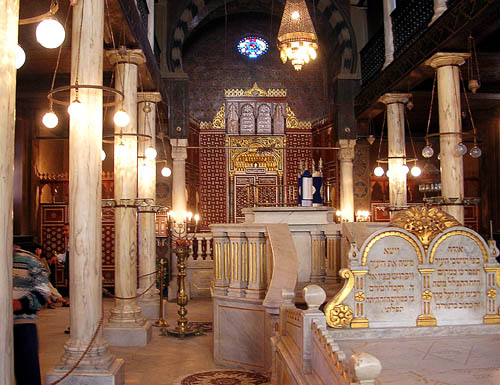
Of special interest is the Ben Ezra Synagogue. It was here that the 140,000 Cairo Geniza fragments of Hebrew and Jewish literature were found. The collection of material dating back to as early as the 9th and 10th century A.D. is now housed in Cambridge, England. This link will take you to some good information about the collection. Until the discovery of the Dead Sea Scrolls these biblical fragments represented our oldest examples of the Hebrew biblical text.

This photo shows the interior of the restored Synagogue. Of course, few Jews live in Egypt now.

Ben Ezra Synagogue after restoration. Photo by Ferrell Jenkins.

Ben Ezra Synagogue after restoration. Photo by Ferrell Jenkins.

Ask for the ancient path

The Bible, both Old Testament and New Testament, makes it clear that God’s people often depart from God’s way. There are numerous exhortation for His people who walk in the old paths.

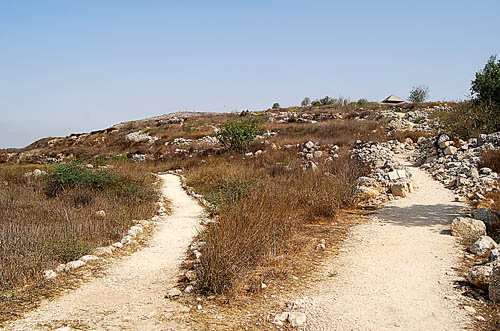
This scene showing two paths at the site of biblical Shiloh reminded me of the Lord’s plea through the prophet Jeremiah in the days of the Babylonian threat against Jerusalem and Judah. The tabernacle was located at Shiloh for many years after Israel entered the land of Canaan. I was just reading the first few chapters of 1 Samuel that tell of Samuel living there during his early years.

Two paths at Shiloh. Photo by Ferrell Jenkins.

Two paths at Shiloh. Photo by Ferrell Jenkins.

Thus says the LORD: “Stand by the roads, and look, and ask for the ancient paths, where the good way is; and walk in it, and find rest for your souls. But they said, ‘We will not walk in it.’ (Jeremiah 6:16)

To ask for the ancient path means to respect the revealed word of the Lord and follow it. This thought is similar to the teaching of Jesus in the Sermon on the Mount (Matthew 7:13-14).

Archaeology: The Bible as blueprint

The Jerusalem Post has been running a series of “People of the Year” articles. The most recent one was on Dr. Eilat Mazar. Mazar has been involved in a dig in the City of David over the last several years. The article says,

Mazar, who is both revered and reviled by some of her colleagues for being a “biblical archeologist,” says that the Bible is unquestionably the most important historical source for her work, since it contains a “genuine historical account of the past.”

“I work with the Bible in one hand and the tools of excavation in the other,” she says. “The Bible is the most important historical source.”

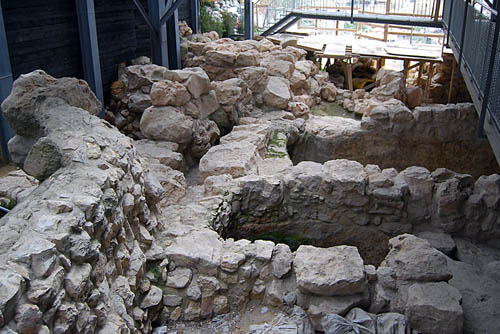
The area where Mazar believes she has found a palace that might have belonged to David, has been covered by a structure to protect it. Here is a photo I made in early April.

A portion of the City of David excavation. Photo by Ferrell Jenkins.

A portion of the City of David excavation. Photo by Ferrell Jenkins.

The full article may be read here.

HT: Joseph I. Lauer.

More on Damascus and Paul

It has been my pleasure to visit Damascus several times since 1967. David McClister, a colleague from the Biblical Studies department at Florida College, and I visited the city in May, 2002. We tried to identify the traditional places associated with Saul’s stay in the vicinity. Southwest of the city, within sight of Mount Hermon, and on the road toward Jerusalem, there is a Greek Orthodox chapel marking the site where Jesus spoke to Saul. We drove as far south toward Quneitra in the Golan Heights as the military would allow. We can not be sure that the chapel marks the exact spot, but we know it was nearby.

Off Straight street one can visit the house of Ananias. All we can say with certainty is that this is another of those uncertain traditional places. Luke tells us that Ananias went to the house of Judas where Paul was staying.

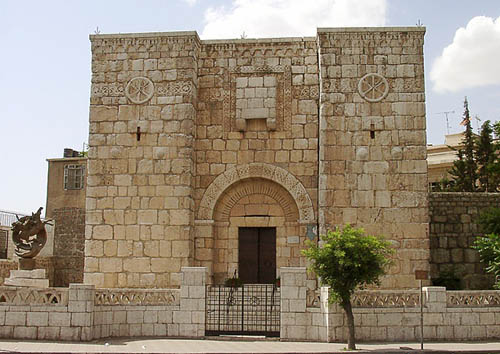
An ancient wall still surrounds much of the old city. A modern chapel is built into the wall to indicate the place where Paul was let down through a window when a plot was made to kill him (Acts 9:25; 2 Cor 11:32-33).

Saul (Paul) in Damascus

Damascus is first mentioned in the Bible at the time of Abraham (Gen. 14:15; 15:2-3). As the capital of Syria, the city had much contact with the kingdoms of Israel and Judah.

All of the New Testament references to Damascus are related to the conversion of Saul of Tarsus (Acts 9; 22; 26; 2 Cor. 11:32; Gal. 1:17). Saul had participated in the stoning of Stephen and was active in the persecution of the disciples of Christ in Jerusalem. He asked the high priest for authority to go to Damascus and seek out men and women who belonged to the Way and bring them bound to Jerusalem.

The Lord appeared to Saul as he approached Damascus and told him to go into the city where he would be told what he must do (Acts 9:6). Saul stayed at a house on the street called Straight. Ananias came to him and told him to arise and be baptized so that his sins might be washed away (Acts 22:16; 9:18). Saul stayed with the disciples for several days and immediately began to proclaim Jesus in the synagogues as the Son of God (9:20).

The street called Straight (Acts 9:11), the ancient Via Recta of the Roman city, now lies about 20 feet below the present street which runs the length of the old city, east to west. At the east end of the street a Roman gate has been elevated to the present level and partially restored. A small monumental arch can be seen near the middle of the street.

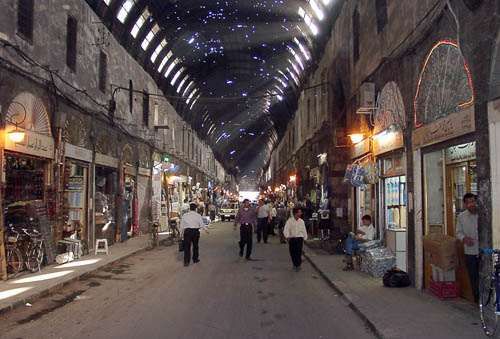
The photo below is one I made on Straight Street in 2002. This is not the main shopping street in the old city, but is historically significant.

The street called straight in Damascus. Photo by Ferrell Jenkins.

The street called straight in Damascus. Photo by Ferrell Jenkins.

The Rivers of Damascus

Naaman was the commander of the army of the king of Aram (Syria). The biblical text says he was “esteemed and respected by his master” because of the victories he had given the country. Great people often have great problems as well as great acclaim. Naaman was a leper. The term leper is used throughout the Old Testament of a serious skin disease without a cure. Read the full account in 2 Kings 5:1-18.

A young girl who had been taken captive from Israel during one of the raids made by the Arameans was serving as an attendant to Naaman’s wife. She knew of the prophet [Elisha] in Samaria and was confident he could cure Naaman of his leprosy.

When Elisha send a messenger to Naaman to tell him to “Go and wash in the Jordan seven times” the commander was furious. He said,

Are not Abana and Pharpar, the rivers of Damascus, better than all the waters of Israel? Could I not wash in them and be clean?” So he turned and went away in a rage. (2 Kings 5:12 ESV)

These rivers, Abana and Pharpar, flow from the Anti-Lebanon range eastward into the desert. Here is a photo that I made of the Nahr Barada river a short distance west of Damascus (on the outskirts of the city). The river continues to flow through the city of Damascus. The Nahr Barada is often identified with the Abana of the Bible.

The Abanah River near Damascus. Photo by Ferrell Jenkins.

The Abanah River near Damascus. Photo by Ferrell Jenkins.

Naamam was cured of his leprosy only after he dipped in the Jordan seven times. We should not elevate our judgment (opinion) to the point that we can argue with the Lord about what ought to be done. He is the Creator; we are the creature.