Category Archives: Bible Study

More on Herod’s Tomb

A month ago I wrote about visiting the Herodium here.

Todd Bolen has provided some new information about continuing work at the Herodium here. I sent him a couple of photos showing some construction I saw August 23. He has included one of those photos in an update of his post. The Bible Places Blog is one that I read almost every day. I’m disappointed when Todd has not had time to update the blog. (But I understand.)

Even though I have multiple thousands of photos from Israel, I still use photos from Todd’s Pictorial Library of Bible Lands regularly. Every person who teaches the Bible and uses presentation software should have his collection. See BiblePlaces.com for details. Photos like this help to make Bible lessons come to life.

Aswan, Egypt

Aswan is the location of the first cataract of the Nile River. This made it an ideal location for the Aswan Dam which was built between 1898 and 1902. This created a small lake south of the dam, but it was nothing to compare with Lake Nasser which has been formed as a result of the building of the new high dam at Aswan between 1960 and 1971.

The new high dam was constructed at a time when the Soviet Union was providing technical, economic and military support to Egypt. I remember staying in a hotel in Egypt in 1973 filled with Soviet tourists. In the following years we saw none of them. Lake Nasser stretches south for more than 300 miles. Many of the Nubians who lived in this area had to be resettled by the Egyptian government.

Kitchener’s Island, shown below, was given to Lord Horatio Kitchener for his service in the Sudan Campaign. It now is owned by the state and is the site of a beautiful botanical garden. The Mausoleum of the Aga Khan is visible on the top of the hill in the photo below.

Some scholars identify the Arabic name Aswan with the Syene of Ezekiel 29:10 and 30:6. It may be identified with the Sinim of Isaiah 49:12.

Kitchener's Island at Aswan, Egypt. Photo by Ferrell Jenkins.

The Nile River at Aswan. Photo by Ferrell Jenkins.

Mount Carmel – site of a great conflict

Mount Carmel is not just a protrusion into the Mediterranean Sea as some sketch maps might suggest. It is a range about 14 1/2 miles long by 5 miles wide, consisting largely of limestone. The elevation of Mount Carmel is about 1500 feet above sea level. From the western promontory one can overlook the city and port of Haifa. The Roman general Vespasian, who later became emperor, offered sacrifices on Mount Carmel before the war against the Jews (A.D. 66-70) (Hoade, Guide to the Holy Land, 665).

Mount Carmel is best known to Bible students as the place where the prophet Elijah contended with the prophets of Baal (1 Kings 18:17-40). The traditional site for this event is shown at Muhraka on the eastern end of Mount Carmel. This photo was made near Muhraka.

View of part of Mount Carmel near Muraka. Photo by Ferrell Jenkins.

View of part of Mount Carmel near Muraka. Photo by Ferrell Jenkins.

Azekah was an important fortified city of Judah

The biblical site of Azekah is identified with Tell ez-Zekariyeh which overlooks the Valley of Elah. Azekah is a town of the Shephelah and is mentioned seven times in the Bible. Here is a summary of the information:

  • Azekah is mentioned in the account of Joshua’s long day (Joshua 10:10-11).
  • It was assigned to the tribe of Judah (Joshua 15:35).
  • The Philistines camped at Ephes-Dammim, between Socoh and Azekah, at the time of the conflict between David and Goliath (1 Samuel 17:1).
  • It was one of the fortified cities of Rehoboam, king of Judah (2 Chronicles 11:9).
  • Upon return from Babylonian captivity some of the Jews settled in Azekah and its villages (Nehemiah 11:30).

Jeremiah states that only Lachish and Azekah remained of the fortified cities of Judah at the time of the Babylonian captivity of Judah in 586 B.C. (Jeremiah 34:7). This indicates that Jeremiah wrote shortly before Lachish Letter # 4 was written. The last portion of the letter reads this way:

And let (my lord) know that we are watching for the signals of Lachish, according to all the indications which my lord hath given, for we cannot see Azekah. (The Ancient Near East an Anthology of Texts and Pictures, 322)
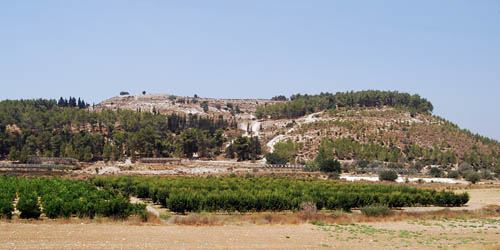
Here is a photograph of Azekah from the Valley of Elah.
Tel Azekah overlooks the Valley of Elah. Photo by Ferrell Jenkins.

Tel Azekah overlooks the Valley of Elah. Photo by Ferrell Jenkins.

A photograph of the Valley of Elah made from atop Tel Azekah may be seen here. An excavation conducted by Bliss and Macalister in 1898-99 showed that Azekah was occupied from Canaanite times. (The New International Dictionary of Biblical Archaeoogy, 83).

Roman army photos

A large number of visitors to this blog have looked at the post on the Roman soldiers and chariot races at Jerash, Jordan. Photos of Roman soldiers can be helpful in illustrating Bible class lessons and sermons. Think of a few of the texts.

  • The Centurion at Capernaum (Matthew 8:5).
  • Cornelius, the first Gentile convert to Christ (Acts 10:1).
  • “Whoever forces you to go one mile, go with him two” (Matthew 5:41).
  • Soldiers who mocked Jesus (Luke 23:36).
  • Soldiers and centurions who rescued Paul from the mob (Acts 21:32).
  • Paul’s figurative reference to fellow-workers in the Kingdom as soldiers (2 Timothy 2:4; Philemon 1:2).
  • The praetorian guard (Philippians 1:13).
  • The full armor of God (Ephesians 6:10).

David Padfield has prepared 15 photos from the RACE (Roman Army and Chariot Experience) program at Jerash, Jordan, under the title Bible Times: Roman Army Enactment. All of these photos are prepared in 1024 x 768 size, suitable for PowerPoint presentations. Here is a small photo from the collection.

Roman Army in Battle Gear. Photo by David Padfield.

Roman Army in Battle Gear. Photo by David Padfield.

Take a look at all of the photos here. From this page you can locate other sets of photos that David has prepared for use in teaching the Word.

Cappadocian sunrise

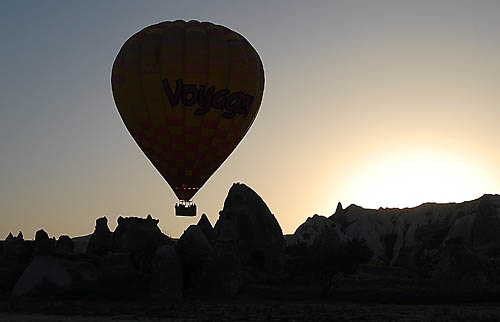
He is a photograph I made at sunrise in the Cappadocian region of Turkey.

Cappadocian sunrise. Photo by Ferrell Jenkins.

Cappadocian sunrise. Photo by Ferrell Jenkins.

The Bible tells us that Jews of Cappadocia were present in Jerusalem on the day of Pentecost (Acts 2:9). Peter wrote his epistles to saints scattered throughout Cappadocia and other places in Roman Asia Minor (modern Turkey).

Peter, an apostle of Jesus Christ, To those who are elect exiles of the dispersion in Pontus, Galatia, Cappadocia, Asia, and Bithynia,  2 according to the foreknowledge of God the Father, in the sanctification of the Spirit, for obedience to Jesus Christ and for sprinkling with his blood: May grace and peace be multiplied to you. (1 Peter 1:1-2)

Second Temple wall of Jerusalem uncovered

The Israel Antiquities Authority announced last week the discovery of a wall below modern “Mount Zion” that dates from the time of the Hasmonean kings to the destruction about A.D. 70. Here are a few comments in the official press release.

An exciting discovery in Jerusalem constituting extraordinary remains of the wall of the city from the time of the Second Temple (second century BCE-70 CE) that was built by the Hasmonean kings and was destroyed during the Great Revolt, and also the remains of a city wall from the Byzantine period (324-640 CE) which was built on top of it, were uncovered in an extensive excavation that is currently underway on Mount Zion. The lines of these fortifications delineated Jerusalem from the south in periods when the ancient city had reached its largest size.

The new finds were presented today (Wednesday) at a press conference that was held on Mount Zion. The excavation has been in progress for the past year and a half, under the direction of archaeologist Yehiel Zelinger of the Israel Antiquities Authority, in cooperation with the Nature and Parks Authority and with financial support provided by the Ir David Foundation.

You may read the entire news release at the IAA web page.

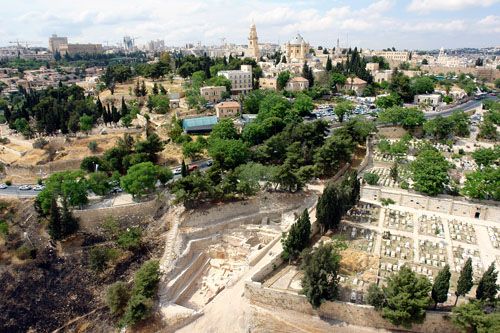
Here is an aerial photograph of the excavation, Mount Zion Valley. Photograph: Skyview, courtesy of the Israel Antiquities Authority.

Aerial photo of Mount Zion valley. Skyview. Courtesy of Israel Antiquities Authority.

Aerial photo of Mount Zion valley. Skyview. Courtesy of Israel Antiquities Authority.

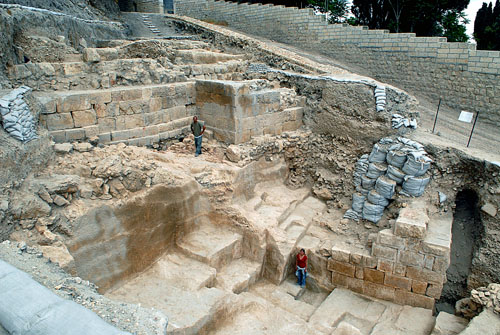
This pictures shows the excavation area.

Tsilla Sagiv. Courtesy of the IAA.

The excavated area. Photo: Tsilla Sagiv. Courtesy of the IAA.

Todd Bolen provides a concise summary of the information on this discovery at his BiblePlaces Blog.

Shiloh – the place of the tabernalce

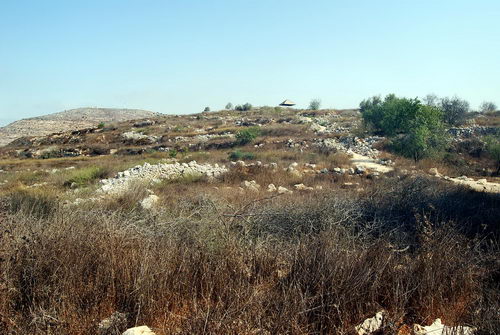
Shiloh (Shilo) was the site of the tabernacle for many years (Joshua 18:1), until the Israelites took it with them into battle against the Philistines at Ebenezer. The ark was captured by the Philistines (1 Samuel 4).

I don’t have time to tell you more about our experience, or to fully explain the photo, but I wanted to share this one with you. The suggested site for the tabernacle is on the north side of the tel.

Tel Shilo. Photo by Ferrell Jenkins.

Tel Shilo. Photo by Ferrell Jenkins.

Soon we will be headed for the airport to return to our home.

A day in the old city of Jerusalem

Elizabeth and I have been visiting sites in Israel for the past two weeks. We are delighted to be going home to see Drew, but I wish we had another week or two. I would say that I have been successful in seeing 80 to 90 percent of the places I had hoped to visit. Well, there is always a reason for another visit.

We entered the Old City through the Dung Gate this morning and went immediately to the Temple Mount. Everyone who had visited Jerusalem and the Western Wall should remember that the entrance into the Temple Mount is through the Mugrabi Gate. For years this had been a mount of earth. At first if overlooked the Western Wall to the north. Later, after excavations leading to the pre-70 A.D. street, only a narrow mound of earth led up to the Temple Mount. In recent years Israel has erected a new entrance, and at the same time they have conducted excavations in the previous earth mound. There is considerable conflict between Israeli and Muslim authorities over this matter.

Here is a view of the Mugrabi Gate today and just a glimpse of the excavations.
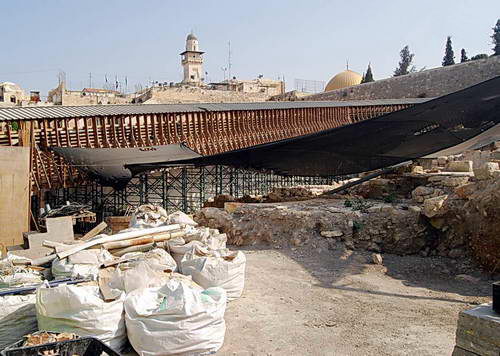
Mugrabi Gate leading to the Temple Mount. Photo by Ferrell Jenkins.

Mugrabi Gate leading to the Temple Mount. Photo by Ferrell Jenkins.

In recent years it has not always been possible to visit the Temple Mount because it is under the control of Muslim authorities. The present Dome of the Rock sits on (or very near) the site of the biblical temple. I was delighted to get some good morning shots of the Dome of the Rock and the Al Aqsa mosque. Here is one of those photos.
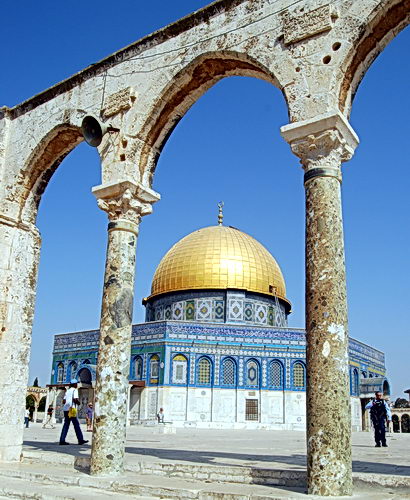
The Dome of the Rock. Photo by Ferrell Jenkins.

The Dome of the Rock. Photo by Ferrell Jenkins.

We made a stop at the Pool of Bethesda because the sun was in the east. This provided perfect lighting for the site. Then we went along the Way of the Cross. At the first stop I was able to make arrangements to visit the museum of the Studium Biblicum Franciscanum. I had been there many years ago and it was good to have a reminder of the collection. SBF has conducted archaeological excavations at Cana, Capernaum, Nazareth, Mount Nebo, and other places.

Our next stop was at the Sisters of Zion. This was once the site of the Fortress of Antonio. Many have visited it thinking that it was where Jesus appeared before Pilate. It may have been, but the beautiful Roman street and pavement apparently date to a time after the destruction of the temple in A.D. 70. Nice visit. Very few tourist were at these sites, so we had freedom to enjoy and make photos.

Numerous stops were made along the way to the Church of the Holy Sepulchre. We arrived in time for one of the religious ceremonies involving the tomb of Jesus. From there we visited the nearby Russian church to see walls believed to be from the first century. This indicates that the Church of the Holy Sepulchre was built outside the wall of the city at the time of Jesus.

I revisited the roof of the Petra Hotel where one has a view of the so-called pool of Hezekiah, and of several important area landscapes. We stopped by the Church of St. James in the Armenian Quarter, and then made some photos of Jaffa (Joppa) Gate.

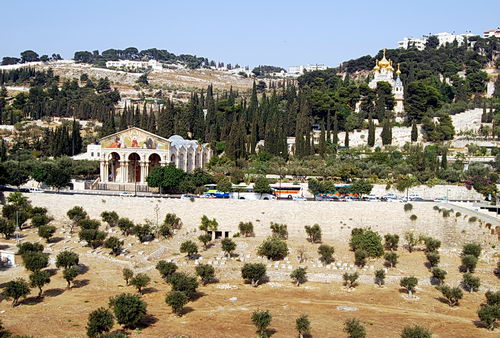
By this time we were ready to head to the hotel. We used a taxi today due to the fact that the entire day was spent in the Old City. We passed along the Kidron Valley and the afternoon sun was on the Mount of Olives. I asked the driver if he would be able to stop at this point so I could make a photo. He agreed. Here is one of the photos. It shows the Church of All Nations. The Garden of Gethsemane is to the left. The “onion top” building to the right is the Russian Orthodox Church of Mary Magdalene.

Garden of Gethsemane on the Mount of Olives. Photo by Ferrell Jenkins.

Garden of Gethsemane on the Mount of Olives. Photo by Ferrell Jenkins.

Up to Jerusalem again

The Bible speaks of going up to Jerusalem and down from Jerusalem. Certainly the main reason for this is the elevation of Jerusalem. It is located in the central mountain region of Judea at an elevation of about 2400 to 2500 feet above sea level.

We left Tiberias and the Sea of Galilee (Kinneret) this morning, spent some time in the Jezreel Valley, stopped by Caesarea Maritima, and then drove up to Jerusalem.

Here is a photo I made this morning at sunrise from my window on the shore of Galilee. I had in mind a photo that would be suitable for a presentation background. It reminded me of the fact that some of the disciples were fishermen, and were called by the Jesus to leave that work and accept His offer to become fishers for men.

Going on from there He saw two other brothers, James the son of Zebedee, and John his brother, in the boat with Zebedee their father, mending their nets; and He called them.  Immediately they left the boat and their father, and followed Him.  (Matthew 4:21-22)

A fisherman on the Sea of Galilee at sunrise. Photo by Ferrell Jenkins.

A fisherman on the Sea of Galilee at sunrise. Photo by Ferrell Jenkins.