Category Archives: Bible Study

Do the work of an evangelist

This morning I am scheduled to speak at the Florida College annual lectures on the subject “Do the Work of an Evangelist.” I thought I would share a tiny section of the material I have prepared in a part of the lecture dealing with the importance of preparation (next two paragraphs).

The evangelist must be an approved workman who can handle accurately the word of truth (2 Tim. 2:15). A. T. Robertson wrote a small book nearly 90 years ago entitled Types of Preachers in the New Testament. He began with a chapter on “Apollos the Minister with Insufficient Preparation.” Apollos was eloquent (learned, cultured) and “mighty in the Scriptures” (Acts 18:24). We understand that his knowledge was incomplete, but that he was willing to learn. Robertson’s comment is apropos for today.

There is hope for the man who is ready to learn. One is never too old to learn. The minister who is always learning will always have a hearing. There is no deadline for him. That comes the minute one stops learning. Apollos is a rebuke to the preacher who is content to preach his old sermons through the years without reading the new books or mastering the old ones. Here is a profound student of the Scriptures, a master in Old Testament interpretation, who is glad to sit at the feet of Priscilla and Aquila and learn more of Jesus. That is the place for all of us, at the feet of anyone who can teach us more about Jesus. We cannot know too much about Him. We cannot be too accurate in our knowledge of Him. (24)

Paul, Timothy, Apollos, Priscilla and Aquila were all associated with the work of the gospel at Ephesus (Acts 18:24-19:1; 1 Timothy 1:3). The photo below shows the ruins of the Arcadian Way. This street led from the theater to the harbor. The harbor is now dry, but must have been used by all of these characters in their contact with the city of Ephesus.
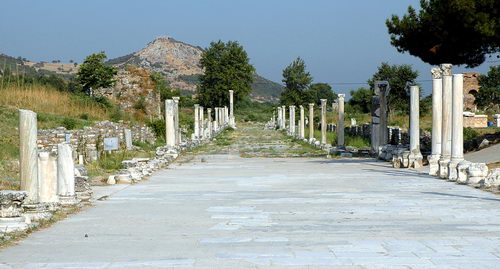
The Arcadian Way at Ephesus. Photo by Ferrell Jenkins.
The Arcadian Way at Ephesus. Photo by Ferrell Jenkins.
The Vulture

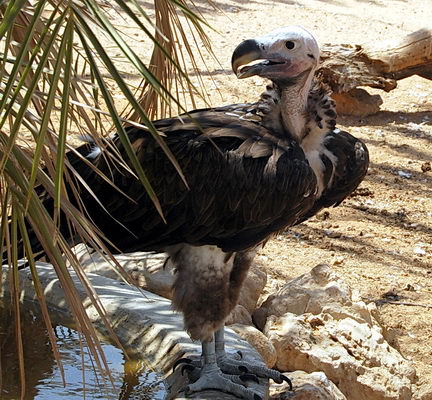
Vultures were among the unclean animals for the Israelites (Leviticus 11:13, 18; Deuteronomy 14:12, 17). This means that Israelites were not permitted to eat vultures. In some of the references both eagles and vultures are mentioned.

Vulture at the Hai-Bar Reserve in Israel. Photo by Ferrell Jenkins.

Vulture at the Hai-Bar Reserve in Israel. Photo by Ferrell Jenkins.

In the Greek New Testament the word aetos is translated both eagle (Revelation 8:13; 12:14) and vulture (Matthew 24:28; Luke 17:37).

One of the most memorable comments about the vulture was made by Jesus in His discussion of the destruction of Jerusalem. He described the condition of the Jewish state at the time when the Roman armies invaded the country.

Wherever the corpse is, there the vultures will gather. (Matthew 24:28 ESV)

Not a pretty picture. And a clear warning for all.

A meditation for Sunday

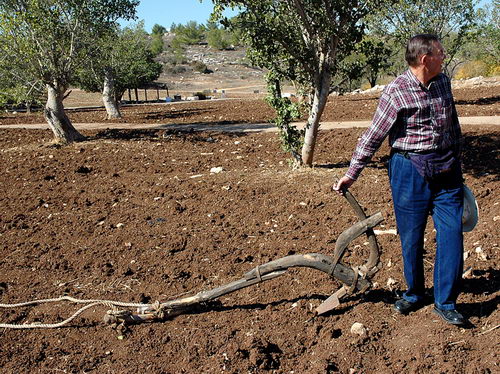
As they were going along the road, someone said to him, “I will follow you wherever you go.” And Jesus said to him, “Foxes have holes, and birds of the air have nests, but the Son of Man has nowhere to lay his head.” To another he said, “Follow me.” But he said, “Lord, let me first go and bury my father.” And Jesus said to him, “Leave the dead to bury their own dead. But as for you, go and proclaim the kingdom of God.” Yet another said, “I will follow you, Lord, but let me first say farewell to those at my home.” Jesus said to him, “No one who puts his hand to the plow and looks back is fit for the kingdom of God.” (Luke 9:57-62)

Illustrating a parable at Neot Kedumim in Israel. Photo by Leon Mauldin.

Illustrating a parable at Neot Kedumim in Israel. Photo by Leon Mauldin.

Travel to Egypt

Because of a severe famine in Canaan, Abraham traveled to Egypt and sojourned there (Genesis 12:10). Joseph was sold by his brothers and eventually became a slave in Egypt (Genesis 37:28). Jacob and his family, at least 70 persons, went into Egypt and settled in the land of Goshen (the eastern Delta) during a time of famine in Canaan (Genesis 46; Acts 7:11-16).

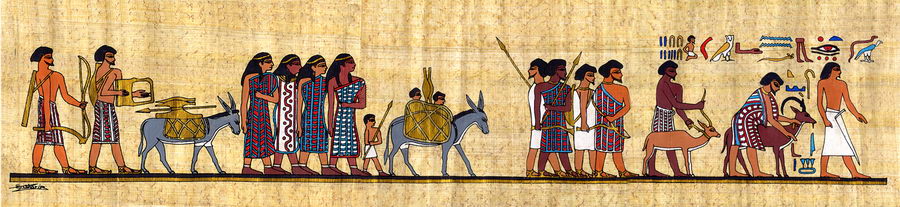
What do we know outside the Bible about travel to Egypt during the Patriarchal age (the Middle Bronze age)? It is clear that foreigners traveled to Egypt. In the tomb of Khnum-hotep III at Beni Hasan, about 169 miles south of Cairo, there is a painting showing 37 Asiatics of the desert bringing gifts to Egypt and desiring trade. This tomb painting is dated to about 1890 B.C.

Here is a description of the painting given by J. A. Thompson in The New International Dictionary of Biblical Archaeology:

One picture shows thirty-seven seminomadic tribesmen from Palestine, from the land of Shutu (central Trans-Jordan), led by Absha, their chief. The men were beared, and the women used bands to hold their long hair in place. Their clothes were multicolored, the men wearing short skirts and sandals and the women having calf-length dresses, which they fastened at the shoulder by means of a clasp. Instead of sandals, the women had shoes on their feet. One of the men carried a lyre, and on one of the donkeys were two bellows, indicating that at least some members of the group were traveling metalworkers.

Egypt has many shops selling papyrus sheets. Some have tomb paintings. I am told that the Abu Simbel Papyrus store in Giza is the only one that has permission to sell a painting of the Asiatics arriving in Egypt. This looks better than any tomb painting one might see today while visiting a tomb. This papyrus painting shows only a portion of the 37 travelers making their way into Egypt. The Asiatics are wearing multicolored clothing. The person to the right in white is an Egyptian.

A portion of the Beni Hasan painting showing Asiatics arriving in Egypt.

A portion of the Beni Hasan painting showing Asiatics arriving in Egypt.

Click on the art for a larger image that might be suitable for use in a PowerPoint presentation.

The Story of Sinuhe – an Egyptian traveler

The earliest description of Canaan comes from an Egyptian literary text. In The Story of Sinuhe (see-NUU-hay) written in the 20th century B.C., a traveler tells of his pleasant stay in northern Canaan (possibly the Beka Valley of Lebanon). He describes the land as follows:

Figs were in it, and grapes. It had more wine than water. Plentiful was its honey, abundant its olives. Every (kind of) fruit was on its trees. Barley was there, and emmer. There was no limit to any (kind of) cattle. (qtd. in Pritchard, Ancient Near Eastern Texts, 19)

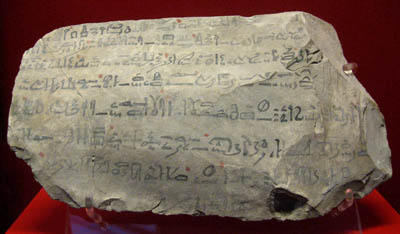
This description reminds one of the promise God made to the Israelites to bring them into a land flowing with milk and honey (Exodus 3:8). A copy of The Story of Sinuhe written on stone is on display in the Ashmolean Museum, Oxford, England. The stone below, now in the British Museum, contains the final stanza of the Story or Tale.

Final stanza of the Story of Sinuhe in the British Museum. Photo by Ferrell Jenkins.

The Tale of Sinuhe in the British Museum. Photo by Ferrell Jenkins.

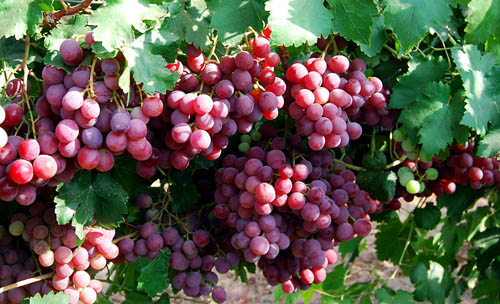
The photo of grapes from Lachish reminds us of the abundance of the land through which Sinuhe traveled.

Grapes near Lachish. Photo by Ferrell Jenkins.

Grapes on the vine near Lachish. Photo by Ferrell Jenkins.

From Egypt to New York in 12 hours

We arrived in the USA yesterday afternoon, and got a good night of rest. Typically it takes about a day for every hour in time change to get over jet-lag. We look forward t0 making our way to Florida this afternoon.

Delta now has a non-stop New York/Cairo flight. The service was good in both directions, and the flights were on time. We felt fortunate yesterday to have quite a few empty seats that allowed passengers to spread out over the plane. We know that other members of the tour group arrived in the USA last Monday. We have heard from most of them after arrival at their homes. For this we are thankful.

Our tour members repeatedly said that the trip was a real adventure,  just as we had advertised. It was fun, but primarily it was a real educational and spiritual experience. We not only learned about ancient and modern Egypt, but we related this to the biblical characters who called Egypt home for a while.

Elizabeth and I went to Alexandria on Tuesday. We traveled along the high desert road from Giza to Alexandria. The area is filled with new housing, factories, and agricultural area made possible by modern irrigation.

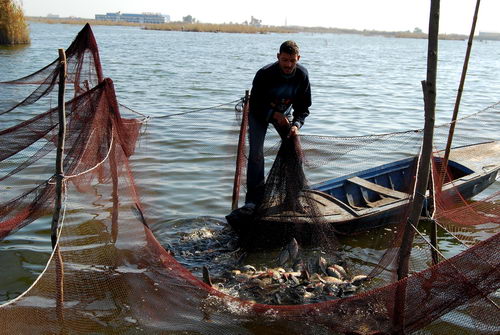
Shortly before we reached Alexandria we passed an area filled with bulrushes. We stopped to watch some fishermen pull in their nets. We were told that these fish are farm fish.

An Egyptian fisherman working the nets. Photo by Ferrell Jenkins.

An Egyptian fisherman working the nets. Photo by Ferrell Jenkins.

I also made some similar photos along the Nile and the canals of Egypt. As we think of ancient Egypt we recall the oracle against Egypt in Isaiah 19. I suggest you read the entire chapter. For now, note these verses.

The bulrushes by the Nile, by the edge of the Nile And all the sown fields by the Nile Will become dry, be driven away, and be no more. And the fishermen will lament, And all those who cast a line into the Nile will mourn, And those who spread nets on the waters will pine away. (Isaiah 19:7-8 NAS)

References like these from the Old Testament prophets were fulfilled in the centuries before the coming of Christ. Remember that the ancient Hamitic Egyptian disappeared long ago. The modern Semitic Egyptians are caretakers of an antiquity they had nothing to do with.

Roman period figurine discovered in Jerusalem

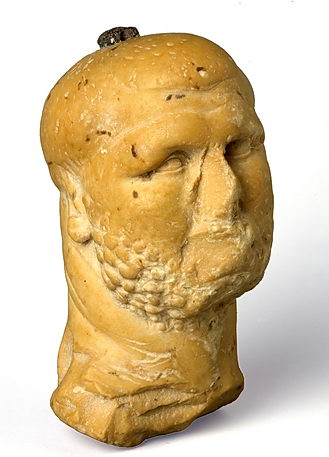
The Israel Antiquities Authority announced a few days ago the discovery of a figurine in the image of a bearded man, probably a boxer. The artifact was uncovered in the Givati car park excavation south of the Dung Gate, and is dated to the second or third century A.D.

Clara Amit, IAA.

Head of Roman Boxer found at Jerusalem. Photo: Clara Amit, IAA.

Notice a few comments from the press release.

The stylistic motifs that are manifested in the image, such as its short hair style, the prominent lobes and curves of the ears, as well as the almond-shaped eyes suggest that the object most likely portrays an athlete, probably a boxer. Boxing was one of the most popular fields of heavy athletics in Roman culture and more than once Roman authors mention the demand by the Roman public in general, and the elite in particular, for boxing matches. Besides the prestige and the substantial amounts of money the victors of boxing competitions won, they were also afforded the support of the emperor himself, as in the famous case of Melancomas who was Titus’ favorite boxer.

According to the researchers the two tiny holes that were drilled in its nape and which contained the remains of metal that was inserted in them indicate that this is a suspended weight that was used with hanging scales that are characteristic of the Roman period. Miniature bronze images of athletes, philosophers, satyrs etc were among the most popular of the suspended weights that were used in the regions that were under the control of the  Roman Empire – from Pompeii to Sepphoris.

I have seen busts of boxers or wrestlers with “cauliflower ears” in museums.  One such bust is in the museum at Thessalonica.

In a different setting, writing to the church in Greco-Roman Corinth, Paul says,

Therefore I run in such a way, as not without aim; I box in such a way, as not beating the air;  but I discipline my body and make it my slave, so that, after I have preached to others, I myself will not be disqualified. (1 Corinthians 9:26-27).

Read the complete report here.

A final visit to the Sphinx and Pyramids

For the past six days my wife and I have been staying at a hotel near the famous Giza Pyramids as we traveled in the area to visit various sites. Children from the early grades learn about the Pyramids of Egypt. Our four-year-old grandson stayed with us shortly before we left for this tour. Early one morning he said, “What were the pyramids?” I tried to explain.

This morning Elizabeth and I went to the Pyramid Plateau for one last view.  Our first visit here was 1967. We never fail to be impressed with the enormity of the structures, and the motivation that caused them to be built.

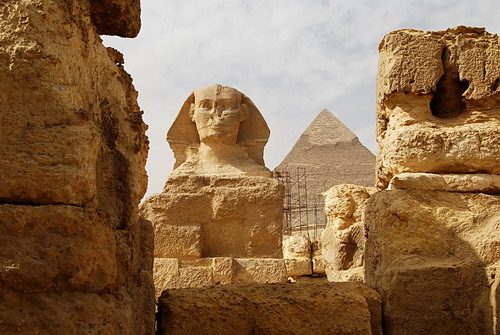
The sphinx and the pyramid of Cheops. Photo by Ferrell Jenkins.

The sphinx and the pyramid of Cheprern. Photo by Ferrell Jenkins.

The Giza Pyramids were built about 2400-2600 B.C. Biblical characters such as Abraham, Joseph, and Moses likely saw these structures. Obviously the biblical Israelites, who lived in the country nearly a millennium later, had nothing to do with their building.

Another day in Goshen

Today I spent another “long” day in the land of Goshen, but still did not get to all of the places I had hoped to visit.

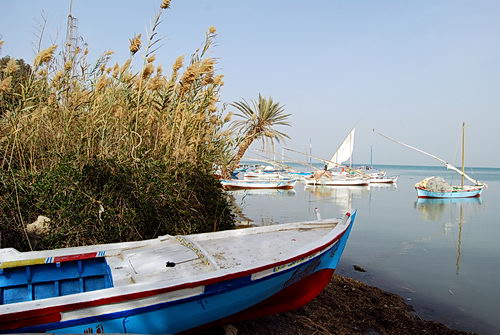
This photo shows reeds (bulrushes) growing on the banks of the Great Bitter Lake. The Suez Canal runs through a chain of lakes. This is the largest of them.

Reeds (bulrushes) growing in the Great Bitter Lake. Photo by F. Jenkins.

Reeds (bulrushes) growing in the Great Bitter Lake. Photo by F. Jenkins.

There are several good suggestions for the place of the exodus recorded in Exodus 14. This vicinity may be the sea described in Exodus 14:9.

Then the Egyptians chased after them with all the horses and chariots of Pharaoh, his horsemen and his army, and they overtook them camping by the sea, beside Pi-hahiroth, in front of Baal-zephon.

Other scholars suggest a location associated with Lake Timsa which is further north.

Group headed for home

Our group, all healthly and happy, left the hotel a short time ago for the Cairo International Airport.  The flight isn’t until 12:30 p.m. (Cairo time), but we have been staying near the Giza Pyramids. With nearly 20 million people in Cairo one never knows how long the normally 1 hour trip to the airport will take.

Elizabeth and I are remaining for a few days to visit some other sites we have not seen or been able to photograph.

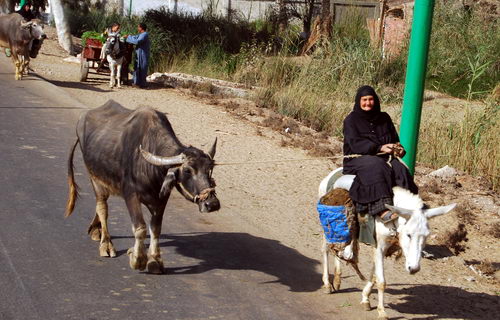
Yesterday I had a photo ready that I wanted to share. It was made at Memphis and is typical of so much of what we see in Egypt. Don’t get the wrong impression. There are many affulent people in this country, but the vast majority seem to eek out a living day by day.

Moving the "herd" near ancient Memphis. Photo by Ferrell Jenkins.

Moving the "herd" near ancient Memphis. Photo by Ferrell Jenkins.

Yesterday our group used a long day to visit the Eastern Delta of
Egypt. Biblically we know that land as Goshen. Few travelers are able to go into this area of Egypt. Over the next few weeks I will try to share a few photos and thoughts about the area.

You might enjoy reading a first person account of the tour written by one of our tour members. This would be especially true if you know some of the folks who have been traveling with us. Click on Picture This.