Category Archives: Bible Study

Memphis in Egypt

This morning, after a period of worship, we visited the ruins of ancient Memphis. The prophet Ezekiel has this to say about Memphis.

This is what the sovereign LORD says: I will destroy the idols, and put an end to the gods of Memphis. There will no longer be a prince from the land of Egypt; so I will make the land of Egypt fearful.  (Ezekiel 30:13)

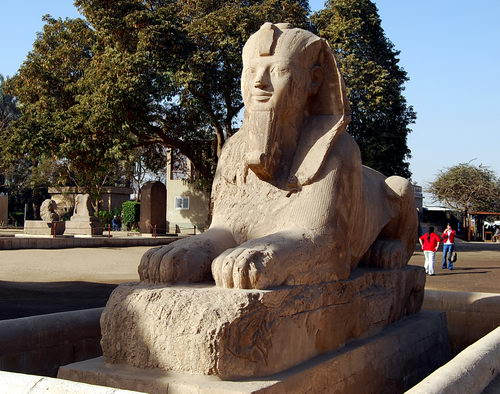
The alabaster sphinx of Rameses II  (13th century B.C.) is one of the nicest pieces on display at the site. It is also one of the few artifacts to be seen. The prophecy has surely come to pass.

Alabaster sphinx of Rameses II at Memphis. Photo by Ferrell Jenkins.

Alabaster sphinx of Rameses II at Memphis. Photo by Ferrell Jenkins.

Next we moved to the edge of the desert to visit the tomb of a Nobleman dating to about 2400 B.C., and the Step Pyramid of Zoser.

After lunch we returned to Old Cairo to spend some time in the Coptic Museum and the Abu Sarga church. This is the church associated with the visit of Mary, Jopseph, and Jesus to Egypt (Matthew 2).

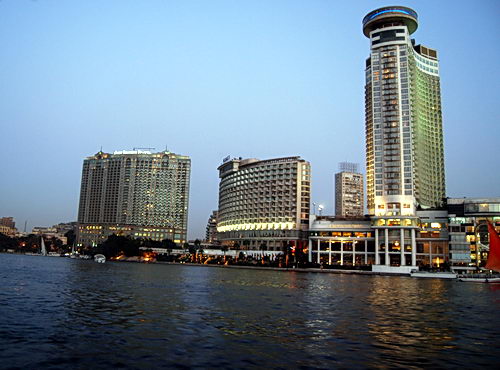
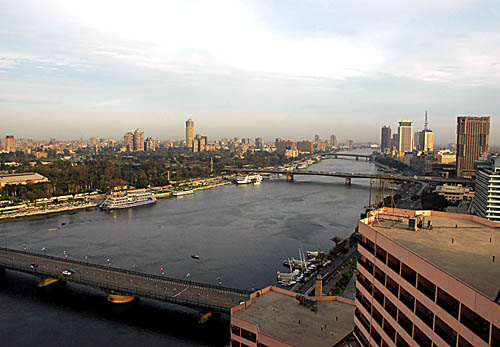
The last event of the day, and of the tour, was a felucca ride on the Nile River. The large buildings of down town Cairo are beautiful after sunset.

Cairo on the Nile at Night. Photo by Ferrell Jenkins.

Cairo on the Nile at Night. Photo by Ferrell Jenkins.

Reeds, Rushes, or Bulrushes along the Nile

One of the best known stories of the Bible is the account of the mother of Moses hiding the baby among the reeds, rushes, or bulrushes along the edge of the Nile. The terms mentioned above are used interchangeably in various English Bible versions.

Read the full account in Exodus 21. Here are the first few verses.

A man from the household of Levi married a woman who was a descendant of Levi.  The woman became pregnant and gave birth to a son. When she saw that he was a healthy child, she hid him for three months.  But when she was no longer able to hide him, she took a papyrus basket for him and sealed it with bitumen and pitch. She put the child in it and set it among the reeds along the edge of the Nile.  (Exodus 21:1-3 NET Bible)

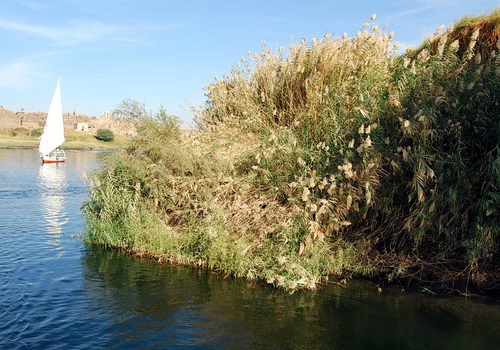
In the past few days we traveled on the Nile River and saw many examples of the reeds or rushes along the banks of the River.

Reeds or rushes along the edge of the Nile River. Photo by Ferrell Jenkins.

Reeds or rushes along the edge of the Nile River. Photo by Ferrell Jenkins.

Tirhakah of Cush

Frequently the Bible records the statements of various foreign rulers. One such record is that of the Assyrian king Sennacherib.

When he heard them say concerning Tirhakah king of Cush, “Behold, he has come out to fight against you,” he sent messengers again to Hezekiah saying,  “Thus you shall say to Hezekiah king of Judah, ‘Do not let your God in whom you trust deceive you saying, “Jerusalem will not be given into the hand of the king of Assyria.”  (2 Kings 19:9-10)

The Theological Wordbook of the Old Testament comments on the term Cush (Ethiopia) as it is used in several Old Testament prophecies.

In several cases, especially in the prophets, Ethiopia is used in parallel construction as a synonym of Egypt (Isa 20:3-5; Ezek 30:4; Nah 3:9). This probably represents the dominance of Ethiopia (or, more precisely, Nubia) over Egypt between 750 and 663 B.C. Terhakah was a notable Nubian pharaoh who tried, unsuccessfully, to block Sennacherib’s westward expansion (2Kings 19:9 ; Isa 37:9). After 663 B. C. Egypt was independent of Nubia (Jer 46:9; Ezek 25:4, 5, 9).

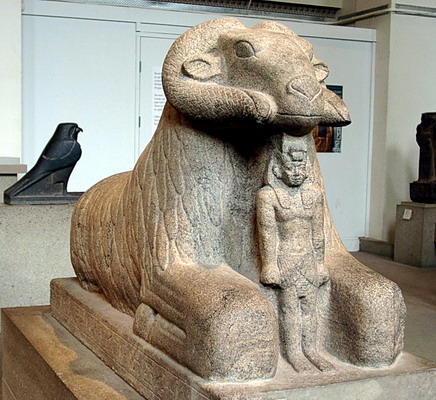
Tirhakah under the protection of the god Amun. British Museum photo by F. Jenkins.

Tirhakah under the protection of the god Amun. British Museum photo by Ferrell Jenkins.

This colossal statue shows Tirhakah standing under the protection of the god Amun shown as a recumbent ram. The gray granite sculpture, dating to about 675 B.C., was found at Karnak. This granite is typical of the Aswan area.

Yesterday afternoon we visited a Nubian Village on the banks of the Nile River at the first cataract of the Nile at Aswan. The Nubians at the village originally lived south of Aswan in the ancient territory of Cush. When the new High Dam was built on the Nile the Nubians were moved to other settlements.

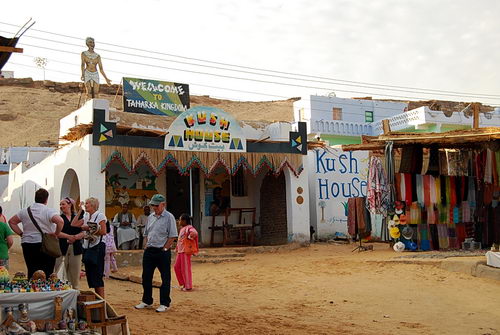
One of the interesting things I observed at the village was a shop of some sort called House of Kush (Cush). A sign on top of the building added “Welcome to Taharka Kingdom.”

House of Kush at Nubian Village, Aswan, Egypt. Photo by Ferrell Jenkins.

House of Kush at Nubian Village, Aswan, Egypt. Photo by Ferrell Jenkins.

This photo is especially for Mrs. Caldwell’s class at the Florida College Academy. I hope you are enjoying the photos of Egypt.

Luxor and the World Powers

Luxor was known as Thebes in Old Testament times. Both Jeremiah and Ezekiel prophesied the Lord’s judgment of the city. Jeremiah says,

The LORD of hosts, the God of Israel, says, ‘Behold, I am going to punish Amon of Thebes, and Pharaoh, and Egypt along with her gods and her kings, even Pharaoh and those who trust in him’” (Jeremiah 46:25; see also Ezekiel 30:14-16).

A visit to the ruined and unoccupied temples of Karnak and Luxor, where Amon (or Amun) was worshipped as a great god, certainly convinces us of the fulfillment of this prophecy. Shortly after the time of Jeremiah (about 586 B.C.), Egypt and Thebes began to decline as a world power.

In 663 B.C. the Assyrian king Ashurbanipal had already conquered Thebes (Hebrew, No Amon). The prophet Nahum, in prophesying the fall of Nineveh, calls attention to this event (3:8ff.).

Jeremiah and Ezekiel prophesied during the Babylonian period of world dominance. Darius the Great (521-486 BC), who befriended the Judeans, helping them rebuild the temple in Jerusalem, depicted himself as a Pharaoh on a shrine door now displayed in the British Museum.

The young Alexander of Macedon came to Thebes in 336 BC and left reliefs of himself portrayed as a Pharaoh making offerings to the god Amon. Cassander rebuilt the city in 315 B.C. The later Ptolemaic kings who succeeded Alexander built temples to the gods at Edfu and Kom Ombo and regularly pictured themselves as worshiping the gods of Egypt. Likewise, the Roman emperors built temples beside the ancient temples of the Pharaoh. The temple of Philae has a small temple to Augustus ( 30 B.C. to A.D. 14) and another to Trajan (A.D. 98-117).

The Giza Pyramids

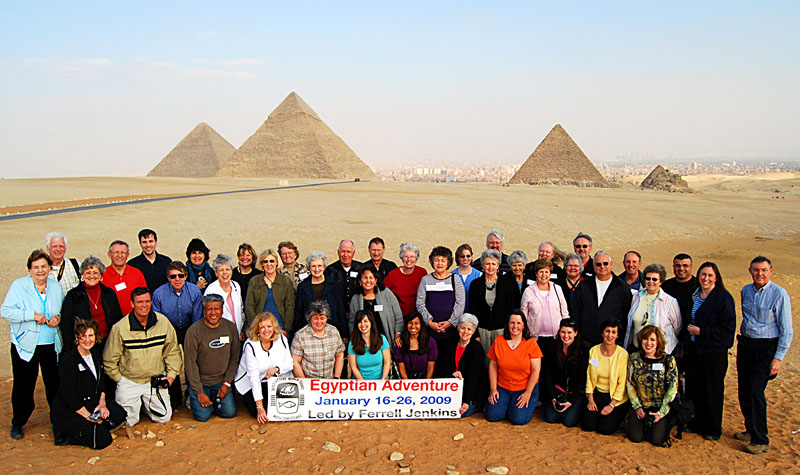
Today has been a long and busy day. Our group visited the Cairo Museum and the Giza Pyramids. This photo of the group was made on the west side of the Pyramids. In the distance you see some of the buildings of Cairo in the Nile Valley.

Egyptian Adventure Group at the Giza Pyramids.

Egyptian Adventure Group at the Giza Pyramids.

Click on the photo for a larger copy.

Tomorrow morning we have a flight scheduled for Luxor. There, after visiting the Luxor and Karnak Temples, we will begin a four day cruise on the Nile with stops along the way to visit important historical sites.

I am not sure if I will be able to have a good Internet connection during most of that time. Keep checking back.

For a more personal outlook on the tour I urge you to see Picture This at http://scenewithsharon.blogspot.com.

Egypt and the Bible

The land of Egypt is an important part of the Bible world, and the country played an important role in biblical history. Egypt is mentioned more than 600 times in the Bible. One may add to this numerous reference to the various cities, such as Alexandria, On, and Pi-beseth, that are mentioned where the word Egypt is not used.

Cairo on the Nile River. Photo by Ferrell Jenkins.

Cairo on the Nile River. Photo by Ferrell Jenkins.

A number of significant Bible stories take their setting in Egypt. Abraham sojourned there (Genesis 12:10). During Joseph’s stay in Egypt he went throughout the land storing grain (Genesis 41:46-48). Moses was born there, adopted by the daughter of a Pharaoh, and trained in all the wisdom of the Egyptians (Acts 7:20-22).

We have every reason to think that these men would have seen the pyramids and other “antiquities” of their time. The Step Pyramid of Djoser, located at Saqqara, was built about 2640 B.C. Shortly thereafter in the twenty-sixth century B.C. came the famous Giza pyramids. Modern man stands in awe of these ancient tombs. This was during the Old Kingdom period of Egyptian history (2800 to 2250 B.C.).

Neither Abraham, Joseph, nor any of the Israelites had anything to do with the building of the pyramids. The pyramids of Giza had been standing more than 500 years when Abraham visited Egypt.

Except for Danny and Sara, who came a day earlier, everyone in our group was tired from the long flight and the loss of seven or more hours. We still made good use of the time by visiting the Citadel and the Mohammed Ali Mosque. Then we went to Old Cairo to visit a Coptic church and the Ben Ezra Synagogue. These churches are built within what has been called Fort Babylon. Hopefully we will get back to visit the church associated with Joseph, Mary, and Jesus, and the Coptic Museum.

See the earlier post about the Ben Ezra Synagogue.

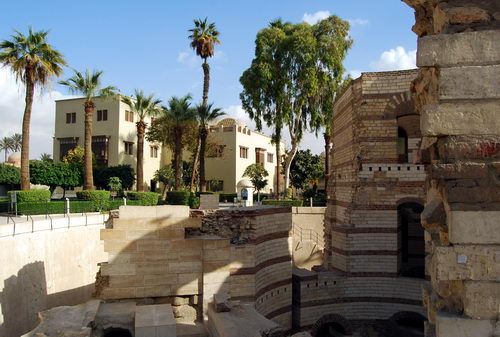
This photo shows a portion of what is marked as a Roman Fort. In the past there have been signs with the phrase Fort Babylon. This ruin (on the right of the photo) is part of the Roman fort that was known as Fort Babylon in Roman times. At that time the Nile River flowed beside the Fort, but has since changed its course. The buildings to the left are part of the newly restored Coptic Museum.

Roman Tower (Fort Babylon, on right) and the Coptic Museum. Photo by Ferrell Jenkins.

Roman Tower (Fort Babylon, on right) and the Coptic Museum. Photo by Ferrell Jenkins.

Arrived safely in Cairo

Our non-stop Delta flight from New York to Cairo took only about 9 hours and 30 minutes of flying time. Weather here is beautiful. All forty two members of the group are accounted for.
We have checked into our hotel near the airport in Heliopolis. It is almost noon now (seven hours ahead of EST). In a few minutes we will begin some sightseeing, likely visiting Old Cairo this afternoon.
We look forward to sharing more with you in the days to come.

Headed for Egypt

In a few hours we plan to be on a non-stop flight to Cairo. We have a good group of fellow-travelers who join us in exploring the ancient culture of Egypt.

nikon-pyramids-t1

Our main purpose for tours like this is to better understand the culture in which so many Bible events took place. We will be joined by a competent Egyptian guide who is well versed in Egyptian history and also understands its relation to the Bible. My job will be to teach the biblical account on the spot. That is a little better than doing so back home with a photo! Not everyone can visit these places, and we are delighted to share a few of our experiences and understanding with you.

I consider these tours of the Bible lands, and this blog, an important part of my teaching ministry. Many of the men and women who travel with me do so in an effort to improve their teaching in the churches where they serve.

My last trip to Egypt was in 2005. I began using WordPress in 2007, and have not determined if we will be able to make proper contact with WordPress to publish our posts. As a backup I have set up an account on Blogger. After we have a day or two to get settled in Egypt, if you don’t see a new post here go to the Blogger site: fjtours.blogspot.com.

We have come to expect Jane to write a blog during our tours, but she and Olen are not able to be with us due to the recent heart surgery for Olen’s father. Jane tells us that Sharon will be writing. We encourage you to check her blog regularly at scenewithsharon.blogspot.com. She is a good photographer and I am sure you will find it of interest.

More illustrations of apocalyptic imagery

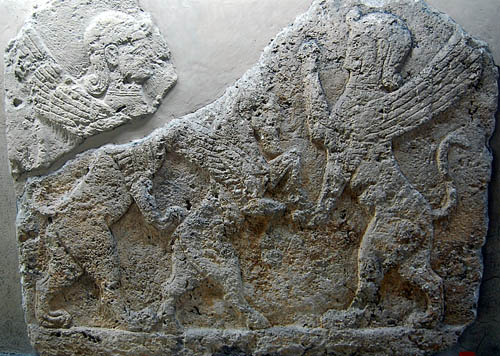
We mentioned in earlier posts on apocalyptic literature that composite images were common among the Assyrians, Babylonians, and Persians. This was also true of the Hittites who lived in the upper Euphrates area. The Anatolian Civilization Museum at Ankara contains many of the reliefs from Carchemish on the Euphrates. The one below shows two human-headed sphinx standing. There is also a winged horse standing between them. They appear to be dancing.

Human-headed sphinxs standing; winged horse standing. Photo by F. Jenkins.

Human-headed sphinx standing; winged horse standing. Photo by F. Jenkins.

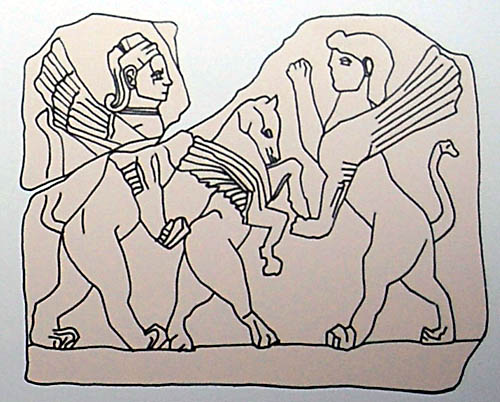
This drawing from the Museum may show the image more clearly. Notice the bird head on the tail of the sphinx on the right.

Drawing of the human-headed sphinx and standing horse.

Drawing of the human-headed sphinx and standing horse.

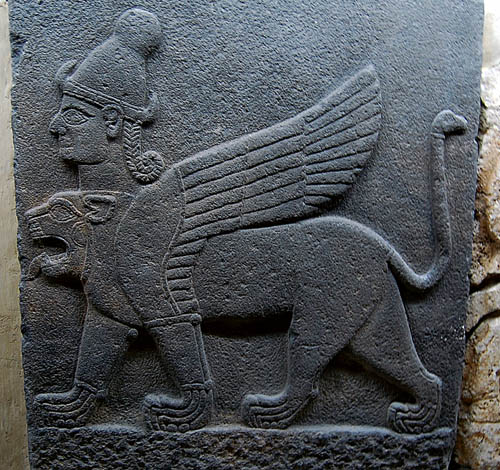
This one is of special interest. It shows a lion with wings and a human head.  The tail shows the head of a bird. There are four images in composite form. This basalt orthostat also comes from Carchemish.

Three-headed sphinx.

Three-headed sphinx.

Judeans who were taken captive to Babylon traveled in this region on their way to their place on the Chebar (Kebar) River in southern Mesopotamia. We know that Nebuchadnezzar made his headquarters at Riblah in the land of Hamath. Because this region was part of the Fertile Crescent we can be sure that the Judeans traveled in the area on their long trip from Judea to Babylon. See 2 Kings 25:6-7.

We are not saying that Ezekiel borrowed his composite creatures from the culture around him. We are saying that such was common and that it would not have been unusual or strange to Ezekiel or his hearers/readers.

Notice, again, Ezekiel’s description of the creatures he saw:

These are the living beings that I saw beneath the God of Israel by the river Chebar;  so I knew that they were cherubim.  Each one had four faces and each one four wings, and beneath their wings was the form of human hands.  As for the likeness of their faces, they were the same faces whose appearance I had seen by the river Chebar. Each one went straight ahead. (Ezekiel 10:20-22 NASB)

For the images in the book of Daniel we could show numerous composite creatures from Babylon.

Apocalyptic imagery is not strange

Visits to the great museums of the world provide many illustrations that help us understand the background of biblical images. This is especially true when we think of the apocalyptic imagery in Ezekiel, Daniel, Zechariah, and Revelation. The Greek name of the Book of Revelation is apocalypsis. In the opening sentence of the book we are told that it is an apocalypse.

In two previous posts we have called attention to the cherubim of the Bible. In this post I want to further this discussion and call attention to the multi-headed creatures that we encounter in apocalyptic literature. In the great throne scene of Revelation 4 we see four living creatures.

The first living creature was like a lion, the second creature like an ox, the third creature had a face like a man’s, and the fourth creature looked like an eagle flying. Each one of the four living creatures had six wings and was full of eyes all around and inside. They never rest day or night, saying: “Holy Holy Holy is the Lord God, the All-Powerful, Who was and who is, and who is still to come!” (Revelation 4:7-8 NET)

In Ezekiel we see figures representing four living beings with human form. Each living being had four faces and four wings. Each face was of a different creature.

Their faces had this appearance: Each of the four had the face of a man, with the face of a lion on the right, the face of an ox on the left and also the face of an eagle. (Ezekiel 1:10 NET)

One notes immediately that in early Christian art the Four Evangelists (or we might say, the four writers of the gospels) were likened to the same creatures.

Andre Parrot, in Babylon and the Old Testament, calls attention to the imagery used in Ezekiel. He provides two drawings of images uncovered by the archaeological spade in Mesopotamia. One shows a two-faced image; the other a four-faced image.
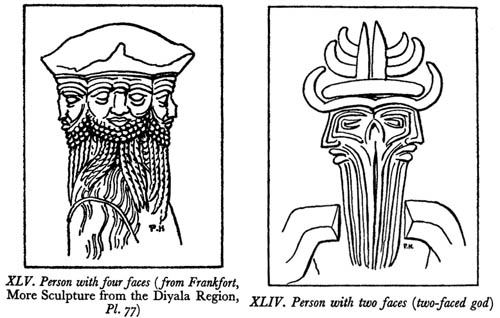
Drawings from Parrot, Babylon and the Old Testament.

Drawings from Parrot, Babylon and the Old Testament.

The location of the images is not given. The four-faced image seems to be an image that is now on display at the Oriental Institute of the University of Chicago. This is a museum you must not miss if you visit the Chicago area. Here is a nice photo made by David Padfield.
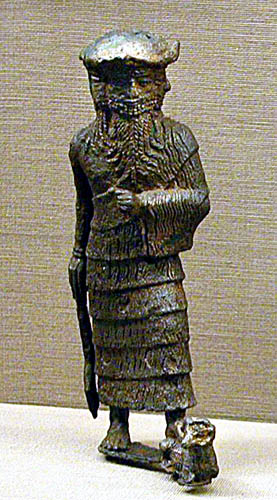
Four-faced image from Mesopotamia. Photo by David Padfield.

Four-faced image from Mesopotamia. Photo by David Padfield.

One notices immediately that these two-faced and four-faced images all have human heads. We need only turn to the sculpture of Assyria, Babylon, and Persia to find many composite creatures bearing features of four or more creatures. That will have to wait for another time.

In closing I must return to the title of this post. “Apocalyptic imagery is not strange.” That is, it was not strange to those to whom the apocalyptic books of the Bible are addressed. It may be strange to us at first glance, but that can easily change by investigating the culture in which these books were written and read.