Category Archives: Bible Study

Be careful where you start a fire

Piazza della Signoria in Florence with Savonarola marker showing. Photo by Ferrell Jenkins.

Piazza della Signoria in Florence with Savonarola marker showing. Photo by Ferrell Jenkins.

Yesterday morning I visited the Piazza della Signoria in Florence, Italy. I think many people walk through this Piazza to get to the Uffizi Gallery and never notice the plaque about Savonarola. Sometimes groups of people were standing on the plaque. When it was clear, one man walked up and said to his companions “Who’s that?” The group walked on without an answer.

Daniel M. Madden says,

In the lovely Piazza della Signoria, the political forum of Florence in all ages, Savonarola arranged a huge bonfire in 1497 so that penitents won over by his words could do away with their wigs, perfumes, lotions, powers and other accouterments of an easy way of life. He himself was burned to death in the same piazza a year later as a heretic. The spot where he died is marked with a plaque. It is not far from the copy of Michelangelo’s statue of “David.” (A Religious Guide to Europe)

One may say anything he wishes as long as he does not step on the toes of those in authority. Jesus faced this problem when He dealt with the Jewish leaders in Jerusalem.

“If we let him go on like this, everyone will believe in him, and the Romans will come and take away both our place and our nation.” (John 11:48 ESV)

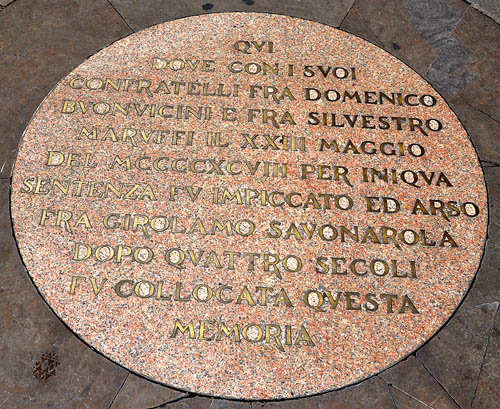
Here is a closeup of the plaque marking the spot where Savonarola died.

Plaque marking spot where Savonarola died. Photo by Ferrell Jenkins.

Plaque marking spot where Savonarola died. Photo by Ferrell Jenkins.

The background of the Protestant Reformation

Dr. Dan Petty, chair of Biblical Studies at Florida College, gave me permission to post some of his information about the Reformation Movement on the blog. Dan has some other material on church history at Lessons on Line. The following section, without indentation, is by Dr. Petty.

-o-o-o-o-

The Protestant Reformation began in 1517, when Martin Luther posted his Ninety-five Theses in Wittenberg, Germany. The background of the movement is complex. The movement was conditioned by political, social, economic, moral and intellectual factors. But it was above all a religious movement led by men interested in a genuine reform of Christianity.

The Decline of Papal Power
The rise of national monarchies in the thirteenth through the fifteenth centuries came at the expense of the power of the papacy. This fact is illustrated by Pope Boniface VIII’s struggle with the king of France, which resulted in the pope’s humiliation and untimely death in 1303. The papacy was subsequently located in Avignon, France for an approximately seventy-year period known in history as the Avignon Papacy or the Babylonian Captivity of the Papacy (1303-77). During that time the papacy was dominated by the French monarchy. Efforts to restore the papacy to Rome at first only resulted in a division, known as the Great Schism. Rival popes claimed legitimacy until the situation was finally resolved in 1417.

Such scandalous affairs in the highest leadership of the Roman Catholic Church led to increasing corruption and a loss of confidence in the church. Many questioned the absolute authority claimed for the pope. Others increasingly called for a reform of the church in “head and members.”

Moral Corruption in the Leadership of the Church
The years leading up to the Protestant Reformation were also plagued by moral corruption and abuse of position in the Roman Catholic Church. The priesthood was guilty of several abuses of privilege and responsibility, including simony (using one’s wealth or influence to purchase an ecclesiastical office), pluralism (holding multiple offices simultaneously) and absenteeism (the failure to reside in the parish where they were supposed to minister). The practice of celibacy which was imposed by the church on  the priesthood was often abused or ignored, leading to immoral conduct on the part of the clergy. Secular-minded, ignorant priests corrupted their position by neglect or abuse of power.

During the fifteenth century the worldliness and corruption in the church reached its worst. The problem of corruption reached all the way to the papacy.

Among those who spoke out for a reform of the church was the Dominican Giralamo Savonarola (1452-1498) of Florence, Italy. This fiery preacher spoke out against the corrupt morals of the city’s leaders and the abuses of the papacy. The people were won over to Savonarola’s cause in Florence, but because of religious rivalries and political circumstances, the movement was short-lived. Savonarola was hanged and burned for heresy in 1498.

-o-o-o-o-

Here is a photo of the Piazza della Signoria in Florence, Italy. This is where Savonarola preached and died. In the next post we will show a photo of the plaque marking the place where Savonarola was martyred in 1498.
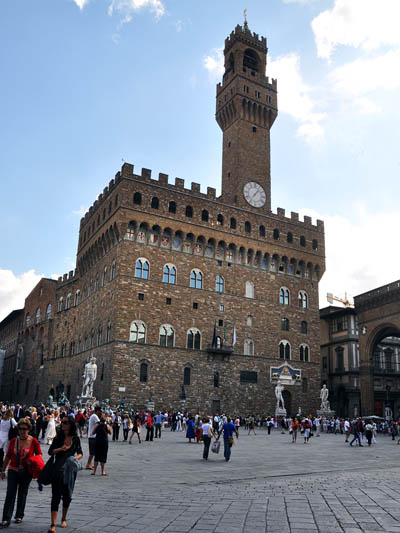
Piazza della Signoria in Florence, Italy. Photo by Ferrell Jenkins.

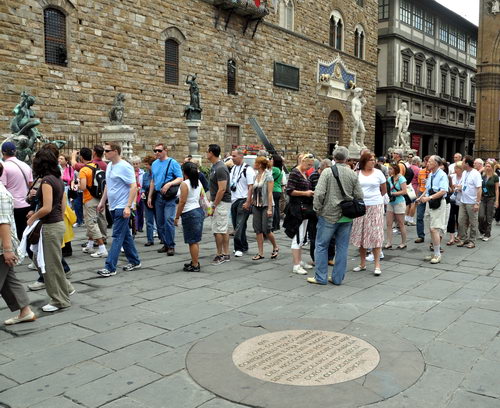
Piazza della Signoria in Florence, Italy. Photo by Ferrell Jenkins.
Venice and Mark

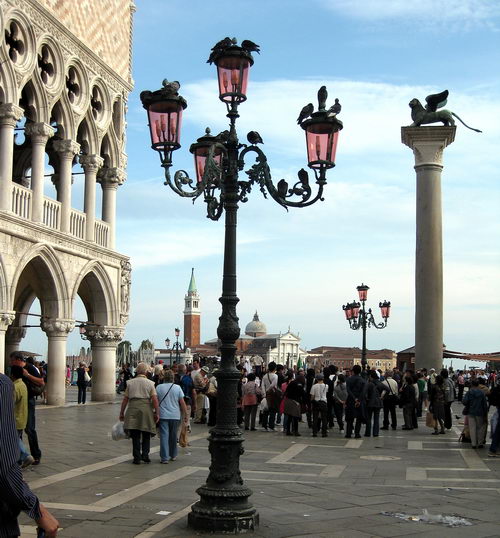
This view shows one corner of the Doge’s palace and the columns with the lion representing Mark the Evangelist. (Some of us would simply say Mark, the writer of the gospel that bears his name.) The buildings visible in the distance are across the Grand Canal.

Note the pigeons resting on the lamp post. There are now fewer pigeons in the Square than in the past because the city has quit feeding then.

Doges Palace and view from St. Mark's Square. Photo by Ferrell Jenkins.
Doges Palace and view from St. Mark's Square. Photo by Ferrell Jenkins.

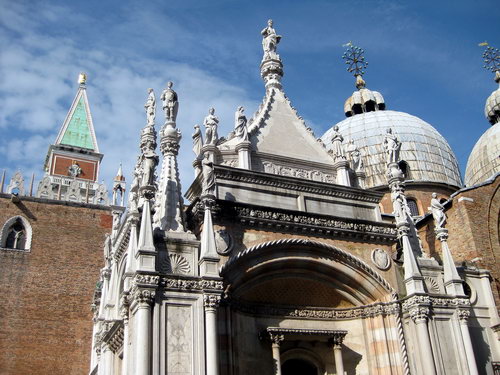
St. Mark’s Cathedral and Square is one of the best known tourist attractions in the world. The building is of the Byzantine style, but the liturgy is Roman Catholic. Madden explains how a Byzantine building happens to be in Italy.

The Byzantine style of St. Mark’s Cathedral bespeaks the maritime past of the Venetian republic, and its long range interests in the eastern Mediterranean, the Mare Nostrum of the Romans (A Religious Guide to Europe, 298).

Clock Tower and the Domes of St. Mark's. Photo by Ferrell Jenkins.

Clock Tower and the Domes of St. Mark's. Photo by Ferrell Jenkins.

It is alleged by some that the body (or relics) of St. Mark the Evangelist were brought to Venice in the 9th century B.C. by Venetian merchants.

Today we traveled from Venice to Florence. It rained most of that time. By the time we reached Florence we had some clearing. At the moment it is bright outside.

Everyone in the group is doing well.

Lucerne, Liechtenstein, and Innsbruck

After a period of worship Sunday morning we left Lucerne headed east to the Austrian town of Innsbruck. The weather of the day was mixed with periods of light rain and sunshine. For lunch we stopped in Vaduz, capital of the Principality of Liechtenstein. The country is sometimes referred to as a postage stamp country. This is for two reasons. Much of the income comes from selling postage stamps to collectors. The other is the size of the country. It consists of an area covering about 62 square miles. Some of the countries of Europe are not as large as some American cities or counties.

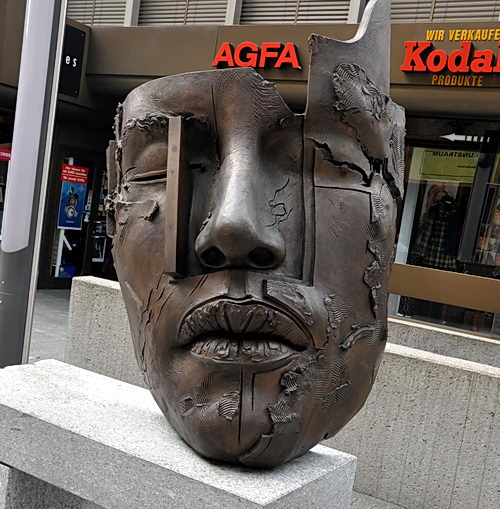
The downtown area of Vaduz, the capital of the country, has been turned into a pedestrian shopping mall. The king of Liechtenstein is a collector of modern art. Modern sculptures cover the strolling area of the city. One piece that caught my attention was a bronze mask called African King. I made my photo to show the Agfa sign on the store behind the mask. My caption for the photo is “A mind filled with images.” Discern if you can.

A mind filled with images. Photo by Ferrell Jenkins.

A mind filled with images. Photo by Ferrell Jenkins.

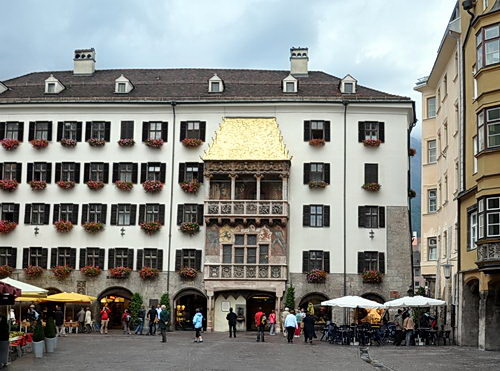
Driving throught the heart of the Alps we arrived in Innsbruck, capital of the Austrian province of Tyrol. This 800-year-old city was named for the bridge across the Inn River, first built in the 12th century. It doesn’t take long to see the highlights of the city. The Goldenes Dachl (Golden Roof), a late Gothic oriel with 2,657 gold-plated tiles, was built between 1494 and 1496 under the rule of Emperor Maximilian I as a royal box for spectacles held in the square below.

The Golden Roof in Innsbruck. Photo by Ferrell Jenkins.

The Golden Roof in Innsbruck. Photo by Ferrell Jenkins.

A beautiful but hazy day in the Bernese Oberland

Today we visited the Bernese Oberland in Switzerland. It was a beautiful sunny day by about 10 a.m., but the distant mountains remained hazy almost all day. We went to Trummelbach Falls. Using an elevator and steps one is able to go inside the mountain to see the falls.  I think everyone in our group saw at least part of the falls, and several went all the way to the top.

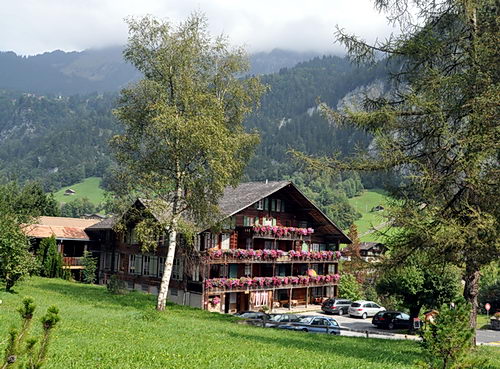
Here is a photo I made of one of the colorful buildings. It is typical here for houses and other buildings to display beautiful flowers under their window”I am my beloved’s and my beloved is mine, He who pastures his flock among the lilies.”s. This provide color for those passing buy as well as for those in the house. This reminds me of the Shunamite (Shulamite) girl’s description of her beloved.

“I am my beloved’s and my beloved is mine, He who pastures his flock among the lilies.” (Song of Solomon 6:3)

A little color adds a lot to life even when one has to deal with difficult earthly problems.

A beautiful house at Lauterbrunen. Photo by Ferrell Jenkins.

A beautiful hotel at Lauterbrunnen. Photo by Ferrell Jenkins.

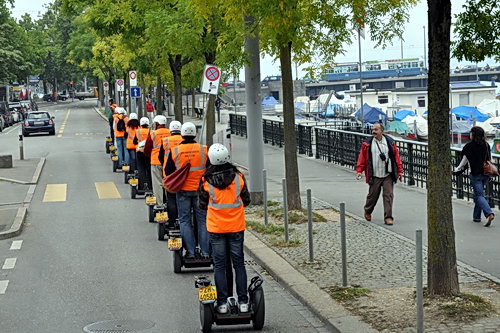
Both in Lucerne and in Interlaken we saw some small tour groups traveling on Segways. This service is offered in the City of David in Jerusalem (click here), but it is the first time I have seen it in action. I think each participtant can hear the leader speaking through the earphones in the helmet.

Segway tour in Lucerne, Switzerland. Photo by Ferrell Jenkins.

Segway tour in Lucerne, Switzerland. Photo by Ferrell Jenkins.

If you know some of the people in our group and wish to read more about the individuals, take a look at Journey’s With Jane.

Remembering Black Tuesday: 9-11

ribbon911

The little ribbon was used by many immediately after the events of 9-11, but I haven’t seen it much lately.

David West, a minister in Florida, presented a lesson on the Sunday following 9-11 entitled “Black Tuesday: Reflections on Another Day of Infamy.” I think you might enjoy taking a look the full speech. The link is here.

It is only by remembering such horrific events that we will be able to avoid similar ones in the future.

Piper: “I want all the words”

John Piper is doubtless one of today’s most respected evangelical leaders. He is a scholar and preaches like a scholar, but with a broad appeal. That is not an easy combination. To say Piper is a Calvinist is an understatement. I am not a Calvinist, but I often profit from the lessons of John Piper. One always comes away challenged.

In this video clip Piper takes on versions that do not allow the reader to know all the words of a text. Many read to get the idea and never learn the details. This can be misleading. I think preachers who never grapple with textual problems and leave their hearers in the dark do them a great disservice.

Piper is discussing John 4:44-45. Here is how it reads in the NASB:

44 For Jesus Himself testified that a prophet has no honor in his own country. 45 So when He came to Galilee, the Galileans received Him, having seen all the things that He did in Jerusalem at the feast; for they themselves also went to the feast.

Here is the NIV rendering of the same text:

44 (Now Jesus himself had pointed out that a prophet has no honor in his own country.) 45When he arrived in Galilee, the Galileans welcomed him. They had seen all that he had done in Jerusalem at the Passover Feast, for they also had been there.

Listen and think.

Todd Bolen’s new collection of old photos

Todd Bolen has produced a new collection of photos. These are not his photos. They are the famous photos of The American Colony and Eric Matson Collection. This set of 8 volumes features 4,000 high-resolution photographs taken by resident photographers in the Holy Land from 1898 to the 1940s.

Every Bible student who has been using Bible study resources for several years has seen the photographs of The American Colony photographers and Eric Matson. When I edited the Truth in Life Bible class literature in the early 1970s we purchased and obtained permission to use several of the photographs in the literature.

The American Colony in Jerusalem was founded in 1881 by Horatio Spafford (author of the famous hymn, It is Well With My Soul). Eric Matson, one of the photographers inherited the collection, added his own work, and later donated his negatives to the Library of Congress. These photos have been available to the public for some time, but it has been difficult to locate a particular photo. And the quality of some of them, after so many years, is not good.

Bolen describes the collection:matson_dvd_front_200

This collection includes more than 4,000 selected photographs of sites and scenes from Palestine, Lebanon, Syria, Jordan, and Egypt. All of the images are included in pre-made PowerPoint® files for quick and easy use, as well as in high-resolution jpg format, suitable for projecting or printing. Quotations from 19th-century travelers give additional context to many of the photographs.

The Collection Includes:

  • Volume 1: Northern Palestine
  • Volume 2: Jerusalem
  • Volume 3: Southern Palestine
  • Volume 4: Lebanon, Syria, and Jordan
  • Volume 5: Egypt and Sinai
  • Volume 6: Traditional Life and Customs
  • Volume 7: Early 20th-Century History
  • Volume 8: People of Palestine

The first volume has been released on CD. Other volumes are being released one CD a month. The complete 8-volume set is available now on 2 DVDs.

In recent weeks Todd has written about Shechem, Samaria, and Beth Shean. Almost every tour group visits Beth Shean, but many are unable to go to the other sites. Take a look here at the way Beth Shean looks now and the way it looked in the 1920s.

Complete information on this set is available at Life in the Holy Land.

Impressive Canaanite fortification in “City of David”

According to a press release from the Israel Antiquities Authority, “An Enormous 3,700 Year Old Fortification was Exposed in the City of David.”

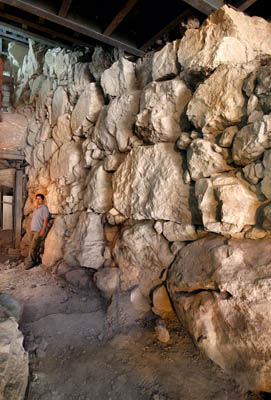
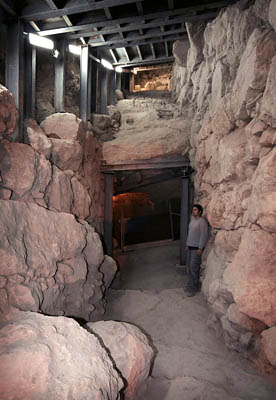
The fortification rises to a height of c. 8 meters [about 26+ feet], and it seems that the Canaanites used it to defend the path that led to the spring.

The excavations are being conducted by the Israel Antiquities Authority in the “Walls Around Jerusalem National Park and are underwritten by the ‘Ir David Foundation.

A huge fortification more than 3,700 years old, which is ascribed to the Canaanites (Middle Bronze Age 2 [2000-1500 BC]), was uncovered in archaeological excavations the Israel Antiquities Authority is currently conducting in the “Walls Around Jerusalem National Park” in the City of David, with funding provided by the ‘Ir David Foundation.

According to the director of the excavation, Professor Ronny Reich of the University of Haifa, together with Eli Shukron on behalf of the Israel Antiquities Authority, “This is the most massive wall that has ever been uncovered in the City of David, and it rises to a height of 8 meters. We are dealing with a gigantic fortification, from the standpoint of the structure’s dimensions, the thickness of its walls and the size of the stones that were incorporated in its construction. The walls appear to be a protected, well-fortified passage that descends to the spring tower from some sort of fortress that stood at the top of the hill. The construction of a protected passage such as this is a plausible solution that explains the innate contradiction of the situation whereby the spring – which is a source of life from the standpoint of the fortress’ inhabitants in time of emergency – is located in the weakest and most vulnerable place in the area. The construction of a protected passage, even though it involves tremendous effort, is a solution for which there are several parallels in antiquity, albeit from periods that are later than the remains described here. A small section of the fortification was discovered in 1909, and it has been ascertained in the present excavations that it was part of an enormous wall. This is the first time that such massive construction that predates the Herodian period has been discovered in Jerusalem.”

During this period Jerusalem and the fields around it were an independent political entity with self-rule, similar to its neighbors Shechem to the north and Jericho to the east. Massive walls resembling the one that was just exposed in Jerusalem are known from Canaanite Hebron (Tel Rumeida), Shechem (Tell Balata) and Gezer.

Middle Bronze II Fortification. Photo: Vladimir Naiahin, IAA.

Middle Bronze II Fortification. Photo: Vladimir Naiahin, IAA.

Professor Reich comments on the fortification:

“Even though it would seem we are dealing with impressive fortifications, the walls were after all primarily used to defend against marauding desert nomads who wanted to rob the city. These are the earliest fortifications in the region and they bear witness to the fact that from this point on the settlement had became an urban entity with a ruler who had the capability and resources to build such a structure. A small settlement would have been unsuccessful in organizing such construction”.

The known section of the fortification is 24 meters long; however, it is thought the fortification is much longer because it continues west beyond the part that was exposed, at the top of the hillside. Professor Reich adds, “The new discovery shows that the picture regarding Jerusalem’s eastern defenses and the ancient water system in the Middle Bronze Age 2 is still far from clear. Despite the fact that so many have excavated on this hill, there is a very good chance that extremely large and well-preserved architectural elements are still hidden in it and waiting to be uncovered”.

Middle Bronze II Fortification. Photo: Vladimir Naiahin, IAA.

Middle Bronze II Fortification. Photo: Vladimir Naiahin, IAA.

The public will be able to visit the fortification for the first time today, September 3. I would like to be there.

What does this mean for the Bible student? The Middle Bronze II period is the period of the Biblical Patriarchs. It was possibly during that period when Melchizedek, king of Salem and priest of God Most High, went out to bless Abraham after his return from rescuing Lot (Genesis 14:18). We have no way to know if this fortification was in existence at that time.

Assuming this fortification was still in use at the time when David captured the stronghold of Zion from the Jebusites, it helps explain the arrogance of the local residents (2 Samuel 5:6-7).

Take a look at the City of David website here.

HT: Joseph I. Lauer

Egyptian and Anatolian contacts with Galilee

Tel Aviv University reports on the discover of a rare Egyptian artifact dating to around 3000 BC from Tel Bet Yerah on the shore of the Sea of Galilee. The link to the report is here. The brief report from the Jerusalem Post is probably adequate here.

Although Egyptian-Israeli relations have been frosty in recent years, ties between the two lands were vibrant around 3,000 BCE during the Early Bronze Age – at least according to Tel Aviv University and University College London archeologists who discovered a rare, four-centimeter-long stone fragment at the point where the Jordan River exits Lake Kinneret.

The piece, part of a carved stone plaque bearing archaic Egyptian signs, was the highlight of the second season of excavations at Tel Bet Yerah (Khirbet el-Kerak). The site lies along an ancient highway that connected Egypt to the wider world of the ancient Near East.

Fragment of Egyptian plaque - c. 3000 BC - from Tel Bet Yerah.

Fragment of Egyptian plaque - c. 3000 BC - from Tel Bet Yerah.

. . . . . .

Earlier discoveries, both in Egypt and at Bet Yerah, have indicated that there was direct interaction between the site – then one of the largest in the Jordan Valley – and the Egyptian royal court. The new discovery suggests that these contacts were of far greater local significance than had been suspected.

The archeologists noted that the fragment – which depicts an arm and hand grasping a scepter and an early form of the ankh sign – was the first artifact of its type ever found in an archaeological site outside Egypt. It has been attributed to the period of Egypt’s First Dynasty, at around 3000 BCE.

. . . . . .

This year’s excavations also provided new insights into contacts between the early town and the distant north, when large quantities of “Khirbet Kerak Ware” (a distinctive kind of red/black burnished pottery first found at Tel Bet Yerah) were found in association with portable ceramic hearths, some of them bearing decorations in the form of human features.

One end of a decorated portable hearth - Khirbet Kerak Culture (c. 2700 BC)

One end of a decorated portable hearth - Khirbet Kerak Culture (c. 2700 BC)

“The hearths are very similar to objects found in Anatolia and the southern Caucasus,” noted Greenberg, “and most were found in open spaces where there was other evidence for fire-related activities.

“The people using this pottery appear to have been migrants or descendants of migrants, and its distribution on the site, as well as the study of other cultural aspects, such as what they ate and the way they organized their households, could tell us about their interaction with local people and their adaptation to new surroundings.”

. . . . . .

The tel was once described by influential American biblical archeologist William F. Albright as “perhaps the most remarkable Bronze Age site in all Palestine.” It presents the most complete sequence of the transition from village to city life in ancient Canaan.

Built on a raised peninsula near an important crossroads and a fertile valley, Tel Bet Yerah became a major regional center, and its fortification systems, city gate, streets and houses reveal elements of advanced urban planning.

Modern archeological research on the mound began in the early 1920s, when E.L. Sukenik (father of the late archeologist and politician Prof. Yigael Yadin) examined finds from the section of the old Samak (Tzemah)-Tiberias road that traversed the mound along its entire length.

At about the same time, Albright conducted his own investigation of the site; he was the first to identify and define the pottery known as Khirbet Kerak Ware.

The first archeological excavation was conducted in 1933, when the modern Tzemah -Tiberias highway was constructed. Over the next 70 years, about 20 excavation licenses were issued for Tel Bet Yerah and some 15,000 square meters were excavated, most of them in Early Bronze Age strata.

I think this type of information illustrates why the Lord placed His people on this land bridge between the great powers of the ancient world. It would continue to remain that way through the days of the Assyrians, Babylonians, Persians, Greeks, and Romans. And beyond.

HT: Joe Lauer