Category Archives: Bible Study

Tel Dor

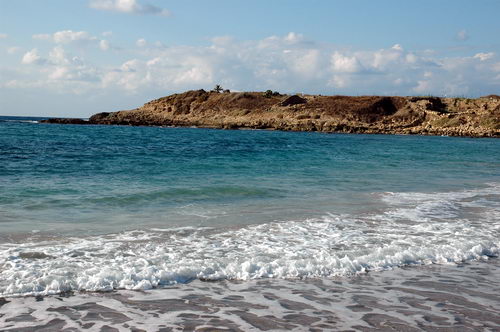
Tel Dor sits on a promontory on the Mediterranean coast between Caesarea Maritima and Mount Carmel.

View of Tel Dor from the south. Photo by Ferrell Jenkins.

View of Tel Dor from the south. Photo by Ferrell Jenkins.

The site of Dor seems to have been inhabited at least from the Late Bronze Age (1550-1200 B.C.). The Tel Dor Excavation site says,

The documented history of the site begins in the Late Bronze Age (though the town itself was founded in the Middle Bronze Age, c. 2000 BCE), and ends in the Crusader period.

Here is what we know about Dor from the biblical accounts:

  • The king of Dor joined the coalition of Jabin, king of Hazor, to fight unsuccessfully against Joshua and the Israelites (Joshua 11:1-2; 12:23).
  • Dor seems to have been allotted to the tribe of Manasseh within the territory of Asher (Joshua 17:11). It appears that Manasseh was unable to maintain control of the city (Judges 1:27).
  • Ben-abinadab, one of Solomon’s deputies, was responsible for the “height of Dor” when Solomon set up his administrative centers  (1 Kings 4:7-11).

Thessalonica on the Aegean

Thessalonica was located on the east-west Egnatian Way. The city was also located on the Bay of Thessalonica on the Aegean Sea. According to the records we have in the Book of Acts and Paul’s Epistles, Paul never used the sea port at Thessalonica.

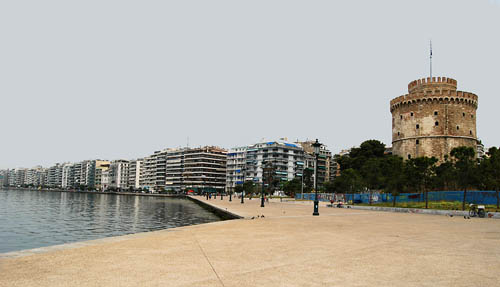
The waterfront of Thessalonica with the White Tower. Photo by Ferrell Jenkins.

The waterfront of Thessalonica with the White Tower. Photo by Ferrell Jenkins.

The tower, called the White Tower, was built in the 15th century by the Venetians or the Turks. It is probably the best known landmark of the city today.

Paul visited Thessalonica during his second journey

Paul came to Thessalonica on his second journey (A.D. 50-53; Acts 17). Paul describes the reception the Thessalonians gave to the gospel in these words:

For they themselves report about us what kind of a reception we had with you, and how you turned to God from idols to serve a living and true God, and to wait for His Son from heaven, whom He raised from the dead, that is Jesus, who rescues us from the wrath to come. (1 Thessalonians 1:9-10 NAU)

The church of the Thessalonians had many questions about the second coming of Christ. Paul addressed these questions in the two letters he wrote to the church from Corinth.

We know little of individuals associated with the church. Jason seems to be one of the earliest converts in Thessalonica (Acts 17:5-9). Aristarchus, a Macedonian of Thessalonica accompanied Paul on the voyage to Rome (Acts 27:2). He was one of the messengers who went with Paul on the return from the third journey (Acts 20:4). When Demas forsook Paul he went to Thessalonica (2 Timothy 4:10).

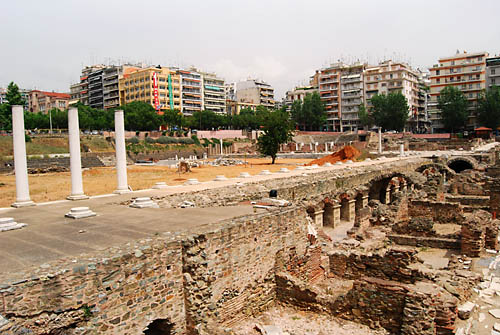
The photo below shows ruins of the Roman Forum in Thessaloniki, the second largest city of Greece. This area of the city was destroyed by a fire in 1917. During preparations for constructing new buildings these ruins were discovered. They date to the second and third century A.D. (See Fant and Reddish, A Guide to Biblical Sites in Greece and Turkey, 137). Perhaps there are older ruins below these. Notice how the modern city is built around the ancient ruins on a higher level. Can you imagine what might be underneath all of those buildings?

Roman Forum at Thessalonica. Photo by Ferrell Jenkins.

Roman Forum at Thessalonica. Photo by Ferrell Jenkins.

A view from Qumran

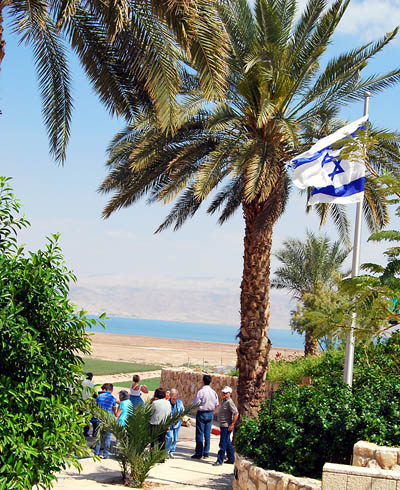
This morning I wanted to share a photo made from Qumran on the western shore of the Dead Sea. Weather conditions were fairly good that day. You can see across the Dead Sea to the mountains of Moab.

View east to the Dead Sea from Quman. Photo by Ferrell Jenkins.

View east across the Dead Sea to Moab. Photo by Ferrell Jenkins.

We associate the land of Moab with Ruth the grandmother of King David.

So Naomi returned, and with her Ruth the Moabitess, her daughter-in-law, who returned from the land of Moab. And they came to Bethlehem at the beginning of barley harvest. (Ruth 1:22)

Mount Hermon is a source of water

The land captured by Joshua and the Israelites included “Baal Gad in the valley of Lebanon at the foot of Mount Hermon” (Joshua 11:17). Today we call this valley to the east of Mount Hermon the Beka Valley. Some have suggested that Baal Gad might be the site later known as Paneas (now Banias), and later Caesarea Philippi. Dan is another important biblical town located at the foothills of Mount Hermon.

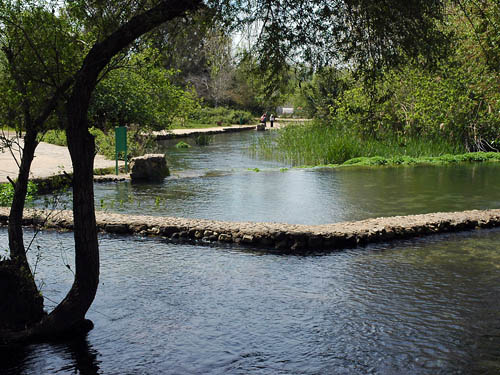
Source of the Jordan River at Caesarea Philippi. Photo by Ferrell Jenkins.

Source of the Jordan River at Caesarea Philippi. Photo by Ferrell Jenkins.

Brethren dwelling together in unity is said to be “like the dew of Hermon Coming down upon the mountains of Zion” (Psalm 133:3). Mount Hermon receives an annual average of about 60 inches of precipitation. In the winter the mountain is usually fully covered with snow.

The proximity of Mount Hermon to Caesarea Philippi, where Jesus was confessed to be the Christ, and where he promised to build the church, causes many scholars to suggest it as the “high mountain” of the transfiguration (Matthew 16:13 – 17:1-9).

Good deal on Bible study CD

From time to time I order Bible software from Rejoice Christian Software. I have no stock in the company, but am delighted to recommend some of their deals to others.

zondervant0310274486Rejoice has Zondervan’s Understanding the Bible Library 6.0 available as a special for only $35.95, less than the price of two volumes in print. You may read about the program details here, but you must go to a special link which I received by Email for the low price. Click here. The Email says it is o.k. to email it to a friend. This is my Email to you.

This program is published by Zondervan. Therefore it uses the Pradis format. This is the only way to get some of the Zondervan titles in digital format.

Here are a few of the significant titles in this program.

  • New International Bible Dictionary. Ed. F. F. Bruce.
  • New International Bible Dictionary. Ed. J. D. Douglas.
  • New International Dictionary of Biblical Archaeology. Ed. Blaiklock and Harrison.
  • New International Encyclopedia of Bible Difficulties. Archer.
  • New International Encyclopedia of Bible Words. Richards.
  • Asbury Bible Commentary.
  • Five Bible versions.

It is unfortunate that I have to open my Libronix program and my Pradis program when I am researching something, but that’s the way it is. Yes, I already have most of these in print, but I love being able to search the entire book on the computer.

The offer is valid through August 22, 2009.

The Meeting of the Waters

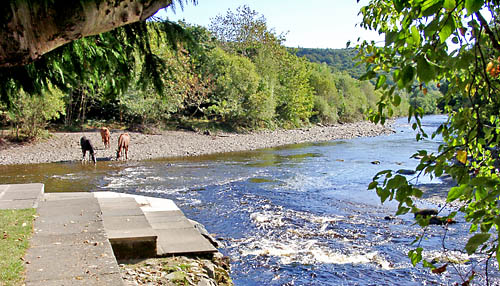
Thomas Moore (1779-1852) is known as one of Ireland’s best writers. A little south of Dublin, in Wicklow County, the Avonmore and Avonberg rivers meet. Moore made this spot famous in his poem The Meeting of the Waters.

Where the Sweet Waters Meet. Photo by Ferrell Jenkins.

Where the Sweet Waters Meet. Photo by Ferrell Jenkins.

The Meeting of the Waters

There is not in the wide world a valley so sweet
As that vale in whose bosom the bright waters meet
Oh the last rays of feeling and life must depart
Ere the bloom of that valley shall fade from my heart

Yet it was not that nature had shed o’er the scene
Her purest of crystal and brightest of green
‘Twas not her soft magic of streamlet or hill
Oh No ’twas something more exquisite still

‘Twas that friends, the belov’d of my bosom were near
Who made every scene of enchantment more dear
And who felt how the best charms of nature improve
When we see them reflected from looks that we love

Sweet vale of Avoca! How calm could I rest
In thy bosom of shade, with the friends I love best
Where the storms that we feel in this cold world should cease
And our hearts, like thy waters, be mingled in peace

How fortunate is any person to have a special place to recall as a place of peace. I have enjoyed several of these places through the years. First, there is home. My study, when my desk is clean and it’s raining outside, is another. I think also of the Sea of Galilee at sunrise, or sunset. Spiritually we find peace in Christ.

Be anxious for nothing, but in everything by prayer and supplication with thanksgiving let your requests be made known to God. And the peace of God, which surpasses all comprehension, will guard your hearts and your minds in Christ Jesus. (Philippians 4:6-7 NAU)

Great source for periodical articles

Rob Bradshaw, over in the UK, has a passion for making available good, scholarly articles from old periodicals. This isn’t as easy as it may sound. He must know the literature, be able to locate a copy of the journal, obtain permission from the author or publisher, scan it, OCR, put into Word format, put it into a portable format such as PDF, post it online, etc.

Most recently I have downloaded J. A. Thompson’s 1964 booklet, The Ancient Near Eastern Treaties and the Old Testament. It is true that I have a copy of this booklet in my library, but I like having the material on my computer for easy searching. A couple of evenings ago I noticed that John R. W. Stott’s The Preacher’s Portrait. Some New Testament Word Studies was available. Now I have a copy on my computer. Did I mention that Rob sometimes scans books? Recently he has made available Carl F. H. Henry’s Revelation and the Bible. There are some great chapters in that book.

Use the search box to locate authors in which you may be interested. There is material by Edward J. Young, F. F. Bruce, et al.

Follow the link to this treasure of significant material: BiblicalStudies.org.uk. Thanks Rob.

Plea for help comes too late

The Times Online recently carried an article by Hannah Devli about a dig in southeastern Turkey under this headline: “Desperate plea for help came too late for ancient Assyrian leader.”

A letter scratched into a clay tablet reveals a desperate plea for reinforcements that came just too late. Alone, petrified and facing almost certain death, the ancient Assyrian leader Mannu-ki-Libbali scrawled a call for help to his commander, but his cry for extra troops came too late.

Soon after it was sent, the ancient city of Tushan was overrun by Babylonian invaders, its temples and palaces pillaged, then torn down or set aflame.

The letter, scratched into a clay tablet in 630BC, may never have reached its intended recipient. But more than 2,500 years later it has been unearthed almost intact by archaeologists, offering an unprecedented glimpse into the downfall of the one of the most powerful empires of the ancient world.
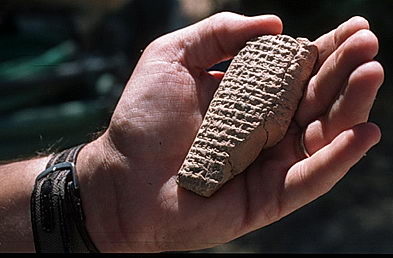
Assyrian tablet with plea of Mannu-ki-Libabli. Photo: Times Online.

Assyrian tablet with plea of Mannu-ki-Libabli. Photo: Times Online.

The archaeologists working at the site say that the author of the letter was a city treasurer who was responsible for building an army to defend the city of Tushan. The article continues…

John MacGinnis, an archaeologist from the University of Cambridge who led the excavation, said: “The letter is written during the process of downfall. The chances of finding something like this are unbelievably small.” Mannu-ki-Libbali laments that he has neither the equipment nor the troops needed for the onerous task ahead. He lists cohort commanders, craftsmen, coppersmiths, blacksmiths, bow makers and arrow makers as essential to building a resistance.

It is apparent that all of the above have already fled the city and that he has been left with a near-impossible task. “Nobody mentioned in this letter, not one of them is there!” he writes. “How can I command?”

He also lacked horses, containers, bandage boxes and chariots.

Expecting the imminent arrival of the Babylonians, armed with arrows, spears, boulders and battle rams, the letter ends with the despairing declaration: “Death will come out of it! No one will escape. I am done!”

Irving Finkel, a British Museum specialist in Assyrian history, said that the tablet captured an epic event. “It has almost a Hollywood quality, this sense of the enemy are coming. I can hear their hooves,” he said.

The Times Online article only mentions Cambridge archaeologist Dr. John MacGinnis as being involved in the dig. Checking on the web I discovered that this project has been carried out by teams from Akron University, Cambridge, Johannes Gutenberg University in Mainz, Marmara University in Istanbul, University of Helsinki, University of Copenhagen, University of Munich, and Sweet Briar College.

The site is known today as Ziyaret Tepe.

Here are some important links:

  • Johannes Gutenberg University (2008 report with photos). It appears that this university is no longer a participant.
  • Ziyaret Tepe website at the University of Akron. There we are told that Dr. Timothy Matney of Akron is the Project Director. This is a nice web site.
  • The Times Online full article is available here.

The cuneiform tablet is now in the Diyarbakir Museum. I had the opportunity to visit this small Museum in 2007.

This photo from the Johannes Gutenberg University shows the “discovery of a rare treasure trove of more than 20 bronze vessels under the paving stones in the courtyard.” Photo courtesy of the Ziyaret Tepe Archaeological Project. This discovery seems to have been in 2008.
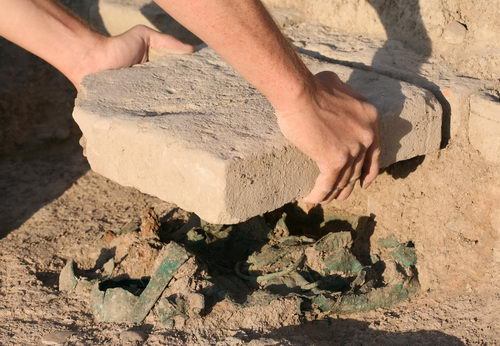
Bronze vessels under paving stones at Ziyaret Tepe in SE Turkey.

Bronze vessels under paving stones at Ziyaret Tepe in SE Turkey.

Why is this of interest to our readers? The Assyrians dominated the politics of the Middle East, including Israel and Judah, between 853 B.C. and 605 B.C. Numerous of the biblical kings had contact with the Assyrians. The Judean king at 630 B.C., the time of the cuneiform plea for help, was Josiah (2 Kings 22-23). Josiah was killed at Megiddo by Pharaoh Neco who was on his way to assist the Assyrians at Carchemish in 609 B.C. (2 Kings 23:28-30).

———–

HT: J. P. van de Giessen, Aantekeningen bij de Bijbel.

Video about Sodom

Dr. Steven Collins, Dean, College of Archaeology, Trinity Southwest University, has posted a short video on The Search for Sodom and Gomorrah at YouTube here. Collins is excavating Tall el-Hammam in the Jordan Valley (Transjordan) east of Jericho.

Numerous articles by Dr. Collins about the excavation at Tall el-Hammam have been posted at the Biblical Research Bulletin page.

Gary Byers of ABR has a good summary report on the excavation prior to the 2009 season here.

The Summer 2007 issue of Bible and Spade has an exchange between Dr. Collins and Dr. Bryant G. Wood. Wood holds that the location of Sodom should be on the southern end of the Dead Sea. Both articles are lavishly illustrated.

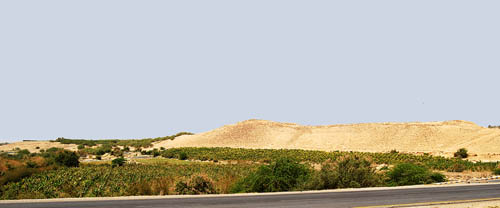
Tall el-Hammam in the Plains of Moab. View toward east. Photo by Ferrell Jenkins 2008.

Tall el-Hammam in Plains of Moab. View toward west. Photo by Ferrell Jenkins 2008.

Other scholars have suggest that Tall el-Hammam is the site of Abel-shittim (Numbers 33:49; Shittim, Numbers 25:1), in the plains of Moab. See Rainey and Notley, The Sacred Bridge, 125. The Israelite spies went out from here to view the land, especially Jericho (Joshua 2:1).

It is now common in Jordan for the old word Tell to be spelled Tall. You know that in Israel the word is Tel. Nothing like consistency.

HT: Dr. David E. Graves at Deus Artefacta.