Category Archives: Bible Places

Where at Caesarea did Herod Agrippa die?

In response to our recent post on the theater at Caesarea Maritima (here), a friend asks, “I was wondering, do you put any stock in Todd Bolen’s contention that the Agrippa I death event happened in the sea side amphitheater, rather than in the theater?”

Boy, am I embarrassed. It is great to have knowledgeable friends, though. I read Todd’s insightful article at The Bible and Interpretation site in July 2010. I was impressed with the article and intended to call attention to it on this blog. For a variety of reasons I failed to get to it, and then let it slip my mind.

The Bolen article challenges Josephus’s location for the place of Herod Agrippa’s death. Here is the synopsis of the argument.

The death of Herod Agrippa I occurred in Caesarea according to both Josephus and the book of Acts. Josephus writes that the king was in the theater when the crowd hailed him as a god and he was struck down. Details in Josephus’s account, however, indicate that the episode occurred in the city amphitheater next door to the temple where the emperor was worshipped.

The article is already too concise and well documented for me to recount the arguments. Bolen believes “that Josephus’s designation of the location was inaccurate. Analysis of his account indicates that the amphitheater, rather than the theater, was the setting for Herod’s public address.” There are four indications showing the Josephus was inaccurate.

  1. The time of day.
  2. The occasion of Agrippa’s death.
  3. An encounter between Pilate and a large crowd a decade earlier.
  4. Josephus’s imprecise use of terms designating buildings of entertainment.

The article may be read in its entirety here. Several informed comments have been added by readers. There are several nice aerial photos with identifications.

The photo below shows the amphitheater (commonly called the hippodrome) running parallel with the coastline. I note that Murphy-O’Connor refers to this as the “Herodian amphitheatre.” At the right (south) bottom of the photo you will see the upper level of what he calls the “Palace of the Procurators.” The Roman theater, which is pictured in our previous post, is to the right of this scene.
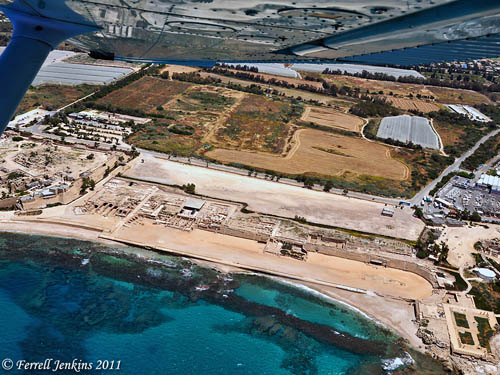
Caesarea amphitheater (hippodrome). Photo by Ferrell Jenkins.

Caesarea amphitheater (hippodrome). Photo by Ferrell Jenkins.

Along the top of the photo, under the wing of the plane, is the later amphitheater (or hippodrome) dating to the late Roman period. A line of trees provides a good outline of the structure.

Here in 306 the emperor Maximinus had Christian martyrs executed before him. Its stones were robbed out when Christianity suppressed such bloody and brutal entertainment. (Murphy-O’Connor, The Holy Land, 5th ed., 248)

The Herodian harbor is located to the left (north) of this photo.
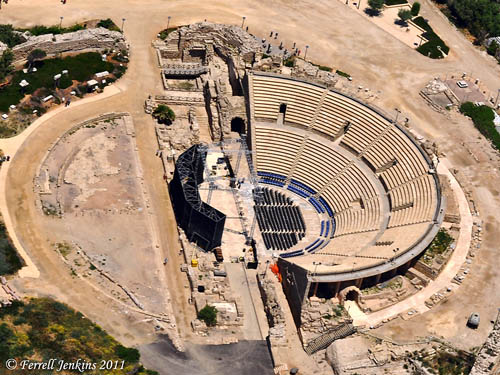
The theater at Caesarea Maritima

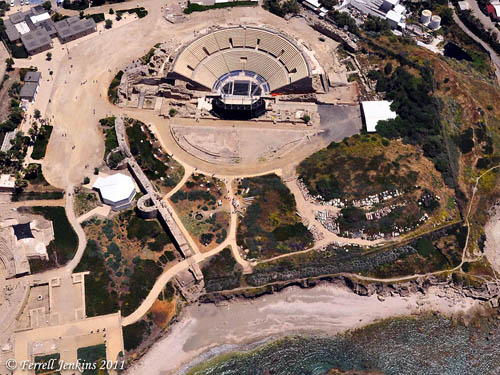
The theater at Caesarea Maritima was built originally by Herod the Great but was added to and modified in later centuries. The seating capacity in its final stage was about 4,000.

The first aerial photo shows the position of the theater (facing west) in relation to the Mediterranean Sea.

The theater at Caesarea Maritima on the Mediterranean. Photo by Ferrell Jenkins.

The theater at Caesarea Maritima on the Mediterranean. Photo by Ferrell Jenkins.

The next photo is an aerial closeup. Most of the seating has been restored since the excavation in the early 1960s.

The theater at Caesarea Maritima. View is South (bottom) to North (top). Photo by Ferrell Jenkins.

View of the theater South (bottom) to North (top). Photo by Ferrell Jenkins.

When we look at the theater from above it appears as a small piece of a model. Musical concerts are held in the restored theater.

King Herod Agrippa I (A.D. 37-44), the grandson of Herod the Great, visited Caesarea. In a dispute with the people of Tyre and Sidon, he put on his royal apparel and addressed them.

On an appointed day Herod, having put on his royal apparel, took his seat on the rostrum and began delivering an address to them. The people kept crying out, “The voice of a god and not of a man!”  And immediately an angel of the Lord struck him because he did not give God the glory, and he was eaten by worms and died. (Acts 12:21-23 NAU)

Josephus informs us that this speech took place in the theater (Ant. 19.344). The NET Bible study notes are helpful in explaining the differences between Luke’s account and that of Josephus. (Scroll down to Acts 12:23 for these notes.)

Josephus, Ant. 19.8.2 (19.343-352), states that Herod Agrippa I died at Caesarea in A.D. 44. The account by Josephus, while not identical to Luke’s account, is similar in many respects: On the second day of a festival, Herod Agrippa appeared in the theater with a robe made of silver. When it sparkled in the sun, the people cried out flatteries and declared him to be a god. The king, carried away by the flattery, saw an owl (an omen of death) sitting on a nearby rope, and immediately was struck with severe stomach pains. He was carried off to his house and died five days later. The two accounts can be reconciled without difficulty, since while Luke states that Herod was immediately struck down by an angel, his death could have come several days later. The mention of worms with death adds a humiliating note to the scene. The formerly powerful ruler had been thoroughly reduced to nothing (cf. Jdt 16:17 ; 2 Macc 9:9; cf. also Josephus, Ant. 17.6.5 [17.168–170], which details the sickness which led to Herod the Great’s death).

We have included two larger images suitable for use in teaching. Just click on the image.

Protecting Israel’s coastline

Last December we reported on damage to Israel’s Mediterranean coastline here (Ashkelon) and here (Caesarea). Now we learn, in an article by Karin Kloosterman, that Israel is spending lots of money to protect the eroding coastline.

A new government initiative worth $135 million will turn about 10 miles of stretches of the Israeli coast into a series of reinforcements and public parks to be enjoyed by locals and tourists. Some of the parks will run through archeological sites of interest.

Kloosterman’s article features the work of geological archaeologist Dr. Beverly Goodman, University of Haifa. Goodman explains the importance of the coastline.

“What we are looking at in Caesarea, on the coastal cliffs, is that we have areas where the coastline has changed so much – and we actually have antiquities that are being eroded into the sea.”

The article says,

Goodman had just finished recording details about the seafloor and archeological remains. After the storm, she returned to her underwater lab to find that some 80 percent of what she’d surveyed had been destroyed or washed away.

You may find a few humorous things in Kloostermann article.

Historically, Israel’s coastal area is important not only for today’s population. According to the Christian Gospels, the Apostle Peter was imprisoned in Caesarea after being arrested in Jerusalem, and an inscription bearing the Christian scriptural name Pontius Pilate was found here.

Our readers will know that it was Peter who first preached the gospel at Caesarea (Acts 10-11), but that it was Paul who was imprisoned at Caesarea (Acts 23-26).

Reporters do have deadlines! Otherwise, the article is fascinating and may be read here.

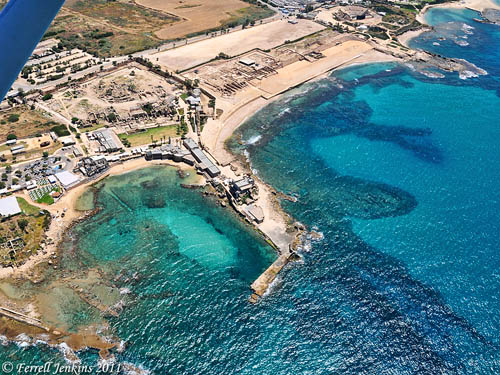
Our aerial photo, made May 11, shows the main part of Caesarea. The Herodian harbor is on the left. The hippodrome is in the upper center of the photo, and the Roman theater is to the extreme upper right.

Aerial view of Caesarea Maritima. Photo by Ferrell Jenkins.

Aerial view of Caesarea Maritima. Photo by Ferrell Jenkins.

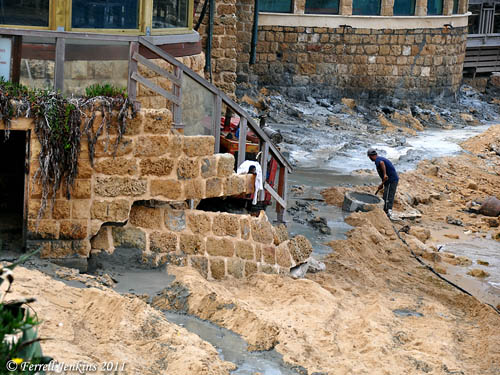
This photo, made April 28, shows some of the damage done to one of the old buildings at the ancient harbor.

Caesarea storm damage from December 2010. Photo by Ferrell Jenkins.

Caesarea storm damage from December 2010. Photo by Ferrell Jenkins.

HT: Joseph Lauer

Friday’s findings

Looking for Joshua’s Ai. Gary Byers, administrative director of the Khirbet el-Maqatir excavation, has already posted info on six days of the dig. Because I assume this series will continue, I suggest you begin with Day One here. The expedition has posted photos on Facebook here. This will give prospective diggers some idea what goes on during a dig. Information about the purpose of the dig, a project of the Associates for Biblical Research, is posted here. Dr. Bryant Wood, and others associated with this dig, are looking for an alternative site for Ai.

Hidden Pyramids. Dr. Zahi Hawass has called in question the BBC program about the work of Dr. Sarah Parcak using satellite imagery to discover 17 new pyramids and other structures.

Although satellite imaging is useful for discovering new sites and monuments, interpretation of the images is not straightforward. No one can say with certainty that the features displayed under the sand are actually pyramids. Such anomalies could be houses, tombs, temples, pyramids, buried cities or even geological features. The only way we can definitely identify what is there is by excavating it – by investigating it physically. This was not made clear in the article.

Read the complete article here. See our earlier report here.

Corinth Matters. David Pettegrew, assistant Professor of History at Messiah College near Harrisburg, PA., has started a blog called Corinth Matters. Pettegrew completed a dissertation on Corinth on the Isthmus. The new blog deals with the ancient city of Corinth, the Isthmus, the Diolkos, and other things Corinthian. You will find readings lists, links to conferences, info on excavations, maps and images relating to Corinth and the Corinthian correspondence.

Dr. Pettegrew currently is traveling in Albania, the location of ancient Illyricum, visiting Corinthian colonies from the pre-Christian period. Paul made reference to preaching as far as Illyricum.

by the power of miraculous signs and wonders, and by the power of God’s Spirit. As a result, I have fully proclaimed the good news about the Messiah from Jerusalem all the way around to Illyricum. (Romans 15:19 CSB)

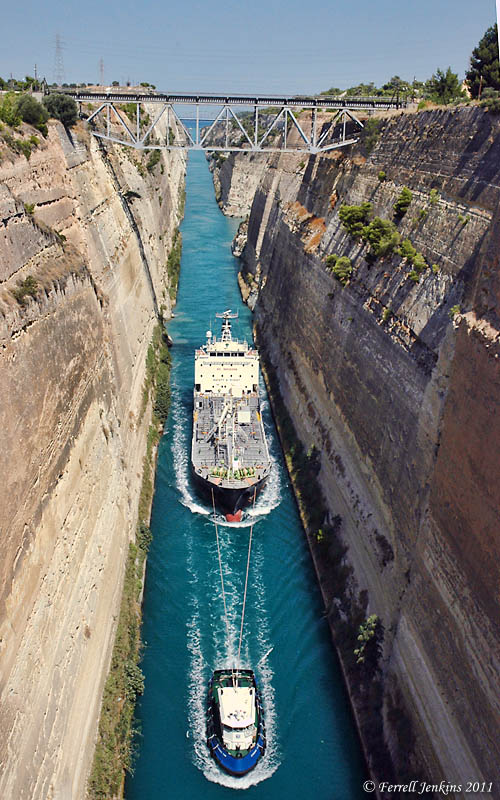
Corinth Canal - Photo by Ferrell Jenkins.

A ship is towed through the Corinth Canal. View west toward the Gulf of Corinth. Photo by Ferrell Jenkins.

Having taught the Corinthian correspondence for several year, I find this blog especially interesting.

The rocks of the wild goats (Ibex)

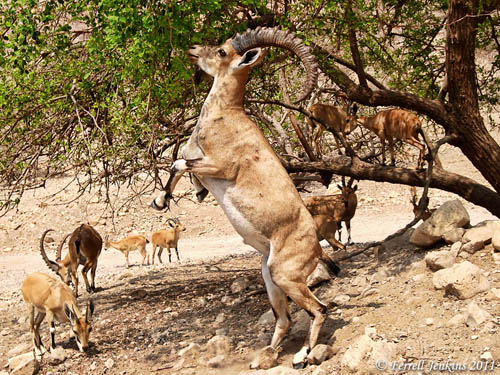
Wild goats (Hebrew ya’el) are mentioned in a few Old Testament passages (1 Samuel 24:2; Job 39:1; Psalm 104:18; Prov. 5:19). This animal is often identified with the Ibex.

The ibex, a type of wild goat, is still found in Southern Palestine, Sinai, Egypt and Arabia; it was known also in ancient times, as is evident from rock carvings. (Fauna and Flora of the Bible, 46).

The wild goats are associated with En Gedi on the shore of the Dead Sea.

Now when Saul returned from pursuing the Philistines, he was told, saying, “Behold, David is in the wilderness of Engedi.” Then Saul took three thousand chosen men from all Israel and went to seek David and his men in front of the Rocks of the Wild Goats. (1 Samuel 24:1-2 NAU)

Our photo below was made at En Gedi.

Ibex at En Gedi. Photo by Ferrell Jenkins.

Ibex at En Gedi. Photo by Ferrell Jenkins.

The Psalmist says the high mountains are for the wild goats.

The high mountains are for the wild goats; The cliffs are a refuge for the shephanim. (Psalm 104:18 NAU)

SourceFlix has put together a nice video showing the Wild Goats (Ibex) at En Gedi.

The Crags of the Wild Goats from SourceFlix on Vimeo.

HT: Dr. Claude Mariottini

Update: Yesterday worked on this post, with the intention of completing it this morning. Early today I had to go to the airport to take a loved one. When I returned I continued working on the post and published it. Just now I decided to check some other blogs. To my surprise, I see that Todd Bolen has posted some fascinating videos of the Ibex fighting. Check it here.

What is that expression about great minds?

Apollonoia (Tel Arsuf) and the Plain of Sharon

Apollonia is not mentioned in the Bible, but the site is significant in understanding the land of the Bible. The coastal plain from Tel Aviv north to Haifa is known as the Plain of Sharon. The pasture lands of Sharon were allotted to the tribe of Gad (1 Chronicles 5:16). The plain seems to be mentioned in the account of the healing of Aeneas by Peter at Lydda (the area of modern Lod). Word spread quickly to the residents of Lydda and Sharon.

There he found a man named Aeneas, bedridden for eight years, who was paralyzed.  And Peter said to him, “Aeneas, Jesus Christ heals you; rise and make your bed.” And immediately he rose.  And all the residents of Lydda and Sharon saw him, and they turned to the Lord. (Acts 9:33-35 ESV)

The city at Tel Arsuf was established by the Phoenicians and dedicated to Reshef, the Canaanite god of fire. The Greeks equated Reshef with Apollo and called the city Apollonia (Alon, Israel National Parks & Nature Reserves, 286).

Apollonia was important to the Crusaders near the close of the 12th century and the decades to follow when the Crusaders “established part of their kingdom in the coastal area of the Holy Land, without Jerusalem” (Alon, 287). The fortress and walls from 1241 A.D. are now part of the National Park.

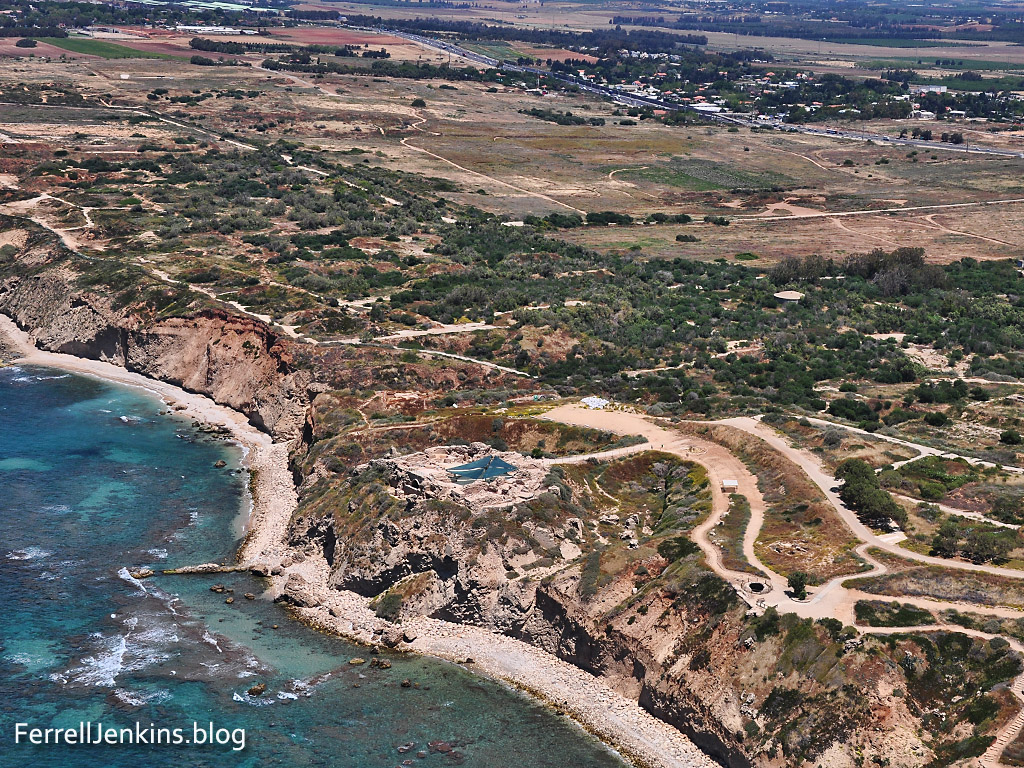
Our first photo shows the coastal plain of Sharon. Notice especially the kurkar ridge along the coast. Israel highway 2 may be seen a short distance inland. You will see Apollonia on the ridge overlooking the sea.

Aerial View of Apollonia and the Plain of Sharon. Photo by Ferrell Jenkins.

Aerial View of Apollonia and the Plain of Sharon. Photo by Ferrell Jenkins.

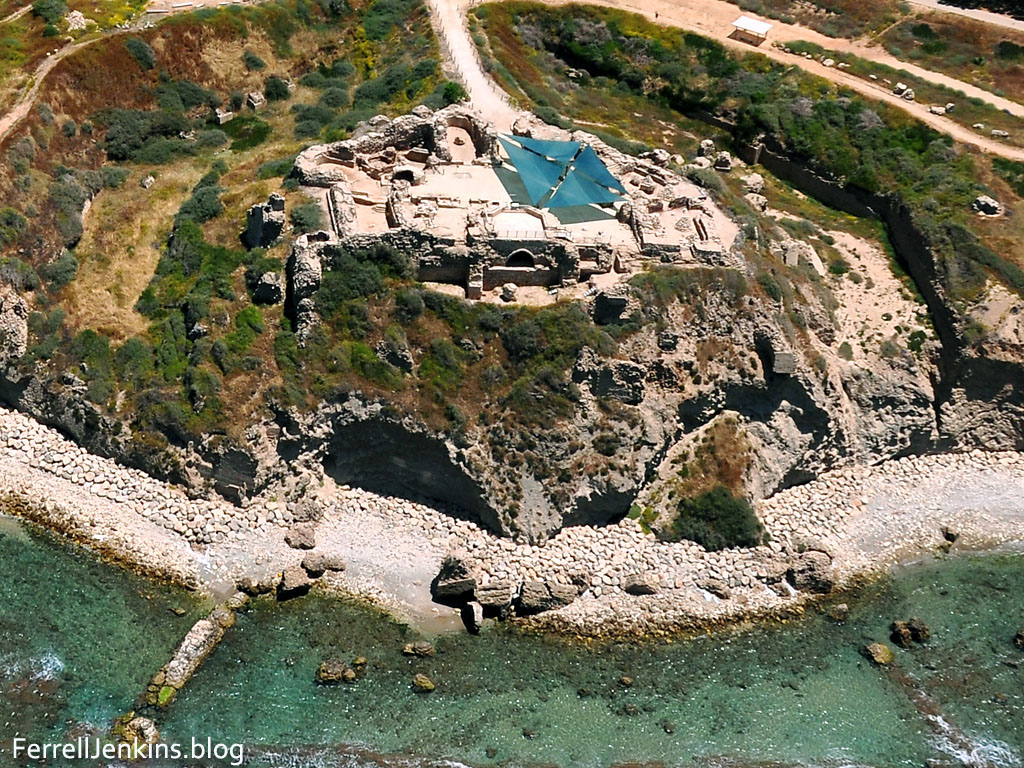
The second photo shows an aerial close up of the site of Tel Arsuf or Apollonia. This site is being damaged by the sea.

Aerial view of the Crusader fortress of Apollonia. Photo by Ferrell Jenkins.

Aerial view of the Crusader fortress of Apollonia. Photo by Ferrell Jenkins.

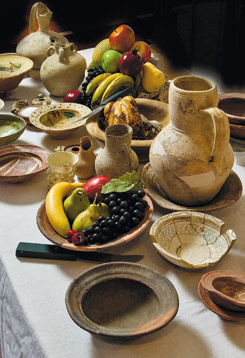
Ha’aretz English Language Edition Magazine reports on an exhibition at the Eretz Israel Museum, Tel Aviv, of the “Last Supper at Apollonia.”

Apollonia Final Supper of the Crusaders. Photo: Ha'aretz.

Apollonia Final Supper of the Crusaders exhibition. Photo: Ha’aretz, Leonid Pedrol.

The exhibition offers a first-time look at a collection of Crusader kitchen utensils. The Mameluke siege of the Crusader fortress began in late March 1265. Inhabitants of the area fled to the fortress.

During the few and far-between peaceful times in the Kingdom of Jerusalem, the fortress, built a generation earlier and leased to the Order of the Hospitallers just four years before its fall, was home to about 50 knights and their servants. At the start of the siege, which would go on for many bloody weeks, nearly 2,000 people were crammed into the fortress

Ronit Vered, author of the article, describes the siege.

During the five-week siege, more than 2,700 heavy boulders brought in from the Samaria hills were catapulted at the fortress walls. Some 1,200 iron-tipped arrows were fired at the defenders, and arrows wrapped in cloth and dipped in a flammable material were launched at the drawbridge and the heavy door, which was made of wood and bronze plates. The archers of the Order of the Hospitallers returned fire and even launched clay grenades filled with fiery materials at their enemies, but they had no defense against the tunnels dug by the Mamluks to undermine the wall’s foundations. On Thursday, April 29, the Mamluk fighters seized control of parts of the Arsur wall and raised their flag over it.

The Crusaders lost almost 1,000 men in the battle. Prof. Israel Roll led an excavation of the site in 1999. A cache of Crusader kitchen utensils were found. These are now exhibited for the first time at the Eretz Israel Museum.

The complete fascinating article may be read here. Larger images are available for those who may find them useful. Just click on the image above.

HT: Joseph I. Lauer

The Mediterranean coast along the Plain of Sharon

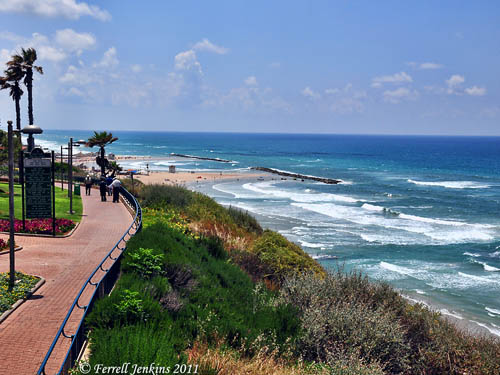
Today I am sharing a photo of the Mediterranean Sea made from the kurkar ridge of the Plain of Sharon at Netanya, Israel.

The Mediterranean Sea from the kurkar ridge at Netanya, Israel. Photo by Ferrell Jenkins.

The Mediterranean Sea from the kurkar ridge at Netanya, Israel. Photo by Ferrell Jenkins.

Biblical Israel was given the Great Sea as the western border of the promised land.

For the western border, you shall have the Great Sea and its coast. This shall be your western border. (Numbers 34:6 ESV)

In other texts the Mediterranean is simply called the western sea (Deuteronomy 11:24).

The sheep of His pasture

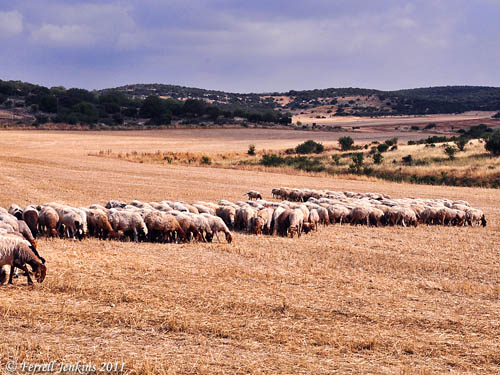
The photo we are sharing today is typical of the beautiful scenes in the Shephelah (lowland) of Israel in the spring (Obadiah 1:19). After the grain has been harvested the sheep are led by their shepherd into the fields to graze. The photo today shows the fields and hills between the Valley of Elah and Beit Guvrin to the east of Highway 38. This is near the entry to the Adullam Grove Nature Reserve and Horbat Midras.

Sheep grazing in the Shephelah. Photo by Ferrell Jenkins.

Sheep grazing in the Shephelah. Photo by Ferrell Jenkins.

Numerous biblical references come to mind. Note what the Psalmist said about the role of man in relation to the animals.

You have given him dominion over the works of your hands; you have put all things under his feet, all sheep and oxen, and also the beasts of the field, the birds of the heavens, and the fish of the sea, whatever passes along the paths of the seas. O LORD, our Lord, how majestic is your name in all the earth!  (Psalm 8:6-9 ESV)

Or, the reference to God’s people as the sheep of His pasture.

But we your people, the sheep of your pasture, will give thanks to you forever; from generation to generation we will recount your praise. (Psalm 79:13-1; cf. 100:3 ESV)

Or, perhaps the most familiar of all:

The LORD is my shepherd; I shall not want. (Psalm 23:1 ESV)

A hi-res photo suitable for use in teaching is available by clicking on the image. You can make your own caption across the sky or the grain field.

Archaeologist Sarah Parcak discovers lost pyramids and other antiquities in Egypt

UAB News (University of Alabama at Birmingham) announces a significant discovery by one of their professors.

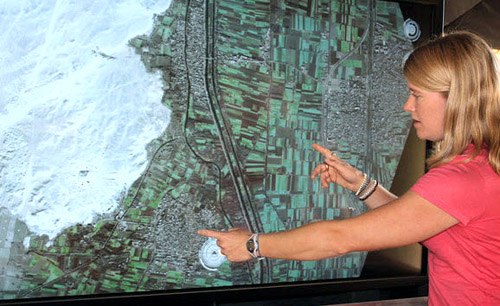
Sarah Parcak, Ph.D., an Egyptologist and assistant professor of archaeology at UAB, used infra-red satellite imaging to discover 17 lost pyramids as well as more than 1,000 tombs and 3,100 ancient settlements.

Dr. Sarah Parcak, UAB, discusses her recent discoveries in Egypt.

Dr. Sarah Parcak, UAB, discusses her recent discoveries in Egypt.

The discovery will be revealed in a BBC documentary next Monday. A different program will be aired on the Discovery Channel later this summer.

At Tanis … Parcak discovered an ancient network of streets and houses, which are completely invisible from the ground.

More information is available in the UAB News here.

Dr. Parcak is well known for her archaeological work and is a member of the American Schools of Oriental Research.

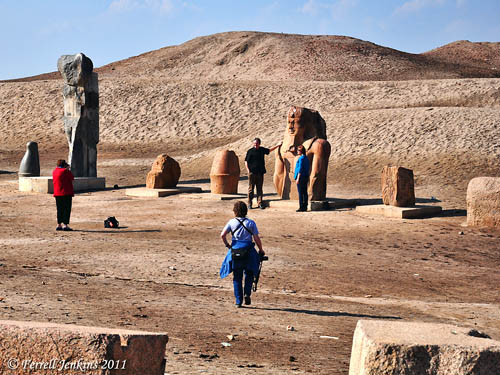
Tourists pose beside ancient monuments at Tanis. Photo by Ferrell Jenkins.

Tourists pose beside ancient monuments at Tanis. Photo by Ferrell Jenkins.

Here we see tourists posing beside the ancient monuments at Tanis. Imagine the complex of houses and streets that may be hidden under the tons of accumulated dirt.

Tanis, modern site of San el-Hagar,  is thought by some Egyptologists to correspond to the Zoan mentioned in several Old Testament references (Numbers 13:22; Psalm 78:12, 43). Kenneth Kitchen says the reference to Hebron being built seven years before Zoan

may indicate a refounding of Zoan in the Middle Kingdom (c. 2000-1800 B.C.), or more probably by the Hyksos kings in the 16th century B.C., whose N capital Avaris Zoan may possible be.” (The New Bible Dictionary, 3rd Ed., 1271)

The Cardo Maximus in Jerusalem

Reconstructing the Jerusalem of the time of Jesus and the Apostles is not as easy as one might think. We have little bits of evidence here and there in basements. I am thinking of the evidence of the pre-70 A.D. ruins such as the Burnt House and the Herodian Mansion. We also have the Herodian Temple Precinct walls, the Temple Mount steps and the street in the Tyropoeon Valley. (This is not intended as a complete list. Just suggestive.)

Some Roman ruins in Jerusalem date to the period after the Bar Kochba revolt in 135 A.D. One impressive site in the Jewish Quarter of the Old City is the Cardo. The Cardo Maximus was the main north-south street running from one end of the city to the other. An east-west street was called the Decumanus Maximus.

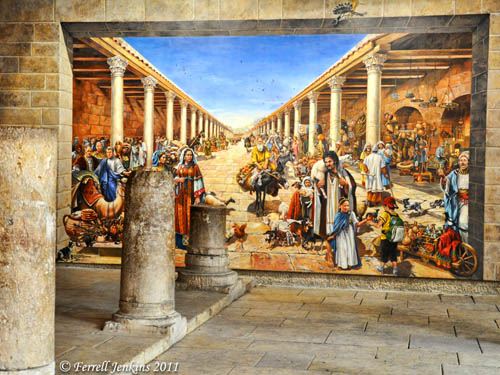
The Emperor Hadrian rebuilt Jerusalem and named it Aelia Capitolina. The photo below shows a portion of the Cardo of that city. We see paving stones and columns that ran along the length of the street. A mural has been placed at one portion of the street to illustrate typical life in the city at that time.

The Roman Cardo in Jerusalem. Photo by Ferrell Jenkins.

The Roman Cardo in Jerusalem. Photo by Ferrell Jenkins.

We are reminded of one of the many references Jesus made to the marketplace (Greek, agora).

And in his teaching he said, “Beware of the scribes, who like to walk around in long robes and like greetings in the marketplaces (Mark 12:38 ESV)

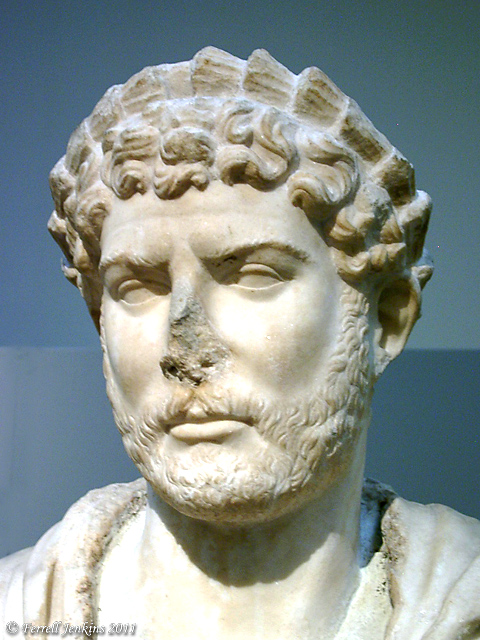
Hadrian was Roman Emperor from 117-138 A.D. Streets, arches, and gates were erected in his honor all over the Roman Empire during his reign. The photo below shows the head of a marble statue in the British Museum showing Hadrian in Greek dress. The statue comes from the Temple of Apollo at Cyrene in northern Africa (modern Libya).

Hadrian in Greek Dress. Temple of Apollo, Cyrene. British Museum. Photo by Ferrell Jenkins.

Hadrian in Greek Dress. Temple of Apollo, Cyrene. British Museum. Photo by Ferrell Jenkins.

A larger image of the Cardo scene suitable for use in teaching is available by clicking on the photo.