Category Archives: Bible Places

Approaching Gennesaret

The Sea of Galilee is called the “lake of Gennesaret” (Luke 5:1), and the “Sea of Tiberias” (John 6:1; 21:1). This indicates that both Tiberias, where Herod Antipas had built his capital in the mid-20s of the first century, and Gennesaret were significant places. When one traveled from Nazareth, Cana, or others places west of the Sea of Galilee, he would pass by Mount Arbel into the plain or land of Gennesaret.

This photo, taken on an unusually clear day, shows a small ship about to anchor at Nof Ginosaur (= Gennesaret). To the west we see Mount Arbel and the pass below allowing travel and commerce between lower Galilee and the towns around the Sea of Galilee.
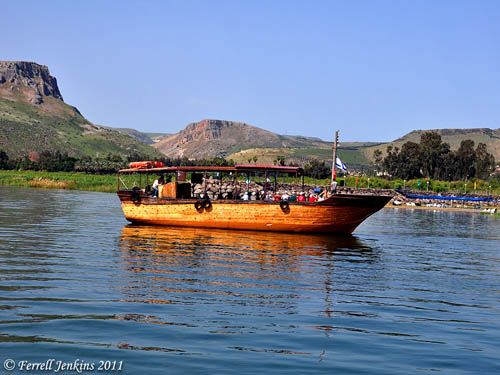
Boat approaches the land of Genessaret. Photo by Ferrell Jenkins.

Boat approaching the land of Gennesaret. Photo by Ferrell Jenkins.

The photo nicely illustrates the text of Mark 6.

When they had crossed over they came to land at Gennesaret, and moored to the shore. When they got out of the boat, immediately the people recognized Him, and ran about that whole country and began to carry here and there on their pallets those who were sick, to the place they heard He was. Wherever He entered villages, or cities, or countryside, they were laying the sick in the market places, and imploring Him that they might just touch the fringe of His cloak; and as many as touched it were being cured. (Mark 6:53-56 NAU. cf. Matthew 14:34-36)

The first disciples of Jesus were called by the lake of Gennesaret (Luke 5:1).
The Patriarchs lived in the Negev

English Bibles translate the Hebrew word negev in a variety of ways.

  • South — KJV; NKJV
  • “the South [country]” is the Translator’s Note in the NET Bible. A study note says, “Negev is the name for the southern desert region in the land of Canaan.”
  • Negeb — ESV
  • Negev — most modern English versions.
  • eremos — the word for desert or wilderness is used in the LXX. This word does not describe the Negev precisely enough.

I am away from home and most of my resources, but I recall hearing the late Anson Rainey describe the Negev like the figure 8. Turn the 8 horizontal with Beersheba in the center. The area is one that is often subject to drought and famine.

The Patriarchs, Abraham, Isaac, and Jacob spent much time in the Negev (Genesis 12:9; 13:1,3; 20:1; 24:62).

The Israelite spies were sent by Moses from the Sinai to investigate Canaan. The text makes it clear that they had to go through the Negev to get to the hill country and Hebron. Hebron is only about 25 miles north of Beersheba. Once we head south from Hebron we begin to notice a change from the hill country to a more dry clime.

When Moses sent them to investigate the land of Canaan, he told them, “Go up through the Negev, and then go up into the hill country (Numbers 13:17 NET)

When they went up through the Negev, they came to Hebron… (Numbers 13:22 NET)

The Canaanite king of Arad lived in the Negev (Numbers 21:1). Arad is located east of Beersheba as the land slopes down to the Dead Sea.

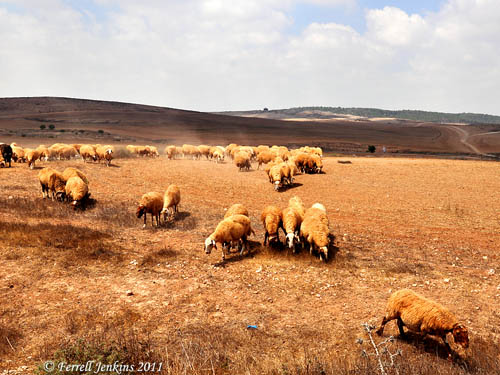
Our photo today was made a few miles north of Beersheba. I think it illustrates the typical dryness of the region.

Sheep in the Negev. Photo by Ferrell Jenkins.

Sheep in the Negev. Photo by Ferrell Jenkins.

Finally got the photo uploaded

I was unable to upload one of the photos about goats in the Sinai peninsula earlier. Finally got it uploaded. If you missed seeing the photo of the nanny goat caring for the newborn kid, please take a look now.

Goats in the Bible world

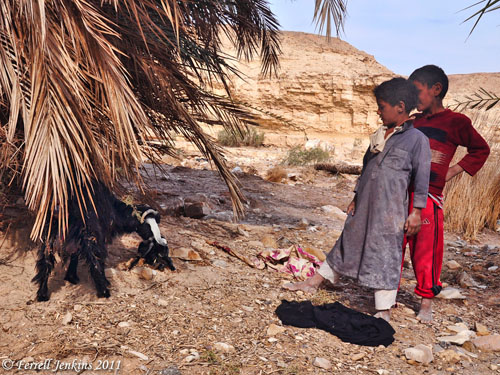
Travel in the Middle East provides many illustration similar to life in Bible times. We are more likely to see these illustrations where we have less modernization. The photos I wish to share today come from the Sinai peninsula. Last January we stopped at a Bedouin settlement on the way from the Suez Canal to Mount Sinai. Our timing was good. A goat had just given birth to a kid. While the nanny was keeping the kid moving around, two of the Bedouin boys were standing by keeping watch. Remembering my own childhood on a farm, I am sure the boys could hardly contain themselves from helping the kid. They had probably been told many times that it would be a big mistake to do so.

Bedouin boys keeping watch over a goat and newborn kid. Photo by Ferrell Jenkins.

Bedouin boys keeping watch over a goat and newborn kid. Photo by Ferrell Jenkins.

The earliest biblical reference to the goat is in Genesis 15:9, the account of Abraham’s sacrifice after the giving of the land covenant. A three year old female goat was among the animals offered. The LORD later commanded Israel to offer goats in their sacrifices.

This photo shows the nanny’s care for the still-wet newborn.

Mother goat cares for newborn kid in the Sinai Peninsula. Photo by Ferrell Jenkins.

Mother goat cares for newborn kid in the Sinai Peninsula. Photo by Ferrell Jenkins.

Goats were used for food. In Rachel’s attempt to have Isaac bless Jacob she prepared “delicious food” for Isaac.

Now therefore, my son, obey my voice as I command you. Go to the flock and bring me two good young goats, so that I may prepare from them delicious food for your father, such as he loves. And you shall bring it to your father to eat, so that he may bless you before he dies. (Genesis 27:8-10 ESV)

Goats’ hair and goatskins were used In the construction of the Tabernacle (Exodus 25:4-5 et al.).

The goat was among the clean animals that could be eaten (Deuteronomy 14:4).

One of the wise sayings of Solomon mentions goats’ milk for food.

There will be enough goats’ milk for your food, for the food of your household and maintenance for your girls. (Proverbs 27:27 ESV).

Photos that are worth 1000 words each

Photos can be used effectively to illustrate Bible lands and customs. Otherwise dull presentations can come to life with the use and explanation of appropriate photos.

Pictorial Library of Bible Lands. We have suggested frequently that every Bible teacher needs access to Todd Bolen’s Pictorial Library of Bible Lands. Todd publishes a Newsletter every few months in which he gives away a few excellent photos already in PowerPoint format. If you don’t receive the Newsletter I suggest you download the November issue here. It contains several panoramic photos that give you the opportunity to see and understand a lot at once. And while you are there you should sign up to receive the Newsletter when it is published. Also take a look at the BiblePlaces Blog and the BiblePlaces.com web site. See also LifeintheHolyLand.com. BiblePaces is now availabe in French at BibleLieux.com and Spanish at LugaresBiblicos.com.

Holy Land Photos. Carl G. Rasmussen, author of the revised Zondervan Atlas of the Bible, is now posting the photos used in the Atlas at his Holy Land Photos site. Begin here. You will find thousands of useful photos at this site. These photos will be especially helpful to those seeking to teach Bible geography or to incorporate geographical information into lessons. These photos are in PowerPoint format. You also need the have and study the Atlas. Also check the HolyLandPhotosBlog for more recent photos and updates.

Order the Zondervan Atlas of the Bible from Amazon (currently $26.12).

David Padfield has a large number of photos of Bible lands available for free download here. Thanks to these men who have devoted much time and money to acquiring the photos and preparing them for others to use. I have used the work of all three in my presentations in recent years.

New religious finds from Khirbet Qeiyafa

Luke Chandler shares some photos sent to him by Prof. Yossi Garfinkel. Luke says,

Yossi Garfinkel recently presented finds from a cultic room unearthed at Khirbet Qeiyafa in 2010. He sent me some photos for this blog just before his presentation in Jerusalem. They are shown here with his permission.

Luke gives his own summary of what is currently known of Khirbet Qeiyafa.

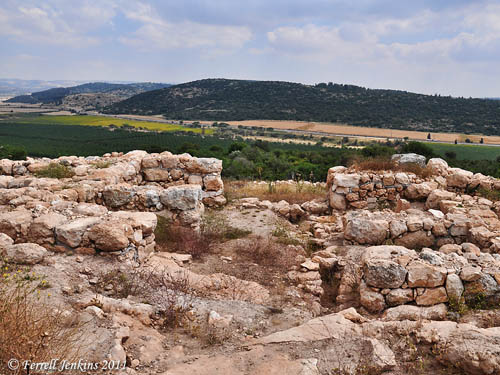
It was a planned fortress city constructed around the beginning of the 10th century B.C. – the time of David’s monarchy in the Bible. It sits at the border of ancient Judah and Philistia along the Elah Valley, where David fought Goliath in 1 Samuel 17.

Chandler then enumerates a summary of six reasons why the site should be considered part of Judah.

Read Luke Chandler’s Blog and see Prof. Garfinkel’s photos here.

View SE over Valley of Elah toward Socoh from Kh. Qeiyafa. Photo by Ferrell Jenkins.

View SE over Valley of Elah toward Socoh from Kh. Qeiyafa. Photo by Ferrell Jenkins.

I prepared the above material Saturday evening with the intention of posting it on Sunday morning. It was a bit surprising this morning to note that Joseph Lauer calls attention to Luke’s blog. He does so as a foreword to an article in the Huffington Post here by Douglas Knight and Amy-Jill Levine. If you have wondered how liberal scholars deal with biblical history, this is your opportunity to see.

“Tischendorf was an honorable man and not a thief!”

If you have an interest in learning the “other side” of the Tischendorf-Sinaiticus matter, I suggest you read the English article from The Art Newspaper here.

What follows below is the comment left by Alexander Schick yesterday. I found it in my spam this morning and have marked it as approved. So far it has not shown up among the comments. I wanted to share this info with our readers, so I have elevated it to a blog entry. I knew there was controversy over the matter. Schick’s mother tongue is German. I have corrected spelling of a few words, but otherwise left the comment as I received it. In my post of yesterday I was telling about the letter posted at Saint Catherine’s. Here is the “other side” of the story. Our thanks to Schick for this information.

— • —

Alexander Schick (responsible for the edition of the Tischendof letters still in posession of the Tischendorf-family)

Your comment about Tischendorf”s letter at St. Catherine monastery. The letter and the explanation of the monks must be seen in a total new light!

The new discovery of the documents related to the Codex Sinaiticus in the archives of the Russian foreign ministry was a big surprise! Scholars hoped, that these documents could appear [be]cause of the international digital-project. A scholar-dream comes true! These donation documents which show, that the Codex Sinaticus was given by the monks as a gift to Alexander II. you can find online with pictures and translations http://www.nlr.ru/eng/exib/CodexSinaiticus/zah/

Worth to study! Everyone can now see, that Tischendorf was an honorable man and not a thief!

You can also find inline the letter of guarantee by Prince A. B. Lobanov-Rostovsky to Archbishop and the community of Mt Sinai Monastery,
from 10th September 1859, which was part of the agreement in Tischendorf’s receipt. See here the picture:
http://www.nlr.ru/eng/exib/CodexSinaiticus/zah/1_1.html

Working on the letters of Tischendorf (still in the possession of the Tischendorf-Family) shows also: it was a difficult donation but it was correct done! Hopefully all the letters of Tischendorf can be published in the near future for the scholarly world. Alexander Schick

http://www.bibelausstellung.de
See the section about Tischendorf here:
http://bibelausstellung.eduxx-irs.de/home/abteilung_05b.php
Read also this article:
http://www.theartnewspaper.com/articles/Key-document-on-Codex-Sinaiticus-discovered/20216

— • —

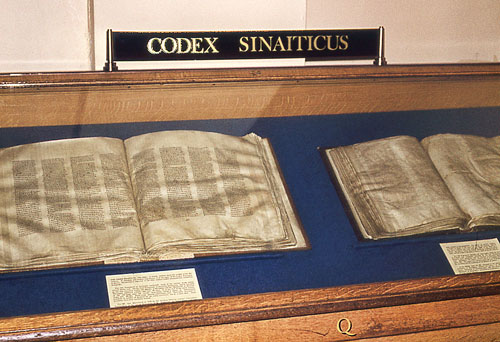
The photo below is from a slide I made at the British Museum in 1976. It shows Codex Sinaiticus and Codex Alexandrinus in a display case at the Museum. The manuscripts are now in the new British Library near the King’s Cross tube station.

Codex Sinaiticus and Codex Alexandrinus displayed in the British Museum in 1976. Photo by Ferrell Jenkins.

Codex Sinaiticus (left) and Codex Alexandrinus (right) displayed in the British Museum in 1976. Photo by Ferrell Jenkins.

The “Burning Bush” in Saint Catherine’s Monastery

Bible students are familiar with the Exodus account of Moses and the burning bush. Note these verses.

Now Moses was keeping the flock of his father-in-law, Jethro, the priest of Midian, and he led his flock to the west side of the wilderness and came to Horeb, the mountain of God.  2 And the angel of the LORD appeared to him in a flame of fire out of the midst of a bush. He looked, and behold, the bush was burning, yet it was not consumed.  3 And Moses said, “I will turn aside to see this great sight, why the bush is not burned.”  4 When the LORD saw that he turned aside to see, God called to him out of the bush, “Moses, Moses!” And he said, “Here I am.”  5 Then he said, “Do not come near; take your sandals off your feet, for the place on which you are standing is holy ground.”  (Exodus 3:1-5 ESV)

There are later biblical references to this event. Deuteronomy 33:16 speaks of “Him who dwelt in the bush.” Jesus called attention to the account in his answer to the questions about the resurrection.

And as for the dead being raised, have you not read in the book of Moses, in the passage about the bush, how God spoke to him, saying, ‘I am the God of Abraham, and the God of Isaac, and the God of Jacob’? (Mark 12:25 ESV)

Both Mark and Luke use the Greek term batos for the bush. This word describes a thorn bush or a bramble bush. Luke’s account of Stephen’s speech also mentions the “burning thorn bush” (Acts 7:30, 35). Josephus also refers to a “thorn bush” (Ant. 2:266).

for a fire fed upon a thornbush, yet did the green leaves and the flowers continue untouched, and the fire did not at all consume the fruit branches, although the flame was great and fierce.

From this event follows the commissioning of Moses to go to Pharaoh to bring God’s people out of oppression in Egypt. When Moses has brought the people out of Egypt he is to “serve God on this mountain” (Exodus 3:12).

Brown-Driver-Briggs define the Hebrew word seneh as “a thorn bush, perh. black-berry bush.”

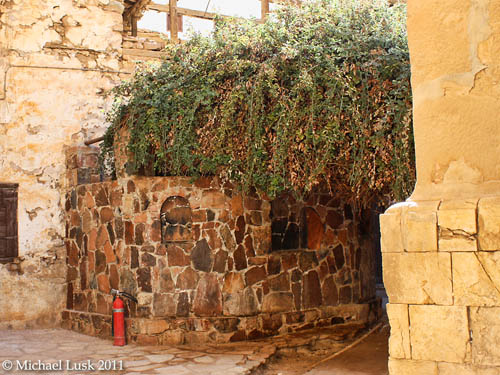
Another of the traditions associated with Saint Catherine’s Monastery is the burning bush. I am using another of the photos by Michael Lusk. Our visit to the Monastery was in the morning — a time when the lighting was bad for a photo of this bush. Michael went a little later than I did and his phot0 is better. I think the fire extinguisher is a nice touch.

The "burning bush" in Saint Catherine's Monastery. Photo by Michael Lusk.

The "burning bush" in Saint Catherine's Monastery. Photo by Michael Lusk.

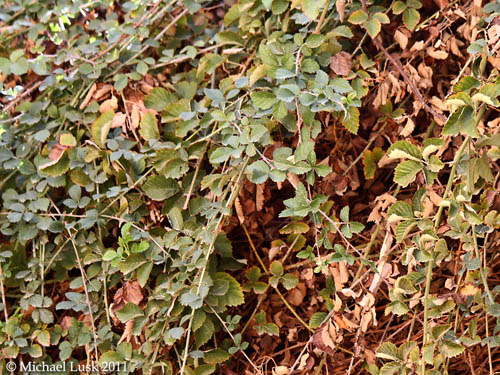
I have no idea about the specific kind of bush mentioned in Exodus. Here is a close up of the bush in Saint Catherine’s Monastery. A careful look reveals that this bush has small thorns on it.

Close up of "burning bush" in St. Catherine's Monastery. Photo by Michael Lusk.

Close up of "burning bush" in St. Catherine's Monastery. Photo by Michael Lusk.

The “Well of Moses” at Saint Catherine’s Monastery

In addition to the unique setting deep in the granite mountains of the Sinai peninsula, Saint Catherine’s Monastery is significant because it marks some important traditions relating to biblical characters and events. Geographers and other scholars make numerous suggestions for the location of Mount Sinai where the law was given to Moses and Israel. I am not entering that discussion at the moment, but am writing about the traditions associated with Saint Catherine’s Monastery.

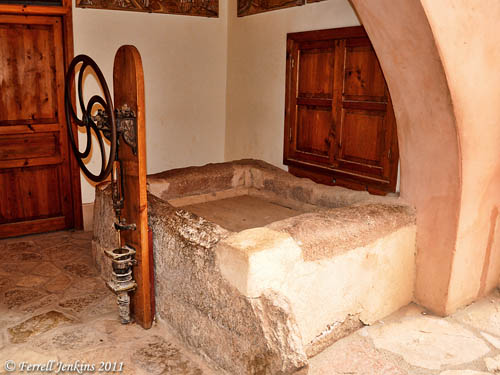
The well pictured below is shown as the Well of Moses and related to the biblical event described in Exodus.

When Pharaoh heard of it, he sought to kill Moses. But Moses fled from Pharaoh and stayed in the land of Midian. And he sat down by a well. Now the priest of Midian had seven daughters, and they came and drew water and filled the troughs to water their father’s flock. The shepherds came and drove them away, but Moses stood up and saved them, and watered their flock. (Exodus 2:15-17 ESV)

Moses Well at Saint Catherine's Monastery. Photo by Ferrell Jenkins.

Moses Well at Saint Catherine's Monastery. Photo by Ferrell Jenkins.

R. Alan Cole says the location of the land of Midian is uncertain, but that it could be somewhere in the Sinai peninsula.

The location is quite uncertain, but clearly it was somewhere beyond the Egyptian frontierposts, and to the east. Somewhere in the Sinai peninsula, or the Arabah (the area south of the Dead Sea), or that part of Arabia east of the gulf of Aqaba, would suit. (Cole, R. A. (1973). Vol. 2: Exodus: An introduction and commentary. Tyndale Old Testament Commentaries (66). Downers Grove, IL: InterVarsity Press.)

We have no way to know with certainty that Moses was at this specific place. The best we can say is that he may have been here.

Saint Catherine’s Monastery

The Monastery of St. Catherine is located at an altitude of about 4925 feet in the Wadi el-Deir at the foot of Gebel Musa. Tradition identifies this as the site where Moses tended the flocks of Jethro and saw the burning bush (Ex. 3:1-4:17). The Monastery was built near the middle of the sixth century A.D. during the reign of the emperor Justinian. It is dedicated to Saint Catherine of Alexandria and is the oldest continuously inhabited monastery in the Christian world. Through the centuries many monks have lived there; today it houses fewer than a dozen Greek Orthodox monks. The monastery became a great center of over 3000 old manuscripts and over 2000 icons. Only the Vatican library has more manuscripts.

Here is a new photo of the Monastery that I made in January.

View of St. Catherine's Monastery. Photo by Ferrell Jenkins 2011.

View of St. Catherine's Monastery. Photo by Ferrell Jenkins 2011.

The bedouin who work at the Monastery are called Jabaliye (Arabic for People of the Mountain).

“According to their tradition they are descendants of Christian slaves who were brought here by Emperor Justinian from Wallachia, today Rumania [Romania], as builders of the monastery and later its guards. In the course of time, when Sinai came under strict Moslem rule they were compelled to embrace Islam” (Vilnay, The Guide to Israel, 564).

There is a mosque within the monastery walls.