Category Archives: Bible Places

New Bible software map program

Scott Richardson, of Impressive Image Impressions, has released the third is his Discovering … series of Bible software. The first two are Discovering… Churches of the New Testament and Discovering… Kings of the Divided Monarchy. The new one is entitled Discovering… Lands and Places of the Bible (usable in both Windows and Mac). Maps cover all periods of the Bible in PDF and PNG format. These are suitable for use in presentations or printing for class.

The program includes a “Build-a-Map” feature for those who wish to edit maps for special purposes.

For detailed study involving the terrain these maps are lacking. With that said, I suspect that most preachers or teachers who use Bible maps in their presentations will find these adequate.

A Quicktime video shows the features of each program. The online store is temporarily down, but you may contact Scott by calling 1-800-762-4843.

The sacred standing stone at Shechem

Robert J. Bull, in a 1960 article in Biblical Archaeologist, tells the story of the earlier discovery of the sacred standing stone that still stands in the courtyard of the temple of Baal-Berith at Shechem.

“Sellin records that the altar base, when uncovered in 1926, was 2.20 meters long and 1.65 meters wide. Today there remain only a few stones arranged in an irregular pattern roughly 1 by 1 1/2 meters in extent. A large hollowed-out stone base and a broken piece of hard white limestone were uncovered by Sellin just southeast of the altar. The hollow in the base was 40 centimeters deep, and measured 45 cms. in width and 1.65 meters in length, while the limestone slab was 1.45 meters by 40 cms., and stood 1.65 meters in height. Since the limestone slab would fit into the base neatly; Sellin concluded he had found the main standing-stone or maṣṣebah of the city. A story which I am not able to confirm relates that Dr. Aage Schmidt, visiting the tell during a temporary absence of Sellin, came upon one of the workmen breaking up the limestone slab with a maul and prevailed upon him to cease until Sellin could be summoned!

Thus it was that some portion of the maṣṣebah was saved. In 1956, the Drew-McCormick Expedition found the socket and slab cast down from the bank of altar fill into the palace area some 6 meters below. One end of the base had been broken off, so that only an open ended niche remained, four-fifths of the original length. Of the maṣṣebah, only 1.45 meters of its original height remained on one side and only 62 cms. on the other. With great effort, a team of workers tugged and hauled these massively heavy stones back up onto the forecourt of the temple, securing the standing stone in its original base with cement. Once again the maṣṣebah dominates the area from a point where it probably stood originally, at least from what we can learn from the drawings and photographs in the Sellin and Welter reports” (Robert J. Bull, Biblical Archaeologist : Vol. 23 1-4, electronic ed. (American Schools of Oriental Research, 2001, c1960).

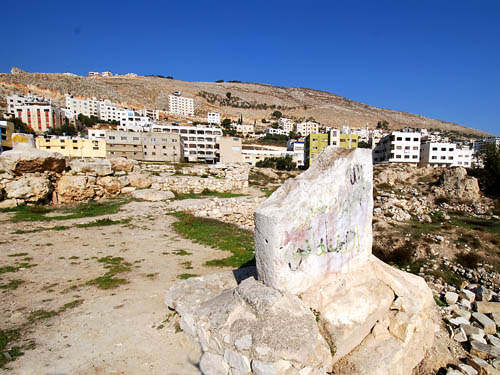
The broken sacred standing stone (massebah) stands in the courtyard in front of the entrance to the Temple of Baal-Berith. The near-barren Mount Ebal, where the curses of the law were read (Deuteronomy 27); Joshua 8:30-33), is visible to the north.

The sacred standing stone at Shechem. Photo by Ferrell Jenkins.

The sacred standing stone at Shechem. Photo by Ferrell Jenkins.

Dr. Bryant Wood says,

Since the temple existed in Joshua’s day, it is possible this was the “large stone” he set up “under the oak that was by the sanctuary of the Lord” at Shechem (Josh. 24:26). The stela is undoubtedly the “pillar” where Abimelech was made king (v. 6)” (Bryant Wood. “From Ramesses to Shiloh.” Giving the Sense. Kregel, 2003).

The entrance to the temple of Baal-Berith

Edward F. Campbell, in a report on the 1960 excavation at Shechem, tells about Sellin’s discovery more than three decades earlier.

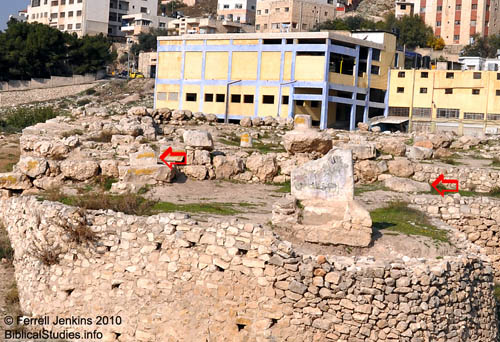
“While this work was underway, he found time to study some stones in the court before the temple. On each side of the door there was a large stone block, one of them nearly 4M ft. long, the other nearly 6 ft. long. Both had long depressions cut into their tops, and Sellin had first thought that they were watering troughs—though how such small depressions could have served any such purpose in front of the temple is difficult to imagine. Directly in front of the door in the courtyard to the southeast was a much larger stone with a similar though much deeper and wider trough, which also had been interpreted as a receptacle for water. Now, however, Sellin took note of a large, flat stone with rounded sides lying nearby. Though broken and much of it gone the reminder is still over 5 ft. high, some 4M ft. wide and 1 m ft. thick. Experiment showed that the smooth flat stone had been made to stand up in the trough, so Sellin put the two together. Two more flat stones were found to fit together in the left (southwestern) stone base beside the temple door. Sellin concluded that these three could only be installations of sacred standing stones that once framed the temple entrance—stones that in Old Testament Hebrew are called massebot” (Biblical Archaeologist: Vol. 20 1-4, electronic ed. (American Schools of Oriental Research).

The stone bases on either side of the entrance to the temple are visible today, and marked here by the red arrows. The base on the left has the broken sacred standing stone in place.

Courtyard and entrance to temple of Baal-Berith. Photo by F. Jenkins.

Notice the courtyard in front of the temple entrance. In a future post we will report how the largest standing stone was almost destroyed.

The temple of Baal-Berith at Shechem

The book of Judges describes the situation at Shechem after the death of Gideon.

After Gideon died, the Israelites again prostituted themselves to the Baals. They made Baal-Berith their god. (Judges 8:33 NET)

Abimelech, the son of Gideon was such a desperate politician that he took money from the Shechemites from the temple of Baal-Berith (Judges 9:4). Dr. Bryant Wood describes the temple of Baal-Berith.

References to the “house of Baal-berith” (v. 4), “Beth-millo” (v. 6,20), “house of their god” (v. 27), “tower of Shechem” (vv. 46,47,49), and “temple of El-berith” (v. 46), all appear to be the same structure at Shechem. Berit is the Hebrew word for covenant, so the temple was for “Baal of the covenant.”

A large fortress (or Migdal) temple discovered on the acropolis of Shechem has been identified as the temple of Judges 9. It was  constructed in the seventeenth century B.C. and lasted until the destruction of the city by Abimelech in the twelfth century B.C. The largest temple yet found in Canaan, it measures 21.2 x 26.3 m, and has foundations 5.1 m thick that supported a multistoried superstructure of mud bricks and timber. On the east, two towers containing stairwells to the upper stories flanked the entrance. Inside, two rows of columns, three in each row, divided the space into a nave and two side aisles (cf. vv. 46-49)” (Bryant Wood. “From Ramesses to Shiloh.” Giving the Sense. Kregel, 2003).

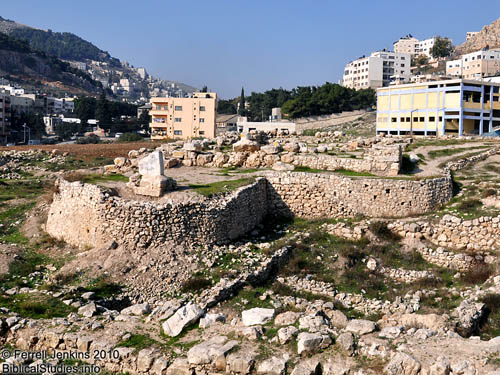
The photo shows the foundation of the Temple of Baal-Berith at Shechem. This structure was brought to light in the

Temple of Baal-Berith in center of photo. Ebal in distance. Photo by F. Jenkins.

Temple of Baal-Berith in center of photo. Gerizim (L) & Ebal (R). Photo by F. Jenkins.

G. Ernest Wright says, “Before 1903 biblical geographers all thought that Shechem was once located where the modern city of Nablus is.” They associated the Roman city of Neapolis with Nablus. The German scholar Herman Thiersch found the walls of “old Shechem” June 26, 1903. He said, “The place is somewhat under cultivation with vegetables and seed-crops.” (G. Ernest Wright, Biblical Archaeologist: Vol. 20 1-4, electronic ed. (Philadelphia: American Schools of Oriental Research, 2001, c1957). This site is identified with the mound of Tell Balata.

The first excavations at Shechem were conducted by Prof. Ernst Sellin in 1913 and 1914. More extensive excavations took place between 1926-1928.

Shechem in biblical history

Tell Balata (Shechem) was excavated by Germans working periodically between 1907 and 1934. In 1956, G. Ernest Wright led the Drew-McCormick Expedition. Work continued in 1969 under the direction of Edward F. Campbell.
I had the privilege of visiting the ruins of Shechem last December. At the time I thought how sad to see such an important site neglected. Shechem is important in biblical history. Some of the significant events associated with the city are listed below.
  • Shechem is the first city of Canaan mentioned in the Bible. The land promise to Abraham was restated here (Genesis 12:6-7).
  • Jacob and his family settled at Shechem (Genesis 33:18). Jacob purchased a parcel of ground and erected an altar here.
  • Joseph’s brothers had gone from Bethlehem to near Shechem to graze their flocks (Genesis 37:12-13).
  • After entering Canaan, the Israelites gathered at Shechem on Mount Gerizim and Mount Ebal to hear Joshua read the blessings and cures of the Law (Joshua 8:30-34; cf. Deuteronomy 28-30).
  • Shechem was within the territory of Ephraim and served as a city of refuge (Joshua 20:7; 21:21).
  • Joseph was buried in a parcel of ground bought by Jacob (Joshua 24:32).
  • The Shechemites supported Abimelech in his bid to be ruler and gave him money from their temple of Baal-berith (Judges 8:33; 9). Jotham’s addressed the people of Shechem from Mount Gerizim with a fable (Judges 9:7ff.).
  • After the Exile, Shechem became a major religious center of the Samaritans. Their temple was built on Mount Gerizim (John 4:20-21).
  • Jesus visited Jacob’s Well near Shechem (John 4).

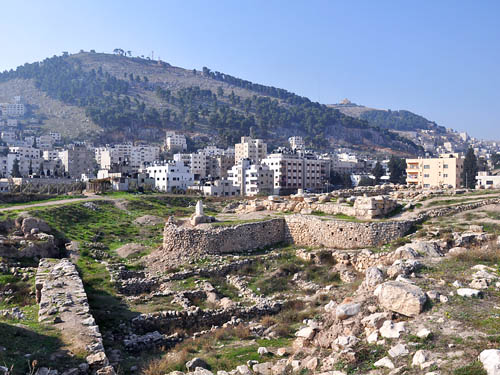
The photo below shows the excavated ruins of Tell Balata (Shechem). Mount Gerizim is on the left (to the south). Mount Ebal is on the right (to the North). The view is toward the west. The modern Arab town of Nablus is in the valley between these two mountains.

Shechem in the valley between Mount Gerizim & Mount Ebal.

Shechem — in the valley between Mount Gerizim and Mount Ebal.

Palestinian archaeology gets a boost at Shechem

Ha’aretz reports that the Dutch government has donated 300,000 euros (about $408,000) to the Palestinian Authority to finance the excavation and conservation of Tell Balata in Nablus. This is the biblical city of Shechem. The full account is here.

The site, according to the Ma’an report, is listed by UNESCO in the Inventory of Cultural and Natural Heritage Sites of Potential Outstanding Universal Value in Palestine, with experts estimating some of its towers and buildings from the Chalcolithic and Bronze Age dating back 5,000 years.
The Netherlands’ representative to the PA, Jack Twiss Quarles van Ufford, said the initiate was meant to bolster PA Prime Minster Salam Fayyad’s plan to work toward a unilateral declaration of Palestinian by 2011.
“The creation of institutions can only be sustainable if it goes hand in hand with the strengthening of the cultural identity of the Palestinian people,” Twiss told Ma’an, adding that “sites like Tell Balata are simply too important to be neglected.”
The photo shows the previously excavated ruins of Tell Balata (Shechem) in the valley below Mount Gerizim.
Ruins of Tell Balata (Shechem) below Mount Gerizim. Photo by Ferrell Jenkins.

Ruins of Tell Balata (Shechem) below Mount Gerizim. Photo by Ferrell Jenkins.

In the next post we will note the importance of Shechem in biblical history.

HT: Joseph I. Lauer

Todd Bolen’s Bible Places Newsletter

The February issue of the Bible Places Newsletter has been released. If you do not receive the Newsletter, I suggest you check it now (here). When you reach the bottom of the page you will see a link that allows you to subscribe.

The current issue of the Newsletter features photo from the Early 20th-Century History, the seventh volume in The American Colony and Eric Matson Collection. You will be able to download a PowerPoint presentation featuring these historic photos.

The entire album of more than 400 historic photos is available at the discounted price of $15. The entire 8-volume collection is on sale for $99. This is a great and important collection. Read about it at Life in the Holy Land.

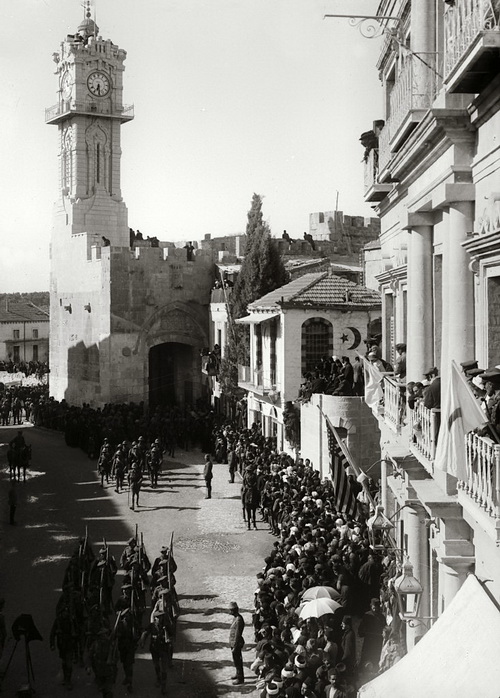
Palestine was under the control of the Turkish Ottoman Empire from 1517 to 1917. The photo below shows General Allenby and the British troops entering Jerusalem through the Jaffa Gate, Dec. 11, 1917.

General Allenby enters Jerusalem through Jaffa Gate - 1917.

General Allenby enters Jerusalem through Jaffa Gate - 1917.

Manatees and Rock Badgers

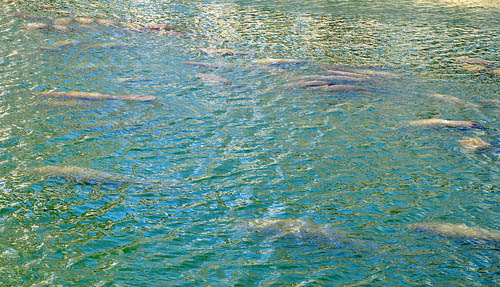
Tuesday we took our 5-year-old grandson to the Manatee Viewing Center on Tampa Bay (Gulf of Mexico). Our local electric power company (TECO) has provided excellent walkways that allow visitors to see the Manatees who come during the winter months to enjoy the warm water discharged from the power plant.

Manatees at the TECO Manatee Viewing Area. Photo by Ferrell Jenkins.

Manatees at the TECO Manatee Viewing Center. Photo by Ferrell Jenkins.

Our grandson enjoyed the visit, especially when he saw a large number of the Manatees moving about in the water. Well, he enjoyed turning $1.53 into three smashed pennies, too. In the learning center there are several exhibits of interest both to children and adults.

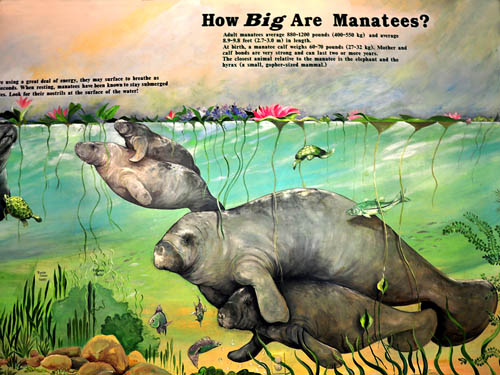
How Big Are Manatees? Photo by Ferrell Jenkins.

How Big Are Manatees? Photo by Ferrell Jenkins.

How Big Are Manatees? The poster says that adult manatees average 880-1220 pounds and are 8-9 feet long. The last statement under the question is this:

“The closest animal relative to the manatee is the elephant and the hydrax (a small gopher-size mammal.”

You may have wondered how I could relate this visit to traveling in the Bible lands. Well, here it is.

The hydrax is identified with the shaphan of the Hebrew Bible. English translations use some of the following terms:

  • hydrax (CSB)
  • shephan (NAU)
  • rock badgers (NET; ESV; NKJ). The NET notes say this is the Syrian Hydrax.
  • badgers (RSV)
  • conies (KJV; ASV); coneys (NIV)

Fauna and Flora of the Bible identifies this animal as the Syrian Coney (Procavia syriacus).

The rock badger lives among rocks from the Dead Sea valley to Mt. Hermon.

One of the best places to see the rock badgers is at En Gedi on the west shore of the Dead Sea.

Rock Badger at EnGedi. Photo by Ferrell Jenkins.

Rock Badger at EnGedi. Photo by Ferrell Jenkins.

The Rock Badger is mentioned in the book of Proverbs among things that are small, but exceedingly wise. There is a great lesson here. Even though they are not mighty, they build their homes in secure places. This is similar to the teaching of Jesus in Matthew 7:24-25. Notice the reading of  Proverbs 30:26 in a few of the English translations:

The shephanim are not mighty people, Yet they make their houses in the rocks; (NAU)

rock badgers are creatures with little power, but they make their homes in the crags; (NET)

the rock badgers are a people not mighty, yet they make their homes in the cliffs; (ESV)

hyraxes are not a mighty people, yet they make their homes in the cliffs; (CSB)

First Temple Period gate and wall

The headline writers are going wild. Arutz Sheva says, “Dig Supports Biblical Account of King Solomon’s Construction” here. The article includes a short video featuring Dr. Eilat Mazar at the site here.

The Associated Press article is headed “Archaeologist Sees Proof For Bible In Ancient Wall” here. The AP headline at Yahoo News reads, “Archaeologist sees proof for Bible in ancient wall,” here.

The news release from the Israel Ministry of Foreign Affairs reads, “Jerusalem city wall from 10th century B.C.E. uncovered,” here.

A good report in the Trumpet (here) reads, “Solomonic Wall Discovered in Jerusalem.”

Dr. Eilat Mazar, of Hebrew University, has been working for several years in the City of David excavation. For the past three months she has been working in the area north of the City of David next to the street that runs along the south side of the Temple Mount. The area is part of what is called the Ophel. Eilat Mazar worked here with her grandfather, Benjamin Mazar, in the 1980s. You can see the area in this aerial photo I made December 15, 2009. In fact, a portion of the excavation is covered by a tarp.
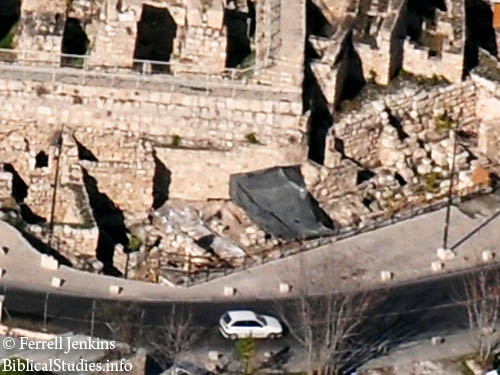
Jerusalem Aerial of Second Temple excavation. Photo by Ferrell Jenkins.

Aerial view of Second Temple excavation. Photo by Ferrell Jenkins.

Thirteen photos are posted on the Hebrew University Facebook album here.

Todd Bolen (here and here and here) and Leen Ritmeyer (here and here) point out that, in spite of the news release, this excavation goes back many years. Dr. Eilat Mazar has spent the past three months working in the area.

Below is a photo of the gate area showing the west chambers that I made in 2005. Benjamin Mazar and his grand daughter Eilat published a report on this area in 1989.

Gate from First Temple Period. Photo by Ferrell Jenkins 2005.

Gate from First Temple Period. Photo by Ferrell Jenkins 2005.

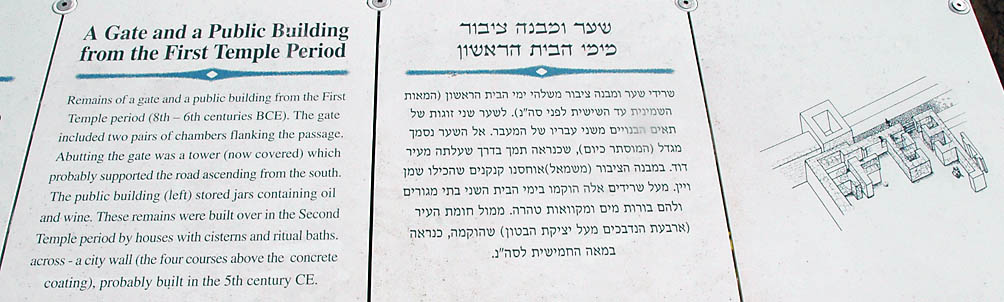
Compare the photo above, and the schematic drawing on the sign below (from 2005), with photos 12 and 13 in the HU Facebook album.

Marker indicated First Temple Period gate. Photo by Ferrell Jenkins 2005.

Marker indicated First Temple Period gate. Photo by Ferrell Jenkins 2005.

It seems uncertain whether this gate belongs to the 8th century B.C., 9th century, or 10th century. Eilat Mazar says it belongs to the 10th century B.C. based on pottery and a comparison of the architecture with that in other excavated cities. We must patiently wait to see the evidence. [See the comment by barnea levi selavan on Ritmeyer’s blog. He points out several significant things not included in the news reports.]

I look forward to seeing the area that has been recently cleaned. The news reports, including the video by Prof. Mazar, do not distinguish between what we already knew and what is new.

No one would enjoy seeing an inscription reading “Built in the 950 B.C. by King Solomon, son of David” more than I. Until more evidence is forthcoming we must leave Solomon out of this picture.

And this is the account of the forced labor that King Solomon drafted to build the house of the LORD and his own house and the Millo and the wall of Jerusalem and Hazor and Megiddo and Gezer. (1 Kings 9:15 ESV)

P.S. I was about 5 minutes away from posting this early today when my wife came to say that we must leave to pick up our grandson for the day. I chose the better part!

Jaffa Gate and the Christian Quarter from the air

In the past few days we have called attention to the excavations being conducted by the Israel Antiquities Authority at Jaffa Gate in Jerusalem. Archaeologists working in the area announced the discovery of an East-West road of the 4th century Byzantine city and the high-level aqueduct that brought water into the city in the second and third century.

The photo below shows Jaffa Gate and the Citadel from the air. Hezekiah’s Pool is visible just to the left (north) of the main street (David Street), almost in the center of the photo. The dome of the Church of the Holy Sepulchre is visible on the upper left side of the photo. Most of the area shown in this photo is called the Christian Quarter of the Old City of Jerusalem.

    Aerial view of the Christian Quarter of the Old City. Photo by Ferrell Jenkins.

Aerial view of the Christian Quarter of the Old City. Photo by Ferrell Jenkins.

Click on the photo for a larger image.