Category Archives: Bible Lands

Second century A.D. Roman road uncovered

Tuesday brought another press release from the Israel Antiquities Authority. The headline of the release calls this “a 2,000 Year Old Road,” but the text states that its’ construction is dated to the time of the Roman Emperor Hadrian (A.D. 117-138).

Aerial photographs of the road. Photographic credit: the Griffin Aerial Photography Company, courtesy of the Israel Antiquities Authority.

Aerial photographs of the road in the lower right corner of the photo. Photographic credit: the Griffin Aerial Photography Company, courtesy of the Israel Antiquities Authority.

The Press Release follows.

— “ —

A wide and impressive 2,000 year old road dating to the Roman period, in an extraordinary state of preservation, was revealed last February in archaeological excavations of the Israel Antiquities Authority near Highway 375. The excavation was conducted prior to laying a water pipeline to Jerusalem, at the initiative of, the Bet Shemesh water corporation “Mei Shemesh”. Students from “Ulpanat Amit Noga” in Ramat Bet Shemesh volunteered to participate in the dig.

The excavation director, Irina Zilberbod, at the site. Photographic credit: the Griffin Aerial Photography Company, courtesy of the Israel Antiquities Authority.

The excavation director, Irina Zilberbod, at the site. Photographic credit: the Griffin Aerial Photography Company, courtesy of the Israel Antiquities Authority.

According to Irina Zilberbod, director of the excavation on behalf of the Israel Antiquities Authority, “The road that we discovered, which 2,000 years ago passed along a route similar to Highway 375 today, was up to 6 meters wide, continued for a distance of approximately 1.5 kilometers, and was apparently meant to link the Roman settlement that existed in the vicinity of Beit Natif with the main highway known as the “Emperor’s Road”. That road was in fact a main artery that connected the large settlements of Eleutheropolis (Bet Guvrin) and Jerusalem. The construction of the Emperor’s Road is thought to have taken place at the time of Emperor Hadrian’s visit to the country, circa 130 CE, or slightly thereafter, during the suppression of the Bar Kokhba revolt in 132-135 CE. The presence of a milestone (a stone marking distances) bearing the name of the emperor Hadrian which was discovered in the past close to the road reinforces this hypothesis”.

Coins were discovered between the pavement stones: a coin from Year 2 of the Great Revolt (67 CE), a coin from the Umayyad period, a coin of the prefect of Judea, Pontius Pilate, dating to 29 CE and a coin of Agrippa I from 41 CE that was minted in Jerusalem.

The ancient coins that were discovered in the excavation. Photographic credit: Clara Amit, courtesy of the Israel Antiquities Authority

The ancient coins that were discovered in the excavation. Photographic credit: Clara Amit, courtesy of the Israel Antiquities Authority. The coin at the top is from the Umayyad period (A.D. 661-750). Bottom row (left to right): Herod Agrippa I – A.D. 41; Pontius Pilate – A.D. 29; Jewish Revolt – year 2 – A.D. 67-68.

Up until 2,000 years ago most of the roads in the country were actually improvised trails. However during the Roman period, as a result of military and other campaigns, the national and international road network started to be developed in an unprecedented manner. The Roman government was well aware of the importance of the roads for the proper running of the empire. From the main roads, such as the “Emperor’s Road”, there were secondary routes that led to the settlements where all of the agricultural products were grown. The grain, oil and wine, which constituted the main dietary basis at the time, where transported along the secondary routes from the surroundings villages and then by way of the main roads to the large markets in Israel and even abroad.

According to Amit Shadman, the Israel Antiquities Authority district archaeologist for Judah, “The ancient road passed close to the Israel National Trail and we believe that it will spark interest among the hikers. The Israel Antiquities Authority and Mei Shemesh Corporation have agreed that the road will be conserved in situ, for the public’s benefit”.

— ” —

Just a few days ago Todd Bolen called attention to David Bivins reports on the gradual destruction of the Roman road from Jerusalem to Emmaus here. The situation there is tragic. I have witnessed some deterioration of the Roman road near Golani Junction in just a few years. Let’s hope that the situations here will be reversed, and that this road will be preserved for many to see.

This recently uncovered road apparently connected with the road we described here.
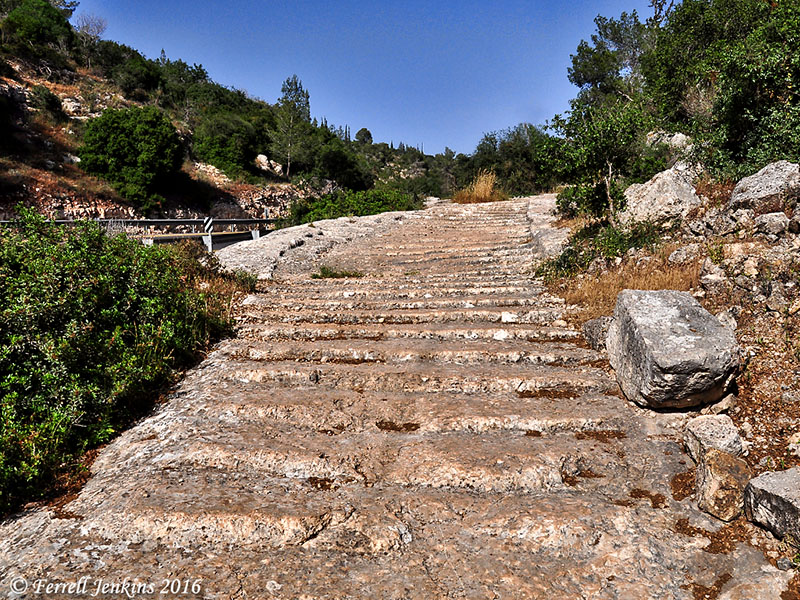
Roman Road 4.2 km W of Mata on Hwy 375. S of Hwy. Photo by Ferrell Jenkins.

Roman Road 4.2 km W of Mata on Hwy 375. S of Hwy. Photo by Ferrell Jenkins.

I find it especially interesting that coins from A.D. 29, 41, and 67-68 should be found on a road constructed in circa A.D. 130. Others can fill in possible answers.

The roman roads that we see in Israel today were not built until about the time of the first revolt – ca. A.D.66, and mostly in the second century under Trajan and Hadrian.

Israel Roll writes,

The Roman road network in Judaea was not constructed at once, but evolved gradually from the First Revolt onward. Until then the Roman administration used roads that had been built during or prior to the reign of Herod. Our knowledge of those roads is scanty. and is based essentially on isolated written sources– mainly in the New Testament and Josephus. These sources do not
mention anything relating to road construction or maintenance before the beginning of the rebellion in 66 C.E. We may conclude, therefore, that the subject was not of central concern to the Roman procurators. (Israel Roll, “The Roman Road System in Judaea,” Jerusalem Cathedra 3 (1983): 138.

My thought is that the later Roman roads generally followed paths that were already in use by the people.

HT: Joseph Lauer
Surprising ancient dolmen exposed in the Galilee

The Israel Antiquities Authority, in conjunction with Tel Hai College and Hebrew University of Jerusalem, released the following Press Release March 5, 2017.

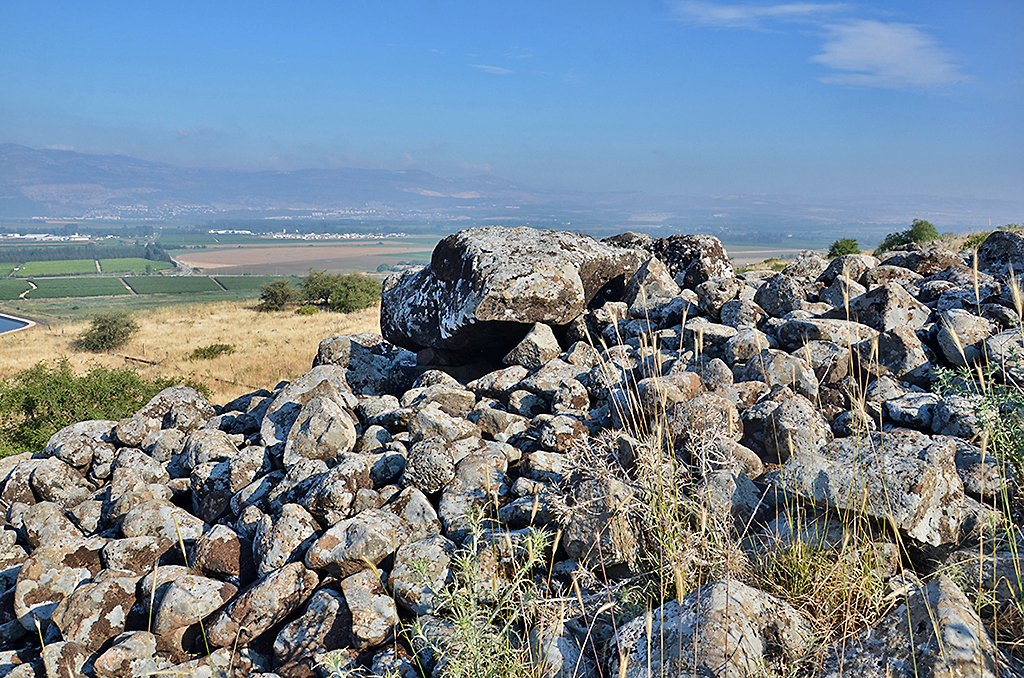
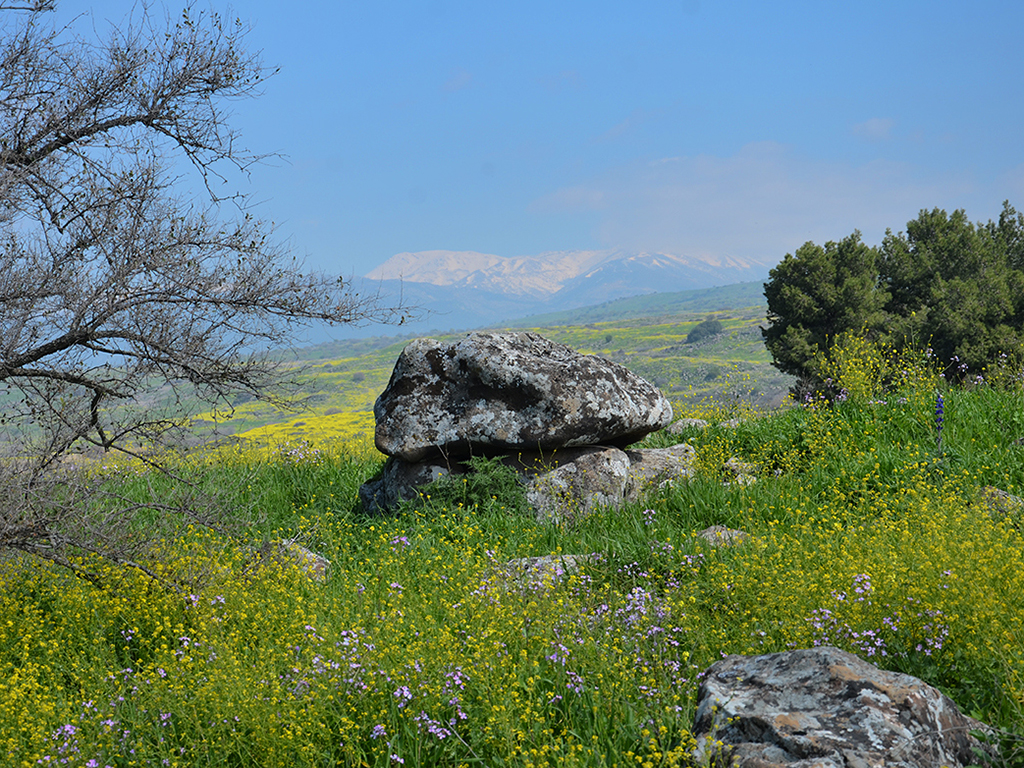
The 4,000 year old dolmen.View facing north toward Mount Hermon. Photographic credit: Gonen Sharon, Tel Hai College.

The 4,000 year old dolmen.View facing north toward snow-covered Mount Hermon. Photographic credit: Gonen Sharon, Tel Hai College.

— “ —

A rare and mysterious ancient dolmen was  exposed that is more than 4,000 years old and decorated with ancient rock art

According to researchers, “This is the first art ever documented in a dolmen in the Middle East”

Archaeologists from Tel Hai College, the Israel Antiquities Authority and the Hebrew University of Jerusalem have recently discovered a mysterious dolmen (a large table-like stone structure) over 4,000 years old in a large field of dolmens, adjacent to Kibbutz Shamir in the Upper Galilee. What makes this dolmen so unique is its huge dimensions, the structure surrounding it and most importantly the artistic decorations engraved in its ceiling. The study was published last weekend (2/3) in the scientific journal PLOS One.

Aerial photograph of the dolmen field. Photo: Shmuel Magal, Courtesy Israel Antiquities Authority.

Aerial photograph of the dolmen field. Photo: Shmuel Magal, Courtesy Israel Antiquities Authority.

The dolmen was discovered during a fortuitous visit to the site by Professor Gonen Sharon of the Galilee Studies Program at the Tel Hai College. It is just one of more than 400 huge stone structures dating to the Intermediate Bronze Age (over four thousand years ago) that are located in the dolmen field around Kibbutz Shamir. When Professor Sharon entered the chamber built beneath the largest dolmen he was surprised to discover rock drawings engraved in its ceiling.

From left to right: Professor Gonen Sharon of Tel Hai College and Uri Berger of the Israel Antiquities Authority. Photographic credit: Shmuel Magal, courtesy of the Israel Antiquities Authority.

From left to right: Professor Gonen Sharon of Tel Hai College and Uri Berger of the Israel Antiquities Authority. Photographic credit: Shmuel Magal, courtesy of the Israel Antiquities Authority.

The discovery of the engravings led to a research project of the dolmen and its environs which produced new revelations concerning the dolmen phenomenon in Israel. “This is the first art ever documented in a dolmen in the Middle East”, said Uri Berger, an archaeologist with the Israel Antiquities Authority and partner in the study. “The engraved shapes depict a straight line going to the center of an arc. About fifteen such engravings were documented on the ceiling of the dolmen, spread out in a kind of arc along the ceiling. No parallels exist for these shapes in the engraved rock drawings of the Middle East, and their significance remains a mystery. The panel depicting the art was scanned in the field by the Computerized Archaeology Laboratory of the Hebrew University. By means of an innovative technique, a three-dimensional model of the engraving was produced. “The three-dimensional scan enabled us to identify engravings that otherwise could not be seen with the naked eye”, explained Professor Lior Grossman, the laboratory director.

The chamber inside the dolmen where the engravings were found on its ceiling is large, measuring 2 × 3 meters, and the stone covering it is also huge, weighing an estimated fifty tons at least! This is one of the largest stones ever used in the construction of dolmens in the Middle East. The dolmen was enclosed within an enormous stone heap (tumulus) c. 20 meters in diameter, and its stones are estimated to weigh a minimum of 400 tons. At least four smaller dolmens that were positioned at the foot of the decorated dolmen were identified inside the stone heap. In other words, what we have here is a huge monumental structure built hierarchically (with a main cell and secondary cells). This is the first time such a hierarchical dolmen has been identified in the Middle East.

The 4,000 year old dolmen. Credit: Gonen Sharon, Tel Hai College.

The 4,000 year old dolmen overlooking the Hula Valley. Credit: Gonen Sharon, Tel Hai College.

The 4,000 year old dolmen. Credit: Gonen Sharon, Tel Hai College.

The 4,000 year old dolmen. Credit: Gonen Sharon, Tel Hai College.

The huge dolmen at Kibbutz Shamir is just one of hundreds of enormous densely scattered structures in this region. It bears witness to the existence of a significant and established governmental system in the region during the “Middle Ages” of the Bronze Age. Archaeologists tend to interpret the past based on material finds. The absence of cities, large settlements and monumental buildings attests to the collapse of the governmental and economic systems during a “dark period” in history. The dolmens tell a different story about the period – a story about a society that had a complex governmental and economic system that executed monumental engineering projects but did not leave behind any other archaeological evidence.

“The gigantic dolmen at Kibbutz Shamir is without doubt an indication of public construction”, says Professor Sharon, “that required a significant amount of manpower over a considerable period of time. During that time all of those people had to be housed and fed. The building of such a huge construction necessitated knowledge of engineering and architecture that small nomadic groups did not usually possess. And even more importantly, a strong system of government was required here that could assemble a large amount of manpower, provide for the personnel and above all direct the implementation and control of a large and lengthy project”.

Despite all this, the circumstances surrounding the construction of the dolmens, the technology involved in it and the culture of the people who built them are still one of the great mysteries of the archeology of Israel.

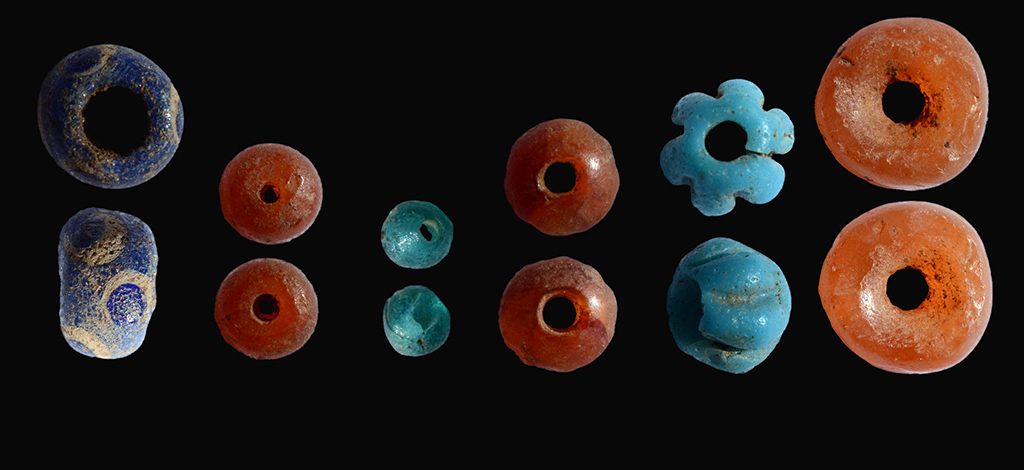
Colored beads that were uncovered in the archaeological excavation inside the dolmen. Credit: Shmuel Magal, courtesy of the Israel Antiquities Authority.

Colored beads that were uncovered in the archaeological excavation inside the dolmen. Credit: Shmuel Magal, courtesy of the Israel Antiquities Authority.

What is a Dolmen – A dolmen (stone table) is a megalithic structure (mega = large, lithos = stone) thousands of years old that is built of huge stones. The basic shape of the dolmen resembles a table, and most of them are surrounded by a heap of stones. Dolmens are known elsewhere in the world, from Ireland to Korea. Thousands of dolmens are scattered across the Middle East, from Turkey to Yemen. In the Golan Heights thousands of dolmens of different types were identified which are scattered in concentrations (dolmens fields) on the plateau. Although they are very common and stand out quite prominently in the landscape of ancient Israel, the mystery surrounding the dolmens’ age and their purpose have still not been resolved.

The Dolmen Field at Kibbutz Shamir– the field was first surveyed by the late Moshe Kagan in the 1950’s. More than 400 huge structures overlooking the Hula Valley were identified in the field.

— ” —

HT: Israeli newspapers; Joseph Lauer
Index of articles – the Romans and the ministry of Jesus

The Romans had occupied the land they later called Palestine for nearly a century when Jesus began His ministry. This means that there was no one alive at that time who remembered when the Romans were not in control.
The writings of Josephus cover this period and New Testament writers called attention to the Roman rulers.

In those days a decree went out from Caesar Augustus that all the world should be registered. (Luke 2:1 ESV)

In the fifteenth year of the reign of Tiberius Caesar, Pontius Pilate being governor of Judea, and Herod being tetrarch of Galilee, and his brother Philip tetrarch of the region of Ituraea and Trachonitis, and Lysanias tetrarch of Abilene, (Luke 3:1 ESV)

Roman soldiers roamed the country and eventually destroyed the Holy City Jerusalem. The culture of Rome can still be seen in the ruins of various cities.

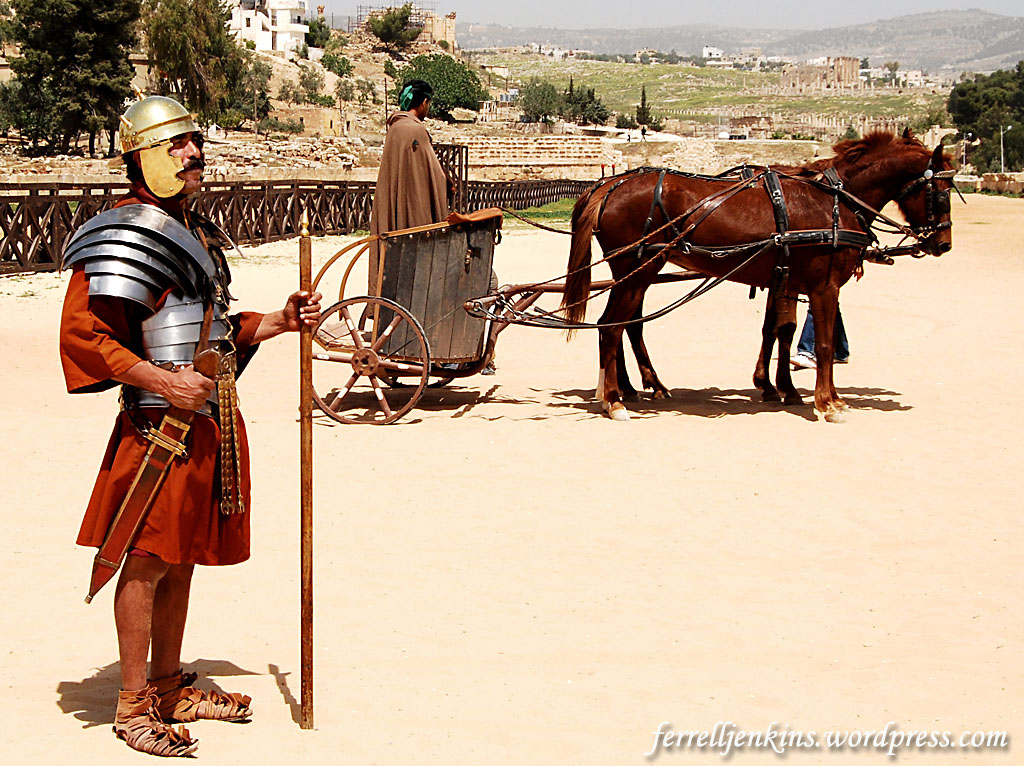
Roman Centurion and a Charioteer at Jerash (the RACE show at Jerash). Photo by Ferrell Jenkins.

I am not sure that this list of posts about the Roman empire in Palestine is a complete one, but I think it will be helpful as you study the impact of Rome and its culture on the ministry of Jesus and His apostles. We could compile another list specifically from the book of Acts, the New Testament Epistles, and the book of Revelation. Use the Search Box to locate other subjects you may be looking for.

Special offer on Carta Jerusalem resources

Yesterday I received a review copy of Jerusalem • Biblical Archaeology from Carta. This is a wonderful resource for anyone traveling to Jerusalem, or anyone interested in the archaeology of the Holy City.

The map of the Biblical Archaeological Sites of Jerusalem are printed on one side of this 2 ft. by 3 ft. map. Half of the other side is an enlargement of the archaeological sites in the Old City. The other half contains helpful information about sites on both sides of the map.

This map was prepared by Carta Jerusalem with the assistance of Yuval Baruch PhD, in collaboration with The Israel Antiquities Authority.

This is exactly the type map I like to use when rambling through Jerusalem.

And here is a special offer from Carta.

carta-jer-arch-map

This offer allows 20% off the list price of…

  • Leen Ritmeyer, The Quest (list price $60.00; sale price $48.00).
  • Dan Bahat, The Carta Jerusalem Atlas (list price $60.00; sale price $48.00).
  • Josephus, The Jewish War (list price $60.00; sale price $48.00). See Todd Bolen’s review of the book here.

These are all great books. And you get the map free when you buy one of them. Use the Search box for Jerusalem Archaeological Sites to locate the map.

This offer is good until January 31st ONLY! Use Voucher Code: 20-off

You can check the Carta Jerusalem website here for details of this special offer.

The Kangal sheep dog of Anatolia

Shepherds in every part of the world have problems they must contend with as they care for their sheep. The Bible uses the analogy of the sheep and the wolves in several places. Jesus warned about the “hired hand” who would abandon the sheep.

He who is a hired hand and not a shepherd, who does not own the sheep, sees the wolf coming and leaves the sheep and flees, and the wolf snatches them and scatters them. (John 10:12 ESV)

Within the past few years I have come across an interesting practice used by shepherds in Anatolia (Central Turkey), and only recently came across an article in a 2003 issue of Saudi Aramco World about the same shepherds. It begins this way,

There are grey wolves in Turkey, thousands of them. There are also bears, jackals, and—recorded just last year for the first time in a quarter century—Anatolian leopards. All are the enemies of sheep and goats. As predators, they live at the expense of the prey animals, the meat-eaters against the grass-eaters. But on Turkey’s Anatolian plateau, the prey have a strong friend, more than a match for any predator: the kangal dog.

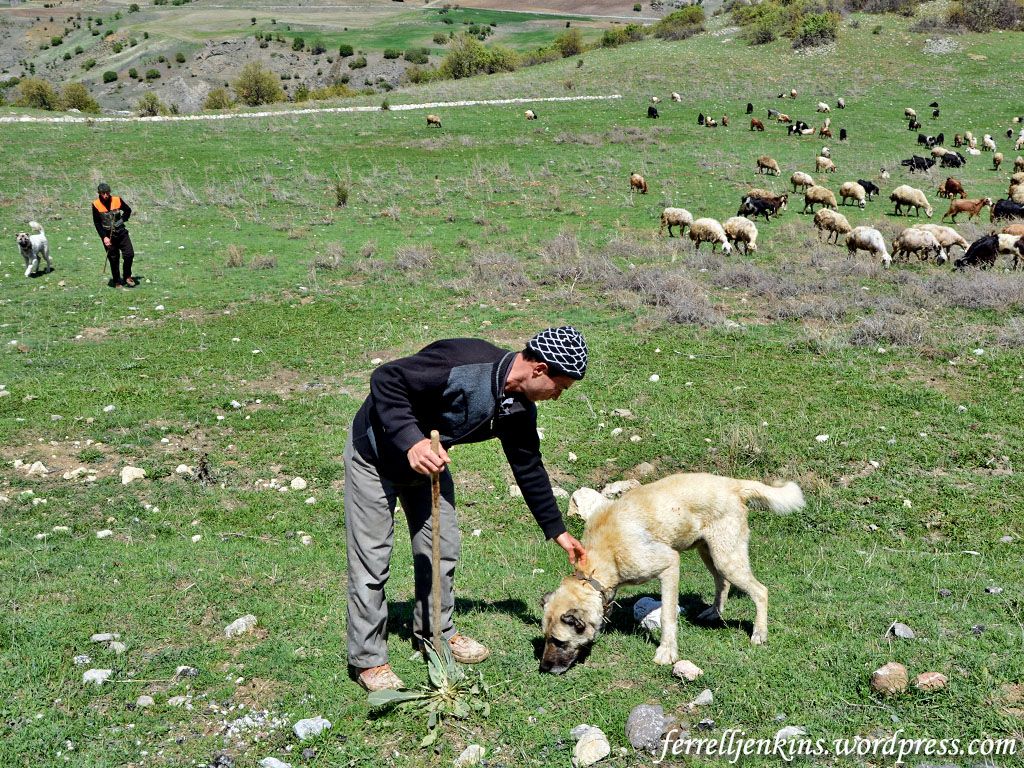
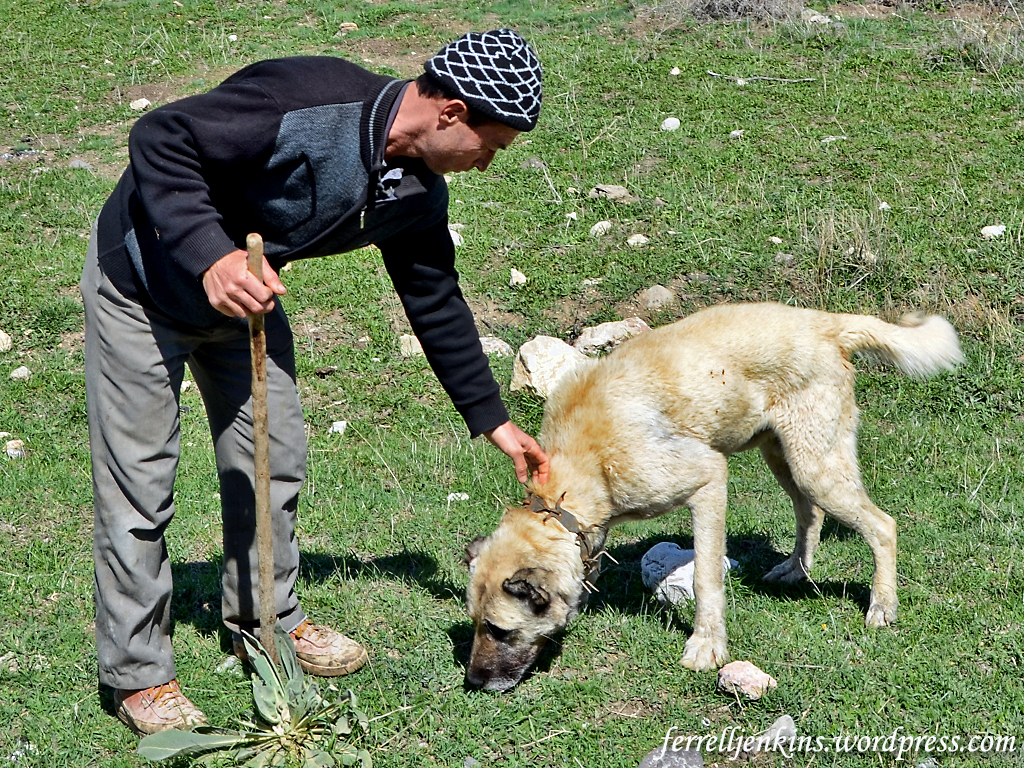
On our last visit to the ancient Hittite city of Hattusas (modern Boghazkale) we saw a large number of sheep grazing over the ruins of the ancient city. Our guide said that the dogs we saw with the shepherds were a special breed of dog that were common in Anatolia, but he could not recall the name of the dogs. In fact, he said might be a slightly different breed from the one he was thinking about.

Shepherd at hattusas with his sheepdog. Notice the collar that is specially prepared to protect these dogs from wolves and other wild animals. Photo by Ferrell Jenkins.

Shepherd at Hattusas with his sheepdog. Notice the collar that is specially prepared to protect these dogs from wolves and other wild animals. Photo by Ferrell Jenkins.

The shepherds were pleased to show us the spiked collar. A wolf, or other wild animal, would go at the throat of the dog, but the spikes would be a strong deterrent. Notice also that the ears of this dog have been cropped. This, according to the article, is “intended to deprive wolves of a tooth-hold.” The author says,

Shepherds frequently dock their dogs’ ears, saving them the trouble of doctoring wounds when they tangle with a wolf. But the heavy spiked collar they wear, called a çengel, or hook, seems enough to keep even the most determined enemy from biting their heads.

Here is a close-up, and you may click on it for an even larger image, showing the spikes or hook.

A close up showing the spikes on the collar of the dog. Photo by Ferrell Jenkins.

A close up showing the spikes on the collar of the dog. Photo by Ferrell Jenkins.

Shepherds of biblical times carried a rod and a staff (Psalm 23:4). The rod could be used to ward off an attacking animal. The staff was used by the shepherd as he made his way up and down the hillsides, and to separate the sheep.

Source: Werner, Louis. “Shepherd’s Best Friend.” Saudi Aramco World July/Aug. 2003: 38-43.

The Horns of Hattin and the battle of 1187

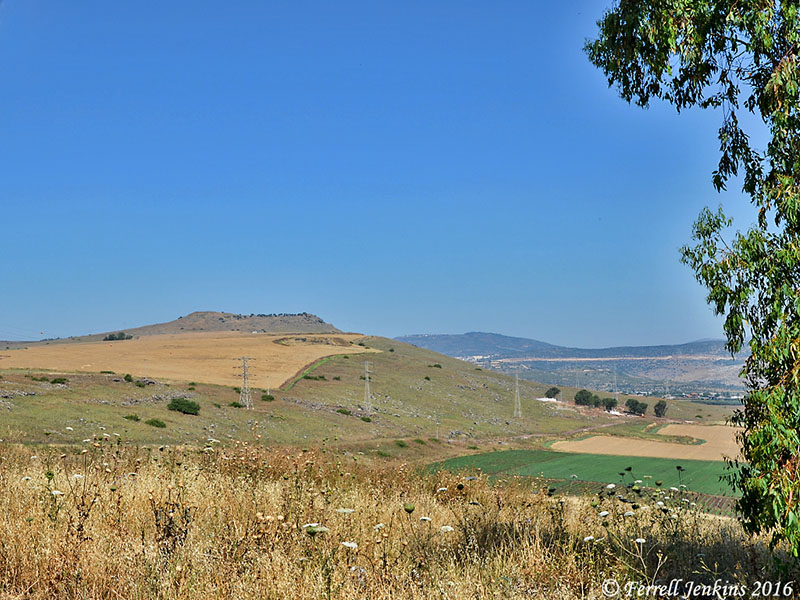
The Horns of Hattin is the name given to a saddle-shaped (or horn-shaped) extinct volcano located about five miles west of the Sea of Galilee. Several older writers, including Jesse L. Hurlbut, referred to this formation as the traditional Mount of the Beatitudes (A Bible Atlas [1910], 15). The hill is about 1200 feet above sea level. Few scholars hold this view today.

A view of the Horns of Hattin northwest of Highway 77. Photo by Ferrell Jenkins.

A view of the Horns of Hattin northwest of Highway 77. Photo by Ferrell Jenkins.

Below Hattin, on the edge of the Arbel Pass, there is a building believed by the Druze to be the burial site of Nebi Shu’eib (Jethro, the father-in-law of Moses; Exodus 3:1). The Druze gather here every spring for a festival.

One of the most important battles of history was fought at the Horns of Hattin on July 4, 1187. The Moslems, headed by Saladin, overpowered the Crusaders and captured most of Palestine including Jerusalem. Perhaps the most significant reason the Crusaders took their stand here was that they thought the Sermon on the Mount (Matthew 5-7) was spoken by Jesus on this hill.

I have never stood atop Hattin, but a friend of mine walked the Jesus Trail after our tour in 2011. Larry Haverstock shared some of his photos of the fascinating formation as he crossed it on his five-day trip from Nazareth to Capernaum.

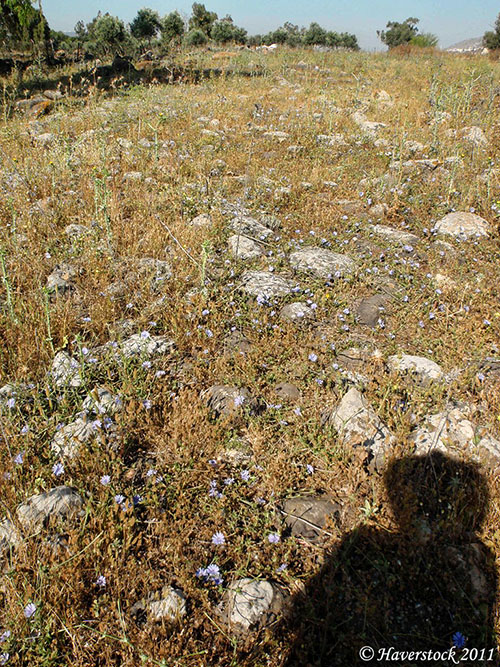
This first photo shows ruins of a Roman road between Golani Junction and Magdala on the Sea of Galilee. The Jesus Trail followed this road. Larry’s friends will recognize his shadow  in the photo.

The Jesus Trail follows ruins of the Roman road from Golani Junction to Magdala. Photo by Larry Haverstock.

The Jesus Trail follows ruins of the Roman road from Golani Junction to Magdala. Photo by Larry Haverstock.

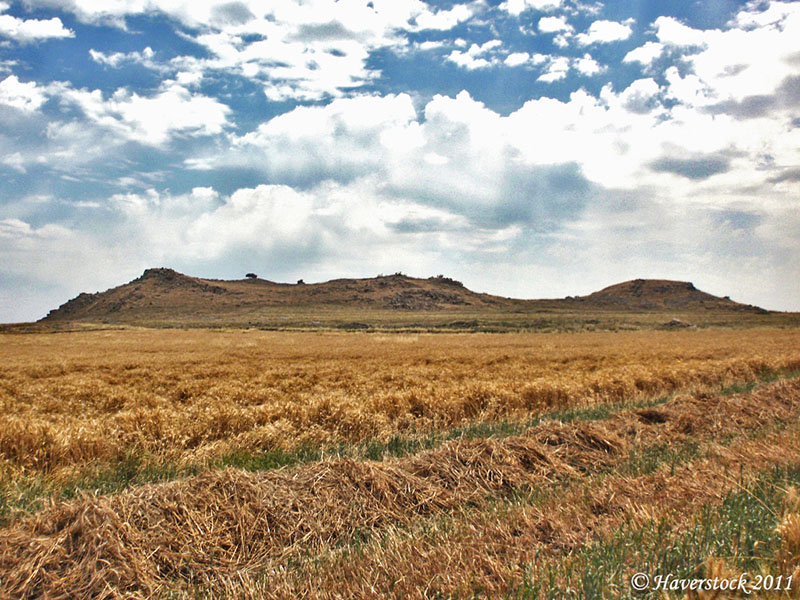
Following the road from the west one approaches the Horns of Hattin knowing that from the top there will be a wonderful view of the Sea of Galilee and the area of the Galilean ministry of Jesus.

The Horns of Hattin from the west. Photo by Larry Haverstock.

The Horns of Hattin from the west. Photo by Larry Haverstock.

Approaching the top of the formation you will see the southern hump and some of the volcanic rubble from ages past.

View to the east, while walking the Jesus Trail from Nazareth. Photo by Larry Haverstock.

View to the east, while walking the Jesus Trail from Nazareth. Photo by Larry Haverstock.

The next photo made from Hattin shows Mount Arbel and portions of the Sea of Galilee. Larry writes and speaks vividly. I notified him that I would be posting this article today. He replied,

Can’t wait to see your Hattin article. I was up there all alone, not one other person in sight as far as the eyes could see from that amazing height. Could almost hear the echoing sounds of war reverberating across the centuries.

View of the Sea of Galilee from the Horns of Hattin. Photo by Larry Haverstock.

View of the Sea of Galilee from the Horns of Hattin. Photo by Larry Haverstock.

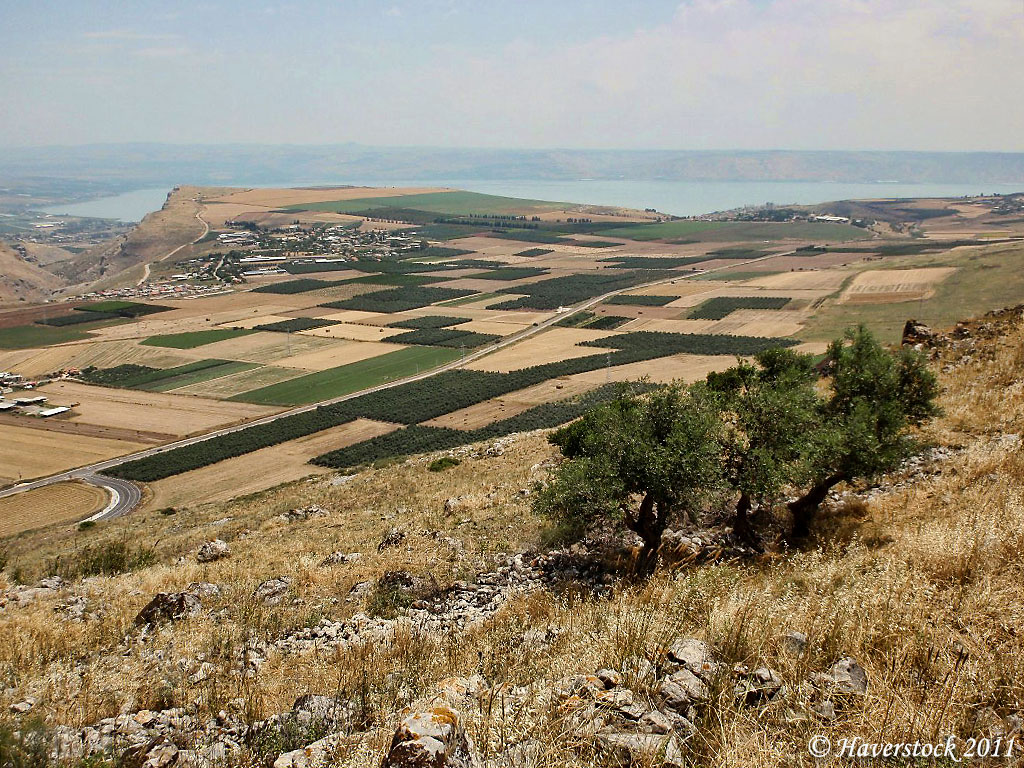
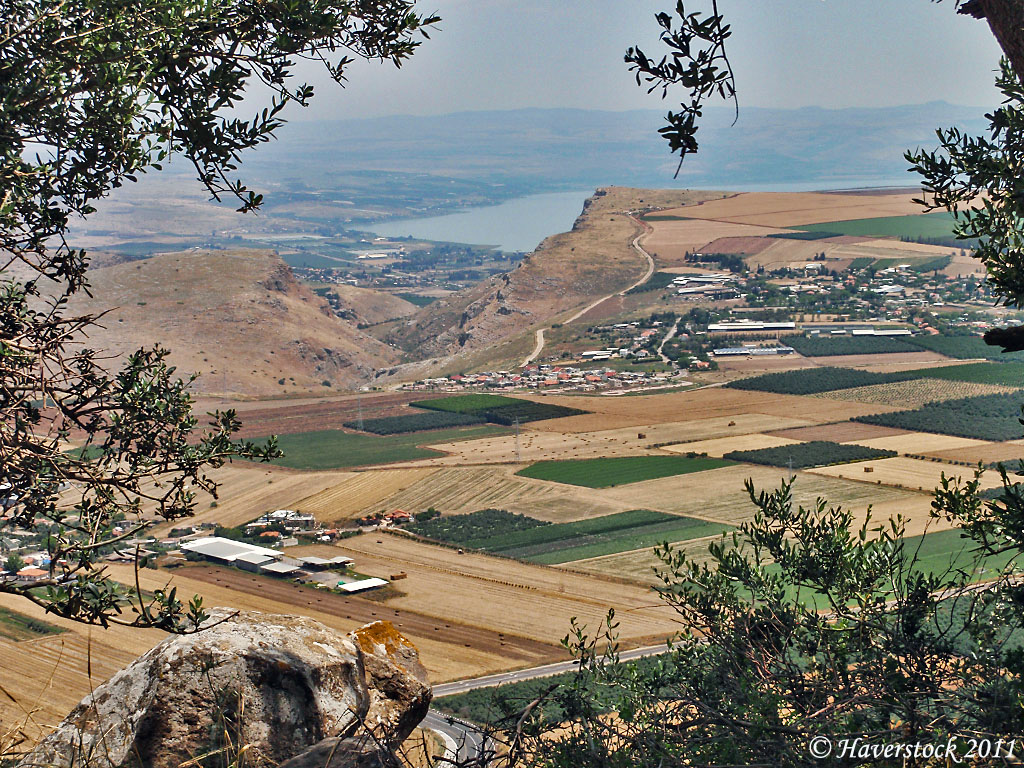
This photo provides a clear view of the depression to the north (left) of Mount Arbel through which the ancient road ran. The valley leading from the Horns of Hattin to the Sea of Galilee is known as Wadi Hamam. It is more commonly called the Arbel Pass, the Valley of the Robbers, or the Valley of the Pigeons. Some scholars say that the main trunk road from the Coastal Plain to Damascus came through this valley. It is common to hear this spoken of as the Via Maris (the way to the sea). This means that the main road from Nazareth, Sepphoris, and Cana to Capernaum ran through this valley. This is the way Jesus and His disciples traveled (Matthew 4:13; John 4:11-12). Other scholars suggest that the route from Capernaum to Nazareth ran to the north of the wadi and the rugged cliffs to the north.

From the Horns of Hattin one sees Mount Arbel, the Arbel Valley, the plain of Gennesaret and the northern end of the Sea of Galilee. Photo by Larry Haverstock.

From the Horns of Hattin one sees Mount Arbel, the Arbel Valley, the plain of Gennesaret and the northern end of the Sea of Galilee. Photo by Larry Haverstock.

I have read several articles about the modern reenactment of the decisive 1187 battle between the Crusaders of the Kingdom of Jerusalem and the followers of Saladin. Here are a few links for those who would like to read more.

  • Times of Israel 2016 article by Ilan Ben Zion here.
  • Times of Israel 2015 article by Oded Balilty here.
  • Daily Mail article with photos here.

Alon describes the day of the battle in 1187.

The engagement took place on a blistering-hot day and the Crusader soldiers encumbered by their heavy and clumsy armor in face of the light cavalry of their enemy. After a day-long battle, not one Crusader soldier remained alive on the battlefield. (Azaria Alon, Israel National Parks & Nature Reserves, 168.)

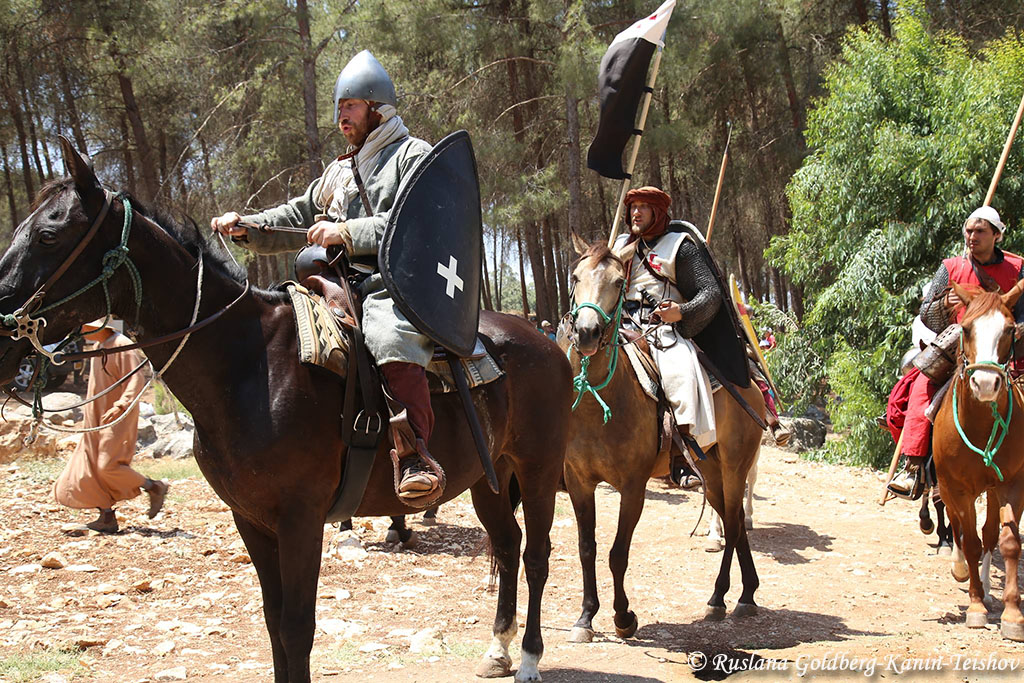
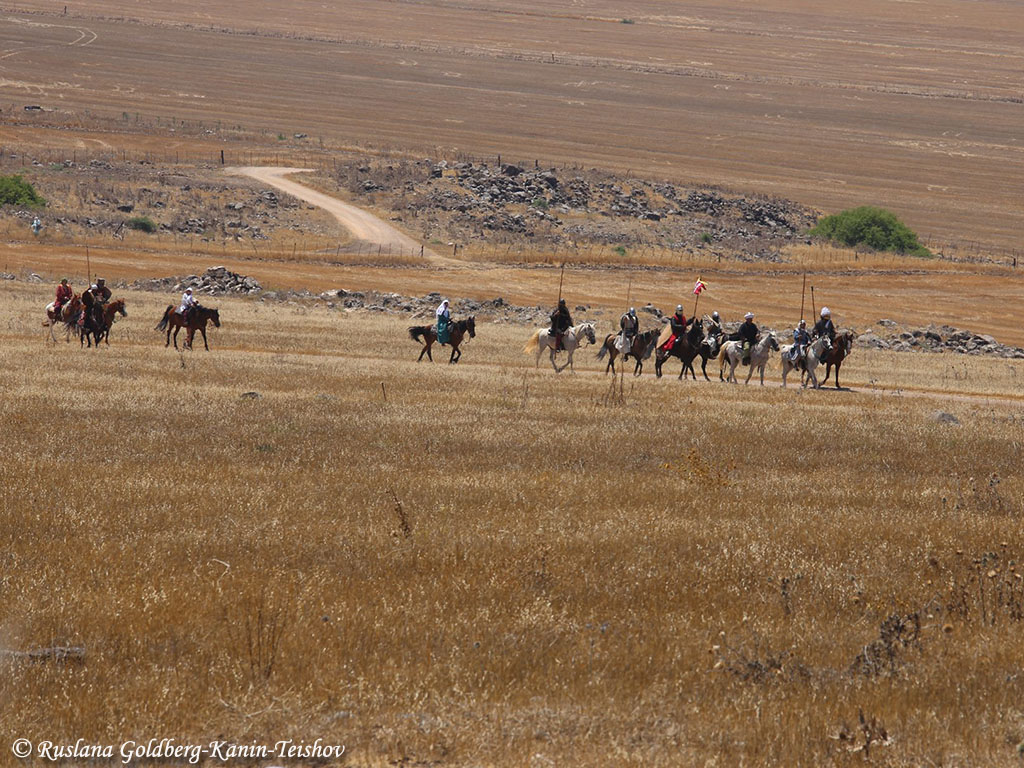
Numerous persons have included photos here and there on the Internet. I was impressed with some photos by Ruslana Goldberg-Kanin Teishov and requested permission to share two or three of them with our readers. Ruslana graciously granted permission. The next three photos are by her. The first shows Crusader soldiers readying for battle. You can see other of her photos here.

History buffs reenact the crusaders as they ready to defend the formation known as the Horns of Hattin. Photo by Ruslana Goldberg-Kanin Teishov.

History buffs reenact the crusaders as they ready to defend the formation known as the Horns of Hattin. Photo by Ruslana Goldberg-Kanin Teishov.

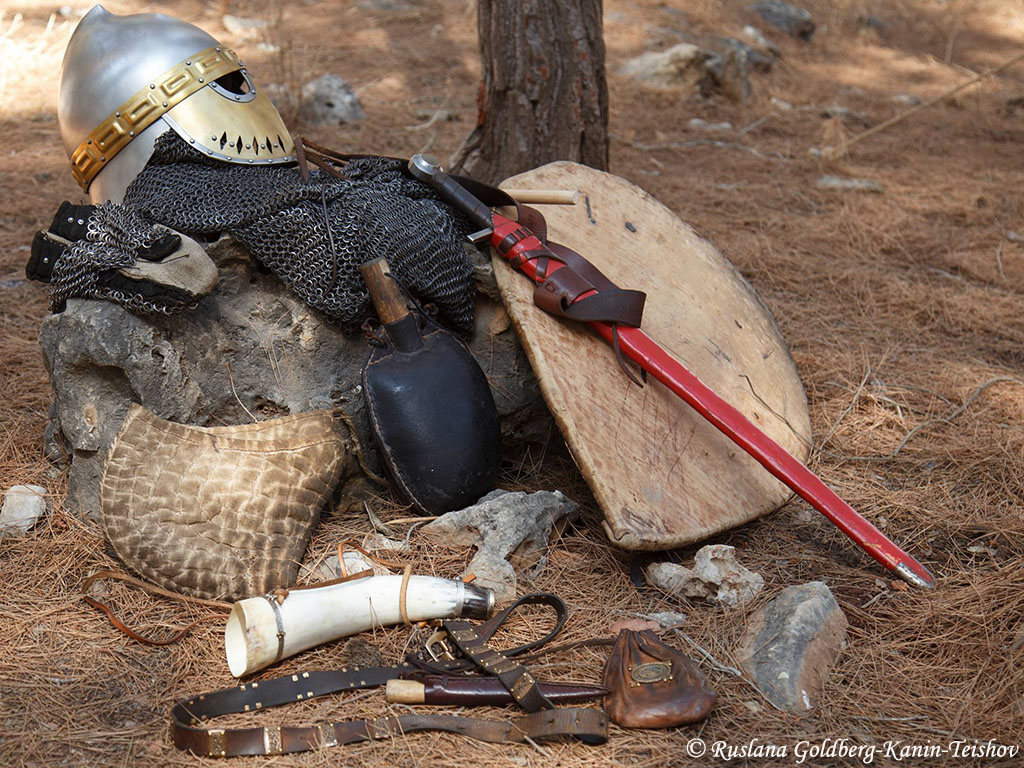
This photo shows the heavy armor worn by some of the soldiers.

One of the soldier actors had his armor laid out to show what the Crusaders had to wear. History buffs reenact the crusaders as they ready to defend the formation known as the Horns of Hattin. Photo by Ruslana Goldberg-Kanin Teishov.

One of the soldier actors had his armor laid out to show what the Crusaders had to wear. History buffs reenact the crusaders as they ready to defend the formation known as the Horns of Hattin. Photo by Ruslana Goldberg-Kanin Teishov.

This photo shows soldiers as they approached the western slope of the Horns of Hattin.

This photo shows soldiers as they approached the western slope of the Horns of Hattin. Photo by Ruslana Goldberg-Kanin Teishov.

This photo shows soldiers as they approached the western slope of the Horns of Hattin. Photo by Ruslana Goldberg-Kanin Teishov.

The official web page for the Horns of Hattin project is here.

Did Jesus preach the Sermon on the Mount here? Probably not.

Many thanks to Larry Haverstock and Ruslana Goldberg-Kanin Teishov for making this post much more interesting than it would have been without their photos. If you wish to follow Larry on the Jesus Trail you may begin here and then use his blog archive to locate the other posts.

Aleppo National Museum – #4

See our previous articles on Aleppo here, here, here, and here.

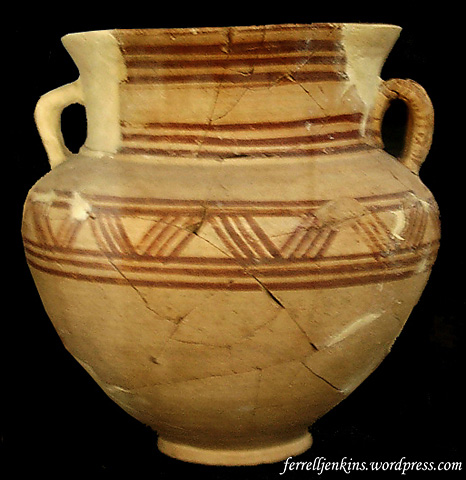
The Ebla tablets were discovered by an Italian team of excavators at Tell Mardikh in Syria (about 30 miles S of Aleppo) in 1975. More than 17,000 cuneiform tablets were discovered, dating to the mid-third millennium B.C. when Ebla was the capital of a great Canaanite empire. Scholars state that there are important affinities between the Eblaite language and biblical Hebrew, both being members of the Northwest Semitic family.

Pottery from Tell Mardikh (Ebla) in Aleppo Museum. Photo by Ferrell Jenkins.

Pottery from Tell Mardikh (Ebla) in Aleppo Museum. Photo by Ferrell Jenkins.

It is my understanding that the Aleppo National Museum became the main repository of the Ebla tablets. In a major controversy between the archaeologist (Paolo Matthiae) and the epigrapher (Giovanni Pettinato), the Museum took the side of Professor Matthiae.

The controversy between these two scholars played out in scholarly and popular archaeological journals in the late 1970s and the early 1980s.

We have posted several articles about Ebla in previous years. You need only put the word Ebla in the Search box to locate those.

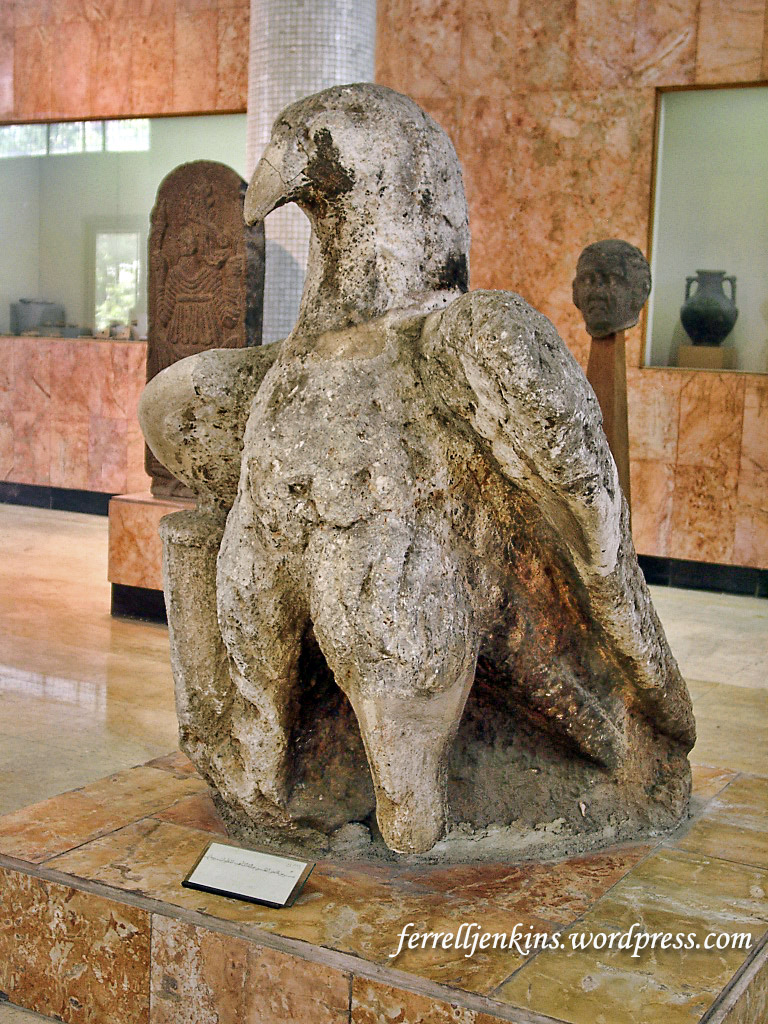
A large eagle caught our attention. David and I were of the opinion that it belonged to the Roman period, but one of the guards we spoke with insisted that it belonged to the Hellenistic period.

An eagle possible from the Hellenistic Period in the Aleppo Museum. Photo by Ferrell Jenkins.

An eagle possibly from the Hellenistic Period in the Aleppo National Museum. Photo by Ferrell Jenkins.

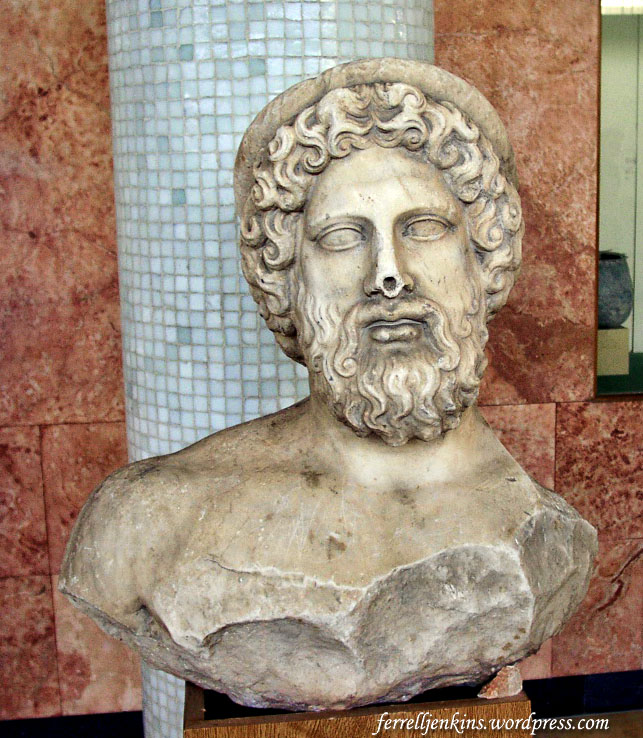
Statues and busts of Asclepios are fairly common throughout the ancient Greek world. Asclepios was known as a god of medicine in the Greek religion. I do not know where this bust was discovered.

Bust of the god Asclepios. Photo by Ferrell Jenkins.

Bust of the god Asclepios. Photo by Ferrell Jenkins.

Even though the quality of the photos leaves much to be desired, I am hopeful that these photos and brief descriptions will be of benefit to those who have not been, and may never get to see the Aleppo National Museum.

This concludes the series on Aleppo.

Aleppo National Museum – #3

See our previous articles on Aleppo here, here, and here.

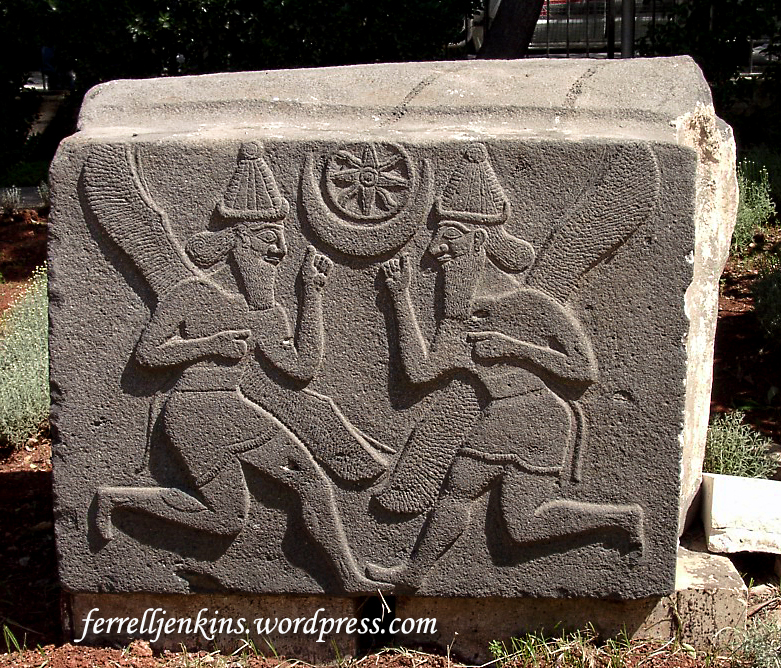
We have one more nice Neo-Hittite piece displayed in the courtyard of the Aleppo National Museum. It shows genii with the symbols of the sun and the moon. These symbols are typical on Neo-Hittite and Assyrian reliefs.

Neo-Hittite genii with image of sun and moon on a basalt block in the courtyard of the Aleppo National Museum. Photo by Ferrell Jenkins.

Neo-Hittite genii with image of sun and moon on a block in the courtyard of the Aleppo National Museum. Photo by Ferrell Jenkins.

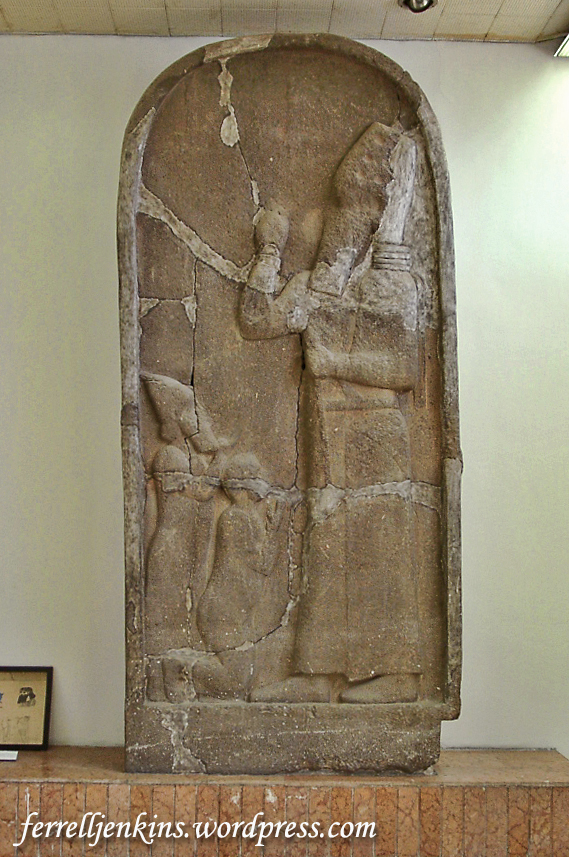
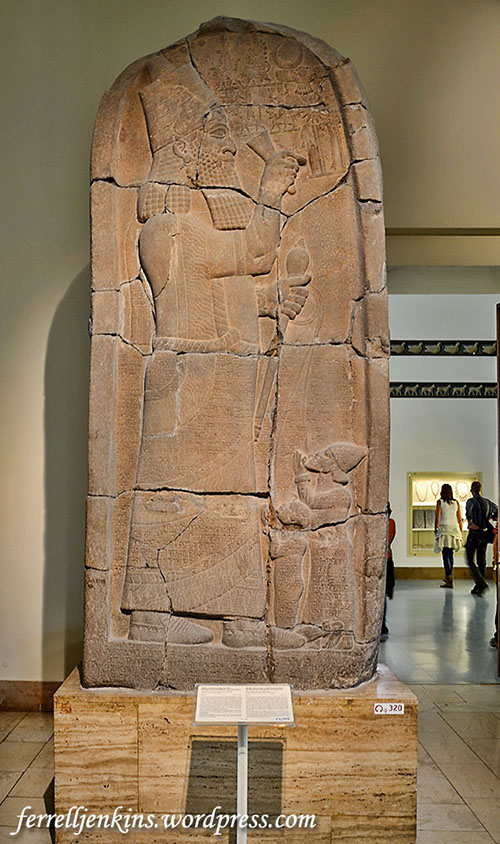
Assyrian. The museum has one stele depicting Esarhaddon, the son of Sennacherib and his successor as king of Assyria (680-559 B.C.; 2 Kings 19:37; Isaiah 37:38; Ezra 4:2). I am not certain about the identity of the rulers who are bowing before Esarhaddon, but I suspect this represents the same persons as the much better stele in the Berlin museum. The stele there depicts the king holding ropes leading to the lips of Tirhakah of Egypt and Ethiopia [Cush] (in ANET, 293, he is referred to as king of Nubia) and Ba’alu of Tyre. If so, then the bowing figure with Negroid features was an ally of Hezekiah against the Assyrians (2 Kings 19:9. The Berlin stele comes from Zinjirli and was discovered in 1888.

First, here is the Aleppo stele.

A broken relief showing Esarhaddon with two captured rulers, one on bended knee, before him. Photo by Ferrell Jenkins.

A broken relief showing Esarhaddon with two captured rulers, one on bended knee, before him. Photo by Ferrell Jenkins.

And here is the Berlin stele (VA 2708).

Stele of Esarhaddon displayed in the Pergamum Museum, Berlin. VA 2708. Photo by Ferrell Jenkins.

Stele of Esarhaddon displayed in the Pergamum Museum, Berlin. VA 2708. Photo by Ferrell Jenkins.

I have the impression that the stele displayed in Aleppo may be one made by a beginner and was never finished. Notice the lack of proportion in the legs of the kneeling figure, and the absence of clear decorations at the top.

One final post on the Museum coming next.

Aleppo National Museum – #2

See our previous post on Aleppo here. Our #1 on the Aleppo National Museum is here.

In the first post on Aleppo I posted a photo of the Hittite Storm god Teshub standing on the back of a bull. I should have mentioned at the time that a large temple of the storm god from the Late Bronze and Early Iron ages has been excavated underneath Islamic buildings at the Aleppo Citadel. A well illustrated article by Kay Kohlmeyer states,

The storm god, first venerated as Hadda, then as Addu, Teshub, Tarhunta, and Hadad, played a supra-regional role in the ancient Near East, which explains the enormous size of his temple at Aleppo and the brilliance of its relief decoration. (Near Eastern Archaeology 72;4 (2009).

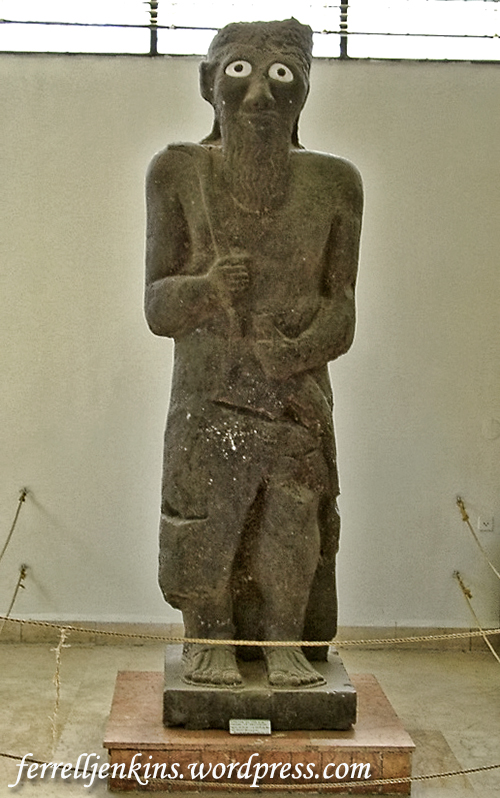
A statue of Hadad of poor quality is also displayed in the museum.

Statue of Hadad displayed in the Aleppo National Museum. Photo by Ferrell Jenkins.

Statue of Hadad displayed in the Aleppo National Museum. Photo by Ferrell Jenkins.

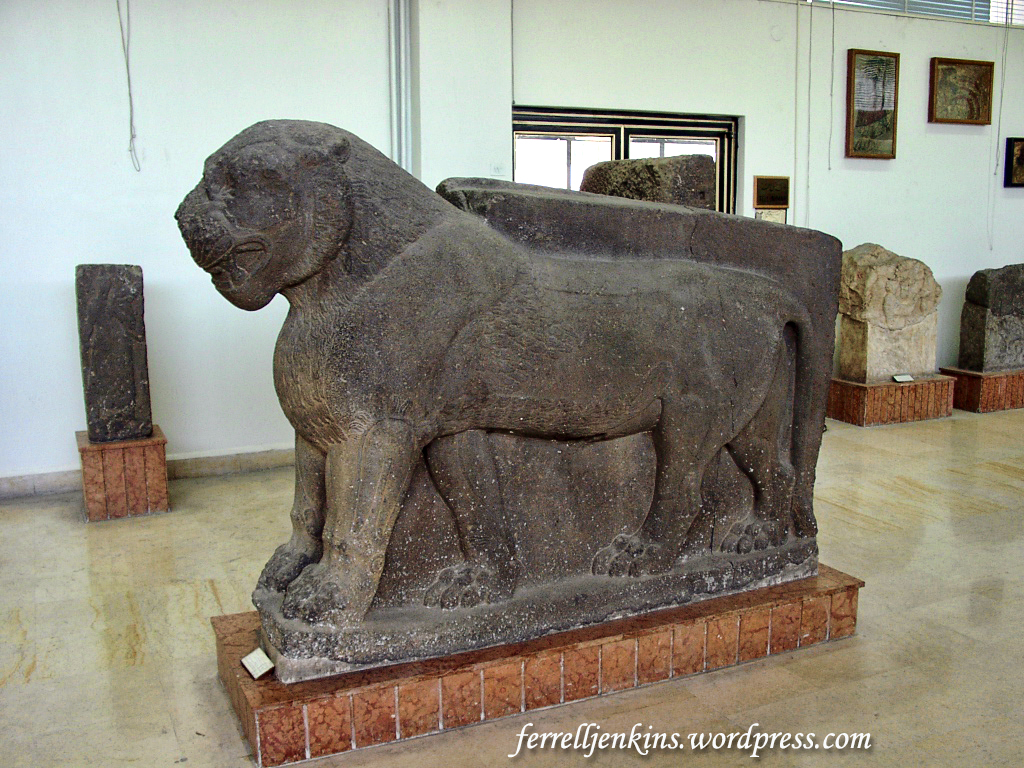
There are several other Neo-Hittite artifacts in the Aleppo National Museum. This first I am showing is a basalt lion with a slight wing relief. This is likely part of a pair that stood along an entrance to some building. Here you will notice that the lion is represented as having five legs. This allows the passerby to see at least four legs from almost any direction. We have become familiar with the huge winged bulls from Assyria that are made in the same fashion. I do not have the original source of the lion, but there are numerous Neo-Hittite sites  to the north of Aleppo in Syria and Turkey.

Lion from the Neo-Hittite Period in the Aleppo National Museum. Photo by Ferrell Jenkins.

Lion from the Neo-Hittite Period in the Aleppo National Museum. Photo by Ferrell Jenkins.

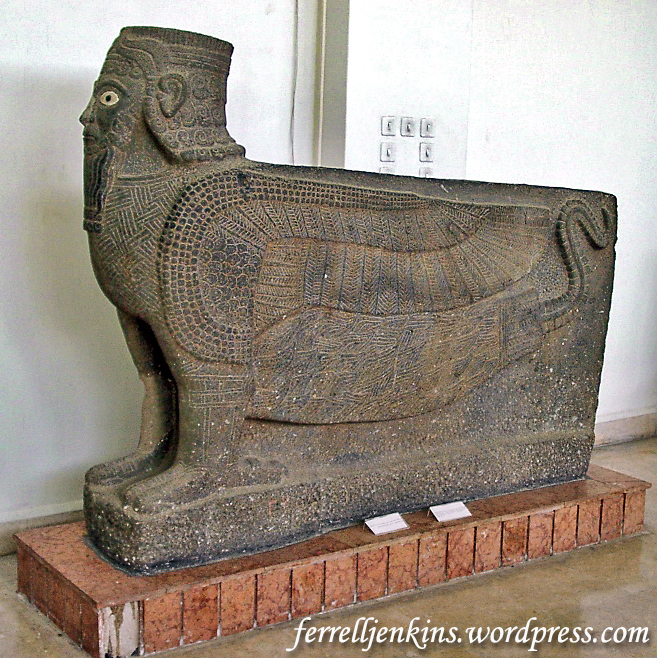
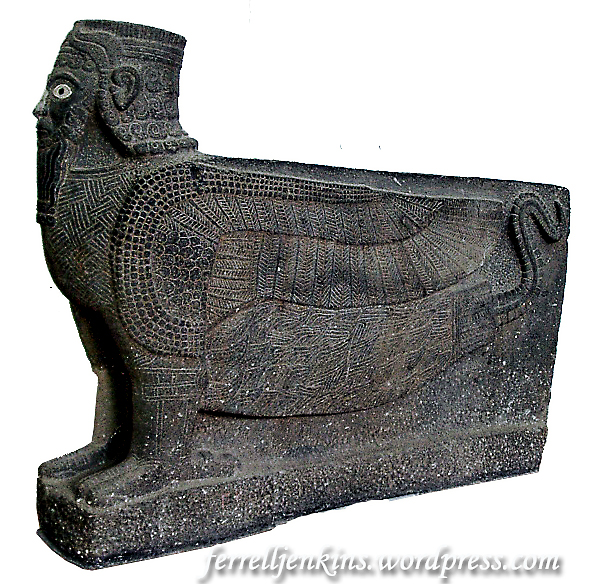
The next image is a fascinating one from the palace of Karara at Tell Halaf. It shows a composite creature of basalt consisting of the head of a man with the feet and wings of a bird, and the tail of a scorpion.

Composite creatures were common during the Hittite, Assyrian, and Babylonian periods of Old Testament history, and many of them have been found in the extended region. They provide us some insight into the background of apocalyptic literature. We find these creatures especially in the Old Testament books of Daniel, Ezekiel, and Zechariah, and in the New Testament book of Revelation (the Apocalypse). See a previous post, “Apocalyptic imagery is not strange,” here.

The composite creature here brought to my mind the events of the sounding of the fifth trumpet in Revelation 9:1-11.

Composite creature showing the head of a man, body and feet of a bird, and the tail of a scorpion. Photo by Ferrell Jenkins.

Composite creature showing the head of a man, body and feet of a bird, and the tail of a scorpion. Photo by Ferrell Jenkins.

I am adding an additional image that I was able to enhance to show a little better sharpness.

aleppo-museum-composite-creature-fjenkins051302_09en

 1 And the fifth angel blew his trumpet, and I saw a star fallen from heaven to earth, and he was given the key to the shaft of the bottomless pit.
2 He opened the shaft of the bottomless pit, and from the shaft rose smoke like the smoke of a great furnace, and the sun and the air were darkened with the smoke from the shaft.
3 Then from the smoke came locusts on the earth, and they were given power like the power of scorpions of the earth.
4 They were told not to harm the grass of the earth or any green plant or any tree, but only those people who do not have the seal of God on their foreheads.
5 They were allowed to torment them for five months, but not to kill them, and their torment was like the torment of a scorpion when it stings someone.
6 And in those days people will seek death and will not find it. They will long to die, but death will flee from them.
7 In appearance the locusts were like horses prepared for battle: on their heads were what looked like crowns of gold; their faces were like human faces,
8 their hair like women’s hair, and their teeth like lions’ teeth;
9 they had breastplates like breastplates of iron, and the noise of their wings was like the noise of many chariots with horses rushing into battle.
10 They have tails and stings like scorpions, and their power to hurt people for five months is in their tails.
11 They have as king over them the angel of the bottomless pit. His name in Hebrew is Abaddon, and in Greek he is called Apollyon. (Revelation 9:1-11 ESV)

Knowing that such imagery was common in the ancient Near East should assist us in our understanding of the nature of apocalyptic literature of the Bible.

Aleppo National Museum – #1

See our previous post on Aleppo here.

In this post we will continue to look at some of the interesting artifacts displayed in the Aleppo National Museum at the time of our visit in 2002.

The Amorites. The Amorites are described as “the inhabitants of the land west of the Euphrates River, which included Canaan, Phoènicia, and Syria” (Youngblood, Bruce, and Harrison, Nelson’s new illustrated Bible dictionary 1995).

Here is a summary of information about the Amorites from the same article.

  • Amorites were one of the major tribes, or national groups, living in Canaan. The Old Testament frequently uses “Amorites” as a synonym for Canaanites in general. The Book of Genesis cites Canaan as the ancestor of the Amorites (Gen. 10:16).
  • Before 2000 B.C. the Amorites lived in the wilderness regions of what today is western Saudi Arabia and southern Syria.… Beginning about 2000 B.C., they migrated eastward to Babylonia in large numbers. There they captured major cities and regions from the native Mesopotamians. “Abram” is an Amorite name, and Abraham himself may have been an Amorite.
  • Throughout Old Testament times, other Amorites remained in Syria, Phoenicia, and the desert regions to the south (Joshua 13:4). A significant number, however, settled in the land of Canaan itself, eventually occupying large areas both east and west of the Jordan River (Judges 11:19–22). These Amorites spoke a dialect that was closely related to Canaanite and Hebrew. Occasionally, the Amorites were identified as a Canaanite tribe (Genesis 10:16). At other times they were called the people of Canaan (Deuteronomy 1:27).
  • During the invasion of Canaan, Joshua and the Israelites defeated Amorite kings Sihon and Og, rulers east of the Jordan River (Joshua 12:1-6).
  • Various cities west of the Jordan—Jerusalem, Hebron, Jarmuth, Lachish, and Eglon—also were called “Amorite” cities (Joshua 10:5), even though Jerusalem was also known as a Jebusite city.
  • While conquering Canaan, the Israelites frequently fought with the Amorites. After the Israelites prevailed, the Amorites who had not been killed remained in Canaan and became servants to the Israelites (1 Kings 9:20–21).
  • Much of our knowledge about the Amorites and their culture comes from clay tablets discovered at Mari, a major Amorite city situated on the Euphrates River in western Mesopotamia. [Numerous artifacts from Mari are displayed in the Damascus National Museum.]

A significant text in Ezekiel 16:3 says to the Israelites of Judea,

… Thus says the Lord GOD to Jerusalem: Your origin and your birth are of the land of the Canaanites; your father was an Amorite and your mother a Hittite. (ESV)

The IVP Bible Background Commentary Old Testament suggests that when the land was conquered, the Israelites were supposed to have purified the land “of its idolatrous traditions (Deut. 7:1-5), but instead the people became just like the nations  they were supposed to displace.”

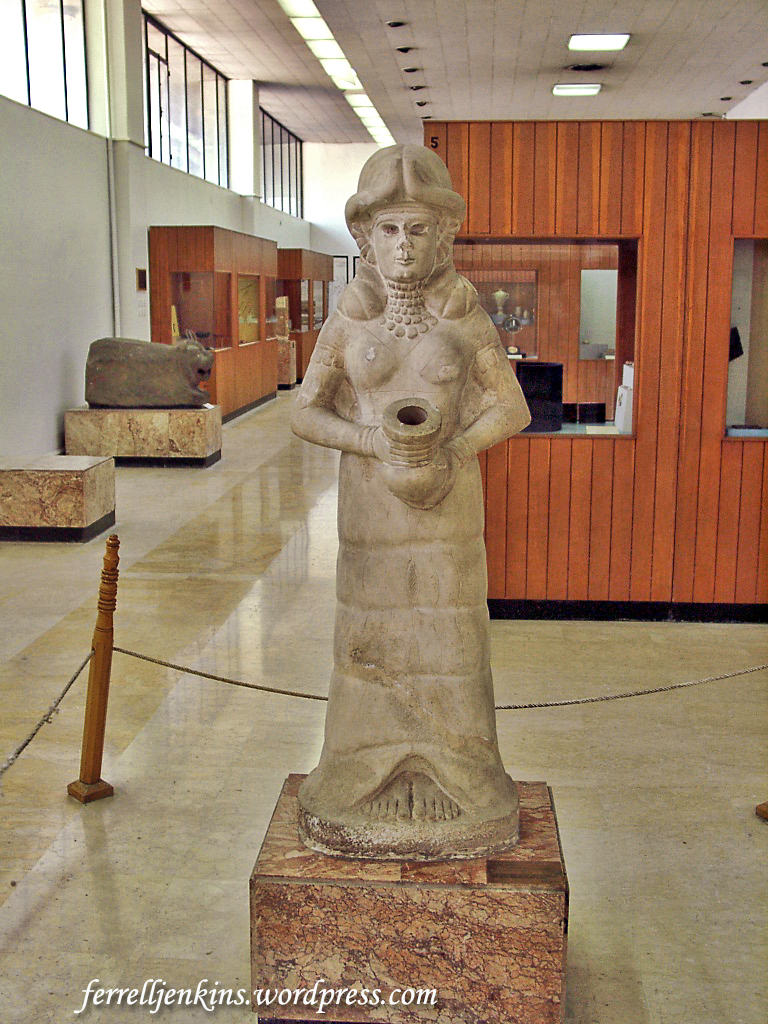
The Amorite Spring Goddess from the 18th century B.C. When I walked in the door of the Museum and saw the impressive statue of an Amorite Spring Goddess I recalled the work of French Archaeologist André Parrot and his comments about the Gushing Vases of Mesopotamia that are displayed in the Louvre.

Amorite Spring Goddess displayed near the main entry of the Aleppo Museum. Photo by Ferrell Jenkins.

Amorite Spring Goddess from the 18th century B.C. displayed near the main entry of the Aleppo National Museum. Photo by Ferrell Jenkins.

In his book Land of Christ, Parrot calls attention to the statement of Jesus in John 7:37-38.

On the last day of the feast, the great day, Jesus stood up and cried out, “If anyone thirsts, let him come to me and drink. Whoever believes in me, as the Scripture has said, ‘Out of his heart will flow rivers of living water.'”  (John 7:37-38 ESV)

Parrot says this passage,

“is an extraordinary and impressive reminiscence of Mesopotamian iconography: monuments from the 3rd, 2nd, and 1st millennia often have representation of male or female deities holding waist-high, in both hands, a vase from which water flows. Rivers literally flow from the heart of the personage represented. Two scholars, Rudolph Bultmann and Millar Burrows, have made the same comparison. They do not explain it, nor do we, but it is nonetheless striking” (page 102).

In our next post on this subject we will show some of the Hittite artifacts.