Category Archives: Archaeology

Ring or no ring, Jesus stood before Pontius Pilate

By this time many people have heard the report on the news or read one of the numerous   articles stating that a ring possibly belonging to Pontius Pilate, the Roman prefect or procurator who condemned Jesus to be crucified, has been found.

The scholarly article on which the reports have been based has been published in Israel Exploration Journal 68:2 (2018). The popular article in The Times of Israel (here) includes a black and white photo of the area in the Herodium where the ring was found. I searched my photos and discovered a color picture I made of the same area in 2011. Even then some reconstructive work was underway.

Photo of the Herodium made from the garden where the ring was discovered. Photo by Ferrell Jenkins.

Photo of the Herodium made from the garden where the ring was discovered. Photo by Ferrell Jenkins in 2011.

Our aerial photo below shows the Herodium in December, 2009. Additional excavations continue to be made on the north side of the artificial mound. The ancient fortress was hidden in the “cone” of the mound.
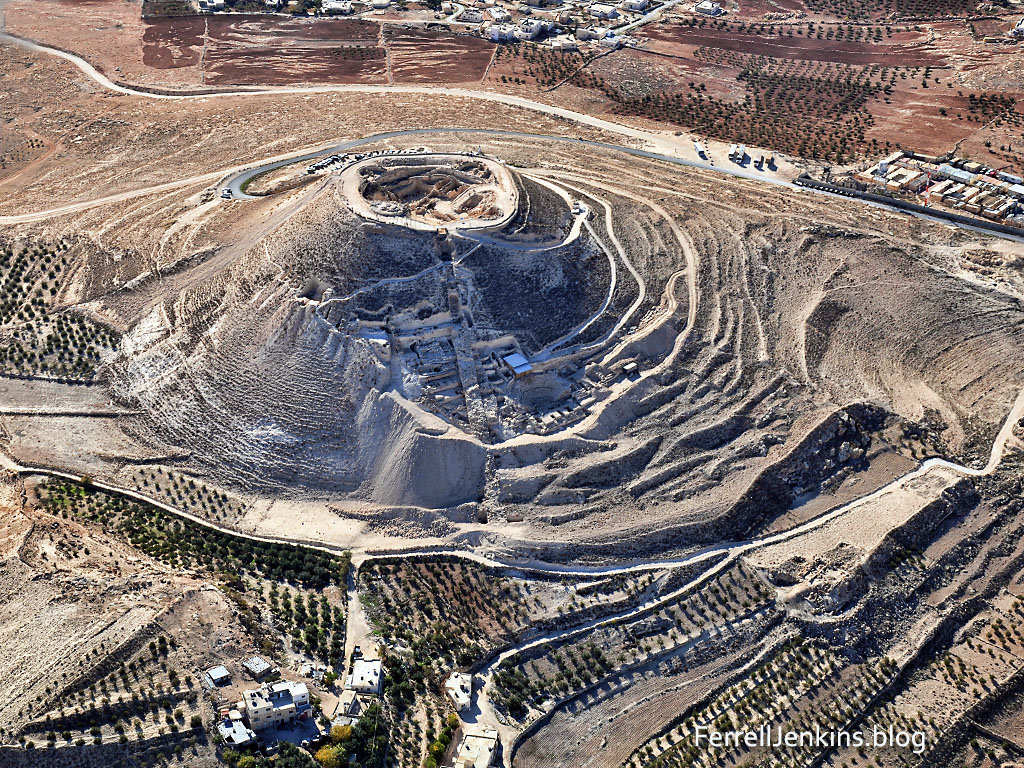
This aerial photo of the Herodium was made in 2009. The ring was found in the garden inside the fortress built by Herod the Great. Photo by Ferrell Jenkins.

This aerial photo of the Herodium was made in 2009. The ring was found in the garden inside the fortress built by Herod the Great. Photo by Ferrell Jenkins.

This ring was found by Hebrew University professor Gideon Foerster during an excavation at the Herodium in 1968-9. Only now have scholars at Hebrew University been able to use modern photographic technology to read the inscription on the ring. The thin ring made of copper-alloy shows a krater with a Greek inscription around it. It reminds one of an ancient coin set in a ring. The krater was often used for mixing wine.
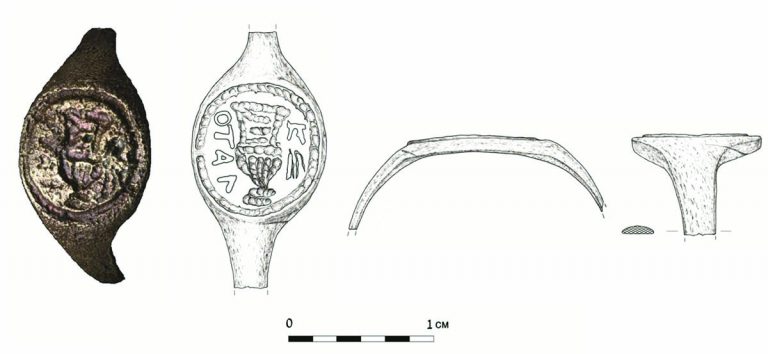
Views and cross section of the ring discovered at Herodium. Drawing: J. Rodman; photo: C. Amit, IAA Photographic Department.

Views and cross section of the ring discovered at Herodium. Drawing: J. Rodman; photo: C. Amit, IAA Photographic Department.

I am not trained in things of this sort, but I immediately wondered about the spelling of the name Pilate. On the ring the Greek inscription is written as PILATO. I wondered why.

Now comes the Bible History Daily written by Robert Cargill, editor of Biblical Archaeology Review.

The ring discovered at Herodium is inscribed in Greek. And while Pilate minted several coins in Greek, he never placed his name on his coins, opting yet again to honor his benefactor, Tiberius, with the Greek inscription ΤΙΒΕΡΙΟΥ ΚΑΙϹΑΡΟϹ (Tiberiou Kaisaros; “of Tiberius Caesar”). Here, Pilate inscribes Tiberius’s name using the Greek genitive, or possessive case, to indicate that the coin was minted during the rule and under the authority of the emperor Tiberius.

Cargill wonders “why” Pilate would inscribe a ring with the name ΠΙΛΑΤΟ (PILATO) in Greek letters. He cites some reasonable info. He suggests one solution offered by Cate Bonesho, Assistant Professor of Hebrew Bible at UCLA. She says,

…ΠΙΛΑΤΟ may be a Greek transliteration of the Latin dative form of the name Pilatus.

You should be able to access Cargill’s article here. Prior to seeing his article I had already prepared a photo of the Pilate inscription discovered at Caesarea Maritima in 1961.

Pilate inscription discovered at Caesarea in 1961. Photo of the original in the Israel Museum. FerrellJenkins.blog.

Pilate inscription discovered at Caesarea in 1961. Photo of the original in the Israel Museum. FerrellJenkins.blog.

More than seven years ago I wrote about the discovery of this stone and the meaning of the inscription here and here.

I like the suggestion made by editor Cargill, and his mention of sources of information we already have.

…the Pilate Stone, hundreds of coins, Josephus, and the Bible itself—there really was a Roman governor in Judea at the time of Jesus named Pilate.

To his list we should add Tacitus and other ancient sources. The most lengthy biblical account is in John 18:29–19:38, but Matthew, Mark, Luke, and Paul also make reference to the event.

Be careful about jumping to conclusions after hearing or reading a brief report about discoveries like this. We have waited this long and we can wait a little longer while those trained in various fields evaluate the evidence.
Trephination was not that uncommon

Archaeologists working at Tel Megiddo excavated skeletons of two brothers from the Canaanite (Late Bronze) period dating to about 3,500 years ago,  who had a “complex medical procedure” known as trephination (or trephanation). An article in Haaretz includes several nice photos in the Premium Magazine here.

A few years ago Leon Mauldin and I traveled to some of the cities along the Turkish Black Sea Coast that may have been associated with the delivery of Peter’s epistles. See the  index of my articles here. In Samsun we visited the small archaeological museum and noted some skulls from Ikiztepe that had undergone the medical practice of trephination.

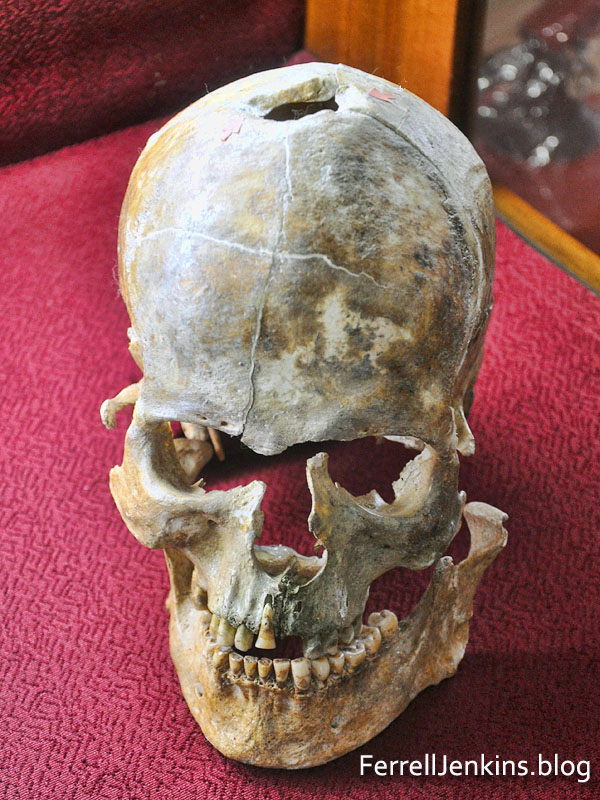
Ancient brain surgery that cut a hole in the skull to relieve pressure is referred to as trepination. A few of the skulls found at Ikiztepe are displayed in the museum. They are said to belong to Bronze Age III. I think that would be in the neighborhood of 1600 B.C. Here are two of the photos I made that show the hole drilled in the skull.

Example of Tripanation, Bronze Age III, Ikiztepe. Samsun Archaeological Museum. Photo by Ferrell Jenkins.

Example of Trepination, Bronze Age III, Ikiztepe. Samsun Archaeological Museum. Photo by Ferrell Jenkins.

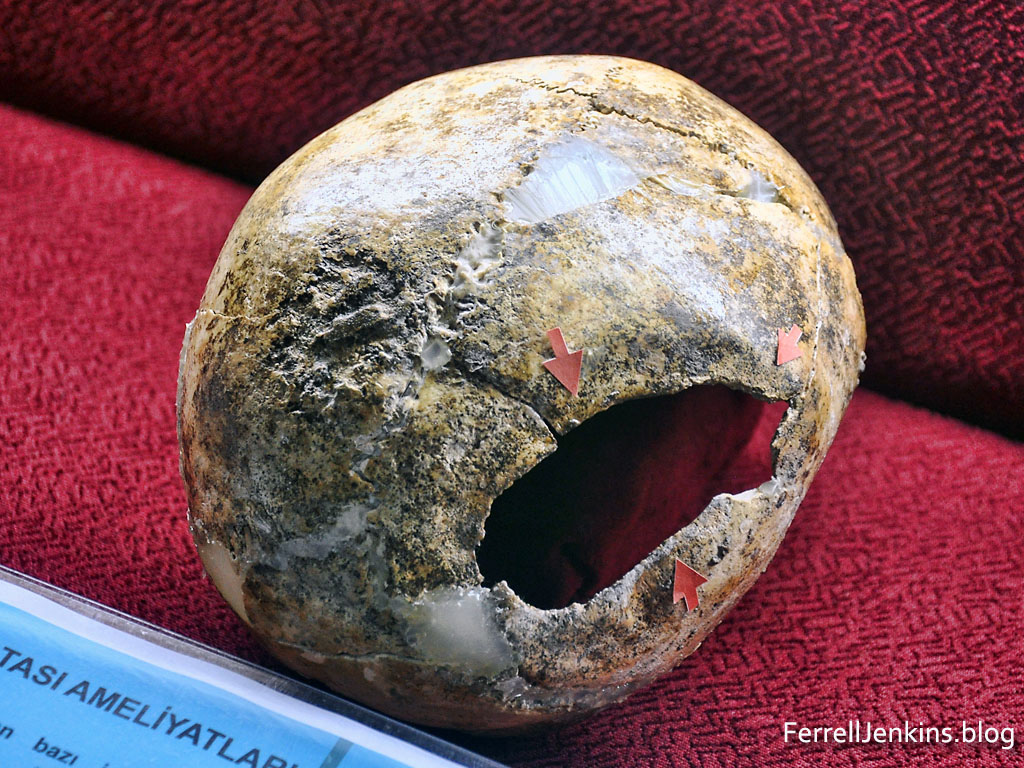
The surgery in the case below required a much larger hole.

Example of Trephenation, Bronze Age III, Ikiztepe. Samsun Archaeological Museum. Photo by Ferrell Jenkins.

Example of Trephenation, Bronze Age III, Ikiztepe. Samsun Archaeological Museum. Photo by Ferrell Jenkins.

There is no indication whether the surgery was successful, or what happened to the surgeon if it failed.

Joe Zias, in an article in Mikhmanim (Spring 1999), says there have been 29 skulls showing trepanation (trephination) discovered in Israel. He says the survival rate based on “inflammatory or bone remodeling” indicate a 77 percent survival rate in these cases. The earlier link I had to this article is broken. I am currently unable to locate a link to this article which also deals with other medical issues in ancient Israel. One of the better known examples comes from Jericho.

Before any surgery involving the skull you should ask your surgeon about his or her grade in trepanation.

Dibon and the Moabite (or Mesha) Stone

Dibon is mentioned in the account of the defeat of King Sihon (Numbers 21:30), and was later built by the sons of Gad (Numbers 32:34). It is located in the “plain of Medeba [Madaba]” (Joshua 13:9), and is associated with Heshbon (Joshua 13:17). Upon the return from Babylon some of the sons of Judah lived in Dibon (Nehemiah 11:25). Both Isaiah (15:2) and Jeremiah (48:18,22) speak of the judgment that is coming, or has come, upon Dibon.

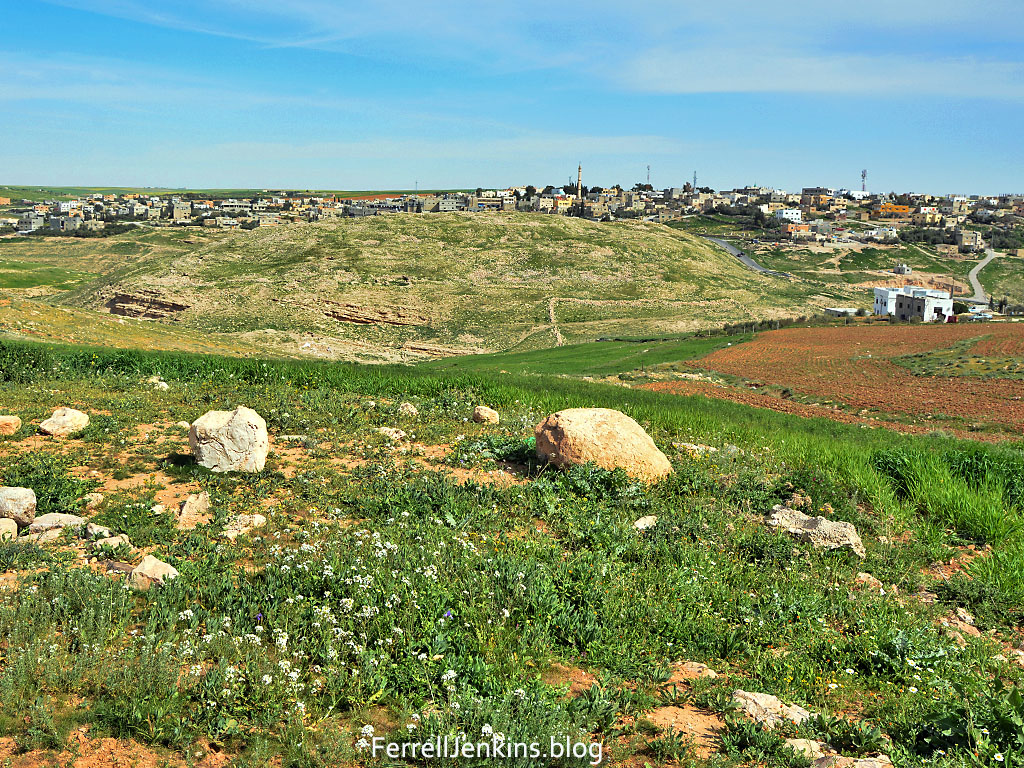
The green hill in the foreground is the ancient site of Dibon. The view is to the east. The modern town of Dhiban, Jordan, is in the distance. Photo by Ferrell Jenkins.

The green hill just above the center of the photo is the ancient site of Dibon. The view to the east shows the modern town of Dhiban, Jordan, in the distance. Photo by Ferrell Jenkins.

Dibon is known today at Dhiban in Jordan. The Moabites were the descendants of Lot, the nephew of Abraham (Gen. 19:37). They settled east of the southern portion of the Jordan River and the northern half of the Dead Sea. There were battles between Israel and Moab during the reigns of Saul and David, but David defeated Moab “and the Moabites became servants to David, bringing tribute” (2 Samuel 8:2). This payment of tribute evidently continued until after the death of Ahab; the Bible records at that time “the king of Moab rebelled against the king of Israel” (2 Kings 3:4ff.).

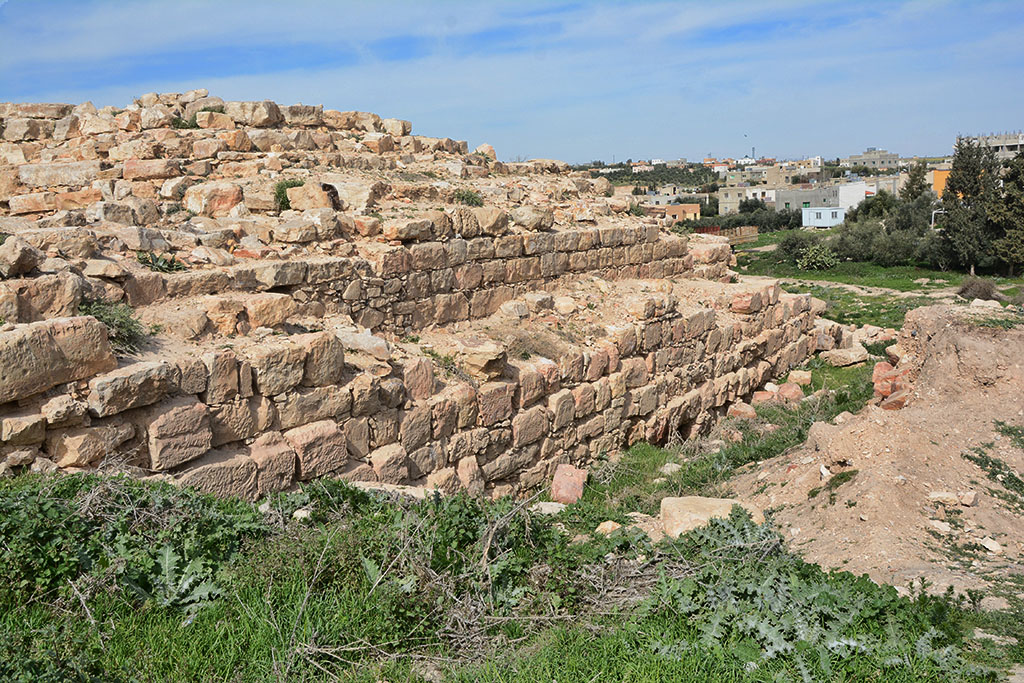
This photo shows some of the ruins on the summit of ancient Dibon. Photo by Ferrell Jenkins.

This photo shows some of the ruins on the summit of ancient Dibon. Photo by Ferrell Jenkins.

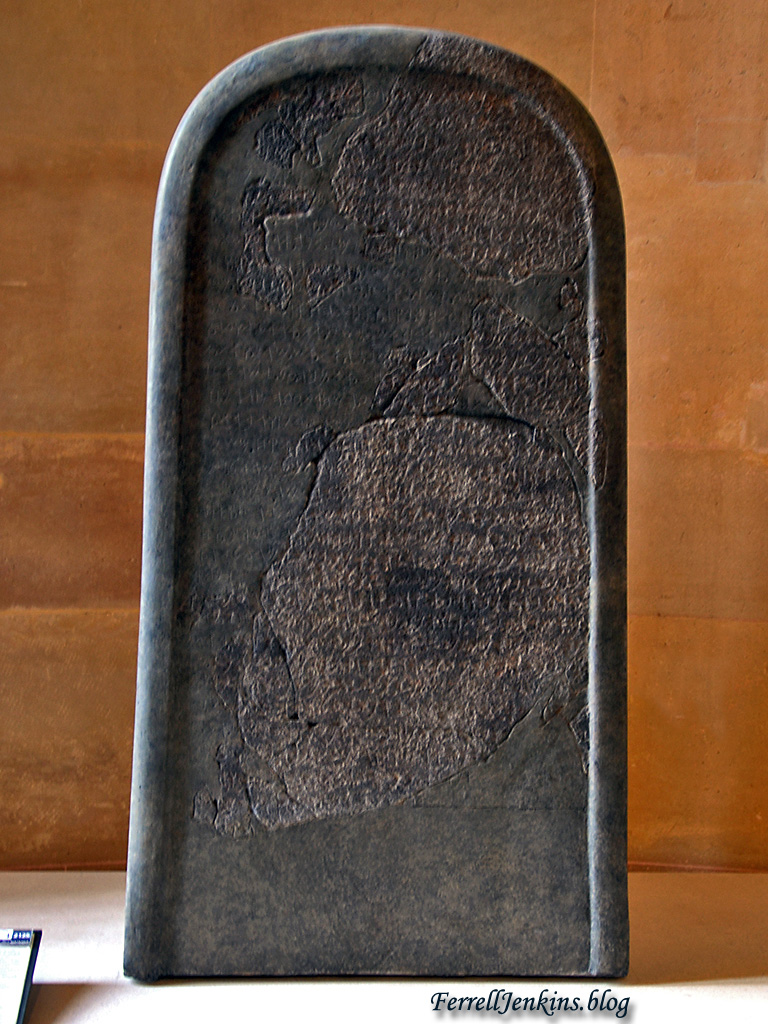
In about 835 BC Mesha, king of Moab, set up a stone to the Moabite god Chemosh (Kemosh) to commemorate his deliverance from the Israelite bondage. This stone, the only Moabite inscription of any significance, was found about 13 miles east of the Dead Sea at Dibon.  It was first discovered by Anglican missionary F. A. Klein in 1868. Klein copied a few words and sought to buy the stone for the Berlin museum for about $400. When the French scholar Clermont-Ganneau learned of the stone he sent an Arab to take a squeeze (a facsimile impression) and offered the natives more than $1,800 for it. The Arabs became suspicious and heated the stone and then poured cold water over it causing it to break into pieces. The natives then distributed the fragments among themselves as amulets and charms. At a later time Clermont-Ganneau was able to recover most of the broken pieces. The original stone of bluish black basalt, two feet wide and nearly four feet high, is now in the Louvre in Paris. Here are a few of the many resources reporting this information: Price, Sellers and Carlson, The Monuments and the Old Testament, 241; The Context of Scripture, Vol. II: 137-138; Jack P. Lewis, Early Explorers of Bible Lands, ch. 7 on Charles Clermont-Ganneau.

The inscription itself mentions David*, Omri, and his son (Ahab, or his grandson Jehoram). Finegan lists 14 places mentioned in the Moabite Stone which are also named in the Bible (Finegan, LAE, 189). The portion of the inscription which tells about the rebellion mentioned in 2 Kings 3:4ff. reads as follows:

Omri was the king of Israel, and he oppressed Moab for many days, for Kemosh was angry with his land. And his son7 succeeded him, and he said — he too — “I will oppress Moab!” In my days did he say [so], but I looked down on him and on his house, and Israel has gone to ruin, yes, it has gone to ruin for ever! (K. A. D. Smelik in Context of Scripture, Vol. II: 137-138)

*André Lemaire argues, based on the recently cleaned squeeze of the Mesha Stela, that line 5 mentions the “house of Israel” and line 31 mentions the “house of David.” Both of these kingdoms are also mentioned in the stela discovered by Avraham Biran at Tel Dan. (“House of David” Restored in the Moabite Inscription, BAR 20:03 (May/June 1994). Lemaire’s translation of the inscription is included with the article.

The Mesha or Moabite Stone displayed in the Louvre, Paris. Photo by Ferrell Jenkins.

The Mesha or Moabite Stone displayed in the Louvre, Paris. Photo by Ferrell Jenkins.

Was Philip martyred at Hierapolis/Pamukkale?

A recent article by an Italian journalist Giuseppe Mancini in al-Monitor caught my attention earlier this week. He says,

Hierapolis is the most popular archaelogical site in Turkey, with its peak of 2 million tourists in 2014 and a comparable number anticipated for 2018. In fact, most of them — largely Russians on day trips from Antalya — see only the natural features of the place: the white cascades of travertine created by thermal waters flowing downhill. The venue is better known in Turkish as Pamukkale, literally the “cotton castle,” whose light blue natural pools are featured in every tourism brochure.

Mancini discusses the archaeological work done by Italian scholars. In 2011 they were convinced that they had located the tomb of Philip the Apostle (Matthew 10:3). He laments that most of the tourists visit only a limited area of Pamukkale.

Few tourists walk the paved roads among the ruins or sit in the well-preserved theater. Fewer still are adventurous enough to climb the steep hill overlooking Pamukkale and Hierapolis — guides apparently advise against going there — where the Christian St. Philip the Apostle was killed, buried and venerated for many centuries.

I have observed the same thing and understand the reasons. (1) The tomb of Philip is an archaeological site. (2) It is a relatively long distance from the cascades, pools, and shops. (3) Tour groups are limited in time and (4) the greater number of tour members would not take time to visit a site like this. Let me show you.

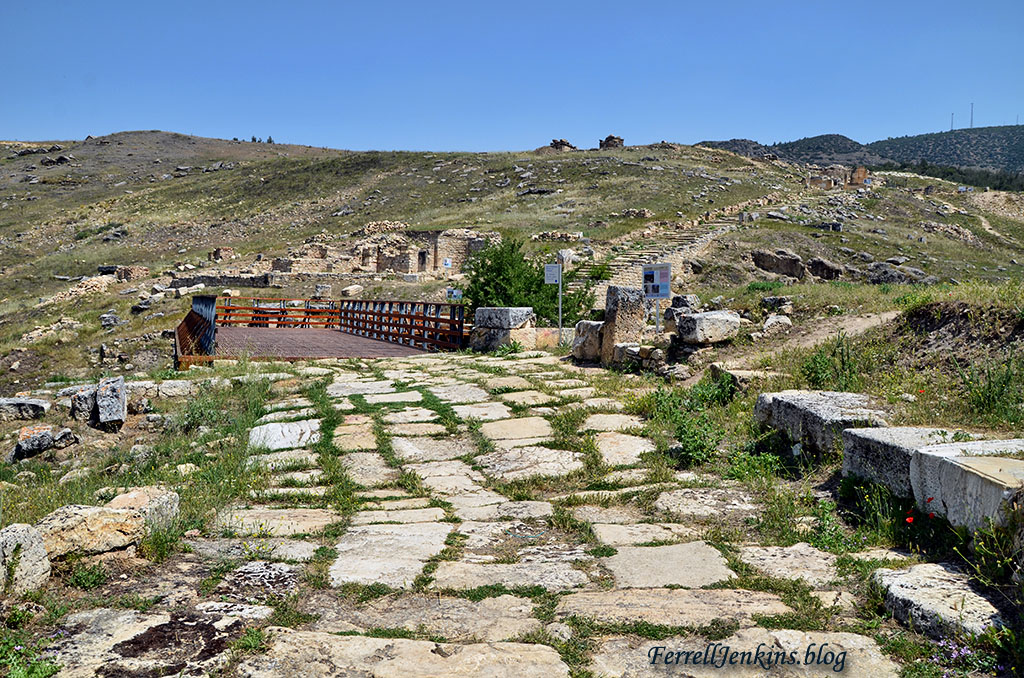
You will be able to see the buildings dedicated to Philip right of the center of the photo on the top of the hill. First you get to walk on ruins of an ancient road.

After walking a rather long distance to the approach to the Martyrium of Philip, we come to this road. Photo by Ferrell Jenkins.

After walking a rather long distance to the approach to the Martyrium of Philip, we pass through the Byzantine walls of Hierapolis. Photo by Ferrell Jenkins.

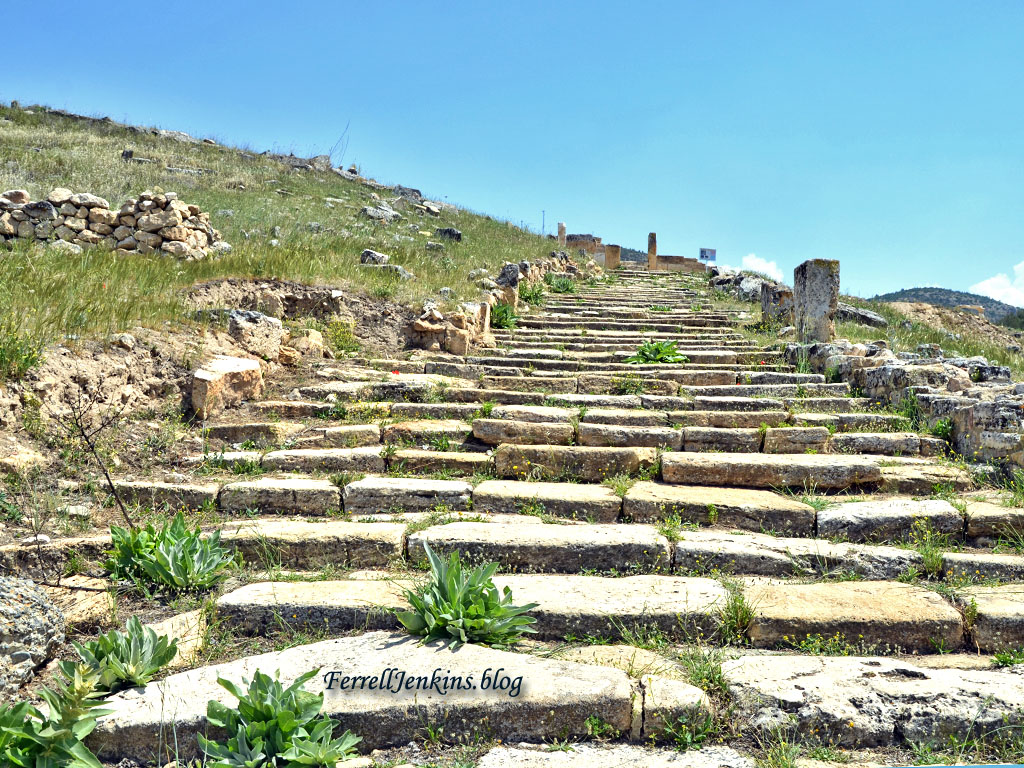
But that is not all. Next you must climb these steps to a plateau near the tomb and complex of buildings.

Tradition associates this with Philip the Apostle, but some scholars think the reference is to Philip the Evangelist. Photo by Ferrell Jenkins.

Tradition associates these steps with the Martyrium of Philip the Apostle. Photo by Ferrell Jenkins.

When you think you have almost arrived, you see steep steps that must be climbed to the plateau where the Martyrium is located.

The final steps leading to the Martyrium of Philip. Photo by Ferrell Jenkins.

The final steps leading to the Martyrium of Philip. Photo by Ferrell Jenkins.

Then you come to the ruins of the church where pilgrims came to honor Philip.

The tomb of Philip is said to have been in this building. Photo by Ferrell Jenkins.

Pilgrims came to this building to honor Philip. Photo by Ferrell Jenkins.

There is another building of significance at the site. It is an octagonal building said to have been where Philip was martyred. Only the strongest portions of the building stand.

The Martyrium of Philip was built in the early 5th century A.D. on the site thought to be where Philip was martyred. Photo by Ferrell Jenkins.

The Martyrium of Philip was constructed in the early 5th century A.D. on the site thought to be where Philip was martyred. Photo by Ferrell Jenkins.

Fant and Reddish say,

The martyrium was apparently used neither as a church (no altar has been found) nor as a burial site (no tomb has been found) but rather served as a place for processions and special services in honor of the saint. (A Guide to Biblical Sites in Greece and Turkey, p. 215).

According to Fatih Cimok these building were destroyed by fire in the 6th century and never rebuilt (Biblical Anatolia, p 160).

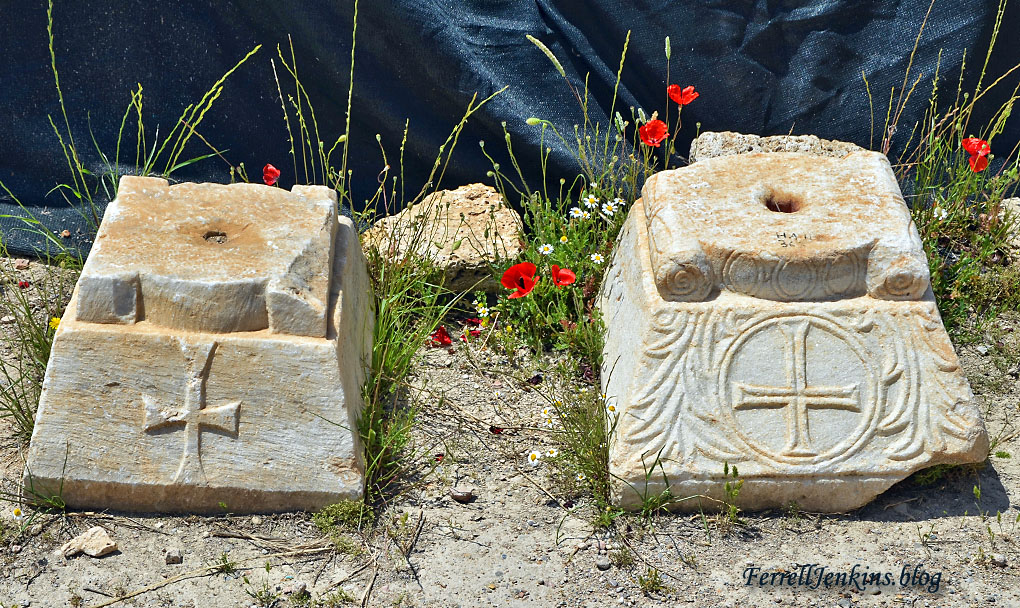
A number of crosses are found at the site engraved on various stones. Cimok says,

Inscriptions speak of “the people of the Jews,” “the settlement of the Jews who dwell in Hierapolis,” and “The archives of the Jews.” (Ibid.)

Crosses on column bases in the Martyrium of Philip at Hierapolis. Photo by Ferrell Jenkins.

Crosses on column bases in the Martyrium of Philip at Hierapolis. Photo by Ferrell Jenkins.

There is much more to see at Hierapolis, including a small but nice museum. Perhaps at a later time I will show you the Hellenistic Theater, the street and arch dedicated to Emperor Domitian, and some of the elaborate tombs. In fact, some have been discussed before. You may locate the posts by typing Hierapolis or Pamukkale in the Search Box.

Resources: In addition to sources cited here, I cited Mark Wilson’s Biblical Turkey in the previous post. These are wonderful resources to use in preparation for a trip to Turkey.

Visit Hierapolis at modern Pamukkale, Turkey

The city of Hierapolis (“holy city”) is one of the three cities of the Lycus River valley named in the New Testament.

For I bear him witness that he has worked hard for you and for those in Laodicea and in Hierapolis. (Colossians 4:13 ESV).

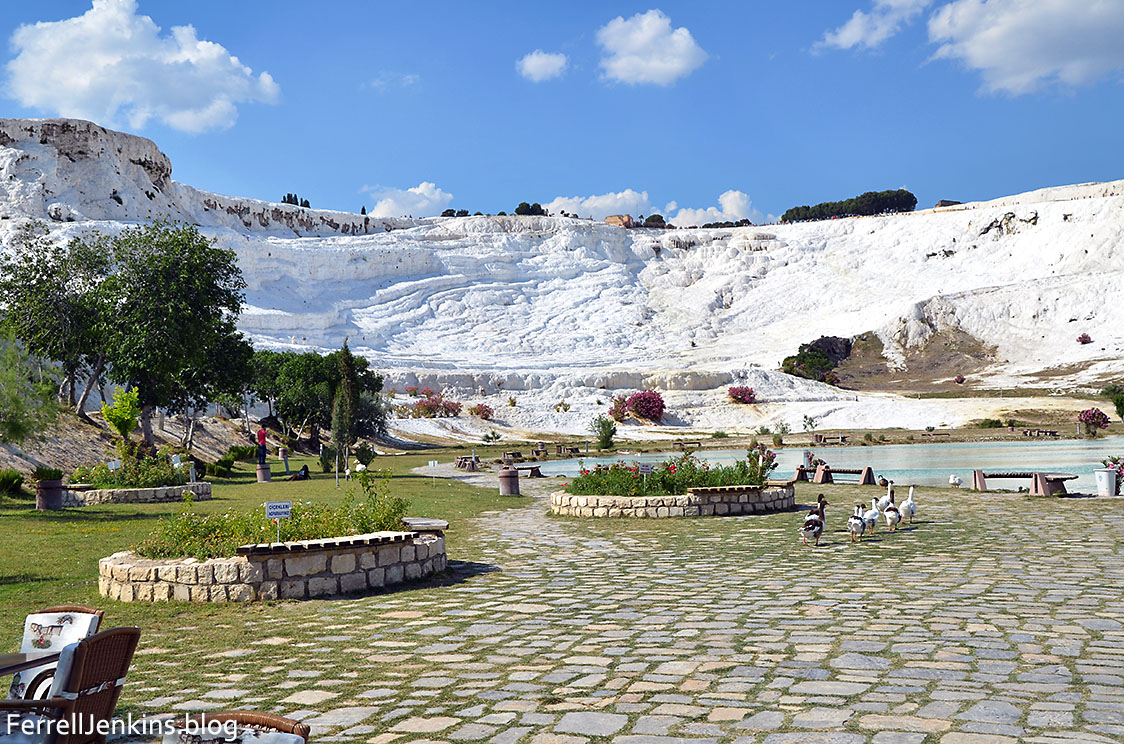
Today Hierapolis is known as Pamukkale, Turkey. The name Pamukkale means “cotton castle” or “cotton fortress,” a name derived from the limestone formation at the site. Mellink describes the formation. He says the city,

… is famous for its continuing geological transformation. Hot mineral springs issue from the rock in the city, and the waters streaming down the cliffs have deposited limestone in large formations, the surface of which is made a gleaming white ‘frozen cascades’ (IDB II:601).

A view of the travertine formation that has formed as a result of the warm water running over the hillside. Photo by Ferrell Jenkins.

A view of the limestone cascade that has formed as a result of the warm water running over the hillside. The spring water at the source is a constant 30º celsus (95º for the rest of us). Click the photo for a larger image. Photo by Ferrell Jenkins.

Hierapolis was the home of Papias (c. A.D. 60 to c. A.D. 130), a disciple of the apostle John and a companion of Polycarp. Some traditions associate Philip with the city. All of the information at the site identify this as Philip, one of the apostles of Jesus (Matthew 10:3). Some scholars suggest the association was with Philip the evangelist (Acts 6:5; 8:5; 21:8). Wilson briefly sorts through the confusion and concludes the better evidence indicates the apostle Philip (Biblical Turkey, 245).

In the 5th century A.D. a monument called the Martyrium of Philip was built to remember the disciple of the Lord from Palestine. In the next post we will show some photographs of the ruins of the monument.

“Jerusalem” 2,000 Year-Old Stone Inscription Uncovered During Dig

An inscription dating from the time of the Second Temple (the time of Herod the Great and the ministry of Jesus, up to A.D. 70) has been uncovered in a salvage excavation by The Israel Antiquities Authority. According to an IAA news release the stone inscription is the first inscription discovered “mentioning Jerusalem written in Hebrew letters, and using the spelling as we know it today.”

The release says,

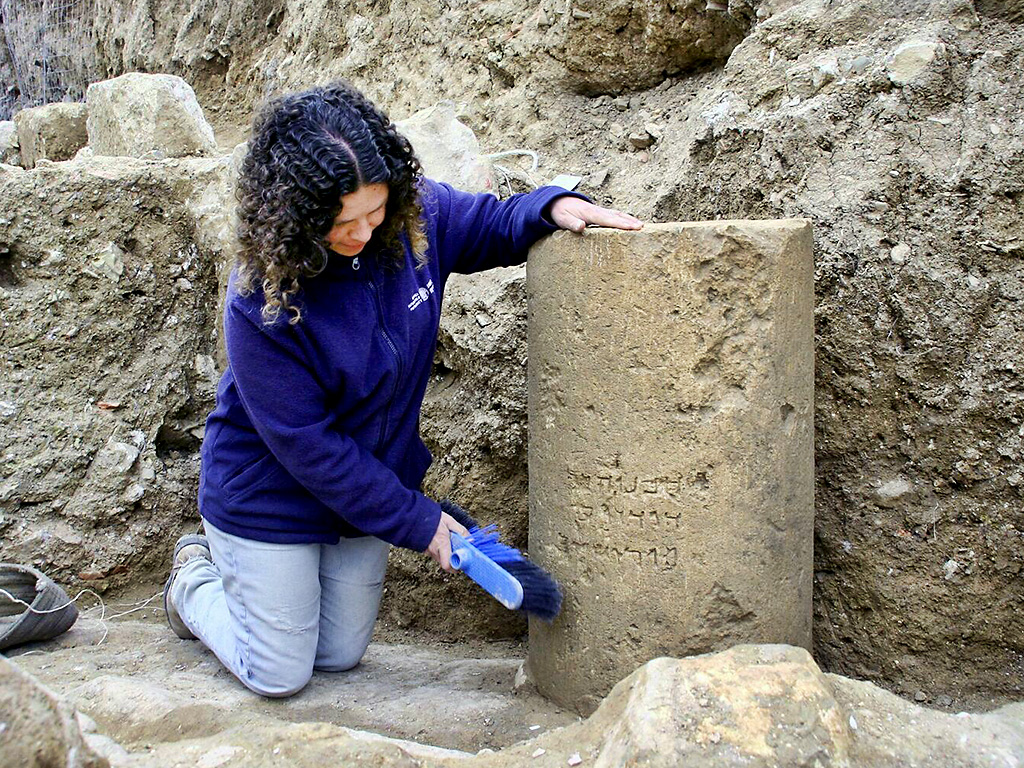
The inscription was found this last winter near Binyanei Ha’Uma [International Convention Center], during an excavation directed by the IAA’s Danit Levy, prior to the construction of a new road, undertaken and funded by Moriah – the Jerusalem Development Company and the Jerusalem Development Authority. During the excavations, the foundations of a Roman structure were exposed, which were supported by columns. The most important discovery was a stone column drum, reused in the Roman structure, upon which the Aramaic inscription appears, written in Hebrew letters typical of the Second Temple Period, around the time of Herod the Great’s reign. The inscription reads:

Hananiah son of
Dodalos
of Jerusalem

Danit Levy, Director of the excavations on behalf of the Israel Antiquities Authority, beside the inscription as found in the field. Photo: Yoli Shwartz, IAA

Danit Levy, Director of the excavations on behalf of the Israel Antiquities Authority, beside the inscription as found in the field. Photo: Yoli Shwartz, IAA.

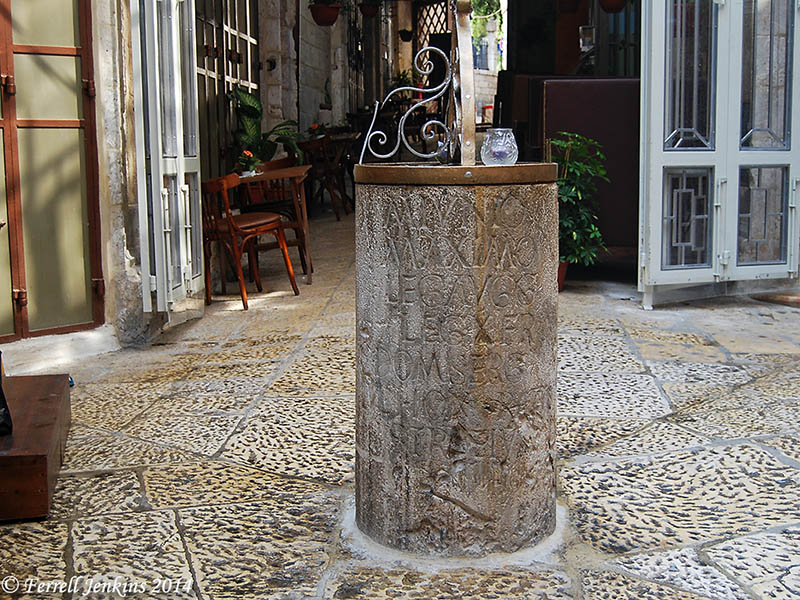
Among other reasons, I find this stone interesting because it reminds me of the post on a side street just inside Jaffa Gate. There is no indication that this was ever a column; it was just a post with an inscription mentioning the Tenth Roman Legion.

Close-up of Roman column mentioning 10th Roman legion. Photo by Ferrell Jenkins.

Close-up of Roman column mentioning 10th Roman legion. Photo by Ferrell Jenkins.

Murphy-O’Connor (The Holy Land) says the post honors the Legate of the emperor Septimius Severus, and was erected about A.D. 200. He gives the following reading of the inscription:

M(arco) Iunio Maximo leg(ato) Aug(ustorum) Leg(ionis) X Fr(etensis) — Antoninianae — C. Dom(itius) Serg(ius) str(ator) eius.

The tenth legion participated in the destruction of Jerusalem in A.D. 70, and remained in the city for about 200 years.

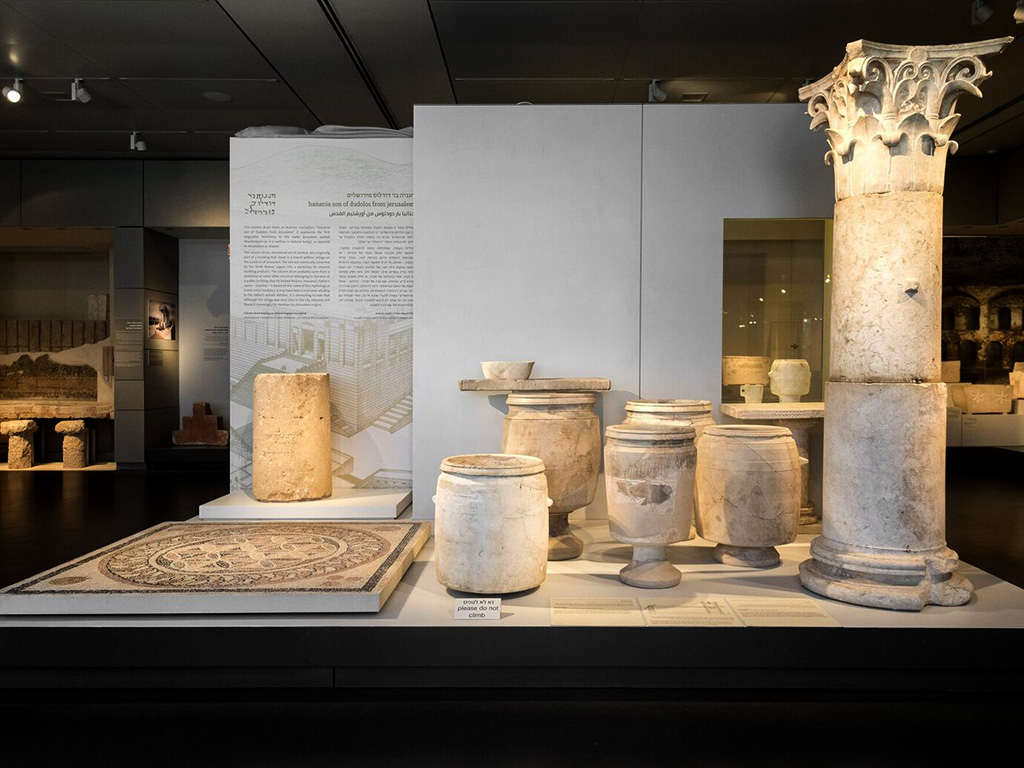
The recently discovered inscription is now on display in the Israel Museum. If you have visited the Israel Museum you will notice that the inscription has been placed beside the stone jars and others items from the so-called Herodian Mansion (Wohl Museum) in the Old City.

More details about this discovery may be found in the IAA Press Release here.

The unique inscription from Jerusalem, as displayed at the Israel Museum. Photo: Laura Lachman, Courtesy of the Israel Museum.

The unique inscription from Jerusalem, as displayed at the Israel Museum. Photo: Laura Lachman, Courtesy of the Israel Museum.

Check our index on the Index of articles on the Romans and the Ministry of Jesus here.

HT: Joseph Lauer and the various Israeli newspapers.

The Cedars of Lebanon

The Bible records that King David provided materials for a proposed temple in Jerusalem before his death.

…and cedar timbers without number, for the Sidonians and Tyrians brought great quantities of cedar to David. (1 Chronicles 22:4 ESV; see verses 1-5)

  • The cedars were floated from Lebanon to Joppa for Solomon’s Temple (2 Chronicles 2:16).
  • Hiram, king of Tyre, built a cedar house for David (2 Samuel 5:11; 7:2).
  • Solomon requested that Hiram have cedars of Lebanon cut for him (1 Chronicles 22:7).
  • Cedars from Lebanon again were floated to Joppa for the rebuilding of the temple (520-516 B.C.; Ezra 3:7).

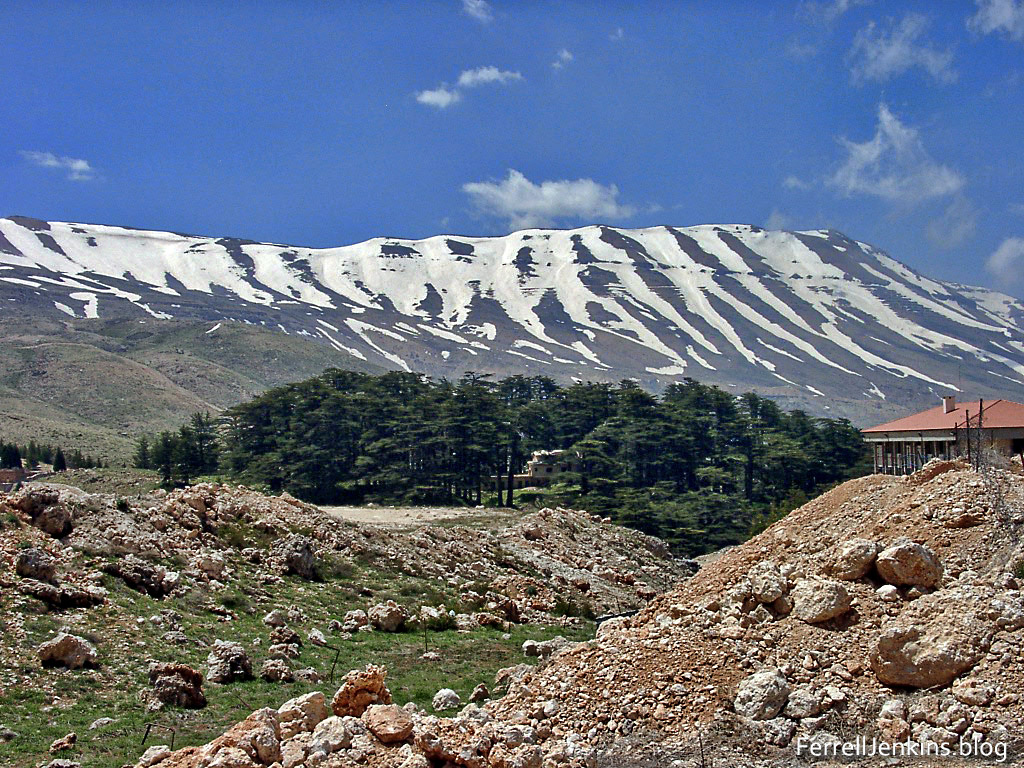
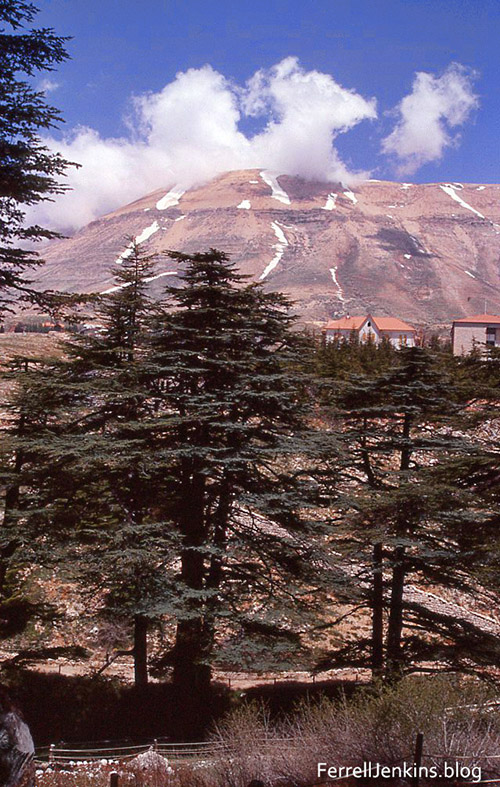
Only a few of the fabled cedars remain in Lebanon. One cluster of trees grow at Besharre in the north of Lebanon at an elevation of about 5000 feet or more above sea level. Our photo below was made in May, 2002, when there was some snow still on the surrounding mountains.

A view of the clump of cedars at Besharre, Lebanon. FerrellJenkins.blog.

A view of the clump of cedars at Besharre, Lebanon. Photo by Ferrell Jenkins.

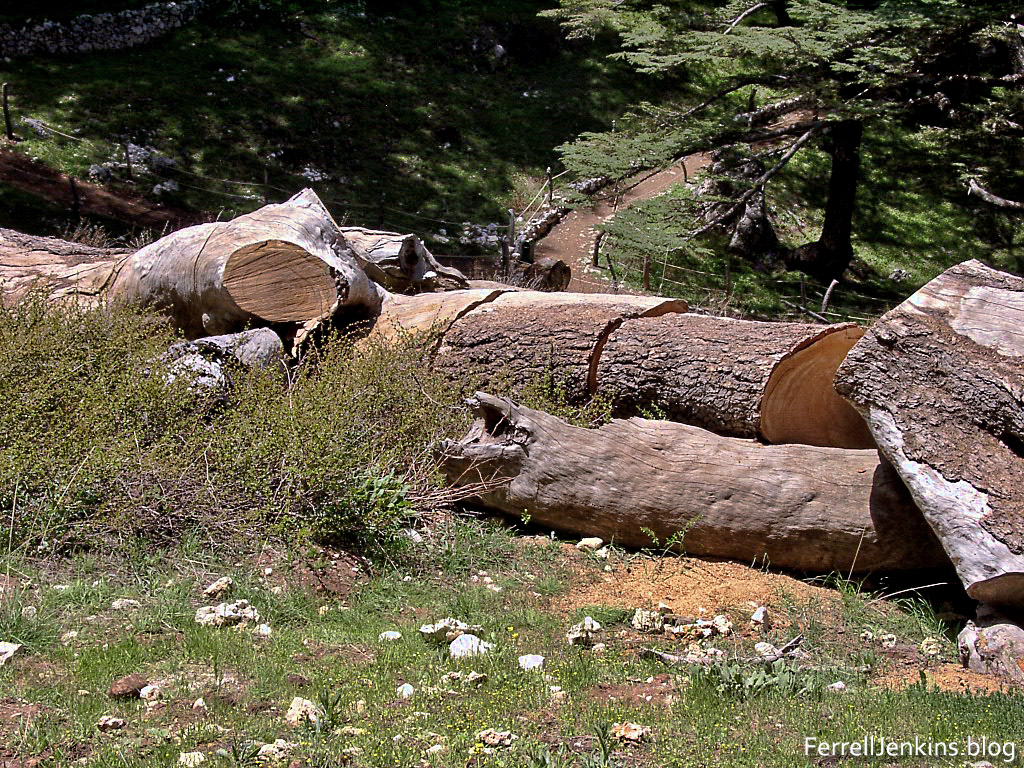
The cedars in Lebanon are now protected and may be cut for the wood only when a tree has fallen.

A fallen cedar at Besharre in northern Lebanon. FerrellJenkins.blog.

A fallen cedar at Besharre in northern Lebanon. Photo by Ferrell Jenkins.

The Cedrus libani is described in Fauna and Flora of the Bible.

The enthusiasm with which the OT writings praise the cedar of Lebanon is understandable. It is a majestic tree of great beauty, reaching 27 m [88 ft.] in height and 12 m [39 ft.] in girth. Its long branches spread out horizontally from the trunk, and the leaves are dark and evergreen, glittering like silver in the sun. The cones take three years to mature. The fragrant wood is much sought after for building purposes, as it does not easily rot. Its great value as timber is often mentioned, especially in the history of King Solomon. (p. 108)

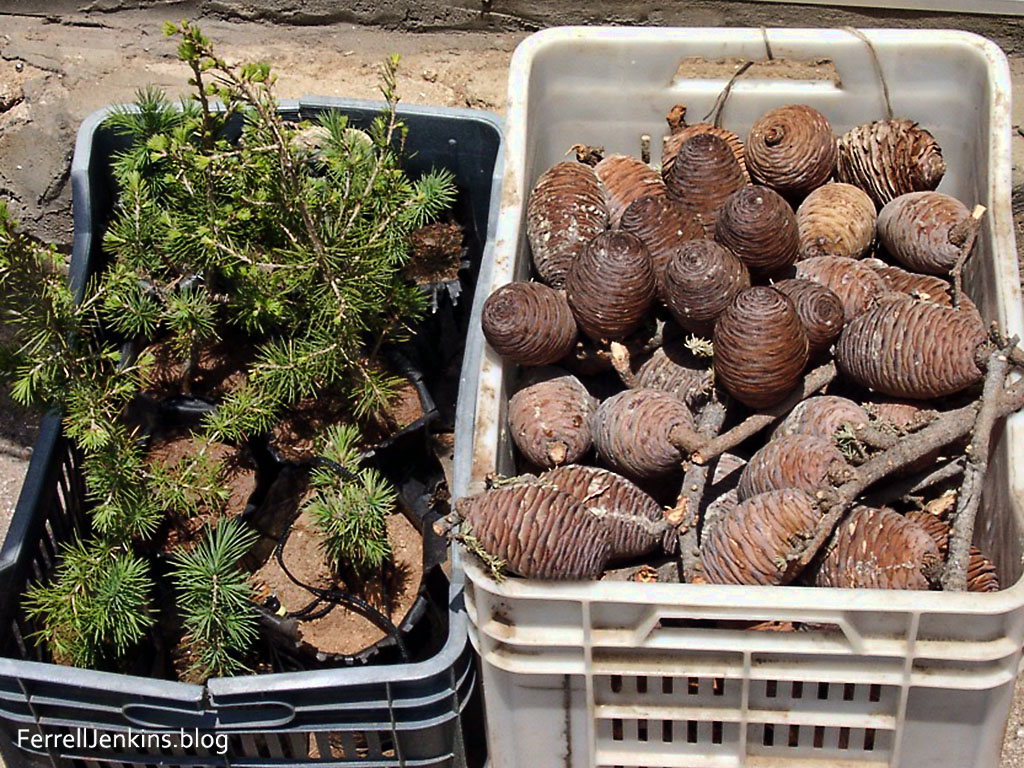
Small twigs and cones from the cedars of Lebanon. ferrelljenkins.blog.

Small potted plants and cones from the cedars of Lebanon. Photo by Ferrell Jenkins.

The next photo illustrates how the branches “spread out horizontally from the trunk.” This tree is different from the cedars so many of us have enjoyed for Christmas trees.

A few of the Cedars of Lebanon at Besherre. ferrelljenkin.blog.

A few of the Cedars of Lebanon at Besherre. Photo by Ferrell Jenkins.

Not so many of the cedars remain because various nations have used them in buildings projects.

We have an example in a temple from the Late Bronze Age, a period of Egyptian control at Lachish. The description of the temple by David Ussishkin is fascinating, but I must concentrate on two things. Several charred beams were found on the floor of the building. Ussishkin says,

The roof was spanned by long wooden beams laid parallel to one another across the main hall. Their charred remains, identified as cedar of Lebanon, were found lying on the floor; altogether, remains of about ten beams could be detected along the southern part of the hall… (Ussishkin, David. “Excavations at Tel Lachish – 1973-1977.” Tel Aviv 5:1-2 (1978): 1-97: 13.

This temple is also designated as the Acropolis Temple. Information about it, including a plan and reconstruction drawings are found in Ussishkin, Biblical Lachish, pp. 140-164.

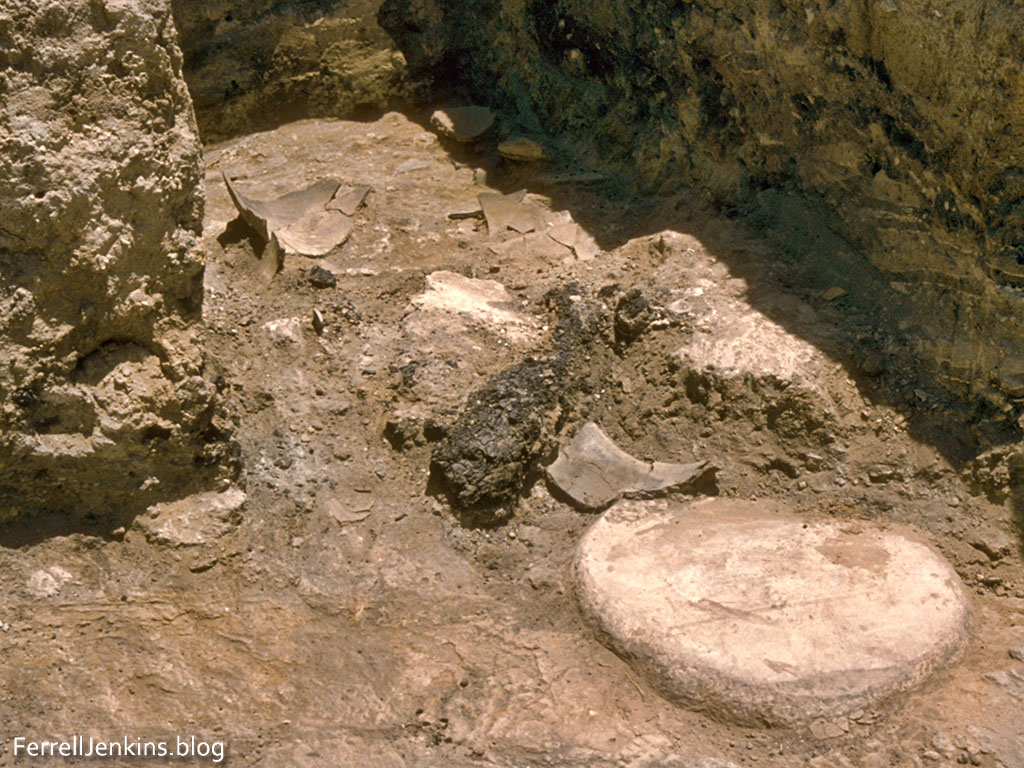
In our photo below that I made in 1980 only one piece of wood remains (in the center of our photo).

Charred beam made of Cedar of Lebanon in the Egyptian-period temple at Lachish. Photo by Ferrell Jenkins, 1980.

Charred beam made of Cedar of Lebanon in the Egyptian-period temple at Lachish. Photo by Ferrell Jenkins, 1980.

Notice the column base. Two of these were found in the temple. The scholars who analyzed the carbonized beams with a diameter of about 30 cm [12 inches]. Cedar trunks of that diameter could have been 14 metres [45 feet] or longer, and thus easily capable of spanning the ceiling across the main hall without additional support (Usshishkin, Excavations).

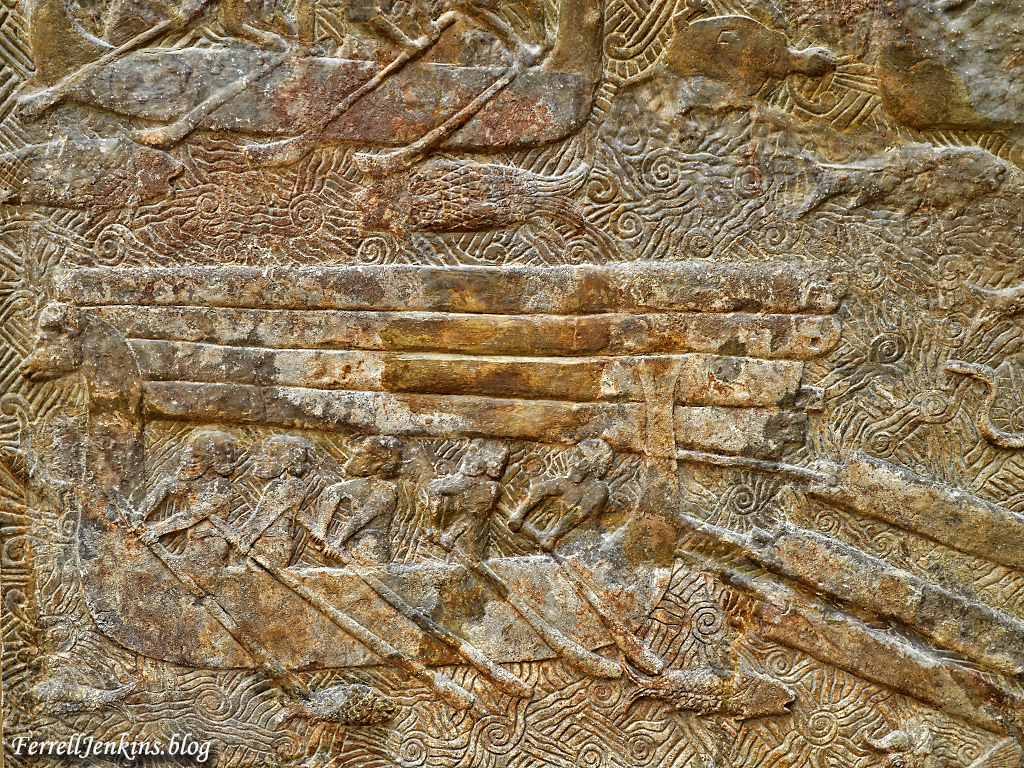
Ancient nations used the cedar of Lebanon for their boats and buildings. Several panels are displayed in the Louvre showing boats transporting logs of cedars of Lebanon for use in the palace of Sargon. Our photo shows a small portion of one panel.

Assyrians transporting cedar of Lebanon for their buildings. Louvre. Photo by Ferrell Jenkins.

Assyrians transporting cedar of Lebanon for their buildings. Period of Sargon II (721-705 BC). Louvre. Photo by Ferrell Jenkins.

Dr. Jack P. Lewis — 1919 – 2018

We note the death of Dr. Jack Pearl Lewis earlier this week on July 24th. The name Jack Pearl Lewis will be unknown to many readers of this blog. Others will recognize his name and his work. I write here because he was an outstanding biblical scholar who played a part in my travel experiences.

Lewis was a founding faculty member at the Harding Graduate School of Religion in Memphis, now known as Harding School of Theology. At the time of his retirement he was named Professor Emeritus. Among several good teachers that I had, Lewis was unique. He held two earned doctorates, a Ph.D. in New Testament from Harvard, and a Ph.D. in Old Testament from Hebrew Union. He was the most demanding teacher I had, and one of a few from whom I learned the most.

After the high school years at Athens Bible School, and four years of Bible at Florida Christian College (now Florida College), with teachers such as Homer Hailey and Franklin T. Puckett, I had a good general knowledge of the Bible. I think I had about 60 hours of Bible at FCC. I had added about seven years in full-time preaching before attending the Graduate School. The graduate work was not too difficult, it was just on a more demanding advanced level. Dr. Lewis was always available to talk with if you could locate him among all of the books in his office.

It was part of the graduate program generally, but Lewis taught the importance of using primary sources where possible and the importance of thorough preparation. He entered the class room, called the roll, and began lecturing. As a student I made notes the best I could, then spent hours after each class verifying the names, dates, and facts presented. Different from the students I had in college, we would never imagine asking “How do you spell that?” He taught us the importance of using up-to-date sources in our research.

Jack Lewis was my first teacher who had spent a considerable amount of time studying the land of the Bible. He had worked in the archaeological excavation at Arad, and had spent a year as a fellow at the American Schools of Oriental Research in Jerusalem (now the Albright Institute).

In one of the classes with Dr. Lewis I did a paper on “Authentic First Century Remains in Palestine.” Soon afterward I began to prepare for my own visit to the Bible lands. I might have gone anyway, but I must credit Dr. Lewis, and his unique insight into the land of the Bible, for spurring my interest in traveling to this part of the world. The last time I visited with him was March 6, 2008, at Faulkner University where he made a couple of presentations and was honored for his work. As we visited, he said something like this: “There is nothing as valuable as seeing the places you study about.” So, now you know one of the major motivations in my travels to Bible lands over all these years since the first trip in 1967. I still learn on every trip, and in the preparation for the trip.

Dr. Lewis was a prolific writer. His many books included The History of the English Bible from the KJV to the NIV, The Interpretation of Noah and the Flood in Jewish and Christian Literature, Historical Backgrounds to Bible People, and a two-volume commentary on the Gospel of Matthew. There are also books on the prophets and other areas of biblical studies.

One of the lectures given by Dr. Lewis at Faulkner University was on “The Battle for the Integrity of the Bible.” In his typical rapid-fire manner, he surveyed the battles that have been won in demonstrating the integrity of the Bible. It was just a survey, but he seemed as sharp as in those classes on The History of the English Bible and on Archaeology and the Bible from which I profited so much.

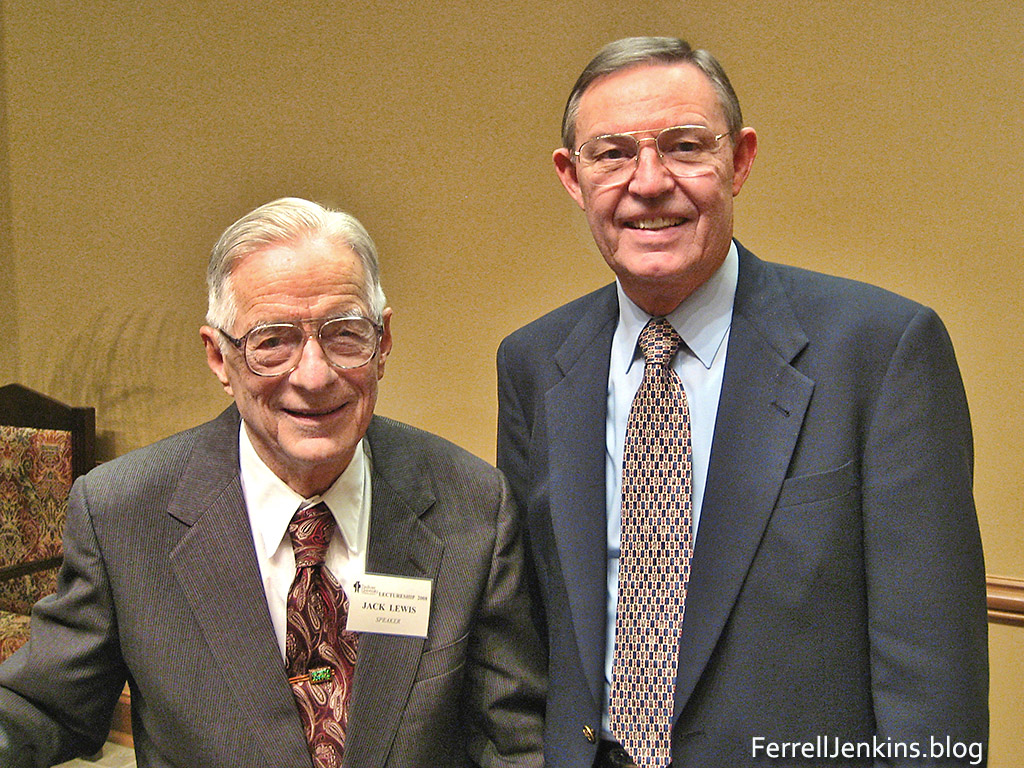
Dr. Jack P. Lewis and Ferrell Jenkins. FerrellJenkins.blog.

This photo was made March 6, 2008, after the lecture on “The Battle for the Integrity of the Bible” at Faulkner University. Photo by Leon Mauldin.

If you would like to learn a little about the background of this unique man we suggest his 2012 autobiography, As I Remember It.

I wrote some of this material back in 2008 after the visit with Dr. Lewis. When our mutual friend, Don Meredith, the librarian at HST, saw it he printed it for Dr. Lewis. Here is the response I received from Dr.Lewis:

I appreciate very much the kind things you had to say.  I am trying to get finished the work on the twelve prophets I started more than twenty years ago.  I am a great one at starting, but less successful in finishing. I will look forward to seeing you in Boston in November  [at the annual professional meetings].  Sincerely, Jack P. Lewis.

The Shema Seal from Megiddo

Perhaps you have seen a drawing or a photo of a replica of the Shema Seal. Professors Israel Finkelstine and David Ussishkin, directors of the most recent major excavation at Megiddo, tell us about the discovery.

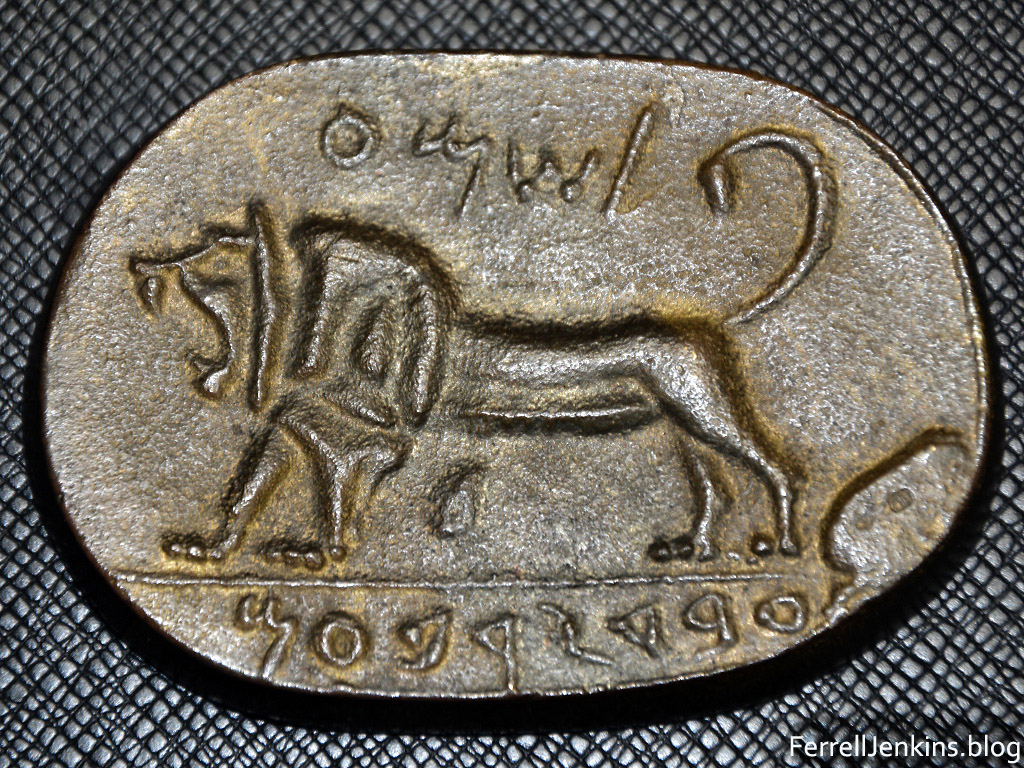
The first excavation of the site was undertaken between 1903 and 1905 on behalf of the German Society for the Study of Palestine by Gotlieb Schumacher, an engineer who lived in the German community of Haifa. Schumacher cut a 65-foot-wide trench across the mound from north to south and a number of smaller trenches in other parts of the site, identifying six building levels. His most famous find is a jasper seal portraying a roaring lion and inscribed “(belonging) to Shema, servant of Jeroboam.” Shema was apparently a high official of the king of the northern kingdom, either Jeroboam I (end of tenth century B.C.E.) or Jeroboam II (eighth century B.C.E.). This striking emblem of a powerful lion was sent by Schumacher to the Turkish Sultan in Constantinople, who kept it there in his royal collection. It is not clear what happened to it later, but today its whereabouts are unknown. (“Back to Megiddo.” Biblical Archaeology Review, Jan/Feb 1994).

McKinny dates the reign of Israelite king Jeroboam II from 793 to 753 B.C. He says there was a sole reign of 29 years and a joint reign of 12 years with Jehoash (Regnal Chronology of the Kings of Judah and Israel: An Illustrated Guide, 21). The biblical reference says,

In the fifteenth year of Amaziah the son of Joash, king of Judah, Jeroboam the son of Joash, king of Israel, began to reign in Samaria, and he reigned forty-one years. (2 Kings 14:23 ESV)

On one of my earliest tours, either 1967 or shortly thereafter, I purchased a metal desktop paper weight replica of the Shema seal. It may have been at the shop at Megiddo or at the Rockefeller Museum. It is certainly larger than the original jasper seal. The photo which I recently made of my “seal” is slightly different in detail from the one included in Ussishkin’s study in Coogan, et al., Scripture and Other Artifacts, 410-428. (See also Pritchard, The Ancient Near East: An Anthology of Texts and Pictures, 75.)

This is a replica that I bought during one of my earliest trips, perhaps in 1967. I think it may have been at Megiddo or at the Rockerfeller Archaeological Museum. Photo by Ferrell Jenkins.

This is a replica that I bought during one of my earliest trips, perhaps in 1967. I think it may have been at Megiddo or at the Rockefeller Archaeological Museum in Jerusalem. Photo by Ferrell Jenkins.

Ussishkin describes the original seal:

The seal of Shema is an unpierced scaraboid of jasper measuring 37 by 27 by 17 mm; it portrays a roaring lion and contains the inscription … “(belonging) to Shema, servant of Jeroboam.” (419)

I thought this photo might be useful to teachers who like to have good images to use in their classes.

Earthquakes felt in Galilee

The Times of Israel reports that two earthquakes were felt in and around Tiberias and the Sea of Galilee last night. The report describes a “wave of earthquakes” that have hit the area in the past week.

The Great Rift, which we wrote about recently in a series of post on the Arabah here, runs all the way from northern Syria through Lebanon, Israel, the Arabah, and into eastern Africa. In Israel the area is called the Jordan Valley or the Dead Sea Rift, It is not surprising that earthquakes are mentioned frequently in the Bible. The prophet Amos dates his visions to “two years before the earthquake” (Amos 1:1). The earthquake he makes reference to must have been so memorable that everyone would know what he was talking about. Zechariah (14:5) also calls attention to this earthquake in the days of Uzziah king of Judah.

Jesus, in predicting the fall of Jerusalem to the Romans, said, “and in various places there will be famines and earthquakes” (Matthew 24:7; see Luke 21:11).

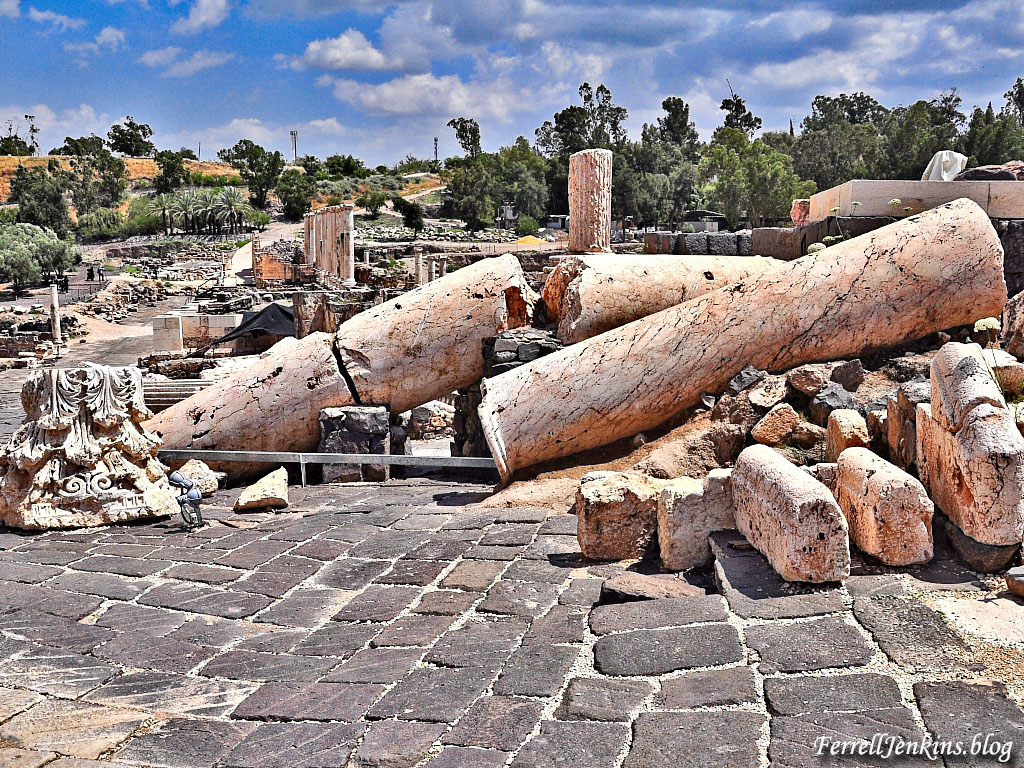
We have a wonderful example of the power of an earthquake in the Jordan Valley at the site of Bethshan [Bet-she’an, Beth-shean], about 25 miles south of the Sea of Galilee. The city was destroyed by an earthquake in A.D. 749. This photo shows the evidence brought to light during recent archaeological excavations in the city.

Earthquake damage at Beth-shean in the Jordan Valley. FerrellJenkins.blog.

Earthquake damage at Beth-shean in the Jordan Valley from A.D. 749. Photo by Ferrell Jenkins.

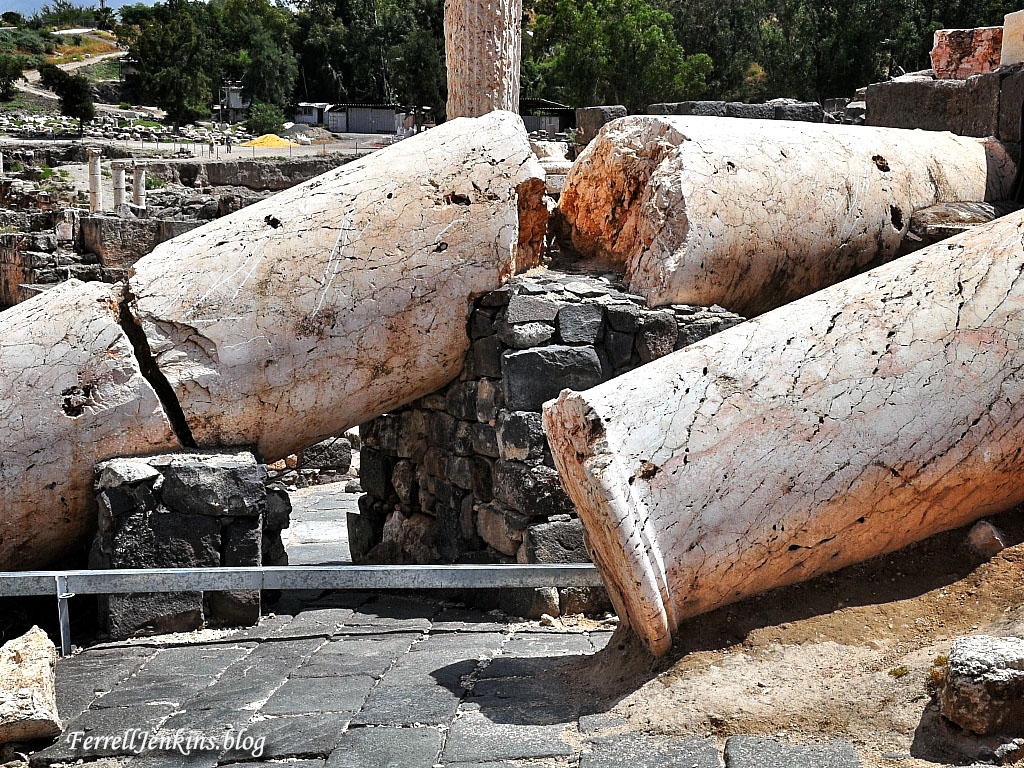
Below we have a closeup of some of damage remaining from A.D. 749.

Closeup of the earthquake damage at Bethshean in A.D. 749. Photo by Ferrell Jenkins.

Closeup of the earthquake damage at Bethshean in A.D. 749. Photo by Ferrell Jenkins.

If you would like to see more material about earthquakes in the Middle East just put the word earthquake in the search box.