Category Archives: Archaeology

The gods of Elephantine Island

Khnum (also Khnoum and Khnemu) was the chief Egyptian god in a region stretching from Thebes (modern Luxor) to Philae. Philae is a short distance south of Aswan and Elephantine Island.

According to Budge,

… the principal sanctuaries of the god were at the two ends of the First Cataract, i.e., on Elephantine on the north and on Philae and the adjoining islands on the south. He [Khnum] was the god par excellence of the First Cataract, throughout which, with his female counterpart Satet and the local Nubian goddess Anqet, he was worshipped from the earliest dynasties … (The Gods of the Egyptians, II:50).

Recently I learned of Ancient Egypt Online. This well-constructed site describes Khnum:

Khnum was originally a water god who was thought to rule over all water, including the rivers and lakes of the underworld. He was associated with the source of the Nile, and ensured that the inundation deposited enough precious black silt onto the river banks to make them fertile. The silt also formed the clay, the raw material required to make pottery. As a result he was closely associated with the art of pottery. According to one creation myth, Khnum moulded everything on his potters wheel, including both the people and the other gods.

Budge sums up the essence of the god when he says that Khnum “was originally a water or river-god, and that in very early times he was regarded as the god of the Nile and of the annual Nile-flood…”

A courtyard and an impressive granite doorway mark the location of the Late Khnum Temple on Elephantine Island. This gate, belonging to Dynasty XXX,  was constructed in the reign of Nectanebo II (c. 350 B.C.). The Wikipedia entry says he was the last native ruler of ancient Egypt.

Ruins of the Khnoum Temple on Elephantine Island. Photo by Ferrell Jenkins.

Granite doorway of the Khnoum Temple on Elephantine Island. Photo by Ferrell Jenkins.

The Book of Exodus quotes the LORD saying that, in the plagues of Egypt, he would execute judgment on the gods of Egypt.

I will pass through the land of Egypt in the same night, and I will attack all the firstborn in the land of Egypt, both of humans and of animals, and on all the gods of Egypt I will execute judgment. I am the LORD. (Exodus 12:12 NET; cf. Numbers 33:4).

Khnum was the god of the Nile. Not much left today.

Elephantine Island

There are numerous ways to describe the location of Elephantine Island. It is an island in the Nile River at Aswan (= Syene in Ezekiel 29:10 and 30:6). Or we might say that the island is located at the first cataract of the Nile.

According to Budge, the earlier name for Elephantine was Abu. One way of writing the name of the island included the drawing of an elephant (E. A. Wallis Budge, The Gods of the Egyptians, II:51).

Various suggestions have been made regarding the origin of the name Elephantine. Some say the smooth rocks of the first cataract remind one of an elephant back. Others say, the island is shaped like an elephant tusk. Or, the island was the center of ivory trading in the past.

A small granite statue of an elephant has been uncovered on the extreme south end of the island. Aswan, you likely recall, was noted for its granite.

Granite Elephant on Elephantine Island, Aswan, Egypt. Photo by Ferrell Jenkins.

Granite Elephant on Elephantine Island, Aswan, Egypt. Photo by Ferrell Jenkins.

In the Septuagint Old Testament and in the New Testament the word elephantinos is translated ivory. You can think of Samaria’s famous beds of ivory, made from the tusks of elephants (Amos 6:4), or the unsold cargoes of the merchants who could no longer trade with the fallen Babylon [Roman Empire] (Revelation 18:12).

Paul spent a night at Cos (Kos)

Paul and his companions, including the physician Luke, made their way from Miletus to Cos (Kos).

And when we had parted from them and set sail, we came by a straight course to Cos, and the next day to Rhodes, and from there to Patara. (Acts 21:1 ESV)

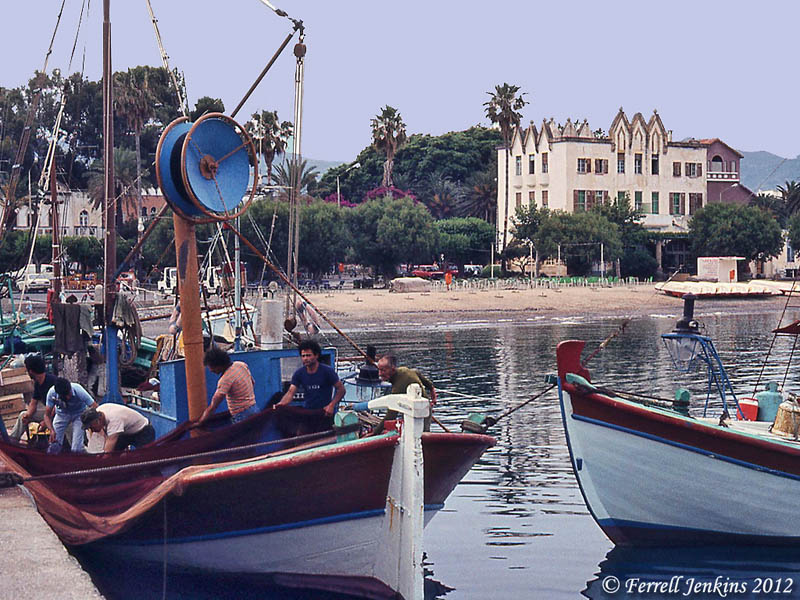
Cos is one of the islands belonging to a group of 12 called the Dodecanese. Patmos is also an island of this group. The Mycenaeans settled Cos in the 15th century B.C. In the centuries to follow the island came under the control of the Persians, the Greeks, and the Romans. In modern times the island has been under Turkish and Italian control, and German occupation. Since 1948 it has been part of Greece. My only visit to Cos was a brief stop en route from Patmos to Rhodes in 1984. Here is one of the photos I made.

The harbor on the Island of Cos in 1984. Photo by Ferrell Jenkins.

The harbor on the Island of Cos in 1984. Photo by Ferrell Jenkins.

In the time of Paul, Cos was noted as the birthplace of Hippocrates, the “father of medicine.” Hippocrates was associated with the Asclepium, ruins of which can still be seen. A Hellenistic gymnasium and some Roman ruins, including portions of a Roman road, may also be seen. There is also an archaeological museum.

Howard F. Vos describes the island with these words:

One of the most beautiful ports of the ancient world, Cos not doubt was most famous as a health resort. It was the site of the first school of scientific medicine and the sanctuary of Asclepius (Esculapius). The island had a healthful climate and hot ferrous and sulfurous springs, which the great Hippocrates (ca 460–377 b.c.), the father of medicine, first used to cure his patients. (The International Standard Bible Encyclopedia, revised.)

James Strahan, in the old Hasting’s Dictionary of the Apostolic Church, says,

It was renowned for its vines and looms, its literature and art, and above all for its temple of Æsculapius and school of medicine, which must have made it especially interesting to St. Luke.

According to Josephus, Herod the Great assisted the people of Cos with grain and other goods. (JW 1:424).

Two Other Good Sources:

Fant, C. E. and M. G. Reddish, A Guide to Biblical Sites in Greece and Turkey.

Wilson, Mark. Biblical Turkey: A Guide to Jewish and Christian Sites of Asia Minor. This book deals with Turkey, but devotes ½ page to Cos as a Sidetrip.

Dr. Bryant Wood’s Lectures on Archaeology and the Conquest

Dr. Bryant G. Wood recently presented three lectures on “Archaeology and the Conquest: New Evidence on an Old Problem” for the 2012 William R. Rice Lecture Series. The lectures, and a fourth lecture on Old Testament Archaeological Discoveries, are available in MP3 here.

The four topics available for listening are:

  • Background and Chronology of the Exodus and Conquest.
  • Digging Up the Truth at Jericho.
  • The Discovery of Joshua’s Ai.
  • Great Archaeological Discoveries Related to the old Testament.

Wood is Director of Research at the Associates for Biblical Research, editor of Bible and Spade, and director of the Excavations at Khirbet el-Maqatir (suggested as a possible site for Biblical Ai).

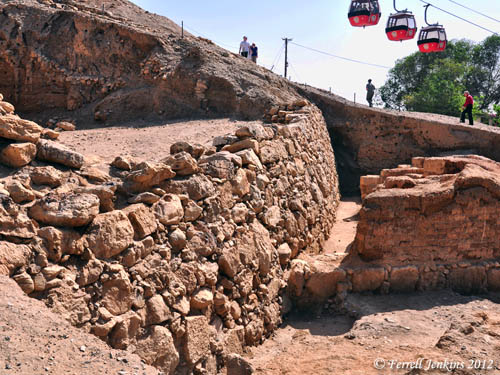
Jericho's Outer Revetment Wall on South End of Tel es-Sultan. Photo by Ferrell Jenkins.

Jericho's Outer Revetment Wall on the South End of Tel es-Sultan. Recent archaeological work at Jericho indicates that mud brick had fallen on houses built against this wall. Wood believes that this evidence fits perfectly with the biblical record in Joshua. Photo by Ferrell Jenkins.

HT: Bible-X

Roman Volubilis — “Stunning with few tourists”

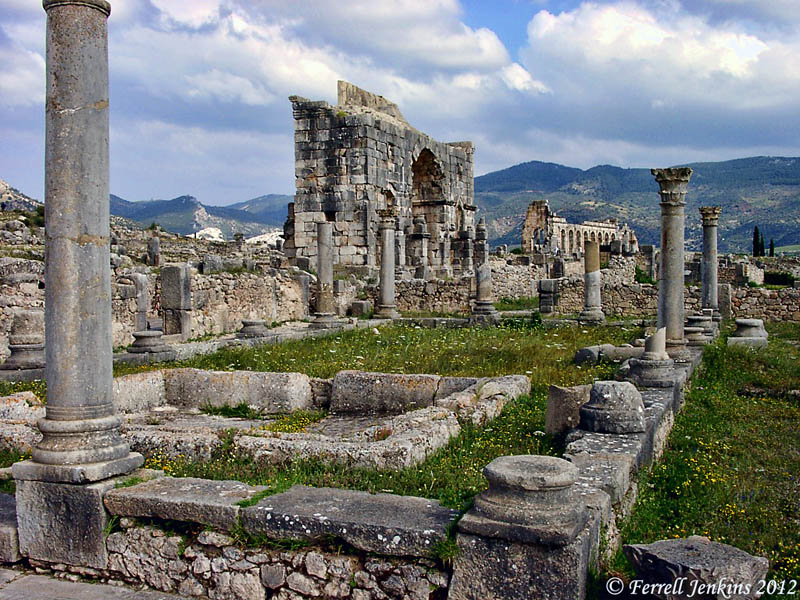
Ruins of Roman Volubilis in Morocco. Photo by Ferrell Jenkins 2000.

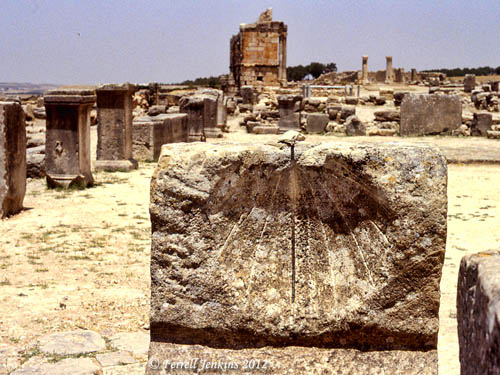
Ruins of the Roman City of Volubilis in Morocco. Slide by Ferrell Jenkins, 1980.

A feature at Seattlepi.com says that Morocco’s Roman ruins are “Stunning, with few tourists.” The article describes Volubilis,

The jewel in the crown of Morocco’s Roman ruins is certainly Volubilis, located at the foot of the Atlas mountains in a sweeping valley filled with olive and almond trees.

This city of 20,000 was the westernmost extremity of an empire that once stretched to the gates of Persia. The sprawling floor plans of its buildings and brilliant floor mosaics suggest great wealth.

The site is dominated by the remains of the grand public buildings around the forum, with the impressive arches of the Basilica courthouse arrayed in front of pillars of the temple to the god Jupiter — now topped by bushy stork nests. Every old ruin in Morocco appears to host its own of population of the large black and white birds, which soar over the sites or preen in their nests as tourists snap away with cameras.

Ruins of the Roman City of Volubilis in Morocco. Slide by Ferrell Jenkins, 1980.

Ruins of the Roman City of Volubilis in Morocco. Slide by Ferrell Jenkins, 1980.

Students of the New Testament realize that the Roman Empire was vast. Volubilis became part of the Roman province Mauretania Tingitania under the Emperor Claudius in A.D. 45. Claudius was Emperor from A.D. 41-54 during the time of Paul’s journeys to spread Christianity throughout the Empire (Acts 18:2).

And he [Paul] found a Jew named Aquila, a native of Pontus, recently come from Italy with his wife Priscilla, because Claudius had commanded all the Jews to leave Rome. And he went to see them, (Acts 18:2 ESV)

Twice I have taken tours to Volubilis, about 20 miles from Meknes. Most of the ruins we see today date from the second and third centuries A.D.

Volubilis has been added to the list of World Heritage Sites because “this site is an exceptionally well preserved example of a large Roman colonial town on the fringes of the Empire.”

The feature about Morocco’s Roman ruins may also be read at CBS News here.

HT: Jack Sasson

Monday Meandering — March 19

Greatest Finds. The Israel Ministry of Foreign Affairs has compiled a list of the “Greatest archeological finds in Israel” here with links. Places include Masada, Megiddo, Beit Guvrin-Maresha, Ashkelon, the City of David, Hazor, Dan, Herodion, Khirbet Qeiyafa, and Tel es-Safi (Gath), and others.

The Scale of the Universe 2 here. Fascinating. Requires Flash. Reminds me of two Biblical references.

 When I look at your heavens, the work of your fingers, the moon and the stars, which you have set in place,  4 what is man that you are mindful of him, and the son of man that you care for him? (Psalm 8:3-4 ESV)

For by him all things were created, in heaven and on earth, visible and invisible, whether thrones or dominions or rulers or authorities– all things were created through him and for him.  And he is before all things, and in him all things hold together.  (Colossians 1:16-17 ESV)

Marine Life in the Corinthian Gulf here. Beautiful photos.

The Acrocorinth. Wonderful, clear view of the mountain above ancient Corinth here. Carl Rasmussen has posted several other nice photos of Corinth recently.

A history of the Roman Empire in 75 seconds here.

The Burnt House. The headline in the Jerusalem Post read “House in Old City as Titus left it.” Leen Ritmeyer includes this and another news article, along with his reconstruction of the Burnt House here.

Geopolitics of Israel. Every student of Bible geography will enjoy the analysis of the geopolitics of Israel by the Stratfor Global Intelligence here.

2,000-year-old Israeli date palm. Has it been trumped by a 32,000-year-old Russian flower? Tom Powers provides some links about the palm which is now about 8 feet tall, here.

HT: Aren Maeir; NT Resources Blog; Corinthian Matters; Luke Chandler’s Blog; Bible Places Blog.

“Beware the ides of March”

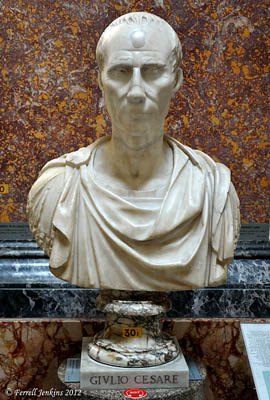
Bust of Julius Caesar in Vatican Museum. Photo by Ferrell Jenkins.

Bust of Julius Caesar in the Vatican Museum. Photo by Ferrell Jenkins.

Shakespeare has the Sootsayer warn Caesar, “Beware the ides of March.” The ides of March was used to describe the 15th of March in the Roman calendar. It was on that day that Julius Caesar was assassinated in 44 B.C. As a result, the expression has come to have a sense of foreboding — a sense that something bad is about to happen.

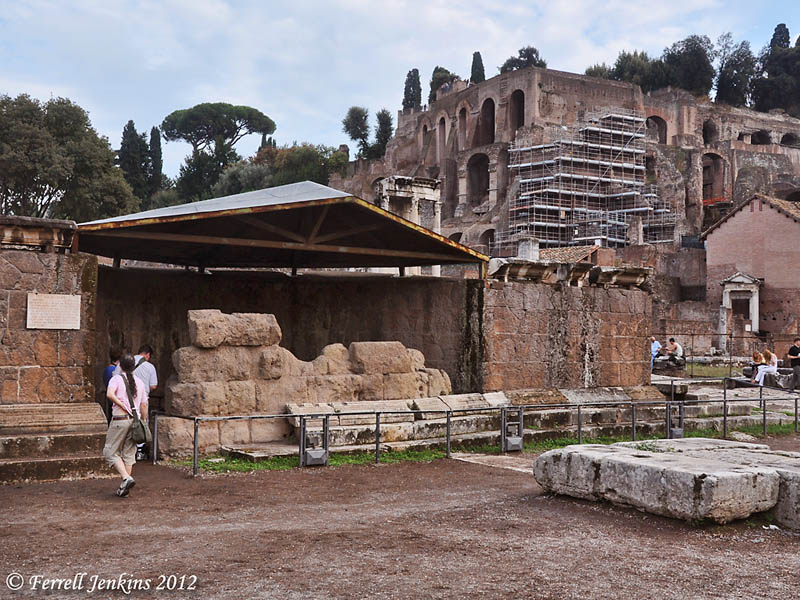
Our photo below shows the place in the Roman Forum where a temple was built to honor Julius Caesar by Augustus in 29 B.C. The deification of rulers was already common in the eastern part of the Empire. This practice would become a serious problem for the Christians of the Roman Empire before the end of the first century A.D., especially those living in Asia Minor. This is one of the issues addressed in the Book of Revelation.

Ruins of the temple erected to Caesar in the Roman Forum. Photo by Ferrell Jenkins.

Ruins of the Temple erected to Caesar in the Roman Forum. Photo by Ferrell Jenkins.

The James Ossuary verdict. Does it matter?

Shortly after the SBL meeting in Toronto (November, 2002), I presented a lecture on the subject and posted similar material on Bible World here. The material I have posted in the past two days, and this one, has been posted at Bible World since December 18, 2002. Only minor changes have been made to correct tenses, mention dead links, etc.

Below are the questions I asked in my study, and the conclusions I drew, in 2002. This was when the issue was still a matter of scholarly discussion. No criminal forgery charges had been made at the time.

— • —

Several important questions should be asked about this ossuary. These questions will help us draw some conclusions.

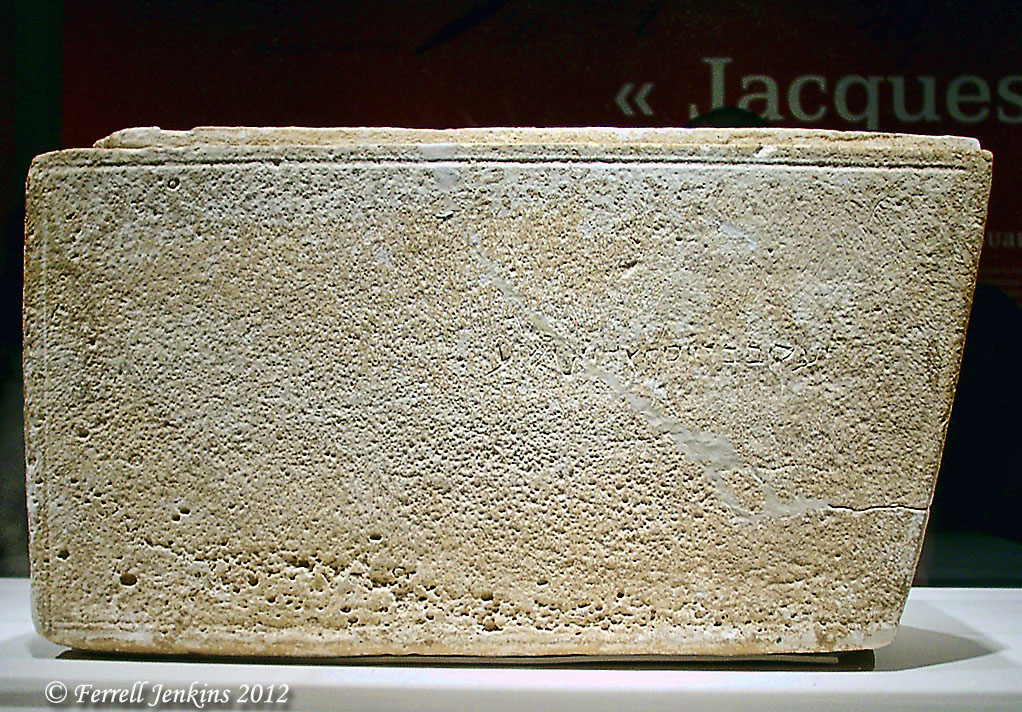
Did the ossuary originate in first century Jerusalem? The evidence indicates that it did. The Geologic Survey of Israel has certified that the limestone is typical of that quarried in Jerusalem during the first and second centuries A.D. The patina in the inscription contains no modern elements, and there is no indication of the use of a modern tool on the ossuary. André Lemairé thinks this type of ossuary can be dated between 20 B.C. and A.D. 70.

James Ossuary at the Royal Ontario Museum - Nov. 22, 2002.

James Ossuary at the Royal Ontario Museum -2002. Photo by Ferrell Jenkins.

Is the inscription authentic? The shape of certain of the letters indicates that the Aramaic inscription belongs to the last decades before the destruction of Jerusalem in A.D. 70. This is the exact period, according to Josephus, when James was killed. Some scholars have suggested that the inscription may have been written by two different hands. Lemairé sees no reason to draw this conclusion. After the panel discussion [at the SBL meeting in Toronto] the ossuary was examined by Frank Moore Cross and Joseph Fitzmeyer, both experts in the Aramaic of this period. According to Oded Golan, in an interview with the Discovery Channel  [the link is no longer active], they believe the inscription was written by one hand.

Is this the James of Galatians 1:19 and Acts 15? Is the James mentioned on the ossuary the James of the New Testament (Acts 15; Gal. 1:19)? In first century Jerusalem many people bore the names James, Joseph, and Jesus. When we consider the combination of relationships (son of, brother of), the number of possibilities goes down dramatically. The exact size of the population is uncertain. Lemairé estimated a maximum population of 80,000. Based on ossuary inscriptions of the period, Lemairé first suggested that about 20 people could be called “James son of Joseph brother of Jesus.” Golan says that Professor Camil Fuchs, head of Tel Aviv University’s Department of Statistics and Operations Research in the School of Mathematical Sciences, estimates on the basis of a highly complex statistical analysis that “only one person could be ‘James son of Joseph brother of Jesus,’ and that is the man who was known as James the Just, a leader in the early church and the brother of Jesus Christ” (Paddey, Patricia L. “Ossuary’s Owner Reveals New Research.” http://www.biblenetworknews.com (23 Nov. 2002; this link is no longer active). I think the combination of relationships makes it highly probable that this is the ossuary of the James of Acts 15, but we may never know for certain.

Does it matter? If the inscription is authentic, it is another of the many archaeological confirmations of Biblical characters. We already know of Caiaphas, Pilate, Erastus, et al. It is another example of the historicity of the New Testament. It provides the earliest inscriptional evidence of Jesus. If the inscription is not authentic then it is just an ordinary limestone bone box, but one that has caused multitudes to discuss Jesus and the New Testament. Let us use it as an opportunity to discuss Jesus with those who do not know Him.

Please keep in mind that the New Testament documents, all of which date to the first century, provide the evidence that Jesus is the Christ, the Son of God (John 20:31).

Now Jesus did many other signs in the presence of the disciples, which are not written in this book; but these are written so that you may believe that Jesus is the Christ, the Son of God, and that by believing you may have life in his name. (John 20:30-31 ESV)

The Current Situation (2012). Today, and in the months to come, the reaction to this court decision will likely be along this line. Those who “knew” that the ossuary inscription was a fake, still think it is a fake. Those who thought the full inscription is genuine, still think it is genuine. Those who did not know whether the inscription was genuine or a fake still do not know. That is where I stand.

Additional Links of Interest.

Herschel Shanks, Bible History Daily, here.

Eric Meyers’ reaction on the ASOR Blog here.

Christopher Rollston, here.

James Ossuary — no proof of forgery

The word is out. In a 475-page verdict, Judge Aharon Farkash says the prosecutor failed to prove beyond a reasonable doubt that the James Ossuary and the Jehoash Inscription were forgeries.

Robert Deutsch was acquited of all charges. Oded Golan was acquited of charges that he forged a portion of the inscription on the James Ossuary.

Here are some links you can follow to “read all about it.”

Matthew Kalman’s report here. Kalman has followed this case through four years of testimony.

Todd Bolen’s comments at the Bible Places Blog here.

Response of the Israel Antiquities Authority here.

Haaretz: “After a decade, Israel court acquits collector of forging Jesus’ brother’s tomb” here.

The Times of Israel: “After 7-year saga, a surprising end to antiquities fraud case” here.

Later I plan to follow up on this with the question, “Does it matter?”

HT: Joseph Lauer

The James Ossuary Exhibition in Toronto

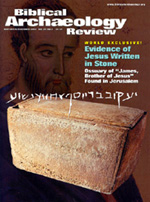
Biblical Archaeology Review cover above the James Ossuary.The existence of an ossuary bearing an Aramaic inscription, “Ya’akov bar Yosef akhui diYeshua” [James the son of Joseph the brother of Jesus] was announced at a press conference conducted by Hershel Shanks, editor of Biblical Archaeology Review, October 21, 2002. In the feature article of the November-December issue of Biblical Archaeology Review, Professor Andre Lemairé gives details about the ossuary and its inscription. An ossuary was used to house the bones of the deceased after the decay of the body. An ossuary need be only as large as the longest bones. The ossuary under consideration is about 20 inches long, 12 inches high, and 10 inches wide. They were commonly used by the Jews for secondary burial in the first century A.D.

The James Ossuary was placed on display at the Royal Ontario Museum in Toronto, Canada, from November 15th through December 29, 2002. It was displayed in a third floor room by itself in a well-lighted case. The walls of the room were filled with information about James, ossuaries, Jewish burial customs, and the James ossuary. The ossuary was cracked in transit from Israel to Canada but was been restored by the museum staff. The ROM has a good selection of material from the ancient Mediterranean world. The exhibition of the James Ossuary was arranged to coincide with the annual meetings of the American Schools of Oriental Research, the American Academy of Religion, and the Society of Biblical Literature. About eight thousand professors of religion and Biblical studies from around the world attend these meetings.

“No Ordinary Box of Bones”

The Society of Biblical Literature (SBL) planned a special session under the title “No Ordinary Box of Bones” for a learned discussion about the ossuary. The panel included the following scholars:

André Lemairé, the epigrapher from the Sorbonne who recently published the ossuary inscription in the Biblical Archaeology Review.

John Painter, author of a book on James, from Charles Stuart University in Australia.

Steve Mason, a Josephus scholar, from York University, Toronto. He put the quotation about James in Josephus in its proper context.

Eric Meyers, an archaeologist and scholar of Judaism at Duke University.

Hershel Shanks, editor of Biblical Archaeology Review.

Adele Reinhartz, of Wilfred Laurier University, served as chair of the panel.

Lemairé summarized the material from his BAR article. He responded to some recent charges that the second half of the inscription [brother of Jesus] is different from the first part [James the son of Joseph]. Evidence from paleography places the Aramaic inscription near the middle of the first century AD, prior to AD 70.

Eric Myers, a former president of ASOR, stated that he had concern about the existence of such a panel in light of the fact that the ossuary was “looted” and sold on the illegal antiquities market. He said the owner had been questioned by the police in Israel about the ossuary.
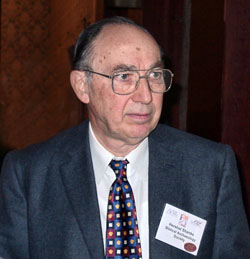
Herschel Shanks at SBL in Toronto, 2002.

Herschel Shanks in Toronto, 2002.

Herschel Shanks took exception to several statements made by Myers. Shanks publishes artifact which belong to private collectors. Both Shanks and Lemairé emphasized that the Dead Sea Scrolls fall into the same category. Shanks said there are good collectors and bad collectors. Good collectors allow their material to be published and share it with the world. Bad collectors keep their artifacts in their basements for personal enjoyment.

Mason put the quotation about James from Josephus in proper historical context. Josephus was dealing with the character of High Priests and mentioned, incidentally, that one of the people put to death was the brother of Jesus, the so-called Christ.

The quotation from Josephus, perhaps written in the last decade of the first century A.D., reads this way:

…when, therefore, Ananus was of this disposition, he thought he had now a proper opportunity [to exercise his authority]. Festus was now dead, and Albinus was but upon the road; so he assembled the Sanhedrin of judges, and brought before them the brother of Jesus, who was called Christ, whose name was James, and some others, [or some of his companions]; and, when he had formed an accusation against them as breakers of the law, he delivered them to be stoned: (Ant 20:200)

Painter mentioned the tradition that the throne of James (as Bishop of Jerusalem) and his burial in the Church of Saint James, an Armenian church in Jerusalem. He also cited other traditions about the death and burial of James from Clement of Alexandria, Hegesippus, and Eusebius.

A portion of the quotation from Eusebius, from the early 4th century A.D., reads,

These things are related at length by Hegesippus, who is in agreement with Clement. James was so admirable a man and so celebrated among all for his justice, that the more sensible even of the Jews were of the opinion that this was the cause of the siege of Jerusalem, which happened to them immediately after his martyrdom for no other reason than their daring act against him.

Josephus, at least, has not hesitated to testify this in his writings, where he says, “These things happened to the Jews to avenge James the Just, who was a brother of Jesus, that is called the Christ. For the Jews slew him, although he was a most just man.” (Ecclesiastical History 2 23:19-20)
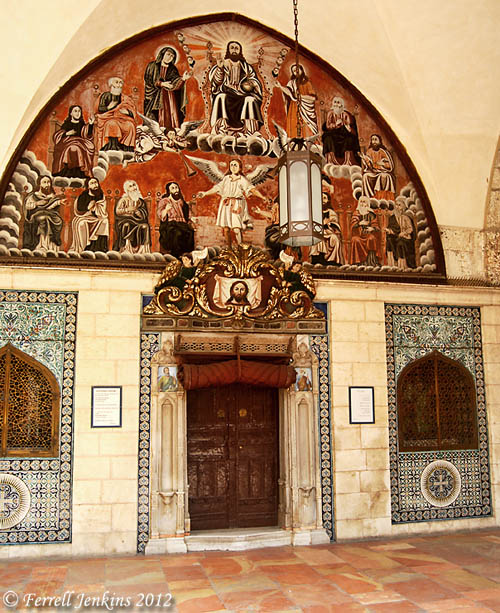
Entrance to St. James Cathedral in the Armenian Quarter of Jerusalem. Photo by Ferrell Jenkins.

Entrance to St. James Cathedral in the Armenian Quarter in the Old City of Jerusalem. Photo by Ferrell Jenkins.

When the panelists finished their presentations, time was allowed for only two or three questions from the audience of about 800 persons. I was seated directly in front of the podium about 4 or 5 rows from the front and rose to ask the first question. The owner of the ossuary, Mr. Oded Golan, was present for the session. I stated that we would like to hear him say how long the ossuary had been in his possession and whether the inscription was on it when he obtained it. Mr. Golan went to the platform and stated that he obtained the ossuary in the 1970s and that the inscription was on it when he obtained it. He is 51 years of age, and has been collecting ossuaries and other antiquities since he was 8 years old. He stated that one item from his collection had been published by the late Yigael Yadin.
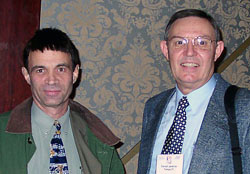
Oden Golan and Ferrell Jenkins at SBL, Toronoto, 2002.

Oden Golan and Ferrell Jenkins at SBL, Toronoto, 2002.

It may sound strange to Americans that a young boy would be collecting ossuaries and other antiquities. We must remember that ancient artifacts are everywhere in Israel (and the West Bank) and that archaeology is a sort of past-time for many people who live there. As a boy growing up in north Alabama I picked up Indian arrowheads from the cotton fields. I have visited several homes in which the host would bring out numerous boxes of artifacts that they had collected from Indian mounds.

Well, I trust this will give our readers a little perspective on the initial presentation of the James Ossuary. You may read more about the trial which has been going on since December, 2004, here.