Category Archives: Archaeology

Ophel Excavation 2012

Amir Kohen Klonymus, Area A supervisor of the Ophel Excavation, shows a few of the items found in a fire pit at the Ophel Excavation in December. You may find it difficult to understand his English, but stay with the 11 minute video, past the family visit of some sponsors of the dig, to the summation by Prof. Eilat Mazar.
I think anyone who has seen any part of the excavation areas on the south side of the Temple Mount will enjoy this video.

This video and others are available on the blog of The Key to David’s City here.

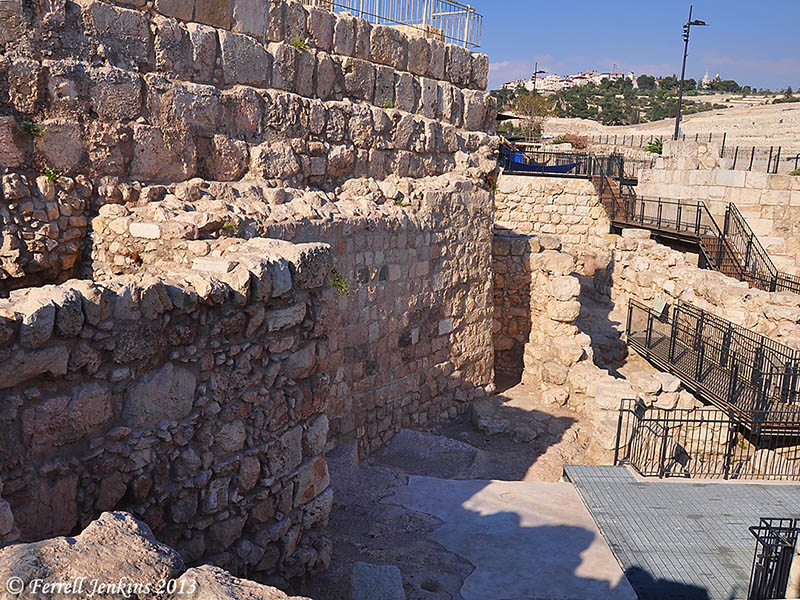
The photo below shows a portion of the Ophel Excavation.

Ophel Excavations - View East. Photo by Ferrell Jenkins.

Ophel Excavations – View East. Photo by Ferrell Jenkins.

Jothan, king of Judah (740-732 B.C.), is said to have built extensively in the area known as Ophel.

He built the Upper Gate to the LORD’s temple and did a lot of work on the wall in the area known as Ophel. (2 Chronicles 27:3 NET)

HT: Jack Sasson

The significance of Gaza

After my first tour to the Bible Lands, including Rome, Greece (Athens and Corinth), Egypt, Lebanon, Syria (Damascus), Jordan, and Israel, in April/May, 1967, I decided to make a second tour the following year. For many years, I always added some new places on each tour. In 1968 I added Beersheba and Gaza. The Gaza Strip (named such because of the long, narrow size of the small entity) had been under Egyptian control for several decades until June, 1967.

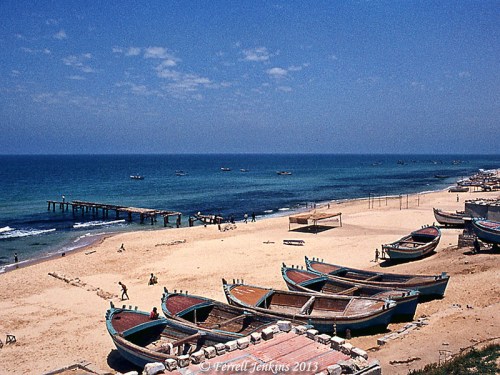
There was not much to see at Gaza. By the time we visited in 1968, Gaza was under Israeli control. We drove to the coast where there were only a few houses and some small fishing boats. This is one of the few slides that I have to illustrate the visit to Gaza.

Gaza on the Mediterranean Sea in May, 1968. Photo by Ferrell Jenkins.

Gaza on the Mediterranean Sea in May, 1968. Photo by Ferrell Jenkins.

Gaza is mentioned several times in the Old Testament. Here is a summary of these references.

  • Gaza was the southwestern boundary of the Canaanites in the table of Nations (Genesis 10:19).
  • The original inhabitants of Gaza were replaced by the Caphtorim, likely the ancestors of the Philistines (Deuteronomy 2:23).
  • Joshua defeated Canaanites “even as far as Gaza” (Joshua 10:41).
  • Joshua eliminated the Anakites except in Gaza, Gath, and Ashdod (Joshua 11:21-22). We recognized these cities as later belonging to the Philistines.
  • Gaza is listed as belonging to the tribe of Judah (Joshua 15:47; Judges 1:18).
  • The Midianites oppressed Israel, “as far as Gaza”, for seven years (Judges 6:4).
  • Samson had contact with the inhabitants of Gaza (Judges 16).
  • Gaza is listed as one of the five Philistine cities in the time of the Israelite Judges (1 Samuel 6:17).
  • Solomon controlled territory as far southwest as Gaza (1 Kings 4:24).
  • Hezekiah defeated the Philistines as far as Gaza and its territory (2 Kings 18:8).
  • Jeremiah makes reference to Gaza being conquered by Pharaoh (Jeremiah 47:1).
  • The prophets of Judah pronounced judgments upon Gaza (Amos 1:6-7; Zephaniah 2:4; Zechariah 9:5).

The only New Testament reference to Gaza is in Acts 8:26. Philip the evangelist was instructed to go south on the road that descends from Jerusalem to Gaza. English translators struggle with the issue of whether the city was desert, or the road leading to the city ran through a desert area. (I will leave that for some other time.)

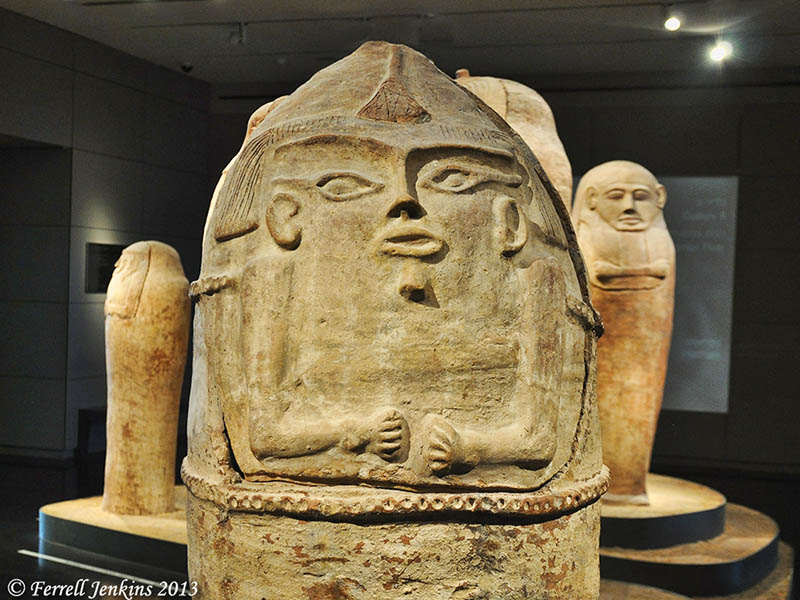
The first display one sees as he enters the archaeology wing of the Israel Museum is that of the anthropoid coffins from Deir el-Balah, a site south of Gaza city. The coffins, excavated by Trude Dothan in 1972, bear evidence of Egyptian influence. They date to the 13th century B.C.
Anthropoid Coffins from Deir el-Balah in the Israel Museum. Photo by Ferrell Jenkins.

Anthropoid Coffins from Deir el-Balah in the Israel Museum. Photo by Ferrell Jenkins.

“Dried up like a potsherd”

Simple things make good illustrations. Just ask Jesus.

David used many simple illustrations in the Psalms. In one he spoke of the common piece of broken pottery (potsherd) which could be found around every home and camp site.

my strength is dried up like a potsherd, and my tongue sticks to my jaws; you lay me in the dust of death. (Psalm 22:15 ESV)

In this text David describes his own feeling of weakness and/or that of the coming Messiah. There are times, I think, when each of us feels like this.

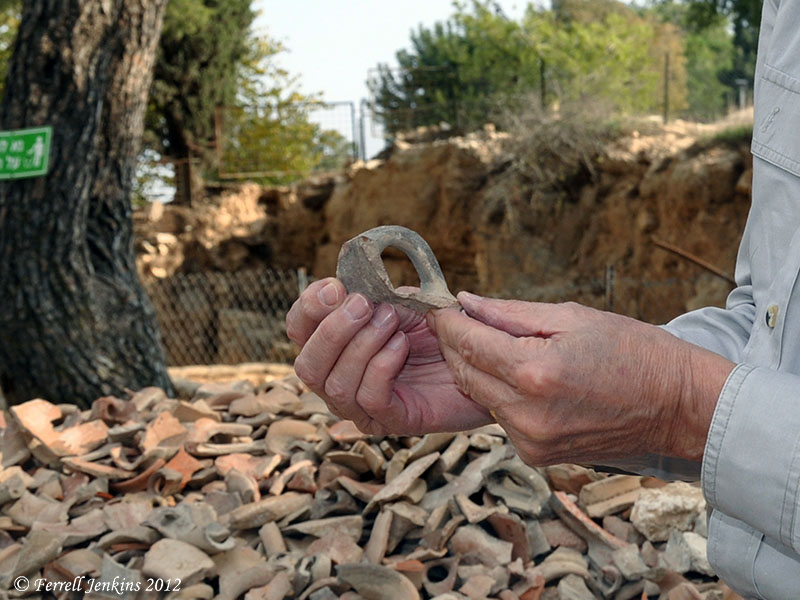
A common thing we see at archaeological digs is a pile of potsherds from ancient times. Archaeologists relish an unbroken piece of pottery, but even the sherds or potsherds reveal a lot about the age of the stratum being worked and the life of the ancient people. The broken jar handle from Ramat Rachel, south of Jerusalem, tells its own story.

Potsherds at Ramat Rachel excavation. Photo by Leon Mauldin.

Potsherds Potsherds at Ramat Rachel excavation. Photo by Leon Mauldin.

Unless it is an old college professor (pick your own), nothing is drier than a piece of broken pottery. Great illustration.

The Antikythera Shipwreck and “Danger at sea”

The following post appeared in part on this blog June 4, 2012. I am repeating some of it for the benefit of those who missed it, and because it provides some complementary information for the study of Acts 27. A few changes have been made to make it more useful in connection with the Acts study.

The Antikythera Shipwreck is a special exhibition at the Athens (Greece) National Museum which is scheduled to run from April 2012 to April 2013.

The Ship and the Treasures

The shipwreck off the eastern coast of Antikythera is dated to 60-50 BC, a period during which maritime trade and transportation of works of Greek art from the Eastern Mediterranean to Italy flourished. Its cargo dates from the 4th to the 1st century BC. The ship was a freighter of about 300 tons capacity and was sailing towards Italy.

Bronze and marble sculpture luxurious glass vessels and golden jewellery, a large amount of pottery and bronze couches formed part of its cargo. Amongst these the famous “Antikylhera Mechanism” still contributes an enormous amount to our knowledge of ancient Greek technology and astronomy. All the finds recovered from the shipwreck bear witness to the aesthetic preferences of their orderers or potential purchasers but, above all, they reflect the new phenomenon of art trade, the first in the history of the West civilization.

The Mechanism

Constructed in the second half of the second century BC, the Mechanism comprises gears, scales, axles, and dials. The inscriptions on the surface of the Mechanism refer to astronomical and calendar calculations, while the inscriptions on its metal protective plates contain instructions for its use. The Antikythera Mechanism is the earliest preserved portable astronomical calculator. It displayed the positions of the Sun, the Moon and most probably the five planets known in antiquity. It was used to predict solar and lunar eclipses, it kept an accurate calendar of many years, and displayed the date of Pan-Hellenic games (Olympia, Nemea, Isthmia, Delphi and Dodona.

We had visited Thera (aka Santorini) during our Aegean cruise. Antikythera (“opposite Kythera”) is a Greek island between Crete and the Peloponnese (where Corinth is located). This area is north of where Paul’s ship encountered the storm that drove it off course (Acts 27:8-16).

In the earlier post I included two of the sculptures being transported on the ship. Go here to see those photos. I will share some different photos today.

One display case deals with the “Self-Sufficient Microcosm.” In addition to cargo, there were a few human skeletal remains on the ship. Those who traveled by sea often had to take their own food supplies on board with them. It is thought that olives and snails were part of the daily diet. There were stones “for grinding seeds, liquefying vegetables and herbs, and stirring liquids.”

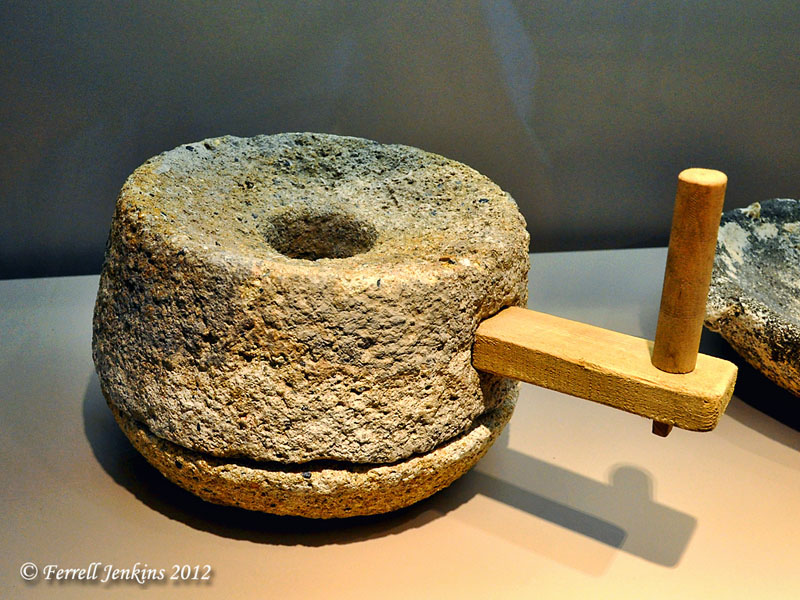
A manually operated quern was used for grinding grain.

Manually operated quern for grinding grain. Photo by Ferrell Jenkins.

Manually operated quern for grinding grain. Photo by Ferrell Jenkins.

Salted meat and fish, as well as olives, and wine could be stored for transport in amphorae and other containers. This display shows some of the amphorae as they might have been scattered on the sea bed.

Amphorae used for transporting goods. Photo by Ferrell Jenkins.

Amphorae used for transporting goods. Photo by Ferrell Jenkins.

Many of the sculptures found with the ship wreckage are encrusted with sea organisms. Be sure to see the previous post. There was one marble statue of a boy. The sign accompanying the sculpture says,

The boy is depicted nude and half bent-over with his head raised. The upper part of his torso leans sharply forward.

Some believe that this young man was preparing for wrestling. Others think he was a pancratiast (one who participated in both wrestling and boxing). Notice that the left side of the statue (our view on the right) is covered with sea organisms. The right side seems to have been buried in sediment on the sea bed, and thus protected.
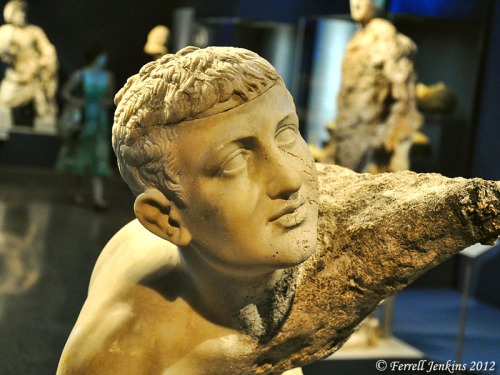
Statue of a boy from the Antikythera shipwreck. Photo by Ferrell Jenkins.

Statue of a boy from the Antikythera shipwreck. Photo by Ferrell Jenkins.

Numerous bronze pieces are displayed. I especially like the one known as “The Antikythera Philosopher.” See the previous article.

We typically think of ships from the Roman period, and earlier, staying near the shore (coasters). This was certainly true of many of the sea journeys of the Apostle Paul (Acts 20:5, 13-16; 27:5-7).

Greek archaeologists announce here the discovery of two Roman-era shipwrecks in water nearly a mile deep. Sailing to Italy required leaving the safety of the nearby shore for deep waters. Such was true of Paul’s journey to Rome after leaving Crete (Acts 27).

Paul spoke of the dangers at sea in his second letter to the Corinthians (11:24-29) about A.D. 55.

  • Three times I was shipwrecked.
  • A night and a day I was adrift at sea.
  • He mentioned “Danger at sea.”

The Malta shipwreck is the only one recorded in Acts, and it occurred after the writing of 2 Corinthians. Hughes mentions at least nine voyages between Acts 9 and 18. Paul says three of these ended in shipwreck. Hughes says there were at least another nine voyages between the writing of 2 Corinthians and the Malta shipwreck (The Second Epistle to the Corinthians, NICNT, 410-411).

At least some of the ships used by Paul were grain ships (Acts 27:38), but there may have been other cargo on some of them.

If you visit Athens between now and April 2013, be sure to take some time for The Antikythera Shipwreck.

Acts 27 #2 — Did Paul dock at Cnidus (Knidos)? — Photo Illustration

Paul’s voyage to Rome, as it is often called, was actually a trip as a prisoner on a variety of ships from Caesarea Maritima to Puteoli in Italy (Acts 27:1 – 28:13. The trip westward from Myra, on the Mediterranean coast, took the ship near Cnidus (also spelled Knidos) (Acts 27:6-7).

We sailed slowly for many days and arrived with difficulty off Cnidus. Because the wind prevented us from going any farther, we sailed under the lee of Crete off Salmone. (Acts 27:7 NET)

Mark Wilson says,

Paul would have passed within sight of Cnidus on his return to Jerusalem during his second and third journeys, possibly even stopping at the city (Acts 18:21-22; 21:1). The grain ship upon which Paul was traveling on his captivity voyage to Rome encountered fierce head winds as it tacked westward along the coast of Asia Minor. It is not clear if Paul’s ship was able to make port in Cnidus’ commercial harbor, but the sailing conditions probably prevented it (Acts 27:7). — Biblical Turkey, 192.

A British archaeologist excavated at Cnidus in 1957-59. A colossal marble lion that once rested on a monumental tomb was taken to the British Museum where it is displayed in the Queen Elizabeth II Great Court. The lion dates to the late 4th-early 3rd century B.C.

Colossal marble lion from Cnidus. British Museum. Photo by Ferrell Jenkins.

Colossal marble lion from Cnidus. British Museum. Photo by Ferrell Jenkins.

The sign in the British Museum informs us that,

This lion crowned a monumental tomb at the edge of a cliff overlooking the sea. The hollow eyes were probably inset with glass to catch the light.

Did Paul see this lion? More than likely, I think, during the return from the second and third journeys.

The map below shows the location of Cos, Cnidus, Rhodes and Patara. Click the image for a higher resolution.

Map showing Cnidus, Rhodes, and Patara. Made with Bible Mapper 4.

Map showing Cnidus, Rhodes, and Patara. Made with Bible Mapper 4.

Acts 26 — Photo Illustrations — Herod’s Praetorium and Audience Hall

We have mentioned previously that the events of Acts 24-26 took place at Caesarea. The material we have presented may be used with either chapter.

Luke says that Agrippa and Bernice came amid great pomp into the audience hall.

So on the next day Agrippa and Bernice came with great pomp, and they entered the audience hall with the military tribunes and the prominent men of the city. Then, at the command of Festus, Paul was brought in. (Acts 25:23 ESV)

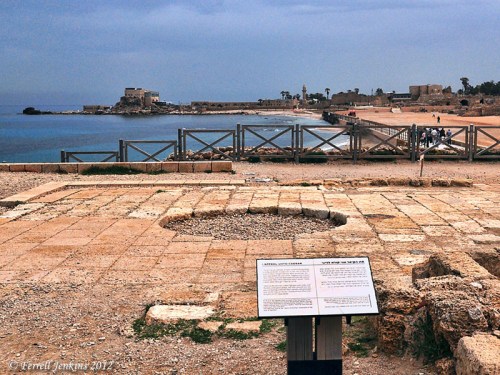
Excavations at Caesarea in 1997 caused Yosef Porat, of the Israel Antiquities Authority, to think that the auditorium or audience hall mentioned here has been discovered. This photo shows the general area within the Herodian Palace (cf. John McRay, Paul: His Life and Teaching).

Area of the Audience Hall at Caesarea. Photo by Ferrell Jenkins.

Area of the Audience Hall at Caesarea. Photo by Ferrell Jenkins.

The sign visible in the foreground is found only in my 2011 photographs. Signs are moved because they become incorrect, worn, or in the way of continued restoration. Here is the sign.

Sign at the Audience Hall in Caesarea. Photo by Ferrell Jenkins.

Sign at the suggested Audience Hall in Caesarea. Photo by Ferrell Jenkins.

Paul may have appeared before Felix, Festus, and Agrippa at this place. I often tell my tour groups, “If it didn’t happen right here (pointing down), it happened right here (motioning with arms extended, meaning nearby).”

When Paul first arrived at Caesarea, Felix said,

…  “I will give you a hearing when your accusers arrive.” And he commanded him to be guarded in Herod’s praetorium. (Acts 23:35 ESV)

Two prison inscriptions were found in the same area, leaving the scholars working there to conclude that this was indeed the Praetorium of the Palace.

The first reads, “The fraternity of the Frumentarii. Happiness for all.”

The inscription reads, “O, good hope, I came to this office. I will be secure.” An accompanying sign says,

“This inscription indicates that a Latin-speaking guard was in charge of the security of the building, and of the safety of the governor.”

Prison inscription found at Caesarea. Photo by Ferrell Jenkins.

Prison inscription found at Caesarea. Photo by Ferrell Jenkins.

The second inscription reads, “The fraternity of the Frumentarii. Happiness for all.” The Frumentarius was an official in charge of police duties and prisoners. The accompanying sign says that Paul was the most famous prisoner held there.

Prison inscription found at Caesarea. Photo by Ferrell Jenkins.

Prison inscription found at Caesarea. Photo by Ferrell Jenkins.

As a Roman citizen, Paul was allowed his right to appeal to Caesar (Acts 25:11-12). We all know that the wheels of justice often move slowly.

Turkey wants British Museum to return sculptures from the Mausoleum of Halicarnassus

According to an article in The Guardian (here), the town of Bodrum in Southwest Turkey wants the British Museum to return several priceless sculptures once associated with the Mausoleum of Halicarnassus in the 4th century B.C.

Human rights legislation that has overturned the convictions of terrorists and rapists could now rob the British Museum of sculptures created for one of the seven wonders of the ancient world.

A Turkish challenge in the European court of human rights will be a test case for the repatriation of art from one nation to another, a potential disaster for the world’s museums.

Halicarnassus is where Mausolus built a gigantic tomb in honor of himself. Leon Mauldin and I visited the site earlier in the year. You may read about our visit (with photos) here. It became known as one of the Seven Wonders of the Ancient World.

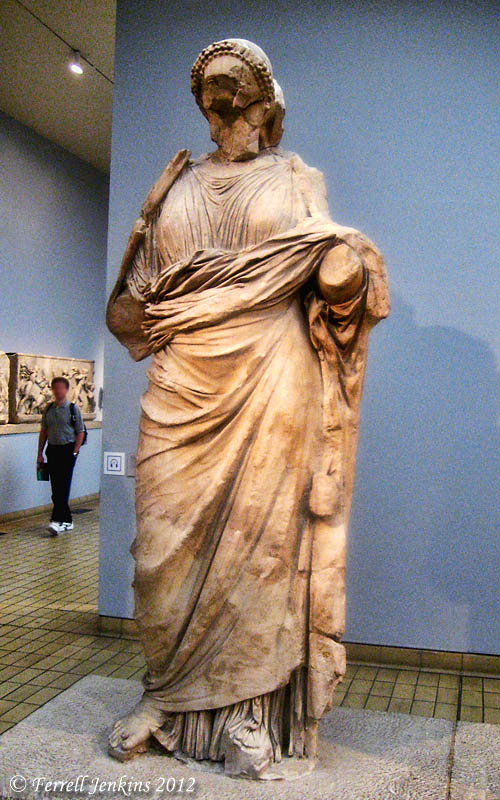
Two of the sculptures that the town of Bodrum wants returned are through to be of Mausolus and Artemisia, his wife. Here is a photo of the marble statue thought to be Mausolus.

Statue of Mausolus in British Museum. Photo by Ferrell Jenkins.

Statue of Mausolus in British Museum. Photo by Ferrell Jenkins.

The next statue is usually identified as Artemisia, wife of Mausolus.

Statues from the Mausoleum of Maussollos - Marble, About 350 B.C

Statue from Halicarnassus, usually identified as Artemisia, the wife of Mausolos. Photo by Ferrell Jenkins.

Another reason to visit the British Museum soon, or Turkey later.

HT: Jack Sasson

Acts 25 — Photo Illustrations — Coins of the Rulers

We continue our look at the three chapters describing Paul’s stay at Caesarea Maritima — Acts 24-26. Three civil rulers are mentioned in these chapters. They are known not only from Luke’s account, but in the writings of Josephus.

Rapske says that Caesarea “was the administrative seat of the Roman procurators of Palestine.” He adds that in the time of the Flavians it became a Roman Colony (The Book of Acts in its First Century Setting; Vol. 3, The Book of Acts and Paul in Roman Custody, 155).

After the Romans occupied “Palestine” the Jews had both a religious and a secular tax to pay. The procurators (prefects) were responsible for collecting the taxes for Rome. Coins were minted by various procurators, including Felix and Festus. I have chosen one example from each to show the type of coin current in their time.

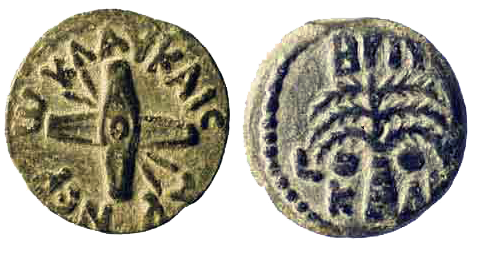
Antonius Felix — A.D. 52-59.

Felix is described as a hegemon in the Greek New Testament. Major English versions use the term governor (Acts 23:24, 26; 24:2, 22, 24, 25, 27; 25:14). Hemer says that hegemon is a general word to describe a ruler, “the formal Latin title of these governors of Judaea being procurator or praefectus” (The Book of Acts, 128).

The obverse (head) of the coin of Felix shows two oblong shields and two spears. The inscription is translated “Nero Claudius Caesar–son of Claudius. The reverse (tail) shows a “six-branched palm tree bearing two bunches of dates” with a Greek inscription above and below (Hendin, Guide to Biblical Coins (1987), 117).

Coin of Roman Procurator Felix.

Coin of Roman Procurator Felix.

Porcius Festus — A.D. 59-61.

Porcius Festus followed Felix as governor or procurator. He is mentioned in each of the three chapters we are discussing. Paul had been left in custody by Felix, and Festus seems to be pleased to get the advice of King Agrippa when he visited Caesarea.

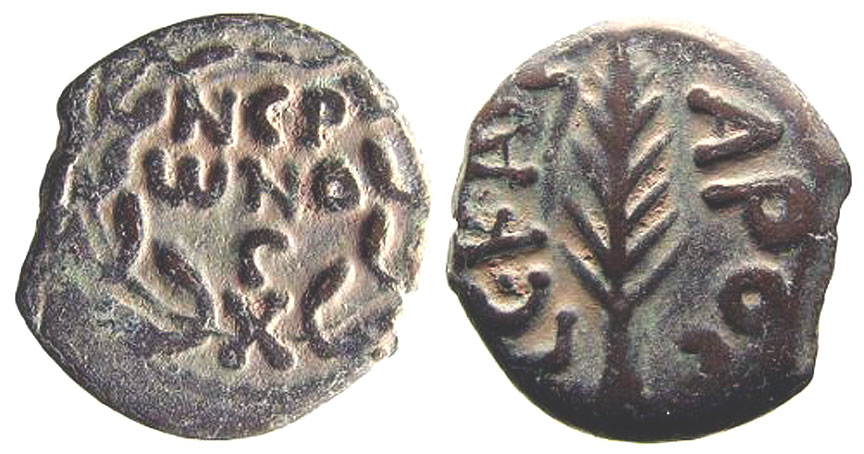
The coin of Festus, struck in A.D. 58, bears a Greek inscription within a wreath on the obverse. At the bottom is an X. The inscription reads NER ONO C (Nero). The reverse shows a palm branch with a Greek inscripton KAIC APOC (Caesar). The date LE means year five (Hendin, 118).

Coin of Porcius Festus.

Coin of Roman Procurator Porcius Festus.

Herod Agrippa II — A.D. 48-70.

Herod Agrippa II was the son of Herod Agrippa I, the grandson of Herod the Great (Acts 12:1, et al.). Agrippa II was the tetrarch of Chalcis and of northern territories. Chalcis was the small but beautiful territory between the Lebanon and Antilebanon mountains. Later he was granted the territories that had been controlled by Philip and Lysanias. Agrippa lived until the end of the first century, and minted coins even to the time of the Roman Emperor Domitian (A.D. 81-96).

According to Hendin, the obverse shows a laureate bust of Domitian facing right. The inscription around it reads DOMITIAMOC KAICAP (Domitian Caesar). The reverse shows Nike standing right. One foot is resting on a helmet. She is writing on a shield that is resting on her knee. The inscription reads ETO KZBA AΓPIΠΠA (Year 27 of King Agrippa). The coin was struck in A.D. 83. (I do not know how best to harmonize the dates associated with the reign of Agrippa II.)

Coin of Herod Agrippa II with image of Domitian. Struck A.D. 83.

The coin above is copied from FORVM ANCIENT COINS.


I have only the original edition of Hendin’s Guide to Biblical Coins, but recommend the newer fifth edition of his book in the event that you have a genuine interest in Biblical coins. From my limited collecting experience, I can say that it is both fascinating and educational.

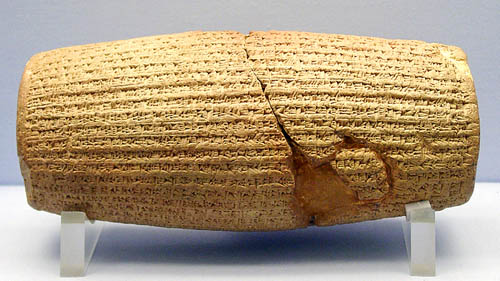
Cyrus Cylinder scheduled for a U.S.A. tour

The British Museum announces that the Cyrus Cylinder will tour to five major U.S.A. museums in 2013. Plan your vacation how.

The Cylinder will travel with an exhibition of sixteen objects under the title ‘The Cyrus Cylinder in Ancient Persia’. The exhibition shows the innovations initiated by Persian rule in the Ancient Near East (550 BC-331 BC). The Persian Empire was then the largest the world had known. It had a huge impact on the ancient world, introducing changes in terms of ethical behaviour as witnessed in the proclamation on the Cyrus Cylinder.
For more information see Artdaily here. A nice photo of the Cylinder is included.

The Cyrus Cylinder is important to Bible students because Cyrus is the Persian king who allowed the Judeans to return to Jerusalem and rebuild the temple.

Now in the first year of Cyrus king of Persia, that the word of the LORD by the mouth of Jeremiah might be fulfilled, the LORD stirred up the spirit of Cyrus king of Persia, so that he made a proclamation throughout all his kingdom and also put it in writing:  “Thus says Cyrus king of Persia, ‘The LORD, the God of heaven, has given me all the kingdoms of the earth, and he has charged me to build him a house at Jerusalem, which is in Judah. Whoever is among you of all his people, may the LORD his God be with him. Let him go up.'” (2 Chronicles 36:22-23 ESV; cf. Ezra 1:1-4).
Cyrus Cylinder.

Cyrus Cylinder in the British Museum. Photo by Ferrell Jenkins.

The U.S.A. schedule is as follows:
  • Smithsonian’s Arthur M. Sackler Gallery and Freer Gallery of Art, Washington D.C., 9th March – 28th April 2013
  • Museum of Fine Arts, Houston, 3rd May – 14th June 2013
  • The Metropolitan Museum of Art, New York 20th June – 4th August 2013
  • Asian Art Museum, San Francisco, 9th August – 22nd September 2013
  • J. Paul Getty Museum at the Getty Villa, Los Angeles, 2nd October – 2nd December 2013
HT: Jack Sasson

Acts 23 — Photo Illustrations — Antipatris

The site of Antipatris was known as Aphek in Old Testament times. It it is the place where the Philistines were encamped when they took the ark of the covenant from the Israelites who had camped at nearby Ebenezer (1 Samuel 4:1).

Antipatris was built by Herod the Great and named in honor of his father.

Herod was also a lover of his father, if any other person ever was so; for he made a monument for his father, even that city which he built in the finest plain that was in his kingdom, and which had rivers and trees in abundance, and named it Antipatris. He also built a wall around a citadel that lay above Jericho, and was a very strong and very fine building, and dedicated it to his mother, and called it Cypros. (Jewish Wars 1:417)

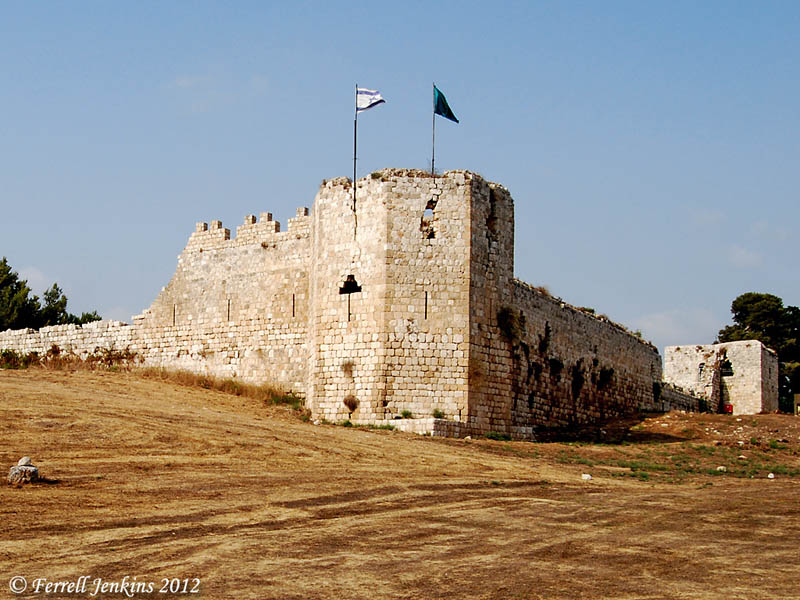
Because Aphek/Antipatris sat on a major south-north and west-east routes, it was dominated by many nations. The dominant feature of the site today is the Turkish fort. Inside are the excavated ruins of buildings from Canaanite to Herodian/Roman times.

Turkish fort at Aphek-Antipatris. Photo by Ferrell Jenkins.

Turkish fort at Aphek/Antipatris. Photo by Ferrell Jenkins.

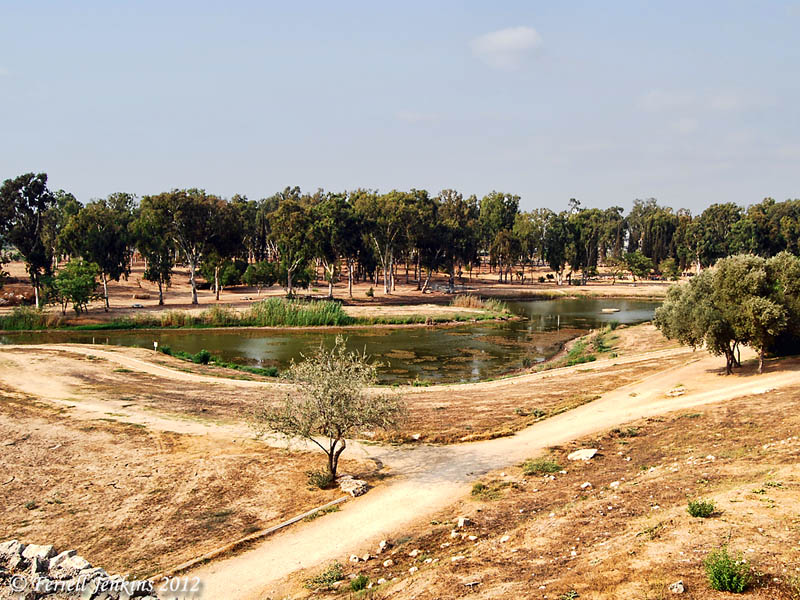
Aphek/Antipatris is known by the modern name Ras el-Ain because it is located at the source of the Yarkon River which flows a few miles into the Mediterranean.

Source of the Yarkon River at Aphek-Antipatris. Photo by Ferrell Jenkins.

Source of the Yarkon River at Aphek-Antipatris. Photo by Ferrell Jenkins.

When a plot was raised against Paul while he was in the Fortress of Antonia in Jerusalem, he was sent by night to Antipatris. The next day he was escorted to Caesarea.

So the soldiers, according to their instructions, took Paul and brought him by night to Antipatris.  And on the next day they returned to the barracks, letting the horsemen go on with him.  When they had come to Caesarea and delivered the letter to the governor, they presented Paul also before him. (Acts 23:31-33 ESV)

From Jerusalem to Antipatris is about 30 miles. From there to Caesarea is an additional 27 miles.

Paul would remain in custody at Caesarea for two years.