Category Archives: Archaeology

Uruk (Erech) in the Pergamum Museum

The Pergamon Museum’s Ancient Near Eastern Department (Vorderasiatisches Museum) has a collection of artifacts from Uruk, now know as modern Warka in Iraq. German excavators began work at Uruk in November 1912. An English sign with the display of artifacts explains the significance of the city.

In the Old Testament, Uruk is mentioned under the name Erech, along with Babylon and other important ancient cities. But written references to Uruk extend much further into the past. The city plays a role in the Gilgamesh epic which can be traced back to the second half of the 3rd millennium BC. The legendary Sumerian king Gilgamesh whose exploits are the subject of the poem is credited with building the wall that surrounded the city. A number of objects uncovered at Uruk before 1939 came to Berlin and the museum with the division of finds following on the excavations. Together with artifacts from Babylon and Assur, they document the material legacy of ancient oriental cultures.

Uruk was the major center for the worship of the goddess Inana/Ishtar. The first photo shows a portion from the façade of the Inanna Temple built by the Kassite ruler Kara-indash at Uruk about 1413 B.C. The museum explains,

Standing male and female deities alternate in the niches. Life-giving water pours forth onto the earth from the vessels in their hands. The hump-like symbols on the projecting elements of the niched façade and on the garments of the male divinities refer to the mountainous region where the Kassites originated. An inscription on the bricks names the Kassite ruler Kara-indash as the person who commissioned the structure.

Portion of the façade of the Inanna/Ishtar Temple at Warka (Uruk/Erech). Photo by Ferrell Jenkins.

Portion of the façade of the Inanna/Ishtar Temple at Warka (Uruk/Erech). Display in the Pergamum Museum, Berlin. Photo by Ferrell Jenkins.

The next photo shows a reproduction of a limestone cult vessel from Uruk.
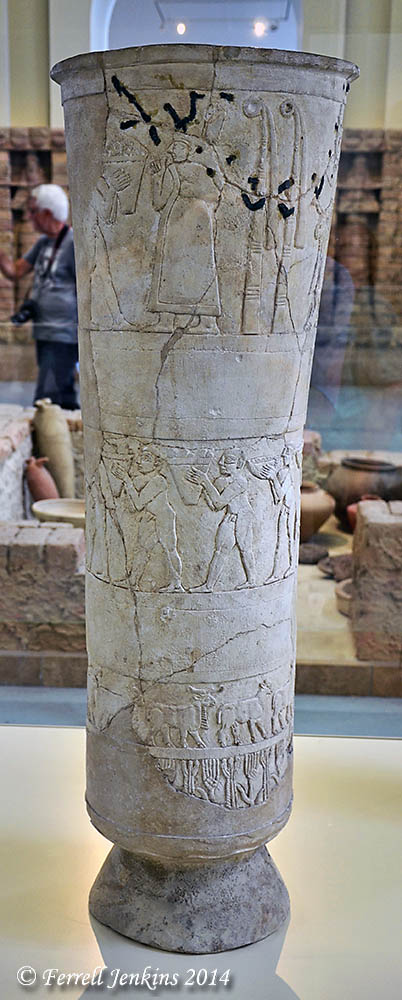
Stone cult vessel from Uruk. Photo by Ferrell Jenkins.

Stone cult vessel from Uruk. Photo by Ferrell Jenkins.

The Museum explains the design on the vessel.

The limestone vase from the Eanna Temple precinct at Uruk is one of the most impressive works of pictorial art produced in the Uruk Period. The arrangement of the motifs reflects the Sumerian world view, with life-giving water flowing forth in the lowest zone to sustain the plant and animal world above. The representations continue with a procession of nude men bearing votive offerings for the goddess Inanna which culminates in the upper register.

The New International Dictionary of Biblical Archaeology points out,

There are no direct references to Sumer in the Bible, although it corresponds to the “land of Shinar” mentioned eight times in the OT.

Amraphel is designated as the king of Shinar (Genesus 14:1). Notice a couple of other references.

The beginning of his [Nimrod] kingdom was Babel, Erech, Accad, and Calneh, in the land of Shinar. (Genesis 10:10 ESV)

And as people migrated from the east, they found a plain in the land of Shinar and settled there. (Genesis 11:2 ESV)

This map of southern Mesopotamia (modern Iraq) shows the location of Erech (Uruk) north of traditional Ur.
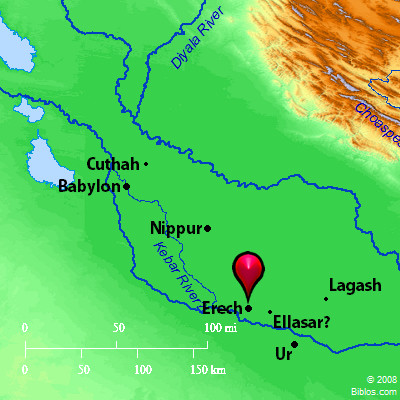
This map shows the location of Erech (Warka). Map: biblos.com.

This map shows the location of Erech (Warka in southern Iraq). Map: biblos.com.

Book on the origin of Israel available

Daniel I. Block’s book, Israel: Ancient Kingdom or Late Invention?, is available in Kindle format today for $2.99. The retail price of the hardback is $28.

The publisher (B&H) of the 2008 book describes it as

a collection of essays responding to the radical claims that Israel and its history actually began following the Babylonian exile, and that the history of Israel we read about in the Bible is a fictionalized account.

Contributors are leading Bible and archaeology scholars who bring extra-biblical evidence to bear for the historicity of the Old Testament and provide case studies of new work being done in the field of archaeology.

The book includes the following essays dealing with some of the current discussions in Biblical studies.

  • Israel – Ancient Kingdom or Late Invention? – Daniel I. Block
  • The Value and Limitations of the Bible and Archaeology – Alan R. Millard
  • Contextual Criticism as a Framework for Biblical Interpretation – John M. Monson
  • North-West Semitic Inscriptions and Biblical Interpretation – Joel Drinkard
  • From Joseph to David: Mari and Israelite Pastoral Traditions – Daniel E. Fleming
  • Major Geographical Issues in the Accounts of the Exodus – James K. Hoffmeier
  • Slavery and Slave Laws in Ancient Hatti and Israel – Harry A. Hoffner Jr.
  • Were the Israelites Really Canaanites? – Alan R. Millard
  • Syria and the Bible: The Luwian Connection – Richard S. Hess
  • David and Solomon’s Jemsalem: Do the Bible and Archaeology Disagree? – Alan R. Millard
  • Who Were Israel’s Transjordanian Neighbors and How Did They Differ? – Gerald L. Mattingly
  • Shalmaneser III and Israel – K. Lawson Younger Jr.
  • Did the Israelites Really Learn Their Monotheism in Babylon? Simon J. Shenvin
  • Did Persian Zoroastrianism Influence Judaism? – Edwin M. Yamauchi
  • Interpreting the Bible as an Ancient Near Eastern Document – John H. Walton

Following the Blogs

Available today only in Kindle format: How We Got the Bible by Neil Lightfoot. This is not the only book you need on this subject, but it is a good beginning source.
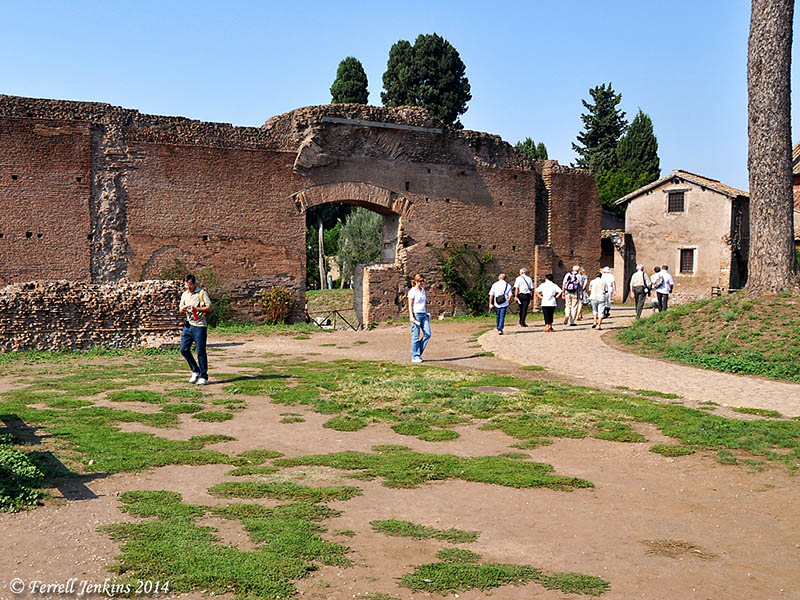
Todd Bolen’s Bible Places Blog is the best source for keeping up with news and recent materials related to Bible Places. I am a fan of the Weekend Roundup, with links to a variety of helpful materials. Today’s post reports that that rooms of Emperor Augustus on the Palatine Hill in Rome are now open to the public. Read here.

House of Augustus on the Palatine Hill, Rome. Photo by Ferrell Jenkins.

House of Augustus on the Palatine Hill, Rome. Photo by Ferrell Jenkins.

Charles Savelle provides a regular flow of links to helpful tools for serious Bible teachers and students at his BibleX (Bible Exposition). He recently pointed us to material on the Didache, The Dating of Deuteronomy and the Suzerain-Vassal Treaty Forms, and The Importance of Biblical Geography. I check this site regularly.

I enjoy following Bible Lands Explorer, the blog of Mark Ziese. Mark is a unique writer. His most recent post points us to a Brazilian newspaper for which he provided photos of the Jesus Trail. You may not be able to read the Portuguese newspaper, but there is a nice slide show of Mark’s photos.

Reading Acts. The blog by Phillip J. Long has some helpful articles for Bible students. Check some of these recent posts:

Ancient History Encyclopedia. This is a nice site including an encyclopedia that is primarily intended for high school level. Includes Index, Timeline, Maps, Photos, Videos, etc. Check the article on Roman Roads here.

ePlace. Research materials provided by Asbury Theological Seminary. Includes TREN collection of professional conference papers, dissertations, et al.

The Journal of Inductive Biblical Studies. This journal is built on the well-known work of Kuist, Traina, and others who wrote on Inductive Bible Study.

Daily Dose of Greek. Sign up for a 2-minute video Daily Dose of Greek by Rob Plumber, professor of Greek and New Testament at Southern Baptist Seminary.

Mark Hoffman, Biblical Studies and Technological Tools, recently posted two helpful lists of Greek lexical forms. Click here.

Resources to Help You Defend the Deity of Jesus. A list of resources by J. Warner Wallace, author of Cold Case Christianity.

HT: Brooks Cochran

Babylon’s Procession Street and Ishtar Gate

German archaeologists, under the direction of Robert Koldeway, excavated at ancient Babylon in Iraq, between 1899 and 1917. The Procession Street ran from the Ishtar Gate to the bridge over the Euphrates River. A 250 meter [820 feet] section of the street was excavated by the German expedition. Only a short section is reconstructed in the Museum in Berlin. The section here is 30 meters [98 feet] long and 8 meters [26 feet] wide. Original fragments were used in the reconstruction. The street was originally 20 to 24 meters [54-79 feet] wide. (See Fant & Reddish, Lost Treasures of the Bible, 199-205.)

The Procession Street from Babylon. Berlin. Photo by Ferrell Jenkins.

The Procession Street from Babylon. Berlin. Photo by Ferrell Jenkins.

The Ishtar Gate was constructed during the reign of Babylonian king Nebuchadnezzar (605-562 B.C.). All of these lions, bulls, and dragons were excavated from the mound of ancient Babylon, and eventually taken to Berlin in 1926. Even under the Communist government of East Germany this gate was preserved. I saw it several times before the Berlin Wall came down.

The Babylon Ishtar Gate. Berlin. Photo by Ferrell Jenkins.

The Babylon Ishtar Gate. Berlin. Photo by Ferrell Jenkins.

The Procession Street and Ishtar Gate are reconstructed in the Pergamum Museum in Berlin, but technically, this wing of the museum is called the Vorderasiatisches Museum (Museum of the Ancient Near East).

Babylon was once the greatest city of the world when the Neo-Babylonian Empire reigned supreme in the Ancient Near East (626-539 B.C.). The prophet Daniel was active in Babylon from 605 B.C. until after the fall of the city to the Persians (The prophecy of Daniel).  I can not imagine that he failed to see this gate.

Nebuchadnezzar was a megalomaniac. His pride is evident in the statement recorded by the prophet Daniel.

The king uttered these words: “Is this not the great Babylon that I have built for a royal residence by my own mighty strength and for my majestic honor?” (Daniel 4:30 NET Bible)

Byzantine compound discovered during construction

Many significant archaeological discoveries are made during construction. This can be private construction, road work, improvement of water or gas lines, or large construction projects.

The most recent announcement comes from the area of Beth Shemesh (Bet Shemesh, Beit Shemesh). The Israel Antiquities Authority released the following information Thursday.

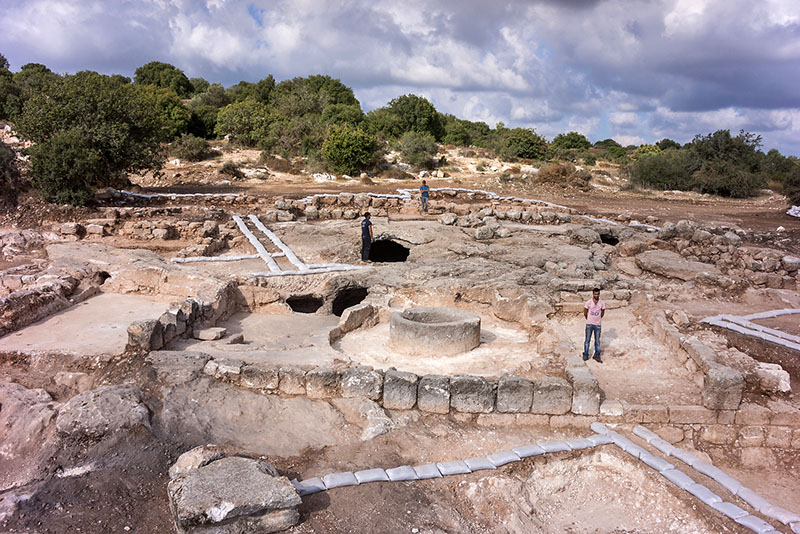
An archaeological survey conducted on foot along the hills south of Bet Shemesh brought to light remarkable finds. During the survey blocked cisterns, a cave opening and the tops of several walls were visible on the surface. These clues to the world hidden underground resulted in an extensive archaeological excavation there that exposed prosperous life dating to the Byzantine period which was previously unknown.

The compound is surrounded by an outer wall and is divided on the inside into two regions: an industrial area and an activity and residential area. An unusually large press in a rare state of preservation that was used to produce olive oil was exposed in the industrial area. A large winepress revealed outside the built compound consisted of two treading floors from which the grape must flowed to a large collecting vat. The finds revealed in the excavation indicate the local residents were engaged in wine and olive oil production for their livelihood. The impressive size of the agricultural installations shows that these facilities were used for production on an industrial-scale rather than just for domestic use. In the residential portion of the compound several rooms were exposed, some of which had a mosaic pavement preserved in them. Part of a colorful mosaic was exposed in one room where there was apparently a staircase that led to a second floor that was not preserved. In the adjacent room another multi-colored mosaic was preserved that was adorned with a cluster of grapes surrounded by flowers set within a geometric frame. Two entire ovens used for baking were also exposed in the compound.

The directors of the excavation believe the site is a monastery from the Byzantine period. The photo below provides an aerial view of the complex.

Byzantine compound near Ramat Bet Shemesh. Photo: Griffin Aerial Photography, IAA.

Byzantine compound near Ramat Bet Shemesh. Photo: Griffin Aerial Photography, IAA.

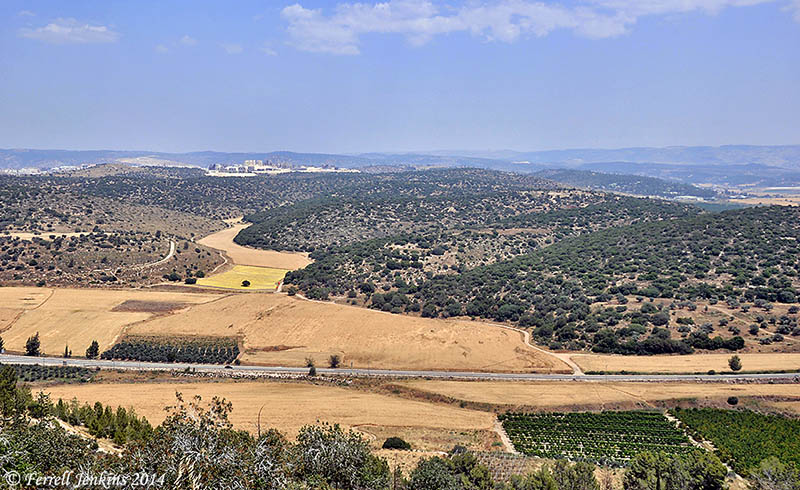
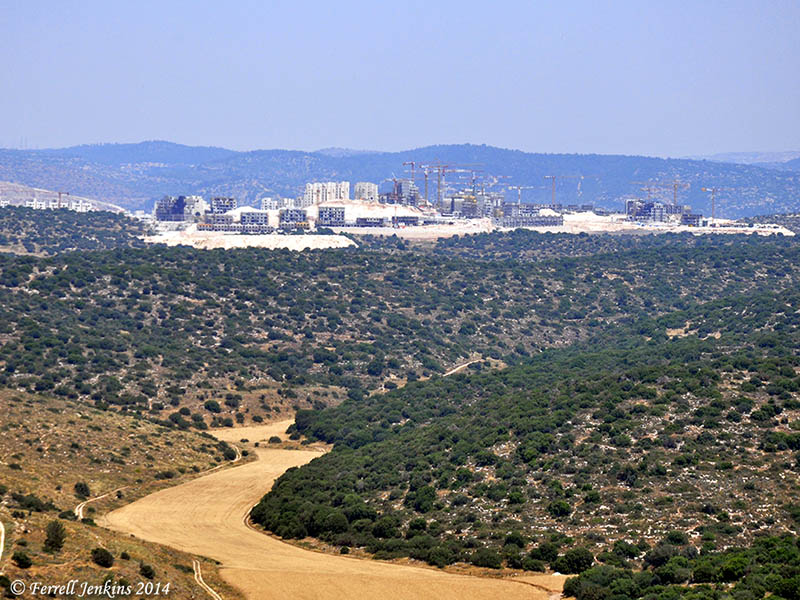
Based on the driving instructions provided by the IAA, I can show you the general area. My photo was made from the top of Tel Azekah. The road below the tel runs across the Valley of Elah. In the distant left you will see a white area on the hill with high-rise apartments under construction. The discovery was made near this large construction area. Left of the construction, Tel Yarmuth (Jarmuth, Joshua 10:3, 5, 23; 12:11; 15:35) rises above the trees. Khirbet Qeiyafa is on the hill in the right of the photo.

View from Azekah toward Bet Shemesh and Tell Yarmuth (Jarmuth). Photo by Ferrell Jenkins.

View from Azekah toward Ramat Bet Shemesh and Tel Yarmuth (Jarmuth). Photo by Ferrell Jenkins, made May 4, 2013.

The next photo is a zoom shot of the construction area in May, 2013, from Tel Azekah. Tel Yarmuth is just off the left of the photo, as well as the town of Ramat Bet Shemesh.

The construction area from Azekah. Photo by Ferrell Jenkins.

The construction area from Azekah. Photo by Ferrell Jenkins.

The Khirbet Qeiyafa excavation has been concerned about this new community and its possible encroachment upon the site. Luke Chandler reported on the threat here.


The Altar of Zeus in the Pergamum Museum

The Pergamum Museum in Berlin gets its name from the reconstructed altar of Zeus from Pergamum (Bergama) in western Turkey. I noted earlier that this fabulous reconstruction is now closed for refurbishing. When we visited the Museum in mid-August, 2014, some scaffolding was already in place.

The Pergamum Altar in the Pergamum Museum. Photo by Ferrell Jenkins.

The Pergamum Altar in the Pergamum Museum. Photo by Ferrell Jenkins.

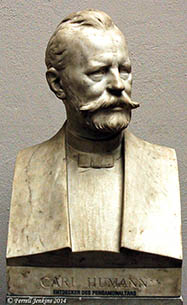
The altar of Zeus was built by Eumenes II (197–159 B.C.) to commemorate the victory of Attalus I over the invading Gauls. This is the most important and largest building from the Hellenistic age. The unique discovery of the Altar is told by Dr. Henry Koch:

Carl Humaan

Carl Humaan

“A German engineer named Carl Humann had been authorized to build a road from Pergamon to the Aegean Sea. While he was supervising the work he noticed that marble statues and torsos were being carted from the ruins of the city and brought to the limekiln to be burnt into lime. It is to be feared that many a valuable statue was thus reduced to limestone. One day Humann also observed, how a peasant was hauling a marble slab adorned with statues and figures to the limekiln. He halted the peasant, asked him, how much he wanted for the slab, paid the price and immediately had the slab sent to the curators of the Berlin Museum in Germany. He offered the peasant more money, if he could procure additional slabs for him. The peasant gladly consented. For him it was lucrative business; for the curators it was a precious find.

Alexander Conze, a curator in Berlin, discerned the great value of the find. He recalled having read that a Roman writer named Ampelius living in the second century after Christ had written a Book of Wonders (Liber Memorialis). Among the wonders he also had mentioned the Altar of Zeus in Pergamum. This was a valuable clue for Conze. Humann was at once requested to obtain as many slabs a possible. Permission was also requested of the Turkish Government to have the slabs sent to Berlin and that excavations could be started at once. Permission was granted and the excavations were carried out from 1879-1885. Fortunately most of the ruins of the Temple had not as yet been found or touched. The curators in Berlin could piece them all together and thus the priceless Altar of Zeus could be assembled” (Koch, The Christian News, Nov. 22, 1976).

The Altar of Zeus was re-assembled in more than twenty years of museum work and is now housed in the special Pergamum Museum in Berlin. A trip to see this fabulous piece of architecture is recommended. The marble frieze depicts the mythological battle between gods and giants. The photo below shows a small portion of a scene.

A portion of the Zeus Altar marble frieze. Photo by Ferrell Jenkins.

A portion of the Zeus Altar marble frieze. Photo by Ferrell Jenkins.

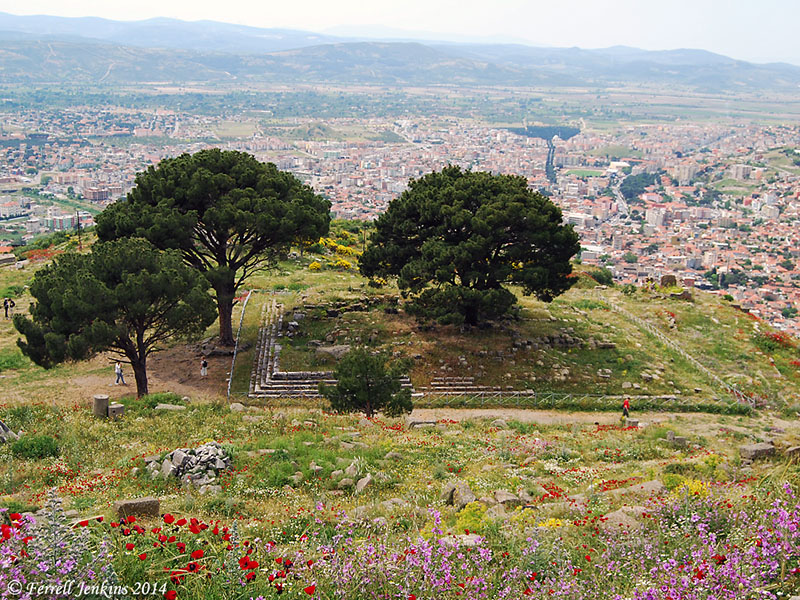
Only the foundations of the altar can be seen at Pergamum. The Turkish government has requested the return of the Zeus Altar and has been putting pressure on Germany. See one report here.

Site of the Zeus Altar at Pergamum. Photo by Ferrell Jenkins.

Site of the Zeus Altar at Pergamum. Photo by Ferrell Jenkins.

In the Lord’s letter to the church at Pergamum, He says,

I know where you dwell, where Satan’s throne is. Yet you hold fast my name, and you did not deny my faith even in the days of Antipas my faithful witness, who was killed among you, where Satan dwells. (Revelation 2:13 ESV)

Some scholars think the reference to Satan’s throne in this text is a reference to the Zeus altar at Pergamum, but there are other suggestions. Kistemaker summarizes some popular views suggested by Colin Hemer:

  • To a traveler coming from the east, the acropolis [of Pergamum] had the appearance of a throne.
  • The altar of Zeus Sōtēr seemed to be a throne.
  • Asclepius Sōtēr was identified with the serpent.
  • Pergamum was the center of emperor worship.

Or, it might be a combination of these elements.

You will probably need to wait two or more years before you can see the Zeus Altar in the Pergamum Museum.

The Miletus Market Gate in the Pergamum Museum

The Pergamum Museum in Berlin is home to three outstanding architectural remains from the ancient world: the Zeus Altar from Pergamum, the Miletus Market Gate, and the Ishtar Gate from Babylon.

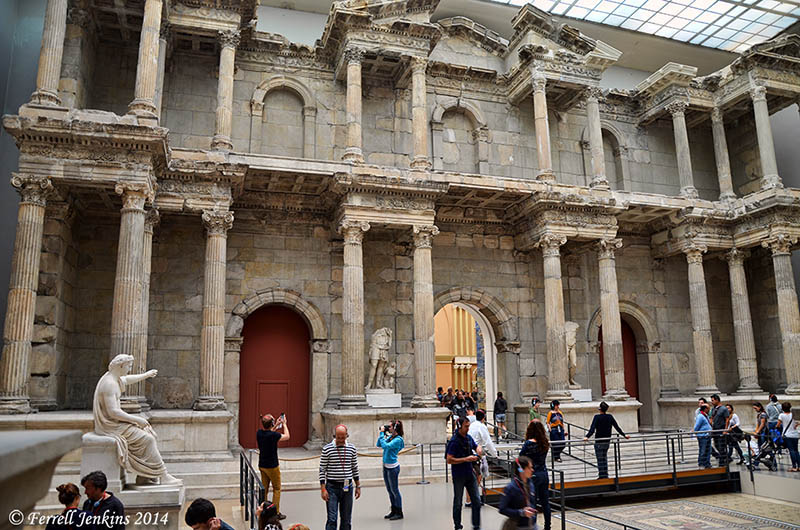
The Market Gate of Miletus, constructed about 120-130 A.D. during the reign of the Emperor Hadrian, has been reconstructed in the museum. Fant and Reddish say,

This two-story gateway is one of the finest examples of Roman façade architecture in existence” (Lost Treasures of the Bible, p. 349).

German archaeologists excavated the gate and sent it to Germany in the first decade of the 20th century. It was more than 20 years before a suitable room was available for the gate to be reconstructed.

Miletus was already a significant city with outstanding monuments when Paul stopped there on the return from his third journey, but this building would not be built for another 60 or 70 years.

The recently renovated Miletus Market Gate in the Pergamum Museum, Berlin. Photo by Ferrell Jenkins.

The recently renovated Miletus Market Gate in the Pergamum Museum, Berlin, Germany. Photo by Ferrell Jenkins.

A seated statue of the Emperor Trajan, seen on the left side of the above photo, comes from a different place. We know from the writings of Pliny that some Christians of Asia Minor were persecuted during the reign of Trajan. See here.

The Emperor Trajan (A.D. 98-117). Photo by Ferrell Jenkins.

The Emperor Trajan (A.D. 98-117). Photo by Ferrell Jenkins.

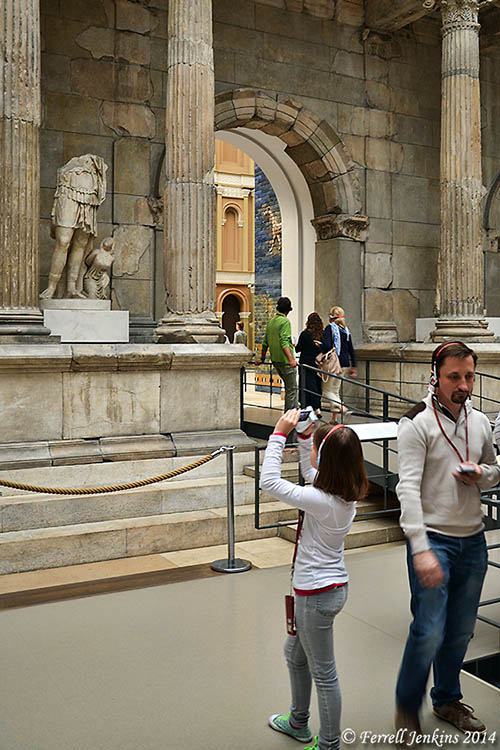
To illustrate the greatness of this museum, if we go through one exit from the room we see the Zeus Altar, but if we go through the gate we see the Ishtar Gate from Babylon. Notice the colored bricks of the Ishtar Gate in the photo below.

The Ishtar Gate can be seen through the Miletus Market Gate. Photo by Ferrell Jenkins.

The Ishtar Gate can be seen through the Miletus Market Gate. Photo by Ferrell Jenkins.

Miletus is mentioned only two places in the New Testament. The first is on Paul’s return from the third journey about A.D. 57 (Acts 20:15, 17). The other time is when Paul tells Timothy, in his last letter, that he had left Trophimus “sick at Miletus” (2 Timothy 4:20). This indicates that Paul may have stopped at Miletus on the voyage to Rome, but no activity is recorded.

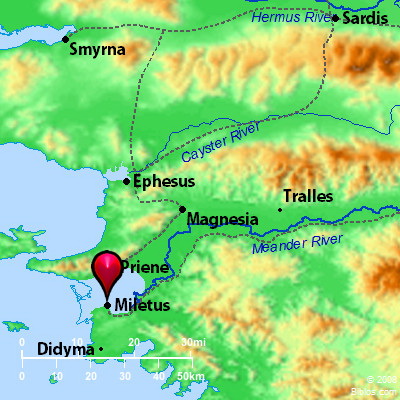
From Miletus, on the first visit, Paul sent for the elders of the church at Ephesus. In those days it would be a lengthy journey for a messenger to go from Miletus to Ephesus. The distance by land would have been about 63 miles. If the couriers went across the Gulf of Latmos (Latmus) the distance would be about 38 miles. The map below shows the location of Miletus on the south of the Gulf of Latmos. Over the centuries the harbor, fed by the Meander River, silted up. Today Miletus is landlocked about five miles away from the Aegean Sea.

Map showing Miletus and Ephesus. Map courtesy BibleAtlas.org.

Map showing Miletus and Ephesus. Map courtesy BibleAtlas.org.

Group claims world’s oldest pyramid “ruined” by restorers

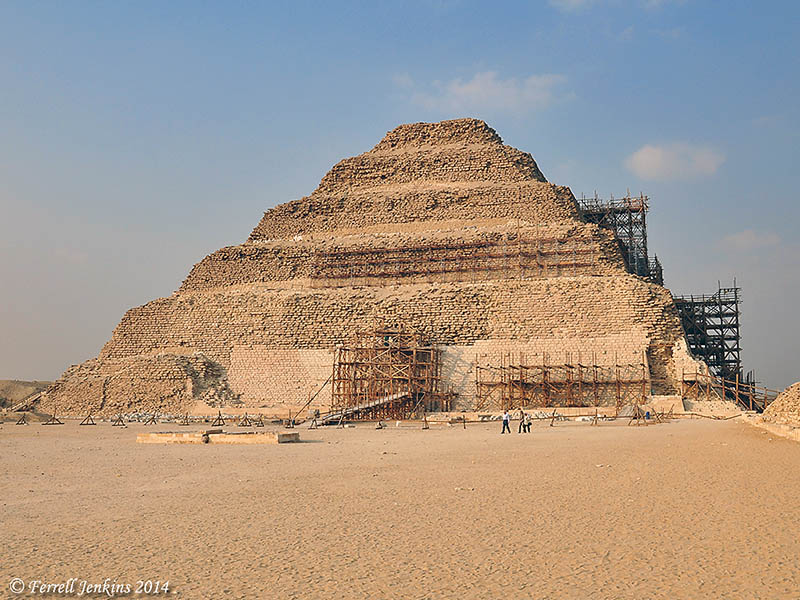
According to a report in the International Business Times, activists in Egypt are angry with the Minister of Antiquities for re-hiring a company to restore the Step Pyramid of Zoser at Saqqara. The group says the firm “caused damage and major deterioration to the structure while trying to repair it.” The report may be read here.

Saqqara is significant because it is the location of the oldest freestanding stone building in the world. The architect of this structure was the vizier and physician Imhotep. Zoser reigned about 2600 B.C.

Hachette World Guide on Cairo, Alexandria and Environs, describes the pyramid in these terms:

The Step Pyramid is formed of six unequal sections and is not, in the strict sense, a pyramid tat all. The plan is not square, but oblong in the S-W sense, and the summit is formed by a terrace (also oblong) and not by a Pyramidion. The dimensions of the base are approximately 397 feet by 357 feet. The present height of the Pyramid is 193 feet. It would originally have been some 196 feet. The verticle slope of the steps is on an average of some 16°, the horizontal [slope is] 22°.

On my last visit to Egypt in January, 2011, I noticed scaffolding on all sides of the step pyramid.

The Step Pyramid of Zoser at Saqqara. Photo by Ferrell Jenkins.

The Step Pyramid of Zoser at Saqqara. Photo by Ferrell Jenkins.

This pyramid, as well as the great pyramids of Giza, was built long before the time of the  biblical characters who visited Egypt — Abraham, Joseph, Jacob, et al.

HT: Jack Sasson

The Route of the Exodus and the Location of Mount Sinai

Over the past 48 years I have had the opportunity to visit almost all parts of the Bible World. I certainly have not solved all of the problems that are raised about locations of certain events, but I have tried to look at the major claims whether it is the location of Cana, the site for the baptism of Jesus, the place of the crucifixion and burial of Jesus, the location of Ararat, or the route of the exodus and the location of Mount Sinai, et al.

In this post I have pulled together a list of some things I have written about the route of the Exodus and the location of Mount Sinai. I hope you will find the posts helpful when you study this subject.

  • Pharaoh’s chariot wheels and other things that won’t float – Examining the claims of the late Ron Wyatt here.
  • Location of the Red Sea crossing and Mount Sinai here.
  • Location of Mount Sinai here.
  • Solomon’s Seaport at Ezion-geber here.
  • Sharks at Sharm el-Sheikh in the Sinai here. Sharm el-Sheikh is at the Straits of Tiran.
  • “Cracked Pot Archaeology” here.
  • Pseudo Archaeologists here.
  • Goshen and the Great Bitter Lake here.
  • Another day in Goshen here.

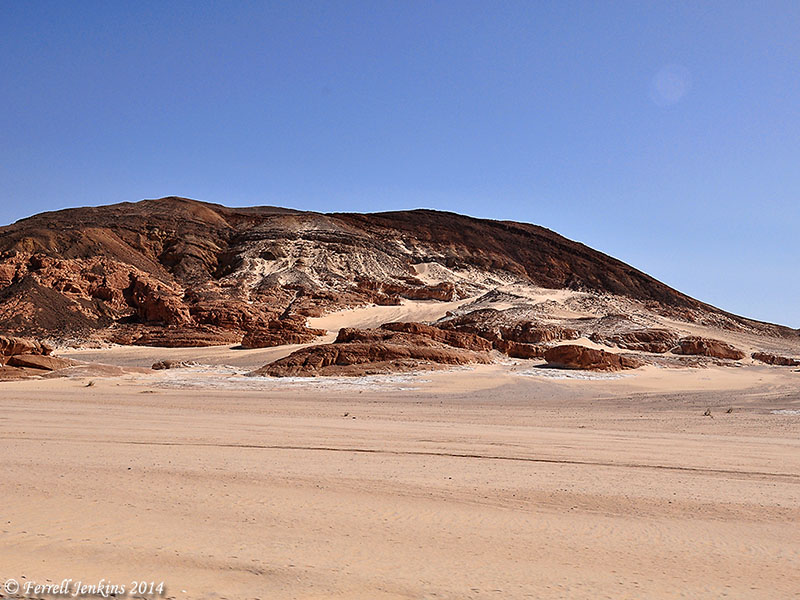
Below are a couple of photos that show the changing scenery that one sees in the Sinai Peninsula.

Sinai Peninsula near the Gulf of Eilat or Aqaba. Photo by Ferrell Jenkins.

Sinai Peninsula near the Gulf of Eilat or Aqaba. Photo by Ferrell Jenkins.

Read some scholarly presentations on the subject. Such as these recent Bible atlases.

  • Beitzel, Barry J. The New Moody Atlas of the Bible, 106-114.
  • Currid, John D. and David P. Barrett. Crossway ESV Bible Atlas, 77-91.
  • Rasmussen, Carl G. Zondervan Atlas of the Bible, 100-105.
Wadi Feiran in the Sinai Peninsula. Photo by Ferrell Jenkins.

Wadi Feiran in the Sinai Peninsula. Photo by Ferrell Jenkins.

Or books such as…

  • Hoffmeier, James K. Israel in Egypt: The Evidence for the Authenticity of the Exodus Tradition, chs. 8-9.

The Associates for Biblical Research includes several articles about the Exodus at their website here.

  • Is Mount Sinai in Saudi Arabia? here.
  • Mount Sinai is Not Jebel Al-Lawz in Saudi Arabia here.

I am hopeful you will browse through this material and remember to examine it more closely the next time you study Exodus.

London and the British Museum

We finally reached the third of the big three museums with Ancient Near Eastern collections that we had planned to visit. We spent large portions of two days in the museum. The museum is open every day of the week. Closing time is 5:30 p.m. every day except Friday when the time is 8:30 p.m. There is no required entry fee, but a request is made for a £5 (about $8.50) or more donation.

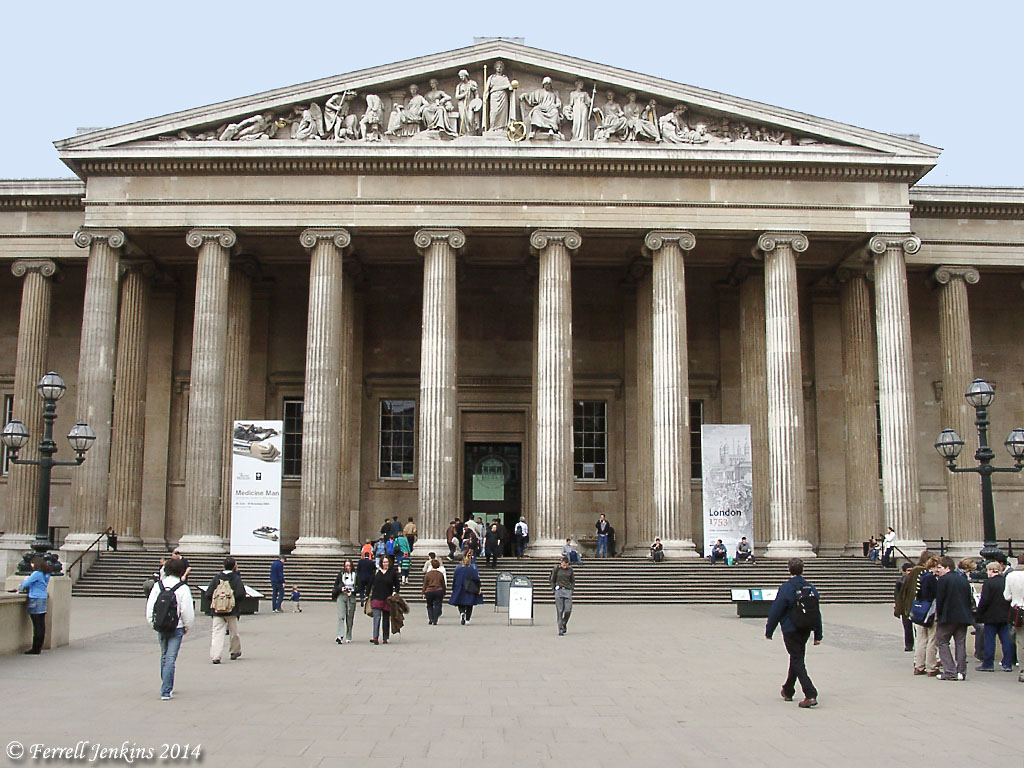
I have emphasized the crowds in the Pergamum Museum, and the Louvre. The same was true in the British Museum. The photo below was made a few years ago at the end of September. Once school is in session one should be able to find times without hugh crowds. Many galleries have natural light that comes in. Some photos are better with the natural light and others are better with the artificial light, depending on the glare on the case.

British Museum entrance on Great Russel Street, London. Photo by Ferrell Jenkins.

British Museum entrance on Great Russell Street, London. Photo by Ferrell Jenkins.

The British Museum was founded in 1753 to house the collection of Sir Hans Sloane which had been left to the nation. It is now among the greatest museums of the world.

Each of the big three museums has a specialty depending on the areas where the country has done archaeological work. The Pergamum museum is loaded with material from Mesopotamia and Turkey. The Louvre has a fabulous collection from the Levant, especially Syria, and Iran (Persia). The British Museum is big on the Levant, Egypt and Mesopotamia. All three have nice Roman and Greek galleries.

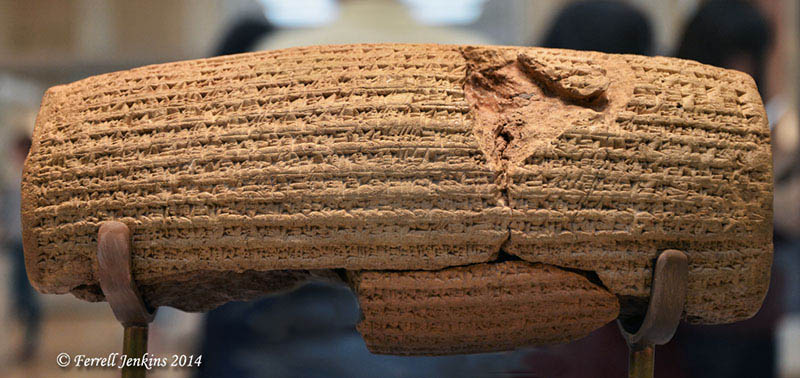
I knew that the Cyrus Cylinder had been part of a traveling exhibit for a few years. When we got near the Ancient Iran Room I told my wife that I would make a quick run to see what was there. I was delighted to see the Cyrus Cylinder prominently displayed.

Cyrus Cylinder in the British Museum. Photo by Ferrell Jenkins.

Cyrus Cylinder in the British Museum. Photo by Ferrell Jenkins.

The Cyrus Cylinder is important to Bible students because Cyrus is the Persian king who allowed the Judeans to return to Jerusalem and rebuild the temple.

Now in the first year of Cyrus king of Persia, that the word of the LORD by the mouth of Jeremiah might be fulfilled, the LORD stirred up the spirit of Cyrus king of Persia, so that he made a proclamation throughout all his kingdom and also put it in writing:  “Thus says Cyrus king of Persia, ‘The LORD, the God of heaven, has given me all the kingdoms of the earth, and he has charged me to build him a house at Jerusalem, which is in Judah. Whoever is among you of all his people, may the LORD his God be with him. Let him go up.’” (2 Chronicles 36:22-23 ESV; cf. Ezra 1:1-4).

Some artifacts that I had expected to see were not on display. Cases are changed and artifacts are moved around. Sometimes there will be a sign saying that the items is on loan, being photographed, or studied. In other instances there is no reference to the removed item. One significant item that I missed seeing in its usual place is the Babylonian Chronicle that gives the date of the Babylonian capture of Jerusalem in 597 B.C. Another missing item was the Standard of Ur.

A BBC report says that the 80,000 artifacts displayed in the British Museum amount to only 1% of the artifacts held by the Museum. On several occasions I have made inquiry about an artifact and been given a time when someone would be available to show it to me.

The British Museum web site provides information about planning a visit, and it also includes an online collection with photos.