Monthly Archives: April 2010

Jaffa Gate unveiling tomorrow

The newly rehabilitated Jaffa Gate will be unveiled tomorrow, April 21, after several months of conservation work. Jaffa Gate is the only one of the seven gates of the Old City on the western side of Jerusalem.
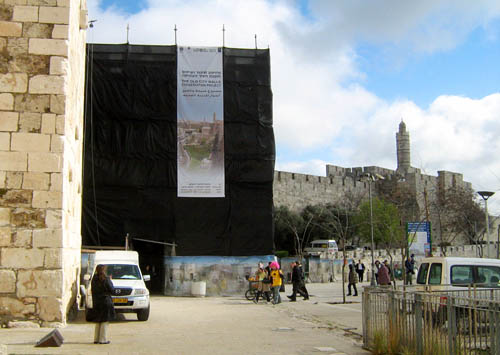
Jaffa Gate awaiting unveiling. Photo: IAA.

Jaffa Gate awaits unveiling after several months of rehabilitation. Photo: IAA.

The Israel Antiquities Authority press release briefly describes the history of the gate:

Jaffa Gate was first inaugurated in 1538. It constituted part of the city walls and in fact it was only toward the end of the nineteenth century did it become a center of bustling and prosperous activity. The period culminated in the year 1898, when it was decided to breach a wide entrance in the city wall of Jerusalem (as we know it today) and thereby allow the German Kaiser, Wilhelm II and his wife, Augusta Victoria, to enter the city in their carriage. Thus, for the first time in the history of modern Jerusalem, carts could enter the Old City.

In the War of Independence the gate was the focal point of some very harsh battles. During the war Jaffa Gate was completely blocked by an armored vehicle that had been damaged in the fighting and was wedged in the opening. In the cease-fire agreements between Israel and Jordan Jaffa Gate stood at the opening to the no man’s land that stretched from Jaffa Gate to Zahal Square and the Mamilla neighborhood and separated it from Jordanian controlled Jerusalem in the east. Consequently, the blocked armored vehicle was not removed, and the gate remained closed the entire period that the city was divided. The remains of the bullets that pierced the stones of the gate are clearly visible on the upper parts of the structure.

You may read the press release in its entirety here.
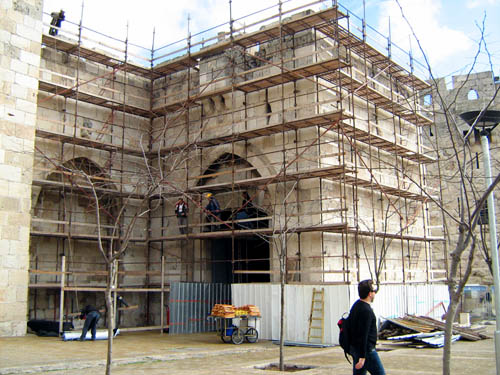
Jaffa Gate during rehabilitation. Photo: IAA.

Jaffa Gate during rehabilitation. Photo: Israel Antiquities Authority.

English Bible students will recognize the word Jaffa as Joppa. This is the gate through which one would leave Jerusalem to go to Joppa on the Mediterranean coast. Cedar timber from Lebanon was brought from Joppa to Jerusalem for the building of Solomon’s temple.

And we will cut whatever timber you need from Lebanon and bring it to you in rafts by sea to Joppa, so that you may take it up to Jerusalem. (2 Chronicles 2:16 ESV)

HT: Joseph I. Lauer
Practical uses of potsherds

Once pottery is broken it appears to be useless. The prophet Jeremiah, prior the Babylonian destruction of Jerusalem, was told by the LORD to buy a piece of pottery. Follow the story:

The LORD told Jeremiah, “Go and buy a clay jar from a potter. Take with you some of the leaders of the people and some of the leaders of the priests. Go out to the part of the Hinnom Valley which is near the entrance of the Potsherd Gate. Announce there what I tell you. (Jeremiah 19:1-2 NET)

Eventually, he was to break the clay jar.

The LORD continued, “Now break the jar in front of those who have come here with you. Tell them the LORD who rules over all says, ‘I will do just as Jeremiah has done. I will smash this nation and this city as though it were a potter’s vessel which is broken beyond repair. The dead will be buried here in Topheth until there is no more room to bury them.’ (Jeremiah 19:10-11 NET)

Broken pottery is clay that has been formed and fired before being broken. David described his weakened condition using an analogy to potsherds:

The roof of my mouth is as dry as a piece of pottery; (NET), or “my strength is dried up like a potsherd” (Psalm 22:15 ESV)

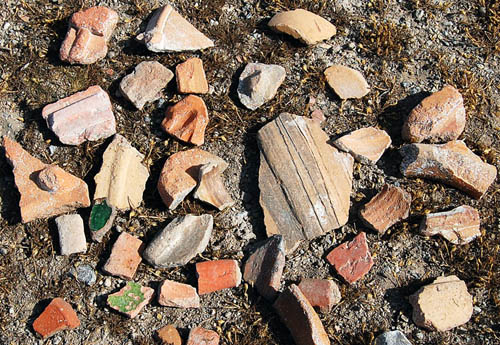
Collected potsherds on the surface of Derbe. Photo by Ferrell Jenkins.

Collected potsherds on the surface of Derbe. Photo by Ferrell Jenkins.

The pottery is now potsherds, sherds, or shards. Is there any practical use for it? Yes.

  • Scraping sores. “Job took a shard of broken pottery to scrape himself with while he was sitting among the ashes.” (Job 2:8 NET)
  • Taking fire from the hearth, or scooping water from a cistern (Isaiah 30:14). This would require a shard from a larger jar.
  • Writing material. When the potsherd is used as a writing surface it is called an ostracon (plural is ostraca). We have some famous examples such as the Lachish Letters, the lots at Masada, the Arad ostraca, Samaritan ostraca, et al.

In Nebuchadnezzar’s vision of the future, the “toes of the feet were partly of iron and partly of clay [pottery, NAU]” (Daniel 2:42). I could have told him this would not work. “Iron does not mix with clay [pottery, NAU]” (Daniel 2:43).

If we move to modern times, there is another practical use for potsherds.

  • Archaeological dating. Potsherds are an indicator of the chronological periods during which a tell was occupied. Flinders Petrie, working at Tell el-Hesi in 1890, observed the relationship between the various layers of the tell and the pottery found in each layer.

Potsherds, sherds, and shards

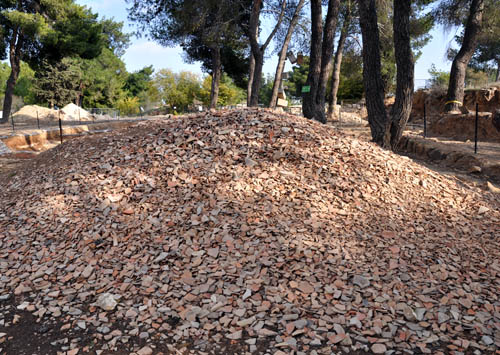
Pottery is the most durable of things discovered during an archaeological dig. Even when the pottery is broken it endures, and can be useful for some purposes. The pieces of broken pottery are called potsherds, sherds, or shards.  Visit any archaeological site and you will see a pile of broken pottery. The largest pile I recall seeing is at Ramat Rachel between Jerusalem and Bethlehem.

A pile of potsherds at Ramat Rachel. Photo by Ferrell Jenkins.

A pile of potsherds at Ramat Rachel. Photo by Ferrell Jenkins.

Cities of biblical times likely had a common place to dump broken pottery. In the days of Jeremiah, Jerusalem had a gate known as the Potsherd Gate.

Go out to the part of the Hinnom Valley which is near the entrance of the Potsherd Gate. Announce there what I tell you. (Jeremiah 19:2 NET)

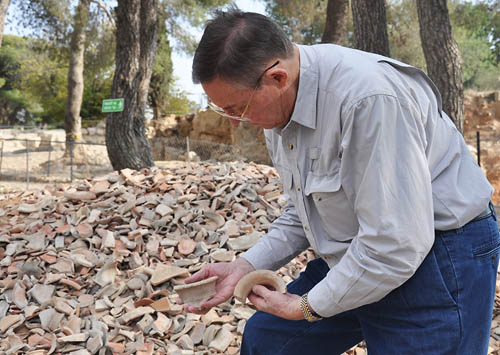
Looking through the pottery shards at Ramat Rachel.

Ferrell Jenkins looking at a rim and a handle at Ramat Rachel. Photo: Leon Mauldin.

Is there any use for this broken pottery? Answer to follow…

Did someone say “Free”?

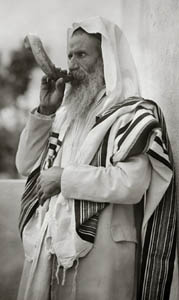
Yemenite Rabbi blowing shofar.

Yemenite Rabbi blowing shofar.

Todd Bolen is giving away a PowerPoint presentation, and the associated jpg images, of Jewish People in the Early 1900s. These photos are part of the The American Colony and Eric Matson Collection that Todd has made available.

We have recommended the entire collection here.

For the free presentation or the images, click here. The photo to the right is a miniature of one showing a Yemenite Rabbi blowing a shofar. It dates to between 1934 and 1939. Shofar is the Hebrew word often translated trumpet (2 Kings 9:13) or ram’s horn (Leviticus 25:9) in English versions of the Bible.

Robbers arrested for digging up archaeological site

Illegal digging of archaeological sites is a problem in many countries. Israel reports that at 150 robbers are caught each year. Thievery has been a special problem in Iraq. I have seen archaeological mounds in Turkey with evidence of fresh digging.

Ron Friedman of The Jerusalem Post reports on a recent case in which four men were arrested at a site near Moshav Zechariya. The headline says the men were arrested near Beit Shemesh [Beth-shemesh]. Zechariya is about 6-7 miles south of Beit Shemesh.

The Antiquities Authority revealed on Tuesday that officers from its Unit for the Prevention of Antiquities Robbery arrested four men from Rahat who were allegedly attempting to rob an archeological site near Beit Shemesh on Saturday. The unit’s inspectors caught the men digging a large hole uncovering a network of underground passages in their search for buried treasure they believed to be hidden there.

The men were arrested on the spot and taken by members of the Border Police to the Jerusalem central police station for interrogation. When brought before a judge, the suspects denied the charges and were released on NIS 50,000 bail. The Antiquities Authority spokeswoman said that an indictment charging the men with damaging an archeological site and unlawful digging in an archeological site – offenses that carry five- and three-year sentences, respectively – will be issued in the coming days.

The site where the arrests took place holds the remnants of 3,000 years of habitation, dating back to the days of the First Temple. The site, which was also populated in the Byzantine period 2,000 years ago and during the Crusades 900 years ago, features remains of a fortified wall, various structures, graves and a network of underground caves and tunnels. The alleged robbers destroyed structure walls, and their aggressive digging caused irrecoverable damage to multiple archeological levels.

Amir Ganor, who heads the antiquities robbery prevention unit, was on hand during the arrest and said the damage done by the men was irreversible.

Ganor’s comment about the value of archaeological sites is significant:

Archeological sites belong to the whole public and are human heritage assets. Digging up a site causes irreversible damage. Anything removed from it is taken out of the human inventory. No length of time in prison can make up for or correct the damage that is done to the site. Harming ancient sites is like ripping pages from the cultural history books of the land and its people.

You may read the article in its entirety here.

HT: Joseph I. Laurer

Temples made by man

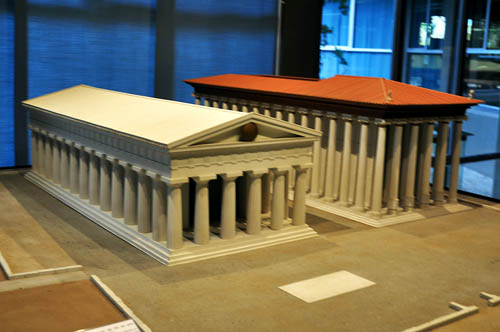
Any Greek or Roman city we visit is surely to have ruins of a theater and a temple. Both Greek and Roman theaters remain at Syracuse (Acts 28:12).The Paoli Orsi Regional Archaeological Museum displays a model of the Temple of Athena (left; 480 B.C.) and the Temple of Artemis (right; 520 B.C.).

Temple models at Syracuse, Sicily, archaeological museum.

Model of Temple Athena and Temple of Artemis. Syracuse. Photo by Ferrell Jenkins.

The Apostle Paul had to contend with this in every Roman city he visited. At Athens he said,

The God who made the world and everything in it, being Lord of heaven and earth, does not live in temples made by man, nor is he served by human hands, as though he needed anything, since he himself gives to all mankind life and breath and everything. (Acts 17:24-25 ESV)

He reminded the Corinthians, who lived in a city filled with temples,

For although there may be so-called gods in heaven or on earth–as indeed there are many “gods” and many “lords”– yet for us there is one God, the Father, from whom are all things and for whom we exist, and one Lord, Jesus Christ, through whom are all things and through whom we exist. (1 Corinthians 8:5-6 ESV)

Solomon’s temple in Jerusalem, as well as the later temples built by Zerubbabel and Herod, were made with hands. Paul certainly knows this. But he also knows what Solomon said about the same subject:

“But will God indeed dwell on the earth? Behold, heaven and the highest heaven cannot contain you; how much less this house that I have built! (1 Kings 8:27 ESV)

Read the full account of the building and dedication of the temple in 1 Kings 6-8. The temple was a place of worship, but it was not to be the object of worship.

Jesus taught His disciples to pray like this: “Our Father in heaven, hallowed be your name” (Matthew 6:9).

Paul stayed three days in Syracuse

After three months on the Island of Malta, Paul’s voyage to Rome resumed when an Alexandrian ship that had wintered there set sail. The next stop was Syracuse in Sicily (Acts 28:11-12).

K. L. McKay describes Syracuse:

A city with a large harbour on the E coast of Sicily. Founded in 734 bc by Corinthian colonists, it had by the end of the 5th century bc become the most important city, politically and commercially, in Sicily, especially under the tyrants Gelon and Dionysius I. (New Bible Dictionary, 1143).

The stop at Syracuse is nearly overlooked by Luke, with only these words:

We put in at Syracuse and stayed there three days. (Acts 28:12 NET)

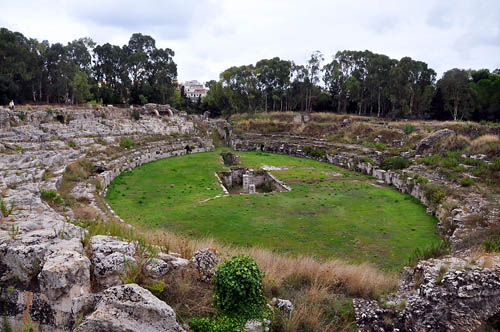
It is doubtful that Paul, as a prisoner, had much liberty to visit the sites of the city as he did at Athens (Acts 17:23). There are a few Roman and Greek ruins to be seen today. Our photo today is of the Greek theater built in the fourth century B.C.

Syracuse Greek Theater. Photo by Ferrell Jenkins.

Ruins of the Greek Theater in Syracuse. Photo by Ferrell Jenkins.

The Good Shepherd

When the Pharisees and scribes complained that Jesus received sinners and ate with them, He told them a parable that we call the parable of the lost sheep (Luke 15:1-7).

“What man among you, if he has a hundred sheep and has lost one of them, does not leave the ninety-nine in the open pasture and go after the one which is lost until he finds it? “When he has found it, he lays it on his shoulders, rejoicing. “And when he comes home, he calls together his friends and his neighbors, saying to them, ‘Rejoice with me, for I have found my sheep which was lost!’  “I tell you that in the same way, there will be more joy in heaven over one sinner who repents than over ninety-nine righteous persons who need no repentance. (Luke 15:4-7 NAU)

“When he has found it, he lays it on his shoulder, rejoicing.” This describes the work of good shepherds and a practice that was well known to those who heard Jesus. On another occasion Jesus called Himself the good shepherd (John 10:11, 14).

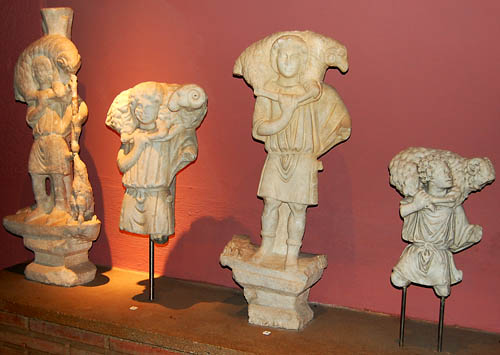
The motif of the good shepherd with the sheep on his shoulder became common in later Christian iconography. Similar drawings are known from the catacombs in Rome. The four statuettes shown below date from the 4th century A.D., and are displayed in the Istanbul Archaeological Museum.

Good shepherd statues. Istanbul Archaeological Museum. Photo by Ferrell Jenkins.

Good shepherd statues. Istanbul Archaeological Museum. Photo by Ferrell Jenkins.

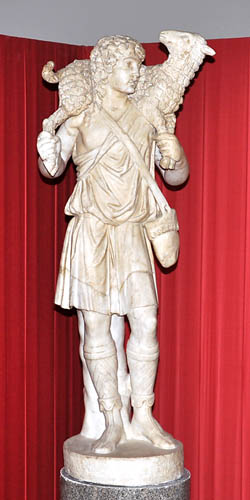
Last September I saw a special exhibit of early Christian artifacts in the Vatican Museum. The photo below shows a wonderful early 4th century statuette of the Good Shepherd.

The Good Shepherd in the Vatican Museum. Photo by Ferrell Jenkins.

The Good Shepherd in the Vatican Museum. Photo by Ferrell Jenkins.

Judean Desert scholar Hanan Eshel dead

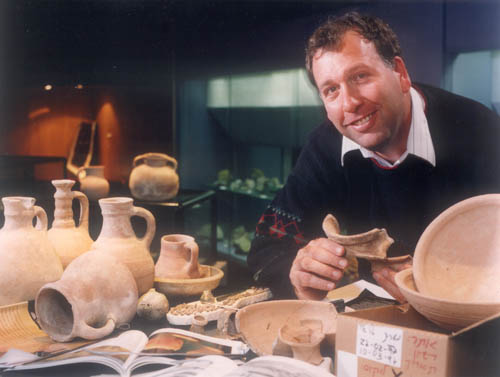
Word comes of the passing of Professor Hanan Eshel. Aren Maeir, who taught with Eshel says,

Hanan Eshel, my good friend and colleague from the Department of Land of Israel Studies and Archaeology at Bar-Ilan University, and one of the leading scholars in the field of Dead Sea Scrolls, the Bar Kochba Revolt, and many other issues, passed away last night, after a long illness.

Three field guides (Ein Gedi, Masada, and Qumran) by Hanan Eshel were published by Carta last fall. Todd Bolen provides a report and ordering information here.

The photo is taken here from the Trinity Western University web site here.

Hanan Eshel

HT: Joseph I. Lauer; Aren Maeir

The Vineyard

The prophet Isaiah records the song of the LORD for His vineyard that had become unfruitful.

1 Let me sing now for my well-beloved A song of my beloved concerning His vineyard. My well-beloved had a vineyard on a fertile hill.
2 He dug it all around, removed its stones, And planted it with the choicest vine. And He built a tower in the middle of it And also hewed out a wine vat in it; Then He expected it to produce good grapes, But it produced only worthless ones.
3 “And now, O inhabitants of Jerusalem and men of Judah, Judge between Me and My vineyard.
4 “What more was there to do for My vineyard that I have not done in it? Why, when I expected it to produce good grapes did it produce worthless ones?
5 “So now let Me tell you what I am going to do to My vineyard: I will remove its hedge and it will be consumed; I will break down its wall and it will become trampled ground.
6 “I will lay it waste; It will not be pruned or hoed, But briars and thorns will come up. I will also charge the clouds to rain no rain on it.”
7 For the vineyard of the LORD of hosts is the house of Israel And the men of Judah His delightful plant. Thus He looked for justice, but behold, bloodshed; For righteousness, but behold, a cry of distress. (Isaiah 5:1-7 NAU)

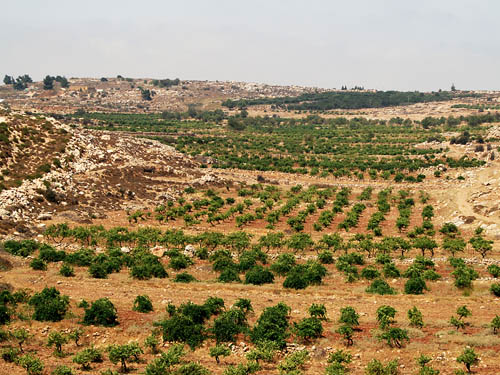
The photo was made in the hill country of Judah south of Bethlehem near the Patriarchs Way. This region of the country is filled with vineyards.

Vineyard in the hill country of Judah near the Patriarchs Way. Photo by Ferrell Jenkins.

Vineyard in the hill country of Judah. Photo by Ferrell Jenkins.