Tag Archives: Syria

Peeking into the Great Rift Valley

The natural depression that runs from northern Syria, through Lebanon, Israel/Jordan, continuing into the Gulf of Eilat/Aqaba, into eastern Africa, is known as the Great Rift. This rift has an important effect on travel and the life of the people of the area — perhaps more in ancient times than now.

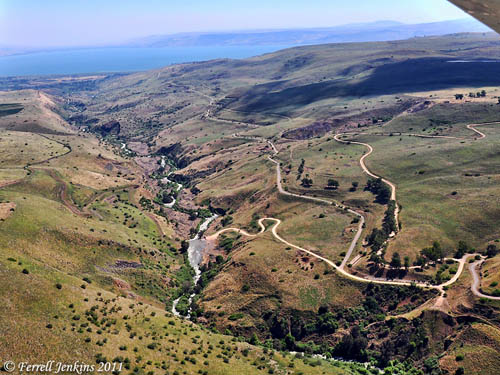
This aerial view was made south of Lake Huleh, looking south toward the Sea of Galilee. You can see the Jordan River descending from north to south. Glueck calls this the Jordan Rift.

Jordan Valley north of the Sea of Galilee. Photo by Ferrell Jenkins.

The Jordan Valley north of the Sea of Galilee. Photo by Ferrell Jenkins.

The elevation at Lake Huleh is 230 feet above sea level. By the time the Jordan River flows into the Sea of Galilee, ten miles south, the elevation of about 700 feet below sea level. This is the area of most rapid descent.

Nelson Glueck describes this portion of the Jordan River.

…it tears out on a run that, for some distance, brooks no restraint. It tumbles and cascades almost continuously through a forbidding, black basalt gorge. Foaming and muddy, it bursts out of the ravine. Then, collecting itself somewhat, it wriggles its way for about another mile through a small plain and a delta of its own making into the clear waters of the Lake of Galilee. (The Jordan River, 35)

Latakia, Syria, and possible biblical connections

News coming out of Syria is not good. Syria’s dictatorial leadership has oppressed the people of Syria and tried to keep them uninformed about world events.

My first visit to Damascus, the capital of Syria, was in 1967 — just a day visit from Beirut. I returned several times during the next decade and made one trip by road from Beirut to Damascus and on to Amman. During that trip I left my camera in the seat of the car when we stopped at the Syrian border with Jordan. When I got back in the car I noticed that my camera back was open. The film had been exposed. I still remember that some of my best photos ever were on that roll. Sort of like the fish that got away. 🙂

My only visit throughout the country of Syria was in May, 2002, when a teaching colleague and I spent a week in the country driving to most of the major cities and historical sites.

We drove along the Mediterranean coast from south to north in order to visit Ras Shamra (Ugarit), significant because of what the site revealed about Canaanite culture. This means that we needed to spend the night at Latakia, about 6 or 7 miles south of Ugarit. We stayed at the nice LeMeridien seaside hotel.

Internet use was difficult. I recall dialing long distance from the Commodore Hotel in Damascus to Beirut in order to have dial-up service to AOL. We had set up AOL and Excite accounts, having heard that some hotels would allow one, and some another. AOL generally was not allowed in the country. I have a copy of the short Email we sent home from Latakia.

Today we go to Ebla and on to Aleppo. We are unable to check our mail here. Access to AOL and Excite are prohibited on this server, but the hotel staff was kind to allow us to use one of the office computers. So we can at least let you know we are fine. Hope to have some mail from you when we arrive in Aleppo.

Later from Aleppo I wrote,

Hotel personnel are helpful and friendly. I am not able to go to AOL or Excite to get mail. A backroom manager-type allowed me to use the hotel email to write.

Latakia is not named in the Bible, but the city is important in wider biblical history. In 1967 I purchased a copy of The Middle East, one of the Hachette World Guides, published in 1966. Here are a few facts garnered from that book.

  • In the 2nd millennium B.C. Latakia was part of the territory of Ugarit
  • Latakia became part of the Assyria empire during the 9th century B.C.
  • In 604 B.C. Latakia was controlled by the Babylonians.
  • The town became part of the 5th Persian satrapy.
  • After the Battle of Issus (333 B.C.) Alexander conquered the city.
  • Seleucus I named the city Laodicea in honor of his mother.
  • The city later came under Roman, Byzantine, Islamic, Crusader, again Islamic, French, modern Syria, etc.

This late afternoon photo shows the harbor on the north side of Latakia. This is probably not more than 30 miles south of the Syria-Turkey border.
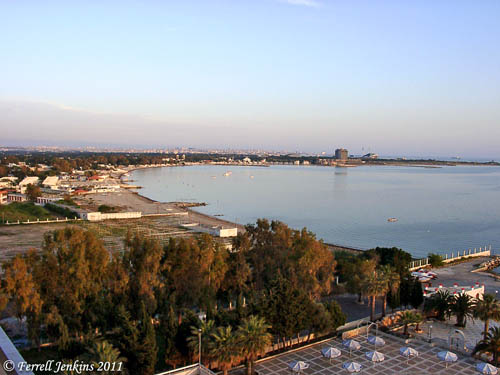
Harbor north of Latakia, Syria. Photo by Ferrell Jenkins.

Harbor north of Latakia, Syria. Photo by Ferrell Jenkins.

The next photo was made in the center of town. Ross Burns, Monuments of Syria, says,

In Jumhuriye Square (where the Damascus and Ugarit roads start) stand a grouping of four elegant monolith columns, topped with Corinthian capitals. This may have been part of the Temple of Adonis whose myth, sourced to the mountainous region of Northern Lebanon, was strong in this area. (p. 145)
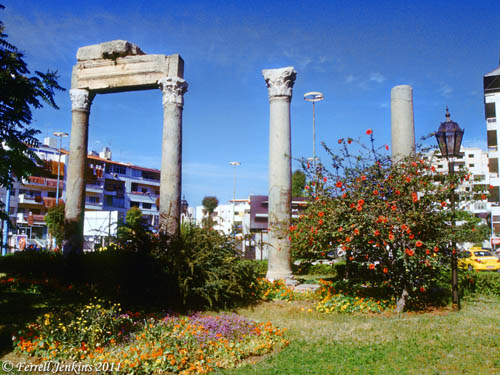
Surviving columns may be from the temple of Adonis. Photo by Ferrell Jenkins.

Surviving columns may be from the temple of Adonis. Photo by Ferrell Jenkins.

It would not be out of place to suggest that Paul (Saul) sailed by Latakia (Laodicea) when he went from Caesarea to Tarsus (Acts 9:30), and when he sailed from Caesarea to Rome (Acts 27:3-5). Perhaps Barnabas and Saul traveled this way when they took the financial aid from Antioch to Judea (Acts 11:29-30).

The Golden Age of Ebla — before the biblical Patriarchs

My only visit to Ebla was in 2002. This means I do not have hi-res photos, except for a few slides that I have had digitized, but I am delighted to have any photos. At the site I picked up a small booklet, Tell Mardikh — Ebla, written by Faja Haj Muhammad that gives a short presentation of the history and remains of the kingdom of ancient Ebla. I will share a couple of photos with some brief info from that book.

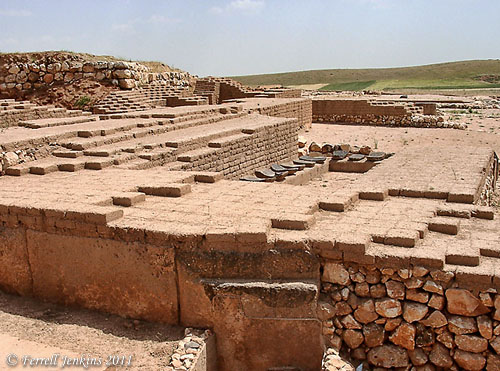
The first photo shows the reconstruction of the Palace of the Crown Prince (Palace Q or Western Palace). This palace, built of mud brick, is “located in the lower town, west of the Acropolis.” In the portion of the palace shown here you will see “a well preserved room, used for the grinding of cereals, in order to prepare bread for hundreds of persons.”

Ebla Western Palace Reconstruction. Photo by Ferrell Jenkins.

Ebla Western Palace Reconstruction. Note the grinding stones. Photo by Ferrell Jenkins.

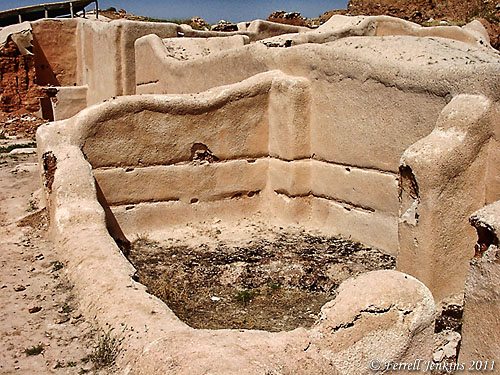
The Royal Archives. In 1975 the excavators discovered a square room west of the Administrative Wing, on the wall, filled with 17,000 clay tablets. The large square tablets had been on shelves. The small round one were found in baskets on the floor.

… the texts were placed according to their subject, and different subjects corresponded to different shapes of tablet.

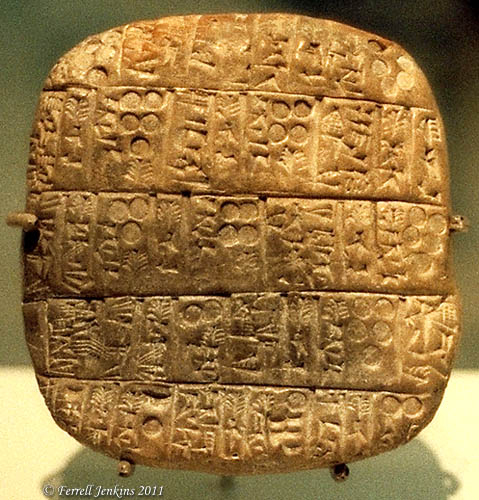
… There are administrative, economical, historical, judicial, religious texts. The writing is cuneiform. The language is a local language, now called by scholars (Eblaite), which belongs to the same family as Akkadian of Mesopotamia.

Ebla Archives Room. Photo by Ferrell Jenkins.

Ebla Archives Room. Photo by Ferrell Jenkins.

The Western Palace and the Archive are dated to the first golden age of Ebla, 2400–2250 B.C. This is long before the time of Abraham who lived north of Ebla at Haran in Padan Aram for a time. Haran is about 150 miles north of Ebla.

So Abram went, as the LORD had told him, and Lot went with him. Abram was seventy-five years old when he departed from Haran.  (Genesis 12:4 ESV)

Isaac took Rebekah, the daughter of Bethuel the Aramean of Paddan-aram to be his wife (Genesis 25:20). Jacob spent more than two decades in the same area. Most of the children of Jacob (= Israel) were born in the region.

God appeared to Jacob again, when he came from Paddan-aram, and blessed him. (Genesis 35:9 ESV)

When did Abraham live? I don’t want to begin a fight, but I will note several dates suggested by scholars for Abraham.

  • Between 2000 and 1700 B.C. A large number of scholars such as Glueck, Albright, and Wright took this position.
  • 14th Century B.C. This was the view of Cyrus Gordon. (Too late for me.)
  • Born 2165 B.C. The view of John Davis in his excellent book, Paradise to Prison. Davis understands Galatians 3:17 to begin with the arrival of Abraham in Egypt.
  • Born 1950 B.C. This view says Galatians 3:17 is dated from the entrance to Canaan (Genesis 12:4). My inclinations are here.

Now you have something to work on. My only point here is to show that Ebla was a powerful, thriving, economic power long before Abraham. Ebla flourished again in Middle Bronze I-II (1850-1600 B.C.). It is possible that Isaac and Jacob knew of the city.

Ebla and the Ebla Tablets

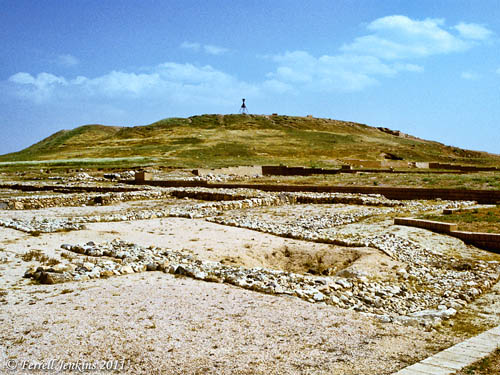
The Ebla tablets were discovered by an Italian team of excavators at Tell Mardikh in Syria (about 30 miles S of Aleppo) in 1975. More than 17,000 cuneiform tablets were discovered. They date to the mid-third millennium B.C. when Ebla was the capital of a great Canaanite empire. Scholars state that there are important affinities between the Eblaite language and biblical Hebrew, both being members of the Northwest Semitic family.

Ebla - Tell Mardikh - Syria. Photo by Ferrell Jenkins. May, 2002.

Tell Mardikh (Ebla) in Syria. Photo by Ferrell Jenkins, May 2002.

Numerous articles have appeared in the popular press and in scholarly journals stating that the names of Sodom and Gomorrah appear in the Ebla tablets. At one point it was even being said that all five cities of the plain (Gen. 14), and perhaps the name of one of the kings, were mentioned in the tablets. Much controversy has surrounded this discussion. Infighting between the excavator (Paolo Matthiae), the epigrapher (Giovanni Pettinato), and other scholars, along with some political implications, clouded the whole issue.

The late Mitchell Dahood (died 1982), an expert in Ugaritic literature, claimed that the cities of Sodom and Zeboim “may have counterparts” in the Ebla tablets (Giovanni Pettinato, The Archives of Ebla, 287). Pettinato was the first to read and interpret tablets from the Ebla archives and the first to identify the Northwest Semitic language in which they are written. Paolo Matthiae, the archaeologist, says the rumors that there is proof of the historical accuracy of the Bible patriarchs, references to Sodom and Gomorrah, etc. “are tales without foundation” (Ebla: An Empire Rediscovered, 11). One scholar states, “the initial enthusiasm about the light the tablets would shed on the early stages of biblical culture is now mostly seen as exaggerated. Clearly, no biblical personages can be identified in the tablets … ” (Harper’s Bible Dictionary, [1985] 235). Dahood, in the Afterword of Pettinato’s book, commented on the pessimism of one university professor with this classic put down:

How a savant can determine how relevant to the Bible a new discovery may be before the tablets have been published must remain a mystery. (Pettinato, The Archives of Ebla, 273).

Dahood says that the people of Ebla spoke a dialect of Canaanite and that their principal god was Dagan the Canaanite or the Lord of Canaan. This indicates that Canaan extended much further north than previously thought (Pettinato, 272). Dahood cites several biblical passages in which he believes a parallel exists between the Hebrew and Eblaite words (271-321). Numerous names in Genesis find parallel in the Ebla tablets. I had the opportunity to hear Dahood speak on this subject at a professional meeting in Dallas years ago.

Ebla Tablet at Bible Land Museum Jerusalem. Photo by Ferrell Jenkins shortly after the BLMJ opened and photos were permitted.

An Ebla Tablet. BLMJ. Originally the museum allowed photos. Photo by Ferrell Jenkins.

At this point scholars are not agreed on the proper reading of some of the Eblaite words. Perhaps in time we will know more about this. For the present we must wait patiently. Numerous articles about Ebla have appeared in Biblical Archaeologist and Biblical Archaeology Review, as well as other journals.

Word comes regarding the death of Professor Giovanni Pettinato at the age of 77. Details here. HT: Bible Places Blog.

The mosaics of the Antakya Museum

Yesterday’s post about Antakya, Turkey (biblical Antioch of Syria, Acts 11), was highly popular. We had more than 1400 hits. Thanks for your interest. We hope you will find other entries of interest as well.

Take a look at the two good comments on the previous post. One from Balagebalogh calls attention to the mosaics from Antakya that are in the Baltimore Museum of Art and to his illustration of Antioch, and another from TBrinley calling attention to the mosaics in the Antakya Museum. I haven’t had the opportunity to visit the Baltimore museum, but I have been to the Antakya Museum a few times.

I thought I would share just one of the many mosaics displayed in the Antakya Museum. These mosaics typically date to the fourth or fifth century as I recall. (I am away from home and do not have access to my usual sources.)

Our photo shows a beautifully preserved mosaic displayed on a large wall. I am taking the liberty of copying info about it from Sacred Destinations, a site we have recommended before. Regarding this mosaic the site says,

Detail of mosaic from the floor of the 5th-century Bath of Apolausis, a small suburban bath uncovered in the Antioch excavations on the slopes of Mount Silpios, east of the city. The woman depicted in the middle is Soteria (Salvation) who formed a pair with Apolausis (Enjoyment). Soteria and Apolausis were minor deities who had the power to deliver people from danger and were popularly associated in late antiquity with baths, whose warm waters could give pleasure and soothe pain. Antakya Museum.

Antakya Museum mosaic displayed on wall. Photo by Ferrell Jenkins.

Antakya Museum mosaic displayed on wall. Photo by Ferrell Jenkins.

Beautiful, isn’t it? Turkey is filled with similar mosaics. I recall especially those from Zeugma displayed in the Gaziantep Museum.

Homemade in the Golan Heights

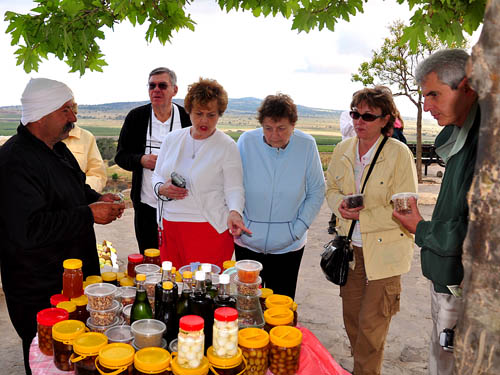
Today I am traveling, but I thought I would share a photo that illustrates one of the educational and sometimes fun things about travel in cultures other than our own. This Arab peddler has set up his table in the Golan Heights at the overlook from Israel into Kuneitra (Quneitra), Syria.

He seems to have a nice variety of the local goodies: olives, olive oil, nuts, and various fruits. Are those pickled eggs? He has already made two sales and it appears he is about to make a third. It can be really chilly in the Golan Heights, even in early May. Some of the potential customers would probably more quickly buy a sweat shirt.

Peddling homemade goodies in the Golan Heights. Photo by Ferrell Jenkins.

Peddling homemade goodies in the Golan Heights. Photo by Ferrell Jenkins.

Extreme weather in the Middle East

Most parts of the United States have severely cold weather tonight. Even here in Florida we are expecting record cold tonight and tomorrow night. One of the cruise ships was unable to enter the Tampa port today due to strong winds.

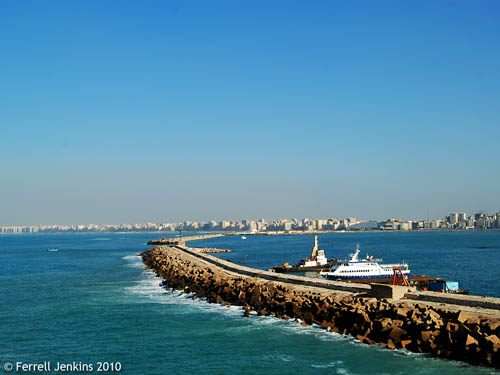
All of that reminded me about the extreme weather in the eastern Mediterranean and various parts of the Middle East. The network news showed conditions on the cruise ship that was unable to enter the harbor at Alexandria. The photo below show the breakwater at the entrance to the Alexandria harbor. The flat looking building to the right on the shore is the famous new library of Alexandria.

Breakwater at entrance to Alexandria harbor. Photo by Ferrell Jenkins.

Breakwater at entrance to Alexandria harbor. Photo by Ferrell Jenkins.

RFIenglish has the following summary:

Twenty-six ships were barred from entering the Suez Canal and 29 vessels delayed for three hours. The waterway was hit by poor visibility and winds of up to 40 knots an hour, said an official at the canal, which is Egypt’s third-largest source of foreign revenue after tourism and remittances from expatriate workers.

Red Sea and Mediterranean ports were closed for a second day on Sunday, while an Italian container ship, Jolly Amaranto, was stranded off the north-western coast after its engines broke down.

Visibility at Cairo airport was reduced to 300 metres.

As a long drought that affected the region came to an end, temperatures plummeted and storms hit Lebanon, Syria, Jordan, the Palestinian territories and Israel:

* In Lebanon seaside roads and ports have been closed after a 45-year-old woman was killed by a falling tree hitting her car – the year’s first snowstorm hit the country’s mountains;
* Off Israel a Moldovan freighter went down near the port of Ashdod but its crew of 11 Ukrainians was rescued.
* Syria’s capital Damascus was hit by snowstorms;
* Jordan suffered sandstorms and was braced for heavy rain and snow, which could lead to flooding.

Forecasters expect the bad weather to continue on Monday and have advised people to stay indoors due to a sandstorm that has blanketed the Egyptian capital.

Read also the BBC report here, or the Breitbart coverage which Todd Bolen mentioned here.

The Israel National News reports on snow in the Jerusalem area. Haaretz says the precipitation is a boon to the Sea of Galilee which has been extremely low in recent months.

Riblah — important in Old Testament history

Riblah served as a base of operation for the Egyptian Pharaoh Necho and the Babylonian King Nebuchadnezzar. The city is located on a broad plain about 50 miles south of Hamath (modern Hama in Syria), on the main road between Egypt and Mesopotamia. The Orontes River flows past the site on the west side. On a modern map you will locate Riblah in Syria immediately north of the border with Lebanon.

There is little more than a “country store” at the site today, but the name Riblah is preserved as Ribleh, Syria.

  • Pharaoh Necho imprisoned Jehoahaz, king of Judah, at Riblah. He later took him to Egypt where he died. The date was about 609 B.C. (2 Kings 23:31-34).
  • Zedekiah, puppet king of Judah, tried to escape capture by the Babylonians. He fled Jerusalem but was captured on the plains of Jericho and brought to Riblah. There Nebuchadnezzar passed sentence on him. His sons were slaughtered in his sight and he was bound with brass fetters and taken to Babylon. The date was 586 B.C. (2 Kings 25:5-7; see also Jeremiah 39:5-6; 52:9-10).
  • The officials of Zedekiah were taken to Riblah where they were put to death (2 Kings 25:19-21; see also Jeremiah 52:26-27).

In 2002 a colleague and I spent several days visiting sites in Syria. Riblah was the most difficult to locate. Most folks, after seeing the site, would probably say, “What’s the big deal?”  Even though Riblah is mentioned only these few times in the Old Testament, it’s location makes it important in all movement between the south (Egypt and Israel) and Mesopotamia.

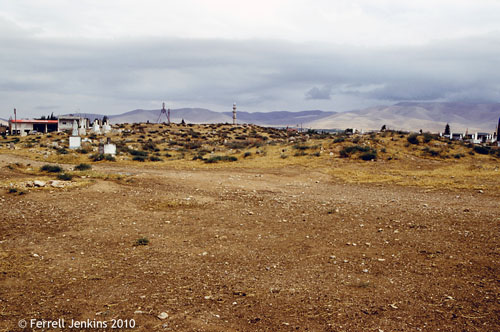
Riblah in the land of Hamath. Photo by Ferrell Jenkins.

Riblah in the land of Hamath. Photo by Ferrell Jenkins.

The slopes of this tell are now used as a cemetery. We know that this would make it difficult to negotiate rights to excavate.

This post was published March 2, 2009, but I had some slides scanned and am able to post a new photo of the tell of Riblah. A photo suitable for use in teaching is available by clicking on the image ago.

Replica Phoenician ship completes 20,000 mile voyage

A replica of a 600 B.C. Phoenician ship has almost completed 20,000 miles and two years at sea.

The replica Phoenician ship, captained by British explorer Philip Beale, has completed the circumnavigation of Africa – a voyage made by Phoenicians in 600 BC. With up to 16 crew members on any one leg the replica vessel has welcomed sailors from all corners of the globe.

The voyage has presented Captain Beale and his international crew with many challenges including losing one of the ship’s rudders in the Red Sea, the threat of piracy off the Somali coast and gale force weather conditions around the Cape of Good Hope. At the end of the expedition the ship will have visited 14 countries – each time sparking interest in the achievements of ancient Phoenician mariners.

The successful completion of the voyage is of enormous significance to historians and archaeologists as it proves that the Phoenician vessels were capable of sailing around the African continent – something that has been the cause of much speculation over centuries.

The ship will complete its voyage  at Arwad, Syria, where it was built.

Phoenician Ship under sail in the North Atlantic. Courtesy Phoenicia Ship Expedition.

Phoenician Ship under sail in the North Atlantic. Courtesy Phoenicia Ship Expedition.

For more information read the short article in the Gibraltar Chronicle here. A web site about the expedition is available at Phoenicia.

The prophet Ezekiel foretold the fall of the ancient Phoenician city of Tyre. I suggest you read the entire account in Ezekiel 26-28. Notice especially these verses about the effect that the fall of Tyre had on other nations and merchants.

The ships of Tarshish traveled for you with your merchandise. So you were filled and heavily laden in the heart of the seas. “Your rowers have brought you out into the high seas. The east wind has wrecked you in the heart of the seas. Your riches, your wares, your merchandise, your mariners and your pilots, your caulkers, your dealers in merchandise, and all your men of war who are in you, with all your crew that is in your midst, sink into the heart of the seas on the day of your fall.

At the sound of the cry of your pilots the countryside shakes, and down from their ships come all who handle the oar. The mariners and all the pilots of the sea stand on the land and shout aloud over you and cry out bitterly. They cast dust on their heads and wallow in ashes; they make themselves bald for you and put sackcloth on their waist, and they weep over you in bitterness of soul, with bitter mourning. In their wailing they raise a lamentation for you and lament over you: ‘Who is like Tyre, like one destroyed in the midst of the sea? (Ezekiel 27:25-32 ESV)

For a larger image of the photo suitable for use in teaching click on the photo above.

HT: PaleoJudaica.

Ties between Mesopotamia, the Mediterranean, and Egypt

Folks who study the Bible have understood that the people of the ancient near east traveled through Canaan as they made their way from Mesopotamia to Egypt, and back.

Several discoveries illustrating the contact between these ancient lands have recently been made. We commented on discoveries at Tell el-Da’ba in Egypt showing contacts between Babylon and Egypt here.

Word has come of a Syrian-German expedition “working in the Katana Kingdom ruins at Tel el-Mesherfeh archaeological site in Homs.”

Prof. Peter Pfalzner said the archeological finds in the site during the past two days indicate that Katana Kingdom enjoyed influence and important international and trade ties.

He added the finds reveal the existence of cultural relations between Katana Kingdom and the Pharaohs and Mesopotamia, in addition to trade relations with Mediterranean countries

The news report, which may be read here, continues,

Pfalzner underlined the importance of Katana kingdom during the Middle Bronze Age in the 2nd Millennium BC, adding that the royal palace in it was one of the greatest in Syria. He also noted that the archeological sites in Syria are filled with treasures waiting to be uncovered.

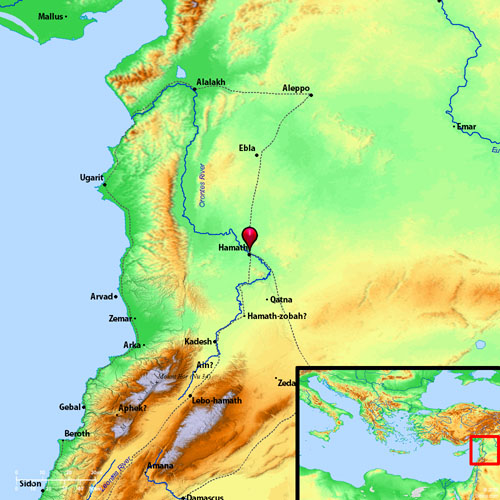
The Middle Bronze Age (about 2100 to 1550 B.C.) is the period of the biblical Patriarchs. Assume for a moment that Abraham and his family came from Ur in southern Mesopotamia (modern Iraq), rather than from northern Mesopotamia (Genesis 11:28 — 12:5). The map from Bible Atlas shows some of the places we will mention below.

Map showing Hamath and Kedesh. BibleAtlas.org.

Map showing Hamath and Kedesh. Courtesy of BibleAtlas.org.

The route taken by Abraham from Haran to Shechem in Canaan would most likely take him through the Syrian towns we know as Aleppo, Ebla, Hama and Homs. Homs would be at approximately the point referred to in the Bible as the entrance of Hamath (= modern Hama; 1 Kings 8:65). Several of these references indicate that Israel’s territory extended that far north during certain historical periods (2 Kings 14:25; Amos 6:14).

A few miles south of Homs are two significant sites illustrating the movement of ancient kingdoms. Tell Nebi Mend is the site of the battle of Kadesh where Rameses II and the Hittites fought. Another site nearby is Riblah where Nebuchadnezzar made his headquarters when he destroyed Jerusalem.

Then they captured the king and brought him up to the king of Babylon at Riblah, and they passed sentence on him. They slaughtered the sons of Zedekiah before his eyes, and put out the eyes of Zedekiah and bound him in chains and took him to Babylon. (2 Kings 25:6-7 ESV)

Here is a photo I made of Tell Nebi Bend. The Orontes River is to our back in this photo, and the valley of the battle of Kadesh is on the opposite side of the tell. There were a few houses of a modern village on the tell, but most of them were empty.

Kadesh - Tell Nebi Mend in Syria. Photo by Ferrell Jenkins.

Tell Nebi Mend (=Kadesh) in Syria. Photo by Ferrell Jenkins.

The Bible informs us that 4 kings of the east engaged the 5 kings of the region of Sodom and Gomorrah (Genesis 14).

And all these joined forces in the Valley of Siddim (that is, the Salt Sea). (Genesis 14:3 ESV)

The new information we are learning shows that such movement was not all that uncommon.

HT: Joseph Lauer