Tag Archives: Roman Empire

“Beware the ides of March”

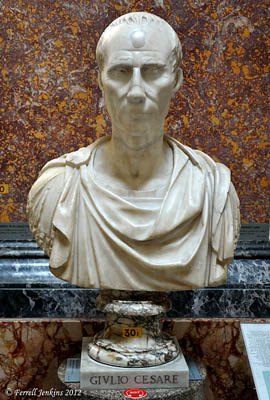
Bust of Julius Caesar in Vatican Museum. Photo by Ferrell Jenkins.

Bust of Julius Caesar in the Vatican Museum. Photo by Ferrell Jenkins.

Shakespeare has the Sootsayer warn Caesar, “Beware the ides of March.” The ides of March was used to describe the 15th of March in the Roman calendar. It was on that day that Julius Caesar was assassinated in 44 B.C. As a result, the expression has come to have a sense of foreboding — a sense that something bad is about to happen.

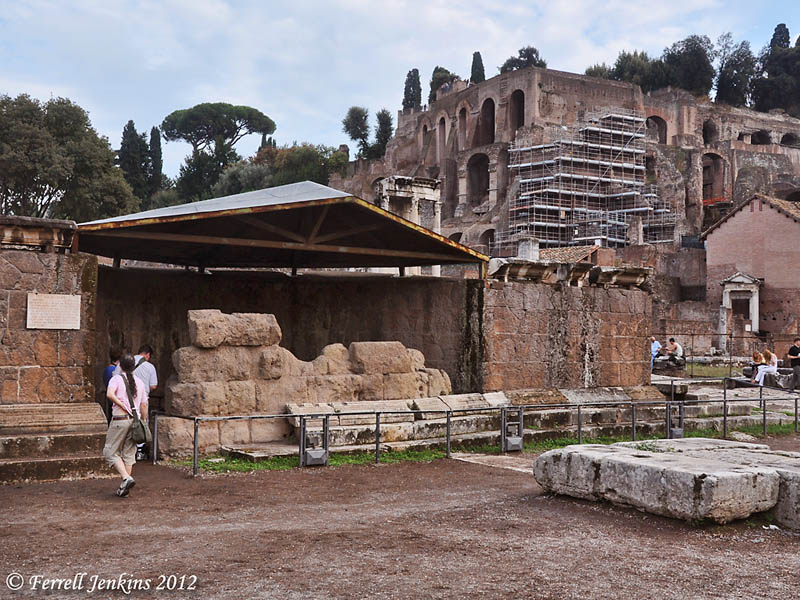
Our photo below shows the place in the Roman Forum where a temple was built to honor Julius Caesar by Augustus in 29 B.C. The deification of rulers was already common in the eastern part of the Empire. This practice would become a serious problem for the Christians of the Roman Empire before the end of the first century A.D., especially those living in Asia Minor. This is one of the issues addressed in the Book of Revelation.

Ruins of the temple erected to Caesar in the Roman Forum. Photo by Ferrell Jenkins.

Ruins of the Temple erected to Caesar in the Roman Forum. Photo by Ferrell Jenkins.

Athens — a “city full of idols”

While the Apostle Paul waited for his companions to come from Macedonia his spirit was provoked or upset because he observed “the city full of idols” (Acts 17:16).

There were many idols in Athens, but none more impressive than those on the Acropolis. The word acropolis means the “high point of the city.” The name was applied to any fortified strong hold or citadel overlooking a populated area. It served as a place of refuge and defense. The Acropolis is 512 ft. high.

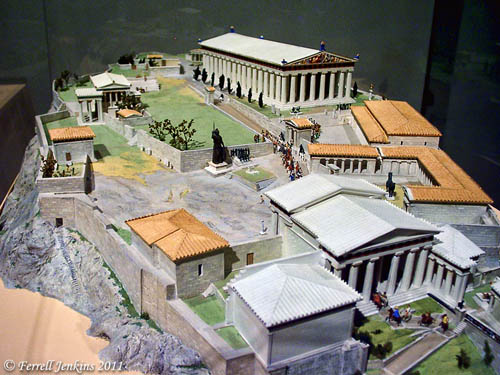
The Royal Ontario Museum in Toronto has a nice exhibit of Greek artifacts and a helpful model of the Acropolis with its magnificent buildings. Click on the photo for an image suitable for use in teaching.

Athens - Acropolis - ROM, Toronto.

Model of the Acropolis at Royal Ontario Museum. Photo by Ferrell Jenkins.

Here is a list of significant monuments Paul might have visited:

  1. The Parthenon where the goddess Athena was worshiped was built between 447 and 438 B.C.
  2. Temple of Athena Nike (Wingless Victory, 5th cent. B.C.).
  3. The Erechtheion with its porch of Caryatids was built between 421 and 406 B.C. An olive tree beside the building commemorates the first olive tree planted by Athena.
  4. Temple of Rome and Augustus.

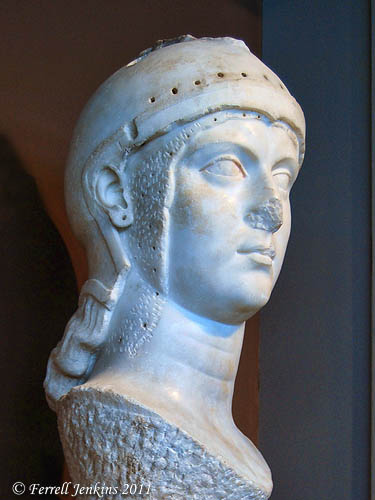
Temples were built to Athena all over the Roman Empire. This photo of a bust of Athena was made in the Archaeology Museum of Thessalonica (Thessaloniki, Greece).

Athena. Archaeology Museum of Thesaloniki, Greece. Photo by Ferrell Jenkins.

Athena. Archaeology Museum of Thesaloniki. Photo by Ferrell Jenkins.

Paul described gods and goddesses like Athena as having been formed by man.

Being then the children of God, we ought not to think that the Divine Nature is like gold or silver or stone, an image formed by the art and thought of man. (Acts 17:29 NAU)

As Paul writes to the Corinthians, he says,

For even if there are so-called gods whether in heaven or on earth, as indeed there are many gods and many lords,  yet for us there is but one God, the Father, from whom are all things and we exist for Him; and one Lord, Jesus Christ, by whom are all things, and we exist through Him. However not all men have this knowledge;  (1 Corinthians 8:5-7a NAU)

Herod the Great didn’t do it all

Archaeologists in Jerusalem announced yesterday a new discovery that changes popular thinking about the building of the walls around the Temple Mount. It is not much of a surprise. We already knew that the Roman Street found at the SW corner of the wall dates to the period just before the destruction of Jerusalem by the Romans in A.D. 70. The last paragraph of the press release mentions that what was found was in harmony with the account of Josephus.

I have understood John 2:20 to be saying that work on the temple precinct was continuing as late as A.D. 26/27. That is a major reason this is not a surprise.

Then the Jewish leaders said to him, “This temple has been under construction for forty-six years, and are you going to raise it up in three days?” (John 2:20 NET)

Here is a portion of the press release issued by the Israel Antiquities Authority. I am leaving it full width for easier reading.

— • —

Professor Ronny Reich of the University of Haifa and Eli Shukron of the Israel Antiquities Authority: A ritual bath exposed beneath the Western Wall of the Temple Mount shows that the construction of that wall was not completed during King Herod’s lifetime.

Who built the Temple Mount walls? Every tour guide and every student grounded in the history of Jerusalem will immediately reply that it was Herod. However, in the archaeological excavations alongside the ancient drainage channel of Jerusalem a very old ritual bath (miqwe [mikve]) was recently discovered that challenges the conventional archaeological perception which regards Herod as being solely responsible for its construction.…

In an excavation beneath the paved street near Robinson’s Arch, sections of the Western Wall’s foundation were revealed that is set on the bedrock — which is also the western foundation of Robinson’s Arch — an enormous arch that bore a staircase that led from Jerusalem’s main street to the entrance of the Temple Mount compound.

According to Professor Reich, “It became apparent during the course of the work that there are rock-hewn remains of different installations on the natural bedrock, including cisterns, ritual baths and cellars. These belonged to the dwellings of a residential neighborhood that existed there before King Herod decided to enlarge the Temple Mount compound. The Jewish historian Josephus, a contemporary of that period, writes that Herod embarked on the project of enlarging the compound in the eighteenth year of his reign (that is in 22 BCE) and described it as “the largest project the world has ever heard of.”

When it was decided to expand the compound, the area was confiscated and the walls of the buildings were demolished down to the bedrock. The rock-cut installations were filled with earth and stones so as to be able to build on them. When the locations of the Temple Mount corners were determined and work was begun setting the first course of stone in place, it became apparent that one of the ritual baths was situated directly in line with the Western Wall. The builders filled in the bath with earth, placed three large flat stones on the soil and built the first course of the wall on top of this blockage.

While sifting the soil removed from inside the sealed ritual bath, three clay oil lamps were discovered of a type that was common in the first century CE. In addition, the sifting also yielded seventeen bronze coins that can be identified. Dr. Donald Ariel, curator of the numismatic collection of the Israel Antiquities Authority, determined that the latest coins (4 in all) were struck by the Roman procurator of Judea, Valerius Gratus, in the year 17/18 CE. This means that Robinson’s Arch, and possibly a longer part of the Western Wall, were constructed after this year – that is to say: at least twenty years after Herod’s death (which is commonly thought to have occurred in the year 4 BCE).

This bit of archaeological information illustrates the fact that the construction of the Temple Mount walls and Robinson’s Arch was an enormous project that lasted decades and was not completed during Herod’s lifetime.

This dramatic find confirms Josephus’ descriptions which state that it was only during the reign of King Agrippa II (Herod’s great-grandson) that the work was finished, and upon its completion there were eight to ten thousand unemployed in Jerusalem.

— • —

If you wish to see the complete press release click here.

Below are a few of the photos provided by the IAA. The first shows the lowest course of the wall resting on bedrock.
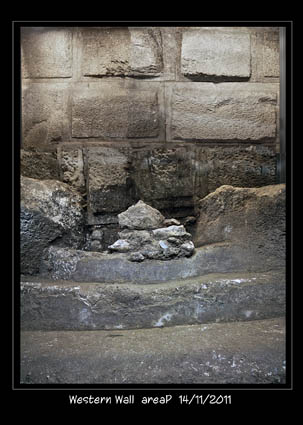
The first course of the wall resting on the bedrock. Photograph: Vladimir Naykhin.

The first course of the wall resting on the bedrock. Photograph: Vladimir Naykhin.

The next photo shows one of the coins dating to the time of Roman Procurator Valerius Gratus in the year A.D. 17/18. He was procurator A.D. 15-26, and followed by the better known Pontius Pilate (A.D. 26-36).

A coin of the Roman procurator Valerius Gratus, which helped in dating the construction of Robinson’s Arch.

A coin of the Roman procurator Valerius Gratus, which helped in dating the construction of Robinson’s Arch. Courtesy IAA.

The third photo shows some of the workers excavating the area.
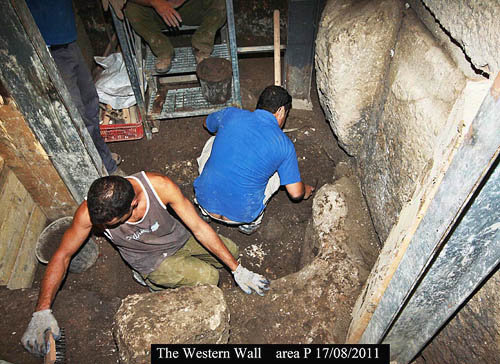
Archaeologists working at bedrock below Robinson's Arch. Photo: IAA.

Archaeologists working at bedrock below Robinson's Arch. Photo: IAA.

After writing my post, I see that Todd Bolen accuses the IAA of being “desperate for headlines.” See his comments here.

HT: Joseph I. Lauer

The Cardo Maximus in Jerusalem

Reconstructing the Jerusalem of the time of Jesus and the Apostles is not as easy as one might think. We have little bits of evidence here and there in basements. I am thinking of the evidence of the pre-70 A.D. ruins such as the Burnt House and the Herodian Mansion. We also have the Herodian Temple Precinct walls, the Temple Mount steps and the street in the Tyropoeon Valley. (This is not intended as a complete list. Just suggestive.)

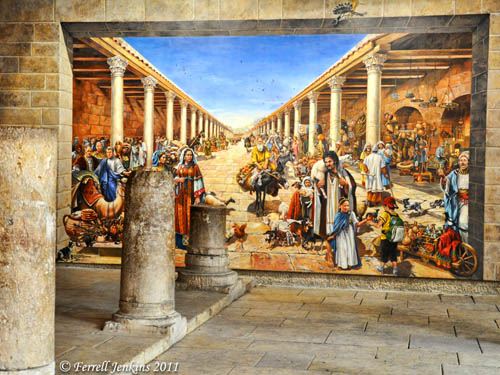
Some Roman ruins in Jerusalem date to the period after the Bar Kochba revolt in 135 A.D. One impressive site in the Jewish Quarter of the Old City is the Cardo. The Cardo Maximus was the main north-south street running from one end of the city to the other. An east-west street was called the Decumanus Maximus.

The Emperor Hadrian rebuilt Jerusalem and named it Aelia Capitolina. The photo below shows a portion of the Cardo of that city. We see paving stones and columns that ran along the length of the street. A mural has been placed at one portion of the street to illustrate typical life in the city at that time.

The Roman Cardo in Jerusalem. Photo by Ferrell Jenkins.

The Roman Cardo in Jerusalem. Photo by Ferrell Jenkins.

We are reminded of one of the many references Jesus made to the marketplace (Greek, agora).

And in his teaching he said, “Beware of the scribes, who like to walk around in long robes and like greetings in the marketplaces (Mark 12:38 ESV)

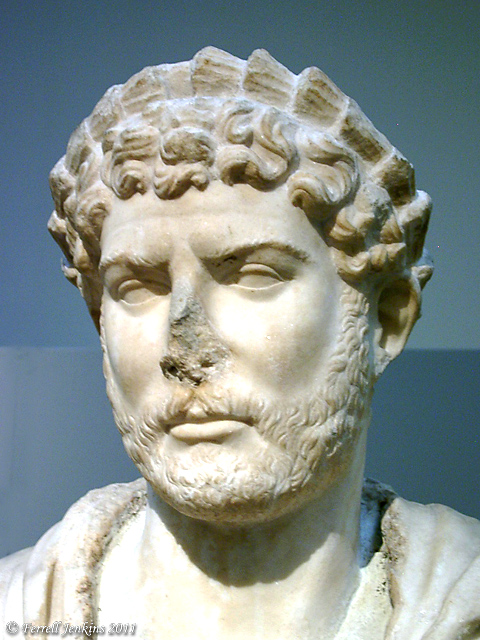
Hadrian was Roman Emperor from 117-138 A.D. Streets, arches, and gates were erected in his honor all over the Roman Empire during his reign. The photo below shows the head of a marble statue in the British Museum showing Hadrian in Greek dress. The statue comes from the Temple of Apollo at Cyrene in northern Africa (modern Libya).

Hadrian in Greek Dress. Temple of Apollo, Cyrene. British Museum. Photo by Ferrell Jenkins.

Hadrian in Greek Dress. Temple of Apollo, Cyrene. British Museum. Photo by Ferrell Jenkins.

A larger image of the Cardo scene suitable for use in teaching is available by clicking on the photo.

Libya and the Bible — more than you think

UNESCO: respect historical sites in Libya

According to an article in M & C here, UNESCO has called for Libyan and allied forces to protect six specified historical sites in Libya.

Libya’s sites on the World Heritage List include the archaeological site of Cyrene, which was established as a Roman province in 74 BC; and the site of Leptis Magna, which was founded in the first millennium BC.

Cyrene is located near Al Bayda in eastern Libya.

The Biblical Connection

When Jesus was being led to the place of crucifixion, Simon of Cyrene was compelled to bear his cross. He was the father of Alexander and Rufus, to people apparently known to Mark’s audience (Mark 15:21).

As they were going out, they found a man from Cyrene named Simon, whom they forced to carry his cross. (Matthew 27:32 NET)

The fifth station of the cross along the traditional Via Dolorosa in Jerusalem marks the spot where Simon took up the cross. Photos of the Catholic chapel at the spot may be viewed at Holy Land Photos here. Just search for Cyrene. Or check the photos at Bible Walks here.

  • Jews from the district of Libya around Cyrene were present in Jerusalem on Pentecost (Acts 2:10).
  • Some men from Cyprus and Cyrene were responsible for the first preaching to Gentiles at Syrian Antioch (Acts 11:20).
  • Lucius of Cyrene was one of the prophets or teachers at Antioch (Acts 13:1).

Galen Frysinger has a collection of older photos of Cyrene on his website here.

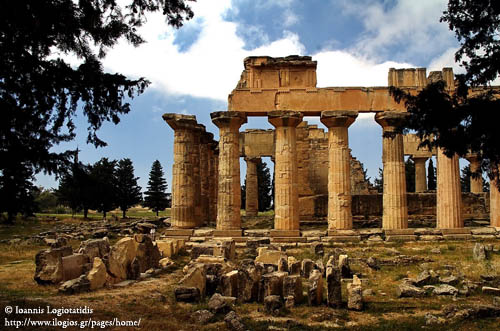
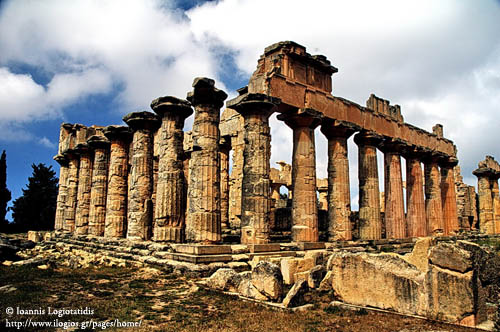
Ioannis Logiotatidis has some of the best photos I have found for Cyrene. He has kindly granted permission for me to share a couple of these with our readers. Both of are the Temple of Zeus. This temple was built originally in the 5th century B.C., but has been destroyed and rebuilt several times over the centuries.

Temple of Zeus at Cyrene, Libya. Photo by Ioannis Logiotatidis.

Temple of Zeus at Cyrene, Libya. Photo by Ioannis Logiotatidis.

Check out more of Ioannis’ newer artistic photographs at his web site here.

Temple of Zeus at Cyrene, Libya. Photo by Ioannis Logiotatidis.

Temple of Zeus at Cyrene, Libya. Photo by Ioannis Logiotatidis.

You may notice a strong resemblance between this temple and the Temple of Apollo at Corinth.

The Alexander (son of Simon) Ossuary

Sukenik and Avigad discovered an ossuary in 1941 bearing the inscription “Alexander (son) of Simon.”

Tom Powers, a guide in Israel, has written two articles about the ossuary for BAR. You may access them here. He concludes in the second article that this ossuary could be the ossuary of both Alexander and Simon.

Another article about ossuaries and Jesus contains photographs and a brief mention of the Alexander-Simon ossuary. Click here.

Paul’s Shipwreck on the Voyage to Rome

Libya is not mentioned, but the Syrtis is mentioned in the account of Paul’s voyage to Rome.

Running under the lee of a small island called Cauda, we managed with difficulty to secure the ship’s boat. After hoisting it up, they used supports to undergird the ship. Then, fearing that they would run aground on the Syrtis, they lowered the gear, and thus they were driven along. (Acts 27:16-17 ESV)

You will notice that the Syrtis Major and the Syrtis Minor are located on the Mediterranean coast of Libya. This was a dangerous place for a ship in a storm.

Gordon Franz recently posted an article asking “Why were the sailors afraid of the Syrtis Sands?” here.

In the map below you will note the location of Cyrene. Simon had a long trip to Jerusalem. Notice also the location of the Syrtis Major in relation to the suggested route of Paul’s ship. Click on the map for a clearer image. (I am still struggling to learn the Bible Mapper program and how to export maps.)

Paul's Voyage to Rome. Map by BibleMapper.

Paul's Voyage to Rome. Map by BibleMapper.

Elaborate hairstyles in New Testament times

The apostle Peter wrote much, by comparison to the size of his first epistle, about the Christian and submission. I wish to call attention to something he said about the relation of wives to their husbands. Notice the reading in four English versions.

Your beauty should not consist of outward things like elaborate hairstyles and the wearing of gold ornaments or fine clothes; (1 Peter 3:3 CSB)

Do not let your adorning be external–the braiding of hair and the putting on of gold jewelry, or the clothing you wear– (1 Peter 3:3 ESV)

Let your beauty not be external– the braiding of hair and wearing of gold jewelry or fine clothes– (1 Peter 3:3 NET)

Your beauty should not come from outward adornment, such as braided hair and the wearing of gold jewelry and fine clothes. (1 Peter 3:3 NIV)

Years ago I was impressed with the comments by William Barclay about the elaborate dressing habits of the upper class women of the Greco-Roman world.

In the world of the Greeks and the Romans it is interesting to collect the references to personal adornments. There were as many ways of dressing the hair as there were bees in Hybca. Hair was waved and dyed, sometimes black, more often auburn. Wigs were worn, especially blonde wigs, which are found even in the Christian catacombs; and hair to manufacture them was imported from Germany, and even from as far away as India. Hairbands, pins and combs were made of ivory, and boxwood, and tortoiseshell; and sometimes of gold, studded with gems. (Barclay, Daily Study Bible Series: The Letters of James and Peter)

He gives other illustrations of the expensive clothing and jewelry of some of the women of the Imperial household. He says,

Christianity came into a world of luxury and decadence combined.

In face of all this Peter pleads for the graces which adorn the heart, which are precious in the sight of God. These were the jewels which adorned the holy women of old. Isaiah had called Sara the mother of God’s faithful people (Isaiah 51:2); and if Christian wives are adorned with the same graces of modesty, humility and chastity, they too will be her daughters and will be within the family of the faithful people of God.

Kistemaker calls attention to a comment by J.N.D. Kelly,

The elaboration in hair-styles, make-up, dress and personal jewelery in the [first] and [second] cent[urie]s is eloquently attested by the literature and art of the period.

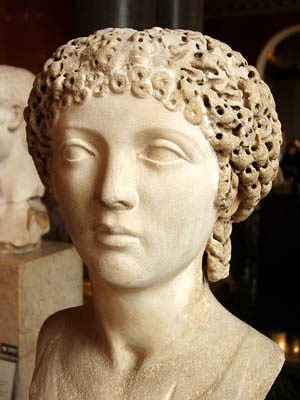
With that in mind I decided to show a few examples of statuary of some of the women of the royal households. The first is a woman from the time of Nero (A.D. 54-68). Peter’s letters were written during that period.

Woman from the time of Nero. The Louvre. Photo by Ferrell Jenkins.

Woman from the time of Nero. The Louvre. Photo by Ferrell Jenkins.

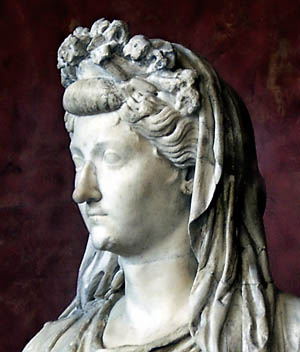
The next example is of Livia, the wife of Augustus and the mother of Tiberius.

Livia, wife of Augustus, mother of Tiberius. The Louvre. Photo by Ferrell Jenkins.

Livia, wife of Augustus, mother of Tiberius. The Louvre. Photo by Ferrell Jenkins.

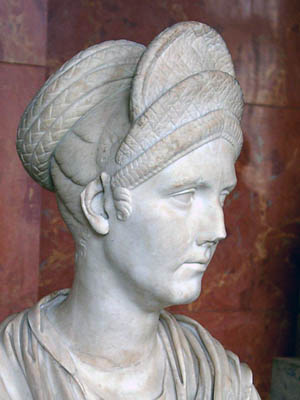
And finally, here is a bust of a neice of Trajan (A.D. 98-117).

Trajan's neice. The Louvre. Photo by Ferrell Jenkins.

Trajan's neice. The Louvre. Photo by Ferrell Jenkins.

Can you imagine the women of that time watching the TV award shows or reading the latest glamor magazines and not wanting to have their hair fixed the same way?

There is a lesson here for everyone, both female and male, who seeks to imitate Christ.

The apostles as gladiators

The apostle Paul compared the work of the apostles to that of gladiators in the arena. In writing to the Corinthians he says,

For I think that God has exhibited us apostles as last of all, like men sentenced to death, because we have become a spectacle to the world, to angels, and to men. (1 Corinthians 4:9 ESV)

As the last event of the day, the gladiator’s who were condemned to death were brought into the arena as a spectacle for the excited crowd. The word spectacle translates the Greek theatron, easy enough for everyone to understand the reference.

Leon Morris (Tyndale New Testament Commentary) calls attention to James Moffatt’s translation of this text.

The imagery is derived from the arena, as Moffatt’s rendering brings out, ‘God means us apostles to come in at the very end, like doomed gladiators in the arena!’

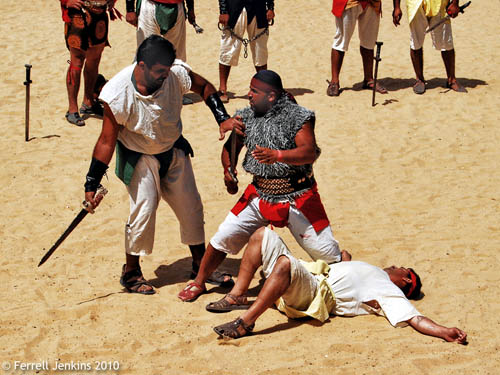
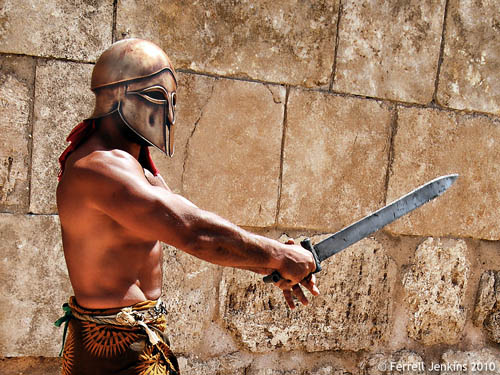
The photo below shows gladiators in the Roman hippodrome at the RACE (Roman Army and Chariot Experience)  show at Jerash, Jordan.

Gladiators in the Roman hippodrome at Jerash, Jordan. Photo by Ferrell Jenkins.

Gladiators in the Roman hippodrome at Jerash, Jordan. Photo by Ferrell Jenkins.

Here is a close up of one of the gladiators.

Gladiator in the RACE show, Jerash, Jordan. Photo by Ferrell Jenkins.

Gladiator in the RACE show, Jerash, Jordan. Photo by Ferrell Jenkins.

Both photos are available in a larger size suitable for use in teaching. Just click on the images.

David Padfield has several photos of gladiators here.

Scientific study of “headless” gladiators

Discovery News reports here on a new study about the “headless” gladiators found in a cemetery at York, England, a few years ago.

Britain’s enigmatic “headless Romans” lost their heads far away from home, according to a multi-isotopic analysis of the 1,800-year-old skeletal remains.

Unearthed between 2004 and 2005 in a cemetery in York, England, the remains belong to 80 individuals, almost all males, who died violently at ages ranging between 19 and 45.

At least 46 of them had been carefully decapitated, with their heads placed by or between their legs or pelvis.

Believed by some to be gladiators, losing their heads after their last fight, the heavily built men were buried in one of the most prestigious cemeteries of York during the 2nd and 3rd century A.D.

A new scientific “multi-isotopic analysis of the skeletal remains” has shown that many of the men were from other parts of Britain and the Roman Empire. It is a fascinating technical study.

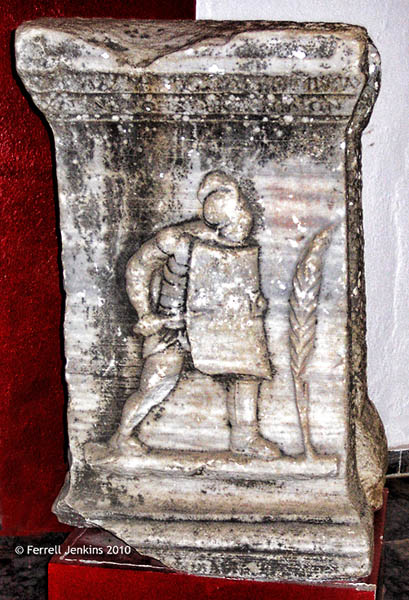
Gladiator at Ephesus. Photo by Ferrell Jenkins.

Gladiator at Ephesus. Photo by Ferrell Jenkins.

The Science Channel web site has a nice video in which Dr. Karl Großschmidt, Medical University of Vienna, discusses the discovery at Ephesus of skeletons belonging to 70 gladiators. Click here to view the video and a second one discussing the weapons used by the gladiators.  Großschmidt thinks that most of the men died in combat before the age of 35.

HT: David Padfield

In a post to follow I will discuss Paul’s use of the gladiator in one of his epistles.

A report today says that Pompeii’s house of gladiators collapsed Saturday morning. Check CNN.

Roman soldiers in Decapolis

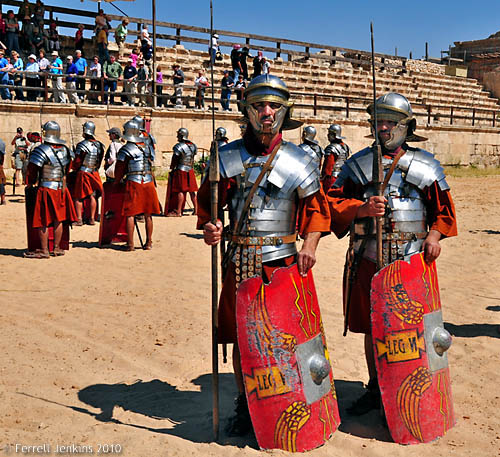
The RACE show at Jerash, Jordan, is a must if you have the opportunity to visit the area. RACE stands for Roman Army and Chariot Experience. You will see actors in authentic dress as armed legionaries, gladiators, and a short chariot race. The show takes place in the Roman hippodrome of Jerash. The view of the city ruins in the vicinity make this a wonderful setting for the performance. Full details may be found here. I have seen the program three times. On the last visit, earlier this year, I thought the performers showed less discipline and the show was not quite as good as on my previous visits.

Jerash was the second largest city of the Decapolis (after Damascus) in New Testament times. People from the Decapolis followed Jesus during His ministry in Galilee (Matthew 4:23-25). When Jesus traveled through the Decapolis he possibly visited the area around Jerash (Mark 7:31).

The photo shows the Roman soldiers of the 6th Legion from the time of the Emperor Hadrian (A.D. 117-138). A visit to this show provides several good photographs to illustrate New Testament times.

Roman soldiers at Jerash, Jordan. Photo by Ferrell Jenkins.

Roman soldiers at Jerash, Jordan. Photo by Ferrell Jenkins.

A larger image, suitable for presentations, is available by clicking on the photo.

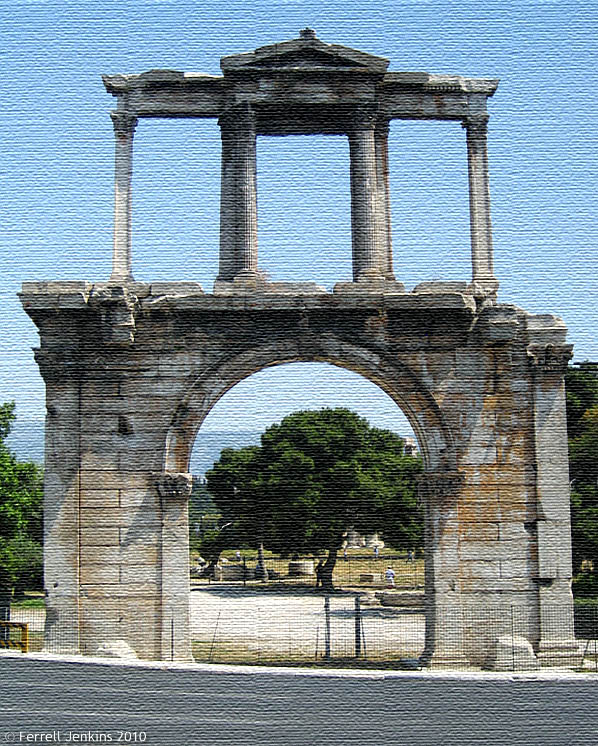
Hadrian’s arch in Athens

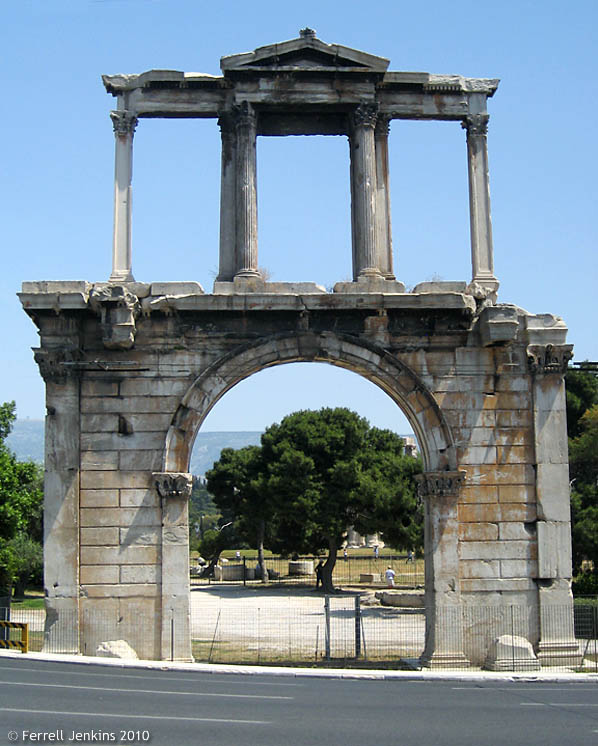
The Roman emperor Hadrian (A.D. 117-138) left arches in many cities he visited. The arch in Athens marks the entry to the Temple of Zeus. Rant and Reddish describe the arch:

The imposing Arch of Hadrian was constructed in honor of the emperor following the completion of the temple [to Zeus], and Hadrian himself walked through it to attend the dedication of the temple in 131 C.E. The western side of the arch (toward the old city) carries the inscription “This is Athens, the city of Theseus.” The inscription on the eastern side of the arch facing the temple (and toward a section of Athens that had been newly renovated by Hadrian) states, “This is the city of Harrian and not of Theseus. (A Guide to Biblical Sites in Greece and Turkey, 33)

To get a photo like this one requires some good footwork. The arch faces one of the busiest streets in Athens, but one must move out into the street between cars to get an unobstructed view.

Arch of Hadrian in Athens. Photo by Ferrell Jenkins.

Arch of Hadrian in Athens. Photo by Ferrell Jenkins.

Photoshop, and some other photo editing programs, provide the opportunity to manipulate photos in unusual ways. Here is the same photo textured as if it were painted on canvas.

Arch of Hardrian on canvas. Photo by Ferrell Jenkins.

Arch of Hadrian on canvas. Photo by Ferrell Jenkins.

The fourth major persecution of the church by the Roman Empire came in the days of Hadrian.