Tag Archives: Roman Empire

Acts 25 — Photo Illustrations — Coins of the Rulers

We continue our look at the three chapters describing Paul’s stay at Caesarea Maritima — Acts 24-26. Three civil rulers are mentioned in these chapters. They are known not only from Luke’s account, but in the writings of Josephus.

Rapske says that Caesarea “was the administrative seat of the Roman procurators of Palestine.” He adds that in the time of the Flavians it became a Roman Colony (The Book of Acts in its First Century Setting; Vol. 3, The Book of Acts and Paul in Roman Custody, 155).

After the Romans occupied “Palestine” the Jews had both a religious and a secular tax to pay. The procurators (prefects) were responsible for collecting the taxes for Rome. Coins were minted by various procurators, including Felix and Festus. I have chosen one example from each to show the type of coin current in their time.

Antonius Felix — A.D. 52-59.

Felix is described as a hegemon in the Greek New Testament. Major English versions use the term governor (Acts 23:24, 26; 24:2, 22, 24, 25, 27; 25:14). Hemer says that hegemon is a general word to describe a ruler, “the formal Latin title of these governors of Judaea being procurator or praefectus” (The Book of Acts, 128).

The obverse (head) of the coin of Felix shows two oblong shields and two spears. The inscription is translated “Nero Claudius Caesar–son of Claudius. The reverse (tail) shows a “six-branched palm tree bearing two bunches of dates” with a Greek inscription above and below (Hendin, Guide to Biblical Coins (1987), 117).
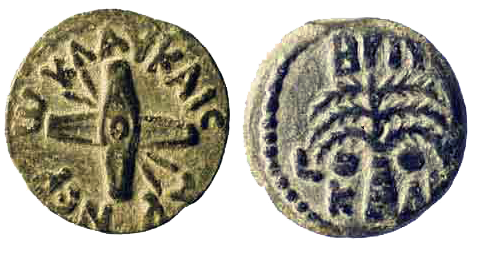
Coin of Roman Procurator Felix.

Coin of Roman Procurator Felix.

Porcius Festus — A.D. 59-61.

Porcius Festus followed Felix as governor or procurator. He is mentioned in each of the three chapters we are discussing. Paul had been left in custody by Felix, and Festus seems to be pleased to get the advice of King Agrippa when he visited Caesarea.

The coin of Festus, struck in A.D. 58, bears a Greek inscription within a wreath on the obverse. At the bottom is an X. The inscription reads NER ONO C (Nero). The reverse shows a palm branch with a Greek inscripton KAIC APOC (Caesar). The date LE means year five (Hendin, 118).
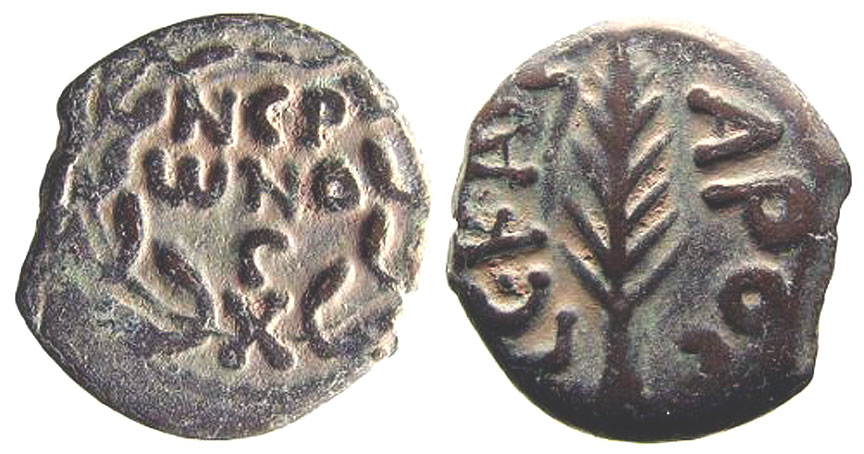
Coin of Porcius Festus.

Coin of Roman Procurator Porcius Festus.

Herod Agrippa II — A.D. 48-70.

Herod Agrippa II was the son of Herod Agrippa I, the grandson of Herod the Great (Acts 12:1, et al.). Agrippa II was the tetrarch of Chalcis and of northern territories. Chalcis was the small but beautiful territory between the Lebanon and Antilebanon mountains. Later he was granted the territories that had been controlled by Philip and Lysanias. Agrippa lived until the end of the first century, and minted coins even to the time of the Roman Emperor Domitian (A.D. 81-96).

According to Hendin, the obverse shows a laureate bust of Domitian facing right. The inscription around it reads DOMITIAMOC KAICAP (Domitian Caesar). The reverse shows Nike standing right. One foot is resting on a helmet. She is writing on a shield that is resting on her knee. The inscription reads ETO KZBA AΓPIΠΠA (Year 27 of King Agrippa). The coin was struck in A.D. 83. (I do not know how best to harmonize the dates associated with the reign of Agrippa II.)

Coin of Herod Agrippa II with image of Domitian. Struck A.D. 83.

The coin above is copied from FORVM ANCIENT COINS.


I have only the original edition of Hendin’s Guide to Biblical Coins, but recommend the newer fifth edition of his book in the event that you have a genuine interest in Biblical coins. From my limited collecting experience, I can say that it is both fascinating and educational.

Acts 21 — Photo Illustrations – Patara

Patara is mentioned only once in the New Testament. When Paul and his companions sailed from Miletus on their way to Syria (Caesarea), they made stops at Cos, Rhodes, and Patara in the Roman province of Lycia in Asia Minor (Acts 27:5).

And when we had parted from them and set sail, we came by a straight course to Cos, and the next day to Rhodes, and from there to Patara. And having found a ship crossing to Phoenicia, we went aboard and set sail.  (Acts 21:1-2 ESV)

Patara is known as Gelemis (in Turkey) today, but the sign on the main highway from Fethiye to Kas points to the ancient site of Patara.

Wilson says,

Patara served as a way station for sea travelers, and Paul changed ships here to Phoenicia at the end of his third journey in AD 57 (Acts 21:1). (Biblical Turkey, 91).

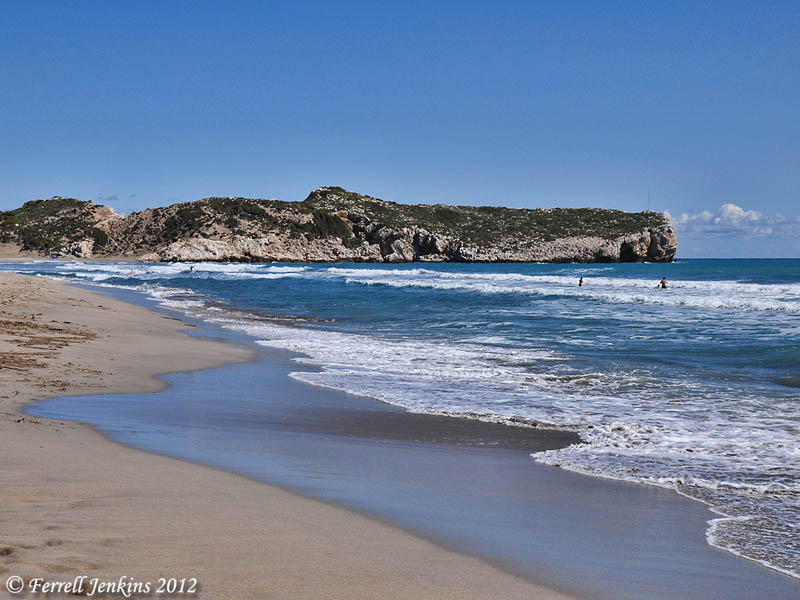
The beach at Patara is a popular leisure place for locals as well as visitors to the area. For this photo we drove the narrow road from the main highway through the ruins of the city to the water.

Beach on the Mediterranean Sea at Patara, Turkey. Photo by Ferrell Jenkins.

Beach on the Mediterranean Sea at Patara, Turkey. Photo by Ferrell Jenkins.

Patara already had a long history before Paul stopped there. Tradition has it that it was founded by Patarus, a son of Apollo. Persians used the port during the Persian Wars. The city later came under the control of Alexander the Great, the Ptolemies, and the Seleucids in succession before being given freedom by the Romans in 167 B.C. In 43 B.C. the city became part of the province of Lycia (Biblical Turkey, 90-91).

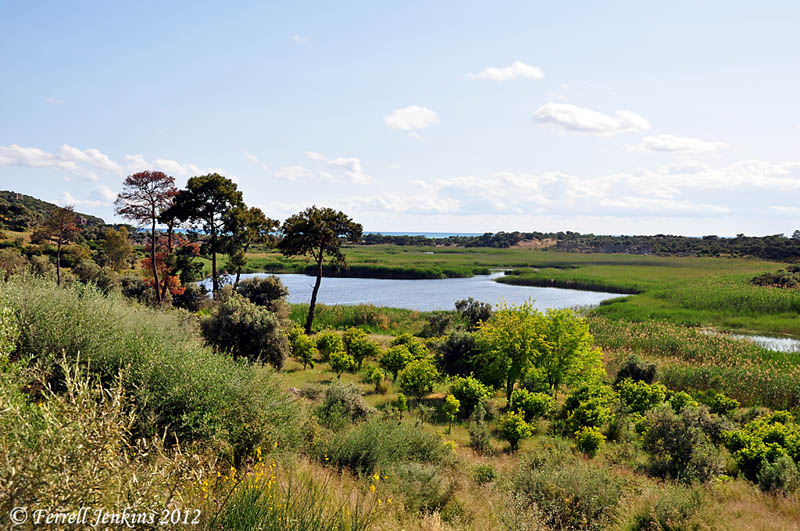
Our next photo shows the site of the silted up harbor of Patara. In the distance you will see a narrow sliver of blue between the trees and the sky. That is the Mediterranean Sea. Entrance to the harbor from the Sea is blocked. Ruins of granaries built in the days of Hadrian (A.D. 117-138) are visible on the west side of the harbor. Click on the photo for a larger image.

Silted up harbor at Patara. The Mediterranean Sea is visible on the horizon. Photo by Ferrell Jenkins.

Silted up harbor. The Mediterranean is visible on the horizon. Photo by Ferrell Jenkins.

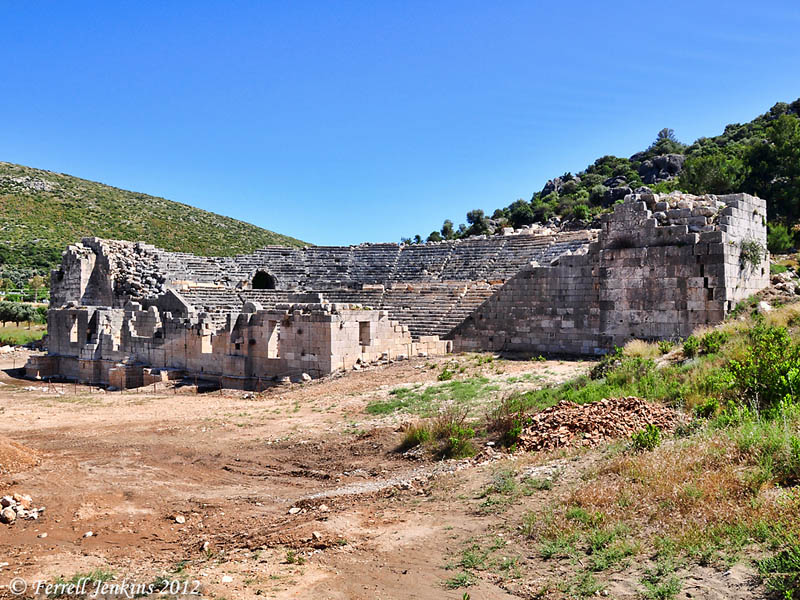
Our last photo shows the theater which was built in the Hellenistic period, but was rebuilt in the time of the Roman Emperor Tiberias (A.D. 14-37). It seated more than 6,000 people.

Theater at Patara. Photo by Ferrell Jenkins.

Theater at Patara. Photo by Ferrell Jenkins.

Use the search box for posts about some of the other places mentioned in Acts 21: Rhodes, Cyprus, Tyre, Ptolemais, and Caesarea.

The delivery of Peter’s Epistles

When I began to write about Pontus, the Black Sea Coast, and the cities of Samsun and Sinop, it was primarily to discuss the address of the Apostle Peter’s epistles.

Peter, an apostle of Jesus Christ, To those who are elect exiles of the Dispersion in Pontus, Galatia, Cappadocia, Asia, and Bithynia, (1 Peter 1:1 ESV)

I assume, based on 2 Peter 3:1, that both of Peter’s epistles were written to the same Christians.

This is now the second letter that I am writing to you, beloved. In both of them I am stirring up your sincere mind by way of reminder, (2 Peter 3:1 ESV)

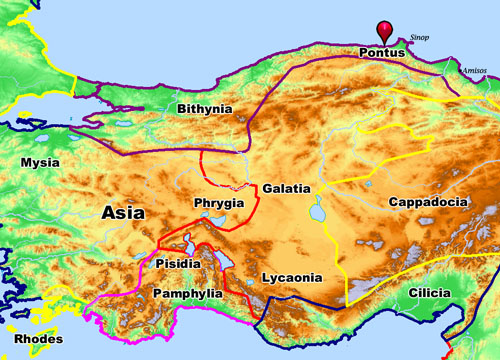
The map below shows the larger portion of Asia Minor. Note the order of the provinces in Peter’s address: Pontus, Galatia, Cappadocia, Asia, and Bithynia.

Map of Asia Minor during the time of the Roman Empire. BibleAtlas.org.

Map of Asia Minor during the time of the Roman Empire. BibleAtlas.org.

We know it was common for the New Testament letters to be carried from the place of writing to the those addressed by personal, trusted messengers.

  • Tychicus was the bearer of Ephesians and Colossians (Ephesians 6:21; Colossians 4:7).
  • Letters were sometimes sent from one church to another (Colossians 4:16).
  • It is often pointed out that the order of the letters to seven churches of Asia follow a typical circuit along known travel routes: Ephesus, Smyrna, Pergamum, Thyatira, Sardis, Philadelphia, and Laodicea (Revelation 1:11; 2-3).

We may raise questions concerning Peter’s epistles. Let us assume for the moment that Peter wrote from Rome. This is my understanding of 1 Peter 5:13. If the bearer of 1 Peter began his delivery route in Pontus, how did he get there? Was it overland or by sea?

Understanding the terrain. Once we understand something about the terrain the answer becomes obvious. Coming from the west it would be much easier to go to Pontus by sea than by land. A first stop might be at the city of Amastis (modern Amasra, west of Sinop). The next stop would be Sinop. Neither of these cities would provide a good place to begin an inland journey going through the named provinces. The ideal beginning point would be Amisos (modern Samsun). Mark Wilson writes about Amastris:

A coasting vessel carrying Peter’s messenger would certainly have stopped here. Amastris has been suggested as an entry point for Peter’s letter to the cities of inner Pontus and northern Galatia, but the road to the interior was difficult. It is more probable that the messenger continued by sea to Sinope and Amisus. (Biblical Turkey, 337).

When you look at a map showing topographical detail you see that both Bithynia and Pontus are not very wide (north to south), and that most of that width is mountainous. Some areas, in fact, have no coastal roads. Such is still true of the region east of Sinope.

Map shows the narrow province of Pontus. Made with Bible Mapper.

Map shows the narrow province of Pontus. Made with Bible Mapper.

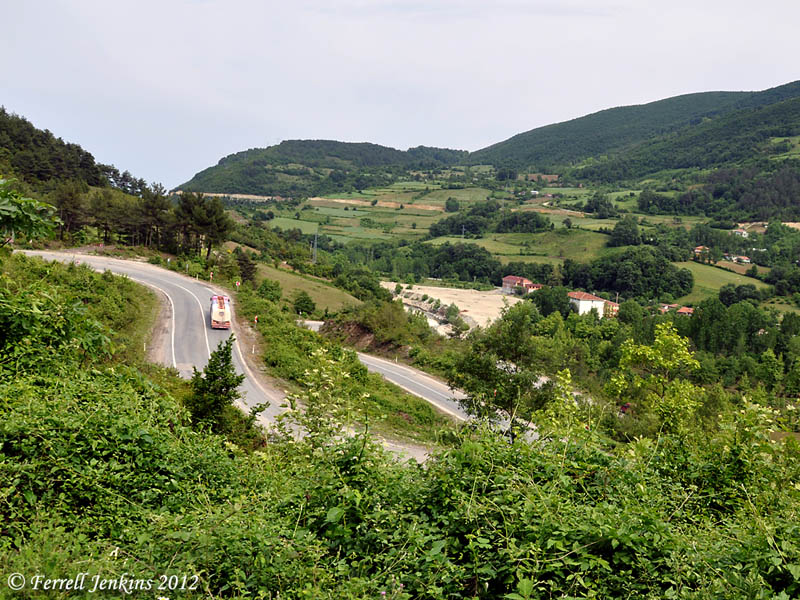
The distance between Samsun and Sinop is barely 100 miles. Leaving Samsun we had good road for about the first 50 miles. After that the road was mountainous and much construction work was underway. Often we were driving high above the Black Sea even when we could see it. We had expected to make the drive in two hours in our good rental car. It took us three hours. Notice this hair pin section of the two lane road.

Hair pin curves in the mountains east of Sinop. Photo by Ferrell Jenkins.

Hair pin curves in the mountains east of Sinop. Photo by Ferrell Jenkins.

Both Sinop and Samsun were significant in the life of Mustafa Kemal Atatürk, the founder of the Republic of Turkey. The following sentence shows that both towns were more easily reached by sea even as recently as a century ago.

Atatürk came to Sinop on the ship Bandirma on 18 May 1919. As there was no road between Sinop and Samsun at that time, he continued his journey by sea. (McDonagh, Blue Guide: Turkey; Emphasis added).

Wilson comments on the importance of Amisus (Samsun) as a port of entry into Asia Minor.

Amisus was at the northern terminus of the main road that ran across Asia Minor to Tarsus. Peter’s messenger undoubtedly embarked at Amisus and initially made his way south along this route. (Biblical Turkey, 340)

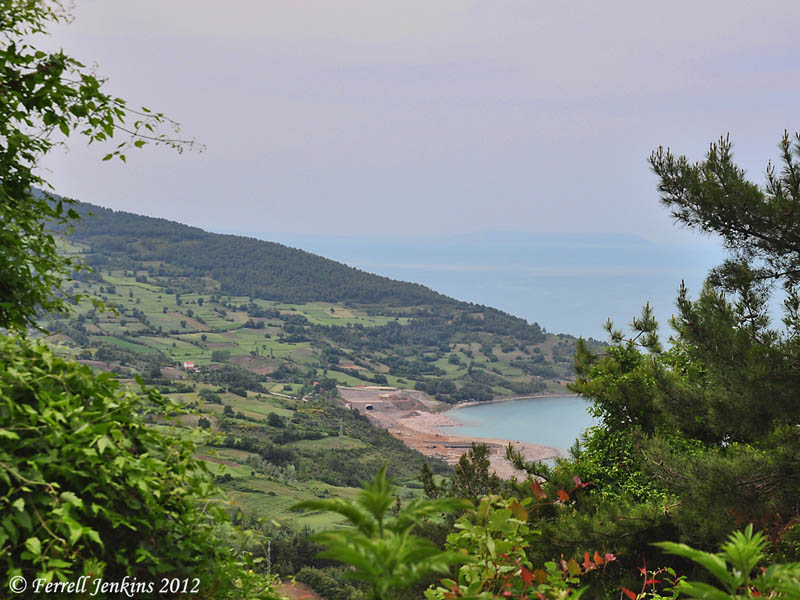
The photo below was made from the highway east of Sinop. I hope that this, and the following photo, will help to illustrate the difficulty of travel in the region.

East of Sinop on the Black Sea. Photo by Ferrell Jenkins.

From highway east of Sinop on the Black Sea. Photo by Ferrell Jenkins.

These photos and the information we have provided show that travel by sea would be much easier than travel by land, and that Sinop would not have been a good place to begin an inland journey. Leon made the following photo of the road and the mountains east of Sinop. This was one of the rare places where a vehicle could pull off road.

Mountains east of Sinop. Photo by Leon Mauldin.

Mountains east of Sinop. Photo by Leon Mauldin.

A note about spelling. Some of the towns we are writing about have an ancient name and a different modern name. In the case of Sinop, it is spelled Sinope in older sources.

Persecution of Christians in Pontus

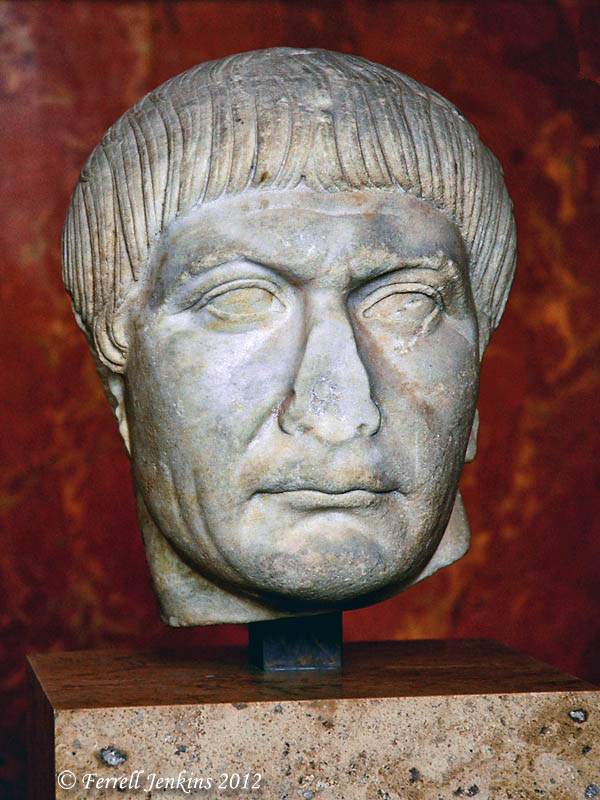
Pliny. Pliny was the governor of the Bithynia and Pontus. According to The Dictionary of the Christian Church he was born c. 61 and died c. 112. He exchanged a series of letters with the Roman Emperor Trajan (98-117 A.D.). I have done some browsing in the older Loeb edition (revised by Hutchinson) of Pliny Letters. I see references to the Black Sea cities of Heraclea (now Eregli), Amastris (now Amastra), Sinope (now Sinop), and Amisus (now Samsun). I mention this to emphasize that Pliny was familiar with the cities of Pontus. He writes of Sinope being ill supplied with water and suggests a solution to the Emperor.

Roman Emperor Trajan in the Louvre. Photo by Ferrell Jenkins.

Roman Emperor Trajan in the Louvre. Photo by Ferrell Jenkins.

Pliny wrote to the Emperor saying that he was uncertain about how to deal with the Christians in his province. He said that he had not been present at any of the trials of Christians. He explains his procedure to the Emperor:

In the meanwhile, the method I have observed towards those who have been denounced to me as Christians is this: I interrogated them whether they were Christians; if they confessed it I repeated the question twice again, adding the threat of capital punishment; if they still persevered, I ordered them to be executed. (X.xcvi).

The Christians were ordered to offer wine and incense to the image of the Emperor. Pliny had been told that those who are really Christians would not make such an offering. Some of those who were questioned said they had quit serving Christ as much as 25 years earlier. Think about that date (about 85 A.D.). This gets us close to the date of Peter’s epistles (1 Peter 1:1).

Trajan answered Pliny:

The method you have pursued, my dear Pliny, in sifting the cases of those denounced to you as Christians is extremely proper. (X.xcvii)

He said that no search should be made for the Christians. If a Christian repented and demonstrated his repentance by “adoring the Gods” [offering the wine and incense to the image of the Emperor] they should be pardoned. I think this is the type of worship mentioned in the book of Revelation which was written a few years earlier to the churches of the Roman province of Asia (Revelation 13; 14:9-11).

Phil Harland comments on the charges brought against the Christians.

The addressees were faced with “suffering” primarily in the form of verbal abuse: they were spoken against, blasphemed, reviled, and falsely called “wrongdoers” (1 Peter 2:12; 3:9, 15-17; 4:3-5; 5:9). The reasons for this suffering stemmed from the Christians’ failure to participate in religious life in the same way as they had before: the Gentiles “are surprised that you do not now join them in the same wild profligacy, and they abuse you” (1 Peter 4:4 [RSV]). Persecution of Christians, which was local and sporadic, was more often than not a consequence of denying the gods and goddesses of others, along with the social implications of non-participation in the rituals that honoured these deities

For more along this same line see Phil Harland’s post about Bithynia and Pontus here.

My intention is to turn next to the specific question of the route of travel taken by the messenger who delivered Peter’s epistles throughout Pontus, Galatia, Cappadocia, Asia and Bithynia.

More famous Sinopeans

In addition to Diogenes and Serapis, Sinop in Pontus was the home of several other well known people in early church history.

Aquila. (Not the Aquila of Acts 18:2.) This Aquila, a native of Sinop in Pontus, is said to have been a relative of the Emperor Hadrian (A.D. 117-138). He was converted to Christianity during a visit to Jerusalem, but was rejected because he refused to give up his studies of astronomy. Later he became a proselyte to Judaism.

Having become a disciple of the Rabbis, from whom he learned Hebrew and the rabbinical method of exegesis, he used his knowledge to make a revision of the Septuagint, bringing it into line with the official Hebrew text. It was soon adopted by Greek speaking Jews in preference to the LXX, which was used by the Christians. His translation, which was finished probably c. 140, was extremely literal, attempting to reproduce individual Hebrew words and phrases exactly. This procedure frequently obscured the sense; but the fidelity of Aquila’s version to the Hebrew original was admitted by the Fathers most competent to judge, such as Origen and Jerome. (Dictionary of the Christian Church, ed. Cross & Livingstone, 94).

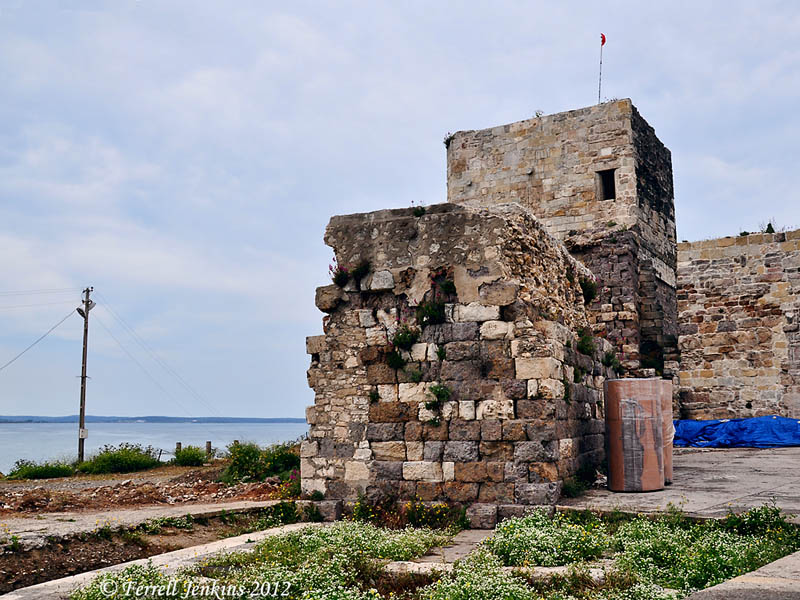
Tower and wall on the Black Sea at Sinop, Turkey. Photo by Ferrell Jenkins.

Tower and wall on the Black Sea at Sinop, Turkey. Photo by Ferrell Jenkins.

Marcion (died c. 160 A.D.). We rarely read or hear the name Marcion without the word heretic attached to it. None of his writings have survived, but his success can be seen by the many early Fathers who spoke of him. (For a list of these see Bercot, ed., A Dictionary of Early Christian Beliefs.) This influential ship master of Pontus rejected the God of the Old Testament who he described as evil and vengeful. According to him, the Christian gospel was a message of love, and the Father of Jesus was not the God of the Old Testament. Many of his views were similar to those of Gnosticism. Marcion accepted only the Gospel of Luke among the Gospels, and the writings of Paul.

Marcion went to Rome about A.D. 140, but within 4 years he was excommunicated from the church. From Rome he spread his teachings all over the Empire.

Phocas (Phokas). Phocas was martyred at Sinop in A.D. 117 during the reign of the Roman Emperor Trajan.

According to the Dictionary of the Christian Church (1282), a different man named Phocas “the Gardener” was martyred  during the persecution by the Roman Emperor Diocletian in A.D. 303. I haven’t determined if he was associated with the port city of Sinop. Wilson seems to confuse these two persons (Biblical Turkey, 342).

The Sinop Gospels is not a person, but should be mentioned in connection with the Black Sea port of Turkey. This parchment document was dyed purple and written in gold ink. The uncial manuscript 023 contains 43 pages of the gospel of Matthew. The manuscript was discovered in Sinop in the late 19th century is thought to have originated in Syria or Mesopotamia in the 6th century A.D. It is now in the Bibliothèque Nationale in Paris.

A brief description in French, and a small image of two pages of the manuscript may be found here. The manuscript features small drawings to illustrate the biblical text. The displayed page shows Jesus healing a blind man.

Black Sea coastal town of Sinop

We drove the 100 miles from Samsun to Sinop today. The distance on the road map is deceptive. about one half of the distance is in serious mountain territory. The drive took three hours each way. We had a 6:15 p.m. flight from Samsun to Istanbul, so our time was limited. The drive was educational and helped us to understand some things we had only read about before.

I don’t have the time to explain the reasons for going to this town, except to say that it is in the region of the ancient Roman province of Pontus (1 Peter 1:1).

Later I hope to show you some photos and explain the importance of the town to the study of Peter’s epistles.

Homeward bound tomorrow after a great (nearly) four weeks in Turkey, Greece, and Cyprus.

Salamis was the first stop for Barnabas and Saul

Barnabas and Saul were sent out by the Holy Spirit from Antioch. Their first stop after leaving the port of Seleucia was Salamis on the eastern coast of Cyprus. Here is Luke’s account.

When they arrived at Salamis, they proclaimed the word of God in the synagogues of the Jews. And they had John to assist them. (Act 13:5 ESV)

It is interesting to note that there are no accounts of conversions at Salamis. The city had a large Jewish population during the Roman period.

Why go to Cyprus? These facts might provide some suggestions.

  • Well, it was east of Antioch, and a first step toward going to the Gentiles.
  • It was also the home of Barnabas (Acts 4:36).
  • After the stoning of Stephen some had traveled to Cyprus preaching to the Jews (Acts 11:19).
  • Some men of Cyprus had come to Antioch preaching to the Hellenists (Greeks) (Acts 11:20).

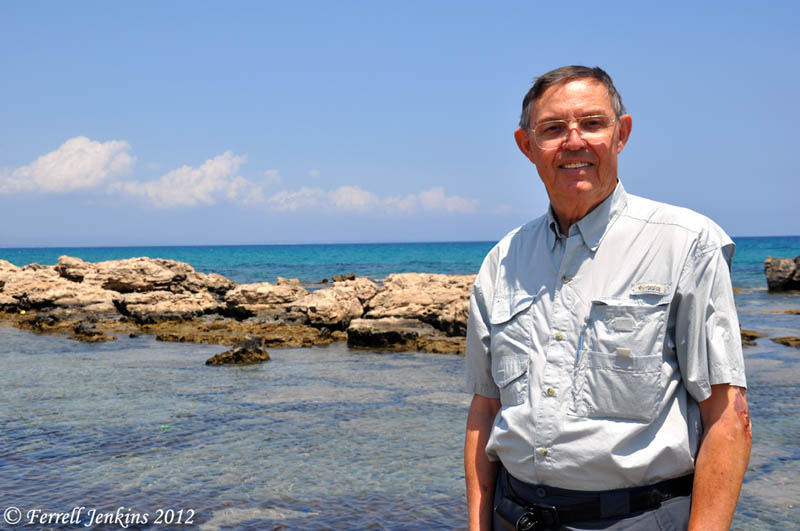
Salamis is now located in the the Turkish Republic of Northern Cyprus, or as the folks in the south say, “the occupied territory.” This photo shows some of the foundation stones of the harbor where Barnabas, Saul, and John Mark landed. Breakwaters extend for some distance into the sea.

Ferrell Jenkins at the ancient port of Salamis.

Ferrell Jenkins at the ancient port of Salamis. Photo by Leon Mauldin.

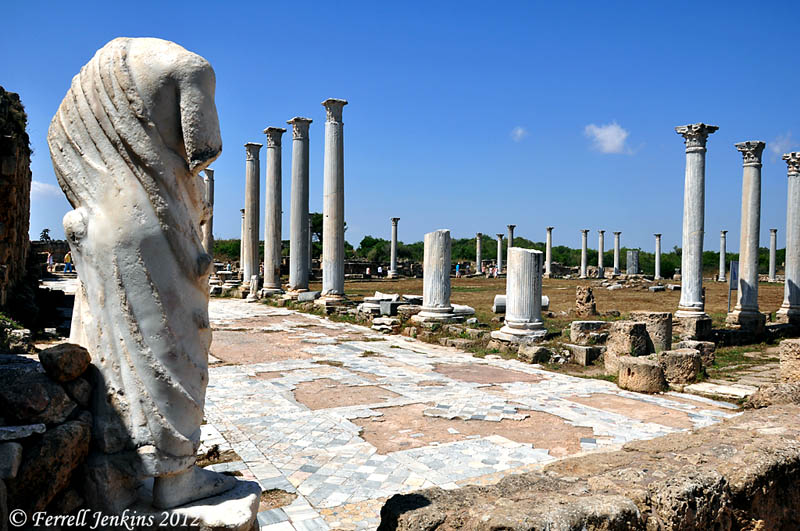
We visited the gymnasium. Not to workout. Our workout came from walking over the large site. This gym was build in the time of the Roman Emperor Augustus.

Salamis Roman gymnasium built in the time of Roman Emperor Augustus. Photo by Ferrell Jenkins.

Salamis Roman gymnasium built in the time of Roman Emperor Augustus. Photo by Ferrell Jenkins.

When I see one of these gymnasiums or palestras (exercise areas) I am reminded of what Paul wrote to Timothy:

for while bodily training is of some value, godliness is of value in every way, as it holds promise for the present life and also for the life to come. (1 Timothy 4:8 ESV)

A short distance from Salamis is the Church of St. Barnabas. The church is now a museum of icons. Many traditions have grown up in Cyprus about Barnabas.

In the afternoon we returned to Nicosia and made a stop at the Cyprus (Archaeology) Museum. They have a nice collection of artifacts, including some of the statues from Salamis, but photos are not allowed. Museum’s often do not allow photographs in hope of selling more books in the gift shop. Allowing photos provides an opportunity for teachers and others to talk about their visit with others. It actually encourages others to visit the museum. Too bad they don’t agree with me.

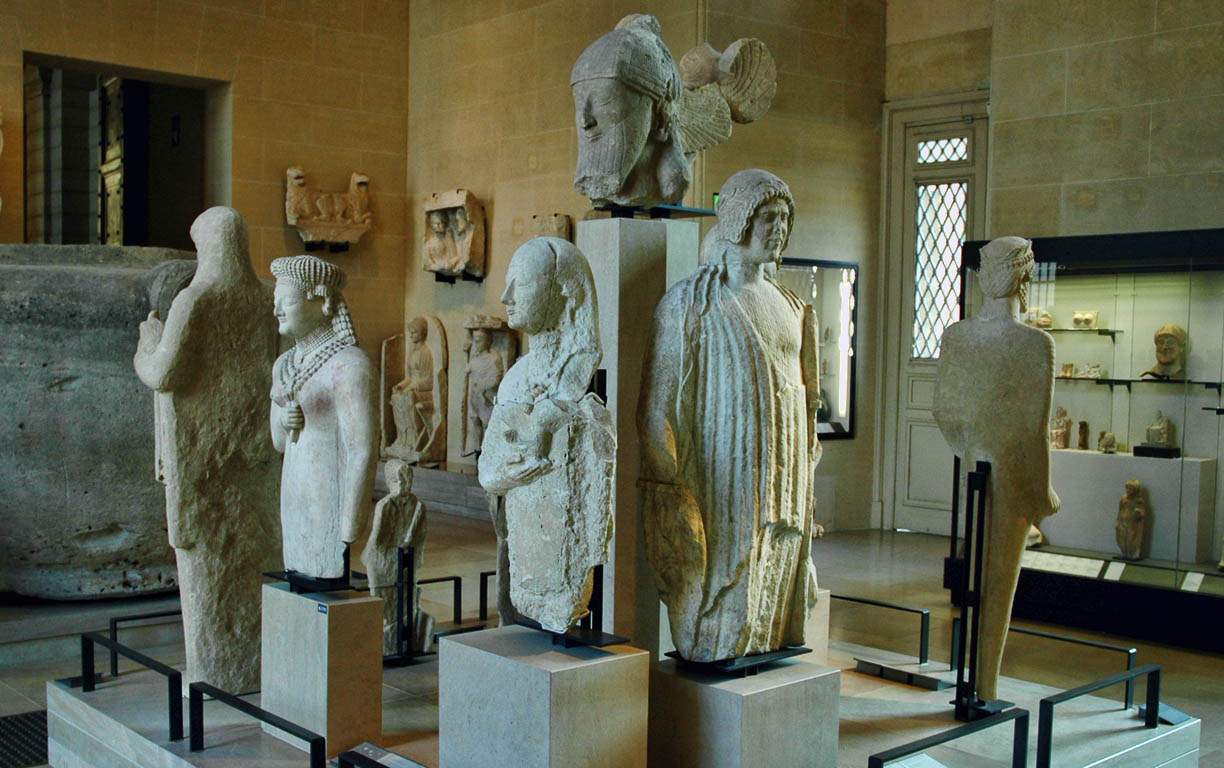
This photo is a collection of statues from Cyprus in the Louvre.

Cyprus collection from the fifth century B.C. in the Louvre. Photo by Ferrell Jenkins.

Cyprus collection from the fifth century B.C. displayed in the Louvre, Paris. Photo by Ferrell Jenkins.

It was a good day.

Millstones work better than concrete shoes

Jesus used the common millstone in one of his teaching illustrations.

And he said to his disciples, “Temptations to sin are sure to come, but woe to the one through whom they come!  It would be better for him if a millstone were hung around his neck and he were cast into the sea than that he should cause one of these little ones to sin. (Luke 17:1-2; cf. Matthew 18:6; Mark 9:42 ESV)

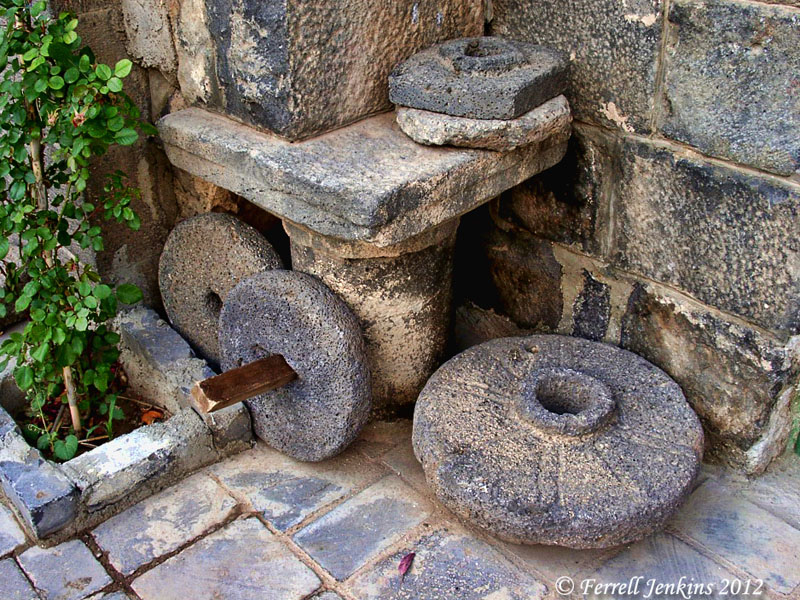
The photo below shows a collection of millstones at the Roman ruins of Bosra in southern Syria, a few miles north of the border with Jordan, in a region known as Hauran. The area has seen much volcanic action in the past. These dark millstones are made of basalt. The region is described by Ulrich Hübner this way.

Bozrah lies on one of the fruitful and water-rich plains of S Haurān at the important intersection of the N–S route, which leads from Damascus through the Transjordan to the Hejaz, with the E–W route, on which one could travel from the Mediterranean to Mesopotamia. (The Anchor Yale Bible Dictionary)

Mill stones at the Roman town of Bosra, Syria. Photo by Ferrell Jenkins.

Mill stones at the Roman town of Bosra, Syria. Photo by Ferrell Jenkins.

This Bosra is not to be confused with Bozrah in Edom (Genesis 36:33) or Bozrah in Moab (Jeremiah 48:21-24).

Millstones were significant in Bible times.

  • Used for grinding grain (even manna) (Numbers 11:8; Isaiah 47:2).
  • The work might be done by a slave girl (Exodus 11:5), or two women working together (Matthew 24:41).
  • Taking a person’s upper millstone as a pledge would deprive the person of his livelihood (Deuteronomy 24:6).
  • A woman at Shechem “threw an upper millstone on Abimelech’s head, crushing his skull” (Judges 9:53; 2 Samuel 11:21).
  • In the LORD’S challenge to Job, He describes Leviathan with a heart as hard as stone, “Even as hard as a lower millstone” (Job 41:24).
  • The sinking of a great millstone is used in the Apocalypse to describe the fall of Babylon (Revelation 18:21).

Paul spent a night at Cos (Kos)

Paul and his companions, including the physician Luke, made their way from Miletus to Cos (Kos).

And when we had parted from them and set sail, we came by a straight course to Cos, and the next day to Rhodes, and from there to Patara. (Acts 21:1 ESV)

Cos is one of the islands belonging to a group of 12 called the Dodecanese. Patmos is also an island of this group. The Mycenaeans settled Cos in the 15th century B.C. In the centuries to follow the island came under the control of the Persians, the Greeks, and the Romans. In modern times the island has been under Turkish and Italian control, and German occupation. Since 1948 it has been part of Greece. My only visit to Cos was a brief stop en route from Patmos to Rhodes in 1984. Here is one of the photos I made.

The harbor on the Island of Cos in 1984. Photo by Ferrell Jenkins.

The harbor on the Island of Cos in 1984. Photo by Ferrell Jenkins.

In the time of Paul, Cos was noted as the birthplace of Hippocrates, the “father of medicine.” Hippocrates was associated with the Asclepium, ruins of which can still be seen. A Hellenistic gymnasium and some Roman ruins, including portions of a Roman road, may also be seen. There is also an archaeological museum.

Howard F. Vos describes the island with these words:

One of the most beautiful ports of the ancient world, Cos not doubt was most famous as a health resort. It was the site of the first school of scientific medicine and the sanctuary of Asclepius (Esculapius). The island had a healthful climate and hot ferrous and sulfurous springs, which the great Hippocrates (ca 460–377 b.c.), the father of medicine, first used to cure his patients. (The International Standard Bible Encyclopedia, revised.)

James Strahan, in the old Hasting’s Dictionary of the Apostolic Church, says,

It was renowned for its vines and looms, its literature and art, and above all for its temple of Æsculapius and school of medicine, which must have made it especially interesting to St. Luke.

According to Josephus, Herod the Great assisted the people of Cos with grain and other goods. (JW 1:424).

Two Other Good Sources:

Fant, C. E. and M. G. Reddish, A Guide to Biblical Sites in Greece and Turkey.

Wilson, Mark. Biblical Turkey: A Guide to Jewish and Christian Sites of Asia Minor. This book deals with Turkey, but devotes ½ page to Cos as a Sidetrip.

Roman Volubilis — “Stunning with few tourists”

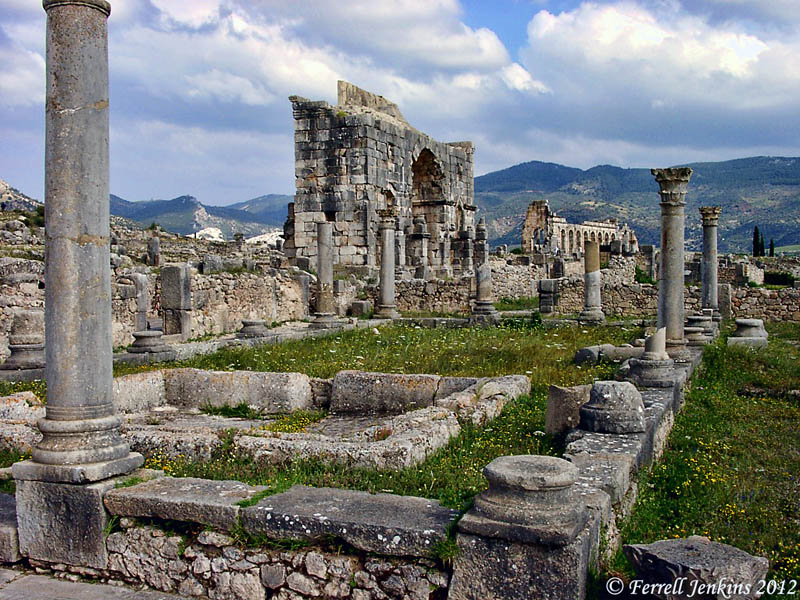
Ruins of Roman Volubilis in Morocco. Photo by Ferrell Jenkins 2000.

Ruins of the Roman City of Volubilis in Morocco. Slide by Ferrell Jenkins, 1980.

A feature at Seattlepi.com says that Morocco’s Roman ruins are “Stunning, with few tourists.” The article describes Volubilis,

The jewel in the crown of Morocco’s Roman ruins is certainly Volubilis, located at the foot of the Atlas mountains in a sweeping valley filled with olive and almond trees.

This city of 20,000 was the westernmost extremity of an empire that once stretched to the gates of Persia. The sprawling floor plans of its buildings and brilliant floor mosaics suggest great wealth.

The site is dominated by the remains of the grand public buildings around the forum, with the impressive arches of the Basilica courthouse arrayed in front of pillars of the temple to the god Jupiter — now topped by bushy stork nests. Every old ruin in Morocco appears to host its own of population of the large black and white birds, which soar over the sites or preen in their nests as tourists snap away with cameras.

Ruins of the Roman City of Volubilis in Morocco. Slide by Ferrell Jenkins, 1980.

Ruins of the Roman City of Volubilis in Morocco. Slide by Ferrell Jenkins, 1980.

Students of the New Testament realize that the Roman Empire was vast. Volubilis became part of the Roman province Mauretania Tingitania under the Emperor Claudius in A.D. 45. Claudius was Emperor from A.D. 41-54 during the time of Paul’s journeys to spread Christianity throughout the Empire (Acts 18:2).

And he [Paul] found a Jew named Aquila, a native of Pontus, recently come from Italy with his wife Priscilla, because Claudius had commanded all the Jews to leave Rome. And he went to see them, (Acts 18:2 ESV)

Twice I have taken tours to Volubilis, about 20 miles from Meknes. Most of the ruins we see today date from the second and third centuries A.D.

Volubilis has been added to the list of World Heritage Sites because “this site is an exceptionally well preserved example of a large Roman colonial town on the fringes of the Empire.”

The feature about Morocco’s Roman ruins may also be read at CBS News here.

HT: Jack Sasson