Tag Archives: Ministry of Jesus

Acts 21 # 2 — Photo Illustrations – Tyre

Luke records the journey from Patara to Tyre in these words:

 2 and having found a ship crossing over to Phoenicia, we went aboard and set sail.  3 When we came in sight of Cyprus, leaving it on the left, we kept sailing to Syria and landed at Tyre; for there the ship was to unload its cargo.  4 After looking up the disciples, we stayed there seven days; and they kept telling Paul through the Spirit not to set foot in Jerusalem.  5 When our days there were ended, we left and started on our journey, while they all, with wives and children, escorted us until we were out of the city. After kneeling down on the beach and praying, we said farewell to one another.  6 Then we went on board the ship, and they returned home again.  7 When we had finished the voyage from Tyre, we arrived at Ptolemais, and after greeting the brethren, we stayed with them for a day.  (Acts 21:2-7 NAU)

Tyre was well known to the Old Testament writers, especially the prophet Ezekiel. In Ezekiel 26-28 you will find a proclamation against Tyre, a prophetic lamentation over the fall of the city, and a proclamation against the king of Tyre.

The ministry of Jesus took Him to the district of Tyre and Sidon (Matthew 15:21).

The disciples, with wives and children, escorted Paul and his companions out of the city. The group kneeled and prayed on the beach before saying farewell to one another.

Tyre was once an important Phoenician city, but is now a small town known as Sur in Lebanon. It has a small fishing port that you see in the photograph below.
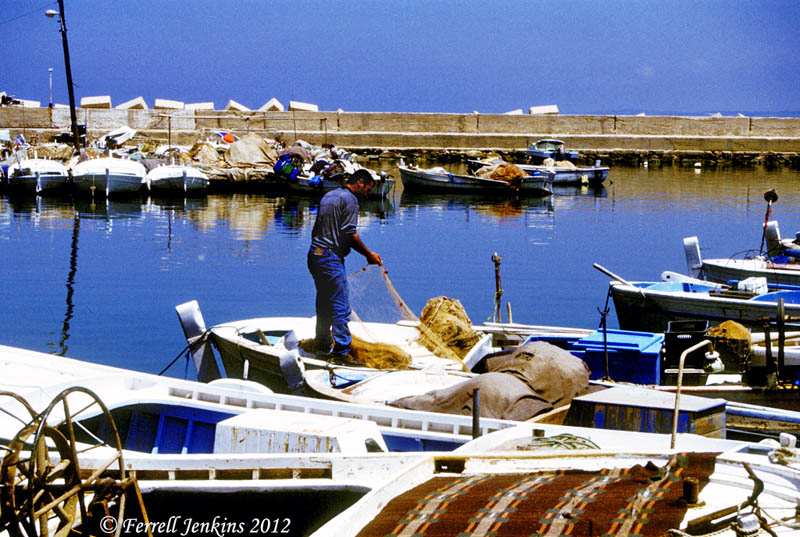
A fisherman works with his nets in the small harbor of Tyre. Photo by Ferrell Jenkins.
A fisherman works with his nets in the small harbor of Tyre. Photo by Ferrell Jenkins.
Jesus returned “to the Sea of Galilee”

Mark tells us that Jesus made a trip to the region of Tyre and Sidon. There He met a Syrophoenician woman and healed her daughter. The text says that he returned “to the Sea of Galilee.”

Then he returned from the region of Tyre and went through Sidon to the Sea of Galilee, in the region of the Decapolis.  And they brought to him a man who was deaf and had a speech impediment, and they begged him to lay his hand on him.  (Mark 7:31-32 ESV)

Capernaum, Chorazin, and Bethsaida were cities around the Sea of Galilee. The region of Decapolis was located east of the Sea.
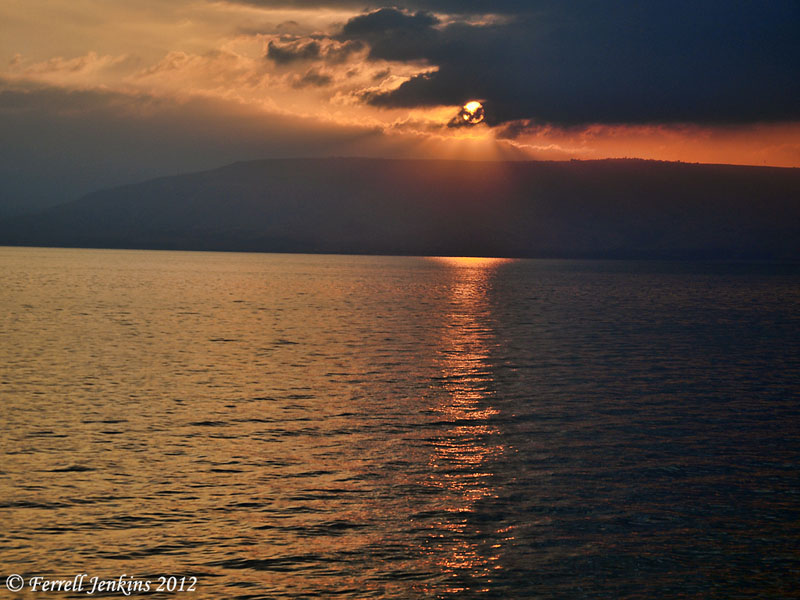
This rather unique sunrise photo gives a clear view of a least a portion of Decapolis.

Sunrise on the Sea of Galilee, view east toward Decapolis. Photo by Ferrell Jenkins.

Sunrise on the Sea of Galilee, view east toward Decapolis. Photo by Ferrell Jenkins.

In Decapolis, Jesus healed a deaf man with a speech impediment (Mark 7:31-37).

The Sea of Galilee has an attraction to people who love Jesus and the events that took place there. On a recent tour, I had one lady who made her second trip to Israel primarily to return to the Sea of Galilee. Every time I post a photo of sunrise on the Sea of Galilee I receive several communications from folks who say it is one of their favorite places.

The Magdala synagogue and table

Several times in the past few years we have called attention to the site of Magdala (Migdal). In September, 2009, we noted the announcement by the Israel Antiquities Authority of the discovery of a synagogue from the Second Temple period (50 BCE—100 CE).

A synagogue from the Second Temple period (50 BCE—100 CE) was exposed in archaeological excavations the Israel Antiquities Authority is conducting at a site slated for the construction of a hotel on Migdal [Magdala] beach, in an area owned by the Ark New Gate Company. In the middle of the synagogue is a stone that is engraved with a seven-branched menorah (candelabrum), the likes of which have never been seen. The excavations were directed by archaeologists Dina Avshalom-Gorni and Arfan Najar of the Israel Antiquities Authority.

The town of Magdala is not mentioned in the Bible, but Mary Magdalene is mentioned a total of 12 times in the four gospels. This place may have been her birthplace or her home. A few late manuscripts mention Magdala (Matthew 15:39 KJV), but earlier manuscripts read Magadan. Magdala is located about 4 miles north of Tiberias on the western shore of the Sea of Galilee.

The Hebrew word Magdala means tower. In New Testament times the city had become Hellenized and bore the Greek name Tarichea because of the importance of the salted-fish industry there. Mendel Nun located a harbor at the site. He says,

“In ancient times, pickled sardines were an important element of diet throughout the country–especially for those who lived near the lake” (BAR, Nov/Dec 1993).

Josephus had his headquarters at Magdala during the first Jewish Revolt against Rome (A.D. 66-70). He was able to get a group of at least 230 boats to go from Magdala to Tiberias (Jewish Wars 2.635-637). Vespasian attacked the town from the sea and destroyed it.

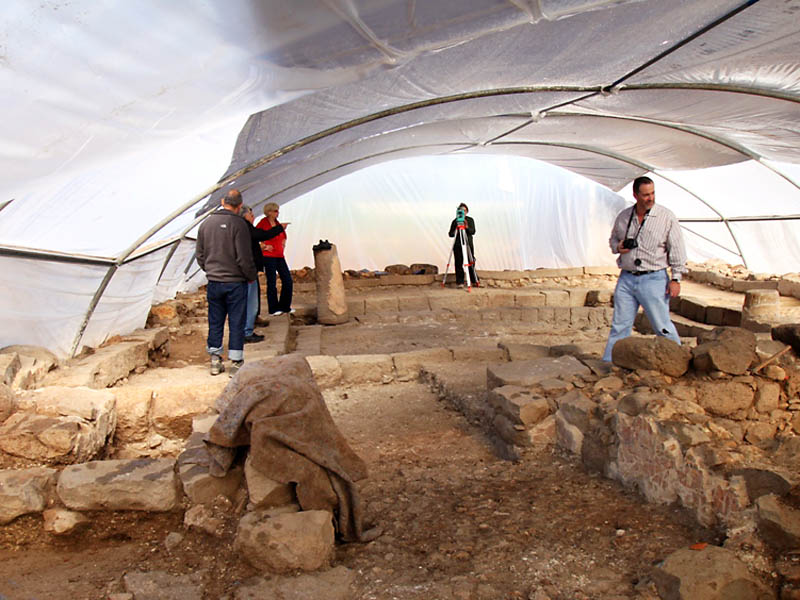
We visited the site on the most recent tour, but everything is covered in a way that make it difficult or impossible to make sense of it. We are fortunate to have a photo made by Jim Joyner a few years ago.

The Magdala/Migdal Synagogue. Photo by Jim Joyner.

The Magdala/Migdal Synagogue. Photo by Jim Joyner.

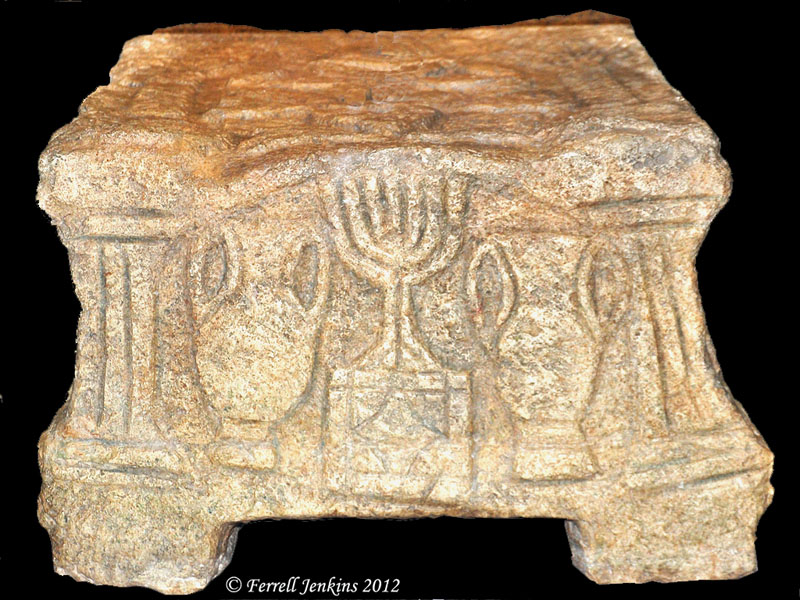
There is a replica of the “table” that was found in the synagogue at the site. The glare on the case was bad, but I followed the tip of Dr. Carl Rasmussen (Holy Land Photo’s Blog), I went to the Notre Dame Hotel and made a photo of the replica there. Since his photo, the table has been put in a case. Notice the menorah.

Magdale Synagogue Table - Notre Dame Hotel, Jerusalem.

Magdala Synagogue Table – Notre Dame Hotel, Jerusalem. Photo by Ferrell Jenkins.

We were told at the site that the original is now in the Rockefeller Museum. Whether on display or being examined by the IAA, I do not know.

The “wife of Christ”

Reminds me of a preaching brother in the Ohio Valley a few decades back who had trouble pronouncing the letter “L”. As a result, he often spoke of the “wife of Christ.” True story. Like the Europeans who says “elewator” in stead of “elevator.”

Having been out of the country for three weeks and still delayed in New York, I have been unable to mention the recent spate of media attention to the claim of a document in which Jesus mentions His wife.

For those who are interested in reading some reliable responses to this nonsense, I call attention to two posts by Todd Bolen at the Bible Places Blog.

In the first one, Bolen briefly summarizes his response to the story under the title “Somebody Once Believed That Jesus Had a Wife” here.

In the second one, here,  he lists a summary of more than a dozen articles worth reading.

Don’t go to church Sunday morning without being prepared. Someone is sure to mention one of the brief reports they heard on TV.

Visiting the Jordan River

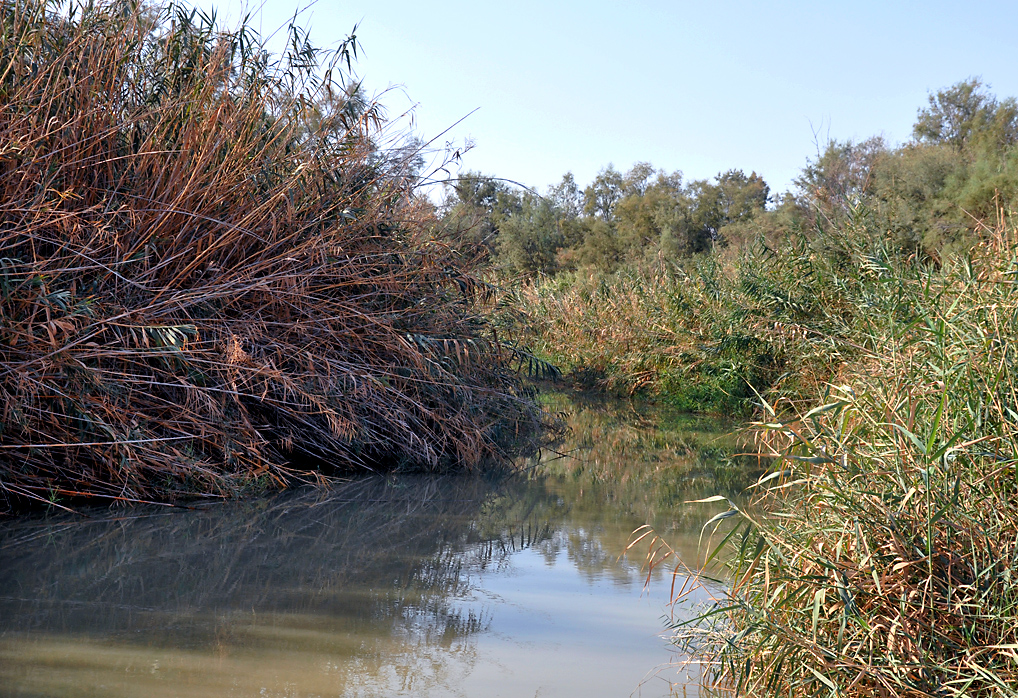
Israel has opened access to the Jordan River at the traditional site of the baptism of Jesus.

Bible students enjoy visiting this site for several reasons.

  • Ancient Israel crossed the Jordan to enter the promised land (Joshua 3).
  • Elijah and Elisha crossed the river (2 Kings 2).
  • John baptized in the Jordan (Matthew 3:6ff.; Mark 1:5-9; John 1:28; 10:40).
  • Jesus was baptized in the Jordan (Matthew 3:13).
  • Naaman dipped in the Jordan at a site further north (2 Kings 5).

We were able to visit the site this morning.

The Jordan River at the site of the baptism of Jesus. View south. Photo by Ferrell Jenkins.

Jordan River at the site of the baptism of Jesus. View south. Photo by Ferrell Jenkins.

We also visited Masada, Qumran, and Jericho.

Jacob’s Well — from Jacob to Jesus

Jesus came to Sychar, a city of Samaria, near the piece of land Jacob had owned (John 4:5; Genesis 33:19). The territory was apportioned to the descendants of Joseph, and Joseph was buried there at Shechem (Joshua 24:32). It was a place of great historic importance.

We are not able to speak with certainty regarding the location of Sychar. Some scholars associate the site with Shechem; others think it should be identified with the village of Askar which is located a short distance north. The traditional Jacob’s Well is located at Shechem in the valley between Mount Gerizim and Mount Ebal. The modern town of Nablus now fills this valley.

André Parrot says,

“Of all the ‘holy places’ of Palestine, none has more reason to be considered authentic than Jacob’s well. Indeed, there is no reason why its authenticity should be questioned” (Land of Christ 65).

Parrot describes the water as “cool and pleasant-tasting…drawn from a depth of 128 feet.” I have drunk the water several times, but in the past couple of decades my guides have advised against it due to pollution in the area.

The Samaritan woman said, “the well is deep” (John 4:11). Parrot reports the well is 128 feet deep. Murphy-O’Connor says it is 22.5 meters deep (about 74 feet). McGarvey cites several measurements mentioned in 19th century writers and reminds us that the well became filled with stones cast in by travelers trying to hear how long it would take a stone to hit the bottom (Lands of the Bible 283). He reports that the well was often dry.

There are numerous springs in the area of Shechem. Jacob, as a late-comer to the region, might have found it necessary to dig a well to assure water for his family and cattle.

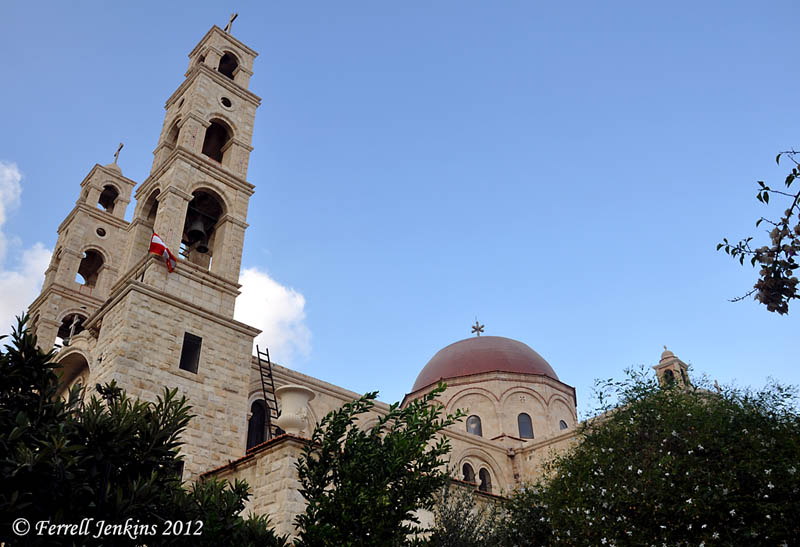
A church was erected over the well about A.D. 380. The Crusaders built another church on the site in the 12th century. The property came under the control of the Greek Orthodox church in 1860. By the end of the 19th century the Greeks began a new church, but construction was halted during World War I. The new building was completed in 2007. This photo shows the towers and dome of the church today.

New Greek Orthodox Church covering Jacob's Well. Photo by Ferrell Jenkins.

New Greek Orthodox Church covering Jacob’s Well. Photo by Ferrell Jenkins.

It has been difficult for groups to visit Jacob’s Well in recent years due to the situation in Nablus and the West Bank. Today we were able to visit the church and make photos.

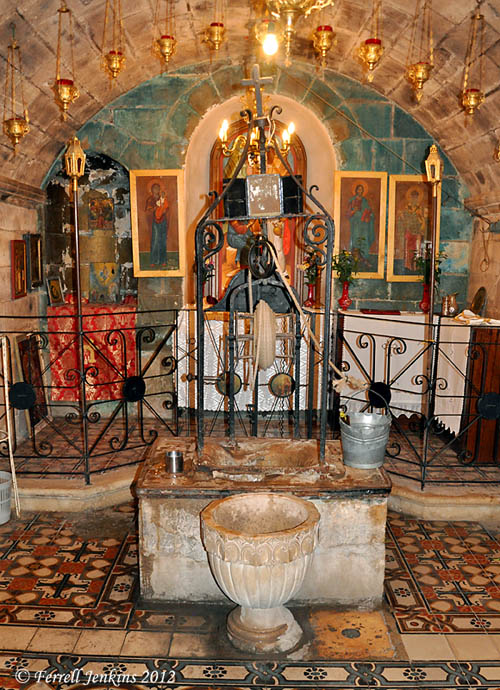
Jacob's Well. Photo by Ferrell Jenkins.

Jacob’s Well. in a Greek Orthodox Setting. Photo by Ferrell Jenkins.

We had a nice day visiting Beth Shean, Spring of Harod (it was dry); Jezreel, Samaria, as well as Jacob’s Well.

Peter confesses Jesus to be “the Christ” at Caesarea Philippi

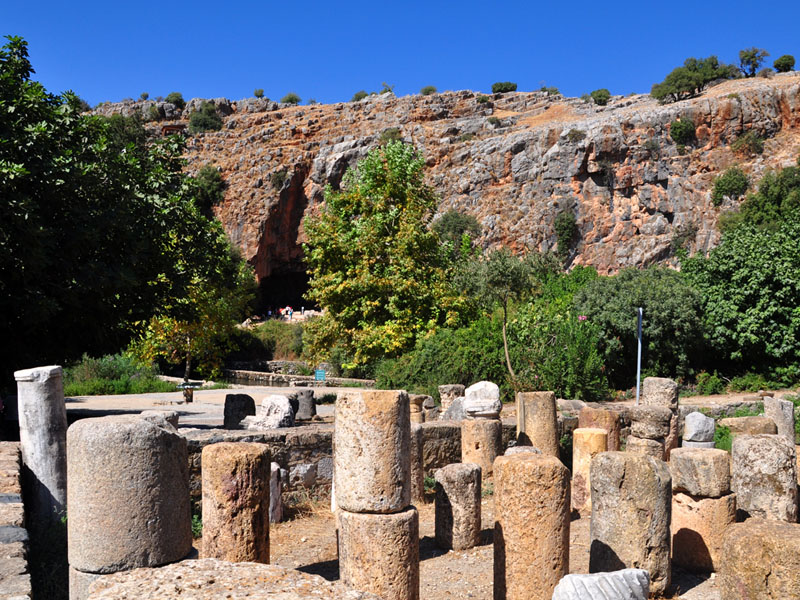
The major sites we visited today included Hazor, Dan, Caesarea Philippi, the Golan Heights, and the Jordan River. Here is a new photo I made at Caesarea Philippi. In the foreground there are broken columns discovered in the excavations at the site. The Banias (or Hermon) River, a major source of the Jordan River,  is hidden by the plants in this photo.

Caesarea Philippi. Photo by Ferrell Jenkins.

Caesarea Philippi. Photo by Ferrell Jenkins.

The Caesarea Philippi of the ministry of Jesus is also known as Banias (Matthew 16:13-19).

Caesarea Philippi is located on the eastern side of the Beka or Hula Valley.  The valley is called the Beka in Lebanon, and a little further south the Hula Valley. The elevation is about 1150 feet above sea level in the foothills of Mount Hermon.

Matthew uses the term district or region to describe the area Jesus visited with His disciples (Matthew 16:13). The King James Version coasts is misleading. Mark’s term is villages (Mark 8:27). It was not far from here that Jesus was confessed as the Christ by Peter.

Jesus went out, along with His disciples, to the villages of Caesarea Philippi; and on the way He questioned His disciples, saying to them, “Who do people say that I am?”  They told Him, saying, “John the Baptist; and others say Elijah; but others, one of the prophets.” And He continued by questioning them, “But who do you say that I am?” Peter answered and said to Him, “You are the Christ.” (Mark 8:27-29 NASB; also read Matthew’s account)

Traveling in Israel

This afternoon we arrived in Israel. My first tour was in 1967, a few weeks before the Six-Day War when Jerusalem was in Jordan. The traditional site of the baptism of Jesus by John the Baptist was easily accessible.  That changed after the War, and we had no access to the River until Jordan opened a site thought to be the location of Bethany Beyond the Jordan (John 1:28). By 2006 we were able to visit the site.

Last year (2011) Israel opened access to the river, by special permission, on the west side. I understand the site is now open to anyone who wishes to visit.

Then Jesus came from Galilee to the Jordan to John, to be baptized by him.  John would have prevented him, saying, “I need to be baptized by you, and do you come to me?”  But Jesus answered him, “Let it be so now, for thus it is fitting for us to fulfill all righteousness.” Then he consented.  And when Jesus was baptized, immediately he went up from the water, and behold, the heavens were opened to him, and he saw the Spirit of God descending like a dove and coming to rest on him;  and behold, a voice from heaven said, “This is my beloved Son, with whom I am well pleased.” (Matthew 3:13-17 ESV)

The River Jordan at the Israel-Jordan border north of the Dead Sea. Photo by Ferrell Jenkins.

Jordan River at the traditional site of the baptism of Jesus. Photo by Ferrell Jenkins.

This will be my eightieth foreign tour to direct in these past 46 years. Not all of these have been to Israel, but I’ve led tours to the land so central in the Biblical story almost annually except for those years when political conditions made it impossible. Occasionally there was a second tour the same year. I have made numerous personal study trips in addition to the tours I lead. I’m still learning, and still making efforts to see places I have not yet visited. Last year I spent about six weeks in the country.

Through this blog I have tried to share a little bit of information and a few of the photos I have accumulated. Over the next two or three weeks I hope to share a bit of the excitement of this tour.

Tell your friends about the blog.

At least three blogs are being written about the tour. You might enjoy them, especially if you know someone traveling with us.

Steven Braman — Braman’s Wanderings
http://bramanswanderings.wordpress.com

Barry Britnell — Exploring Bible Lands
http://exploringbiblelands.com

Trent and Rebekah Dutton
http://www.trentandrebekah.com

Our flight from New York was delayed due to bad weather in New York and connecting cities. We were too late to visit Joppa today. Trent and Rebekah Dutton arrived in Israel yesterday. I see they have already posted some information about Joppa.

Tonight all 39 tour members are settled on the Mediterranean coast at Netanya, Israel. Looking forward to a great day of learning tomorrow.

Could the “Herodian Mansion” have been the house of Annas the high priest?

Archaeological architect Leen Ritmeyer is interviewed by Justin Taylor about the “Palatial Mansion” or “Herodian Mansion” here. Ritmeyer takes the position that the Palatian Mansion, identified as the Wohl Museum, may be “the place of residence for Annas the high priest.”

Todd Bolen, at the Bible Places Blog, says,

While I appreciate the way that Ritmeyer makes these discoveries so accessible to the average Bible reader, I am less optimistic that this particular house is the very house where Jesus stood on trial and Peter denied the Lord. In favor of making this positive identification is the fact that this is the largest house known from this time period in Jerusalem. On the other hand, most of the land in the Old City has never been excavated. If there were 100 houses in Jerusalem in the first century, how likely is it that the only complete one excavated is the same one mentioned in the Bible?

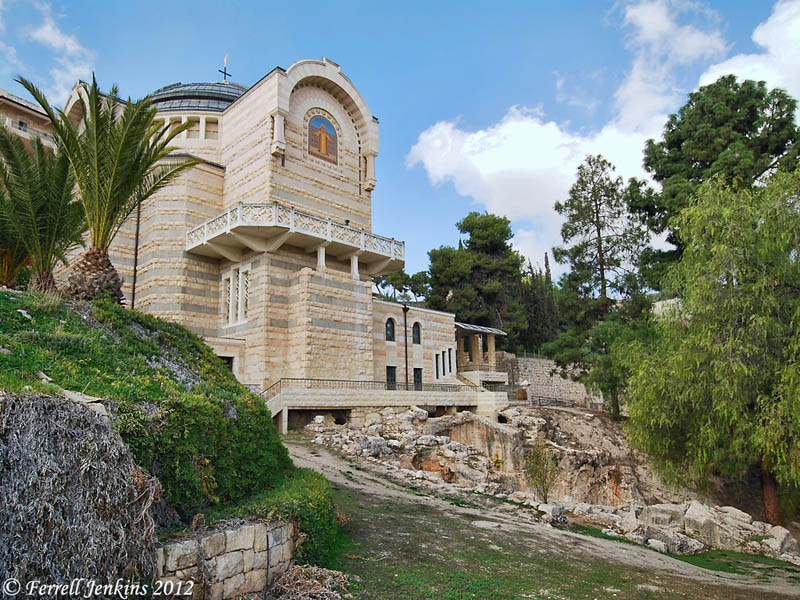
A similar claim is made for the site known as Saint Peter in Gallicantu. Tour groups to Jerusalem often visit both sites. Maybe one of these places is the house of Annas and Caiaphas, and maybe not. Each may provide a good illustration of what happened when Jesus was brought before the high priest. I often say to my groups, “It may not have been right here, but it wasn’t far away.”

St. Peter in Galicantu, Jerusalem. Photo by Ferrell Jenkins.

St. Peter in Galicantu, Jerusalem. This exterior view shows the modern building covering the excavation that some suggest was the house of the high priest. Photo by Ferrell Jenkins.

In comments to the Ritmeyer interview, Shannon Brown shares an album of photos he made at the Wohl Museum a few years ago.

For the Biblical background of this discussion, see John 18:13-24; Matthew 26:57-68; Mark 14:53-65; and Luke 22:54-65.

Kinneret Bot

https://si0.twimg.com/profile_images/283752039/kinneret_reasonably_small.jpgWhile doing some searching for information I came across an interesting account on Twitter. Kinneret Bot is a computer that tweets “the water level of Lake Kinneret/the Sea of Galilee, Israel.” You can get to KB here.
Thursday the water level was 211.67m below sea level. For most Americans that is 694.46 feet below sea level. We reported the level of the lake November, 2010, at 701.71 ft. below sea level. This shows considerable improvement, but it is nearly three months before much rain can be expected.

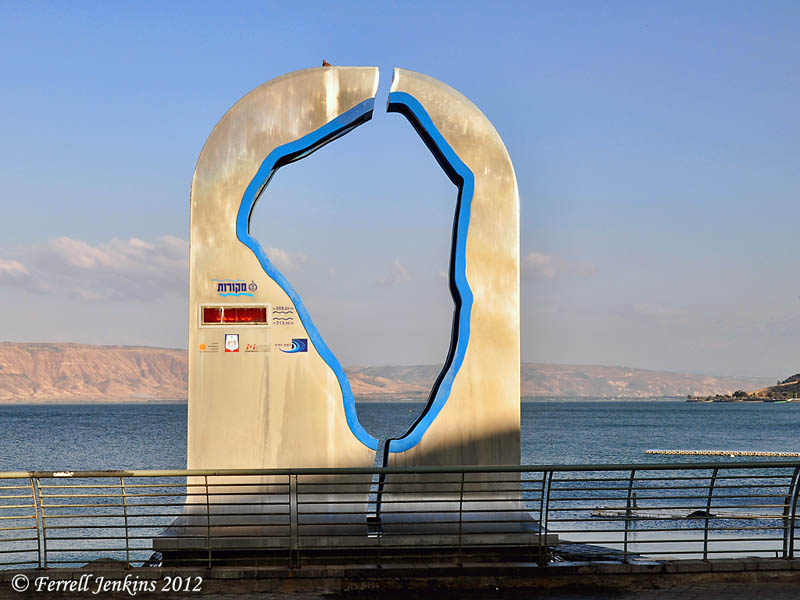
I enjoy visiting the pier at Tiberias on the Sea of Galilee. The gauge that measures the level of the Sea is a nice attraction. The view that we captured in this photos shows the southeastern shore of the Sea.

Gauge on the pier at Tiberias showing level of Sea of Galilee. Photo by Ferrell Jenkins.

Gauge on the pier at Tiberias showing level of Sea of Galilee. Photo by Ferrell Jenkins.

The Sea of Galilee is also called the Sea of Tiberias by the Gospel of John.

After these things Jesus went away to the other side of the Sea of Galilee (or Tiberias). (John 6:1 NAU)

After these things Jesus manifested Himself again to the disciples at the Sea of Tiberias, and He manifested Himself in this way. (John 21:1 NAU)

Update: Sorry that the link to Kinneret Bot was incorrect. Refresh your browser and check again. Thanks JG.