Tag Archives: Ministry of Jesus

New wine is for fresh wineskins

When Jesus was questioned by the scribes of the Pharisees about how His practices differed from those of John the Baptist, He gave three similar illustrations to teach the newness of His teaching and practice.

And Jesus said to them, “Can the wedding guests fast while the bridegroom is with them? As long as they have the bridegroom with them, they cannot fast. The days will come when the bridegroom is taken away from them, and then they will fast in that day. No one sews a piece of unshrunk cloth on an old garment. If he does, the patch tears away from it, the new from the old, and a worse tear is made.  And no one puts new wine into old wineskins. If he does, the wine will burst the skins– and the wine is destroyed, and so are the skins. But new wine is for fresh wineskins.” (Mark 2:19-22 ESV)

The third illustration is about putting new wine into old wineskins. As the wine ferments it expands and stretches the wineskin. If an old wineskin is used, the expansion will cause the wineskin to explode.

Our photo below shows an animal skin being use for churning, but it is easy to understand wine being placed in an animal skin like this.

A Bedouin at Petra using an animal skin for churning. Photo by Ferrell Jenkins.

A Bedouin at Petra using an animal skin for churning. Photo by Ferrell Jenkins.

Instead of using stone jars for storing new wine, Klinck says,

More likely, however, they would use wineskins for this purpose. These are the “bottles” of the Bible. A wine bottle was made out of a goatskin, sewn together where it had been cut to remove it from the carcass. This formed a sack that could be tied at the neck and hung up. The resilience of the new rawhide took up whatever expansion might result from the process of fermentation. Of course, no one would think of putting “new wine into old wineskins,” since the old dried and cracked skins from the previous year were unsafe (Matthew 9:17). (Klinck and Kiehl, Everyday Life in Bible Times, p. 54).

The Gibeonites tricked the Israelites with old wineskins that were “worn-out and torn and mended” (Joshua 9:4). They claimed that the wineskins “were new when we filled them, and behold, they have burst” (Joshua 9:13 ESV)

Elihu used the same illustration in defense of his much speaking.

I also will answer with my share; I also will declare my opinion. For I am full of words; the spirit within me constrains me. Behold, my belly is like wine that has no vent; like new wineskins ready to burst. I must speak, that I may find relief; I must open my lips and answer. (Job 32:17-20 ESV)

They removed the roof and let down the bed

During the ministry of Jesus at Capernaum four men brought a paralyzed man to see Jesus, likely seeking healing, but there were so many people in the house that it was not possible to get in to see Jesus.

And when they could not get near him because of the crowd, they removed the roof above him, and when they had made an opening, they let down the bed on which the paralytic lay. (Mark 2:4 ESV)

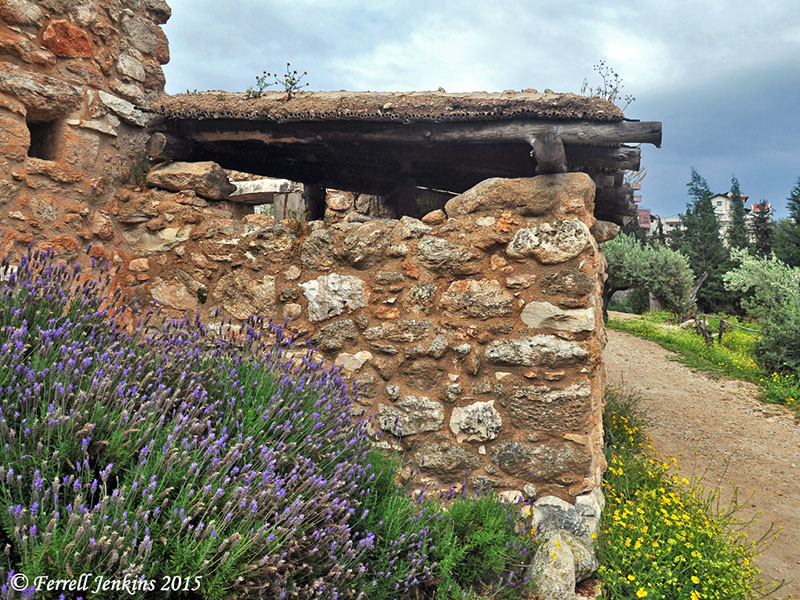
Reconstructed house at Nazareth Village showing roof construction. Photo by Ferrell Jenkins.

Reconstructed house at Nazareth Village showing roof construction. Notice the few weeds growing on the roof. Photo by Ferrell Jenkins.

Craig S. Keener describes the way the roofs of these houses were constructed.

The roof was approached by an outside staircase, so they could reach it unimpeded. The roof of single-story homes was sturdy enough for walking but was normally made of branches and rushes laid over the roof’s beams and covered with dried mud; thus one could dig through it. (The IVP Bible Background Commentary: New Testament)

M. J. Selman says,

Roofs were constructed from beams covered with branches and a thick layer of mud plaster, though the rafters were sometimes supported by a row of pillars along the middle of the room. Cylindrical stone rollers about 60 cm. [23.6 inches] long were used to keep the roofs flat and waterproof, though roofs needed to be re-plastered annually prior to the rainy season to seal cracks which had developed during the summer heat. (New Bible Dictionary, 3rd ed.)

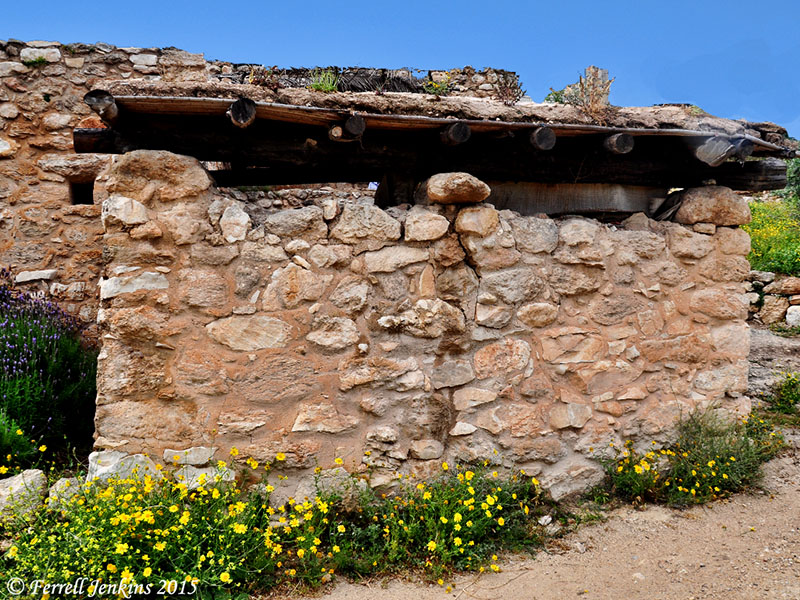
The picture below shows a reconstructed house at Nazareth Village with a roof like the one mentioned above. Notice the beams made from small trees, the mud on the top, and some grass and weeds growing in it.

Reconstructed house at Nazareth Village showing roof construction. Photo by Ferrell Jenkins.

Reconstructed house at Nazareth Village showing roof construction. Photo by Ferrell Jenkins.

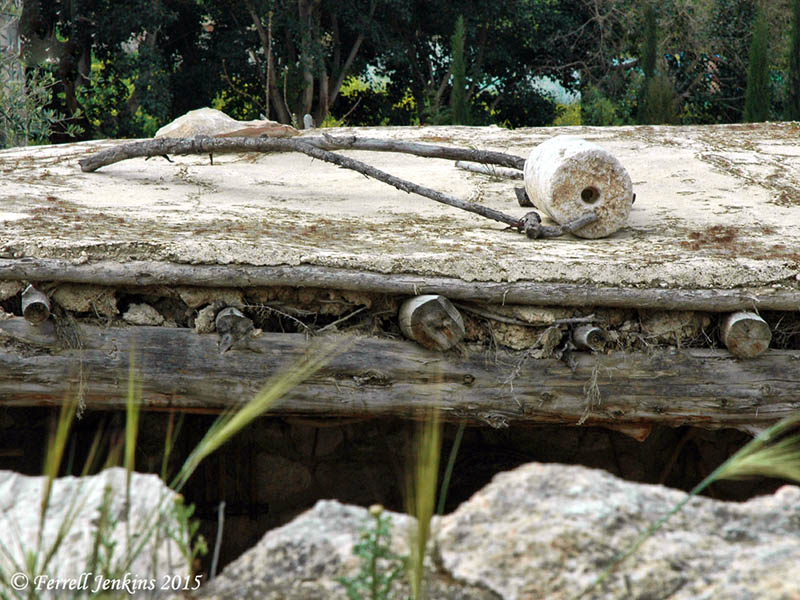
The next photo shows a portion of a roof made from wood and mud. You will also notice a roof roller on the roof. After the winter rains it was necessary to pack the roof with a roof roller. Roof rollers are commonly discovered during archaeological excavations.

Typical roof from NT times with roof roller. Nazareth Village. Photo by Ferrell Jenkins.

Typical roof from NT times with roof roller. Nazareth Village. Photo by Ferrell Jenkins.

The account of Luke, a gentile physician, adds an interesting point that creates a small problem in interpretation.

But since they found no way to carry him in because of the crowd, they went up on the roof and let him down on the stretcher through the roof tiles right in front of Jesus. (Luke 5:19 NET)

Did you notice the reference to roof tiles? One of the Translator’s Notes in the NET Bible discusses this problem.

There is a translational problem at this point in the text. The term Luke uses is keramos. It can in certain contexts mean “clay,” but usually this is in reference to pottery (see BDAG 540 s.v. 1). The most natural definition in this instance is “roof tile” (used in the translation above). However, tiles were generally not found in Galilee. Recent archaeological research has suggested that this house, which would have probably been typical for the area, could not have supported “a second story, nor could the original roof have been masonry; no doubt it was made from beams and branches of trees covered with a mixture of earth and straw” (J. F. Strange and H. Shanks, “Has the House Where Jesus Stayed in Capernaum Been Found?” BAR 8, no. 6 [Nov/Dec 1982]: 34). Luke may simply have spoken of building materials that would be familiar to his readers.

There are other possible interpretations, but I hope this information with the photos will help you better understand the biblical text.

Another look at Hippos (Sussita)

I think many Bible Land travelers pass En Gev on the eastern shore of the Sea of Galilee and never realize that the site of Hippos is visible about one and a half miles to the east. Perhaps that is because of the almost magnetic attraction of the Sea of Galilee.

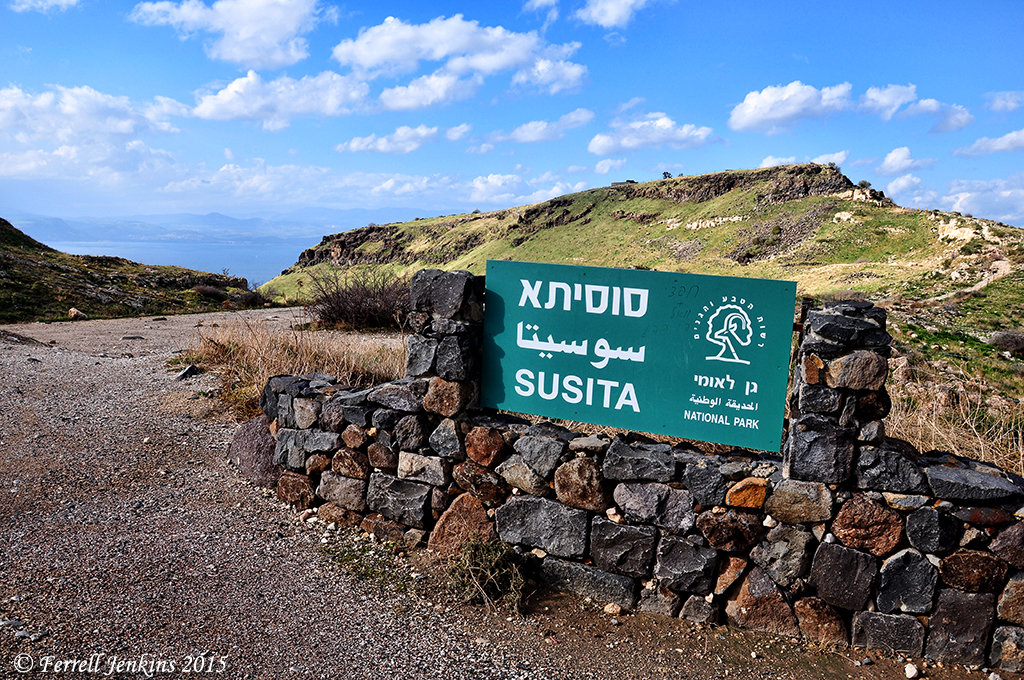
View of Hippos/Sussita (Susita) with the Sea of Galilee. Photo by Ferrell Jenkins.

View of Hippos/Sussita (Susita) with the Sea of Galilee. Photo by Ferrell Jenkins.

Vassilios Tzaferis wrote about Hippos in Biblical Archaeology Review:

If you look at the site of Sussita/Hippos from an adjacent mountain, or, better yet, from the air, and follow the adjoining ridge, or saddle, to the east, the site looks like the head of a horse and the saddle, or ridge, looks like the long, outstretched neck of a horse. It is this configuration that gave the site its name for nearly a thousand years. The ancient Greeks, who apparently were the first to settle the site, must have been aware of this resemblance because they named the place Hippos (horse). When the Jews conquered the city, they translated the name to Sussita, “mare” in Aramaic. When the Arabs conquered it, they called it Qal’at el Husn, the “fortress of the horse.”

The summit of the mountain is a plateau of about 37 acres on which lie scattered the ruins of what was once a beautiful town overlooking the lake.

Our story begins—perhaps it will begin much earlier after the site is thoroughly excavated—about a century after Alexander the Great conquered and Hellenized much of the then-known world. After Alexander’s death in 331 B.C., his empire split in two—the Ptolemies in Egypt and the Seleucids in Syria shared this world. Over the centuries Palestine passed from one side to the other, occasionally winning its own independence. The first evidence we now have of organized habitation at Hippos indicates that it was founded by the Seleucids in the middle of the third century B.C., very probably as a frontier fortress against the threat of the Ptolemaic kingdom to the south. The settlement was located on a most strategic point, on the western approach to Gaulanitis (today’s Golan Heights). The site’s natural fortification and defense allowed it to serve equally as a fortress stronghold and as an effective frontier post, controlling any movement to the east, both in time of war and peace. In about 200 B.C., the boundaries of the Seleucid kingdom were pushed down to southern Palestine, so Hippos lost much of its strategic significance but it retained its importance as an urban cultural center, with a social and political organization in accord with the principles of a Greek polis.

When the town was formally recognized as an official constitutional polis, it was renamed Antiocha, in honor of the head of the Seleucid kingdom, Antiochus the Great (III), although the old name Hippos was also officially used.

Hippos had a port on the Sea of Galilee “to serve the commercial and navigational needs” of the city.

The progress of the city as a Hellenistic center was interrupted for a period of about 20 years during the first half of the first century B.C. Sometime between 83 and 80 B.C., the Judean king Alexander Jannaeus, who then ruled an independent fiefdom, conquered Hippos. According to the first-century A.D. historian Flavius Josephus (Antiquities of the Jews 14.75), Jannaeus forced Hippos’ heathen inhabitants to be circumcised and to accept Judaism. In 64 B.C., however, the Roman army entered the scene. The Roman general Pompey took the city from the Jews; it was then included in the League of the Ten Cities, the Decapolis, created by Pompey in the northern Jordan Valley and adjacent Transjordan. Each city in the Decapolis had jurisdiction over an extensive area. As a member of the Decapolis, Hippos enjoyed internal autonomy and could even mint its own coins. The population of Hippos welcomed Pompey with open arms.

About 35 years later, Hippos again became part of a Jewish realm. In 30 B.C. the Roman emperor Augustus gave Hippos to Herod the Great, who ruled it until his death 26 years later, in 4 B.C. After Herod’s death, Hippos was assigned by the Romans to the province of Syria.

During the First Jewish Revolt against Rome (66–70 A.D.), the Jews attacked Hippos and its Greek inhabitants, who retaliated by killing or imprisoning the Jews residing there. (Biblical Archaeology Review 16:05, Sep/Oct 1990).

Riesner says that Hippos “must be” the city of the Decapolis presupposed in Mark 5:1-20 (the account of casting demons into swine; Dictionary of Jesus and the Gospels 40). It might be. Hippos is the closest of the cities of the Decapolis to the area of Jesus’ ministry which was centered in Capernaum. It would make sense that Gentiles in this area might be growing pigs.

And he [the healed demon-possessed man]went away and began to proclaim in the Decapolis how much Jesus had done for him, and everyone marveled. (Mark 5:20 ESV)

And great crowds followed him [Jesus] from Galilee and the Decapolis, and from Jerusalem and Judea, and from beyond the Jordan. (Matthew 4:25 ESV)

Could Hippos Be the City Set on a Hill? Chris McKinney wrote an article for Seeking a Homeland in May, 2010 suggesting consideration of Hippos (Hippus) for the “city set on a hill” mentioned by Jesus in Matthew 5:14b). He uses Google Earth to show the location of various sites around the Sea of Galilee. There is also a nice photo allowing you to see how the site looks like the head of a horse. Read his article here. Certainly plausible.

Parts of this post are reposted from March 26, 2010. See here.

Pan mask uncovered at Decapolis city of Hippos-Sussita

Earlier today a press release was issued by The University of Haifa regarding a recent discovery at Hippos-Sussita, a town of the Decapolis located about 2 km. east of the Sea of Galilee. (For those who have been in the area, the mound is visible to the east of En Gev.)

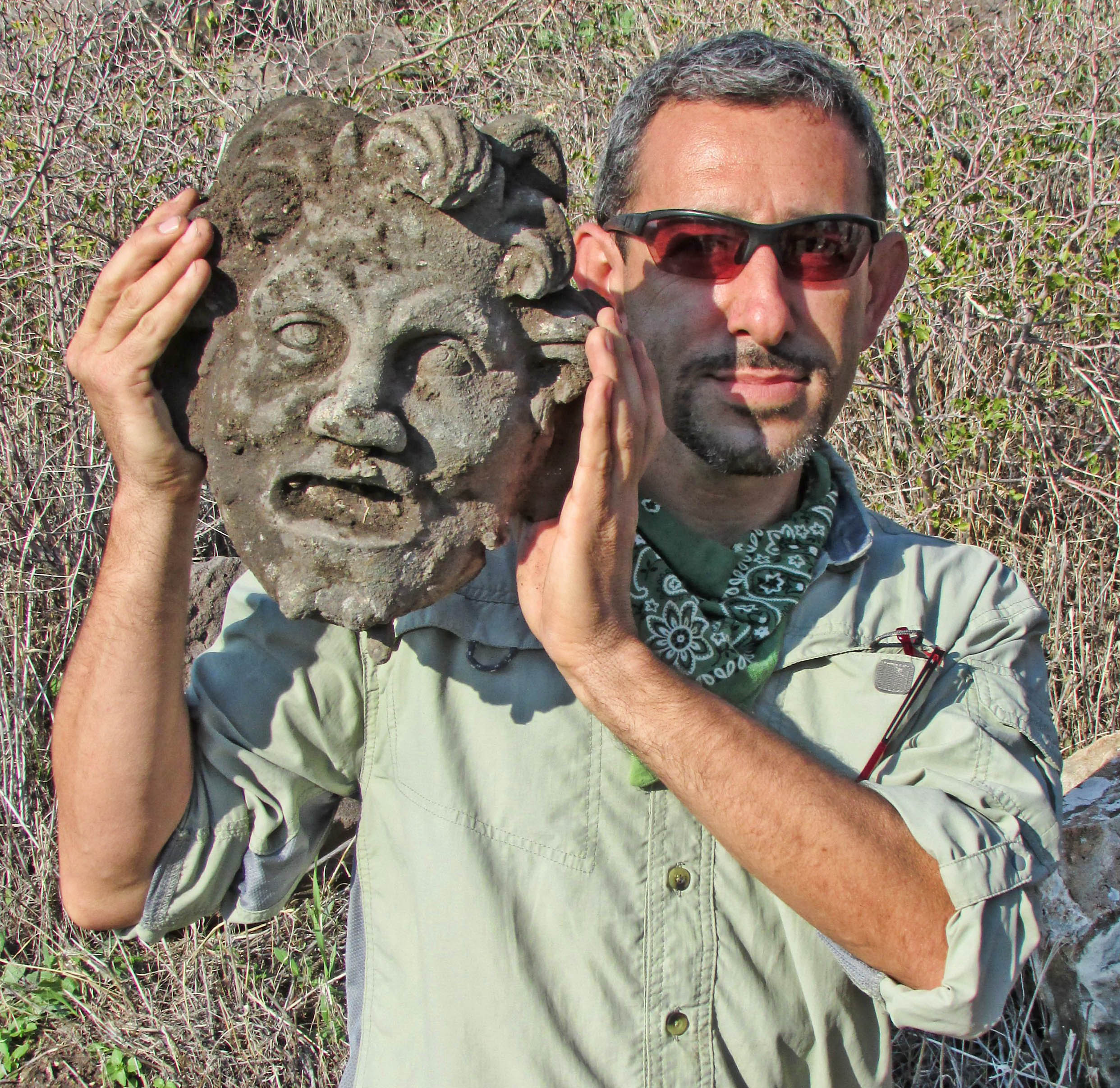
A large bronze mask of the god Pan, the only of its kind, was uncovered at the University of Haifa’s excavation at Hippos-Sussita National Park. According to Dr. Michael Eisenberg, bronze masks of this size are extremely rare and usually do not depict Pan or any of the other Greek or Roman mythological images. “Most of the known bronze masks from the Hellenistic and Roman periods are miniature”.
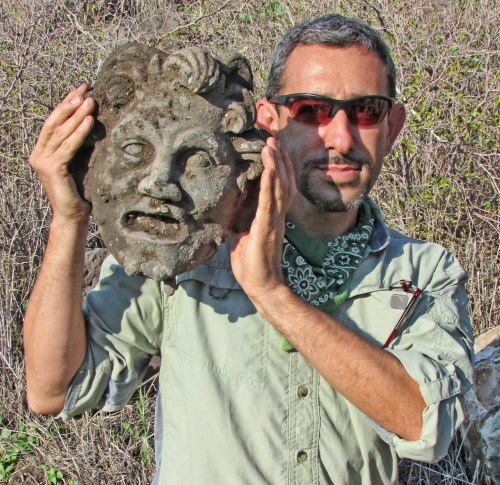
Dr. Michael Eisenberg, University of Haifa, holding the Pan mask discovered at Hippos-Sussita.

Dr. Michael Eisenberg, University of Haifa, holding the Pan mask discovered at Hippos-Sussita.

It seems that in recent years, the mysteries of Hippos-Sussita have been revealing their secrets in an extraordinary way: first, a sculpture of Hercules was exposed by the winter rains of 2011, then, two years later, a basalt tombstone with a sculpture of the deceased’s bust was uncovered. Now there is a new surprise: the only finding of a bronze mask of unnatural size, in the form of the god Pan/Faunus.

Excavations at Hippos-Sussita are usually conducted in the summer. However, a series of intriguing structures on the ridge of the city, where the ancient road passed, led to a one-day dig in the winter. The dig focused on a basalt structure which the researchers assumed was a type of armoured hangar for the city’s projectile machines. The finding of a ballista ball made of limestone, a different material from the basalt that was customarily used at Hippos-Sussita to make balista balls, made them realize that it was an enemy’s projectile.

In light of this interesting find the researchers decided to search the structure for coins to help them date the the balls. It didn’t take long for the metal detector, operated by the capable hands of Dr. Alexander Iermolin, head of the conservation laboratory at the Institute of Archaeology at the University, to start beeping frantically. The archaeologists were not yet aware of what was in store for them: “After a few minutes we pulled out a big brown lump and realized it was a mask. We cleaned it, and started to make out the details: The first hints that helped us recognize it were the small horns on top of its head, slightly hidden by a forelock,” said Dr. Eisenberg.
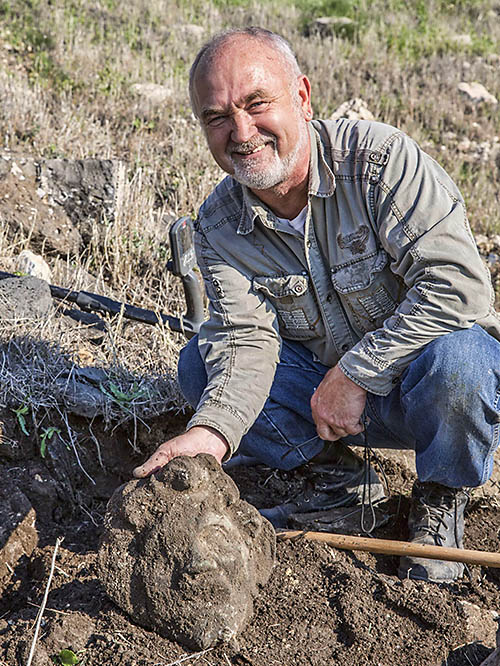
Dr. Alexander Iermolin immediately after uncovering the Pan mask at Hippos-Sussita.

Dr. Alexander Iermolin immediately after uncovering the Pan mask at Hippos-Sussita.

Horns like the ones on the mask are usually associated with Pan, the half-man half-goat god of the shepherds, music and pleasure. A more thorough cleaning in the lab, revealed  strands of a goat beard, long pointed ears, and other characteristics that led Dr. Eisenberg to identify the mask as depicting a Pan/Faunus/Satyr. “The first thought that crossed my mind was, ‘Why here, beyond the city limits?’ After all, the mask is so heavy it could not have just rolled away. The mask was found nearby the remains of a basalt structure with thick walls and very solid masonry work, which suggested a large structure from the Roman period. A Pan altar on the main road to the city, beyond its limits, is quite likely. After all, Pan was worshiped not only in the city temples but also in caves and in nature. The ancient city of Paneas, north of Hippos-Sussita, had one of the most famous worshiping compounds to the god Pan inside a cave. Because they included drinking, sacrificing and ecstatic worship that sometimes included nudity and sex, rituals for rustic gods were often held outside of the city”, Dr. Eisenberg explained.
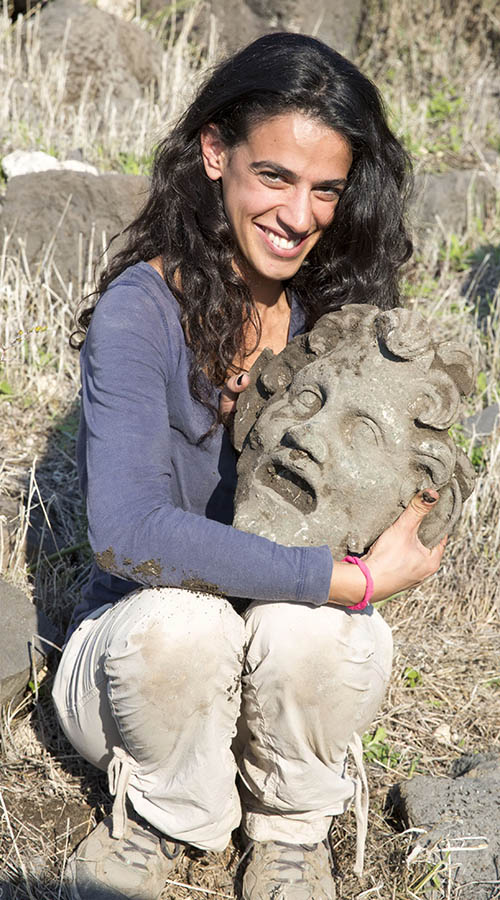
Archaeological team member cradles the mask of Pan.

Archaeological team member cradles the mask of Pan.

Now the archeologists have begun to uncover the basalt structure, in the hopes of finding more clues to its purpose. They assume that it was used for defensive purposes “Perhaps in a later period, during the Pax Romana, when the city fortifications were not required, the building turned into a place of worship to the god of shepherds, and maybe what we have here is a magnificent fountain-head or burial offerings of a nearby mausoleum,” Dr. Eisenberg suggests.

As mentioned, the researchers are unfamiliar with any similar bronze mask from the Roman or Hellenistic era of Pan or a Satyr. “Most of the masks are usually similar in size to theater masks, are made of stone or terracotta and are of ritual, apotropaic, decorative or symbolic significance. I contacted the curators of some of the world’s greatest museums, and even they said that they were not familiar with the type of bronze mask that we found at Hippos. Hippos-Sussita cannot compete in wealth with the ancient cultural centers of the Roman Empire and as such, a finding of this kind here, of all places, is amazing,” concluded Dr. Eisenberg.

The press release may be read in its entirety here.

Jesus visited the region of Decapolis during His public ministry (Mark 5:20; 7:31; Matthew 4:25).

We commonly think of Pan in association with the site of Panias (Banias=Caesrea Philippi), an area visited by Jesus (Matthew 16:13-20). See more info about the site here.

HT: Joseph I. Lauer

Thinking better of Mary Magdalene

A group of Christian women recently convened at the ancient site of Magdala on the western shore of the Sea of Galilee “to honor International Women’s Day and discuss women’s empowerment.”

Advocates spoke of the issue of legal prostitution in Israel and the struggles of the over 15,000 Israeli women who are drawn into the industry, often against their will. (The Jerusalem Post Newsletter, March 11, 2015).

The meeting at Magdala seemed to discuss some important issues, but the characterization of Mary Magdalene is inaccurate to say the least.

Each speaker related the issues of feminism and women empowerment to the lessons of Mary Magdalene, speaking about how the healing process for women who have suffered such abuse. Consecrated woman, Jennifer Ristine, spoke of how Mary Magdalene inspires hope and healing for victims of abuse.

“Through the transforming experience of love, Mary Magdalene’s dignity was affirmed and she becomes a leader among leaders, inspiring hope and  reconciliation,” Ristine said. “Do we have anything in common with this woman? When a woman is deeply convinced of the truth that she is unconditionally loved, she is set free to be what she is called to be for others. She becomes a catalyst for reconciliation.”

An entire “cult” has risen around Mary Magdalene over the years to the point that some have suggested that Mary Magdalene was the wife of Jesus, and that she “carried the royal bloodline of Jesus Christ” (The DaVinci Code, p. 244, 249).

Some writers assume that Mary Magdalene is to be identified with the sinful woman of Luke 7:36-50. The comments by William Hendriksen are helpful in correcting this misunderstanding.

First among the women here mentioned is Mary called Magdalene; that is, Mary of Magdala (meaning The Tower) located on the western shore of the Sea of Galilee and south of Capernaum. She figures very prominently in all the four Passion accounts. She was one of the women who later: (a) watched the crucifixion (Matt. 27:55, 56; Mark 15:40; John 19:25); (b) saw where Christ’s body was laid (Matt. 27:61; Mark 15:47; Luke 23:55); and (c) very early Sunday morning started out from their homes in order to anoint the body of the Lord (Matt. 28:1; Mark 16:1; Luke 24:10). Besides, she was going to be the first person to whom the Risen Christ would appear (John 20:1–18; see also Mark’s disputed ending, 16:9).

The item about the seven demons that had been expelled from Mary Magdalene has led to the wholly unjustifiable conclusion that she was at one time a very bad woman, a terribly immoral person. But there is not even an inkling of proof for the supposition that demon-possession and immorality go hand in hand. Weird and pitiable mental and/or physical behavior are, indeed, often associated with demon-possession (Luke 4:33, 34; 8:27–29; 9:37–43, and parallels), not immorality. (Hendriksen, Baker New Testament Commentary: Luke, comments on Luke 8:2-3)

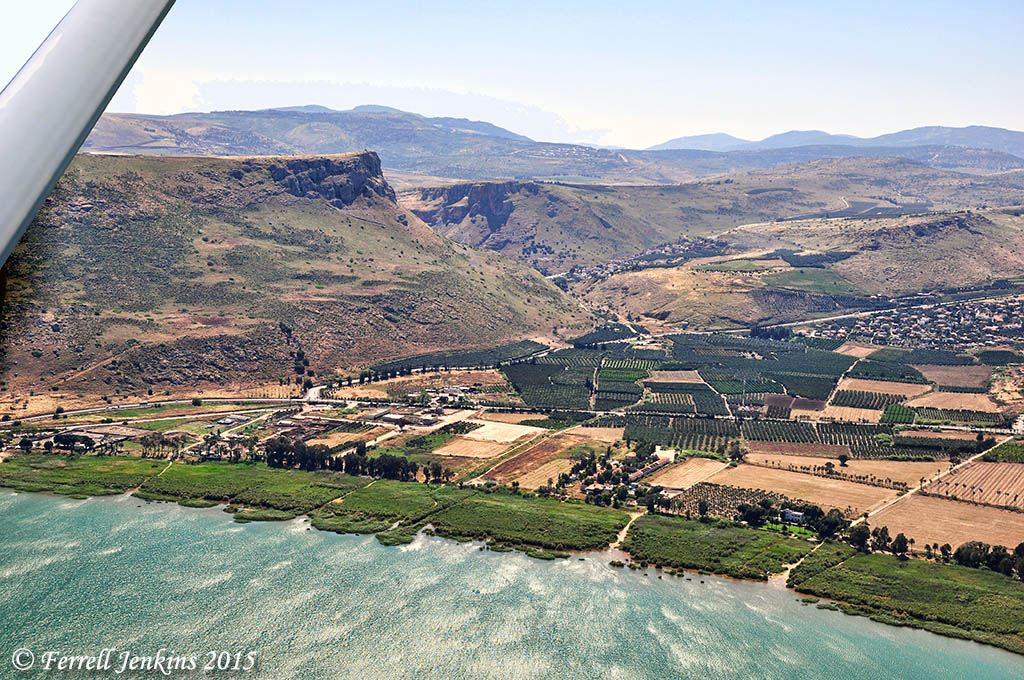
Our aerial photo was made in 2011. The area of ancient Magdala is seen on the left 40% of the photo along the shore of the Sea of Galilee. On the right side you will see the Plain of Genessaret. Mount Arbel and the Via Maris are seen in the background. The mountains of Upper Galilee are visible in the distance. Click on the photo for an image suitable for use in presentations.

Aerial view of Magdala and the Plain of Genessaret. Photo by Ferrell Jenkins.

Aerial view of Magdala and the Plain of Genessaret. Photo by Ferrell Jenkins.

It is wonderful that any variety of sin can be forgiven, but let’s not turn Mary Magdalene into something she was not. The words of Paul, the apostle of Christ Jesus, are encouraging.

Or do you not know that the unrighteous will not inherit the kingdom of God? Do not be deceived: neither the sexually immoral, nor idolaters, nor adulterers, nor men who practice homosexuality, nor thieves, nor the greedy, nor drunkards, nor revilers, nor swindlers will inherit the kingdom of God. And such were some of you. But you were washed, you were sanctified, you were justified in the name of the Lord Jesus Christ and by the Spirit of our God. (1 Cor. 6:9-11 ESV)

Pilate used coins to promote the Emperor Cult

After the death of Herod the Great, his son Herod Archaelaus (Archelaus, Matthew 2:22) ruled over Judea until AD 6. His misrule prompted Rome to appoint a series of prefects or governors over Judea. There were 15 governors appointed from Coponius (AD 6-9) to Gessius Florus (AD 64-66).

Pontius Pilate served as Governor of Judea from AD 26-36 (Matthew 22:7; Luke 3:1).

Carl Rasmussen called my attention to an excellent article by Joan E. Taylor in New Testament Studies dealing with the part played by Pilate in promoting the Imperial Cult. Taylor, now Professor of Christian Origins and Second Temple Judaism at King’s College in London, says that the coinage of Pilate and the Pilate inscription from Caesarea,

“indicate a prefect determined to promote a form of Roman religion in Judaea” (Taylor, Joan E. “Pontius Pilate and the Imperial Cult in Roman Judaea.” New Testament Studies 52. 2006: 555-582.)

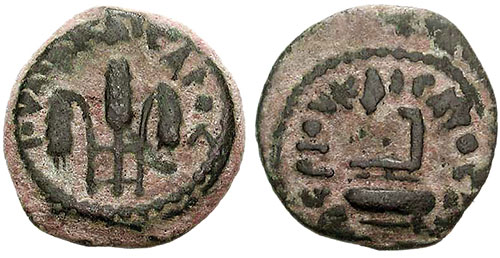
Pilate minted two types of coins. The first coin, minted in AD 29, shows three bound ears of barley on the obverse. The inscription reads “Julia, of Caesar.” After the death of Livia, wife of Augustus, and mother of Tiberias, she was given the name Julia. One ear of barley is standing and two are drooping. On the reverse we see a libation ladle (simpulum) used by Roman priests to pour wine over sacrificial animals. The inscription reads, “TIBEPIOY KAICAROC (of Tiberius Caesar) and date LIS” (Hendin).

Coin minted by Pilate in A.D. 29.

Coin minted by Pilate in AD 29.

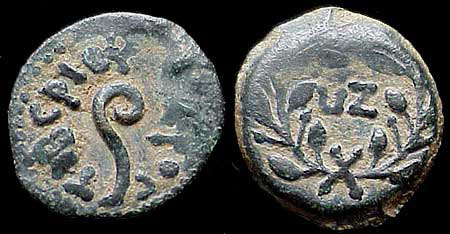
The second coin, struck in AD 30, shows a lituus, a wooden staff or wand used by Roman augures to signify their authority. The inscription on the obverse reads TIBERIOY KAICAROS (Tiberius, Caesar). The reverse shows a wreath with the date.

Coin minted by Pontius Pilate showing a lituus.

Coin minted by Pontius Pilate in AD 30 showing a lituus.

Taylor describes the coins of Pilate’s predecessors as showing primarily agricultural images. She says,

Pilate’s coins, by contrast, depict two key items of specifically Roman religious spiritual use: the lituus and the simpulum. In depicting these instruments on the Judaean coinage Pilate advertised particular rituals of exclusively Roman cult. These instruments were not generic to all cults in the Empire, which now embraced the Hellenistic world, let alone to Jewish or Samaritan rituals, but had emblematic and ritual uses within Roman rites alone. The ritual instruments themselves are described by terms not used for profane utensils, even when these utensils are quite similar (see Arnobius Adversus Nationes XXTV.1-6). They were entirely sacred implements, and they were cared for and stored in sacred space. (558-559)

Carl Rasmussen discusses Pilate’s coin showing the lituus here.

Roman coins and the Imperial Cult

Coins were important in the time of Jesus, and were more significant than their face value. On one occasion the Pharisees plotted against Jesus in an attempt to entangle Him in His words. They sent some of their disciples to Jesus to ask, “is it lawful to pay taxes to Caesar, or not?”

Tiberius in the Louvre. Photo by Ferrell Jenkins.

Bust of Tiberius in the Louvre.

When Jesus asked them to show him the coin used for the tax they brought Him a denarius. The denarius of that time would likely be one minted by the Emperor Tiberius (A.D. 14-37). Jesus asked, “Whose likeness [eikon] and inscription is this?” They said, “Caesar’s.” Jesus responded, “Therefore render to Caesar the things that are Caesar’s, and to God the things that are God’s.” Read the full account in Matthew 22:15-22).

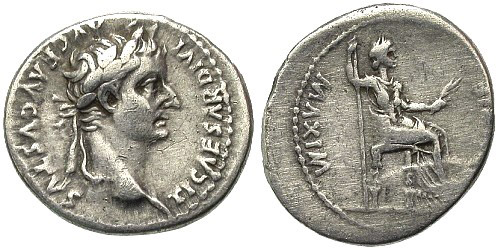
The photo below shows a Denarius with the image of the Emperor Tiberius. The inscription on the obverse (heads) reads “TI CAESAR DIVI AVG F AUGUSTVS” (Tiberius, Caesar Augustus, Son of the Divine Augustus).

Denarius minted by Emperor Tiberias.

Denarius minted by Emperor Tiberius.

David Hendin (Guide to Biblical Coins, 1st. ed, 170-171) describes the reverse (tails) of the coin: “Female figure sits on a plain chair to right, she holds olive branch in her left hand and long sceptre in her right.” The inscription PONTIF MAXIM means High Priest, which Hendin says is “another of the emperor’s titles and later a title of the Bishop of Rome.”

This coin clearly demonstrates the Emperors’ claim to being the son of the divine Augustus, and to being High Priest in the Imperial Cult.

Florence Aiken Banks says,

It is not surprising that this Tiberius denarius–popularly known as the “tribute penny”–is of all coins the one most in demand by collectors who cherish their New Testaments. (Coins of Bible Days, 99)

In the next post I plan to discuss Pontius Pilate, prefect of Judea, and what we can learn about the Imperial Cult from his coins and the inscription bearing his name at Caesarea Maritima.

Special Note About Coin Images. For many years I have included several links to coin and coin collectors under the Bible Places page at the Biblical Studies Info Page. I have found that these web sites come and go. If I use the image of a coin that rightfully belongs to another photographer I will be pleased to give credit if you will point me to the site.

Herod the Great and the Emperor Cult

Herod supported Mark Antony against Augustus in the Roman civil war. When Augustus was victorius at the battle of Actium (31 B.C.), Herod convinced Augustus that he was loyal to him. Herod, who already ruled Judea, was granted authority over Galilee and Iturea.

 “In turn, Herod ingratiated himself to Augustus by building monuments and temples in the emperor’s honor. Temples dedicated to the emperor in the early Roman period (20 B.C.E.–120 C.E.) were part of an empire-wide phenomenon known as “the emperor cult.” This Roman imperial institution played a pivotal role in spreading imperial propaganda and encouraging allegiance to the emperor, who was portrayed as a god, or imbued with the spirit of a deity. (Overman, Olive, and Nelson,“Discovering Herod’s Shrine to Augustus.” BAR 29:02).

Herod erected three temples to Augustus: (1) Caesarea Maritima; (2) Samaria, which he named Sebaste, Greek for the Latin Augustus; (3) Near Paneion (Caesarea Philippi; Banias] at the fountain of the Jordan (JW 1:404).

Josephus says,

So when he had conducted Caesar to the sea, and was returned home, he built him a most beautiful temple, of the whitest stone, in Zenodorus’ country, near the place called Panion. This is a very fine cave in a mountain, under which there is a great cavity in the earth, and the cavern is abrupt, and prodigiously deep, and full of a still water; over it hangs a vast mountain; and under the caverns arise the springs of the river Jordan. Herod adorned this place, which was already a very remarkable one, still further by the erection of this temple, which he dedicated to Caesar. (Ant 15:363-364)

We are concerned here with the third temple near Panion (Paneion). We know the same site as Caesarea Philippi because the city was built by Herod Philip and named to honor Caesar and himself. Excavators at Caesarea have identified a structure there, at the entrance of the cave, as the temple to Augustus. Other scholars suggest that this is part of a monumental entrance to the cave of Pan.

Josephus’ expression “near the place called Panion” [Banias, later Caesarea Philippi] indicates a place closer to the Pan temples. However, the Greek term used in Matthew 16:13 (meros) can be translated district, region, or geographical area.

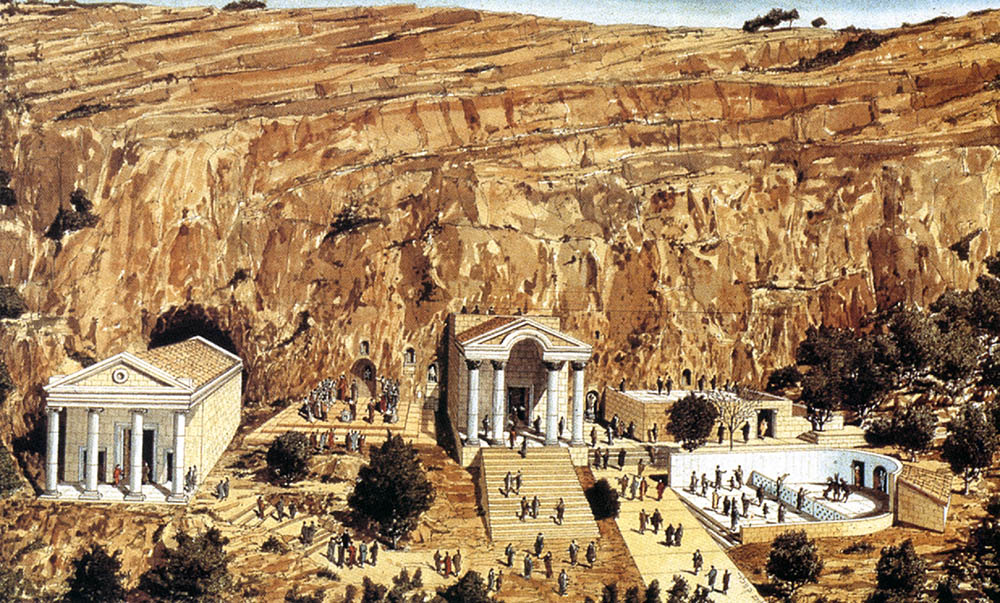
In the drawing below we see an artistic reconstruction of the Pan temenos at Panias (Banyas). The Temple to Augustus is the building on the left that backs up to the cave.

Reconstruction of the Pan temenos at Panias. From Archaeological Sites in Israel, published by the Israel Information Center, Jerusalem, 1998.

Reconstruction of the Pan temenos at Panias. From Archaeological Sites in Israel, published by the Israel Information Center, Jerusalem, 1998.

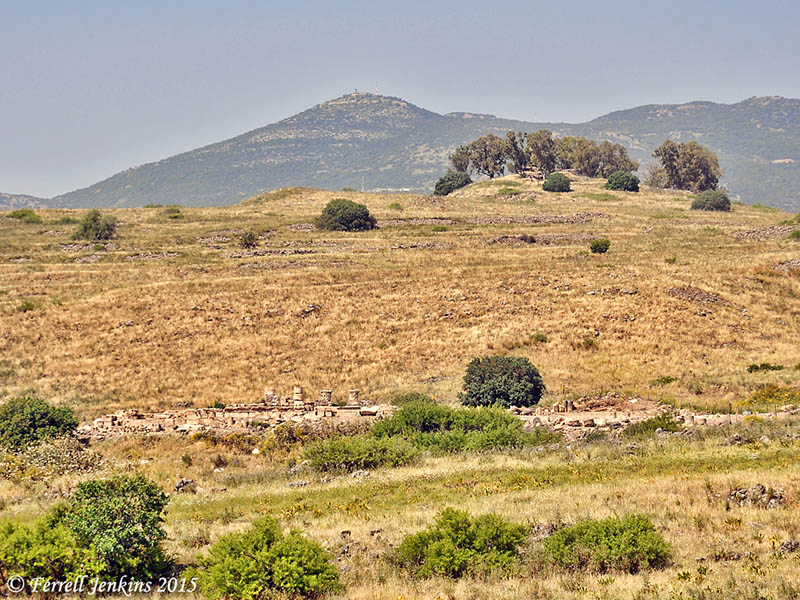
Archaeologists from Macalester College and Carthage College, working since 1999, have suggested that the third temple was built at Omrit, about three miles southwest of Banias on a bluff overlooking the Hula Valley from the east. If this is correct, then this may be the site of Caesarea Philippi (Mt. 16:13; Mk. 8:27).
Currently the site of Omrit is practically impossible to reach by car, but you can reach the area and then walk to the excavation.

View of the site of Omrit from the south. Photo by Ferrell Jenkins.

View of the site of Omrit from the south. Photo by Ferrell Jenkins.

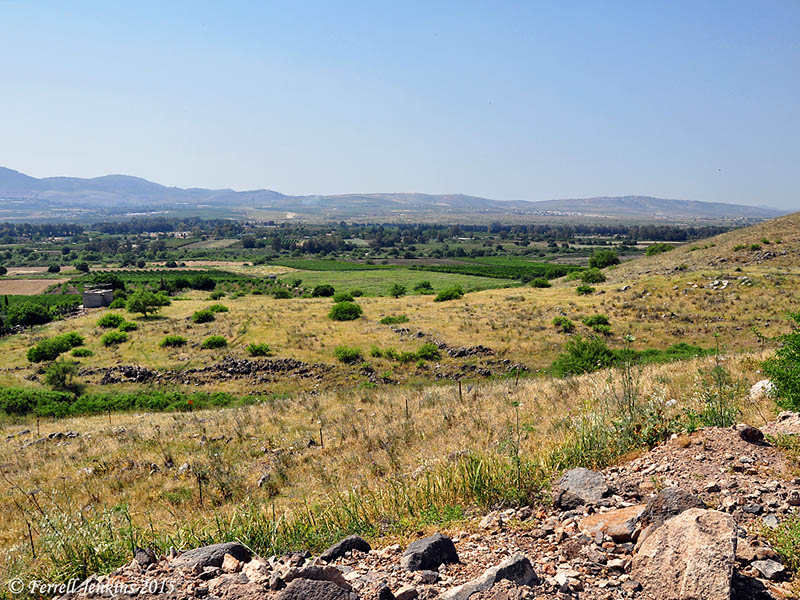
If we look West from Omrit we have a good view of the northern end of the Hula Valley.

A view NW to the Hula Valley from Omrit. Photo by Ferrell Jenkins.

A view NW to the Hula Valley from Omrit. Photo by Ferrell Jenkins.

According to the excavators, a total of three ornate Roman temples were built at Omrit over a period of about 120 years. The steps we see below belong to the third temple erected near the end of the first century A.D.

Temple steps at Omrit. Photo by Ferrell Jenkins.

Temple steps at Omrit. Photo by Ferrell Jenkins.

The photo below looks below the ground level to the earlier temples or monumental buildings that are now covered to protect them.

The earlier temples at Omrit. Photo by Ferrell Jenkins.

The earlier temples at Omrit. Photo by Ferrell Jenkins.

A brochure, Omrit A Unique Archaeological Site in the Upper Galilee, is available in PDF here. Note that it presents the viewpoint of the excavators that this is the site of Herod’s Augusteum (p. 5).

In “Debate: Where Was Herod’s Temple to Augustus” BAR 29:05 (Sept./Oct. 2003), Andrea Berlin argues that Banias is still the best candidate for the Augustan temple. Overman, Olive, and Nelson reply and reaffirm their preference for Omrit.

A third suggestions is made by the late Ehud Netzer that an opus reticulatum (latice-type stone work) building at Banias is the site of Herod’s temple to Augustus. This site is about 100 yards west of the Cave of Pan.

Carl Rasmussen calls Omrit his favorite site in Israel here.

Post-traumatic stress as early as 1300 B.C.

A team of scholars at Anglia Ruskin University in the East of England released a report showing evidence of post-traumatic stress as early as 1300 B.C. The study involved documents from ancient Mesopotamia.

Accounts of soldiers being visited by “ghosts they faced in battle” fitted with a modern diagnosis of PTSD.

The condition was likely to be as old as human civilisation, the researchers concluded.

Prof Jamie Hacker Hughes, a former consultant clinical psychologist for the Ministry of Defence, said the first description of PTSD was often accredited to the Greek historian Herodotus.

The brief notice is available at BBC here. I found it interesting that the photo associated with the article shows an Assyrian king of the 9th century B.C. with a bow and arrow, and two others with javelins. In fact, this is not a war or battle relief. A view of the entire relief shows that it was the king is on a lion hunt. But, that has nothing to do with the validity of the report.

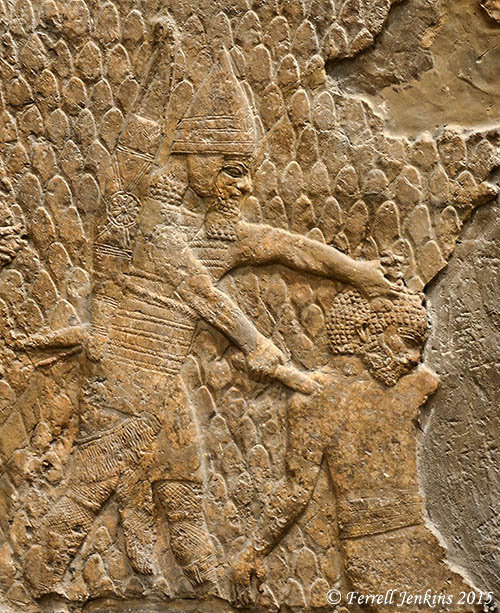
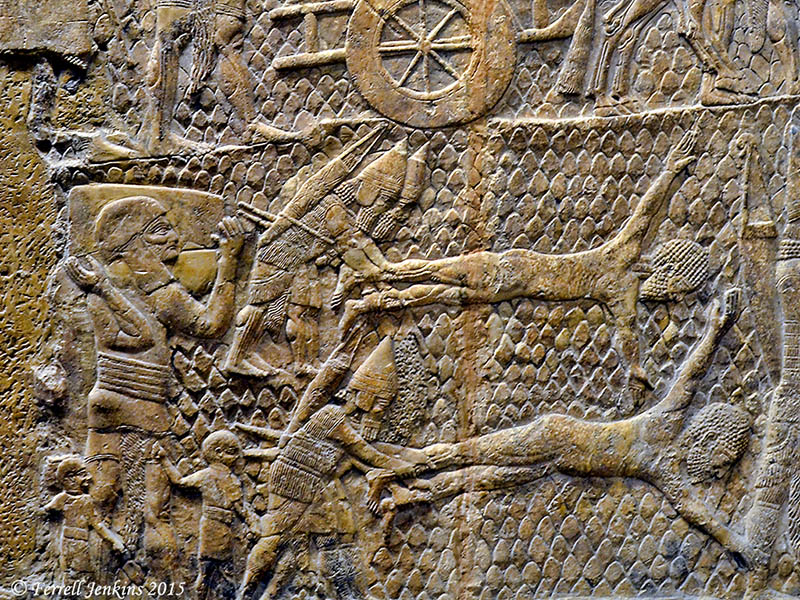
Several examples of the cruelty of war in ancient times is the limestone relief of the siege of Lachish which was found in Sennacherib’s (704-681 B.C.) palace at Nineveh. A replica of the relief may be seen in the Israel Museum, but the original is in its own designated room in the British Museum.

An Assyrian warrior kills one of the locals at Lachish. Photo by Ferrell Jenkins.

An Assyrian warrior kills one of the locals at Lachish. Photo by Ferrell Jenkins.

The Bible mentions the siege of Lachish in several places, including 2 Chronicles 32:9-10.

After this, Sennacherib king of Assyria, who was besieging Lachish with all his forces, sent his servants to Jerusalem to Hezekiah king of Judah and to all the people of Judah who were in Jerusalem, saying, “Thus says Sennacherib king of Assyria, ‘On what are you trusting, that you endure the siege in Jerusalem? (ESV)

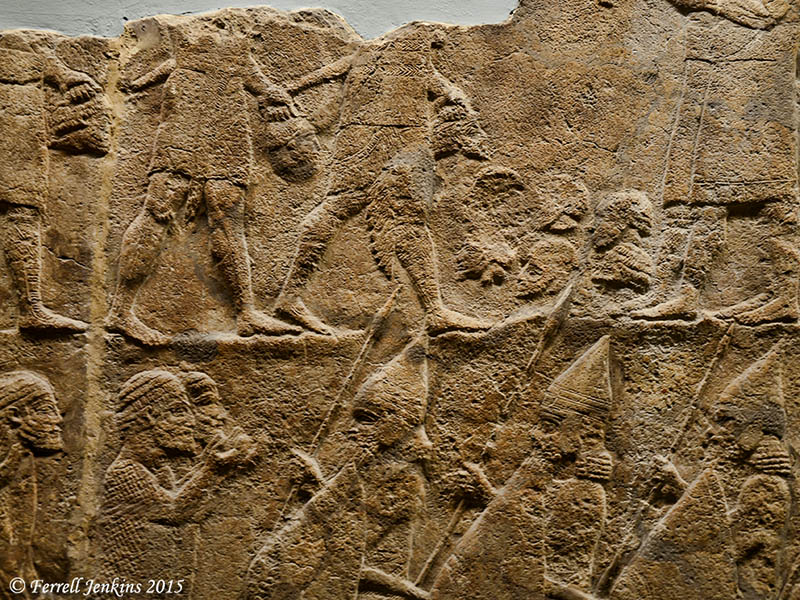
Counting the heads of the dead at Lachish. Photo by Ferrell Jenkins.

Counting the heads of the dead at Lachish. Photo by Ferrell Jenkins.

Some scholars suggest that the next panel portrays the Assyrians flaying the Judeans.

Bodies of the dead at Lachish. Photo by Ferrell Jenkins.

Bodies of the dead at Lachish. Photo by Ferrell Jenkins.

One panel shows local citizens being impaled on poles. After a day of impaling, beheading, or counting heads, it might be easy enough to see “ghosts”.

We can desire that all men come to accept the teaching of Jesus when one of His disciples used a sword to advance the cause of the Lord.

Then Jesus said to him, “Put your sword back into its place. For all who take the sword will perish by the sword.” (Matthew 26:52 ESV)

HT: Agade list

Flying over Beit She’an, Bethshan, Beth-shan

The Israelis call it Beit She’an, but English Bible readers will know it as Bethshan. The town is mentioned only a few times in the Old Testament. The English Standard Version uses both Beth-shan and Beth-shean to identify this town. Other English versions use a variety of spellings including Bethshan.

From atop the ancient tell, called Tell el-Husn or Tel Beth She’an, one has an impressive view of the area. Occupational levels date back at least to 3000 B.C. Artifacts from Canaan, Egypt, Anatolia, north Syria, and Mesopotamia have been uncovered from the mound.

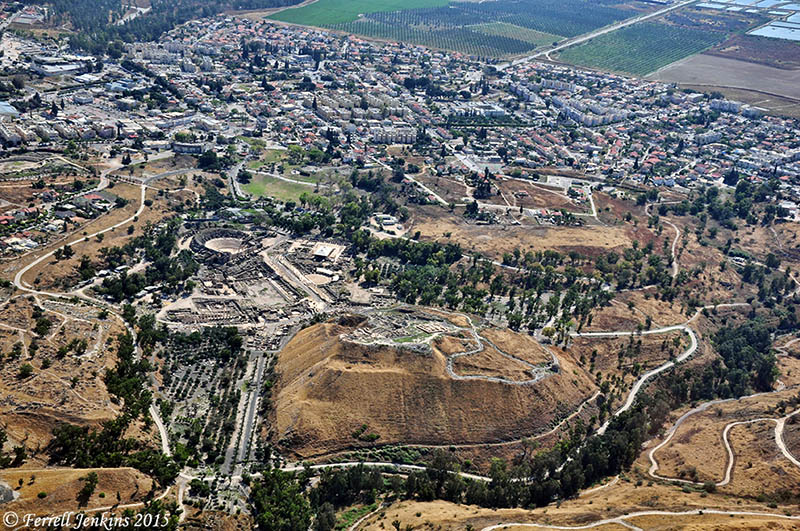
The photo below was made from the air with a view northeast. A small portion of the Harrod Valley, with some fish ponds, is visible in the top of the photo. The River Harod flows to the east of the tel hidden by the line of trees.

Tel Husn (Bethshan) is visible in the bottom of the image. Photo by Ferrell Jenkins.

Tel Husn (Bethshan) is visible in the bottom of the image. Photo by Ferrell Jenkins.

For many Bible students the first event that comes to mind is the defeat of King Saul at the hands of the Philistines. After his death on nearby Mount Gilboa, Saul’s body was taken to Beth-shean and fastened to the wall of the city (1 Samuel 31).

During the Greek period the city was named Scythopolis (city of the Scythians) and expanded to the foot of the tell.

In 63 B.C. the Romans, under the general Pompey, made the city part of the Decapolis (a league of ten cities; Matthew 4:25; Mark 5:20; 7:21). This was the only city of the Decapolis west of the Jordan River. The city was populated by gentiles, Jews and Samaritans.

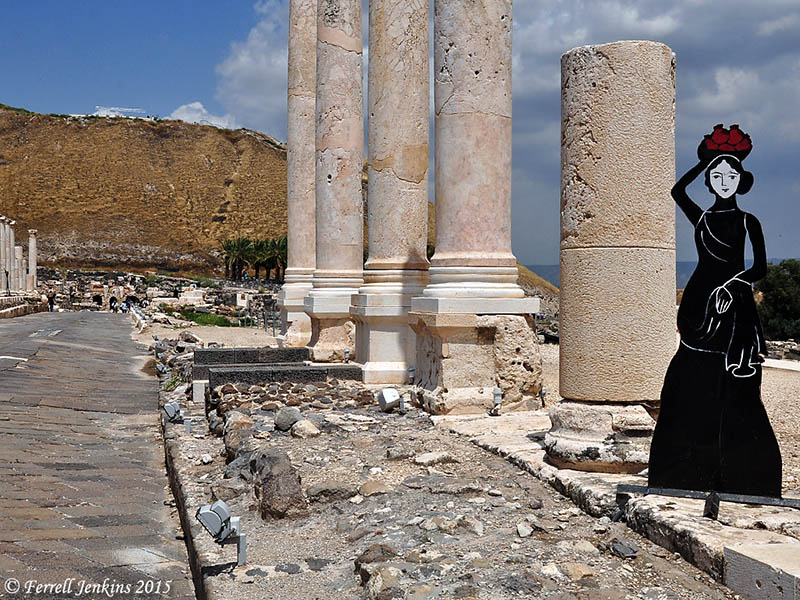
The main street of the Byzantine city. The tel of ancient Bethshan is visible at the end of the street. Photo by Ferrell Jenkins.

The main street of the Byzantine city. The tel of ancient Bethshan is visible at the end of the columned street. Photo by Ferrell Jenkins.

The city grew to its largest size during the Byzantine period as a “Christian” city. It came under Muslim control in A.D. 636, and was destroyed by an earthquake in A.D. 749.

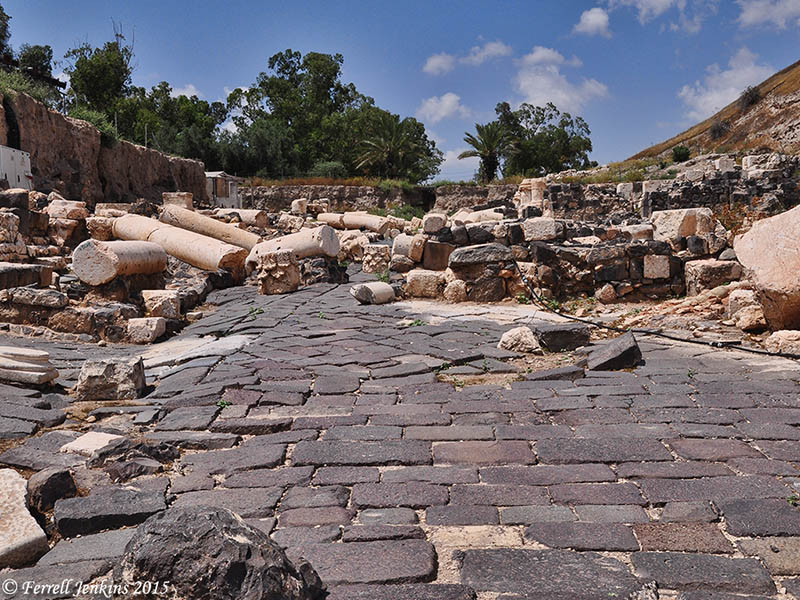
Some of the earthquake damage at Bethshan. Photo by Ferrell Jenkins.

Some of the earthquake damage at Bethshan. Photo by Ferrell Jenkins.

The destroyed Byzantine city lies between the theater and the mound. That’s a lot of history in one small place.