Tag Archives: Herod the Great

Should Herod’s tomb be rebuilt?

The Israel Nature and Parks Authority and the Gush Etizion Regional Council has announced plans to rebuild the tomb of Herod the Great at the Herodium.

An article published Sunday in Ha’aretz describes the plan:

The plan, which is being promoted by the Israel Nature and Parks Authority and the Gush Etzion Regional Council, includes building a lavish mausoleum in its original size out of light plastic material, and turning it into a visitor’s center. The plan is the first of its kind in the realm of Israeli archeological digs, as most sites consist of either miniaturized or renovated historical sites that use the original materials found at the site.

Miniature model of Tomb of Herod. Photo: Israel Nature and Parks Authority.

Miniature model of Tomb of Herod. Photo: Israel Nature & Parks Authority.

One archaeologist, who wished to remain anonymous, said,

“It’s crazy — Archaeology is not Disneyland, you don’t take an archeological site and make a joke out of it.”

The entire article may be read here.

We have called attention to the Herodium and the work of the late Ehud Netzer numerous times. Just use the search box to location the posts.

HT: Joseph I. Lauer

Herod the Great didn’t do it all

Archaeologists in Jerusalem announced yesterday a new discovery that changes popular thinking about the building of the walls around the Temple Mount. It is not much of a surprise. We already knew that the Roman Street found at the SW corner of the wall dates to the period just before the destruction of Jerusalem by the Romans in A.D. 70. The last paragraph of the press release mentions that what was found was in harmony with the account of Josephus.

I have understood John 2:20 to be saying that work on the temple precinct was continuing as late as A.D. 26/27. That is a major reason this is not a surprise.

Then the Jewish leaders said to him, “This temple has been under construction for forty-six years, and are you going to raise it up in three days?” (John 2:20 NET)

Here is a portion of the press release issued by the Israel Antiquities Authority. I am leaving it full width for easier reading.

— • —

Professor Ronny Reich of the University of Haifa and Eli Shukron of the Israel Antiquities Authority: A ritual bath exposed beneath the Western Wall of the Temple Mount shows that the construction of that wall was not completed during King Herod’s lifetime.

Who built the Temple Mount walls? Every tour guide and every student grounded in the history of Jerusalem will immediately reply that it was Herod. However, in the archaeological excavations alongside the ancient drainage channel of Jerusalem a very old ritual bath (miqwe [mikve]) was recently discovered that challenges the conventional archaeological perception which regards Herod as being solely responsible for its construction.…

In an excavation beneath the paved street near Robinson’s Arch, sections of the Western Wall’s foundation were revealed that is set on the bedrock — which is also the western foundation of Robinson’s Arch — an enormous arch that bore a staircase that led from Jerusalem’s main street to the entrance of the Temple Mount compound.

According to Professor Reich, “It became apparent during the course of the work that there are rock-hewn remains of different installations on the natural bedrock, including cisterns, ritual baths and cellars. These belonged to the dwellings of a residential neighborhood that existed there before King Herod decided to enlarge the Temple Mount compound. The Jewish historian Josephus, a contemporary of that period, writes that Herod embarked on the project of enlarging the compound in the eighteenth year of his reign (that is in 22 BCE) and described it as “the largest project the world has ever heard of.”

When it was decided to expand the compound, the area was confiscated and the walls of the buildings were demolished down to the bedrock. The rock-cut installations were filled with earth and stones so as to be able to build on them. When the locations of the Temple Mount corners were determined and work was begun setting the first course of stone in place, it became apparent that one of the ritual baths was situated directly in line with the Western Wall. The builders filled in the bath with earth, placed three large flat stones on the soil and built the first course of the wall on top of this blockage.

While sifting the soil removed from inside the sealed ritual bath, three clay oil lamps were discovered of a type that was common in the first century CE. In addition, the sifting also yielded seventeen bronze coins that can be identified. Dr. Donald Ariel, curator of the numismatic collection of the Israel Antiquities Authority, determined that the latest coins (4 in all) were struck by the Roman procurator of Judea, Valerius Gratus, in the year 17/18 CE. This means that Robinson’s Arch, and possibly a longer part of the Western Wall, were constructed after this year – that is to say: at least twenty years after Herod’s death (which is commonly thought to have occurred in the year 4 BCE).

This bit of archaeological information illustrates the fact that the construction of the Temple Mount walls and Robinson’s Arch was an enormous project that lasted decades and was not completed during Herod’s lifetime.

This dramatic find confirms Josephus’ descriptions which state that it was only during the reign of King Agrippa II (Herod’s great-grandson) that the work was finished, and upon its completion there were eight to ten thousand unemployed in Jerusalem.

— • —

If you wish to see the complete press release click here.

Below are a few of the photos provided by the IAA. The first shows the lowest course of the wall resting on bedrock.
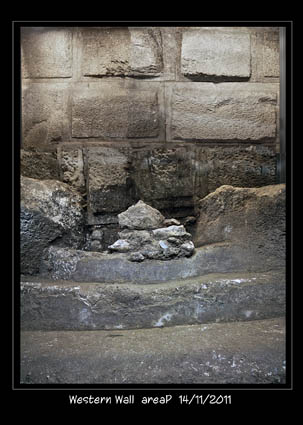
The first course of the wall resting on the bedrock. Photograph: Vladimir Naykhin.

The first course of the wall resting on the bedrock. Photograph: Vladimir Naykhin.

The next photo shows one of the coins dating to the time of Roman Procurator Valerius Gratus in the year A.D. 17/18. He was procurator A.D. 15-26, and followed by the better known Pontius Pilate (A.D. 26-36).

A coin of the Roman procurator Valerius Gratus, which helped in dating the construction of Robinson’s Arch.

A coin of the Roman procurator Valerius Gratus, which helped in dating the construction of Robinson’s Arch. Courtesy IAA.

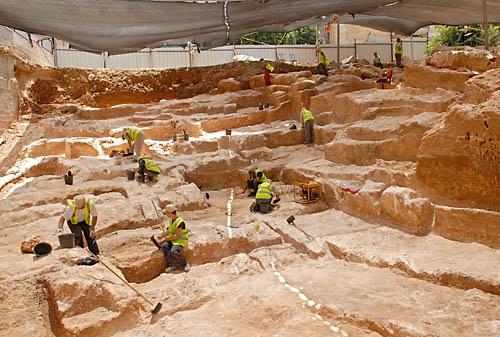
The third photo shows some of the workers excavating the area.
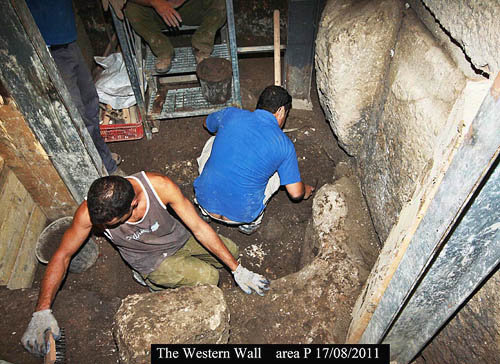
Archaeologists working at bedrock below Robinson's Arch. Photo: IAA.

Archaeologists working at bedrock below Robinson's Arch. Photo: IAA.

After writing my post, I see that Todd Bolen accuses the IAA of being “desperate for headlines.” See his comments here.

HT: Joseph I. Lauer

Short video on Masada

The Israel Nature and Parks Authority has prepared a short video on Masada. The narrator presents a brief history of the fortress of Masada while beautiful scenes of the site are shown.

Arutz Sheva (Israel National News) provides a link to the video with an article about Masada here. (A direct link to the video on You Tube is here.) Elad Benari, author of the article, describes Masada in these words:

The top level had four bedrooms and a semicircular balcony, from which there was a spectacular view of the Dead Sea, Ein Gedi, and the Moab Mountains. A sophisticated and hidden staircase led to a middle level in which a large hall was built, surrounded by a veranda whose poles were placed at the edge of the cliff. The staircase went down to the bottom level, in which a large hall surrounded by vestibules was established. The walls of the hall were decorated with spectacular frescoes. A private bathhouse was built adjacent to the hall for the occupants of the northern palace.

At the peak were 29 large warehouses, each one 27 meters long. Excavations of the site found hundreds of pottery vessels in which huge amounts of food were stored. Thus, using a rare combination of natural conditions and human endeavors, Masada became a cliff that was almost impossible to conquer.

The great halls of the palaces were unsuitable for housing families, and thus became headquarters and public buildings.

The building near the north wall, which served as a stable in the days of Herod, was later turned into a synagogue. This is one of the Jewish people’s most ancient synagogues, known to be in use during the period of the second Holy Temple in Jerusalem, an unusual occurrence as synagogues became the accepted place to pray only after the destruction of the second Temple.

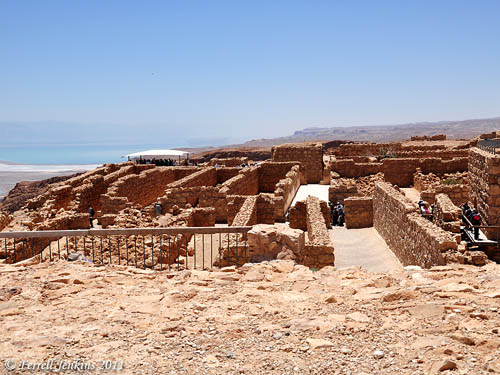
Our photo shows some of the large warehouses at the fortress. The Dead Sea and the mountains of Edom are visible in the left background.

Warehouses at Masada with the Dead Dea visible in the distance. Photo by Ferrell Jenkins.

Warehouses at Masada with the Dead Sea visible in the distance. Photo by Ferrell Jenkins.

It is possible that David visited the site of Masada long before it was turned into a fortress by King Herod. Gordon Franz has examined evidence for this suggestion at his Life and Land blog here.

One of the verses examined is Psalm 18:2 in which the term for fortress is the Hebrew metsudah (our English masada)

To the choirmaster. A Psalm of David, the servant of the LORD, who addressed the words of this song to the LORD on the day when the LORD rescued him from the hand of all his enemies, and from the hand of Saul. He said: I love you, O LORD, my strength.
2 The LORD is my rock and my fortress and my deliverer, my God, my rock, in whom I take refuge, my shield, and the horn of my salvation, my stronghold. (Psa 18:1-2 ESV)

HT: Joseph I. Lauer

Herodium and the tomb of Herod the Great

Shmuel Browns has an article in Popular Archaeology on “Netzer’s Legacy: The Wonders of Herodium” here. One of the comments by Browns caught my attention as being especially important for all of us who use photos in our teaching.

When visiting an archaeological site, one often cannot see the artifacts that were discovered there as they have been removed and are displayed at a museum.

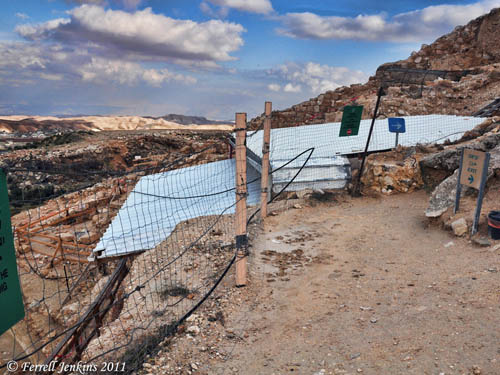
Browns gives an illustration of part of the Roman bath from the lower city at Herodium. I often think about how important it is to be at an archaeological site at just the right time. When I visited the Herodium in January, and again in May, this is what I saw at the place of Netzer’s most recent work.

Herodium - Place of Herod's Mausoleum. Photo by Ferrell Jenkins.

Herodium - Place of Herod's Mausoleum. View to the East. Photo by Ferrell Jenkins.

How disappointing. My thought is that some day the Antiquities department will have this site prepared for visitors. Until then…

Herod's Tomb. Shmuel Browns.

Herod's Tomb. View to NW. Shmuel Browns.

Browns has a couple of nice photos of the Mausoleum as it looks under the tin roof. I am including a thumbnail of one of his photos to encourage you to go to the article. A site begins to look different after the winter rains. Unless it is continually cleaned (which requires money), it deteriorates quickly.

Herod the Great is known in Scripture as the wicked king who inquired about the birth of Jesus in order to eliminate any opposition to the throne.

After Jesus was born in Bethlehem in Judea, in the time of King Herod, wise men from the East came to Jerusalem  saying, “Where is the one who is born king of the Jews? For we saw his star when it rose and have come to worship him.”  When King Herod heard this he was alarmed, and all Jerusalem with him.  After assembling all the chief priests and experts in the law, he asked them where the Christ was to be born. (Matthew 2:1-4 NET)

Joseph, Mary, and Jesus did not stop to see the tomb of Herod on their return from Egypt.

But when he heard that Archelaus was reigning over Judea in place of his father Herod, he was afraid to go there. After being warned in a dream, he went to the regions of Galilee.  He came to a town called Nazareth and lived there. (Matthew 2:22-23a NET)

Chris McKinny recently posted a paper on “The Growth of Herod’s Kingdom” at Seeking a Homeland here. The well-documented paper includes maps and charts.

Tom Powers reported in February that the Israel Post has issued a series of stamps featuring Herod’s building projects. Click here for photos of the beautiful stamps.

HT: Bible Places Blog.

Could this be the quarry of Herod the Great?

The Israel Antiquities Authority announced Monday the discovery of a large stone quarry dating to the first century B.C. It is suggested by the director of the excavation that this was one of the quarries used by Herod the Great in his building projects in Jerusalem.

First century B.C. quarry on Shmuel HaNavi Street. Photo: Assaf Peretz, courtesy IAA.

First century B.C. quarry on Shmuel HaNavi Street. Photo: Assaf Peretz, courtesy IAA.

Dr. Ofer Sion, the excavation director on behalf of the Israel Antiquities Authority, believes, “The immense size of the stones (maximum dimensions: length 3 m, width 2 m, height 2 m) indicates it was highly likely that the large stones that were quarried at the site were destined for use in the construction of Herod’s magnificent projects in Jerusalem, including the Temple walls. It seems that a vast number of workers labored in the quarry where various size stones were produced: first they quarried small stones and when the bedrock surface was made level they hewed the large stones. The stones were quarried by creating wide detachment channels that were marked by means of a chisel which weighed c. 2.5 kilograms. After the channels were formed the stones were severed from the bedrock using hammers and chisels”.

The full news release may be read here. Similar quarries have been discovered in Jerusalem in the decade. Todd Bolen, at Bible Places Blog, provides some links to the earlier quarries as well as some good photos. One photo shows the Ketef Hinnom quarry that has since been covered by the Menahem Begin Heritage Center. I’m glad Todd was there to capture that one.

HT: Todd Bolen; Joseph Lauer