Tag Archives: Apostle Paul

The synagogue — a place of study and discussion

The origin of the synagogue is difficult to determine, but it is generally held that it arose during the time of the Babylonian exile. Synagogues did not become common until the intertestamental period. The term intertestamental is used by many writers to describe the period between the close of the Old Testament (about 425 B.C.) and the coming of John the Baptist in the early first century A.D. Others use the term interbiblical, or the longer phrase, between the testaments.

With the destruction of the Temple (586 B.C.), sacrifices ceased. Prayer and the study of the sacred Scriptures, however knew no geographical limitations. The Book of Ezekiel describes the elders of Israel gathering in the prophet’s house (8:1; 20:1-3) (Charles Pfeiffer, Between the Testaments, 59).

In the sixth year, in the sixth month, on the fifth day of the month, as I sat in my house, with the elders of Judah sitting before me, the hand of the Lord GOD fell upon me there. (Ezekiel 8:1 ESV)

In the seventh year, in the fifth month, on the tenth day of the month, certain of the elders of Israel came to inquire of the LORD, and sat before me. And the word of the LORD came to me: “Son of man, speak to the elders of Israel, and say to them, Thus says the Lord GOD, Is it to inquire of me that you come? As I live, declares the Lord GOD, I will not be inquired of by you. (Ezekiel 20:1-3 ESV)

The word synagogue is of Greek origin. It simply refers to a gathering of the people, or a congregation. “The Hebrew word for such a gathering is keneseth, the name used for the parliament in the modern state of Israel” (Pfeiffer, 59).
After the rebuilding of the Temple (520–516 B.C.), the synagogue continued to fill the spiritual needs of the Jews of the Diaspora. There were synagogues in many of the cities visited by Paul: Damascus (Acts 9:2); Salamis (13:5); Antioch of Pisidia (13:14); Thessalonica (17:1); Corinth (18:4); Ephesus (19:8), and others. Only ten families were needed to compose a synagogue.

In 1898 a partial inscription mentioning a “synagogue of the Hebrews” was found at Corinth. It was published by Benjamin Powell in 1903 and identified as having come from the synagogue where Paul preached. McRay says that further study showed that it should be dated considerably later than the time of Paul. (Archaeology and the New Testament, p. 319).
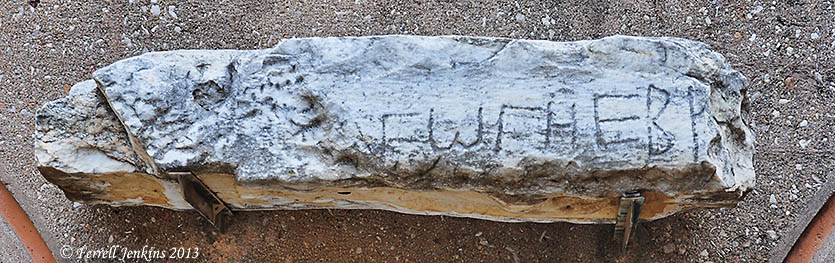
Synagogue Inscription displayed in Corinth Museum. Photo by Ferrell Jenkins.

Synagogue Inscription displayed in Corinth Museum. Photo by Ferrell Jenkins.

A small plaque mounted underneath the inscription at the Corinth Museum reads, “Inscription from a late Roman synagogue.”

One rabbinic tradition has it that there were 480 synagogues in Jerusalem alone. Even the small villages of Galilee had synagogues at the time of Jesus (Mt. 4:23; 9:35).
In search of Barnabas

A recent article (here) in the York [Pennsylvania] Daily Record features the research of Messiah College professor Dr. Michael Cosby. Cosby received a Fulbright Grant to do this research in Cyprus, a place associated with the life of Barnabas.

Barnabas is best known to most of us because of his association with the Apostle Paul on the first missionary journey. He is mentioned more than 20 times in the Book of Acts. Other than that, he is mentioned 3 times in Galatians 2, and once each in 1 Corinthians and Colossians.

We understand from Luke’s account that Barnabas, also known as Joseph, was a Levite of Cyprus (Acts 4:36). The first stop on the First Journey was at Salamis on the eastern end of the Mediterranean island of Cyprus (Acts 13:1-5). There the preachers spoke in the synagogue of the Jews, and later on the western end of the island at Paphos.

When Paul and Barnabas had a dispute prior to the Second Journey, Barnabas took his cousin Mark and went to Cyprus (Acts 15:36-41).

Nothing else is mentioned in the Bible about Barnabas and the island of Cyprus. But a great amount of tradition has grown up on the island. It is this tradition that Prof. Cosby studied, and he researched the association of the tradition to the modern Greek Orthodox Church of Cyprus, and the privileges granted to the Cypriot archbishops.

Having just visited Cyprus last year I find this a fascinating article. Perhaps you will enjoy it.

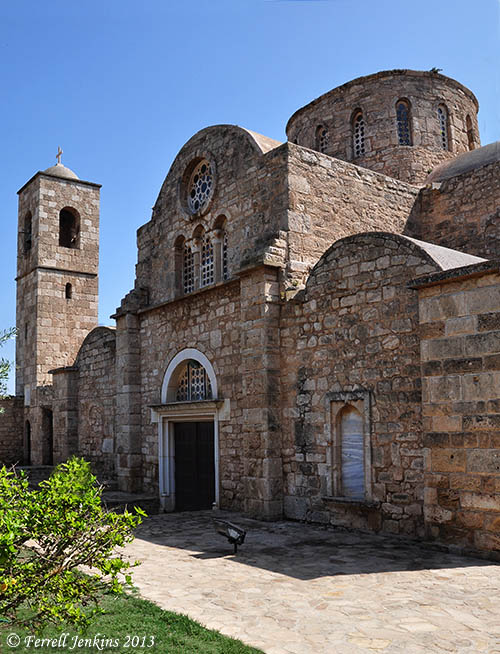
According to a tradition dating back to 488 A.D., the sepulcher of Barnabas was discovered by Anthemios, the Archbishop of Constantia and placed in a church he built near the tomb. The photo below shows the now-empty church near the ruins of Roman Salamis.

The Church of Barnabas at Salamis. Photo by Ferrell Jenkins.

The Church of Barnabas at Salamis. Photo by Ferrell Jenkins.

Salamis is now located in the the Turkish Republic of Northern Cyprus, or as the folks in the south of Cyprus say, “the occupied territory.”

Speaking at Florida College Annual Lectures

Tuesday morning at 10 a.m. I am scheduled to present an illustrated lecture on Biblical Coastal Towns of Turkey in Puckett Auditorium at the Florida College Annual Lectures. Normally in these sessions, in which I have participated in for many years, I present material on lesser-visited places that are important to Bible study.

There are several important coastal towns in Turkey that are mentioned in the Bible, mostly in connection with the journeys of Paul. These include Troas, Assos, Ephesus, Miletus, Patara, Myra, Attalia, Perga, and Seleucia. I have chosen to discuss two Black Sea cities (Sinope and Samsun) that are related to the discussion of the route of delivery of the Epistles of Peter, and to two cities on the Mediterranean Sea (Patara and Myra). I was able to visit all of these cities during the past year.

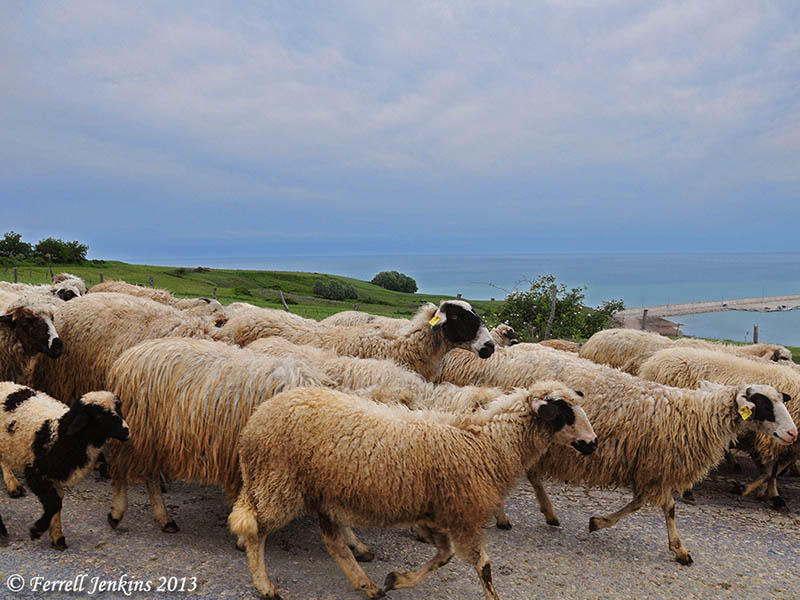
The photo below was made a few miles east of Sinope along the Black Sea (ancient Euxine). The territory is mountainous and the road is often far enough inland that the sea is not visible. Here the road runs along the sea, but still considerably above it. To the south, the mountains are much higher.

Sheep on the road east of Sinope, above the Black Sea. Photo by Ferrell Jenkins.

Sheep on the road east of Sinope, above the Black Sea. Photo by Ferrell Jenkins.

Boxers in the Roman World

Our photo today is of a terracotta statuette of an African boxer. According to the sign accompanying the statuette, it is Roman, possible made in Italy.

The gloves are the Roman caestus, equipped with balls of lead to give a brutal blow.

Terracotta statuettes of African boxers. British Museum.

Terracotta statuette of an African boxer. British Museum. Photo by Ferrell Jenkins.

Paul used a boxing illustration to describe his own disciplined work in preaching.

So I do not run aimlessly; I do not box as one beating the air. But I discipline my body and keep it under control, lest after preaching to others I myself should be disqualified. (1 Corinthians 9:26-27 ESV)

“Every man under his vine…”

A biblical way of describing a time of peace and prosperity is expressed in the following passage describing the time of King Solomon.

And Judah and Israel lived in safety, from Dan even to Beersheba, every man under his vine and under his fig tree, all the days of Solomon. (1 Kings 4:25 ESV)

It is not uncommon in the middle east to see vines used as a shade. Sometime the vine runs up the side of a house and covers a porch on the roof. When I saw this single vine by itself in front of the theater at Miletus I could not help but think of the biblical saying. I asked my traveling buddy, Leon Mauldin, to make a picture of me sitting under my vine.

I can imagine a person sitting under the vine in the late summer and enjoying the fresh grapes from the vine.

Miletus-theater_fj-vine_fjenkins072906_07t

Sitting under the vine at the theater of Miletus. Photo by Leon Mauldin.

Miletus is the city where the Apostle Paul met with the elders from the church at Ephesus as he returned to Jerusalem at the end of his third journey (Acts 20).

The prophet Micah used the same illustration to describe the nature of the Messiah’s kingdom.

It shall come to pass in the latter days that the mountain of the house of the LORD shall be established as the highest of the mountains, and it shall be lifted up above the hills; and peoples shall flow to it, 2 and many nations shall come, and say: “Come, let us go up to the mountain of the LORD, to the house of the God of Jacob, that he may teach us his ways and that we may walk in his paths.” For out of Zion shall go forth the law, and the word of the LORD from Jerusalem. 3 He shall judge between many peoples, and shall decide for strong nations far away; and they shall beat their swords into plowshares, and their spears into pruning hooks; nation shall not lift up sword against nation, neither shall they learn war anymore; 4 but they shall sit every man under his vine and under his fig tree, and no one shall make them afraid, for the mouth of the LORD of hosts has spoken. (Micah 4:1-4 ESV)

Acts 28 — Photo Illustrations

Many of the places mentioned in Acts 28 have been discussed, with photos, over a period of years. For sure, we have posts on Malta, (Publius), Syracuse, Rhegium, (Appian Way), and Rome. Use the search box to locate these for your study and teaching.

For this final post on the Book of Acts I have decided to look at a thought suggested by Paul when he spoke with the leading men of the Jews in Rome.

 17 After three days Paul called together those who were the leading men of the Jews, and when they came together, he began saying to them, “Brethren, though I had done nothing against our people or the customs of our fathers, yet I was delivered as a prisoner from Jerusalem into the hands of the Romans.
18 “And when they had examined me, they were willing to release me because there was no ground for putting me to death.
19 “But when the Jews objected, I was forced to appeal to Caesar, not that I had any accusation against my nation.
20 “For this reason, therefore, I requested to see you and to speak with you, for I am wearing this chain for the sake of the hope of Israel.” (Acts 28:17-20 NAU)

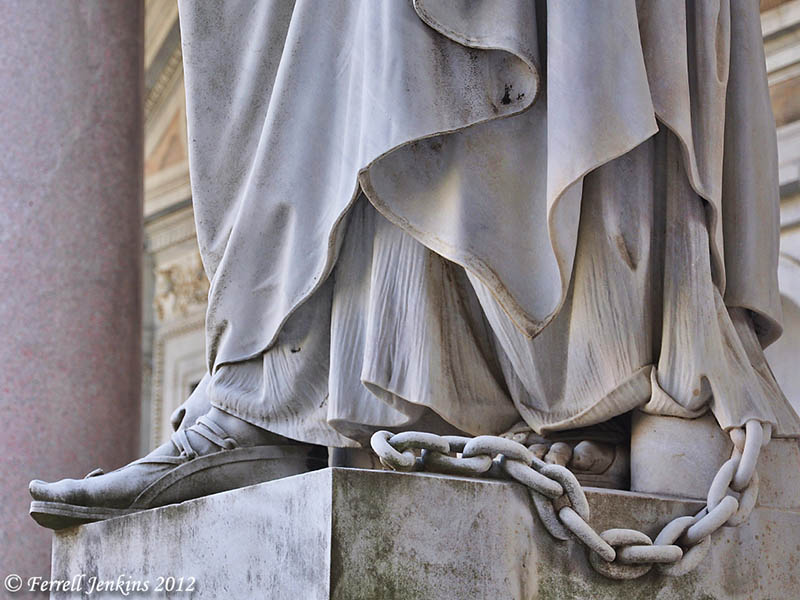
Paul was taken to Rome in chains as a prisoner of the Roman Empire. See also Acts 21:33; 22:29; 26:29; Ephesians 6:20.

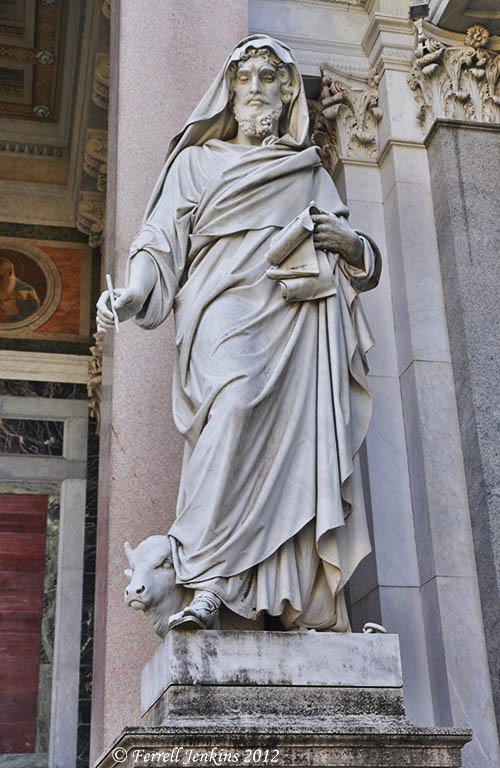
The Basilica of St. Paul, commonly known as St. Paul Outside the Walls, dates to the time of Constantine, and is thought to be the site of the burial of Paul.

Among the statues on the property is the one shown below. Paul is portrayed as a writer and a prisoner ready to be offered. We recall that the Prison Epistles (Ephesians, Colossians, Philemon, and Philippians) were written from Rome. My own understanding is that Paul was likely released after about two years. During that time we know very little about his activities, but believe that he wrote 1 Timothy and Titus. Later he was imprisoned a second time in Rome and writes another prison epistle, 2 Timothy.

Statue representing Paul as a writer in chains. Photo by Ferrell Jenkins.

Statue representing Paul as a writer in chains. Photo by Ferrell Jenkins.

The chains are difficult to see in the photo above, but in the view below they are clearly visible.

Paul in chains. Photo by Ferrell Jenkins.

Paul in chains. Photo by Ferrell Jenkins.

This final post in the series on Acts is sent forth with the hope that the material will be of value to students and Bible class teachers for years to come.

Myra, home of Saint Nicholas

The town Myra is known to students of the New Testament as a place where Paul transferred ships while he was being taken to Rome for trial before Caesar (Acts 27:5).

In the centuries following, Myra became the home of a (Greek Orthodox) bishop known as Nicholas. Born in Patara, Nicholas died December 6, 343. Several legends arose around Nicholas who was noted for giving gifts to the poor and raising the dead.

Highly revered in Greece and Russia, St. Nicholas is known as the patron saint of children, sailors, merchants, and scholars. From his life of piety, kindness, and generosity arose the legendary figure celebrated today as St. Nicholas, Father Christmas, or Santa Claus. (Fant & Reddish, A Guide to Biblical Sites in Greece and Turkey, 256)

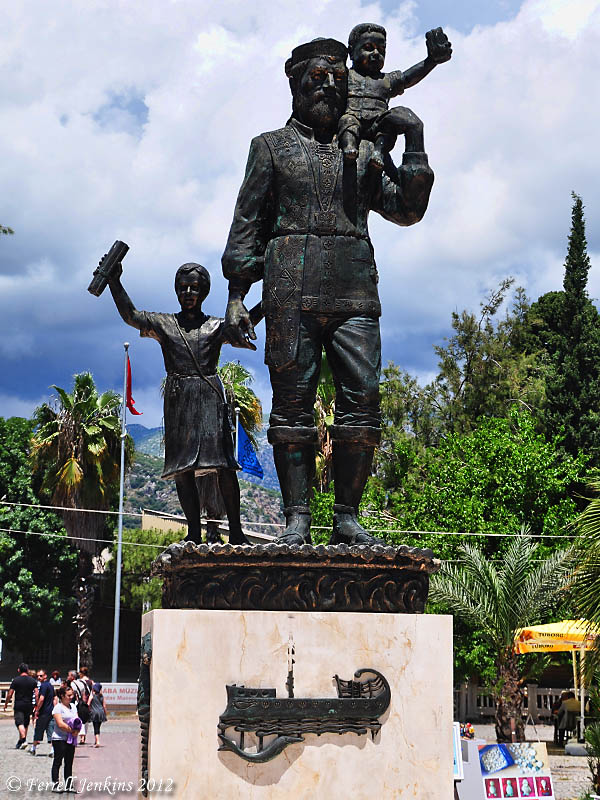
The ancient Myra is associated with the modern Turkish town Demre (or Kale). I thought you might enjoy seeing a few pictures related to Saint Nicholas. In the town square is a recent statue showing St. Nicholas with children. The statue was a gift of the Russian government in 2000. Many Russian tourists were visiting the day I was there.

Modern statue of Saint Nicholas at Myra. Photo by Ferrell Jenkins.

Modern statue of Saint Nicholas at Myra. Photo by Ferrell Jenkins.

A few decades ago I saw an older statue near the entrance to the church. It now has a fresh coat of black paint.

Older statue of St. Nicholas near the entrance of the Byzantine church ruins. Photo by Ferrell Jenkins.

Older statue of St. Nicholas near the entrance of the Byzantine church ruins.This statue depicts him carrying a bag of gifts.  Photo by Ferrell Jenkins.

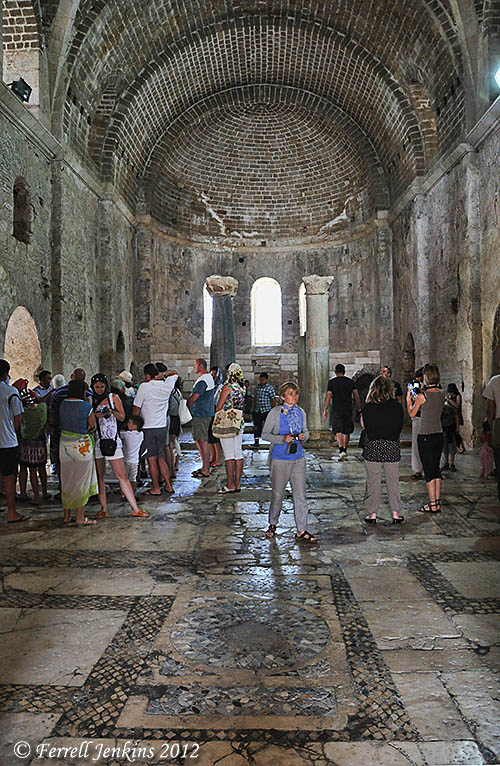
The Byzantine church dates to the 6th century A.D. Several writers point out that the sarcophagus of Nicholas was broken into by Italian merchants in the 1087 A.D., and his bones were taken to Bari, Italy.

Wilson says the church is built like a basilica “in the shape of an orthodox cross” (Biblical Turkey 88).

St. Nicholas Byzantine church, Myra, Turkey. Photo by Ferrell Jenkins.

Ruins of the St. Nicholas Byzantine church, Myra, Turkey. Photo by Ferrell Jenkins.

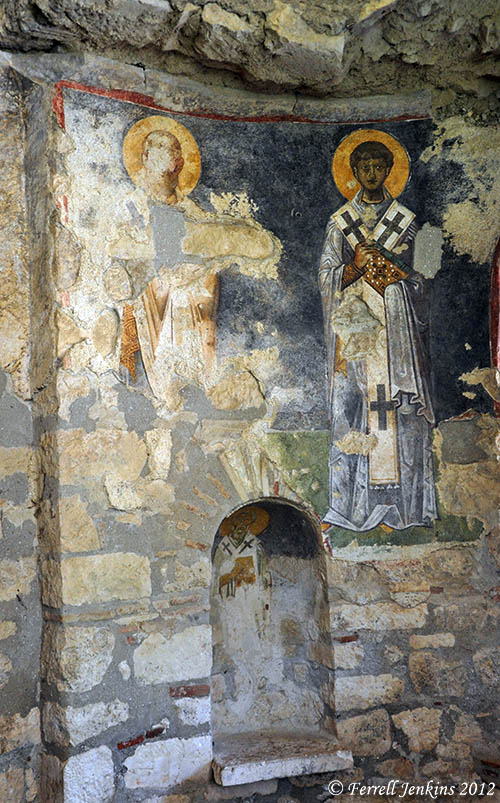
This last photo shows one of the poorly preserved frescoes.

Fresco on the wall of St. Nicholas church in Demre. Photo by Ferrell Jenkins.

Fresco on the wall of St. Nicholas church in Demre. Photo by Ferrell Jenkins.

Tourism seems to be thriving at Myra even though the town is off the beaten track. Whether there are any Christians in the town is doubtful.

For an earlier post about Myra and St. Nicholas, see here.

Acts 27 #2 — Did Paul dock at Cnidus (Knidos)? — Photo Illustration

Paul’s voyage to Rome, as it is often called, was actually a trip as a prisoner on a variety of ships from Caesarea Maritima to Puteoli in Italy (Acts 27:1 – 28:13. The trip westward from Myra, on the Mediterranean coast, took the ship near Cnidus (also spelled Knidos) (Acts 27:6-7).

We sailed slowly for many days and arrived with difficulty off Cnidus. Because the wind prevented us from going any farther, we sailed under the lee of Crete off Salmone. (Acts 27:7 NET)

Mark Wilson says,

Paul would have passed within sight of Cnidus on his return to Jerusalem during his second and third journeys, possibly even stopping at the city (Acts 18:21-22; 21:1). The grain ship upon which Paul was traveling on his captivity voyage to Rome encountered fierce head winds as it tacked westward along the coast of Asia Minor. It is not clear if Paul’s ship was able to make port in Cnidus’ commercial harbor, but the sailing conditions probably prevented it (Acts 27:7). — Biblical Turkey, 192.

A British archaeologist excavated at Cnidus in 1957-59. A colossal marble lion that once rested on a monumental tomb was taken to the British Museum where it is displayed in the Queen Elizabeth II Great Court. The lion dates to the late 4th-early 3rd century B.C.

Colossal marble lion from Cnidus. British Museum. Photo by Ferrell Jenkins.

Colossal marble lion from Cnidus. British Museum. Photo by Ferrell Jenkins.

The sign in the British Museum informs us that,

This lion crowned a monumental tomb at the edge of a cliff overlooking the sea. The hollow eyes were probably inset with glass to catch the light.

Did Paul see this lion? More than likely, I think, during the return from the second and third journeys.

The map below shows the location of Cos, Cnidus, Rhodes and Patara. Click the image for a higher resolution.

Map showing Cnidus, Rhodes, and Patara. Made with Bible Mapper 4.

Map showing Cnidus, Rhodes, and Patara. Made with Bible Mapper 4.

Acts 27 — Photo Illustrations — Myra in Lycia

Myra was a town of Lycia about 85 miles west of Antalya, Turkey (biblical Attalia, Acts 14:25). The town is located about two miles inland from the Mediterranean, but has a port at nearby Andriake. When Paul was being escorted by a Roman centurion from Caesarea Maritima to Rome, the ship sailed along the coast of Cilicia and Pamphylia, and landed at Myra in Lycia (Acts 27:5). There they found an Alexandrian ship sailing for Italy. This was one of the many grain ships that used Andriake as a port (Acts 27:38).

We do not know whether Paul was able to see any of Myra. There are several interesting things that could have been seen.

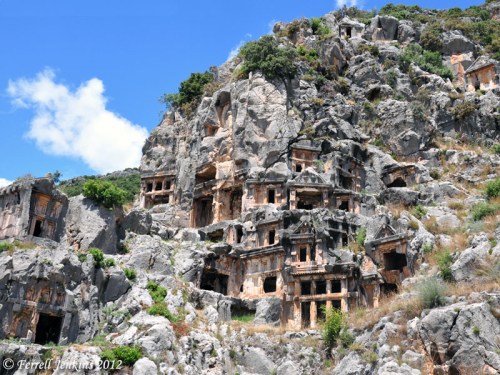
Here is a photo of the house-type tombs in the rock cliffs at Myra dating from the 4th century B.C.

Fourth century B.C. house-type rock tombs at Myra. Photo by Ferrell Jenkins.

Fourth century B.C. house-type rock tombs at Myra. Photo by Ferrell Jenkins.

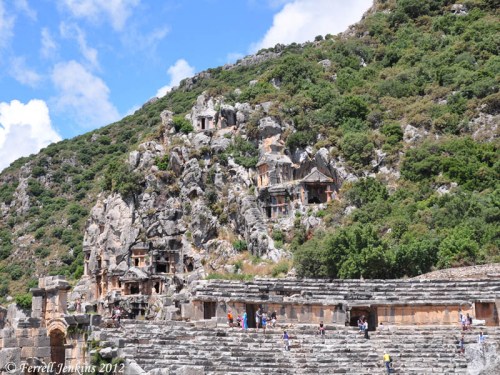
The next photo shows the top seats of the 2nd century B.C. theater with the tombs in the background. The theater seated about 10,000 spectators.

Rock tombs of Myra with Theater in the foreground. Photo by Ferrell Jenkins.

Rock Tombs of Myra with Theater in the foreground. Photo by Ferrell Jenkins.

Our last photo shows the harbor at Andriake, and walls of granaries built in the time of the Roman Emperor Hadrian (A.D. 117-138).  This was an ideal place to find a grain ship headed for Rome, even before Hardian built the granaries.

Anriake, the harbor of Myra, Photo by Ferrell Jenkins

Anriake, the harbor of Myra, Photo by Ferrell Jenkins

Acts 26 — Photo Illustrations — Herod’s Praetorium and Audience Hall

We have mentioned previously that the events of Acts 24-26 took place at Caesarea. The material we have presented may be used with either chapter.

Luke says that Agrippa and Bernice came amid great pomp into the audience hall.

So on the next day Agrippa and Bernice came with great pomp, and they entered the audience hall with the military tribunes and the prominent men of the city. Then, at the command of Festus, Paul was brought in. (Acts 25:23 ESV)

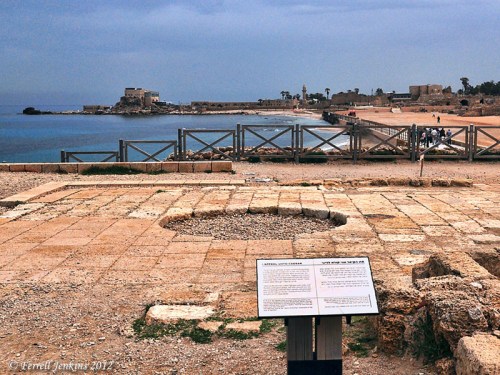
Excavations at Caesarea in 1997 caused Yosef Porat, of the Israel Antiquities Authority, to think that the auditorium or audience hall mentioned here has been discovered. This photo shows the general area within the Herodian Palace (cf. John McRay, Paul: His Life and Teaching).

Area of the Audience Hall at Caesarea. Photo by Ferrell Jenkins.

Area of the Audience Hall at Caesarea. Photo by Ferrell Jenkins.

The sign visible in the foreground is found only in my 2011 photographs. Signs are moved because they become incorrect, worn, or in the way of continued restoration. Here is the sign.

Sign at the Audience Hall in Caesarea. Photo by Ferrell Jenkins.

Sign at the suggested Audience Hall in Caesarea. Photo by Ferrell Jenkins.

Paul may have appeared before Felix, Festus, and Agrippa at this place. I often tell my tour groups, “If it didn’t happen right here (pointing down), it happened right here (motioning with arms extended, meaning nearby).”

When Paul first arrived at Caesarea, Felix said,

…  “I will give you a hearing when your accusers arrive.” And he commanded him to be guarded in Herod’s praetorium. (Acts 23:35 ESV)

Two prison inscriptions were found in the same area, leaving the scholars working there to conclude that this was indeed the Praetorium of the Palace.

The first reads, “The fraternity of the Frumentarii. Happiness for all.”

The inscription reads, “O, good hope, I came to this office. I will be secure.” An accompanying sign says,

“This inscription indicates that a Latin-speaking guard was in charge of the security of the building, and of the safety of the governor.”

Prison inscription found at Caesarea. Photo by Ferrell Jenkins.

Prison inscription found at Caesarea. Photo by Ferrell Jenkins.

The second inscription reads, “The fraternity of the Frumentarii. Happiness for all.” The Frumentarius was an official in charge of police duties and prisoners. The accompanying sign says that Paul was the most famous prisoner held there.

Prison inscription found at Caesarea. Photo by Ferrell Jenkins.

Prison inscription found at Caesarea. Photo by Ferrell Jenkins.

As a Roman citizen, Paul was allowed his right to appeal to Caesar (Acts 25:11-12). We all know that the wheels of justice often move slowly.