Tag Archives: Apostle Paul

The apostles as gladiators

The apostle Paul compared the work of the apostles to that of gladiators in the arena. In writing to the Corinthians he says,

For I think that God has exhibited us apostles as last of all, like men sentenced to death, because we have become a spectacle to the world, to angels, and to men. (1 Corinthians 4:9 ESV)

As the last event of the day, the gladiator’s who were condemned to death were brought into the arena as a spectacle for the excited crowd. The word spectacle translates the Greek theatron, easy enough for everyone to understand the reference.

Leon Morris (Tyndale New Testament Commentary) calls attention to James Moffatt’s translation of this text.

The imagery is derived from the arena, as Moffatt’s rendering brings out, ‘God means us apostles to come in at the very end, like doomed gladiators in the arena!’

The photo below shows gladiators in the Roman hippodrome at the RACE (Roman Army and Chariot Experience)  show at Jerash, Jordan.
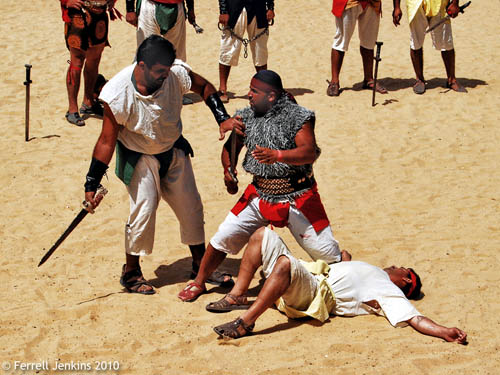
Gladiators in the Roman hippodrome at Jerash, Jordan. Photo by Ferrell Jenkins.

Gladiators in the Roman hippodrome at Jerash, Jordan. Photo by Ferrell Jenkins.

Here is a close up of one of the gladiators.
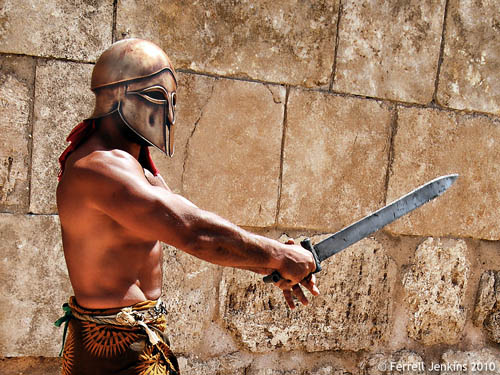
Gladiator in the RACE show, Jerash, Jordan. Photo by Ferrell Jenkins.

Gladiator in the RACE show, Jerash, Jordan. Photo by Ferrell Jenkins.

Both photos are available in a larger size suitable for use in teaching. Just click on the images.

David Padfield has several photos of gladiators here.

Cenchrea — a port used by Paul and Phoebe

Cenchrea is located a few miles east of Corinth on the Saronic Gulf, an arm of the Aegean Sea. In the time of the Apostle Paul Cenchrea was considered the eastern port of Corinth. It was here that Paul had his hair cut before sailing for Syria.

Paul, having remained many days longer, took leave of the brethren and put out to sea for Syria, and with him were Priscilla and Aquila. In Cenchrea he had his hair cut, for he was keeping a vow. (Acts 18:18 NAU)

Our photo provides a view of the port and the northern breakwater.

The port of Cenchrea with view toward the northern breakwater. Photo by Ferrell Jenkins.

Port of Cenchrea with view toward the northern breakwater. Photo by Ferrell Jenkins.

Cenchrea was the home of Phoebe, who was a servant of the church there. Cenchrea would have been one of the unnamed churches “in the whole of Achaia” (2 Corinthians 1:1).

I commend to you our sister Phoebe, who is a servant of the church which is at Cenchrea; that you receive her in the Lord in a manner worthy of the saints, and that you help her in whatever matter she may have need of you; for she herself has also been a helper of many, and of myself as well. (Romans 16:1-2 NAU)

I think we may safely conclude that Phoebe sailed from this port to Rome with the epistle Paul write to the saints at Rome about A.D. 57.

Except for the port, little is to be seen of ancient Cenchrea. Some underwater excavations have taken place. Perhaps at a later time we will call attention to some of the discoveries.

Click on the image if you would like to have a copy of the photo suitable for use in teaching Acts, Romans, or the life and ministry of Paul.

Temples made by man

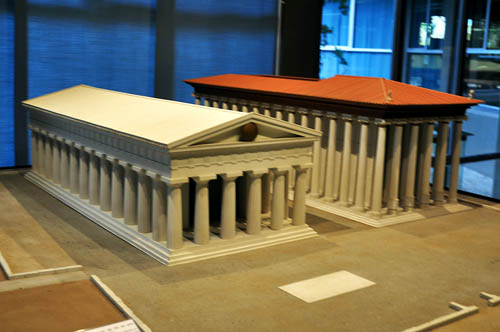
Any Greek or Roman city we visit is surely to have ruins of a theater and a temple. Both Greek and Roman theaters remain at Syracuse (Acts 28:12).The Paoli Orsi Regional Archaeological Museum displays a model of the Temple of Athena (left; 480 B.C.) and the Temple of Artemis (right; 520 B.C.).

Temple models at Syracuse, Sicily, archaeological museum.

Model of Temple Athena and Temple of Artemis. Syracuse. Photo by Ferrell Jenkins.

The Apostle Paul had to contend with this in every Roman city he visited. At Athens he said,

The God who made the world and everything in it, being Lord of heaven and earth, does not live in temples made by man, nor is he served by human hands, as though he needed anything, since he himself gives to all mankind life and breath and everything. (Acts 17:24-25 ESV)

He reminded the Corinthians, who lived in a city filled with temples,

For although there may be so-called gods in heaven or on earth–as indeed there are many “gods” and many “lords”– yet for us there is one God, the Father, from whom are all things and for whom we exist, and one Lord, Jesus Christ, through whom are all things and through whom we exist. (1 Corinthians 8:5-6 ESV)

Solomon’s temple in Jerusalem, as well as the later temples built by Zerubbabel and Herod, were made with hands. Paul certainly knows this. But he also knows what Solomon said about the same subject:

“But will God indeed dwell on the earth? Behold, heaven and the highest heaven cannot contain you; how much less this house that I have built! (1 Kings 8:27 ESV)

Read the full account of the building and dedication of the temple in 1 Kings 6-8. The temple was a place of worship, but it was not to be the object of worship.

Jesus taught His disciples to pray like this: “Our Father in heaven, hallowed be your name” (Matthew 6:9).

Paul stayed three days in Syracuse

After three months on the Island of Malta, Paul’s voyage to Rome resumed when an Alexandrian ship that had wintered there set sail. The next stop was Syracuse in Sicily (Acts 28:11-12).

K. L. McKay describes Syracuse:

A city with a large harbour on the E coast of Sicily. Founded in 734 bc by Corinthian colonists, it had by the end of the 5th century bc become the most important city, politically and commercially, in Sicily, especially under the tyrants Gelon and Dionysius I. (New Bible Dictionary, 1143).

The stop at Syracuse is nearly overlooked by Luke, with only these words:

We put in at Syracuse and stayed there three days. (Acts 28:12 NET)

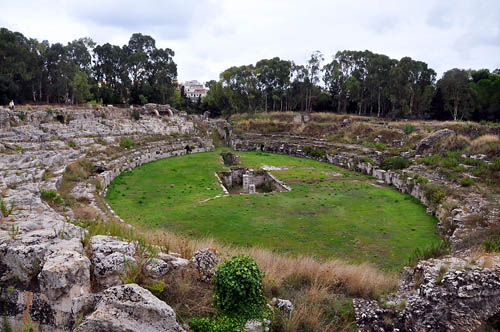
It is doubtful that Paul, as a prisoner, had much liberty to visit the sites of the city as he did at Athens (Acts 17:23). There are a few Roman and Greek ruins to be seen today. Our photo today is of the Greek theater built in the fourth century B.C.

Syracuse Greek Theater. Photo by Ferrell Jenkins.

Ruins of the Greek Theater in Syracuse. Photo by Ferrell Jenkins.

The Fountain of Peirene at Corinth

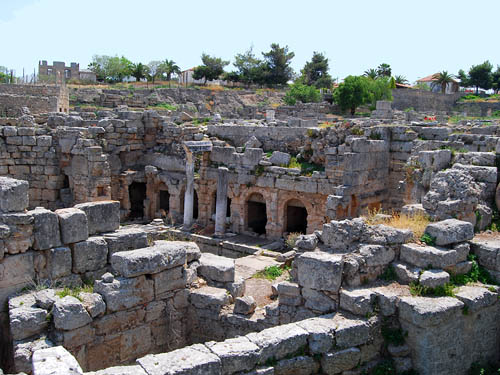
Food, Water, and the ability to defend, were the most important features in ancient cities. Corinth’s most important reservoir, the Fountain of Peirene, was fed from subterranean springs. It had a capacity of over 81,000 gallons.

Take a look at the horizon in the photo below. That was the level of the earth more than a century ago before archaeological excavations began at Ancient Corinth. The entire structure that we know as the Fountain of Peirene was covered with debris. This structure was built along the Lechaion Road which led from the Agora (Marketplace) to the Gulf of Corinth on the west side of the city.

The fountain is no longer in use, but if you walk close to the arches you can hear water flowing underneath the city.

Fountain of Peirene at Ancient Corinth. Photo by Ferrell Jenkins.

The Fountain of Peirene at Ancient Corinth. Photo by Ferrell Jenkins.

Paul visited Corinth on his second journey (A.D. 50-53). In spite of obstacles that brought fear to the heart of Paul, the Lord assured him that He had many people in the city (Acts 18:10).

And he stayed a year and six months, teaching the word of God among them. (Act 18:11 ESV)

“Cracked Pot Archaeology”

If you have not taken a look at Life and Land by Gordon Franz, I suggest you do so now. Gordon is a careful scholar. His material is always well researched and documented. One category that caught my attention at Life and Land is called Cracked Pot Archaeology. Here is how he describes this category.

The Cracked Pot Archaeology category contains articles about popular, contemporary archaeological theories and ideas that, like cracked pots, hold no water! These articles are a review, scholarly analysis and critiques of theories and ideas that have been presented on the Internet or popular books, movies, DVD’s and videos.

Over the past few years Gordon has written a number of articles about the claims of the late Ron Wyatt and Robert Cornuke. Last evening I presented a lesson on “Ports of Paul.” I only had time to talk about Caesarea Maritima and the events of Acts 27-28 (Malta, Syracuse, and Rhegium). I called attention to the claim of Robert Cornuke and the response by Gordon Franz. You will find his response to Cornuke’s book, The Lost Shipwreck of Paul, under the category of Paul and Places. Gordon provides information about the possible places on Malta where the shipwreck may have occurred. I will leave any discussion of that at this time, and let you enjoy working through his material.

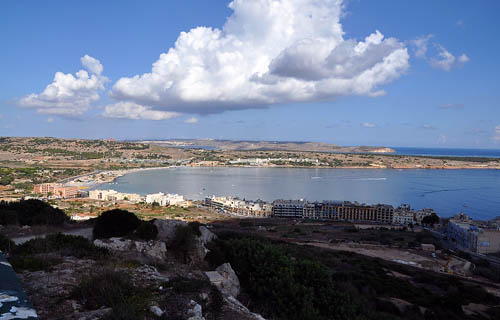
The photo below shows Mellieha Bay on Malta. Beyond the bay you may see the island of Gozo. Mellieha Bay is a few miles north of St. Paul’s Bay, the traditional site of the shipwreck. We discussed several places on Malta back in September here, here, and a few other places (use the Search box to locate places you are studying).

Mellieha Bay, Malta. Photo by Ferrell Jenkins.

Mellieha Bay, Malta. Photo by Ferrell Jenkins.

One of Gordon’s recent articles is a response to Cornuke’s claim to have found an inscription with the name of Yahweh on it. Read it here. The final sentence by Franz sums it up:

The assertion that Mount Sinai is at Jebel al-Lawz in Saudi Arabia still lacks credible and verifiable historical, geographical, archaeological, or biblical evidence.

You will find links to articles dealing with the claim that Jebel al-Lawz in Saudi Arabia is Mount Sinai.

A word of warning. Beware of someone who has discovered something all others have overlooked. Be especially wary if they have found two things no one else knows about. Shall I keep counting?

Pressing on toward the goal

Paul’s admonition to the brethren at Philippi is often used in sermons.

Not that I have already obtained it or have already become perfect, but I press on so that I may lay hold of that for which also I was laid hold of by Christ Jesus. Brethren, I do not regard myself as having laid hold of it yet; but one thing I do: forgetting what lies behind and reaching forward to what lies ahead, I press on toward the goal for the prize of the upward call of God in Christ Jesus. (Philippians 3:12-14)

Most often we hear speakers compare what Paul said to the effort put forth by individuals running in a race. This is certainly not inappropriate. However, many years back I ran across a statement by E. M. Blaiklock that changed my thinking. Blaiklock was a noted classicist. This particular comment comes from Cities of the New Testament.

One mark of the Roman colony is perhaps to be detected in the letter which Paul wrote, over ten years later, to the Macedonian church which he had come to love. It is a hidden metaphor from the chariot race. Exhorting his Philippians to effort and single-minded endurance, Paul writes: ‘This one thing I do-forgetting the things behind, and stretching out to those before, I make for the mark, the prize of the upward calling’.

Commentators generally have not marked the fact that Paul appears to have in mind, not the athletic contests of the Greeks, from which he commonly drew illustration, but the chariot racing of Rome. He was writing to a Roman colony. He was writing also from Rome itself, and never was there such rivalry of racing colours, and circus fever than at that time. The common talk of the soldiers of the soldiers was of the chariot racing, and Paul would gain a vivid impression of this most perilous of sports.

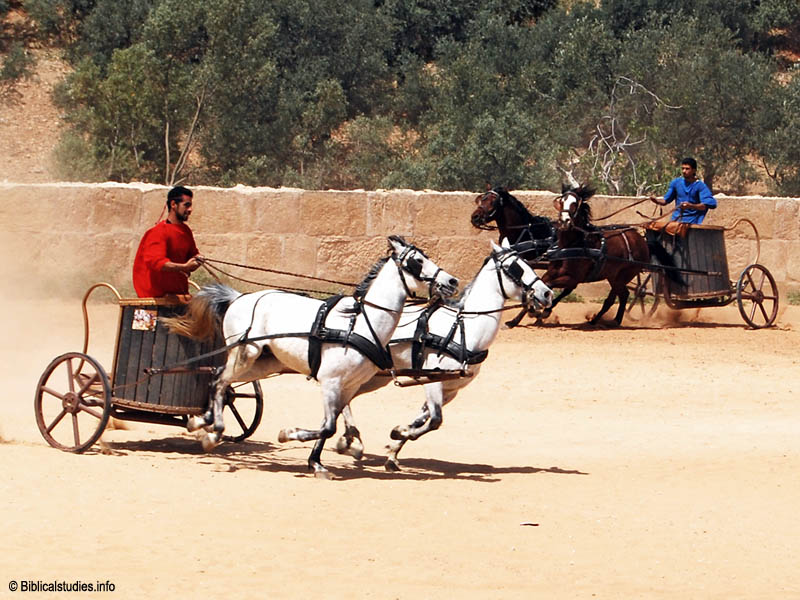
Such a race as that which forms the substance of Paul’s figure is described well in Ben HUR. The charioteer stood on a tiny platform over sturdy wheels and axle. His knees were pressed against the curved rail, and his thighs flexed. He bent forward at the waist, stretching out hands and head over the horses’ backs. This is surely what he means by ’stretching out to the things before’. The reins were wound round the body, and braced on the reins the body formed a taut spring. It can easily be seen how completely the charioteer was at the mercy of his team’s sure feet and his own fine driving skill. Euripides, in his Hippolytus, tells how the hero fell and was killed in such conditions. Ovid describes the same disaster in Book XV of his Metamorphoses. In his intense preoccupation the driver dare not cast a glance at ‘the things behind’. The roaring crowd, crying praise or blame, the racing of his rivals, all else had perforce to be forgotten. One object only could fill the driver’s eye, the point to which he drove at the end of each lap.

Here is a photo that might help to illustrate what Blaiklock said. It was made at the RACE show (Romy Army and Chariot Experience) at Jerash, Jordan.

Chariot race at the RACE show in Jerash, Jordan. Photo by Ferrell Jenkins.

Chariot race at the RACE show in Jerash, Jordan. Photo by Ferrell Jenkins.

This is a reprint from April 30, 2008, but with a different photo suitable for use in presentations. Click on the image for the larger photo.

Paul’s burial in Rome

The apostle Peter gets the most attention in Rome, but Paul also has his share of shrines. Paul was taken to Rome in the custody of the Roman Empire (Acts 27-28).

I appeal to Caesar. (Act 25:11)

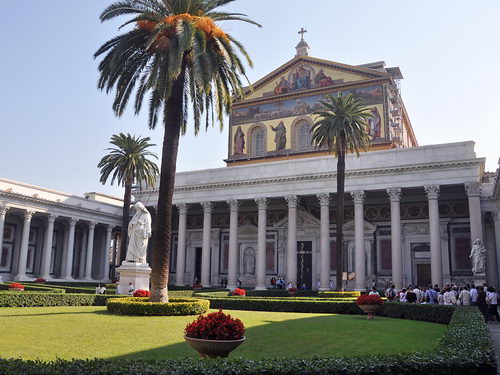
Tradition has it that Paul was buried outside the walls of Rome where we now find the Basilica of St. Paul Outside the Walls.

The basilica of St. Paul Outside the Walls in Rome. Photo by Ferrell Jenkins.

The basilica of St. Paul Outside the Walls in Rome. Photo by Ferrell Jenkins.

The statue in front of the church shows Paul with a drawn sword and a book. The inscription reads PREDICATORI VERITATIS and DOCTORI GENEIUM. Paul was a preacher of truth and a teacher of the Gentiles.

For this I was appointed a preacher and an apostle (I am telling the truth, I am not lying) as a teacher of the Gentiles in faith and truth. (1Timothy 2:7 NAU; see also 2 Timothy 1:11)

Tomb of Caecilia Metella on the Appian Way

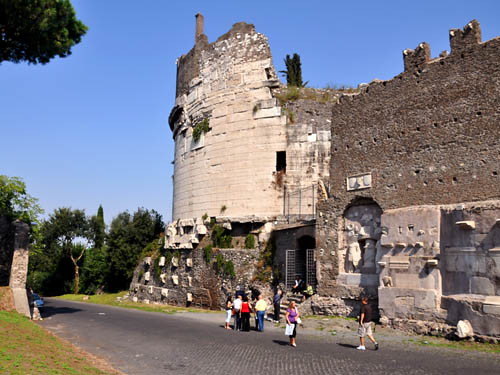
Several ancient structures may be seen along the Appian Way south of Rome. One of the most impressive is the Tomb of Caecilia Metella. The woman for whom this tomb is named was the wife of a certain M. Crassus who shared power in Rome with Julius Caesar and Pompey.

The decorations on the tomb seem to date it to the beginning of the Augustan period (Wycliffe Historical Geography 538). I think we can safely conclude that Paul passed this structure on his way to Rome (Acts 28:13-14).

The Tomb of Caecilia Metella on the Appian Way. Photo by Ferrell Jenkins.

The Tomb of Caecilia Metella on the Appian Way. Photo by Ferrell Jenkins.

Archeobus Tour on the Appian Way

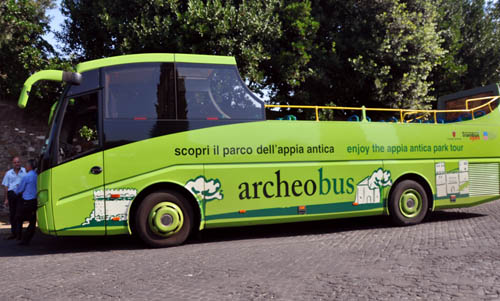
While visiting the Appian Way in Rome I noticed the archeobus. I assume there may have been a guide with the group at the Tomb of Caecilia Metella. That is a neat idea on a dry day.

The Archeobus Tour on the Appian Way. Photo by Ferrell Jenkins.

The Archeobus Tour on the Appian Way. Photo by Ferrell Jenkins.

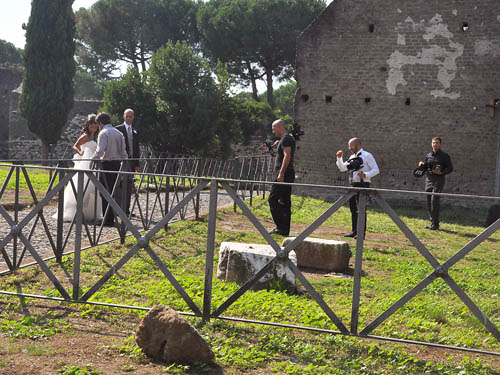
Perhaps the next time I am in Rome I will look into this tour. Photographers were utilizing the beautiful sunny day and the ancient ruins to photograph some newly weds (to be?).

Wedding photography on the Appian Way. Photo by Ferrell Jenkins.

Wedding photography on the Appian Way. Photo by Ferrell Jenkins.

I wondered if they knew that the Apostle Paul once passed this way (Acts 28).