The Rivers of Damascus

Naaman was the commander of the army of the king of Aram (Syria). The biblical text says he was “esteemed and respected by his master” because of the victories he had given the country. Great people often have great problems as well as great acclaim. Naaman was a leper. The term leper is used throughout the Old Testament of a serious skin disease without a cure. Read the full account in 2 Kings 5:1-18.

A young girl who had been taken captive from Israel during one of the raids made by the Arameans was serving as an attendant to Naaman’s wife. She knew of the prophet [Elisha] in Samaria and was confident he could cure Naaman of his leprosy.

When Elisha send a messenger to Naaman to tell him to “Go and wash in the Jordan seven times” the commander was furious. He said,

Are not Abana and Pharpar, the rivers of Damascus, better than all the waters of Israel? Could I not wash in them and be clean?” So he turned and went away in a rage. (2 Kings 5:12 ESV)

These rivers, Abana and Pharpar, flow from the Anti-Lebanon range eastward into the desert. Here is a photo that I made of the Nahr Barada river a short distance west of Damascus (on the outskirts of the city). The river continues to flow through the city of Damascus. The Nahr Barada is often identified with the Abana of the Bible.

The Abanah River near Damascus. Photo by Ferrell Jenkins.

The Abanah River near Damascus. Photo by Ferrell Jenkins.

Naamam was cured of his leprosy only after he dipped in the Jordan seven times. We should not elevate our judgment (opinion) to the point that we can argue with the Lord about what ought to be done. He is the Creator; we are the creature.
More on Herod’s Tomb

A month ago I wrote about visiting the Herodium here.

Todd Bolen has provided some new information about continuing work at the Herodium here. I sent him a couple of photos showing some construction I saw August 23. He has included one of those photos in an update of his post. The Bible Places Blog is one that I read almost every day. I’m disappointed when Todd has not had time to update the blog. (But I understand.)

Even though I have multiple thousands of photos from Israel, I still use photos from Todd’s Pictorial Library of Bible Lands regularly. Every person who teaches the Bible and uses presentation software should have his collection. See BiblePlaces.com for details. Photos like this help to make Bible lessons come to life.

The Roman city of Volubilis

Students of the New Testament probably realize that the Roman Empire was vast. Did you know that there are ruins of a large Roman city in Morocco in north eastern Africa? Twice I have taken tours to Volubilis, about 20 miles from Meknes. Most of the ruins in the city date from the second and third centuries A.D. I have a slide from a 1980 tour with the name of the first century emperor Claudius (A,D, 51-54) on it. This was the time of Paul’s journeys (Acts 18:2).

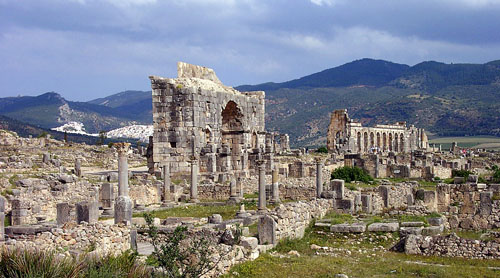
This photo shows the Triumphal Arch dedicated to the Emperor Caracalla and his mother in A.D. 217. The Roman Basilica is visible on the right.

Roman ruins of Volubilis in Morocco. Photo by Ferrell Jenkins.

Roman ruins of Volubilis in Morocco. Photo by Ferrell Jenkins.

Volubilis has been added to the list of World Heritage Sites because “this site is an exceptionally well preserved example of a large Roman colonial town on the fringes of the Empire.”

Aswan, Egypt

Aswan is the location of the first cataract of the Nile River. This made it an ideal location for the Aswan Dam which was built between 1898 and 1902. This created a small lake south of the dam, but it was nothing to compare with Lake Nasser which has been formed as a result of the building of the new high dam at Aswan between 1960 and 1971.

The new high dam was constructed at a time when the Soviet Union was providing technical, economic and military support to Egypt. I remember staying in a hotel in Egypt in 1973 filled with Soviet tourists. In the following years we saw none of them. Lake Nasser stretches south for more than 300 miles. Many of the Nubians who lived in this area had to be resettled by the Egyptian government.

Kitchener’s Island, shown below, was given to Lord Horatio Kitchener for his service in the Sudan Campaign. It now is owned by the state and is the site of a beautiful botanical garden. The Mausoleum of the Aga Khan is visible on the top of the hill in the photo below.

Some scholars identify the Arabic name Aswan with the Syene of Ezekiel 29:10 and 30:6. It may be identified with the Sinim of Isaiah 49:12.

Kitchener's Island at Aswan, Egypt. Photo by Ferrell Jenkins.

The Nile River at Aswan. Photo by Ferrell Jenkins.

Mount Carmel – site of a great conflict

Mount Carmel is not just a protrusion into the Mediterranean Sea as some sketch maps might suggest. It is a range about 14 1/2 miles long by 5 miles wide, consisting largely of limestone. The elevation of Mount Carmel is about 1500 feet above sea level. From the western promontory one can overlook the city and port of Haifa. The Roman general Vespasian, who later became emperor, offered sacrifices on Mount Carmel before the war against the Jews (A.D. 66-70) (Hoade, Guide to the Holy Land, 665).

Mount Carmel is best known to Bible students as the place where the prophet Elijah contended with the prophets of Baal (1 Kings 18:17-40). The traditional site for this event is shown at Muhraka on the eastern end of Mount Carmel. This photo was made near Muhraka.

View of part of Mount Carmel near Muraka. Photo by Ferrell Jenkins.

View of part of Mount Carmel near Muraka. Photo by Ferrell Jenkins.

Professor Avraham Biran

Dr. David Ilan, Director of the Nelson Glueck School of Biblical Archaeology, announced the passing of Professor Avraham Biran. Jack Sasson reports to the academic community the passing of Prof. Avraham Biran.

It is my sad duty to inform you that Prof. Avraham Biran passed away last night.  He was one month shy of his 99th birthday.

Avraham Biran, a third generation Israeli, received his Ph.D. at Johns  Hopkins University under William Foxwell Albright and was Thayer Fellow in the American Schools of Oriental Research, Jerusalem, 1935-37. Formerly Director of the Israel Department of Antiquities and Museums, he served as Director of Hebrew Union College-Jewish Institute of Religion’s Nelson Glueck School of Biblical Archaeology in Jerusalem from 1974-2003. He participated in the excavations of the  Uiversity of Pennsylvania in Iraq, at Tepe Gawra near Mosul, and at Hafaje near Baghdad. He accompanied Nelson Glueck in his epoch-making discoveries at the head of the Gulf of Eilat. Professor Biran directed the excavations of Anathoth, Tel Zippor, Ira, Aroer, the synagogue of Yesud Hama’alah, and the longest ongoing excavations in Israel at Tel Dan (under his direction from 1966 to 1999).

It was my pleasure on several occasions to hear Prof. Biran at professional meetings. I remember hearing him tell of the discovery of the House of David inscription. He always spoke with such enthusiasm; it was contagious. The last year I saw him at one of these annual meetings I was walking across the street from my hotel to the conference center. There was Prof. Biran. I spoke to him and more or less helped him across the street. 

The tremendous work done at Tel Dan seemed to me to be a testimony to his continuing work there. It takes a long time to do a lot of good things, especially archaeology.

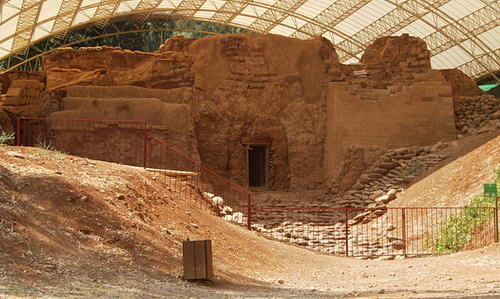
The significant discoveries at Dan are too numerous to mention just now. In 1979 a complete Middle Bronze city gate (19th/18th century B.C.) was found at Dan (ancient Laish). This gate illustrates that the city was strongly fortified at the time Abraham rescued Lot (Genesis 14:14). I made this photo of the preserved gate on August 31.

The Middle Bronze age city gate at Dan. Photo by Ferrell Jenkins.

The Middle Bronze age city gate at Dan. Photo by Ferrell Jenkins.

HT: Joseph I. Lauer

Azekah was an important fortified city of Judah

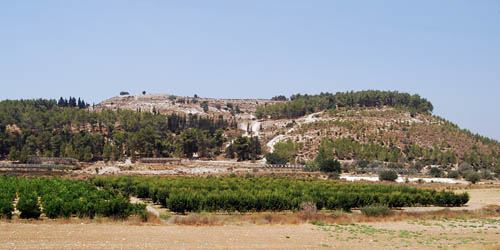
The biblical site of Azekah is identified with Tell ez-Zekariyeh which overlooks the Valley of Elah. Azekah is a town of the Shephelah and is mentioned seven times in the Bible. Here is a summary of the information:

  • Azekah is mentioned in the account of Joshua’s long day (Joshua 10:10-11).
  • It was assigned to the tribe of Judah (Joshua 15:35).
  • The Philistines camped at Ephes-Dammim, between Socoh and Azekah, at the time of the conflict between David and Goliath (1 Samuel 17:1).
  • It was one of the fortified cities of Rehoboam, king of Judah (2 Chronicles 11:9).
  • Upon return from Babylonian captivity some of the Jews settled in Azekah and its villages (Nehemiah 11:30).

Jeremiah states that only Lachish and Azekah remained of the fortified cities of Judah at the time of the Babylonian captivity of Judah in 586 B.C. (Jeremiah 34:7). This indicates that Jeremiah wrote shortly before Lachish Letter # 4 was written. The last portion of the letter reads this way:

And let (my lord) know that we are watching for the signals of Lachish, according to all the indications which my lord hath given, for we cannot see Azekah. (The Ancient Near East an Anthology of Texts and Pictures, 322)
Here is a photograph of Azekah from the Valley of Elah.
Tel Azekah overlooks the Valley of Elah. Photo by Ferrell Jenkins.

Tel Azekah overlooks the Valley of Elah. Photo by Ferrell Jenkins.

A photograph of the Valley of Elah made from atop Tel Azekah may be seen here. An excavation conducted by Bliss and Macalister in 1898-99 showed that Azekah was occupied from Canaanite times. (The New International Dictionary of Biblical Archaeoogy, 83).

Roman army photos

A large number of visitors to this blog have looked at the post on the Roman soldiers and chariot races at Jerash, Jordan. Photos of Roman soldiers can be helpful in illustrating Bible class lessons and sermons. Think of a few of the texts.

  • The Centurion at Capernaum (Matthew 8:5).
  • Cornelius, the first Gentile convert to Christ (Acts 10:1).
  • “Whoever forces you to go one mile, go with him two” (Matthew 5:41).
  • Soldiers who mocked Jesus (Luke 23:36).
  • Soldiers and centurions who rescued Paul from the mob (Acts 21:32).
  • Paul’s figurative reference to fellow-workers in the Kingdom as soldiers (2 Timothy 2:4; Philemon 1:2).
  • The praetorian guard (Philippians 1:13).
  • The full armor of God (Ephesians 6:10).

David Padfield has prepared 15 photos from the RACE (Roman Army and Chariot Experience) program at Jerash, Jordan, under the title Bible Times: Roman Army Enactment. All of these photos are prepared in 1024 x 768 size, suitable for PowerPoint presentations. Here is a small photo from the collection.

Roman Army in Battle Gear. Photo by David Padfield.

Roman Army in Battle Gear. Photo by David Padfield.

Take a look at all of the photos here. From this page you can locate other sets of photos that David has prepared for use in teaching the Word.

Cappadocian sunrise

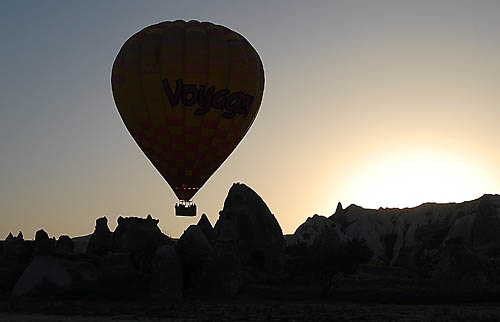
He is a photograph I made at sunrise in the Cappadocian region of Turkey.

Cappadocian sunrise. Photo by Ferrell Jenkins.

Cappadocian sunrise. Photo by Ferrell Jenkins.

The Bible tells us that Jews of Cappadocia were present in Jerusalem on the day of Pentecost (Acts 2:9). Peter wrote his epistles to saints scattered throughout Cappadocia and other places in Roman Asia Minor (modern Turkey).

Peter, an apostle of Jesus Christ, To those who are elect exiles of the dispersion in Pontus, Galatia, Cappadocia, Asia, and Bithynia,  2 according to the foreknowledge of God the Father, in the sanctification of the Spirit, for obedience to Jesus Christ and for sprinkling with his blood: May grace and peace be multiplied to you. (1 Peter 1:1-2)

Second Temple wall of Jerusalem uncovered

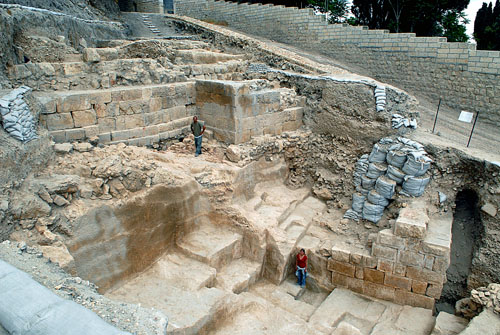
The Israel Antiquities Authority announced last week the discovery of a wall below modern “Mount Zion” that dates from the time of the Hasmonean kings to the destruction about A.D. 70. Here are a few comments in the official press release.

An exciting discovery in Jerusalem constituting extraordinary remains of the wall of the city from the time of the Second Temple (second century BCE-70 CE) that was built by the Hasmonean kings and was destroyed during the Great Revolt, and also the remains of a city wall from the Byzantine period (324-640 CE) which was built on top of it, were uncovered in an extensive excavation that is currently underway on Mount Zion. The lines of these fortifications delineated Jerusalem from the south in periods when the ancient city had reached its largest size.

The new finds were presented today (Wednesday) at a press conference that was held on Mount Zion. The excavation has been in progress for the past year and a half, under the direction of archaeologist Yehiel Zelinger of the Israel Antiquities Authority, in cooperation with the Nature and Parks Authority and with financial support provided by the Ir David Foundation.

You may read the entire news release at the IAA web page.

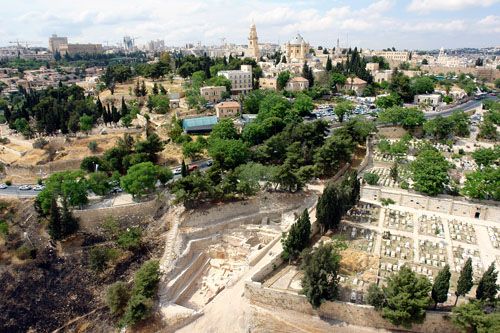
Here is an aerial photograph of the excavation, Mount Zion Valley. Photograph: Skyview, courtesy of the Israel Antiquities Authority.

Aerial photo of Mount Zion valley. Skyview. Courtesy of Israel Antiquities Authority.

Aerial photo of Mount Zion valley. Skyview. Courtesy of Israel Antiquities Authority.

This pictures shows the excavation area.

Tsilla Sagiv. Courtesy of the IAA.

The excavated area. Photo: Tsilla Sagiv. Courtesy of the IAA.

Todd Bolen provides a concise summary of the information on this discovery at his BiblePlaces Blog.