The Sower Went Out to Sow…

One of the best known parables of Jesus is the parable of the sower and the soils. Note the account recorded in Luke.

“The sower went out to sow his seed; and as he sowed, some fell beside the road, and it was trampled under foot and the birds of the air ate it up. “Other seed fell on rocky soil, and as soon as it grew up, it withered away, because it had no moisture. “Other seed fell among the thorns; and the thorns grew up with it and choked it out. “Other seed fell into the good soil, and grew up, and produced a crop a hundred times as great.” As He said these things, He would call out, “He who has ears to hear, let him hear.”  (Luke 8:5-8 NASB)

Jesus used this simple, easily understood illustration to teach about the word of God and the hearts of men. Read the full account in Luke 8:5-15, Matthew 13:3-23, and Mark 4:1-20.

A few weeks ago I was traveling in the vicinity of Hebron and saw these fields that had been plowed and readied for planting. I would assume the crop would be barley or wheat. I was standing on the road. You can see the rocks (be sure the soil is rocky), the weeds (if not thorns), and the good ground. In the time of Jesus seed would be broadcast, scattered by hand. Seed would fall on all the areas, but only that which fell on good ground would bring forth an acceptable crop. Many of the fields in the central mountain range north of Bethlehem are much smaller, but each field has the four elements of good soil, rocks, thorns, and road. How would you describe your heart?
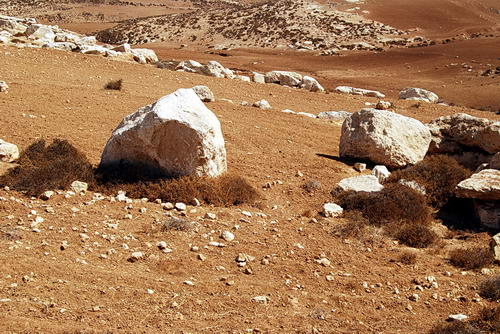
A field showing good soil, rocks, and weeds. Photo by Ferrell Jenkins.
A field showing good soil, rocks, and weeds. Photo by Ferrell Jenkins.
A Bible Land tour for less than $20.00

Journey Through the Holy Lands is a DVD featuring Michael Hasel of Southern Adventist University. Dr. Hasel is Director of the Institute of Archaeology and teaches archaeology at SAU in Collegedale, Tennessee.

In 2007 Hasel was filmed at important biblical sites providing a commentary about the significance of the site. The following sites are visited:

Jerusalem
Garden Tomb; Church of the Holy Sepulcher; the Cardo; Western Wall; Temple Mount; Sheep Gate (often called St. Stephen’s or Lion’s Gate); Pool of Bethesda; Damascus Gate; the First Century House in the Jewish Quarter.

The Dead Sea Area
Qumran, Dead Sea, Masada, Wadi Qelt; Jericho

Egypt and the Sinai
The Giza Pyramids; Saqqara; St. Catherine’s Monastery; Mount Sinai

This DVD is not one of those slick TV presentations. It is the film of a competent scholar who is well acquainted with the history and archaeology of the area telling his tour group about it. I was impressed that Hasel spelled out the facts about such competing sites as the Holy Sepulcher and the Garden Tomb. At some places the commentary was very brief. At Jericho he mentioned the relevant research but did not show any of the evidence on the tell. There is no visit of sites in the Galilee.

At St. Catherine’s, Hasel tells about the discovery of the Sinaiticus Manuscript. Attractive maps and artwork has been added to the film. The background noise at the Giza Pyramids is noticeable and a distraction. The narration could have been added in a studio back home, but it would have changed the character of the film.

It was a pleasure to view the video. I would recommend it to those who have visited these areas and would like an on site review. It would be good for those who will never visit the sites, or those who are preparing for a trip.

Journey Through the Holy Lands is available for $15.00. Shipping and Handling for 1 or 2 copies is $2.50 each. For 3 or more copies it is $5.00.  Payment must be made by money order or check payable to Southern Adventist University. Send order to: Institute of Archaeology, Southern Adventist University, P.O. Box 370, Collegedale, TN 37315.

The Institute of Archaeology operates the Lynn H. Wood Museum which is the repository of the William G. Dever Near Eastern Collection. Check the web page here. I plan to visit the museum if I have an opportunity to travel in the area.

Review: Views That Have Vanished

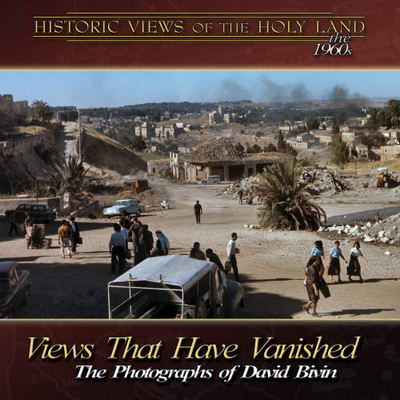
Todd Bolen, BiblePlaces.com, has released an extremely valuable CD that will be helpful to all students of the Bible lands. Views That Have Vanished is a collection of more than 700 high resolution photographs made by David Bivin beginning in 1963.

Views That Have Vanished - Photos of the 1960s.

Views That Have Vanished - Photos of the 1960s.

These photographs were made with one of the best cameras available at the time with the intent to be able to share them with family and friends who were unable to visit Israel, Jordan, Egypt and Greece. Bivin has now lived in Israel more than 30 years. Many of the places he visited in the 1960s have changed since then because of natural erosion. Some of the changes occurred because of archaeological activity, and the normal deterioration that takes place once a site is uncovered. Primarily the sites have changed because of the building activities of man.

My first visit to the Middle East was in 1967. Since then I have returned nearly 40 times and I have observed the tremendous changes made. Some sites, in preparation for visitors, are necessarily changed. Other sites are neglected and become dangerous for all but the most intrepid explorers to visit. Bivin had the wonderful opportunity live in Israel and record his experience in full color. I observe that many of the landscape photographs he made have a beautiful clear sky. Perhaps the sky was clearer 40 years ago. But, this is the advantage of living in the country and being able to go out when the weather is just right.

Everyone who has old photographs and slides knows that they begin to deteriorate after a few years. This happened to some of Bivin’s photographs. Todd Bolen has scanned these old negatives with high quality equipment. In many instances the color has been restored.

The photographs are available in high-resolution (1600 x 1200 or higher) in jpg format and also in PowerPoint with explanatory notes. I was especially impressed with the large number of photographs of some of the well known archaeologists of the past (Glueck, Yadin, et al.) and some historic views such as people in Jerusalem mourning the death of Anwar Sadat, president of Egypt.

Views That Have Vanished is a great addition to the already long list of photographic materials published by BiblePlaces. The CD belongs in the library of every church and every person who teaches Bible classes with an emphasis on the land in which these historical events took place. Frequently I say to my groups, “I wish you could have seen this before….” Now, you can see it through these photographs.

The CD is available for only $20 during October. Take a look here. If you would like to see some examples of Views then and now, take a look here.

Ben Ezra Synagogue in Old Cairo

As the term implies, Old Cairo is the oldest section of Cairo, Egypt. It is sometimes called Coptic Cairo. Visitors may see the Coptic Museum where some of the Nag Hammadi Gnostic texts are displayed. The last time I was in Cairo, in 2005, the museum was closed for some restoration. I am hopeful this will not be the case the next time.

The Church of St. Sergius is located in the Coptic area. Legend has it that Joseph, Mary, and the infant Jesus stayed here when they fled from Herod the Great. The New Testament records all we really know about their stay in Egypt.

Now when they had departed, behold, an angel of the Lord appeared to Joseph in a dream and said, “Rise, take the child and his mother, and flee to Egypt, and remain there until I tell you, for Herod is about to search for the child, to destroy him.” And he rose and took the child and his mother by night and departed to Egypt and remained there until the death of Herod. This was to fulfill what the Lord had spoken by the prophet, “Out of Egypt I called my son.” (Matthew 2:13-15 ESV)

The Romans built a fortress in the area of Old Cairo called Babylon. Some remnants of the fortress can be seen.

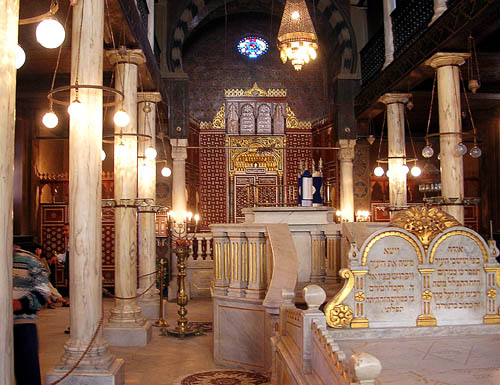
Of special interest is the Ben Ezra Synagogue. It was here that the 140,000 Cairo Geniza fragments of Hebrew and Jewish literature were found. The collection of material dating back to as early as the 9th and 10th century A.D. is now housed in Cambridge, England. This link will take you to some good information about the collection. Until the discovery of the Dead Sea Scrolls these biblical fragments represented our oldest examples of the Hebrew biblical text.

This photo shows the interior of the restored Synagogue. Of course, few Jews live in Egypt now.

Ben Ezra Synagogue after restoration. Photo by Ferrell Jenkins.

Ben Ezra Synagogue after restoration. Photo by Ferrell Jenkins.

Ask for the ancient path

The Bible, both Old Testament and New Testament, makes it clear that God’s people often depart from God’s way. There are numerous exhortation for His people who walk in the old paths.

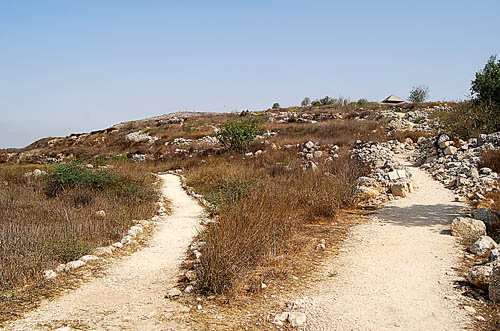
This scene showing two paths at the site of biblical Shiloh reminded me of the Lord’s plea through the prophet Jeremiah in the days of the Babylonian threat against Jerusalem and Judah. The tabernacle was located at Shiloh for many years after Israel entered the land of Canaan. I was just reading the first few chapters of 1 Samuel that tell of Samuel living there during his early years.

Two paths at Shiloh. Photo by Ferrell Jenkins.

Two paths at Shiloh. Photo by Ferrell Jenkins.

Thus says the LORD: “Stand by the roads, and look, and ask for the ancient paths, where the good way is; and walk in it, and find rest for your souls. But they said, ‘We will not walk in it.’ (Jeremiah 6:16)

To ask for the ancient path means to respect the revealed word of the Lord and follow it. This thought is similar to the teaching of Jesus in the Sermon on the Mount (Matthew 7:13-14).

Archaeology: The Bible as blueprint

The Jerusalem Post has been running a series of “People of the Year” articles. The most recent one was on Dr. Eilat Mazar. Mazar has been involved in a dig in the City of David over the last several years. The article says,

Mazar, who is both revered and reviled by some of her colleagues for being a “biblical archeologist,” says that the Bible is unquestionably the most important historical source for her work, since it contains a “genuine historical account of the past.”

“I work with the Bible in one hand and the tools of excavation in the other,” she says. “The Bible is the most important historical source.”

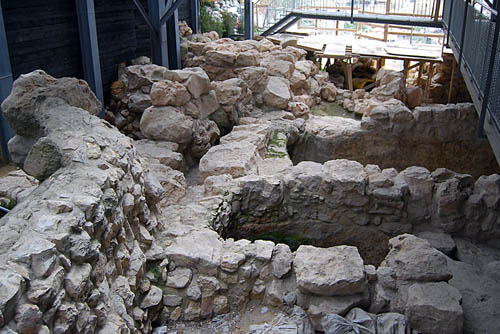
The area where Mazar believes she has found a palace that might have belonged to David, has been covered by a structure to protect it. Here is a photo I made in early April.

A portion of the City of David excavation. Photo by Ferrell Jenkins.

A portion of the City of David excavation. Photo by Ferrell Jenkins.

The full article may be read here.

HT: Joseph I. Lauer.

Toledo, Spain

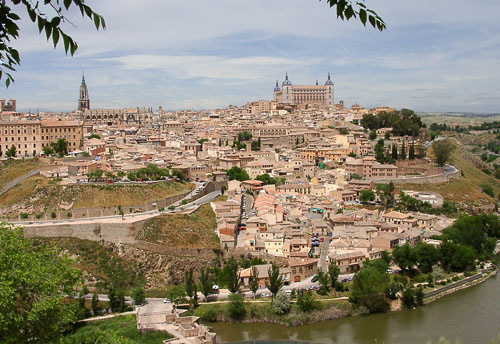
For a little diversion, here is a photo of Toledo, Spain. Toledo is less than 50 miles south of Madrid. The Tagus River flows on three sides of the city. The large building on the hill is the Alcazar. A fortress has been located here since Roman times.

Toledo, Spain. Photo by Ferrell Jenkins.

Toledo, Spain. Photo by Ferrell Jenkins.

I can’t get to my computer!

It was not possible to get much computer work done yesterday. Our almost-four-year-old grandson was here Sunday night and Monday. You can see from this photo that he took over the computer for his games. Not really. We had lot’s of fun doing a variety of things.

Drew takes over the study.

Drew takes over the study.

I am reminded of Psalm 128.

A Song of Ascents. Blessed is everyone who fears the LORD, who walks in his ways!
2 You shall eat the fruit of the labor of your hands; you shall be blessed, and it shall be well with you.
3 Your wife will be like a fruitful vine within your house; your children will be like olive shoots around your table.
4 Behold, thus shall the man be blessed who fears the LORD.
5 The LORD bless you from Zion! May you see the prosperity of Jerusalem all the days of your life!
6 May you see your children’s children! Peace be upon Israel! (ESV)

More on Damascus and Paul

It has been my pleasure to visit Damascus several times since 1967. David McClister, a colleague from the Biblical Studies department at Florida College, and I visited the city in May, 2002. We tried to identify the traditional places associated with Saul’s stay in the vicinity. Southwest of the city, within sight of Mount Hermon, and on the road toward Jerusalem, there is a Greek Orthodox chapel marking the site where Jesus spoke to Saul. We drove as far south toward Quneitra in the Golan Heights as the military would allow. We can not be sure that the chapel marks the exact spot, but we know it was nearby.

Off Straight street one can visit the house of Ananias. All we can say with certainty is that this is another of those uncertain traditional places. Luke tells us that Ananias went to the house of Judas where Paul was staying.

An ancient wall still surrounds much of the old city. A modern chapel is built into the wall to indicate the place where Paul was let down through a window when a plot was made to kill him (Acts 9:25; 2 Cor 11:32-33).

Saul (Paul) in Damascus

Damascus is first mentioned in the Bible at the time of Abraham (Gen. 14:15; 15:2-3). As the capital of Syria, the city had much contact with the kingdoms of Israel and Judah.

All of the New Testament references to Damascus are related to the conversion of Saul of Tarsus (Acts 9; 22; 26; 2 Cor. 11:32; Gal. 1:17). Saul had participated in the stoning of Stephen and was active in the persecution of the disciples of Christ in Jerusalem. He asked the high priest for authority to go to Damascus and seek out men and women who belonged to the Way and bring them bound to Jerusalem.

The Lord appeared to Saul as he approached Damascus and told him to go into the city where he would be told what he must do (Acts 9:6). Saul stayed at a house on the street called Straight. Ananias came to him and told him to arise and be baptized so that his sins might be washed away (Acts 22:16; 9:18). Saul stayed with the disciples for several days and immediately began to proclaim Jesus in the synagogues as the Son of God (9:20).

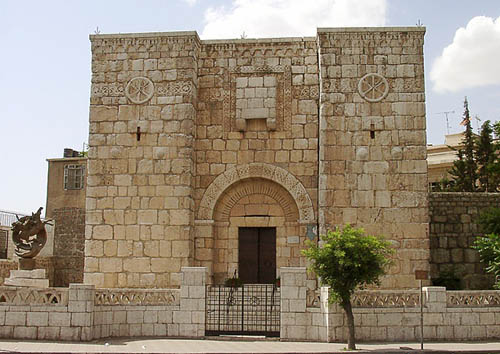
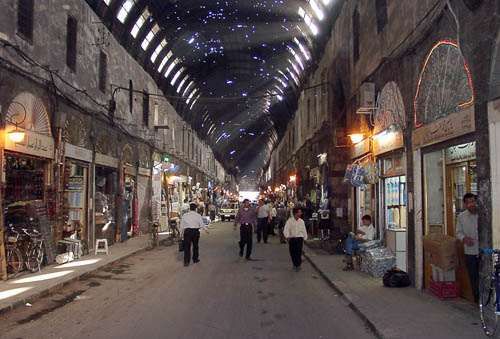
The street called Straight (Acts 9:11), the ancient Via Recta of the Roman city, now lies about 20 feet below the present street which runs the length of the old city, east to west. At the east end of the street a Roman gate has been elevated to the present level and partially restored. A small monumental arch can be seen near the middle of the street.

The photo below is one I made on Straight Street in 2002. This is not the main shopping street in the old city, but is historically significant.

The street called straight in Damascus. Photo by Ferrell Jenkins.

The street called straight in Damascus. Photo by Ferrell Jenkins.