Mohammed Ali Mosque in Cairo

Mohammed (or Mohammad) Ali Alabaster Mosque in Cairo. No, not the boxer. He took the same name. Mohammed Ali was an Albanian who played a prominent role in the history of Egypt during the 19th century. He brought numerous reforms to Egypt and his influence continued until the middle of the 20th century.
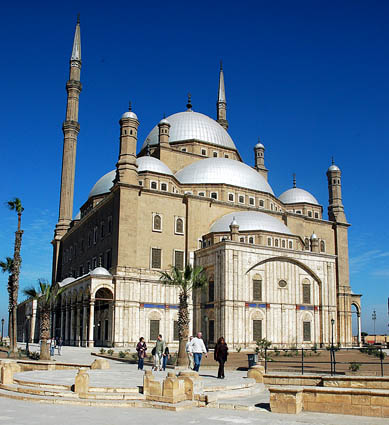
Mohammed Ali Alabaster Mosque in Cairo. Photo by Ferrell Jenkins.

Mohammed Ali Alabaster Mosque in Cairo. Photo by Ferrell Jenkins.

My first visit here was in 1967. I vividly recall sitting on the floor of the mosque with the others of my group listening to our guide, Ahmad, explain about the history of the mosque and answering any questions we had about the Muslim religion. Someone asked him if one was free to be a Christian in Egypt. He said, “Yes, if you are born a Christian you are free to be a Christian.” He went on to say that one would not make a change of religion unless there was some bad motive involved.

In many countries the preaching of the gospel of Christ is not freely allowed. The very nature of the gospel assumes that one must make a change in order to be acceptable to God. Jesus makes this clear in his discussion with the Jewish leader Nicodemus. A spiritual birth is necessary for one to become a Christian.

Jesus answered, “I tell you the solemn truth, unless a person is born of water and spirit, he cannot enter the kingdom of God. (John 3:5 NET)
Temples along the Nile River

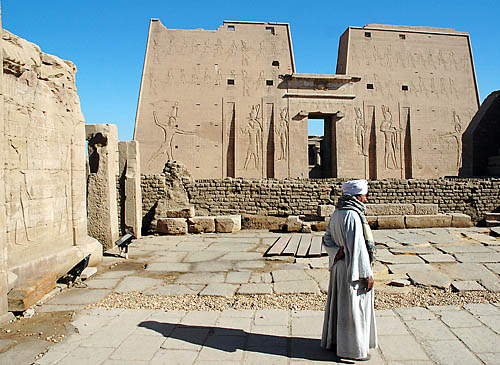
The temple of the sun god Horus at Edfu. Photo by Ferrell Jenkins.

The temple of the sun god Horus at Edfu. Photo by Ferrell Jenkins.

Edfu Temple. This is the temple of the sun god Horus who is represented by a falcon. The temple was begun by Ptolemy III in 237 B.C. and completed by 57 B.C. Ptolemy is portrayed repeatedly on the temple walls.

The Ptolemies were generally favorable to the Jews, whereas the Seleucids of Syria treated them unkindly during the period between the testaments. Ptolemy and Seleucus were generals of Alexander the Great who succeeded him in these area.

Interested in ancient Roman history?

I just ran across a website maintained by Jona Lendering that is meant to keep people updated about the websites LacusCurtius (maintained by Bill Thayer in Chicago) and Livius.Org.

The page that caught my attention has links to some photos of ancient Syracuse. Check here.

Paul and Luke stayed in Syracuse, Sicily, for three days on the voyage to Rome.

Putting in at Syracuse, we stayed there for three days. (Acts 28.12 ESV)

Syracuse is on my want list.

A fortnight in the oldest town in Texas

Since October 5-19 I have worked with the Stallings Drive Church of Christ in Nacogdoches, Texas, teaching a series of intensive Bible classes.

On Sunday morning and Wednesday evening, for a total of six lessons, we studied A Chronological Survey of the Bible. On Sunday evenings I presented three lessons on A Journey Through Ancient Lands. We discussed Eastern Turkey, Lebanon, and sites in the Sinai and Israel.

The center piece of the series was classes each Monday, Tuesday, and Thursday evening on Daily Life in Bible Times. These classes were two hours each evening.

We had a wonderful response to these classes, and it was a joy to be able to work with this good church in this way. I appreciate the vision of the elders in their willingness to plan such an effort. In too many churches Bible classes are taught on a level of mediocrity. There should be classes for the babes in Christ, but there should be classes that challenge those who have studied at the same level over and over.

Randy Harshbarger has been working with the church at Stallings Drive for about 15 years. He is loved by the church and, with his wife Marilyn, is doing a good work. Randy is allowed time each year to preach overseas in Russia, Italy, Ethiopia, and other places. He has begun a blog to report on his trips in Ethiopia. In between those trips you can expect some good inspirational lessons. Check it here.

Nacogdoches is the oldest town in Texas, and the home of Stephen F. Austin State University. A large number of college students attend at Stallings Drive. I was able to attend one of the football games and see SFA thrash Kentucky Weslyan.

I was treated royally while in Nacogdoches, but it is always good to be back to home base.

The church as a solid bulwark

The apostle Paul wrote these words to the saints at Colossae:

For though I am absent in body, yet I am with you in spirit, rejoicing to see your good order and the firmness of your faith in Christ. (Colossians 2:5 ESV)

J. B. Lightfoot suggested that the term stereoma [firmness] was a military metaphor. He says that Paul’s companionship with soldiers of the praetorian guard (Philippians 1:13) might have suggested the image.

I always enjoy William Barclay’s comments on words. He makes the following comments on order and firmness.

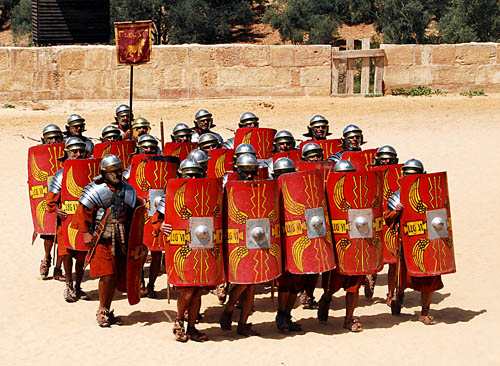
These two words present a vivid picture, for they are both military words. The word translated order is taxis, which means a rank or an ordered arrangement. The Church should be like an ordered army, with every man in his appointed place, ready and willing to obey the word of command. The word translated firmness is stereoma, which means a solid bulwark, an immovable phalanx. It describes an army set out in an unbreakable square, solidly immovable against the shock of the enemy’s charge. Within the Church there should be disciplined order and strong steadiness, like the order and steadiness of a trained and disciplined body of troops.

These soldiers from the Roman Army and Chariot Experience at Jerash, Jordan, demonstrate what is meant by the term firmness (stereoma).

Soldiers in formation as a solid bulwark. Photo by Ferrell Jenkins.

Soldiers in formation as a solid bulwark. Photo by Ferrell Jenkins.

Take our poll

Baalbek – Roman Heliopolis

In the early days of my travel to the Middle East (1967-1975) our groups always visited Baalbek. From Beirut on the beautiful Mediterranean we drove  through the Lebanon Mountains.to the Beka Valley where Baalbek is located. This valley is more than 3800 feet above sea level. The headwaters of the Orentes and Libani rivers are in this valley.

In Roman times Baalbek was called Heliopolis, the City of the Sun. The ruins at Baalbek are among the most impressive in the world. There are three temples: (1)  Jupiter; (2) Baachus; (3) Venus.

In the quarry near Baalbek there is a stone which is estimated to weigh 2,000 tons,. It often suggested that it is the largest hewn stone in the world. The stone is 70 1/2 feet long x 13 3/4 feet high x 15 3/4 feet wide.

My last visit to Baalbek was in 2002. The Beka Valley was a Hezbollah stronghold and was filled with soldiers and artillery, all pointed south.

I would like to see peace prevail in Lebanon for many reasons. The one I will mention here is that it would allow many people of the West the opportunity to see the wonderful sites of the country, including Baalbek.

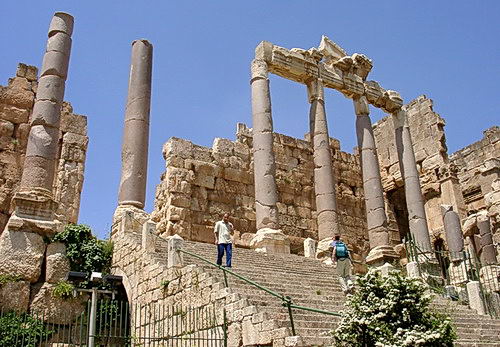
This photo is of the reconstructed propylaea, the monumental gateway, leading to the temple platform.

The reconstructed propylaea of Roman Baalbek. Photo by Ferrell Jenkins.

The reconstructed propylaea of Roman Baalbek. Photo by Ferrell Jenkins.

Dog River in Lebanon

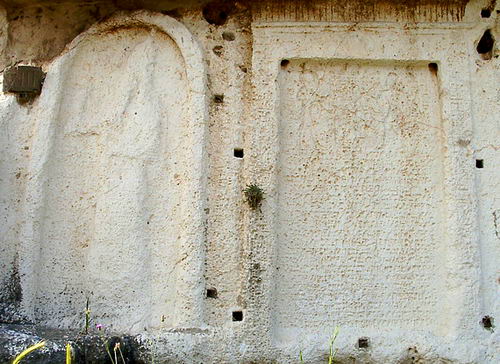
The Nahr el Kelb, the River of the Dog, flows into the Mediterranean Sea about nine miles north of Beirut, Lebanon. In antiquity the river was known as the Lycus. Many important armies have traveled through this pass in the Lebanon mountains leaving their inscriptions on the cliffs.

There are inscriptions or reliefs from the following ancient rulers:

  • Egyptian Pharaoh Ramses II.
  • Assyrian kings Shalmaneser III and Esarhaddon.
  • Babylonian king Nebuchadnezzar.

Shalmaneser III took tribute from Jehu, the king of Israel,  841 B.C. Wright says,

“The tribute was evidently received after Shalmaneser’s fifth attack on Damascus, following which he had marched his army into Phoenicia. While there he says that he received the tribute of Tyre, Sidon, and Jehu, and placed his portrait on the cliff of Ba’ lira’ si. This portrait, along with those of other kings, including Rameses II of Egypt…” is located at Dog River, north of Beirut. (Biblical Archaeology, 158-159).

Jehu was king of Israel in the 9th century B.C. (2 Kings 9). The Bible does not record this event, but the annals of Shalmaneser III record the following information:

“…I (also) marched as far as the mountains of Ba’li-ra’si which is a promontory (lit.: at the side of the sea) and erected there a stela with my image as king. At that time I received the tribute of the inhabitants of Tyre, Sidon and of Jehu, son of Ornri.” (ANET, 280)

This photo, made in 2002, shows the reliefs left by Salmaneser III and Ramses (right).

Reliefs of Shalmaneser III and Pharaoh Ramses at Dog River. Photo by Ferrell Jenkins.

Reliefs of Shalmaneser III and Pharaoh Ramses at Dog River. Photo by Ferrell Jenkins.

Byblos in Lebanon

Byblos is located on the Mediterranean Sea about 25 miles north of Beirut, Lebanon.The ancient Phoenician city of Gebal (modern Arabic Jbeil) was called Byblos by the Greeks because they saw scrolls there made from imported papyrus sheets. The Greek word byblos is translated book in our English versions of the Bible. In fact, our word Bible is derived from the work byblos.

The Gebalites worked with the builders of  Solomon and Hiram to fashion and prepare timber and stone to build the temple (1 Kings 5:17-18). The old men of Gebal are mentioned in the lamentation over Tyre.

The elders of Gebal and her skilled men were in you, caulking your seams; all the ships of the sea with their mariners were in you to barter for your wares. (Ezekiel 27:9 ESV)

Byblos is now designated as a UNESCO World Heritage Site. The history of Byblos is revealed in the excavated ruins.

  • Canaanite or Phoenician ruins as early as 3000 B.C.
  • Egyptian ruins from about 1300 B.C. Rib Addi, king of Byblos wrote letters to Pharaoh Amenophis III to request reinforcements against his neighbors. These letters are part of the collection of letters found at Amarna.
  • Roman ruins from the time of Pompey, about 65 B.C.
  • Crusader ruins from the 12th century A.D.

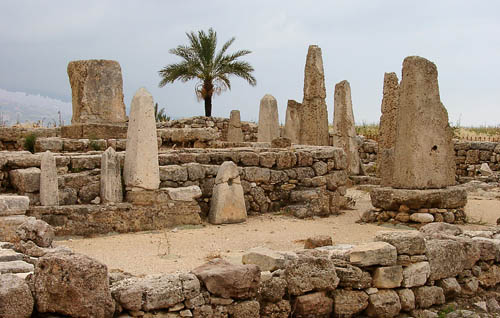
My last visit to Byblos was in 2002. This is a photo I took of the Egyptian Temple of Obelisks which was dedicated to the Egyptian god Reshef.

The Temple of Obelisks at Byblos. Photo by Ferrell Jenkins.

The Temple of Obelisks at Byblos. Photo by Ferrell Jenkins.

Zaccheus climbed up into a sycamore tree

The sycamore (Ficus sycomorus) is a type of tree growing only in the Jordan Valley and near the Mediterranean coast. The sycamore is pictured as growing in abundance in the shephelah (lowland, 1 Kings 10:27). This is in contrast to cedars which Solomon planted in Jerusalem.

The sycamore is not the same as the tree by that name that grows in North America. The sycamore tree belongs to the nettle family, like the mulberry and fig trees. The fruit looks like a fig, but the taste is unpleasant. It is eaten by the poor. See Fauna and Flora of the Bible, 179-81.

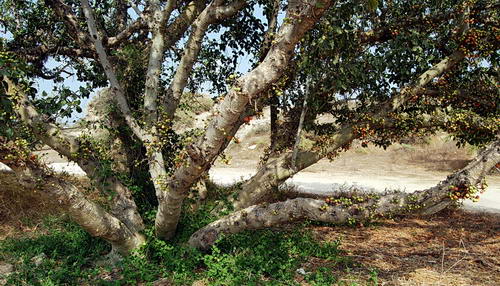
Zaccheus climbed up into a sycamore tree at Jericho (Luke 19:4). Here is a sycamore tree at Ashkelon that reminded me of Zacchaeus. The limbs are low. Even a child could climb into the tree to get a better view.

Sycamore tree at Ashkelon. Photo by Ferrell Jenkins.

Sycamore tree at Ashkelon. Photo by Ferrell Jenkins.

Amos the prophet, who lived at Tekoah on the edge of the Judean wilderness, spoke of working with the sycamore fruit.

Amos replied to Amaziah, “I was not a prophet by profession. No, I was a herdsman who also took care of sycamore fig trees. (Amos 7:14, NET Bible).

This photo shows the sycamore figs on the tree.

Sycamore figs. Photo by Ferrell Jenkins.

Sycamore figs. Photo by Ferrell Jenkins.