Category Archives: Turkey

Green pastures and quiet waters

Psalm 23 is one of the best known and most loved chapters of the Bible. In it David describes his relationship to the LORD under the analogy of a sheep and his shepherd.

The LORD is my shepherd, I shall not be in want. He makes me lie down in green pastures, he leads me beside quiet waters, he restores my soul. He guides me in paths of righteousness for his name’s sake. Even though I walk through the valley of the shadow of death, I will fear no evil, for you are with me; your rod and your staff, they comfort me. (Psalm 23:1-4 NIV)

This Psalm  describes one of the common scenes in certain parts of the Middle East. Our photo was made in the mountains of ancient Urartu (Ararat) in eastern Turkey. Notice especially the green pastures and the quiet waters.
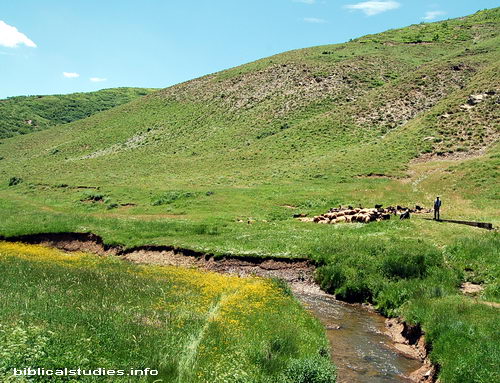
A shepherd provides green pastures and quiet water for his sheep. Photo by Ferrell Jenkins.

A shepherd provides green pastures and quiet water for his sheep. Photo by Ferrell Jenkins.

Jesus called Himself the “good shepherd” (John 10:11, 14). Jesus wants the same of elders or overseers in the local church, and He reminds them that it is God’s flock and that He is the Chief Shepherd (1 Peter 5:4).

To the elders among you, I appeal as a fellow elder, a witness of Christ’s sufferings and one who also will share in the glory to be revealed:  Be shepherds of God’s flock that is under your care, serving as overseers– not because you must, but because you are willing, as God wants you to be; not greedy for money, but eager to serve;  not lording it over those entrusted to you, but being examples to the flock. (1 Peter 5:1-3 NIV)

Good shepherds serve God’s flock willingly to provide food, care, and protection for the sheep. The concept of “lording it over” the flock or “domineering” is foreign to the spirit of a good shepherd. Overseers lead the flock by their example of godliness.
Epaphras worked hard for the Laodiceans

Laodicea is mentioned only in Paul’s epistle to the Colossians (2:1; 4:13-16) and in the Revelation of John (1:11; 3:14). Paul says that Epaphras worked diligently for the saints in Colossae, Laodicea, and Hierapolis.

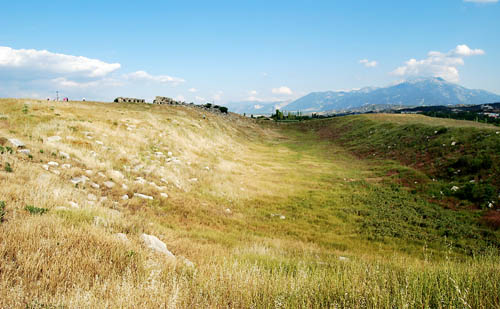
Here is a photo of the ruins of the stadium at Laodicea. Mount Cadmus can be seen in the distance to the east. Colossae was located at the foot of Mount Cadmus. Hierapolis was located to the north of Laodicea.

The stadium at Laodicea. Photo by Ferrell Jenkins.

The stadium at Laodicea. Photo by Ferrell Jenkins.

The stadium was an enclosed structure used for gladiatorial games. An inscription tells that a wealthy family dedicated it to Vespasian and Titus. One still can make our the unexcavated ruins of the 1000 feet long stadium.

The museum at Hierapolis

There is a small, but nice, museum at Pamukkale (ancient Hierapolis, Colosians 4:13). It is housed in a second century Roman bath house. The exhibits indicate a large Roman presence in the area during the second and third century A.D.

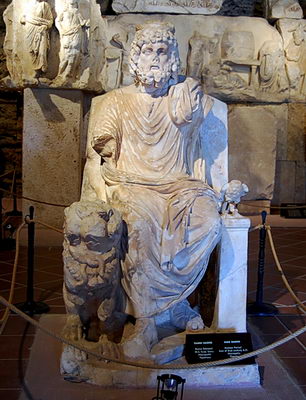
The museum has the nicest statue of the “god” Hades that I have seen.

The god Hades in the Pamukkale Museum. Photo by Ferrell Jenkins.

The god Hades in the Pamukkale Museum. Photo by Ferrell Jenkins.

Hades was known in Greek mythology as the lord of death and the god of the underworld or nether world. The term hades is used in the New Testament of the abode of the souls of the wicked prior to the judgment. Note the comments by William Hendriksen.

As to the word “hell,” which here in the original is Gehenna (and so also in [Matthew] 5:22, 29, 30; 18:9; 23;15, 33; Mark 9:43-47; Luke 12:5; James 3:6), it generally refers to the abode of the wicked, body and soul, after the judgment day. When the same abode is called Hades the references is to the time before the judgment day, though Hades also has other meanings in Scripture. (New Testament Commentary: Exposition of the Gospel According to Matthew 472).

The Book of Revelation makes it clear that Jesus has control over both Death and Hades.

When I saw Him, I fell at His feet like a dead man. And He placed His right hand on me, saying, “Do not be afraid; I am the first and the last,  and the living One; and I was dead, and behold, I am alive forevermore, and I have the keys of death and of Hades. (Revelation 1:17-18 NAU; see also 6:8; 20:13, 14)

The traveler of Hierapolis

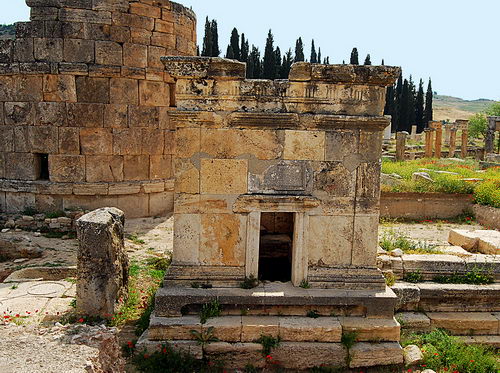
The tomb of a merchant named Flavius Zeuxis at Hierapolis is often called the “Traveler’s Tomb.” The marble inscription above the entrance states that he circumnavigated the southern cape of Peloponnesus 72 times on his way to Italy. It has been estimated that this would have amounted to about 150,000 miles.

The tomb of Flavius Zeuxis at Hierapolis. Photo by Ferrell Jenkins.

The tomb of Flavius Zeuxis at Hierapolis. Photo by Ferrell Jenkins.

This gentleman was roughly contemporary with the Apostle Paul, but he traveled more miles than Paul.

Paul spoke of the dangers associated with his many journeys.

I have been on journeys many times, in dangers from rivers, in dangers from robbers, in dangers from my own countrymen, in dangers from Gentiles, in dangers in the city, in dangers in the wilderness, in dangers at sea, in dangers from false brothers (2 Corinthians 11:26)

Hierapolis, Philip and Papias

Early tradition associates Philip with the city, but scholars differ over whether it was Philip the apostle (Matthew 10:3) or Philip the evangelist (Acts 21:8).

This was the home of Papias (about A.D. 60 to 130) who was a disciple of the apostle John and a companion of Polycarp. Fragments of his writings about the apostles survive in Irenaeus and Eusebius of Caesarea. Eusebius (about A.D. 265 − about A.D. 339), tells us that Papias wrote as follows:

“Matthew also issued a written Gospel among the Hebrews in their own dialect, while Peter and Paul were preaching at Rome, and laying the foundations of the Church. After their departure, Mark, the disciple and interpreter of Peter, did also hand down to us in writing what had been preached by Peter. Luke also, the companion of Paul, recorded in a book the Gospel preached by him.” He adds that John, the disciple who leaned on Jesus’ breast, published a Gospel from Ephesus (Against Heresies III.1.1).

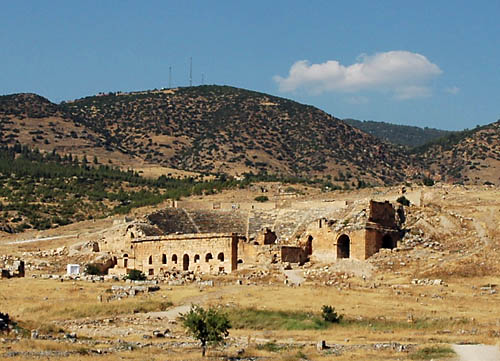
Some things of interest to see at Hierapolis include the hot springs and limestone formations, the monumental Arch of Domitian and Roman Street. This entire region suffered from the policies of the Emperor Domitian. The photo below shows the theater set against the surrounding hills.

Roman theater at Hierapolis. Photo by Ferrell Jenkins.

Roman theater at Hierapolis. Photo by Ferrell Jenkins.

The theater was built in the 2nd century A.D., renovated in the 3rd century, and again in the 4th century.

During the 4th-century renovations, the orchestra area of the theater was altered to allow it to be filled with water for staging mock naval battles and other water presentations. (Fant and Reddish, A Guide to Biblical Sites in Greece and Turkey, 213)

The hot springs at Hierapolis

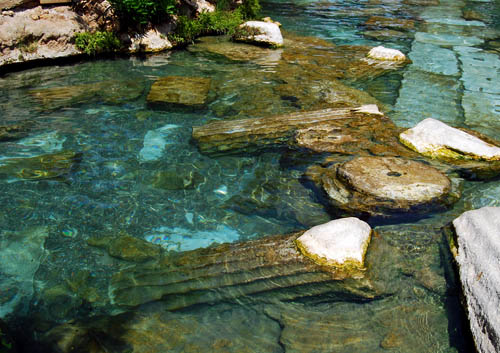
The hot springs at Hierapolis caused the city to be known for its textile industry. There were guilds of wool workers, carpet weavers, and purple dyers. The hot medicinal springs (95°) attracted visitors. The city prospered under the Romans, but often suffered from earthquakes.

Ruins of the Roman city of Hierapolis in the hot springs. Photo by Ferrell Jenkins.

Ruins of the Roman city of Hierapolis in the hot springs. Photo by Ferrell Jenkins.

Recall that Hierapolis is one of three cities of the Lycus River valley named in the New Testament.

For I can testify that [Epaphras] has worked hard for you and for those in Laodicea and Hierapolis. (Colossians 4:13 NET)

Hierapolis and the Lycus River Valley

Hierapolis is mentioned only once in the New Testament. Paul commends Epaphras, who seems to be from Colossae, for his burdensome labor for the churches of the Lycus River Valley. He says,

For I bear him witness that he has worked hard for you and for those in Laodicea and in Hierapolis. (Col. 4:13 ESV)

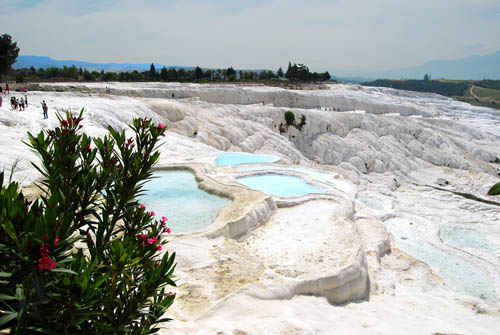
The name Hierapolis means “holy city.” The modern Turkish name is Pamukkale, meaning “cotton castle” or “cotton fortress.” The city is famous for the hot springs and the limestone formations that cascade down the hillside below the city.

Limestone formations at Hierapolis. Photo by Ferrell Jenkins.

Limestone formations at Hierapolis. Photo by Ferrell Jenkins.

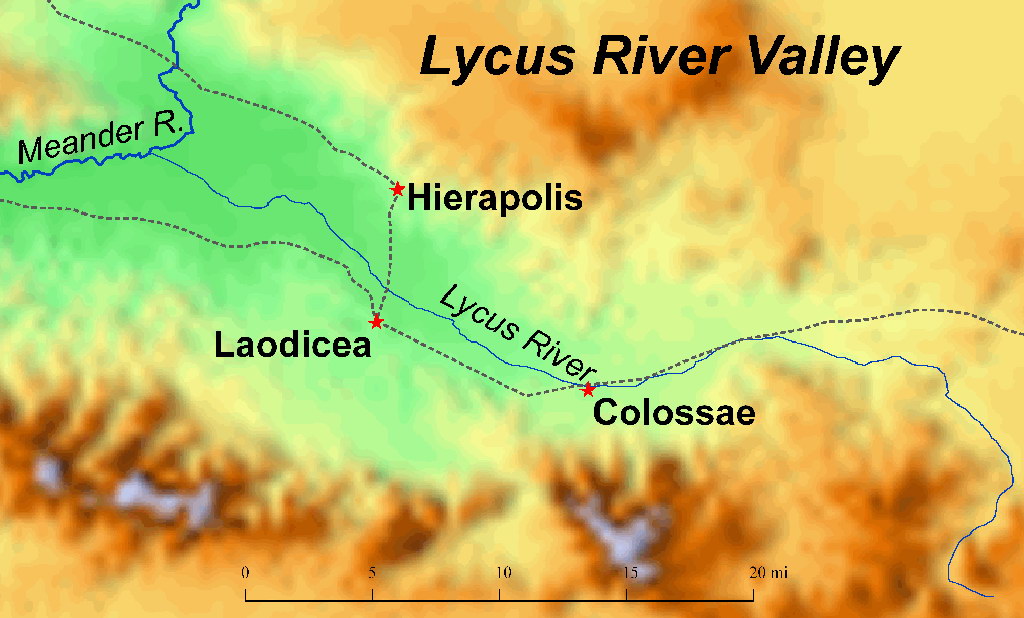
The Lycus valley is in extreme southwestern Phrygia, Asia Minor. Hierapolis is situated on a plateau about 600 feet above the valley floor. Hierapolis, Colossae, and Laodicea form a triangle in the valley. From Hierapolis to Laodicea is about 6 miles south. The sites can be seen across the valley. From Laodicea to Colossae is about 10 miles to the southwest. From Colossae it is about 12 miles to Hierapolis.

The Lycus River Valley.

The Lycus River Valley.

Click on the map for a copy large enough to use in a PowerPoint presentation. Detailed maps of the area around Hierapolis, Laodicea, and Colossae are not usually found in maps found in Bibles, or even atlases. I used Bible Mapper to make this map showing the three cities of the valley. The Lycus river begins south east of Colossae, flows through the valley to join the Meander River. The Meander flows west to the Aegean Sea at Miletus. The dotted lines show the major roads traversing the valley.

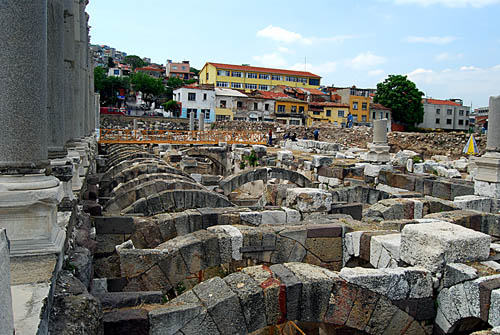
Cinema fire reveals Roman wall in Izmir (Smyrna)

A report from Izmir says that a cinema (movie theater) burned down in Izmir, Turkey, revealing portions of an 11 meter Roman wall and arch.

Archaeologist Akın Ersoy, the leader of a local excavation team, said this new discovery proved the importance of the agora, a meeting place in ancient times. Stating that Izmir had become synonymous with agoras, Ersoy said: “(The excavation) of the agora is the best heritage to leave behind for future generations. With the support of Izmir Metropolitan Municipality, the environment of the Izmir agora, one of the biggest and oldest agoras in the world, has been opened up and can now be seen by people from the Çankaya neighborhood. We have not started work on the wreckage of the cinema building yet but we believe this ancient site is two times bigger than the local agora site.”

The full account is carried in Hurriyet Daily News.

Always a good reason to return to a site. Here is a photo of the lower level of the agora in Izmir. Notice the older buildings along the edge of the agora. If the city of Izmir would clear and excavate this entire area the city would have a real reason for many tourists to visit the city.

Looking over the lower level of the Izmir Agora. Photo by Ferrell Jenkins.

Looking over the lower level of the Izmir Agora. Photo by Ferrell Jenkins.

The Turkish city of Izmir is known as Smyrna in Revelation 1:11, 2:8.

HT: RogueClassicism.

Do the work of an evangelist

This morning I am scheduled to speak at the Florida College annual lectures on the subject “Do the Work of an Evangelist.” I thought I would share a tiny section of the material I have prepared in a part of the lecture dealing with the importance of preparation (next two paragraphs).

The evangelist must be an approved workman who can handle accurately the word of truth (2 Tim. 2:15). A. T. Robertson wrote a small book nearly 90 years ago entitled Types of Preachers in the New Testament. He began with a chapter on “Apollos the Minister with Insufficient Preparation.” Apollos was eloquent (learned, cultured) and “mighty in the Scriptures” (Acts 18:24). We understand that his knowledge was incomplete, but that he was willing to learn. Robertson’s comment is apropos for today.

There is hope for the man who is ready to learn. One is never too old to learn. The minister who is always learning will always have a hearing. There is no deadline for him. That comes the minute one stops learning. Apollos is a rebuke to the preacher who is content to preach his old sermons through the years without reading the new books or mastering the old ones. Here is a profound student of the Scriptures, a master in Old Testament interpretation, who is glad to sit at the feet of Priscilla and Aquila and learn more of Jesus. That is the place for all of us, at the feet of anyone who can teach us more about Jesus. We cannot know too much about Him. We cannot be too accurate in our knowledge of Him. (24)

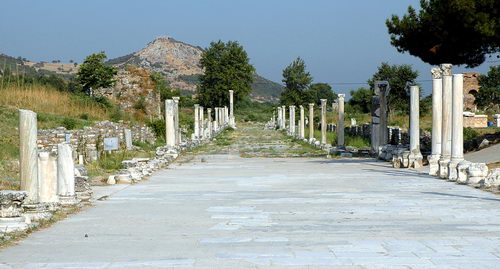
Paul, Timothy, Apollos, Priscilla and Aquila were all associated with the work of the gospel at Ephesus (Acts 18:24-19:1; 1 Timothy 1:3). The photo below shows the ruins of the Arcadian Way. This street led from the theater to the harbor. The harbor is now dry, but must have been used by all of these characters in their contact with the city of Ephesus.

The Arcadian Way at Ephesus. Photo by Ferrell Jenkins.

The Arcadian Way at Ephesus. Photo by Ferrell Jenkins.

Thanks for following our tours

Thanks to your interest we noticed an increase in readers during our trip to Egypt. We appreciate your interest in the subjects we write about.

A blog is different from a web page. On a web page, such as the Biblical Studies Info Page, there are many categories and pages available. When you check the blog you see the last entry at the top of the page. You must click on the Archives listing, or use the Search Box to locate earlier posts.

A list of some other trips we have covered on this blog might be helpful to you (from the most recent to the earliest).

  • Egyptian Adventure (begin January 16, 2009).
  • Israel (personal study) trip (begin August 20, 2008).
  • Steps of Paul and John (Greece and Turkey) (May, 2008).
  • Bible Land Tour of Israel and Jordan (April, 2008).
  • Scotland Highlights (September 2007).
  • Biblical & Historical Sites in Turkey (May and June, 2007).

The purpose of these trips is educational. We seek to relate the history and the land to the biblical account.

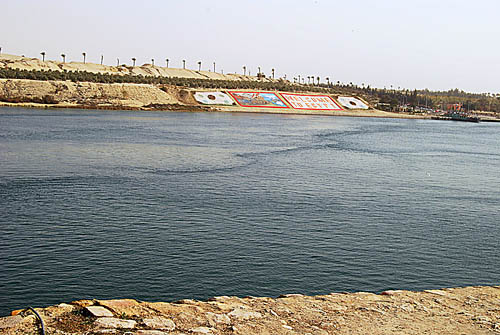
Suez Canal near Ismailia. Photo by Ferrell Jenkins.

Suez Canal near Ismailia. Photo by Ferrell Jenkins.

This view of the Suez Canal at Ismailia looks from the east to the west. The ancient Egyptians dug numerous canals in the general area. This modern canal was officially opened November 17, 1869.

We would like for you to continue to check the blog several times a week as we write about other matters of interest to Bible students.