Category Archives: Turkey

Keeping informed

Egyptian Antiquities. Keep up with breaking news about Egyptian antiquities at Andie Byrnes’ the Egyptology News.

Tomb of the Prophet Zechariah at the Madras Ruins. See the report of the Israel Ministry of Foreign Affairs here. James Davila raises lots of questions about this report. See his Feb. 3, 2011, post here.

HT: Paleojudaica

Photos of Turkey and Greece. Mark Hoffman is making available some nice photos of his recent trip in Turkey and Greece. Read, and find the link to the photos here. The photos are geotagged so you may spot the location in Google Earth.

Birdwatching in Israel.

“There were some 25,000 cranes crowded around us this evening,” reports Judith Schwartz, a Kibbutz Ginosar resident. “One night last week there were 42,000. Your eyes can’t quite believe what you’re seeing. They stand in the lake all night, safe from the bobcats in the area. And here they rest, and lift off in their masses at dawn, blackening the sky like a swarm of gigantic locusts, to continue their 5,000 mile trip to their winter home in Africa.”

At least 500 million birds of 200 different species fly across Israel each spring and fall on their way to and from Africa, Europe and Asia, says Dr. Reuven Yosef, director of Eilat’s International Birding and Research Center. And more than 70 native Israeli species head to warmer Africa in winter, such as the cuckoo, Egyptian vulture, short-toed eagle, hobby and lesser kestrel.

See the full article here.

HT: BiblePlaces Blog

Another shipwreck in the Mediterranean

We see more reports of bad weather in the Mediterranean and the effect it is having on shipping. Note today’s report in Hürriyet, Turkey’s English Daily here.

Stormy weather in Antalya caused a cargo ship to run aground Thursday, leaving one person missing, and may also have contributed to the death of a woman whose body was found in the area.

The vessel, named “Seabright,” had been en route from the Tarsus Port in Adana province to Egypt with a crew of 18 people when it crashed into the rocks in a central part of the Mediterranean province of Antalya, the Anatolia news agency reported Friday.

Did you notice the references to Tarsus and Antalya? This brings to mind the work of the Apostle Paul. Tarsus in Cilicia was the home of Paul (Acts 9:11; 21:39; 22:3). Antalya is identified with Attalia, a coastal city a short distance west of Tarsus (Acts 14:25). Perga, mentioned in the same verse, is nearby.

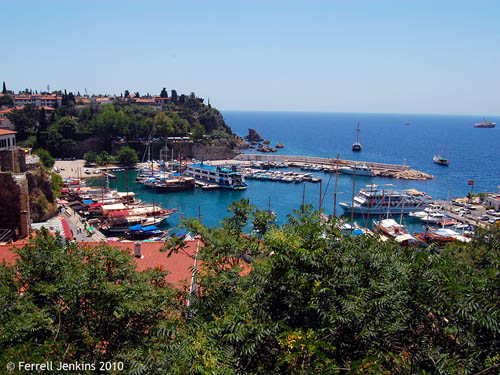
Pleasure harbor at Antalya, Turkey. Photo by Ferrell Jenkins.

Pleasure harbor at Antalya, Turkey. Photo by Ferrell Jenkins.

Mark Wilson writes of Antalya,

The modern city covers the ancient site so few ancient ruins are visible. Those remaining are around the harbor in the old city called Kaleiçi. (Biblical Turkey, 81).

When Paul sailed from Caesarea to Rome his ship went along the southern coast of Asia Minor, modern Turkey. Imagine the effect of this type of storm on a ship dependent on sails for its navigation.

Earlier in the week we noted the effect of dangerous storms in the Eastern Mediterranean. Scroll down for posts about Caesarea, Ashkelon, and Alexandria.

Attending the Near East Archaeological Society

For the past few days I have been attending the annual meeting of the Near East Archaeological Society and the Evangelical Theological Society. NEAS is a small organization which meets in association with the ETS each year. This gives one the opportunity to attend meetings of either society. ETS has grown tremendously over the years that I have attended — first about 1976, I think. This year more than 2600 persons registered for the meeting. Even though I no longer teach, I like to attend these meetings in order to keep abreast of recent scholarship in areas in which I have special interest.

Among the lectures I heard at NEAS are the following:

Douglas Petrovich (University of Toronto) presented an impressive lecture on “More signs of societal upheaval in Egypt during the days of Joseph.”

Randall Price (Liberty University) was scheduled to make a presentation on Messiah in the Temple: A New 3-D Digital Computer Model of the Second Temple based on historical and archaeological data,” but his co-presenter was not able to make the trip from Germany. Dr. Price gave a presentation in refutation of the recent claims of a Chinese group who claimed they had found Noah’s ark on Mount Ararat.

Mark Wilson (Asia Minor Research Center) and Nadin Burkhardt (University of Frankfurt) spoke about the new excavation of the Priene synagogue (in Western Turkey).

Steven Ortiz (Southwestern Baptist Seminary) spoke about the most recent excavations at Gezer. Dr. Ortiz is one of the directors of the dig where much evidence from the 9th and 10th century B.C. is coming to light.

Eric Mitchell (Southwestern Seminary) told about the landscape archaeology associated with the current excavations at Gezer.

Bryant G. Wood (Associates for Biblical Research) presented the finds from the 2009 and 2010 seasons at Khirbet el-Maqatir. Wood thinks that this site is an excellent candidate to be identified with biblical Ai, rather than the generally accepted site at Et-Tell. Wood is director of this dig in the Palestinian West Bank.

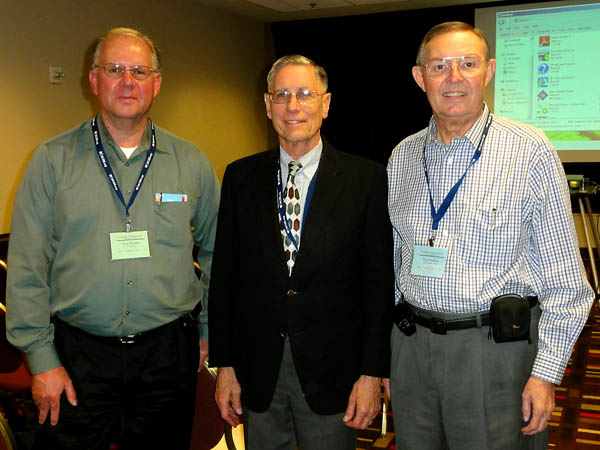
I asked Michael Luddeni, photographer for Bible and Spade and several excavation projects, to make a photo of Leon Mauldin and me with Dr. Bryant Wood.
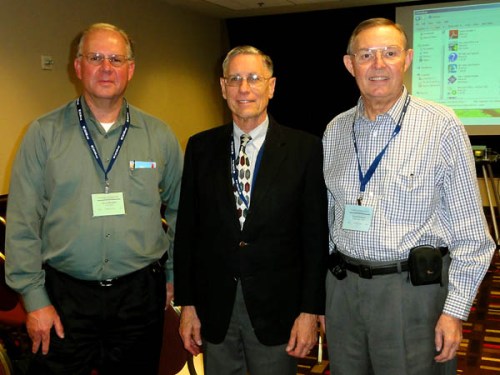
Leon Mauldin, Dr. Bryant Wood, Ferrell Jenkins at NEAS annual meeting.

Leon Mauldin, Dr. Bryant Wood, Ferrell Jenkins at NEAS annual meeting.

Steven Collins (Trinity Southwestern University) made an excellent presentation on the rise and ruin of a bronze age city-state at Tall el-Hammam, Jordan. Collins is director of this dig.

James H. Charlesworth (Princeton Theological Seminary) was an invited speaker who gave a lecture on two Herodian pools north and south of the Jerusalem temple as they relate to the Gospel of John (chs. 5 and 9). These, of course, were the pools of Bethesda and Siloam. He argued that both pools were mikvaoths (ritual pools) at the time.

There were other good lectures at NEAS. Some of these scholars make similar presentation at the ASOR or SBL meetings.

Among the lectures I heard at ETS, I found these two to be extremely good:

British scholar N. T. Wright (St. Andrews University) spoke on “Justification yesterday, today and tomorrow.”

Eugene H. Merrill (Dallas Theological Seminary) gave the presidential address at the banquet on “Old Testament Scholarship and the man on the street: whence and whither?”

When I was still teaching I attended lectures dealing primarily with the subjects I was actively teaching. Now I attend anything that strikes my fancy. Because I frequently travel to the Middle East I enjoy keeping up with the archaeological excavations in those areas.

Scientific study of “headless” gladiators

Discovery News reports here on a new study about the “headless” gladiators found in a cemetery at York, England, a few years ago.

Britain’s enigmatic “headless Romans” lost their heads far away from home, according to a multi-isotopic analysis of the 1,800-year-old skeletal remains.

Unearthed between 2004 and 2005 in a cemetery in York, England, the remains belong to 80 individuals, almost all males, who died violently at ages ranging between 19 and 45.

At least 46 of them had been carefully decapitated, with their heads placed by or between their legs or pelvis.

Believed by some to be gladiators, losing their heads after their last fight, the heavily built men were buried in one of the most prestigious cemeteries of York during the 2nd and 3rd century A.D.

A new scientific “multi-isotopic analysis of the skeletal remains” has shown that many of the men were from other parts of Britain and the Roman Empire. It is a fascinating technical study.

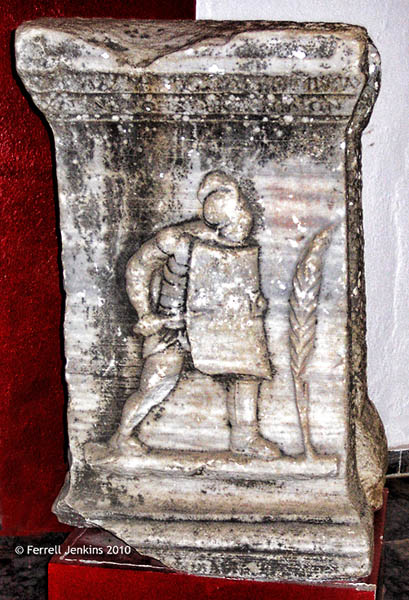
Gladiator at Ephesus. Photo by Ferrell Jenkins.

Gladiator at Ephesus. Photo by Ferrell Jenkins.

The Science Channel web site has a nice video in which Dr. Karl Großschmidt, Medical University of Vienna, discusses the discovery at Ephesus of skeletons belonging to 70 gladiators. Click here to view the video and a second one discussing the weapons used by the gladiators.  Großschmidt thinks that most of the men died in combat before the age of 35.

HT: David Padfield

In a post to follow I will discuss Paul’s use of the gladiator in one of his epistles.

A report today says that Pompeii’s house of gladiators collapsed Saturday morning. Check CNN.

Murex is not the only source of purple

Royal purple dye was made from the secretion of the Murex snail, typically found along the eastern Mediterranean coast, especially near Tyre.

In New Testament times (the first century A.D.), several cities in Asia Minor were noted as producers of dye. Colossae and Thyatira were located inland, far away from the Sea. These, and other cities of the region, made purple from the madder root.

Madder root, a source of purple in Turkey. Photo by Ferrell Jenkins.

Madder root, a source of purple in Turkey. Photo by Ferrell Jenkins.

The three colors shown in the yarn below come from the madder root. The darker color on the right might more closely resemble royal purple.

Yarn dyed with madder root. Photo by Ferrell Jenkins.

Yarn dyed with madder root. Photo by Ferrell Jenkins.

Thyatira was noted as a great center for the wool trade and for its dyeing industry. Lydia, the first convert of the gospel in Europe, was a native of Thyatira (in Asia). She seems to have represented this industry in Philippi. One inscription, found at Philippi in 1872, honored from among the purple dyers a man named Antiochus who was a “native of Thyatira” (Meinardus, St. John, 93).

The purple dye used around Thyatira was evidently a vegetable dye from the madder root which grew in abundance in the region. Hemer says that the madder root “was still cultivated in the district at least until the end of the last century.” The pigment is commonly called Turkey red. In addition to the colors shown in the yarn above, I am told by the Turkish carpet sellers that the “red” in this beautiful Turkish carpet comes from the madder root.

Carpet made from yarn made from the madder root. Photo by Ferrell Jenkins.

Carpet using yarn made from the madder root. Photo by Ferrell Jenkins.

Now when you read about Lydia as a seller of purpose you should think of the dye made from the madder root, or from the dyed products.

A woman named Lydia, a dealer in purple cloth from the city of Thyatira, who worshiped God, was listening. The Lord opened her heart to pay attention to what was spoken by Paul. (Acts 16:14 CSB)

Armenians gather in Turkey

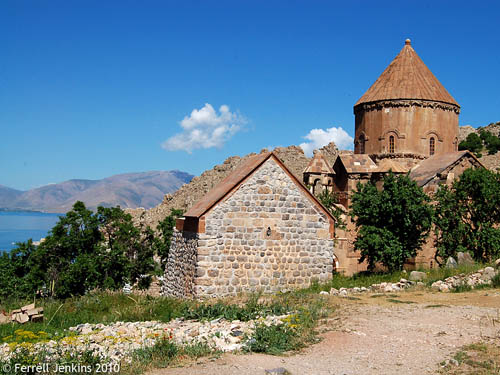
The 10th century Armenian church on Akdamar Island in Lake Van (Turkey) was restored and reopened as a museum by the Turkish government in 2007.  About three months after the opening I was able to visit the church.

Armenian Church on Akdamar Island in Lake Van. Photo by Ferrell Jenkins.

Armenian Church on Akdamar Island in Lake Van. Photo by Ferrell Jenkins.

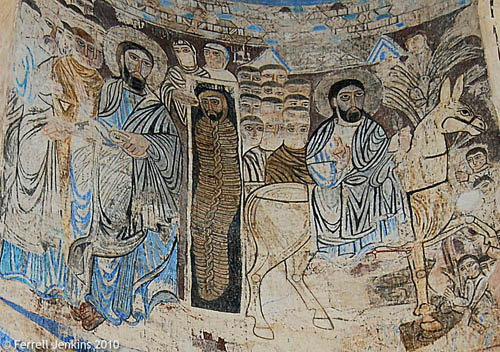
There are some marvelous frescoes and carvings of Bible stories inside and outside the church. The one pictured below shows the raising of Lazarus (John 11) and the Triumphal Entry of Jesus into Jerusalem (John 12). Scenes such as these served to remind those who saw them of the biblical accounts. An Armenian translation of the (Greek) Septuagint Old Testament “was made for the Christian communities of eastern Asia Minor” about A.D. 400 (Price, The Ancestry of Our English Bible, 3rd rev. ed., 119). The New Testament translation was made about the same time (198). Price says,

Armenian manuscripts are very numerous, probably more numerous than those of any other version except the Latin Vulgate.

Bible stories in the Akdamar Island church. Photo by Ferrell Jenkins.

Bible stories in the Akdamar Island church. Photo by Ferrell Jenkins.

Earlier this week USA Today reported that the Turkish government allowed several Armenian Christian pilgrims to visit the Akdamar church last Sunday. This was the first time a service had been held in the church since it was “abandoned during the mass killings of Armenians 95 years ago.”

The media has directed much attention lately to the problems of minority religions in Turkey. The CBS news show 60 Minutes included a feature about restrictions on the Greek Orthodox in Turkey a few weeks ago.

The region around Lake Van in eastern Turkey was the ancient region of Urartu, known as Ararat in the Bible.

  • Noah’s ark landed on the mountains of Ararat (Genesis 8:4).
  • The men who assassinated the Assyrian king Sennacherib fled into the land of Ararat (2 Kings 19:37 = Isaiah 37:38).
  • The kingdoms of Ararat may have joined other nations in the capture of Babylon (Jeremiah 51:27).

The potter’s right over the clay

In arguing that God has the right to do whatever He chooses, Paul uses the illustration of the potter and the clay.

But who are you, O man, to answer back to God? Will what is molded say to its molder, “Why have you made me like this?” Has the potter no right over the clay, to make out of the same lump one vessel for honorable use and another for dishonorable use? (Romans 9:20-21 ESV)

Potter molding a vessel at Avanos in Anatolia. Photo by Ferrell Jenkins.

Potter molding a vessel at Avanos in Anatolia. Photo by Ferrell Jenkins.

Our photo shows a potter molding a vessel, according to his own choosing, at Avanos in Turkey. Avanos, a town north of the region of Cappadocia, is famous for its potters. I am told that many homes have a potter’s wheel and the residents make some of the family income through pottery making.

The words of the LORD through the prophet Jeremiah are fitting:

Then the word of the LORD came to me: “O house of Israel, can I not do with you as this potter has done? declares the LORD. Behold, like the clay in the potter’s hand, so are you in my hand, O house of Israel. (Jeremiah 18:5-6 ESV)

We have included an image suitable for presentations for those who wish to use it in teaching.

Friday variety

Israel Photos. J P vd Giessen has been posting photos from a trip to Israel over the past few weeks at his Aantekeningen bij de Bijbel [Notes on the Bible] blog. You will find photos of Megiddo, Caesarea Maritima, Capernaum, Gamla and other places. Start here. I know, the blog is in Dutch. I follow the blog regularly. When I see something that is of special interest I go to Google Translate and paste in the article for a translation. It is not ideal, but it helps.

Turkey Photos. Ben Witherington III is posting photos of a recent trip to Greece and Turkey at his Bible and Culture blog. You will find photos of Corinth (Acts 18), Sagalassos, Assos (Acts 20:13-14), Alexandria Troas (Acts 16:8), Patara (Acts 21:1), Myra in Lycia (Acts 27:5), Cappadocia (Acts 2:9; 1 Pet. 1:1), and others. The site is not very user friendly, but you may find something of interest. Start here and then use the search box.

Tell es-Safi/Gath. Prof. Aren Maeir has posted several aerial photos of Tell es-Safi/Gath made at the end of the 2010 archaeological excavation season. If you look soon you may just scroll back through the photos here.

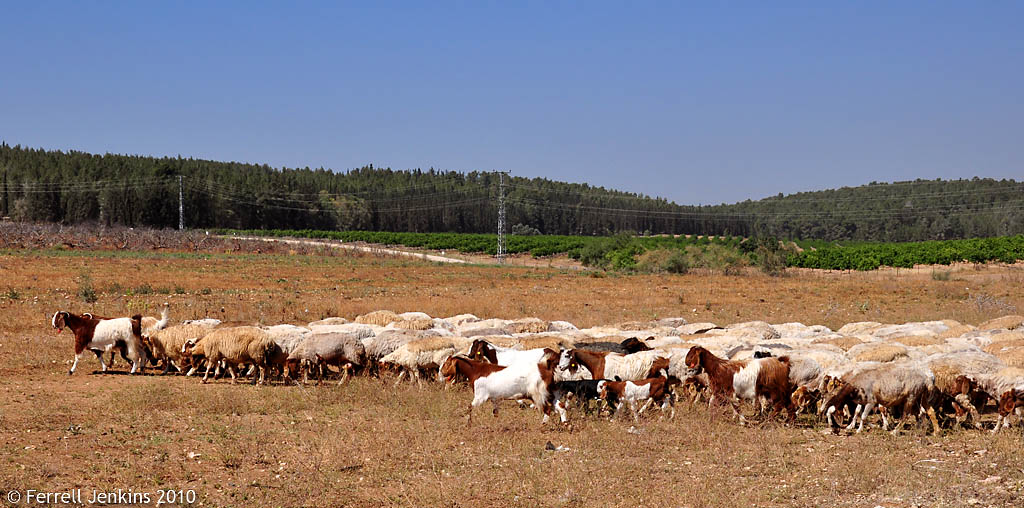
Our photo was made just below Tell es-Safi/Gath just after crossing the Elah brook. This shows the beginning of the coastal plain.

Sheep and goats at Tell es-Safi/Gath. Photo by Ferrell Jenkins.

Sheep and goats at Tell es-Safi/Gath. Photo by Ferrell Jenkins.

Greek, anyone? Rod Decker, a professor of Greek and New Testament, calls attention to some classic essays on using Greek in ministry. Perhaps some readers might find this helpful. Click here.

Passing through the grainfields

All three of the Synoptic Gospels record the incident of Jesus and His disciples passing through the grainfields on a Sabbath.

On a Sabbath, while he was going through the grainfields, his disciples plucked and ate some heads of grain, rubbing them in their hands. But some of the Pharisees said, “Why are you doing what is not lawful to do on the Sabbath?” (Luke 6:1-2 ESV)

I thought I would put together some photos to help you visualize what happened here. First, we have a photo of a wheat field below Mount Tabor. The photo is made looking north west from near the site of ancient En-dor. The area is famous as the home of the medium visited by King Saul (1 Samuel 28:7).

Wheat field below Mount Tabor. Photo by Ferrell Jenkins.

Wheat field with view NW to Mount Tabor. Photo by Ferrell Jenkins.

Now, imagine the disciples taking grain in their hands.

Picking heads of grain. Photo by Ferrell Jenkins.

Picking heads of grain. Photo by Ferrell Jenkins.

And then rubbing the heads to separate the grain from the chaff.

Rubbing grain to separate the head from the chaff. Photo by Ferrell Jenkins.

Rubbing grain to separate the head from the chaff. Photo by Ferrell Jenkins.

The last two photos were made in the vicinity of Mount Nemrut in eastern Turkey. Larger images, suitable for use in teaching, are available by clicking on the photos.

Things are not always what they seem

Surely I will receive a few links from friends who want to inform me that certain discoveries have been made that should be mentioned on this page. Because I am busy getting ready to leave the country I do not have time to write in detail. Please take a look at the links I suggest for reliable information.

Noah’s Ark Found. Yes, it was reported on major news outlets. See the following links:

Bible Places Blog by Todd Bolen.

Ben Witherington. Be sure to see the Bill Cosby clip, too.

Giant Skeleton Found. Michael Hasel discusses the report of the discovery of skeleton’s of giants in the recent issue of DigSight here. There is also good info on the Khirbet Qeiyafa excavation and ostracon.