Category Archives: Turkey

Sardis, Philadelphia, Laodicea, Colossae, and Hierapolis

There were many sites to see today. We left Izmir (Smyrna) in the morning and drove east to the site of ancient Sardis (Revelation 3:1-6). From there we continued to in a southeast direction to Philadelphia (Revelation 3:7-13). Then we made our way to the Lycus River valley. The first stop was at Colossae (Paul’s epistle to the Colossians). After viewing the ancient mound which still awaits excavation, we went to Laodicea (Revelation 3:14-22). On the way to the hotel we stopped for a photo of the cliffs at Pamukkale (ancient Hierapolis, Colossians  4:13). The name Pamukkale means  “cotton castle” or “cotton fortress.”

Mellink describes the formation here. He says the city,

… is famous for its continuing geological transformation. Hot mineral springs issue from the rock in the city, and the waters streaming down the cliffs have deposited limestone in large formations, the surface of which is made a gleaming white ‘frozen cascades’ (IDB II:601).
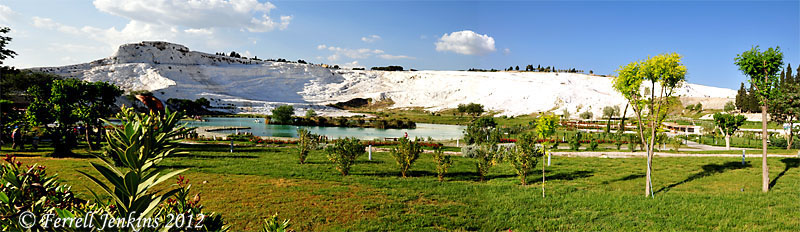
'Pamukkale 'frozen cascades'. Photomerge by Ferrell Jenkins.

‘Pamukkale ‘frozen cascades’. Photomerge by Ferrell Jenkins.

We could see the white hillside clearly from Laodicea about six miles to the south. The photo above was made just below the cliffs. Hierapolis sits on the plateau. Click on the photo for a larger image.

Nothing has changed in the past few years at Sardis, Philadelphia, and Colossae. A tremendous change is taking place at Laodicea. Portions of the city that had remained buried until the past decade are now coming to light. I was surprised at the changes just in the past four years since I was here. Later on we will try to show you some of these new things.

Tomorrow we plan to visit Hierapolis and Aphrodisias before arriving at Kusadasi on the Aegean Sea near Ephesus.

Everyone in our group remains well and seems to be enjoying the visits and the study time together.
Visiting Pergamum and Thyatira

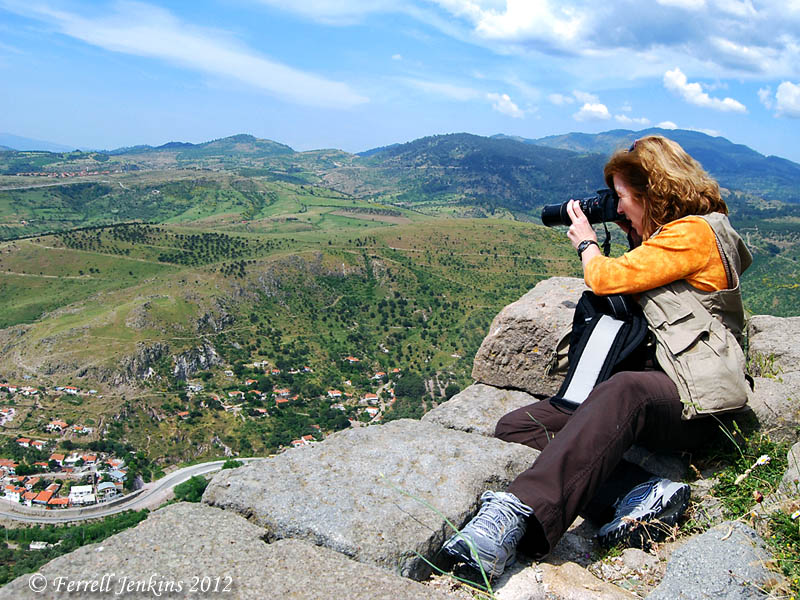
Today we went north from Izmir (Smyrna) to Pergamum (Revelation 2:12-17) where we visited the citadel, the Ascleipion, and the local museum. From there we continued in a southeastly direction to Thyatira before returning to Izmir.

This first photo was made on the acropolis of Pergamum sitting atop a high hill overlooking the territory around it. Sharon, from a previous tour, tries to get a good view of the landscape below.

View from the Acropolis of Thyatira. Photo by Ferrell Jenkins.

View from the Acropolis of Pergamum. Photo by Ferrell Jenkins.

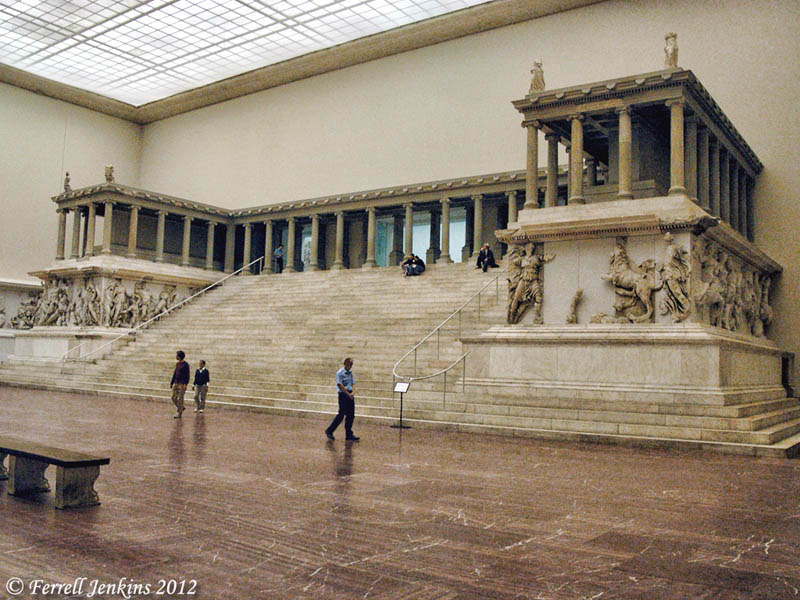
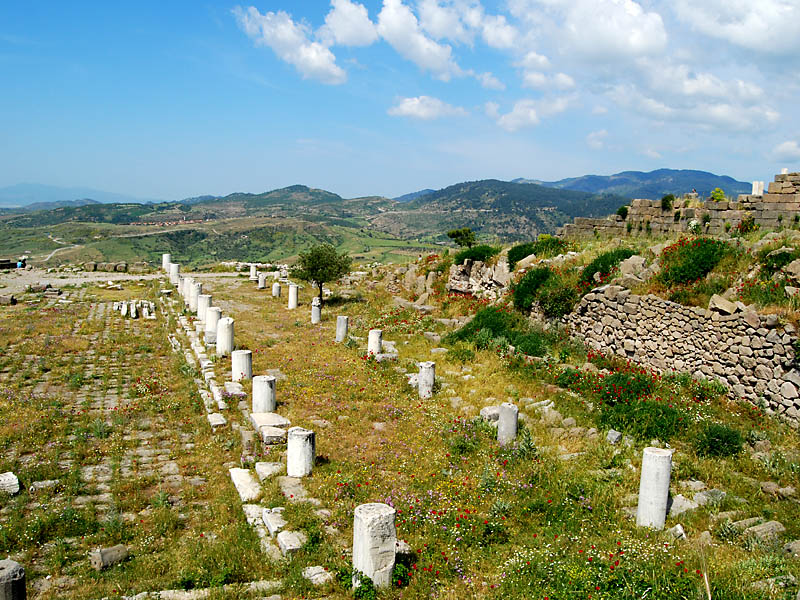
At Pergamum we saw the partially reconstructed Temple of the Emperor Trajan (A.D. 98-117), the area where the famous library of the ancient world stood, the foundation of the temple of Athena, the theater, and the site of the Zeus Altar. The altar has now been reconstructed in the Pergamum Museum in Berlin.

The area of the famous Pergamum library. Photo by Ferrell Jenkins.

The area of the famous Pergamum library. Photo by Ferrell Jenkins.

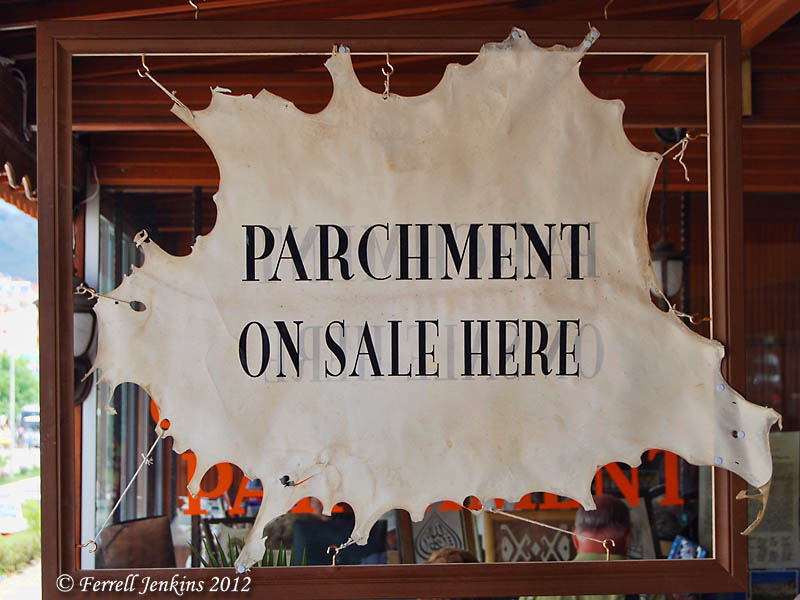
When Pergamum could no longer get papyrus sheets from Egypt they developed the writing material called parchment. There are a few shops in the city today (modern Bergama) selling parchment made from goat skin.

Parchment for sale at Bergama. Photo by Ferrell Jenkins.

Parchment for sale at Bergama. Photo by Ferrell Jenkins.

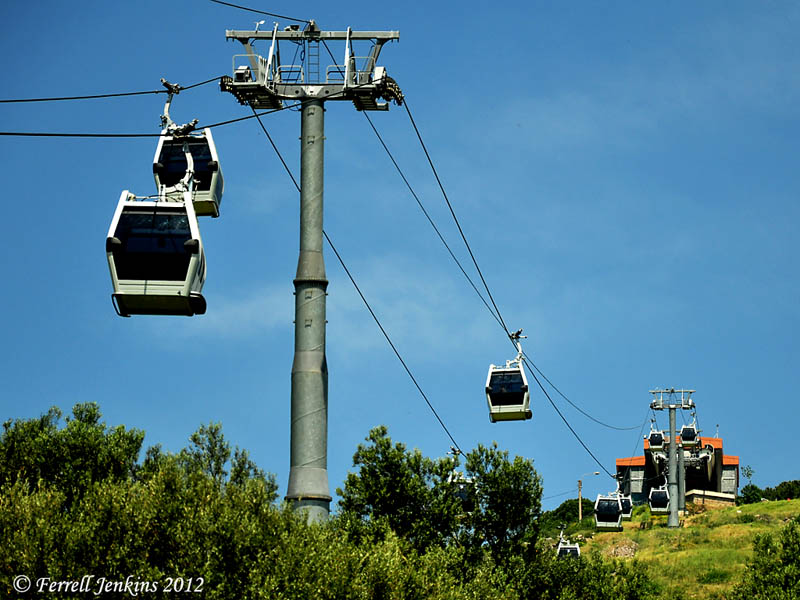
One interesting difference between our visit to Pergamum today and the last time we visited the site is the addition of a cable car. Buses are no longer allowed to drive to the top of the Acropolis. Visitors take the cable cars to the entrance of the archaeological site.

Cable cars to reach the Acropolis at Pergamum. Photo by Ferrell Jenkins.

Cable cars to reach the Acropolis at Pergamum. Photo by Ferrell Jenkins.

There is still little to see at Thyatira. A few scattered ruins can be seen in one square block in the center of the little town of Akhisar. In New Testament times this was the home of Lydia, the seller of purple (Acts 16:14). One of the letters in the Book of Revelation was addressed to the church in the city (Revelation 2:18-29).

I was pleased to see Mark Wilson’s Biblical Turkey: A Guide to Jewish and Christian Sites of Asia Minor, available in a bookshop at Pergamum. Several members of our group who had failed to buy a copy in advance did so today.

Busy day in Istanbul

We had a full day of sightseeing in Istanbul today. Tomorrow we have to get up early to make our flight to Izmir (Biblical Smyrna, Revelation 2). I made several nice photos, but not enough time to prepare them for the blog. Maybe by tomorrow night we will be able to post a photo or two.

Two young ladies on the tour are writing blogs. Both have traveled with us before. You might enjoy reading what they write.

The Other Side of the World. Here is the link to today’s post. You will be able to locate the others from there.
http://stacyjobe.blogspot.com/2012/05/14-istanbul-day-two.html

Jessica’s Jaunts: http://jessicarice.wordpress.com/

Steps of Paul and John in Turkey and Greece

We’re off to visit Turkey and Greece for the next few days. Visiting all of the sites where Paul and John traveled would be impossible in a few weeks. Our tour in Turkey, which we have conducted several times since 1968, is limited to the area of the Seven Churches of Revelation (1:4, 11), and a few cities associated with Paul’s ministry (Ephesus, Acts 19; Colossae and Hierapolis, Colossians 4:13; Miletus, Acts 20). The entry point into the country is Istanbul, the former Constantinople, a city that was significant in the early post-apostolic history of the church.


In the Aegean Sea we visit Patmos (Revelation 1:9), Rhodes (Acts 21:1), and Crete (Acts 27; Titus 1:5).

Our stops in Greece are limited to Athens, Corinth and Cenchreae (Acts 17-18).

We don’t promise to be as thorough as we might while in the comfort of the study at home, but we will try to post a few photos of interest as we move along.

We arrived in Istanbul this morning, collected the luggage, cleared customs and had our luggage loaded on the bus by noon. After a stop for lunch near the Hagai Sophia and the Blue Mosque, we continued with some general sightseeing of the city and a boat ride on the Bosporus. I think everyone is looking forward to a good night of sleep and a full day of sightseeing in the city tomorrow.

Journalist accuses Turkey of Archaeology Blackmail

Owen Matthews, writing in Newsweek Magazine and The Daily Beast, says, “Turkey’s government is playing hardball to repatriate archaeological treasures.” He begins with the story of the German road engineer who excavated the Altar of Zeus at Pergamum (Pergamom) and arranged for the structure to be moved to Berlin and reconstructed in the museum there.

The Turkish government is now asking various museums around the world to return artifacts that  were taken from Turkey. Matthews mentions the Metropolitan Museum of Art in New York, the British Museum, and the Boston Museum of Fine Arts, along with others.

The reconstructed Pergamum Altar of Zeus in Berlin. Photo by Ferrell Jenkins.

The reconstructed Pergamum Altar of Zeus in Berlin. Photo by Ferrell Jenkins.

Today 30 young archeologists from all over the world work at Pergamon, uncovering new parts of the ancient city, meticulously recording, photographing, sketching, and cleaning the uncovered artifacts. The dig is considered the finest of its kind in the world. The state-of-the-art iDAI.field computer system for inputting real-time archeological data was pioneered here, along with many techniques for photographing, conserving, and mapping now considered standard across the world. In 2004 a complex of vulnerable newly discovered mosaics was enclosed in a beautiful wood, stone, and steel building designed by award-winning German architects and paid for entirely by the German government. The practice of hauling finds back to the home country was abandoned, of course, more than a century ago—today, all the finds remain in Turkey.

Despite a century of Germany’s investment in the fabric of Pergamon, the local authorities still view the Germans with suspicion. A recent mayor of Bergama ran on a ticket of returning the Altar of Zeus from Berlin, something the ministry itself hasn’t asked for (the paper trail clearly confirms that the altar was legally exported). And the DAI has come under pressure from tourism authorities to spend more resources rebuilding fallen temples to make them more photogenic to visitors rather than meticulously trowelling [sic] through ancient sewers and tombs.

Matthews says the Turkish authorities have decided “to play hardball” with various countries working in Turkey. Considering the remarkable work done by the Germans at Pergamum and Hattusha, the British at Carchemish, the Austrians at Ephesus, to mention just a few examples, this is an unfortunate situation. Read the article in its entirety here.

Turkish archaeologists have done significant work in numerous places throughout the country. But with more than a thousand archaeological sites, cooperation would be better.

Pergamum is the site of one of the churches addressed in the Book of Revelation (the Apocalypse) toward the end of the first century A.D. (Revelation 1:11; 2:12-17).

HT: Jack Sasson

Nabonidus, the last king of Babylon — 556–539 B.C.

Evil-Merodach (562-560 B.C.) was assassinated by Nergal-Sharezer, who ruled as king of Babylon for four years. Nothing about his reign is recorded in the Bible, but he is mentioned in Jeremiah 39:3 and 13 from the time of the destruction of Jerusalem (587 B.C.). At that time he served as one of the officials of Nebuchadnezzar.

After four years on the throne, Nergal-Sharezer was followed by his son, Labaši-Marduk, who ruled only 9 months.

Nabonidus, who is not named in the Bible, came to the throne in 556 B.C. According to Wiseman the king,

… campaigned in Syria and N Arabia, where he lived at Tema for 10 years while his son BELSHAZZAR acted as co-regent in Babylon. About 544 his people and the kings of Arabia, Egypt and the Medes being favourably disposed, Nabonidus returned to his capital…, but by this time the country was weak and divided. (New Bible Dictionary (3rd ed.), 115).

The mother of Nabonidus was made a high priestess in the temple of Sin at Harran. Our first photo shows the top of a stela from Harran. Nabonidus is portrayed standing before symbols of the principle gods he served. Incidentally, the museum at Sanliurfa, Turkey, has a nice collection of archaeological artifacts tastefully displayed.

Nabonidus Stela in Sanliurfa Museum, Turkey. Photo by Ferrell Jenkins.

Nabonidus Stela in Sanliurfa Museum, Turkey, near Harran. Photo by Ferrell Jenkins.

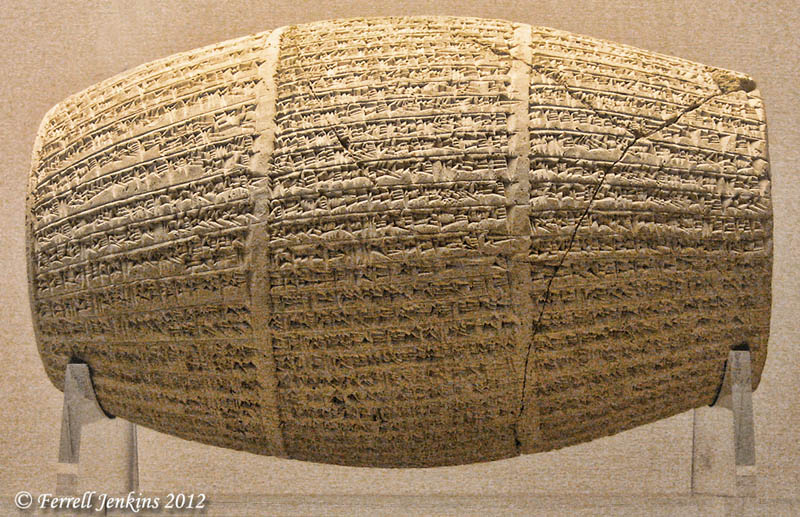
The next photo shows a terracotta foundation cylinder of Nabonidus. The sign accompanying the cylinder in the British Museum tells us that “this document records the reconstruction of temples to the Moon-god at Harran and to the Sun-god and the goddess Amunitum at Sippar.”

Nabonidus Cylinder in British Museum. Photo by Ferrell Jenkins.

Nabonidus Cylinder in British Museum. Photo by Ferrell Jenkins.

In a future post we plan to comment on the relationship of Nabonidus and Belshazzar.

John wore a garment of camel’s hair

Now John wore a garment of camel’s hair and a leather belt around his waist, and his food was locusts and wild honey.  (Matthew 3:4 ESV)

Emmerson comments on the type of garment worn by John:

Hair from the back and hump of the camel was woven into a harsh material, and a softer cloth was produced from the finer hair taken from underneath the animal. The natural variations in the color of the hair could be woven into a pattern. (The International Standard Bible Encyclopedia Revised, 1:584).

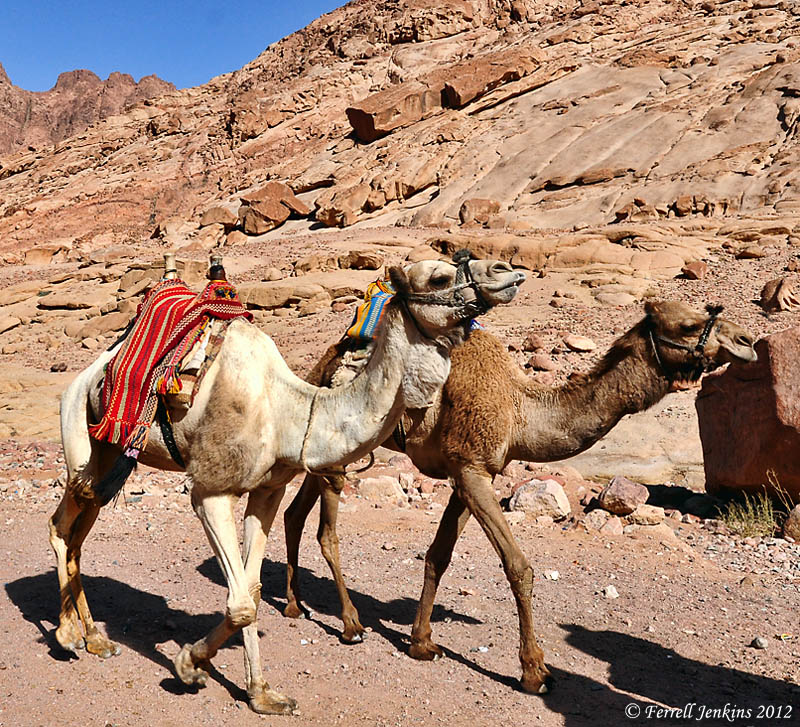
Camels in the Sinai Peninsula. Photo by Ferrell Jenkins.

Camels in the Sinai Peninsula. Photo by Ferrell Jenkins.

John did not wear the soft clothing typical of those who dwell in royal palaces.

What then did you go out to see? A man dressed in soft clothing? Behold, those who are dressed in splendid clothing and live in luxury are in kings’ courts. (Luke 7:25 ESV)

Bible students immediately remember similarities between John and the prophet Elijah (2 Kings 1:8; cf. Luke 1:7).

Bust of king from Hellenistic Period found in Turkey

The country of Turkey now occupies the territory of ancient Asia Minor. It is filled with Greek and Roman ruins — especially in the western area and along the Mediterranean coast. Archaeological excavations are active in the country.

Today’s Zaman, a Turkish newspaper, reported on January 4 the discovery of the relief bust of a king from the Hellenistic period. We are given no hint regarding the identity of the king. We know that Alexander of Macedon crossed Asia Minor in the 4th century B.C. From that time the Greeks had a great influence on the country. Later, in the Roman period this would be the territory visited by Paul on his preaching journeys.

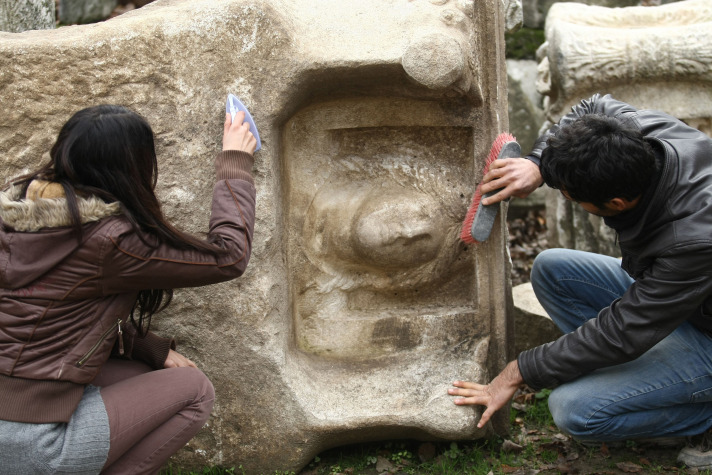
Relief bust of Hellenistic king discovered in Turkish excavation.

Relief bust of Hellenistic king discovered in Turkish excavation. Today's Zaman.

Today’s Zaman says,

A 2,000-year-old relief bust of a king was discovered during excavations in ancient Stratonikeia in Muğla’s Yatağan district.

Dr. Bilal Söğüt, a professor of archeology at Pamukkale University and head of the excavations, told the Anatolia news agency that they found a street in the ancient city which began with a gate and was lined with columns. During their excavations, they also discovered the bust of a king dating back to the Hellenistic period. The bust, which is one-and-a-half meters tall and nearly two meters wide, features depictions of bull heads and the figure of a goddess, Söğüt said.

“The depictions of bull heads on the bust represent wealth and power. It was in this region that we previously found a racing chariot. The discovery of 1,500-year-old mosaics here was another welcome breakthrough for us,” he said.

Stratonikeia is located in the southwestern region of Turkey. The excavation is under the direction of professor from Pamukkale, a site known as Hierapolis in the New Testament (Colossians 4:13).

The entire article may be read here.

2011 in review — according to WordPress

The WordPress.com stats helper monkeys prepared a 2011 annual report for this blog.

Here’s an excerpt:

London Olympic Stadium holds 80,000 people. This blog was viewed about 270,000 times in 2011. If it were competing at London Olympic Stadium, it would take about 3 sold-out events for that many people to see it.

Click here to see the complete report.

Personal Note: Thanks to the readers who keep me going. You are literally scattered all over the earth. Your interest is appreciated. We are thankful for anyone who has been instructed or encouraged.

Please forgive our failure to answer all of the requests for info and photos. We do as many as we can, but to borrow from and paraphrase Jesus, “Sufficient unto the day are the Emails thereof.”

Previous posts relating to the birth of Jesus and Christmas

Thanks for the good response to our posts on frankincense and myrrh. Over the past 4+ years I have written several posts about Christmas, the birth of Jesus, and Bethlehem, in hope that they would be beneficial to Bible students and teachers.

Here are links to some of the more significant articles, usually with photos.

If you have more interest in learning about the origin of the celebration of the birth of Christ, take a look here. A more detailed study of the historical aspects of the celebration is available in PDF here.

For the next couple of days I plan to spent some (read, total) time with my grandson. I trust you will enjoy quality time with your family and friends.

I see that Leon Mauldin has a post about the manger at Leon’s Message Board here, and another about the traditional site of Jesus’ birth in Bethlehem here.

Todd Bolen has a list of his Christmas-Related Posts at Bible Places Blog here.