Category Archives: Turkey

The delivery of Peter’s Epistles

When I began to write about Pontus, the Black Sea Coast, and the cities of Samsun and Sinop, it was primarily to discuss the address of the Apostle Peter’s epistles.

Peter, an apostle of Jesus Christ, To those who are elect exiles of the Dispersion in Pontus, Galatia, Cappadocia, Asia, and Bithynia, (1 Peter 1:1 ESV)

I assume, based on 2 Peter 3:1, that both of Peter’s epistles were written to the same Christians.

This is now the second letter that I am writing to you, beloved. In both of them I am stirring up your sincere mind by way of reminder, (2 Peter 3:1 ESV)

The map below shows the larger portion of Asia Minor. Note the order of the provinces in Peter’s address: Pontus, Galatia, Cappadocia, Asia, and Bithynia.
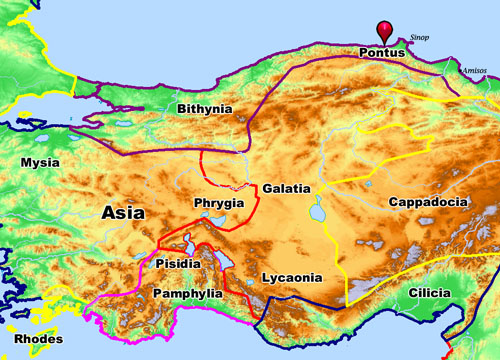
Map of Asia Minor during the time of the Roman Empire. BibleAtlas.org.

Map of Asia Minor during the time of the Roman Empire. BibleAtlas.org.

We know it was common for the New Testament letters to be carried from the place of writing to the those addressed by personal, trusted messengers.

  • Tychicus was the bearer of Ephesians and Colossians (Ephesians 6:21; Colossians 4:7).
  • Letters were sometimes sent from one church to another (Colossians 4:16).
  • It is often pointed out that the order of the letters to seven churches of Asia follow a typical circuit along known travel routes: Ephesus, Smyrna, Pergamum, Thyatira, Sardis, Philadelphia, and Laodicea (Revelation 1:11; 2-3).

We may raise questions concerning Peter’s epistles. Let us assume for the moment that Peter wrote from Rome. This is my understanding of 1 Peter 5:13. If the bearer of 1 Peter began his delivery route in Pontus, how did he get there? Was it overland or by sea?

Understanding the terrain. Once we understand something about the terrain the answer becomes obvious. Coming from the west it would be much easier to go to Pontus by sea than by land. A first stop might be at the city of Amastis (modern Amasra, west of Sinop). The next stop would be Sinop. Neither of these cities would provide a good place to begin an inland journey going through the named provinces. The ideal beginning point would be Amisos (modern Samsun). Mark Wilson writes about Amastris:

A coasting vessel carrying Peter’s messenger would certainly have stopped here. Amastris has been suggested as an entry point for Peter’s letter to the cities of inner Pontus and northern Galatia, but the road to the interior was difficult. It is more probable that the messenger continued by sea to Sinope and Amisus. (Biblical Turkey, 337).

When you look at a map showing topographical detail you see that both Bithynia and Pontus are not very wide (north to south), and that most of that width is mountainous. Some areas, in fact, have no coastal roads. Such is still true of the region east of Sinope.

Map shows the narrow province of Pontus. Made with Bible Mapper.

Map shows the narrow province of Pontus. Made with Bible Mapper.

The distance between Samsun and Sinop is barely 100 miles. Leaving Samsun we had good road for about the first 50 miles. After that the road was mountainous and much construction work was underway. Often we were driving high above the Black Sea even when we could see it. We had expected to make the drive in two hours in our good rental car. It took us three hours. Notice this hair pin section of the two lane road.
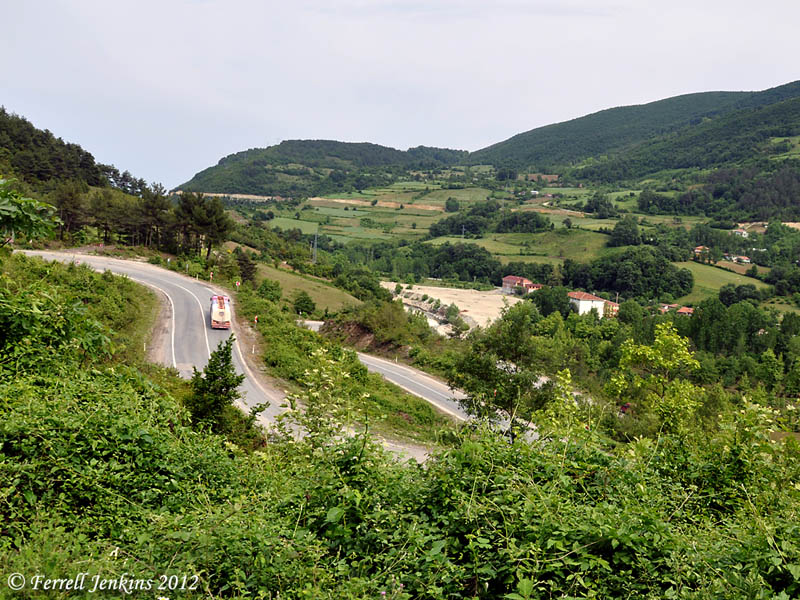
Hair pin curves in the mountains east of Sinop. Photo by Ferrell Jenkins.

Hair pin curves in the mountains east of Sinop. Photo by Ferrell Jenkins.

Both Sinop and Samsun were significant in the life of Mustafa Kemal Atatürk, the founder of the Republic of Turkey. The following sentence shows that both towns were more easily reached by sea even as recently as a century ago.

Atatürk came to Sinop on the ship Bandirma on 18 May 1919. As there was no road between Sinop and Samsun at that time, he continued his journey by sea. (McDonagh, Blue Guide: Turkey; Emphasis added).

Wilson comments on the importance of Amisus (Samsun) as a port of entry into Asia Minor.

Amisus was at the northern terminus of the main road that ran across Asia Minor to Tarsus. Peter’s messenger undoubtedly embarked at Amisus and initially made his way south along this route. (Biblical Turkey, 340)

The photo below was made from the highway east of Sinop. I hope that this, and the following photo, will help to illustrate the difficulty of travel in the region.
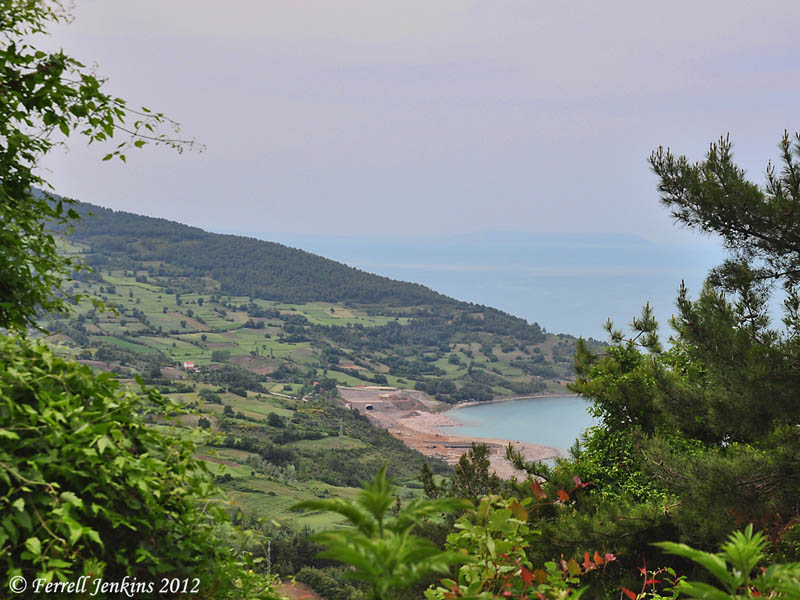
East of Sinop on the Black Sea. Photo by Ferrell Jenkins.

From highway east of Sinop on the Black Sea. Photo by Ferrell Jenkins.

These photos and the information we have provided show that travel by sea would be much easier than travel by land, and that Sinop would not have been a good place to begin an inland journey. Leon made the following photo of the road and the mountains east of Sinop. This was one of the rare places where a vehicle could pull off road.

Mountains east of Sinop. Photo by Leon Mauldin.

Mountains east of Sinop. Photo by Leon Mauldin.

A note about spelling. Some of the towns we are writing about have an ancient name and a different modern name. In the case of Sinop, it is spelled Sinope in older sources.
Persecution of Christians in Pontus

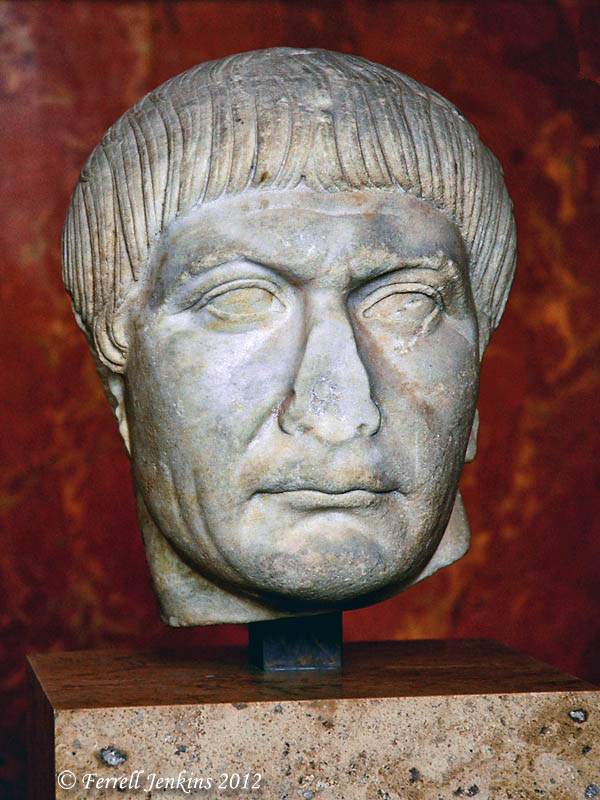
Pliny. Pliny was the governor of the Bithynia and Pontus. According to The Dictionary of the Christian Church he was born c. 61 and died c. 112. He exchanged a series of letters with the Roman Emperor Trajan (98-117 A.D.). I have done some browsing in the older Loeb edition (revised by Hutchinson) of Pliny Letters. I see references to the Black Sea cities of Heraclea (now Eregli), Amastris (now Amastra), Sinope (now Sinop), and Amisus (now Samsun). I mention this to emphasize that Pliny was familiar with the cities of Pontus. He writes of Sinope being ill supplied with water and suggests a solution to the Emperor.

Roman Emperor Trajan in the Louvre. Photo by Ferrell Jenkins.

Roman Emperor Trajan in the Louvre. Photo by Ferrell Jenkins.

Pliny wrote to the Emperor saying that he was uncertain about how to deal with the Christians in his province. He said that he had not been present at any of the trials of Christians. He explains his procedure to the Emperor:

In the meanwhile, the method I have observed towards those who have been denounced to me as Christians is this: I interrogated them whether they were Christians; if they confessed it I repeated the question twice again, adding the threat of capital punishment; if they still persevered, I ordered them to be executed. (X.xcvi).

The Christians were ordered to offer wine and incense to the image of the Emperor. Pliny had been told that those who are really Christians would not make such an offering. Some of those who were questioned said they had quit serving Christ as much as 25 years earlier. Think about that date (about 85 A.D.). This gets us close to the date of Peter’s epistles (1 Peter 1:1).

Trajan answered Pliny:

The method you have pursued, my dear Pliny, in sifting the cases of those denounced to you as Christians is extremely proper. (X.xcvii)

He said that no search should be made for the Christians. If a Christian repented and demonstrated his repentance by “adoring the Gods” [offering the wine and incense to the image of the Emperor] they should be pardoned. I think this is the type of worship mentioned in the book of Revelation which was written a few years earlier to the churches of the Roman province of Asia (Revelation 13; 14:9-11).

Phil Harland comments on the charges brought against the Christians.

The addressees were faced with “suffering” primarily in the form of verbal abuse: they were spoken against, blasphemed, reviled, and falsely called “wrongdoers” (1 Peter 2:12; 3:9, 15-17; 4:3-5; 5:9). The reasons for this suffering stemmed from the Christians’ failure to participate in religious life in the same way as they had before: the Gentiles “are surprised that you do not now join them in the same wild profligacy, and they abuse you” (1 Peter 4:4 [RSV]). Persecution of Christians, which was local and sporadic, was more often than not a consequence of denying the gods and goddesses of others, along with the social implications of non-participation in the rituals that honoured these deities

For more along this same line see Phil Harland’s post about Bithynia and Pontus here.

My intention is to turn next to the specific question of the route of travel taken by the messenger who delivered Peter’s epistles throughout Pontus, Galatia, Cappadocia, Asia and Bithynia.

More famous Sinopeans

In addition to Diogenes and Serapis, Sinop in Pontus was the home of several other well known people in early church history.

Aquila. (Not the Aquila of Acts 18:2.) This Aquila, a native of Sinop in Pontus, is said to have been a relative of the Emperor Hadrian (A.D. 117-138). He was converted to Christianity during a visit to Jerusalem, but was rejected because he refused to give up his studies of astronomy. Later he became a proselyte to Judaism.

Having become a disciple of the Rabbis, from whom he learned Hebrew and the rabbinical method of exegesis, he used his knowledge to make a revision of the Septuagint, bringing it into line with the official Hebrew text. It was soon adopted by Greek speaking Jews in preference to the LXX, which was used by the Christians. His translation, which was finished probably c. 140, was extremely literal, attempting to reproduce individual Hebrew words and phrases exactly. This procedure frequently obscured the sense; but the fidelity of Aquila’s version to the Hebrew original was admitted by the Fathers most competent to judge, such as Origen and Jerome. (Dictionary of the Christian Church, ed. Cross & Livingstone, 94).

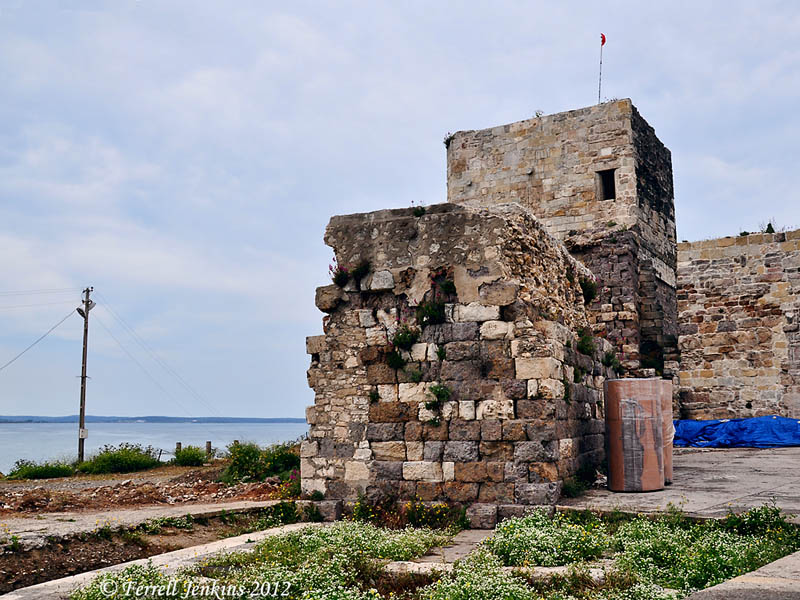
Tower and wall on the Black Sea at Sinop, Turkey. Photo by Ferrell Jenkins.

Tower and wall on the Black Sea at Sinop, Turkey. Photo by Ferrell Jenkins.

Marcion (died c. 160 A.D.). We rarely read or hear the name Marcion without the word heretic attached to it. None of his writings have survived, but his success can be seen by the many early Fathers who spoke of him. (For a list of these see Bercot, ed., A Dictionary of Early Christian Beliefs.) This influential ship master of Pontus rejected the God of the Old Testament who he described as evil and vengeful. According to him, the Christian gospel was a message of love, and the Father of Jesus was not the God of the Old Testament. Many of his views were similar to those of Gnosticism. Marcion accepted only the Gospel of Luke among the Gospels, and the writings of Paul.

Marcion went to Rome about A.D. 140, but within 4 years he was excommunicated from the church. From Rome he spread his teachings all over the Empire.

Phocas (Phokas). Phocas was martyred at Sinop in A.D. 117 during the reign of the Roman Emperor Trajan.

According to the Dictionary of the Christian Church (1282), a different man named Phocas “the Gardener” was martyred  during the persecution by the Roman Emperor Diocletian in A.D. 303. I haven’t determined if he was associated with the port city of Sinop. Wilson seems to confuse these two persons (Biblical Turkey, 342).

The Sinop Gospels is not a person, but should be mentioned in connection with the Black Sea port of Turkey. This parchment document was dyed purple and written in gold ink. The uncial manuscript 023 contains 43 pages of the gospel of Matthew. The manuscript was discovered in Sinop in the late 19th century is thought to have originated in Syria or Mesopotamia in the 6th century A.D. It is now in the Bibliothèque Nationale in Paris.

A brief description in French, and a small image of two pages of the manuscript may be found here. The manuscript features small drawings to illustrate the biblical text. The displayed page shows Jesus healing a blind man.

Some famous Sinopeans

Sinop was a city of the Roman province of Pontus (1 Peter 1:1) in Asia Minor (now Turkey). The city not only had a long and storied history, but also was home to some famous people.

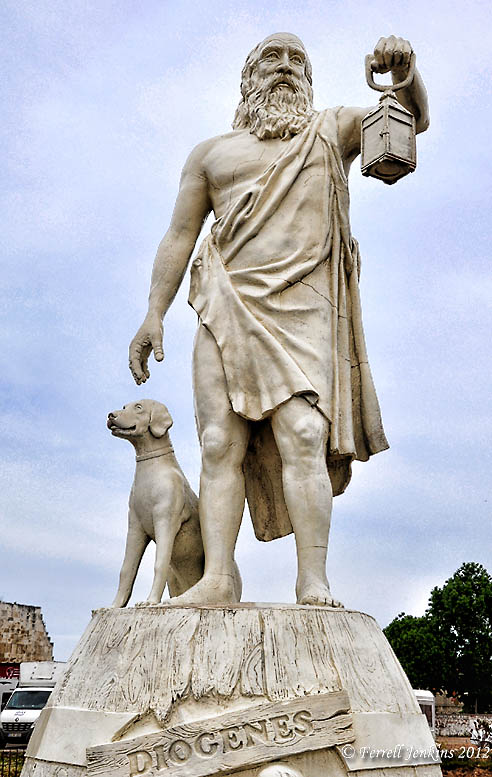
Statue of Diogenes at Sinop, Turkey. Photo by Ferrell Jenkins.

Statue of Diogenes at Sinop, Turkey. Photo by Ferrell Jenkins.

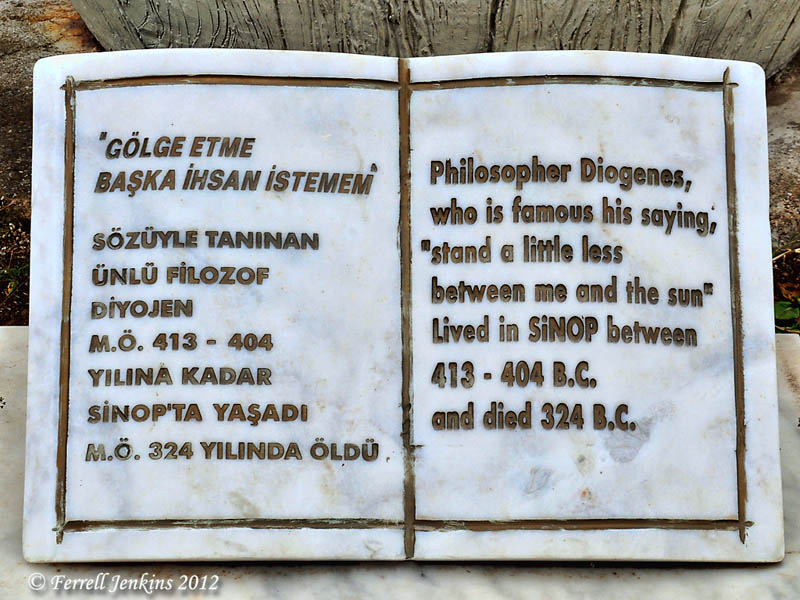
Diogenes the Cynic (4th century B.C.). Diogenes was born in Sinop, but later moved to Athens and became the leader of a group called Cynics. His contempt for the cultural conventions of society earned him the name dog. Several stories are mentioned in books I have read. One says that Alexander the Great offered him anything he wanted. Diogenes is credited with saying, “Stand aside, you’re in my light.”

Sign on the Statue of Diogenes, Sinop, Turkey. Photo by Ferrell Jenkins.

Sign on the Statue of Diogenes, Sinop, Turkey. Photo by Ferrell Jenkins.

Diogenes is said to have walked around with a lamp in the daytime looking for an honest man.

Some writers say that Diogenes spent some of his latter years in Corinth serving as a tutor.

Serapis. We should not think of Serapis as a real person, but the “god” may have an association with Sinop. Clement of Alexandria writes several times indicating that Serapis was brought from Sinop to Alexandria, Egypt (Fathers of the Second Century in ANF Volume 2). Clement asks,

why should I speak … of the fugitive Serapis chased from Sinope to Alexandria…

McDonagh credits the Roman historian Tacitus as saying that “the worship of Serapis started in Sinope and was introduced into Egypt by Ptolemy I Soter (367-283 BC)” (Blue Guide: Turkey).

Serapis. Bust in Vatican Museum. Photo by Ferrell Jenkins.

Bust of Serapis in the Vatican Museum. Photo by Ferrell Jenkins.

More famous Sinopeans to follow.

Sinop is the northernmost city of Asia Minor (now Turkey)

Modern Sinop is built over the ancient city on a peninsula that extends into the Black Sea. We drove toward the northern tip of the peninsula until we came to a military installation. The photo below shows a portion of the acropolis on the left. This is the northern-most land in Turkey, and the narrowest portion of the Black Sea. The sky reflects the fact that it was raining the day we visited the city.

Sinop on the Black Sea Coast of Turkey. Photo by Ferrell Jenkins.

Sinop on the Black Sea Coast of Turkey. A portion of the ancient acropolis can be seen on the left of the photo. It is now part of a military camp. Photo by Ferrell Jenkins.

The history of Sinop is said to date back as early as the Chalcolithic Period (about 4200 B.C.). In the 8th century B.C. colonists from Miletus established a post and a naval station here. In the centuries to follow the city came under Persian control. After Alexander the Great came into Asia Minor, Sinop declared its independence from the Persians. The city was made the capital of the kingdom of Pontus by Mithridates III in 183 B.C.

Mithridates the VI Eupator and his son, the king of Armenia, were defeated by the Romans in 69 and 68 B.C. By 63 B.C. Pompey formally annexed the city (Bernard McDonagh, Blue Guide Turkey).

Sinop was one of the cities of the Roman province of Pontus in New Testament times (Acts 2:9; 1 Peter 1:1). Wilson says,

Sinope was a certain stop in Pontus for the messenger carrying Peter’s first letter. (Biblical Turkey, 342).

We will point out later that it was common for the military, and others, to travel by sea to Sinop and then to Samsun. See the map in the previous post.

In the next post I plan to talk about famous persons associated with Sinop.

Visiting the Black Sea coast of Turkey

One might ask why a person interested in the Bible world would want to visit the Black Sea coast of Turkey. A few weeks ago, while there, I gave some of the reasons here. A summary before proceeding might be advisable. My visit was limited to a region of about 100+ miles from about 20 miles east of Samsun to Sinop.

Both Samsun and Sinop are located in the the region known as the Roman province of Pontus in Asia Minor. By New Testament times the provinces of Bythinia and Pontus were combined and governed as a single province.

Roman Provinces of Asia Minor in New Testament Times. BibleAtlas.org.

Roman Provinces of Asia Minor in New Testament Times. BibleAtlas.org.

There were 13 cities in the province of Pontus (Wilson, Biblical Turkey, 332).

The New Testament mentions Pontus only three times. The first reference is in Acts 2. Note the association with Peter.

  • Jews from Pontus were visiting Jerusalem during Pentecost when the gospel was first announced by Peter (Acts 2:5,9). It is likely that some of these men became obedient to the gospel before returning home.

Beside Peter’s address to Christians in Pontus in his first epistle, the only person named in association with Pontus is Aquila.

  • A Jew by the name of Aquila was a native of Pontus. He had gone to Rome, but was commanded to leave Rome under the decree of the Emperor Claudius (A.D. 41-54). Reaching Corinth, he and his wife Priscilla, met the apostle Paul (Acts 18:2). We are not told whether Priscilla was from Pontus, Rome, or some other place.
  • When Paul left Corinth, Aquila and Pricilla went with him to Ephesus and remained there. When they heard the eloquent Alexandrian preacher Apollos who knew only John’s baptism, they privately taught him the “the way of God more accurately” (Acts 18:18, 26). I think the inference is that they encouraged Apollos to go to Corinth.
  • Paul mentions Aquila and Priscila (Prisca) in his letter to the Corinthians which was written from Ephesus (1 Corinthians 16:19).
  • During Paul’s third journey, when he wrote to the saints at Rome from Greece (Corinth) during the reign of the Emperor Nero (A.D. 54-68), he sends greetings to Prisca and Aquila (Romans 16:3). This means that by this time they found it safe to reside in Rome.
  • In his final letter from Rome, Paul tells Timothy to “Greet Prisca and Aquila” (2 Timothy 4:19).

We have evidence that the name Aquila was known in Pontus. In the 1909 Dictionary of the Bible (ed. James Hastings), A. Souter says,

an inscription has recently been found referring to one Aquila at Sinope, one of the principal cities of the Roman province Pontus.

Do not make the mistake of thinking this is a reference to the husband of Priscilla. It simply means that the name was known in the region.

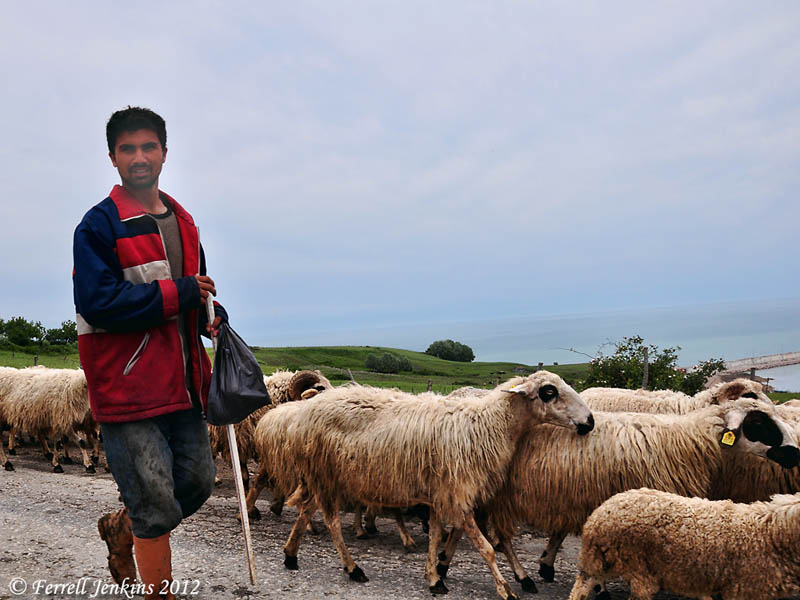
Our photo today was made on a dreary, rainy day near Sinop. Notice that the highway is high in the mountains overlooking the Black Sea. At several points there is no coastal road. This is an important fact that we will speak more about in a future post.

A shepherd overlooking the Black Sea near Sinop, Turkey. Photo by Ferrell Jenkins.

A shepherd overlooking the Black Sea near Sinop, Turkey. Photo by Ferrell Jenkins.

Docking again at Perga

A few days ago we had some discussion here about whether Paul and his companions docked at Atttalia or Perga after sailing from Paphos, Cyprus.

Now Paul and his companions set sail from Paphos and came to Perga in Pamphylia. And John left them and returned to Jerusalem,  but they went on from Perga and came to Antioch in Pisidia. (Act 13:13-14a ESV)

Darryl said that he had been unable to track down the oft-cited reference in Strabo Geography. I located the quotation using Logos 4. The modern names are included in brackets.

[2] Next is the river Cestrus [Ak-su]; on sailing up its stream 60 stadia we find the city Perge, [Murtana] and near it upon an elevated place, the temple of the Pergæan Artemis, where a general festival is celebrated every year.

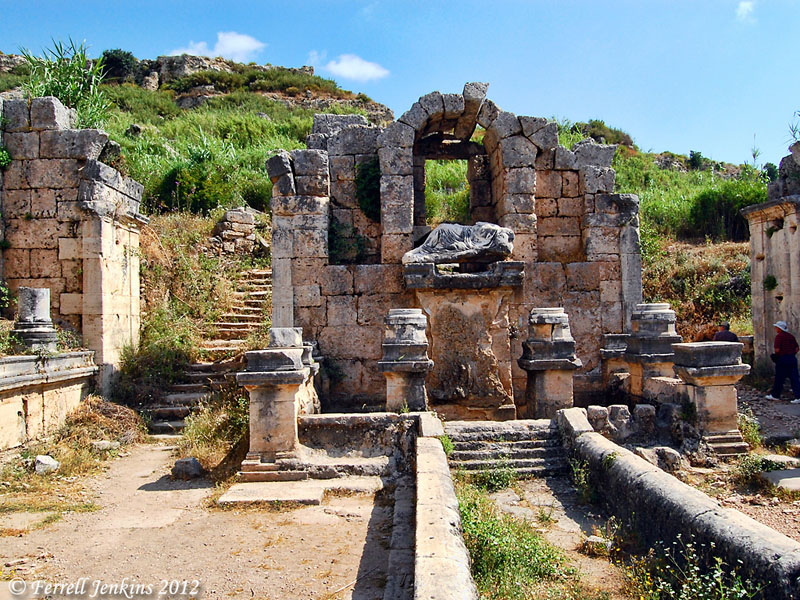
Nymphaeums (fountains) were important in Roman cities. The fountain at Perga flowed into a channel running the length of the main street.

The Nymphaeum (Fountain) at Perga. Water flowed from the fountain. Photo by Ferrell Jenkins.

The Nymphaeum (Fountain) at Perga. Water flowed from the fountain into a channel in the middle of the main street. Photo by Ferrell Jenkins.

This close-up view shows the river god Cestrus. Water flowed under the image into the channel. Other cities had a similar image with the water flowing from a cornucopia held by the river god. At Ephesus it was the god Cayster.

The Nymphaeum (Fountain) at Perga, showing the river god Cestrus. Photo by Ferrell Jenkins.

The Nymphaeum at Perga, showing the river god Cestrus. Photo by Ferrell Jenkins.

Dr. Combs recommended the article by Douglas A. Campbell (“Paul in Pamphylia (Acts 13.13-14a; 14.24b-26): A Critical Note”) in New Testament Studies (2000): 595-602. This afternoon I was able to get access to the article. The map is especially helpful.

Campbell says the 175 mile trip from Paphos to Perga, with favorable winds, would have taken between 25 and 50 hours, but with difficult winds it could have taken longer. It would be more common for ships transporting goods from Cyprus to Perga and other cities in the region to have used the River Cestrus. On the return from the first journey, when Paul was headed east back to (Seleucia, then) Antioch (Acts 14:25-26), it would have been best to use Attalia as the port (as Tim Brinley also pointed out in his comment).

Some other sources explaining that Perga used the river Cestrus as a port include the following:

  • E. A. Judge. Perga. The International Standard Bible Encyclopedia, Revised (3:767-768).
  • E. M. Blaiklock. Perga. New Bible Dictionary (3rd ed.): 901.
  • A. E. Hillard. Perga. (Hastings) Dictionary of the Bible: 700.

An inland city of Pamphylia about 12 miles from Attalia on the coast, but possessing a river harbour of its own on the Cestrus 5 miles away. Its walls date from the 3rd century B.C.

From Perga Paul would have taken the Via Sebaste to Pisidian Antioch. When he returned to Perga, using the same Roman road, he would have taken the Claudian extension of the Via Sebaste which ran southwest for 12 miles to Attalia.

Campbell, a British scholar, says,

In my judgement the author of Acts at these two junctures is, quite simply, spot on.

The Mausoleum at Halicarnassus

Why would we want to visit Bodrum on the Aegean coast of Turkey? It is located in the area of the Roman province of Caria, and is built over the site of ancient Halicarnassus. It is where Mausolus built a tomb for himself. From this structure we get our word mausoleum.

Only a small city block preserves the remains of the famous Mausoleum. Parking nearby is almost an impossibility, but one of the shopkeepers allowed us to block the entry to his shop for a few minutes.

Halicarnassus. Site of the tomb of King Mausolos. Photo by Ferrell Jenkins.

Halicarnassus. Site of the tomb of King Mausolos. Photo by Ferrell Jenkins.

The small brochure available at the site gives this information about the Mausoleum.

It is one of the Seven Wonders of the Ancient World. Its construction was initiated by Mausolus, a member of the Hekatomnid dynasty appointed by Persians as the Satrap of Caria, before his death, and continued by his wife and sister Artemisia after his death. Mausolus, the then most important administrator, probably decided to build such an important structure to symbolize his eternity and greatness. Its construction was started just before Mausolus’ death, i.e. just before 353 B.C.

Along with a few architectural fragments at the site, there is a nice model suggesting how the Mausoleum looked. According to the brochure, the tomb may have been as high as a 20-story apartment building.

Model of the Tomb of Mausolos at Halicarnassus. Photo by Ferrell Jenkins.

Model of the Tomb of Mausolos at Halicarnassus. Photo by Ferrell Jenkins.

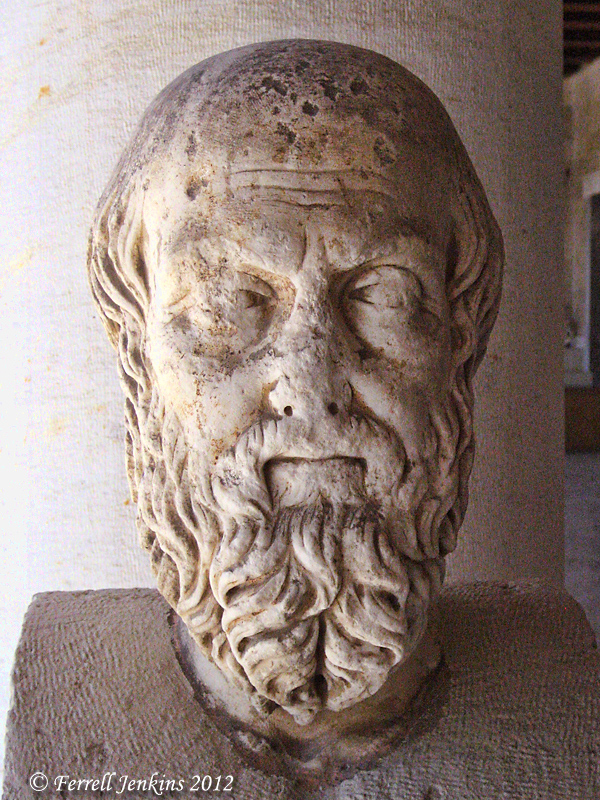
Herodotus Bust displayed in the Stoa of Attalus, Athens Agora

Herodotus Bust displayed in the Stoa of Attalus, Athens Agora. Photo: F. Jenkins.

Is it possible that Paul may have seen this structure when he sailed past Cos (Acts 21:1)? Ferries run between Bodrum (Turkey) and Cos (Greece) today.

Halicarnassus is listed among the towns that were informed by the Romans of their support of the Jews (1 Maccabees 15:23).

The Greek historian Herodotus claimed Halicarnassus as his home.

At least one lesson we learn at Halicarnassus is that monuments built to oneself do not endure for long. Think of Absalom.

Now Absalom in his lifetime had taken and set up for himself the pillar that is in the King’s Valley, for he said, “I have no son to keep my name in remembrance.” He called the pillar after his own name, and it is called Absalom’s monument to this day. (2 Samuel 18:18 ESV)

Did Paul’s ship dock at Perga or Attalia?

My friend and former student Darryl Smelser left a good comment regarding Perga for a post here. I thought I would elevate it to an entire post.

You point out that “Paul, Barnabas, and John Mark made their way from Paphos on Cyprus to Perga in Pamphylia,” which of course is correct. But as Perga is a bit inland from the sea, and Attalia was/is a port, I have pretty much assumed that as they traveled from Cyprus, the three men arrived *first at Attalia* and then went to Perga, and so toward Galatia. Why would not Luke have mentioned Attalia? I suppose the omission is due to the fact that in this part of the journey neither Attalia nor Perga were important to be mentioned, except for the fact that it was in Perga that John Mark turned back; thus it wins a mention. Does that seem to be sound reasoning to you? Would any ship delivering goods to Perga have ported at Attalia, or was there a closer port?

I think we can give no absolute answer to this question. Here is what I know about it.

Look at a good modern atlas of Turkey (Köy Köy Türkiye Yol Atlasi), and you will see the Aksu Cay (the ancient Cestrus River) about 3 miles east of Perga. Attalia (modern Antalya) is farther to the west.

Mark Wilson says,

Strabo (14.6.2) states that the Cestrus was navigable at this time and a road apparently linked the river with Perga. The city was 6 mi/10 km from the Mediterranean and linked to the coast via a road to its port at Magydus (Lara). (Biblical Turkey, 99).

Wilson continues in a sentence that seems to have a typo,

Perga was the port of entry Mark in Asia Minor for Paul, Barnabas, and John on their first journey (Acts 13:13). (100).

My first suggestion is that the word Mark somehow got moved from after John, to the line above. If so, then the sentence should be read as follows:

Perga was the port of entry in Asia Minor for Paul, Barnabas, and John Mark on their first journey (Acts 13:13).

Fant and Reddish say,

In ancient times Perga apparently had a port on the river, which was navigable, thus allowing the city to benefit commercially from the river. (Biblical Sites in Greece and Turkey, 265).

The Dictionary of the Apostolic Church (J. Hastings) recently became available through Logos community pricing. James Strahan says,

Paul and Barnabas were twice at Perga in their first missionary tour. In their outward journey they landed at the river-harbour and went up to the city (Ac 13:13).

The Roman Gate at Perga in Pamphylia. Photo by Ferrell Jenkins.

The Roman Gate at Perga in Pamphylia. Photo by Ferrell Jenkins.

Major revision of the Pictorial Library of the Bible Lands

Todd Bolen announces the release of a total revision of the Pictorial Library of Bible Lands. This revised and expanded edition is the culmination of 9 years of work. The previous version contained 6000 photographs in 10 volumes. According to the announcement,

This new edition consists of 18 volumes with nearly 18,000 photographs, adding hundreds of new sites and re-visiting the old favorites.

Here are just a few features of the new edition of the Pictorial Library of Bible Lands.

  • Eight new volumes: (Lebanon, Eastern and Central Turkey, The Greek Islands, and more. New subjects include Cultural Images, Signs, and Trees, Plants, and Flowers.
  • New Photos: For example, more than 1000 new photos have been added to the Jerusalem volume.
  • New Photographers. In addition to the photos by Todd Bolen, the work of more than 40 photographers are included in this new set.
  • New Maps. New, original maps have been created to identify the sites.
  • New Indexes. Every photograph is indexed in a list of more than 400 pages.
  • You get the hi-res photos and the photos already in PowerPoint. You can use the presentation as it is or include individual slides in your own lesson.
  • And more…
Pictorial Library Complete Collection. BiblePlaces.Com.

Front cover of the new Pictorial Library Complete Collection.

For those who already own the previous collection, Bible Places is offering the new 18-volume set for the upgrade price of $179. The entire set for new purchasers is $389.

Would you prefer to make your own photos? Try buying a good digital SLR camera starting at about $1500, flying to Israel (not to mention Lebanon, Egypt, Turkey, Greece, the Greek Islands, Italy, et al.), renting a car for a few weeks, buying the gas. Oh, and don’t forget to hire a private plane for a few hours so you can get some good aerial photos. That might cost at least $389. 🙂 And what if the lighting conditions were not right for a good photos the day you were at a site? What if you don’t have time to get your photos organized and write a description of each one? Need I go on to make a point? Did I mention that living and teaching in Israel for a decade helps?

Every church should have a set of this material for the teachers to use in their teaching. Over the years I have found that some short-sighted groups (churches) will not make such an expenditure. The other choice is to buy the set for yourself.

I hear several lessons a week, and every one of them could be improved by the use of photos from this wonderful collection.

Learn more about the new Pictorial Library of Bible Lands in the following places:

Charles Savelle has a good interview with Todd Bolen at the BibleX blog here.

I have profited much from the work of Todd Bolen and am delighted to count him as a friend and to recommend this collection of photographs to every teacher of the Bible.

Follow the BiblePlaces.com Blog here.