Category Archives: Travel

Saint Catherine’s Monastery

The Monastery of St. Catherine is located at an altitude of about 4925 feet in the Wadi el-Deir at the foot of Gebel Musa. Tradition identifies this as the site where Moses tended the flocks of Jethro and saw the burning bush (Exodus 3:1-4:17). The Monastery was built near the middle of the sixth century A.D. during the reign of the emperor Justinian. It is dedicated to Saint Catherine of Alexandria and is the oldest continuously inhabited convent in the Christian world. Through the centuries many monks have lived there; today it houses fewer than a dozen Greek Orthodox monks.

The monastery became a great center of over 3000 old manuscripts and over 2000 icons. Only the Vatican library has more manuscripts. The Sinaitic Manuscript (Aleph) of the Bible was discovered by Constantine Tischendorff in 1844. The Sinaitic is the oldest surviving complete manuscript of the New Testament (about 350 A.D.). In 1975 the monks at the monastery found a large number of previously unknown documents. (One interesting recent book dealing with the monastery and its manuscripts is Secrets of Mount Sinai by James Bentley.)The bedouin who work at the Monastery are called Jabaliye (Arabic for People of the Mountain).

“According to their tradition they are descendants of Christian slaves who were brought here by Emperor Justinian from Wallachia, today Rumania, as builders of the monastery and later its guards. In the course of time, when Sinai came under strict Moslem rule they were compelled to embrace Islam” (Vilnay, The Guide to Israel, 564).

There is a mosque within the monastery walls.

I have had an opportunity to visit the area of Gebel Musa a few fimes, and to visit the monastery a couple of times. Here is a photo of the monastery that I made on my last visit to the area in 2005.
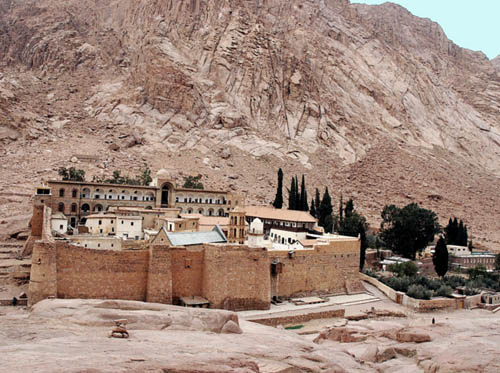
Saint Catherine's Monastery
The joy of traveling together

It is unfortunate that many younger couples are not able to travel to the lands of the Bible. This is especially true of young preachers who need the knowledge they could gain in their ministry. Some young folks could travel to these places if they wanted to. One fine lady who, along with her husband, had been on a tour to Israel and Greece, told me that she had rebuked (not her word) some of the young professionals she knew. She told them that they ought to give up a few ski trips and go to the Bible lands. A matter of priorities, isn’t it.

I find that many women want to travel, but their husbands refuse to do so. It often happens that the husband dies and the wife gets to travel. Too bad they could not have made these memories together. Elizabeth and I have enjoyed being blessed to travel to many parts of the world. We realize that most of those years are behind us and we have great memories to share. And we have made many wonderful friends in our travels.

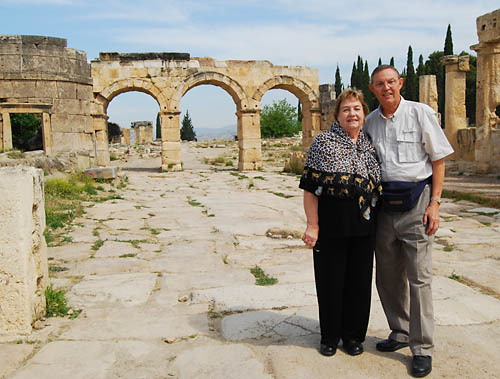
The photo below was made at Pamukkale, Turkey (ancient Hierapolis). We are standing on the colonnaded Roman road, and the monumental gateway behind us is the Arch of the Emperor Domitian (A.D. 81-96). It was constructed in A.D. 82-83.

Hierapolis was the home of Papias (c. A.D. 60 to c. A.D. 130). He was a disciples of the apostle John and a companion of Polycarp. There are some traditions associating Philip (apostle?, evangelist?) with the city.

The city of Hierapolis is one of the three cities of the Lycus River valley named in the New Testament.

For I testify for him that he has a deep concern for you and for those who are in Laodicea and Hierapolis. (Colossians 4:13).

The Fascination of Egypt

Egypt has a grip on the imagination of each of us. We probably first learned something about it in our elementary school studies. We have seen it portrayed in movies and television programs.

Every Bible student has studied about Egypt in numerous contexts. Not only did the tribes of Israel grow into a nation while in Egyptian bondage, but we know of the following characters who visited Egypt: Abraham, Jacob, Joseph, Moses, Joshua, Jeremiah, Jesus, Mary and Joseph. The prophets spoke much about the land of Egypt. Egypt is mentioned more than 600 times in the Bible.

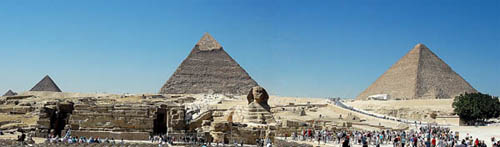
This is a panoramic photo I made of the Pyramids of Giza in 2005. The pyramids, from left to right, are Mycerinus, Chephren, and Cheops. These structures were built about 2500 B.C. Some people have the mistaken idea that the Israelites in Egyptian bondage built the pyramids. You can see from the date that these pyramids were built about 1000 years before the Israelites did their building (Exodus 1:11).

Ramoth in Gilead

Ramoth in Gilead (or Ramoth-gilead) was a town in Gilead that was included in the territory of the Israelite tribe of Gad in Transjordan (Joshua 20:8). It was one of the Levitical cities of refuge for the Israelites (Joshua 21:38). The most memorable associated with Ramoth-gilead recorded in the Bible is the battle with Aram (Syria) in which Ahab was killed (1 Kings 22). Elijah sent one of the sons of the prophets to Ramoth-gilead to anoint Jehu as king of Israel (2 Kings 9:1).

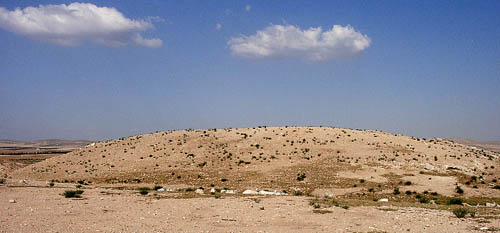
The identity of Ramoth-gilead is uncertain. Two sites are frequently mentioned by scholars: Tall ar-Rumeith and Ar-Ramtha.

Burton MacDonald, in East of the Jordan, says,

There is also archaeological support for choosing Tall ar-Rumeith, situated in the fertile plain area just to the southeast of the junction of the ‘Amman-Damascus and Irbid-Mafraq highways, as the location for Ramothgilead. (page 200)

Paul Lapp excavated at Tall ar-Rumeith in 1967. Little archaeological work has been done at Ar-Ramtha. I have not gone into the Jordanian city of Ramtha, but understand that the mound is covered by the town, thus making it difficult to conduct an excavation.

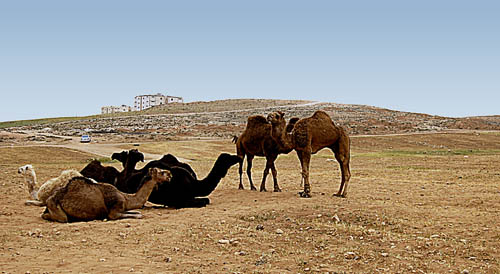
Here is a photo I made at Tall ar-Rumeith in 2002. It is not surprising to see camels here because the desert is near (to the east). From the top of the tell there is a great view looking north across a fertile plain to the border with Syria.

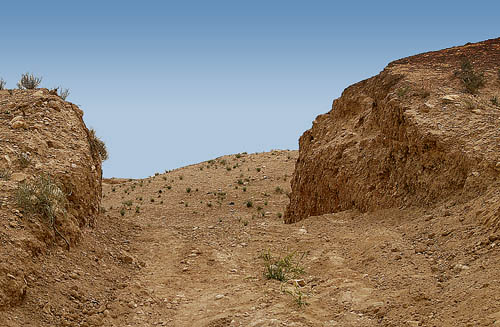
Earlier this year I went back to the site, but found that some modern housing has been built adjacent to the east side of the tell. It appears to be serving as housing for Indian students. I speculate that they attend a nearby university.

This photo shows a modern trench made to make a road to part of the construction site.

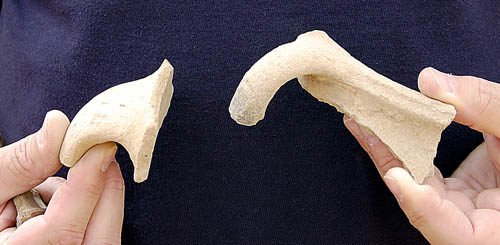
We found some pottery in the road, but can not be certain that it came from the damage to the tell. I did not see any shards along the edge of the cut.

This illustrates a real problem associated with ancient sites in isolated places. In a place like Jordan there are so many sites that it is impossible to excavate, preserve, and guard all of them.

A note on spelling. You may note different spellings of the word describing an archaeological mound. In Israel the term Tel is used. Earlier the term Tell was used throughout the Middle East. In Jordan the term Tall has come into common use.

There is also much variation in the spelling of some of the compound biblical names in scholarly sources, and even in English translation of the Bible. This is illustrated in this post and the previous one on Bethshan.

“You cows of Bashan”

Amos of Tekoa is recognized as a straight forward, no nonsense, prophet (Amos 1:1). He called the women of the northern kingdom of Israel cows. Nothing politically correct about that.

Hear this word, you cows of Bashan who are on the mountain of Samaria, Who oppress the poor, who crush the needy, Who say to your husbands, “Bring now, that we may drink!” (Amos 4:1)

The sn (study note) in the NET Bible is worth reading.

The expression cows of Bashan is used by the prophet to address the wealthy women of Samaria, who demand that their husbands satisfy their cravings. The derogatory language perhaps suggests that they, like the livestock of Bashan, were well fed, ironically in preparation for the coming slaughter. This phrase is sometimes cited to critique the book’s view of women.

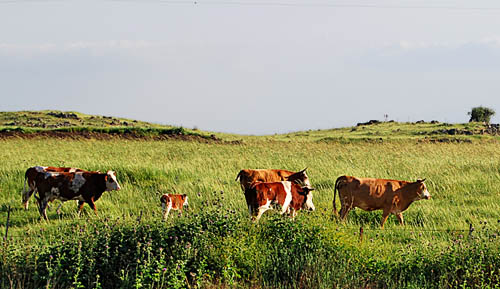
Bashan is in the area we now call the Golan Heights. It is located to the east of the Sea of Galilee and northward. Golan in Bashan was one of the cities of refuge located in the territory of eastern Manasseh (Joshua 20:8). The region was noted as good pasture land.

In the modern state of Israel we notice an attempt to grow crops known from biblical times in the same area where they were grown then. And the same is true of cattle. Here is a photo I made this year of some of the cows grazing in ancient Bashan (modern Golan Heights).

Philadelphia, the church with an open door

Philadelphia is located about 30 miles southeast of Sardis in the valley of the Cogamis, a tributary of the Hermus. The city is built on the slope of Mount Tmolus overlooking a fertile valley. Philadelphia was in the province of Lydia in Western Asia Minor.

Philadelphia stood at the place where the borders of Mysia, Lydia, and Phrygia met. “It was characteristically a border town” (Barclay). This position made it the gateway to the East. Ramsay says,

“the Imperial Post-Road of the first century, coming from Rome by Troas, Pergamum and Sardis, passed through Philadelphia and went on to the East; and thus Philadelphia was a stage on the main line of Imperial communication” (The Letters to the Seven Churches 395).

The site of ancient Philadelphia is now covered by the Turkish agricultural town of Alashehir which has a population of about 20,000. Alashehir (Red City) is named for the volcanic earth in the area (Blaiklock 122). The plain is filled with vineyards. If Philadelphia were not a Biblical city very few tourists would put forth the effort to visit it.

According to Hemer, the location had one great disadvantage.

“It lies perilously close to the region known as the Catacecaumene (“the burnt land”) of Lydia, a hilly tract to the northeast which contained volcanic cones which had been active in recent geological time. And the whole area lies in the Anatolian fault system. Philadelphia was peculiarly liable to earthquake” (Hemer, “Unto the Angels of the Churches,” Buried History 11 (1975), 166).

Trench says, “No city of Asia Minor suffered more, or so much, from violent and often recurring earthquakes.” In A.D. 17 there was a destructive earthquake in the region which affected 12 cities. Sardis suffered worst, but Philadelphia is also mentioned. The cities were exempted from direct taxation and Tiberius provided personal funds for relief (Tacitus. Annals. 2.47).

Ramsay, who spent much time in Asia, reports that “the first great shock of earthquake is not so trying to the mind as the subsequent shocks, even though less severe, when these recur at intervals during the subsequent weeks and months….” Colin J. Hemer visited Philadelphia in 1969 just a few days after an earthquake (172-73). The people would leave the city and go out into the open fields and live in tents. When all danger was passed, and they did the necessary rebuilding, they would go back into the city. Strabo reports this in A.D. 20 (Ramsay), and Hemer provides a photograph of people living in tents outside their houses in 1969.

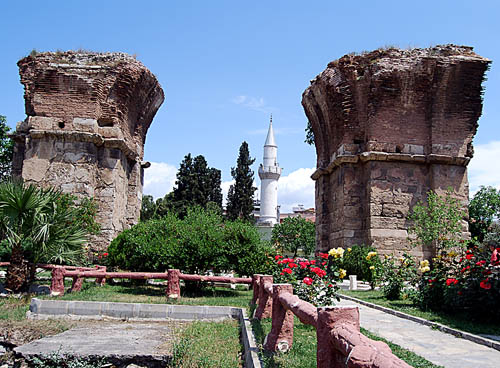
Our photo shows the ruins of the Byzantine church. Local tradition says this building served as a cathedral dedicated to St. John the Theologian. In Turkey the minaret is positioned to be in almost every tourist photo.

Toward the end of the first century the Lord sent a letter to the church at Philadelphia (Revelation 1:11; 3:7-13). The Lord commended the church with these words:

Behold, I have put before you an open door which no one can shut, because you have a little power, and have kept My word, and have not denied My name. Revelation 3:8

Another kind of Poppy

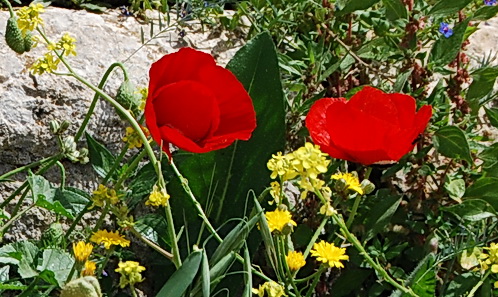
A few days ago I posted a photo of some poppies in Turkey and included the term anemone with it here. Reader J. P. Van de Griessen, of the Netherlands, informed us that he thinks that this is the “Papaver rhoeas or family of it.” I do not have much knowledge about plants, but I had noticed that the poppies in Turkey were a bit different from the ones I have seen in Israel and Jordan in the spring of the year. J. P. has a section of his blog dealing with flora. Even if you can not read the Dutch you might be able to make a suitable translation using the Google language tools.

In the past three trips to Israel, with good digital equipment, I have not seen many poppies growing. In past visits, earlier in the year, we have seen entire fields colored with them. Here is a photo of some poppies among the ruins at Jerash in Jordan.

I understand this to be the anemone. Dr. David Darom, in Beautiful Plants of the Bible, calls it the common poppy (Papaver sp.). One Wikipedia article indicates that there are more than 150 varieties of the poppy. Darom links this plant with the “lilies of the field” mentioned by Jesus.

And why are you worried about clothing? Observe how the lilies of the field grow; they do not toil nor do they spin, yet I say to you that not even Solomon in all his glory clothed himself like one of these. “But if God so clothes the grass of the field, which is alive today and tomorrow is thrown into the furnace, will He not much more clothe you? You of little faith! (Matthew 6:28-30)

The UBS Fauna and Flora of the Bible comments on the New Testament word krinon:

It is used by Jesus in the Sermon on the Mount, when he says: ‘Even Solomon in all his glory was not arrayed like one of these.’ Most commentators now think of the Anemone coronaria, the anemone with beautiful bright colours which is to be found on the hills of Galilee, where it would undoubtedly have been seen by the people listening to Jesus. (page 135)

Thanks, J.P. Any other help will be appreciated.

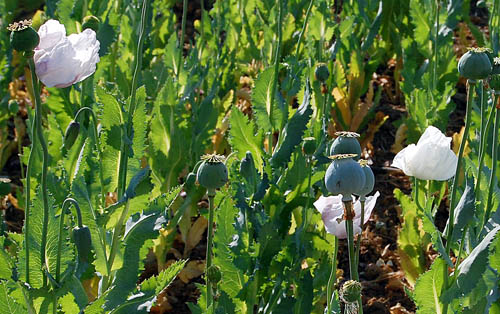
Speaking of poppies. In Turkey, another type of poppy is legally cultivated. On the outskirts of Yalvac (near Pisidian Antioch of Acts 14), I have seen cultivated fields of white poppies along the road. Under U. S. pressure, Turkey outlawed the growing of poppies in 1971. By 1974 they were allowing them to be grown under strict government control. Government factories convert the dried stems into poppy-straw concentrate (PSC) and then into morphine and codeine (See “The Poppy,” National Geographic, Feb., 1985, pp. 143-189). Here is a photo I made last year. I trust that I will not be charged with possession of a poppy photo!

From the mountains of Ararat to the island called Patmos

Or, from Genesis to Revelation. I did not make an intentional plan to do so, but within the past twelve months I have visited areas of the Bible world, from the mountains of Ararat to the island of Patmos. What a blessing to have the opportunity to spend about four weeks in Turkey, covering most of the sites mentioned in the Bible, about 10 days in Greece, more than a week in Israel, and a week in Jordan.

This means that I have been able to visit some of the most significant portions of the Bible world. Better than visiting the area alone, I have been able to share the area with other teachers (both men and women) who will be incorporating this information into their lessons for years to come.

When I first reflected on the past year and realized that I had been to Mount Ararat, in the mountains of Ararat, and on the Island of Patmos, I realized that this covers from Genesis 6 to the book of Revelation. Of course, this doesn’t mean that I have visited every place in between, but it does give a sense of comprehensive overview.

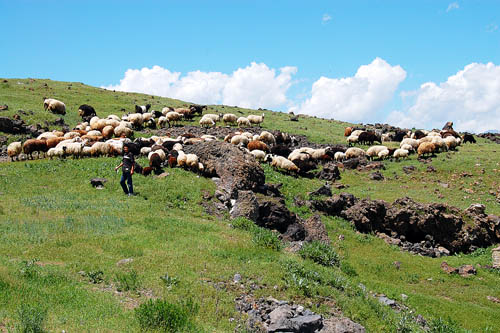
Here are a couple of photos I trust you will find helpful. The first is of a shepherd with his sheep in the mountains of Ararat. Remember that the book of Genesis records that Noah’s ark rested “upon the mountains of Ararat” (Genesis 8:4).

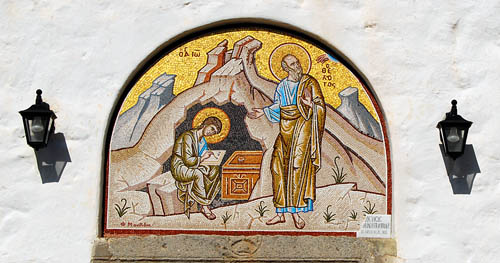
This photo was made at the entry to the cave of the Apocalypse on “the island called Patmos” (Revelation 1:9). John was exiled here during the reign of the Roman emperor Domitian. Whether the book of Revelation was written on Patmos, or after John’s release, we can not say with certainty. The mosaic over the entry to the cave shows John dictating the revelation given to him by the Lord.

It is my conviction that Bible land travel can enhance one’s Bible study and improve one’s understanding of the text. This, in turn, needs to be converted to action in obedience to the will of the Lord, and in service to Him.

Be sure to read…

I want to encourage you to go back to the post on “The historical credibility of the Gospel of John” and read the comment by my friend Bruce Hudson. Prof. F. F. Bruce was at the University of Manchester for many years. You might enjoy some comments I made about Prof. Bruce last Septermber when I was in Scotland. Click here.

A pretty picture

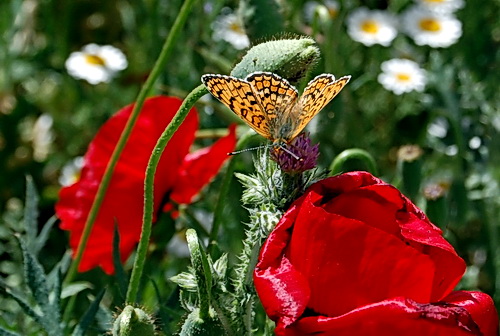
While looking for a photo for use in a lesson for Sunday I noticed this photo that I made near Konya, Turkey. This is the site of biblical Iconium (Acts 13:51-14:5). I was lucky to catch the butterfly on a poppy (anemone). Enjoy.