Category Archives: Travel

The Arabah road and Arad in the Negev

This morning we left Eilat and headed north along the Arabah road (Deuteronomy 2:8) to the Dead Sea where we planned to spend the night. On our right hand, to the east, was the territory of ancient Edom. Before checking in at the hotel, we went east up to Tel Arad. Arad is located in the Negev about 20 miles east of Beersheba.

The biblical account informs us that the king of Arad fought against Israel and took some as captives.

When the Canaanite, the king of Arad, who lived in the Negeb, heard that Israel was coming by the way of Atharim, he fought against Israel, and took some of them captive. (numbers 21:1).

Israel promised the LORD that they would destroy all of the cities if He would give them victory in a second battle.

It seems that the Kenites settled in the region of Arad (Judges 1:16). Note the reference to the “wilderness of Judah” in this text.

Tel Arad consists of two mounds. The Canaanite city belongs to the Early Bronze Age II (2900-2700 B.C.). The other is from the Iron Age, ranging from the time of Solomon to the end of the Kingdom of Judah. Various suggestions are made in an effort to solve the problem of the gap in occupation from 2700 B.C. to about 1200 B.C., when the city was built as a fortress.

Several sites in Bible times had places of worship in competition with the temple at Jerusalem (Dan, Bethel, Beer Sheba, et al.) (Amos 5:5; 8:4). One fascinating thing about Arad is the temple built to dimensions similar to the temple in Jerusalem. In the courtyard there is an altar of the same dimensions as the altar of burnt offering at the tabernacle. In the holy of holies there are two small incense altars and two standing stones. The originals are in the Israel Museum.

Aharoni, the excavator of Arad (1962-1967), thinks this was a Kenite high place.
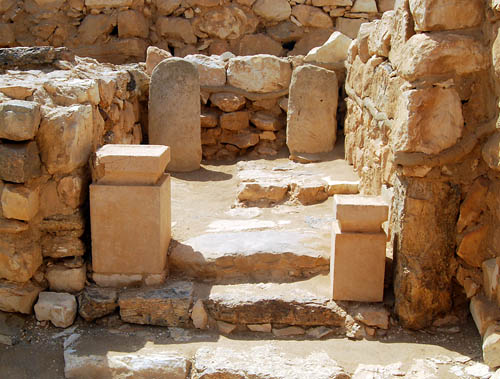
Iron Age temple at Arad. Photo by Ferrell Jenkins.

Iron Age temple at Arad. Photo by Ferrell Jenkins.

On the way back to our hotel on the Dead Sea I made several photos of the wilderness of Judea. This view shows the Dead Sea. Notice the wadi.
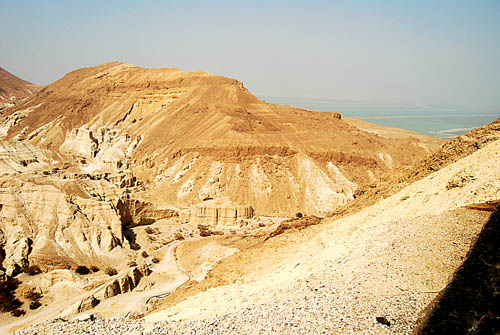
The wilderness of Judea at the south end of the Dead Sea. Photo by F. Jenkins.

The wilderness of Judea at the south end of the Dead Sea. Photo by F. Jenkins.

We are where the Dead Sea used to be. There are several hotels in the area of the Dead Sea Works. The water here is being pumped from the north end of the Dead Sea because it is needed in the mining works.
The tabernacle in the wilderness

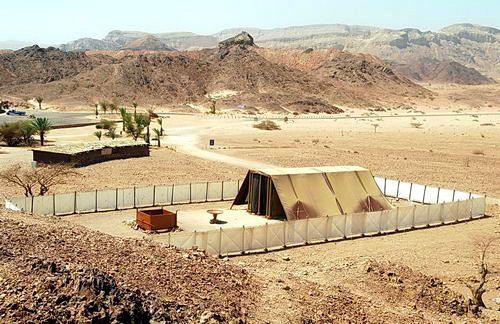
A full size model of the Israelite tabernacle has been constructed in Timna Park, 17 miles north of Eilat. This was one of the big reasons I wanted to visit Eilat on this trip. The tabernacle was built while the Israelites were at Mount Sinai (Exodus 25-40). The tabernacle was a movable tent of worship which was taken each place Israel wandered during the forty years in the wilderness. Stephen spoke of the tabernacle this way:

“Our fathers had the tabernacle of testimony in the wilderness, just as He who spoke to Moses directed him to make it according to the pattern which he had seen. (Acts 7:44)

I walked up hill above the tabernacle model and took this view of the tabernacle with the laver and the altar of burnt offering in the courtyard.

The tabernacle in the wilderness. Photo by Ferrell Jenkins.

The tabernacle in the wilderness. Photo by Ferrell Jenkins.

If you are ever near Eilat, drop by and see this wonderful model.

The wilderness – Zin and Paran

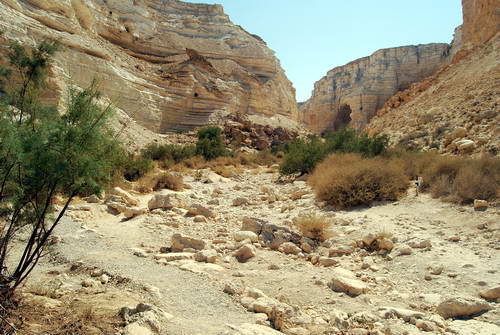
Yesterday we drove from Beersheba to Eilat. The whole region is inhospitable and uninviting. Here is a photo of a section of the Wadi Zin. The wadi is dry now, but when there is rain it will become a river in the desert.

Wadi Zin. Photo by Ferrell Jenkins.

Wadi Zin. Photo by Ferrell Jenkins.

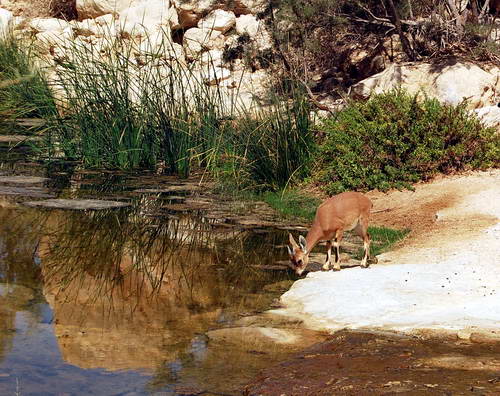
In Wadi Zin there are some small springs and a cool water pool. We did not take time to hike to the pool, but stopped by a small spring to watch the Ibex. Here is a young Ibex drinking water that reminds me of Psalm 42:1.

As a deer pants for flowing streams, so pants my soul for you, O God. (Psalm 42:1)

A young Ibex in Wadi Zin. Photo by Ferrell Jenkins.

A young Ibex in Wadi Zin. Photo by Ferrell Jenkins.

When the time came for Moses to die, the Lord told him that he would not be allowed to enter the promised land,

because you broke faith with me in the midst of the people of Israel at the waters of Meribah-kadesh, in the wilderness of Zin, and because you did not treat me as holy in the midst of the people of Israel. (Deuteronomy 32:51)

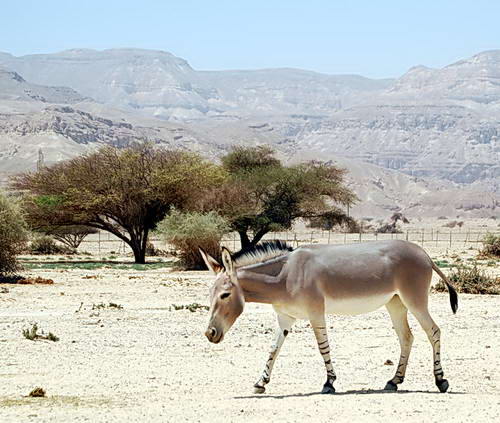
Today we visited the Yotvata Hai-Bar Nature Reserve, located about 20 miles north of Eilat in the Arabah. I made photos of many of the animals in the reserve.

A Somalia Wild Donkey at the Yotvata Hai-Bar Reserve. Photo by Ferrell Jenkins.

A Somalia Wild Donkey at the Yotvata Hai-Bar Reserve. Photo by Ferrell Jenkins.

Ishmael is described in these terms:

He shall be a wild donkey of a man, his hand against everyone and everyone’s hand against him, and he shall dwell over against all his kinsmen.” (Genesis 16:12)

Sometimes the LORD used simple facts to illustrate His wisdom. He asked Job,

“Who has let the wild donkey go free? Who has loosed the bonds of the swift donkey, (Job 39:5)

We are located less than a mile from the border with Jordan. In the afternoon we drove down to the Taba border crossing with Egypt. We also saw some of the beautiful coral and colorful fishes in the Red Sea.

The temperature today was 45 degrees celcius. Go figure! (For those of you who are metrically challenged, that is 113 degrees farenheit. It was really hot. We were expecting it to be 105!)

Traveling south

Monday we left Jerusalem and drove to Beersheba. I was able to get some great photos of agricultural practices in the hill country of Judea. The Negev (southland in some English versions) begins at Beersheba. It is an area plagued by lack of water, always dependent on the amount of rain it receives in the winter months. (I am speaking primarily of biblical times, but even with irrigation the area is still fairly barren.). The account of Hagar and Ishmael is illustrative of the conditions in the area (Genesis 21:8-21)

We stopped at Tel Be’er Sheva. The Genesis account says,

Abraham planted a tamarisk tree in Beersheba and called there on the name of the LORD, the Everlasting God. (Genesis 21:33).

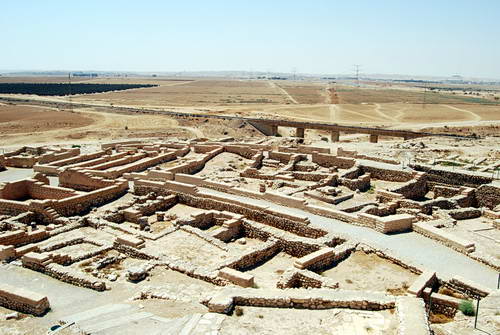
There is a nice observation tower on the mound that allows one to get a view of the complete excavated area. The photo also shows the terrain. The highway in the distance is the main highway from Beersheva to Eilat.

View of Excavation at Tel Be'er Sheva. Photo by Ferrell Jenkins.

View of Excavation at Tel Beersheva

We saw so much yesterday that it would take me hours to write a summary. We stopped at Wadi Zin and the Wilderness of Zin where the Israelites wandered. See Numbers 13:21 and 20:1. Since I am not too fond of Manna, I think a few days would be enough for me! By 8 p.m. we arrived at Eilat.

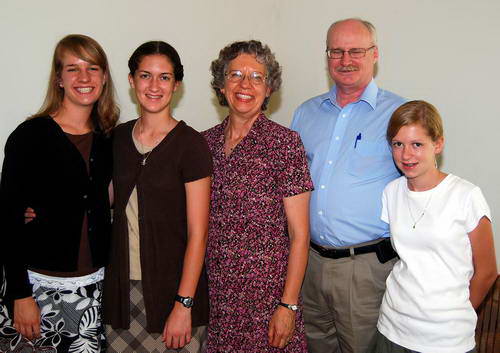
Sunday we visited with some Christian friends who live north of Tel Aviv. Ken and Vickie Boyd are here for two years in connection with Ken’s job. We met with them for worship. Vickie prepared a wonderful lunch that was far superior to the hotel buffets we had been eating. The Boyd’s were students of mine in the ancient days. We wish them well in their time in Israel.

Jessica, Savanah, Vickie, Ken, Heather

Jessica, Savanah, Vickie, Ken, Heather

In the afternoon we stopped at Aphek for a few photos. In New Testament times this was known as Antipatris. More later, perhaps. We also went to Gezer, but were to late to do a complete visit or to get good photos.

Sunday evening in Jerusalem

We had a good day, but I do not have time this evening to give a report on the activities of the day. Tomorrow we plan to leave early for a trip to Beersheba, the Negev (including the wilderness of Zin), and Eilat on the Gulf of Eilat/Aqaba.

Visiting the Judean Hills

We were able to visit several sites in the Judean Hills yesterday. Many of them were in the territory of the Israelite tribe of Dan.

Zorah was the birthplace of Samson. The biblical record says,

And the Spirit of the LORD began to stir him in Mahaneh-dan, between Zorah and Eshtaol.  (Judges 13:25)

Both of these towns are within an area now designated a forested park land.

When the Ark of the Covenant was returned by the Philistines on a cart pulled by milk cows, it came into the Zorek Valley near Beth Shemesh (1 Samuel 6). The ark was later taken to Kiriath-jearim before being moved to Jerusalem by David (2 Chronicles 1:4). We visited all of these sites.

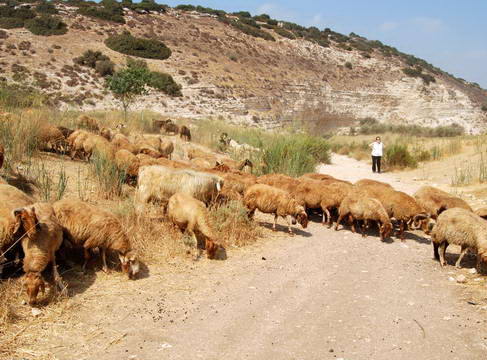
We also visited the sites around the Valley of Elah where young David met Goliath the Philistine from Gath in a decisive battle (1 Samuel 17). While we were in the process of picking up five smooth stones for our grandson, Drew, a shepherd drove a flock of sheep across the brook. You can see from the photo that Elizabeth and I were separated for a while.

Elizabeth and I were temporarily separated in the brook of Elah by a flock of sheep. Photo by Ferrell Jenkins.

Elizabeth and I were temporarily separated in the brook of Elah by a flock of sheep. Photo by Ferrell Jenkins.

Understand that the brook (nachal) of Elah has water in it only during the rainy season. We also visited Tell es-Safi, thought to be the site of Gath, one of the major Philistine cities and the home of Goliath. The excavator, Aren Maeir, has a marvelous aerial photo of the top of the tell posted at the Tell es-Safi/Gath blog. We did not have time to climb to the top, but maybe we can get back to it another day.

In Jerusalem

Elizabeth and I had on-time flights to Israel. Can’t say as much for the car rental company at the Ben Gurion airport. Anyway, we are safely in our hotel in Jerusalem. We are looking forward to a good night of rest.

Maybe by tomorrow evening we will have some new info to post.

Restricting information

China has been in the news a lot in the past years. Most recently we have seen them assuring us they could resolve a severe pollution problem within weeks. Then there were all of those toys containing lead. One day we told our little grandson to take something from his mouth that he had picked up off the floor. He said, “Why, was it made in China?” We heard that the media in China to cover the Olympics would have free access to the Internet, but then certain sites were blocked.

More serious than all of this are those matters pertaining to human rights and the restriction of religious rights. In 1986 we carried a few Bibles into the country and gave them to individuals or left them where they might be picked up. Several friends who have visited China, or lived there for short periods, have mentioned the restrictions and the secrecy under which Christians meet for study of the Bible and the worship of Christ.

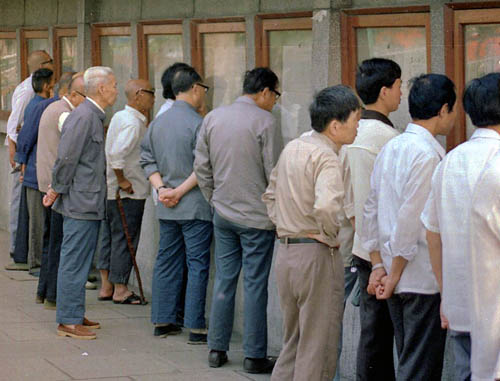
Here is a photo I made in 1986 in one of the cities we visited. The only news the people got was what the government posted for them. Such censorship is deplorable whether in China or elsewhere. It is based on fear. I was in Bangkok when I learned of the Tiananmen Square protests of 1989. The next few days in Hong Kong I saw marches protesting what was happening in mainland China. Several people had copies of newspaper reports about the incident. They wanted us to fax or mail them to their friends in China.

Men lined up to read the news in China in 1986. Photo by Ferrell Jenkins.

Men lined up to read the news in China in 1986. Photo by Ferrell Jenkins.

We hope the time will come when the people of China will have free access to the Bible and all other information so readily available to those who live in freedom.

China, then and now

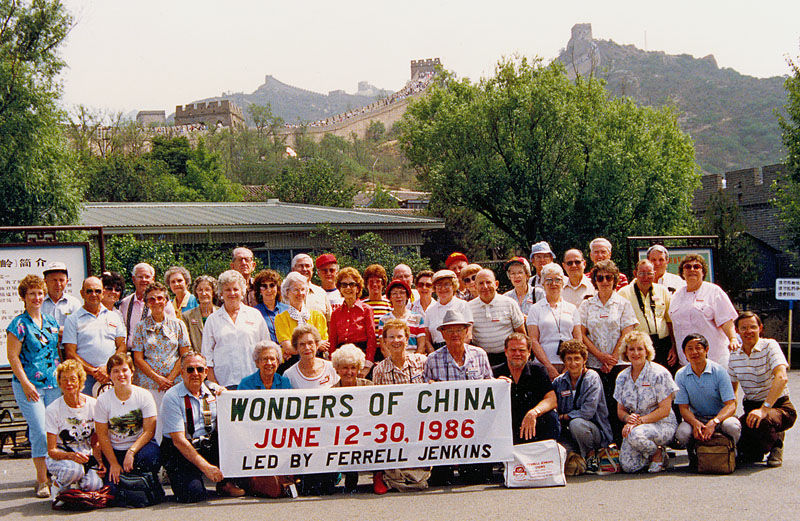
The media, especially NBC, is giving lots of attention to the upcoming Olympic games from China. Many changes have taken places in China over the past few decades. Some good; some not so good. In 1986 we took a tour to China. This morning I dug out a photo of the group that we made before climbing the Great Wall, and thought that some of you might enjoy seeing it.

Wonders of China group led by Ferrell Jenkins at the Great Wall in 1986.

Wonders of China group led by Ferrell Jenkins at the Great Wall in 1986.

If you know some of the folks who have traveled with us in the past you may click on the image to see a larger copy.

A river in Pamphylia

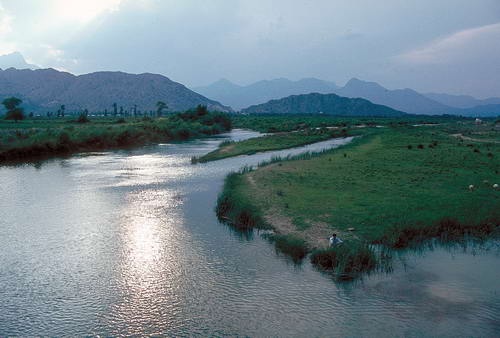
This week I am busy with a number of projects, but I wanted to share a beautiful photo that I made early one morning in the mid-80s. This is a river that flows from the Tarus Mountains into the Mediterranean at Antalya, Turkey. Antalya is know in the Bible as Attalia. Paul and Barnabas sailed from Attalia at the conclusion of the first preaching journey.

When they had spoken the word in Perga, they went down to Attalia. From there they sailed to Antioch, from which they had been commended to the grace of God for the work that they had accomplished. (Acts 14:25-26)

Attalia was in the Roman province of Pamphylia in the days of Paul.

A river in Pamphylia with the Tarus Mountains in the background.