Category Archives: Travel

Sunset on the Aegean

This photo was made from one of the resort hotels overlooking the Aegean Sea at Kusadasi, Turkey, near the ancient city of Ephesus.

Sunset on the Aegean near Ephesus. Photo by Ferrell Jenkins.

Sunset on the Aegean near Ephesus. Photo by Ferrell Jenkins.

The Aegean is not mentioned by name in the New Testament, but it plays a prominent role in the journeys of the Apostle Paul. Perhaps in a few days I will pull together some of this information and share it with you.

Apollos, the eloquent man of Alexandria, learned the way of the way of God more accurately at Ephesus. When he heard of the work in Achaia (Corinth) he wanted to go there. He likely sailed west from Ephesus to Cenchrea, a port of Corinth.

But when Priscilla and Aquila heard him, they took him aside and explained to him the way of God more accurately. And when he wanted to go across to Achaia, the brethren encouraged him and wrote to the disciples to welcome him; and when he had arrived, he greatly helped those who had believed through grace, for he powerfully refuted the Jews in public, demonstrating by the Scriptures that Jesus was the Christ. (Act 18:26-28 NAU)

Euphrates River in northern Syria

The photos we post of the Euphrates River are always popular. I suppose this is because of the historic events associated with the river, and because so few people have seen the river. The Euphrates begins in the mountains of eastern Turkey (ancient Urartu/Ararat), flows south through Syria and Iraq before ending at the Persian Gulf.

Some of the great Bible characters are associated with the River, even when it is not named. We can be sure that Abraham crossed the Euphrates when he left Haran and headed south to Canaan (Genesis 11:32 – 12:1-9). I like the account of Jacob fleeing from Laban.

He left with all he owned. He quickly crossed the Euphrates River and headed for the hill country of Gilead. (Genesis 31:21 NET)

This photo was made in northern Syria, northeast of Aleppo in 2002. Here the river is wide because of a series of dams built by the Syrians. This can not be far from the place where the biblical patriarchs crossed the river.

The Euphrates River in northern Syria. Photo by Ferrell Jenkins.

The Euphrates River in northern Syria. Photo by Ferrell Jenkins.

Paul, Silas, and Timothy pass through Amphipolis

Amphipolis was situated about 30 miles west of Philippi on the Via Egnatia. Luke remained at Philippi while Paul, Silas and Timothy continued to Thessalonica. There is no indication of any preaching done in Amphipolis and Appollonia. In fact, the reference to the city barely attracts notice.

Now when they had passed through Amphipolis and Apollonia, they came to Thessalonica, where there was a synagogue of the Jews. (Act 17:1 ESV)

The River Strymon runs past Amphipolis and continues for about 3 1/2 miles south where it flows into the Aegean Sea. The photo of the River Strymon below was made in the late afternoon against the sun, but I like the effect.

The River Strymon at Amphipolis. Photo by Ferrell Jenkins.

The River Strymon at Amphipolis. Photo by Ferrell Jenkins.

K. L. McKay, in an article in The New Bible Dictionary, describes the city briefly:

Prized by the Athenians and Macedonians as the key both to the gold, silver and timber of Mt Pangaeus and also to the control of the Dardanelles, it became under the Romans a free town and the capital of the first district of Macedonia. Amphipolis is about 50 km WSW of Philippi on the Via Egnatia, a great Roman highway, and Paul passed through it on his way to Thessalonica (Acts 17:1).

The city is somewhat difficult to reach and there is little is to be seen.

Amphipolis Archaeological Site. Photo by Ferrell Jenkins.

Amphipolis Archaeological Site. Photo by Ferrell Jenkins.

Neapolis was the port of Philippi

During his second journey, while at Troas, Paul saw a vision of a man of Macedonia. Luke gives the following record of the vision and of the subsequent action of the apostle.

A vision appeared to Paul in the night: a man of Macedonia was standing and appealing to him, and saying, “Come over to Macedonia and help us.” When he had seen the vision, immediately we sought to go into Macedonia, concluding that God had called us to preach the gospel to them. (Acts 16:9-10)

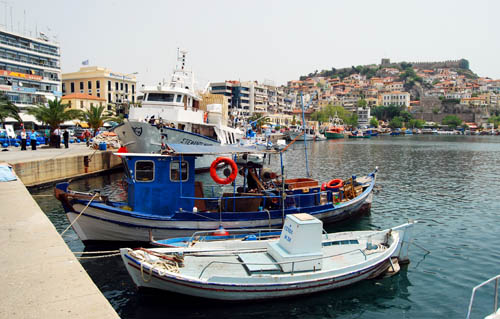
Paul and his companions, including Luke, landed at Neapolis (modern Kavalla). The text indicates that the real goal of their mission was to reach the Roman colony of Philippi. Philippi was about 10 miles away, and could be reached by traveling the famous Via Egnatia across Mount Symbolum. Neapolis had been founded in the 7th century B.C. and served as the port of Philippi. Here is a photo of the modern port at Kavalla in northern Greece.

The harbor of Kavalla, Greece, known as Neapolis at the time of Paul. Photo by Ferrell Jenkins.

The harbor of Kavalla (biblical Neapolis), Greece. Photo by Ferrell Jenkins.

Luke uses his words sparingly.

So putting out to sea from Troas, we ran a straight course to Samothrace, and on the day following to Neapolis. (Act 16:11)

Paul and his companions sailed from Philippi (the port of Neapolis) to Troas on the return from the third journey (Acts 20:3-6.

Cappadocia was home to early Christians

John Freely describes Cappadocia in these words:

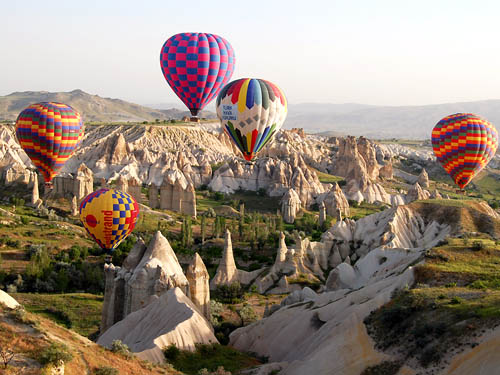
“Most of this part of Cappadocia is covered with a deep layer of tufa, a soft stone of solidified mud, ash and lava which once poured down from the now extinct volcanoes on Hasan Dagi and Ericiyes Dagi, the two great mountain peaks of Cappadocia. In the eons since then the rivers of the region have scoured canyons, gorges, valleys and gulleys through the soft and porous stone, and the elements have eroded it into fantastic crags, folds, turrets, pyramids, spires, needles, stalagmites, and cones, creating a vast outdoor display of stone sculptures in an incredible variety of shapes and colours” (The Companion Guide to Turkey, 238).

Devout Jews from Cappadocia were present in Jerusalem on Pentecost (Acts 2:9). Peter=s letters were addressed to Christians living in Cappadocia (1 Pet. 1:1). In the centuries after New Testament times many Christians settled in this volcanic region of perhaps 50,000 cones.

Gliding gently over Cappadocia. Photo by Ferrell Jenkins.

Gliding gently over Cappadocia. Photo by Ferrell Jenkins.

The best way to enjoy the Cappadocian landscape is by taking a hot air balloon early in the morning. Drifting gently over the landscape is a unique experience.

Todd Bolen calls attention to a nice photo gallery of Cappadocia in the Los Angeles Times here.

The Apostle Paul came to Philippi

The Apostle Paul came to Philippi on his second preaching journey. Luke accurately describes the city with these words:

So putting out to sea from Troas, we ran a straight course to Samothrace, and on the day following to Neapolis; and from there to Philippi, which is a leading city of the district of Macedonia, a Roman colony; and we were staying in this city for some days. (Act 16:11-12 NAU)

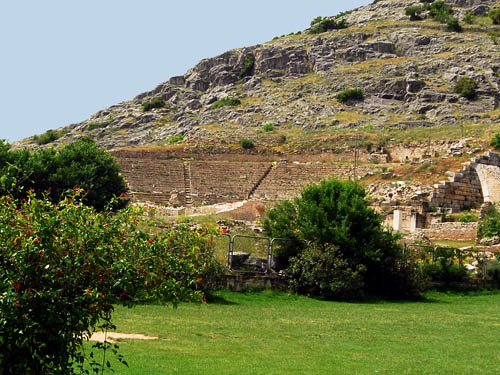
The photo below shows ruins of the theater which was cut into the mountain side. It was built in the days of Philip II in the 4th century B.C. During renovations in the second and third century A.D. arrangements were made for gladiatorial contests.

The theater at Philippi. Built in 4th century B.C. Photo by Ferrell Jenkins.

The theater at Philippi. Built in 4th century B.C. Photo by Ferrell Jenkins.

According to Fant and Reddish,

the theater was modified for gladiatorial contests. The first three or four rows of seats were removed, protective walls were added to keep the animals from the audience, new rows of seats were added on the upper part of the theater, and, in the 3rd century, an underground tunnel was constructed underneath the orchestra for the purpose of bringing in the wild animals. (A Guide to Biblical Sites in Greece and Turkey, 109-110)

Leeks in the land of Goshen

Israel’s experience in the Sinai wilderness might be summarized by the two words complained and murmured. One such account is given in Numbers 11.

We remember the fish we ate in Egypt that cost nothing, the cucumbers, the melons, the leeks, the onions, and the garlic. But now our strength is dried up, and there is nothing at all but this manna to look at.” (Numbers 11:5-6 ESV)

The Land of Goshen, where the Israelites lived, was located in the eastern Nile Delta along the Pelusiac Branch of the Nile. The land is flat and fertile, and their are canals with water. Because water is rare in the wilderness (or desert) crops are also rare.

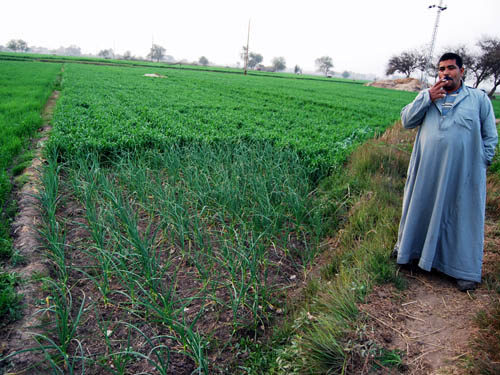
From the wilderness, the great meals of fish and vegetables in Egypt looked good to the Israelites. The hard days of oppression were overlooked. (A lot like the bondage of sin!) I had an opportunity to be in some of the fields in Goshen. The farmers grow crops for the cattle, but they use the corners of the fields to grow vegetables for their own use. I saw leeks and cabbage.

Field in the land of Goshen. Photo by Ferrell Jenkins.

Field in the land of Goshen. Photo by Ferrell Jenkins.

The white object in the field is one of the pieces of the colossal statue of Rameses that we mentioned in an earlier post. Smoking is widespread in Egypt.

Remembering D-Day

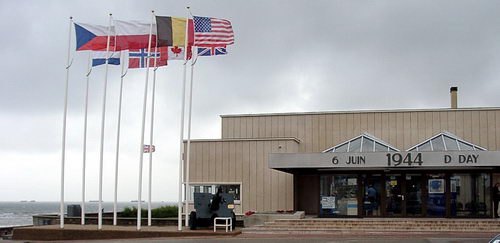
The D Day Museum at Normandy. Photo by Ferrell Jenkins.

The D Day Museum at Normandy. Photo by Ferrell Jenkins.

“A new beginning” in the Muslim world

United States President Obama calls for “a new beginning” in the Muslim world in Cairo today.

We watched the presidential inauguration on Al Jazeera in Egypt last January. The Egyptian men were all excited about this change in America. For a day or two afterward we would be greeted with big smiles and chants of  “Obama, Obama.” One camel driver told a member of our group, “I like Obama; he’s my color.”

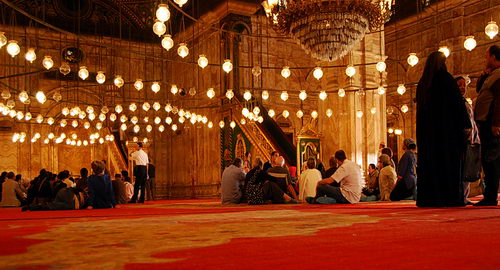
The Obama party is making visits to the pyramids and the Mohammed Ali Mosque. Typical tourist things to do. See our comments about the Mosque and a photo of the exterior of the building here. Below is a photo I made inside the mosque using a tiny tripod (about 6 inches high) on the floor of the mosque. Tourist groups are sitting on the floor listening to the history of the mosque.

Interior of Mohammed Ali Mosque in Cairo. Photo by Ferrell Jenkins.

Interior of Mohammed Ali Mosque in Cairo. Photo by Ferrell Jenkins.

Understanding is good. Let’s hope that this “new beginning” allows freedom for those in the Muslim world who profess Christ.

The full text of President Obama’s speech is available from The Guardian.

“Our IAA which art in Israel”

Tourist confesses to taking a stone from an Israel Antiquities Excavation 12 years ago.

Twelve years after a stone disappeared from an Israel Antiquities Authority Excavation south of the Temple Mount, a tourist from New York confessed: “I Took It. My Conscience Bothers Me and I Am Asking for Forgiveness” The stone, which weighs 21 kilo, was returned to Jerusalem this week.

Here is part of the account released by the IAA in Jerusalem.

In 1997, a twenty one kilogram fragment of a marble column disappeared from one of the excavations the Israel Antiquities Authority was conducting south of the Temple Mount.

Several weeks ago, the IAA received an unexpected e-mail from a clergyman in the state of New York: “I am requesting forgiveness for a member of my congregation”, he writes. “The fellow confessed to me that twelve years ago he took a stone from Jerusalem and his conscience has bothered him ever since. I wish to return the stone to Israel and hope that you will forgive the man for his transgression”.
A letter from the fellow was attached to the heavy stone fragment, which arrived in Jerusalem in a wooden crate that was specially constructed for the flight back to Israel. “I came to Israel on an organized trip. As a student of archaeology, I was very excited when we visited an excavation south of the Temple Mount. I asked how I can purchase a stone from the excavation because I wanted a souvenir with which to pray for Jerusalem and was told it was not possible. On the last day of the trip our Israeli tour guide approached me and took the stone fragment from inside his coat. ‘Take it’, he said. ‘It’s a present from me’. I asked him how he obtained the stone and he replied, ‘It’s okay; don’t worry’. I was very happy and took the stone with me on my flight back to New York. Only later did I realize that he probably took the stone from the excavation without permission. For the past twelve years since then, rather than remind me of the prayer for Jerusalem, I am reminded of the mistake I made when I removed the stone from its proper place in Israel. I am asking for your forgiveness”.

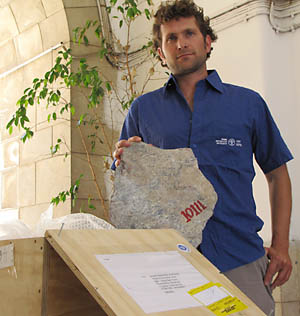
Shay Bar Tura displays the package and the returned stone. Photo by IAA.

Shay Bar Tura displays the package and the returned stone. Photo by IAA.

Shay Bar Tura, Deputy Director of the Unit for the Prevention of Antiquities Robbery in the IAA, stated,

It should be emphasized that any activity conducted at an antiquity site requires permission from the IAA. Taking archaeological artifacts from antiquities sites constitutes a severe criminal offense which is punishable by law with imprisonment”.

Who was the tour guide?

HT: Joe Lauer