Category Archives: Photography

The Potter

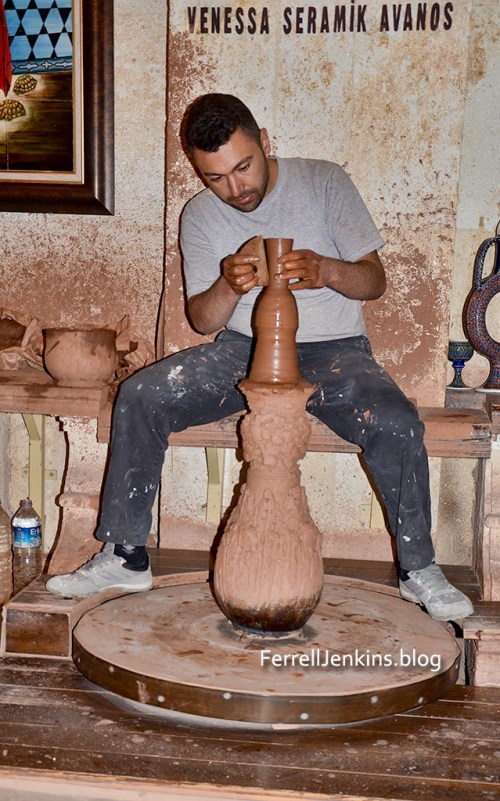
Throughout the modern lands that we often refer to as the Bible World groups are taken to a shop where they see a potter at work making pottery typical of ancient pottery. The resulting pottery is often decorated, etc. to make it sell for more than a simple pot. The town of Avonos, Turkey, is noted for it potters. In our photo you see the potter molding the clay into the vessel of his choice.
The prophet Isaiah reminds us all that the LORD God is the potter and we are the clay. He has given us free will and this means that we must choose to allow Him to make us as he wishes.

But now, O LORD, you are our Father; we are the clay, and you are our potter; we are all the work of your hand (Isaiah 64:8).

 An experience with AI.

AI is all the rage in our society. Well, today WordPress allowed AI [Artificial Intelligence] to tell me how I should have written this blog. I thought of some of the things suggested in the AI comment, but had specifically chosen not to write that way. I am hoping that I will classify as not a complete dummy. But I thought you might enjoy reading the AI suggestions.

AI Assistant


The content explains the process of pottery making and relates it to the analogy of God being the potter and us being the clay. The use of the photo is a nice visual addition. However, the feedback could be improved by adding more depth and analysis to the topic. Here are some suggestions to enhance the content:

1. Provide more historical context: Explain the significance of pottery in ancient cultures and how it was an essential part of their daily lives.

2. Elaborate on the analogy: Explore the deeper meaning behind the analogy of God as the potter and us as the clay. Discuss how this relates to our relationship with God and the concept of surrendering to His will.

3. Include biblical references: In addition to Isaiah 64:8, reference other passages in the Bible that highlight God’s role as the potter and how it is relevant to our lives today.

4. Offer personal reflections: Share personal anecdotes or stories that illustrate the transformative power of God working in our lives and shaping us according to His purpose.

5. Connect with the reader: Provide practical insights on how readers can allow God to mold them and align their lives with His plans.

By expanding on these points, the content will become more engaging and insightful for the readers.

– – – – – – – – – – – – – – – – – – – – – –

Now, for those who read through the additional AI comments, you can let me know which you prefer today. Leave a brief comment to say if you liked FJ or AI.
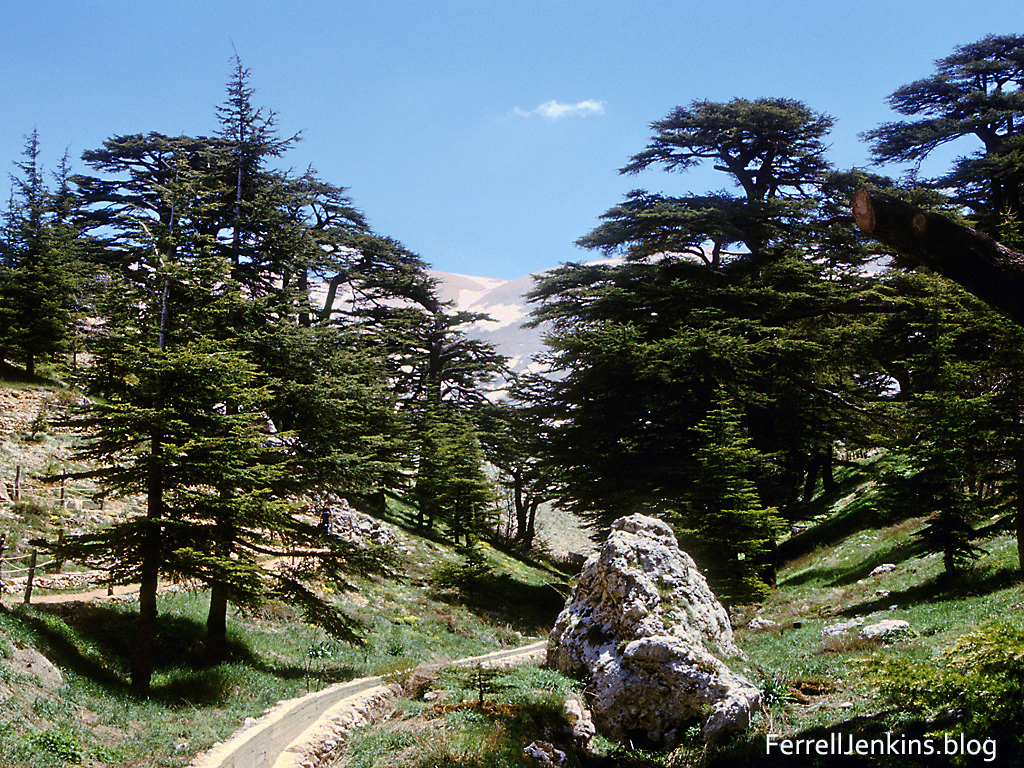
 

Cedars of Lebanon in 1969

My first trip to Lebanon was in May, 1968. At that time I was able to visit several of the historic places that I had read about in the Bible and other sources. These included Tyre and Sidon, Byblos, and the Cedars of Lebanon.

The Cedars are about 75 miles north of Beirut on a mountainous road and not included on my second Bible Lands Tour. But we had a half day free to visit as we wished. My wife Elizabeth and I were joined by Louis and Margie Garret, co-workers at Florida College, and Joe Corley who had come all the way from Lethbridge, Alberta, Canada to join the tour. We had met Joe and his family earlier when I preached there a year or two earlier. We crowded into a taxi willing to take us to the Cedars.

A couple of days ago I located a slide I made on Agfachrome film during that visit. I hope you will enjoy it about half as much as I enjoyed seeing it again.

There are numerous biblical references to the cedars, but I wanted to mention just one reference today.

About 1040 BC King Solomon, the new king of Israel, requested cedars from King Hiram of Tyre in Lebanon for use in building the temple in Jerusalem. If you have visited Israel or read about the buildings you know that most of them are made of stone. Wood for various purposes had to be brought from other places.

Now therefore command that cedars of Lebanon be cut for me. And my servants will join your servants, and I will pay you for your servants such wages as you set, for you know that there is no one among us who knows how to cut timber like the Sidonians” (1 Kings 5:6 ESV).

Over the years we have posted several articles about the Cedars of Lebanon. To access these just put Cedars of Lebanon in the Search box. Think of the blog as a mini-dictionary where you can find information about various Bible places and customs.

Continue reading

They tried to kill Jesus

True. It happened more than once. Here I have in mind the event at Nazareth at the beginning of His ministry (Luke 4:16-30). Jesus read a portion of Isaiah 61 in the synagogue and claimed that He fulfilled that scripture. His teaching outraged those present. They took Jesus to the brow of the hill on which their city was built, intending to throw him down the cliff. Jesus passed through the crowd and left Nazareth to go down to Capernaum, a town that would become the headquarters for His earthly ministry.

Nazareth is located in the hills of Lower Galilee, where the elevation is about 2000 feet above sea level. These hills lie on the north side of the Valley of Jezreel (Esdraelon, or Megiddo). The hill of precipitation overlooks the Jezreel valley.

The Mount of Precipitation at Nazareth. Photo by Ferrell Jenkins.
The Mount of Precipitation at Nazareth.

Vineyards at Lachish Then and Now

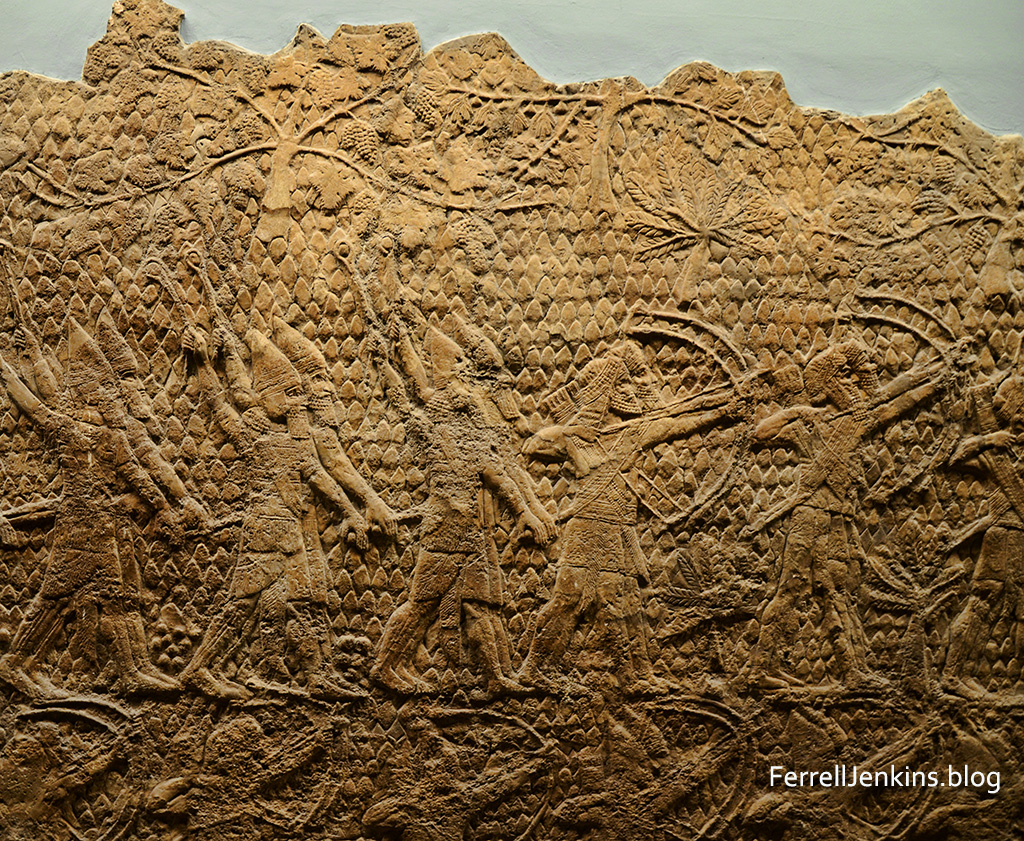
After Sennacherib, king of Assyria (704-681 BC), defeated the Judeans who lived at Lachish he tried to capture Jerusalem but was unsuccessful. Back home in Nineveh the king left a limestone relief of the siege of Lachish on his palace wall. The original is now in the British Museum. There is a replica in the Israel Museum.

The panel below shows the landscape around Lachish with palm trees and vineyards. Here is a small section of the relief. Notice especially the upper left corner of the relief.

A portion of the battle scene from Sennacharib's palace relief. British Museum. Photo by Ferrell Jenkins.

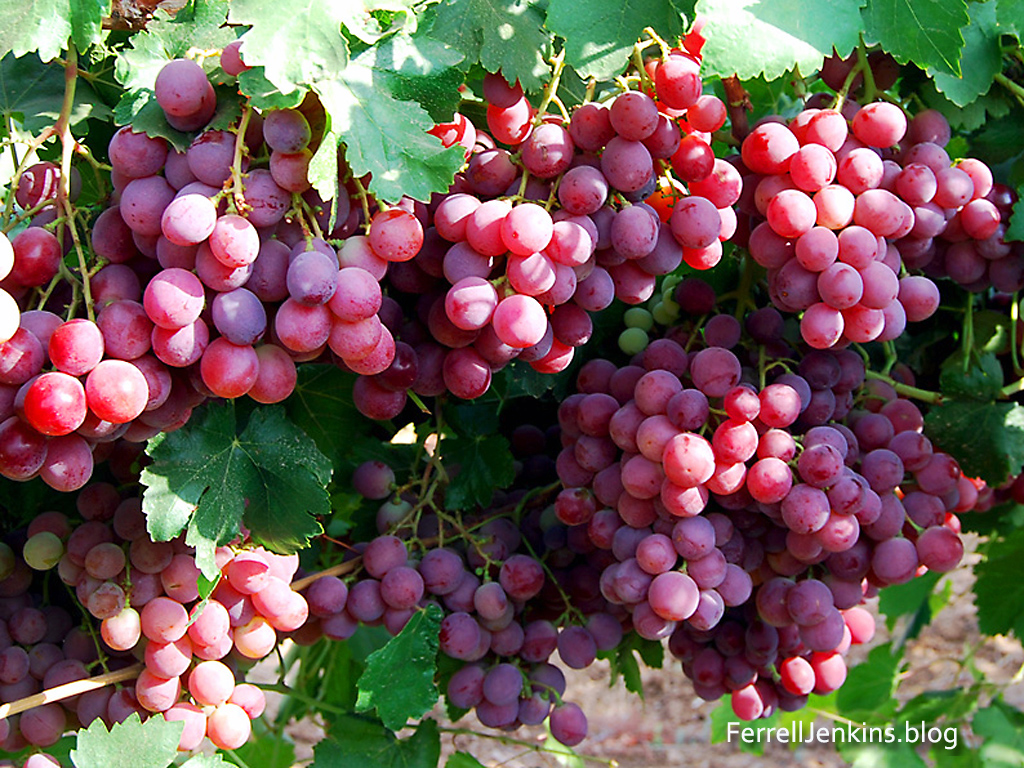
In resettling the land of Biblical Israel, the modern settlers tried to plant the same plants known in Bible times. The Sennacherib relief shows clearly that date palms and vineyards were in abundance in the region. Our next photo which I made in the Lachish area in the month of August shows grapes for eating in abundance.

Grapes growing in abundance in the area of Lachish, Israel.

Click on the images to see a larger photo suitable for use in your teaching.

The Eastern View of the Mount of Olives

Today’s photo shows the Mount of Olives from the east. The tall tower on the peak is the traditional place of the ascension of Jesus (Acts 1:9-11).

Luke’s account of the ascension says Jesus took the disciples as far from Jerusalem as Bethany where he was taken up (Luke 24:59-51). Both Bethphage and Bethany are located on the eastern slope of the Mount of Olives. Bethphage is nearest to the tower of ascension with Bethany being a short distance further to the south (left in the photo).

The Mount of Olives is about 200 feet higher in elevation than the ridge on which the city of Jerusalem is built. The city of Jerusalem is not visible from the east until one is on the Olivet ridge, or Mount Scopus further to the north (right). This is the view of the Mount of Olives Jesus and others would have seen when walking from Jericho to Jerusalem.

You may download the photo and use it in your teaching of the Bible. Please maintain our credit logo which shows in the lower right corner.


Did Paul visit Adramyttium?

Adramyttium is mentioned only once in the New Testament. In Acts 27:2 we are informed that the ship used to transport Paul to Rome for his appeal before Caesar was “a ship of Adramyttium” (Acts 27:1-2). Paul continued in this ship as far as Myra in Lycia (Acts 27:5-6) where he was transferred to an Alexandrian ship.

But there is still a chance that Paul stopped at Adramyttium on the return from his second preaching journey. Luke provides us with a detailed account of the stops along the way. He says, “And when he met us at Assos, we took him on board and went to Mitylene. And sailing from there we came the following day opposite Chios; the next day we touched at Samos; and the day after that we went to Miletus” (Acts 20:14-15 ESV).

Notice the reference to Chios. When we check a variety of versions we come up with some interesting results.

  • The ESV says “we came…opposite Chios.”
  • ASV, NKJ: “over against Chios”
  • NAS, NAU: “opposite Chios”
  • CSB: “off Chios”
  • NIV, NET: “off Chios”
  • NLT: “past the island of Kios”

The Greek word used here is antikpus and usually means off or opposite. Mark Wilson suggests that “Paul probably passed near Adramyttium on his second journey to Troas, if the southern route below Mysia is reckoned (Acts 16:8). He also probably passed through the city following his departure from Ephesus while traveling up the coast to Troas (Acts 20:1-2; 2 Corinthians 2:12).” (15

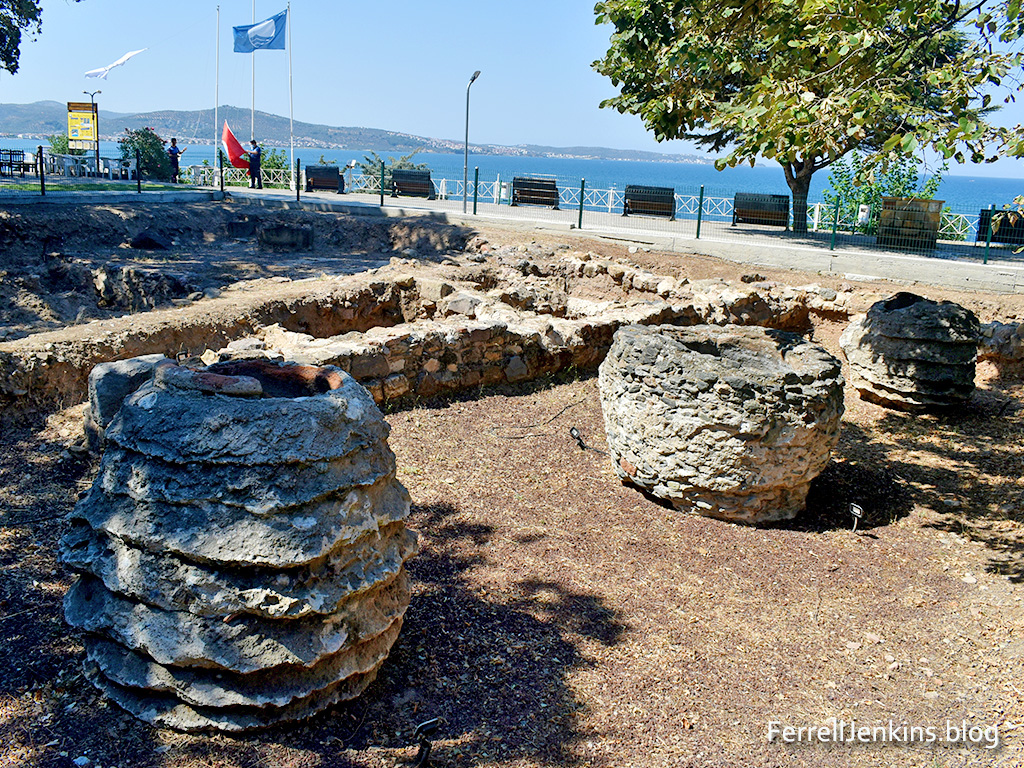
So, whether or not, here is a photo from ancient Adramyttium in the modern Turkish town of Ören in the Mersin district of Turkey.

Some of the ruins of Adramyttium at the modern site of Oren.This area of excavation is under some large trees causing
the dark spots in some places.

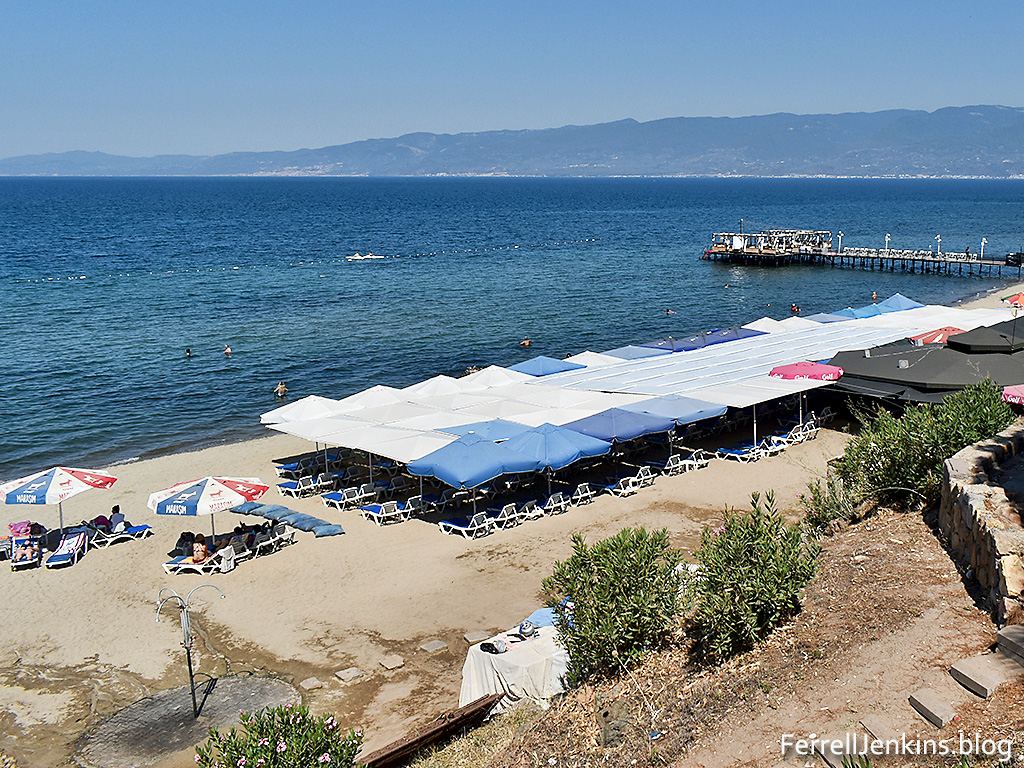
The next photo shows the beautiful beach at Ören.

Source: Williams, Mark. Biblical Turkey. 4th ed., Yayinlari, 2020, pp. 185-87.

The Broom Tree

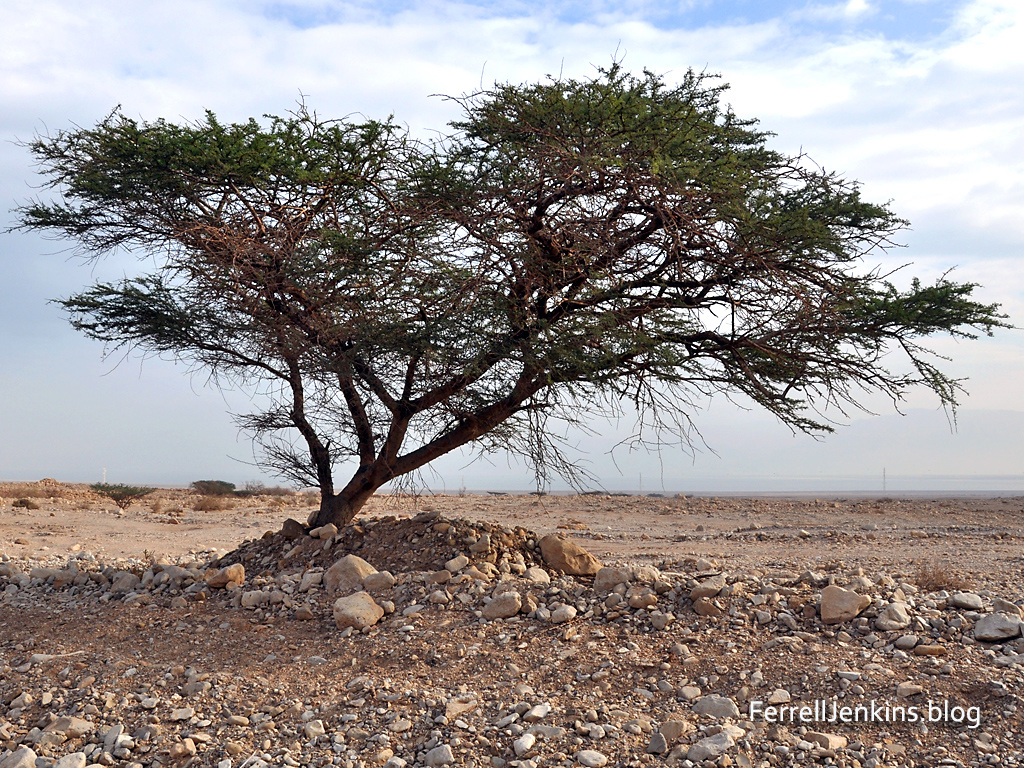
Traveling along the Dead Sea or in the Sinai one sees many Broom trees.  Our first picture shows one along the shore of the Dead Sea.

This Broom tree is growing along the shore of the Dead Sea.

The broom tree is mentioned only a few times in the Bible.

  • After Elijah had traveled a day’s journey he sat down under a broom tree, then he lay down and slept there (1 Kings 19:4-5). The Hebrew word for the tree (rethem) is also translated juniper tree, broom bush, and shrub.
  • Job 30:4 states that some eat the roots of the broom tree.
  • Psalm 120:4 mention burning coals of the broom tree.

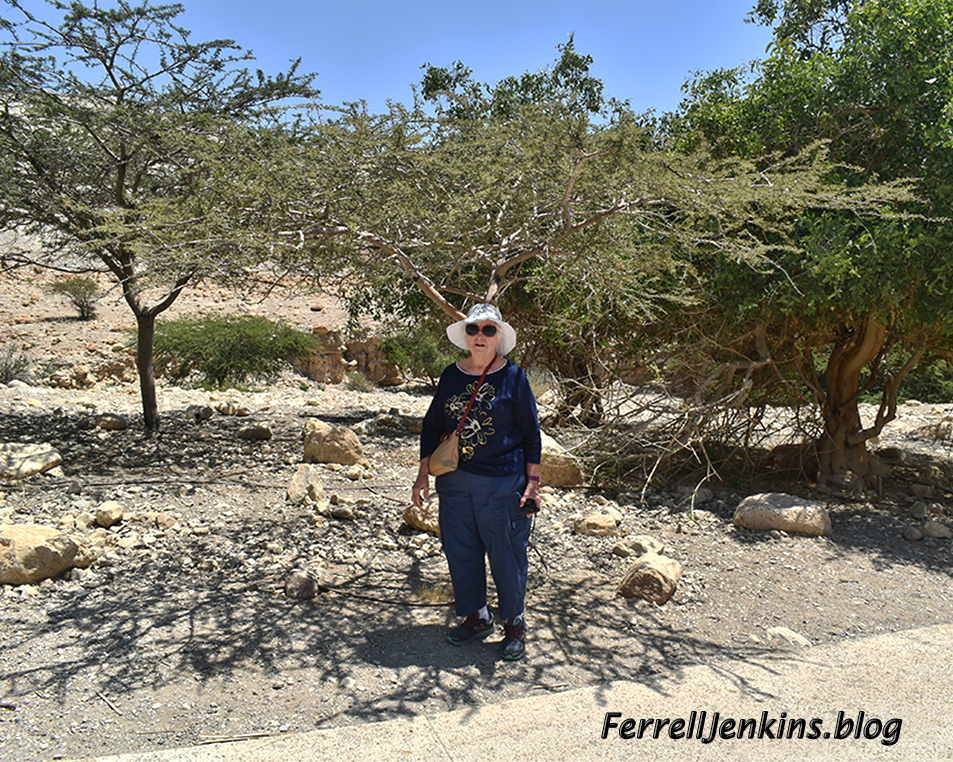
It was hot when we visited EnGedi along the western shore of the Dead Sea. Numerous broom trees may be seen growing in the area. Paulette tried to get a little shade under one of the broom trees,

A Beautiful View

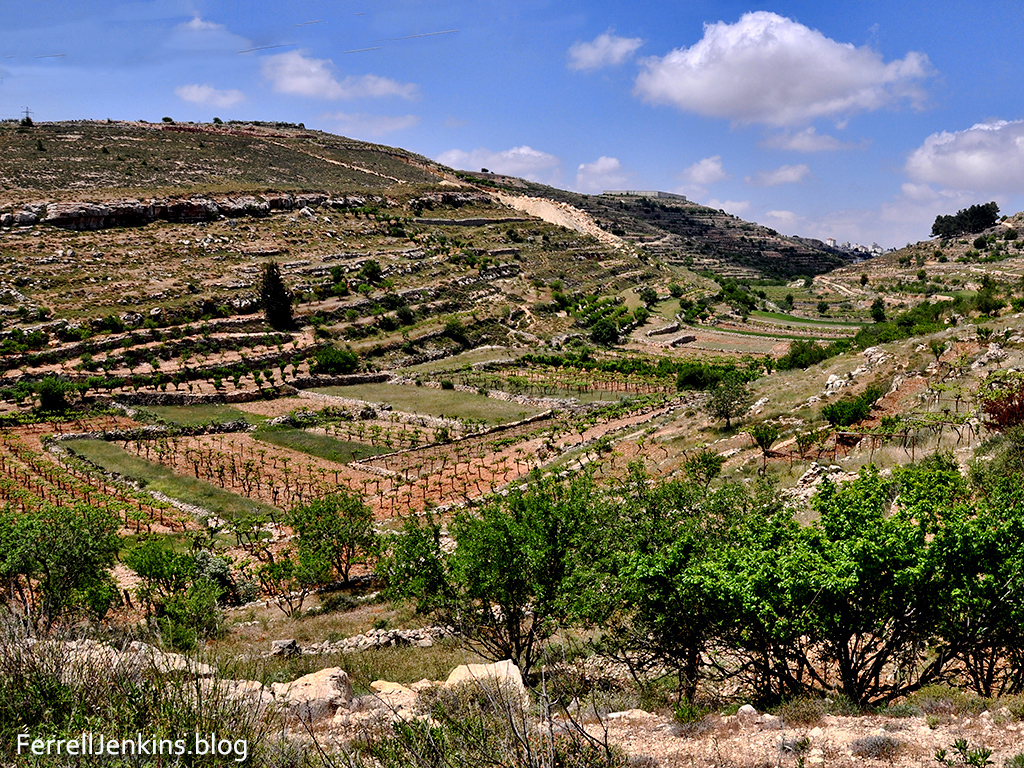
Along the central mountain road between Bethlehem and Hebron. There are many beautiful views. This one shows examples of the continued fertility of the land that was promised to the ancient Israelites. It illustrates the use of valleys to collect water during the rain season to provide water for the plants. The hillsides illustrate the terracing used as far back as the Biblical Iron age (around 1000 B.C.).

View of beautiful, fruitful hillsides along the road between Bethlehem and Hebron. Photo by Ferrell Jenkins.
View of hillsides and valleys along road between Bethlehem and Hebron. Photo by Ferrell Jenkins.

How Much Territory Does the Madaba Map Cover?

After the previous post I was ask how far the map extended. I have seen the map several times, but much of my detailed info comes from an article by Victor R. Gold: “The Mosaic Map of Medeba.” This article first appeared in Biblical Archaeologist, XXI.3 (Sept. 1958), pp.59-71. It was included in a 3-volume set called The Biblical Archaeologist Reader, vol. 3.

Here is a section on the extent of the Map:

“Except for the [third century] Tabula Peutingeriana [road map of the world], the Madeba map is the only map of ancient Palestine still in existence. The large remaining section extends from Aenon in the Jordan valley, or near it, in the north, to the Canobic branch of the Nile in the south. Not even this section is complete, however, the footing of one of the columns rests over a section of Judea from Eleutheropolis (Beit Jibin) to Ashdod and Beersheba.” (Campbell, Edward F., and David N. Freedman, editors. The Biblical Archaeologist Reader 3. First ed., vol. 3, Doubleday and Company, 1970, pp. 359-65, 3 vols.

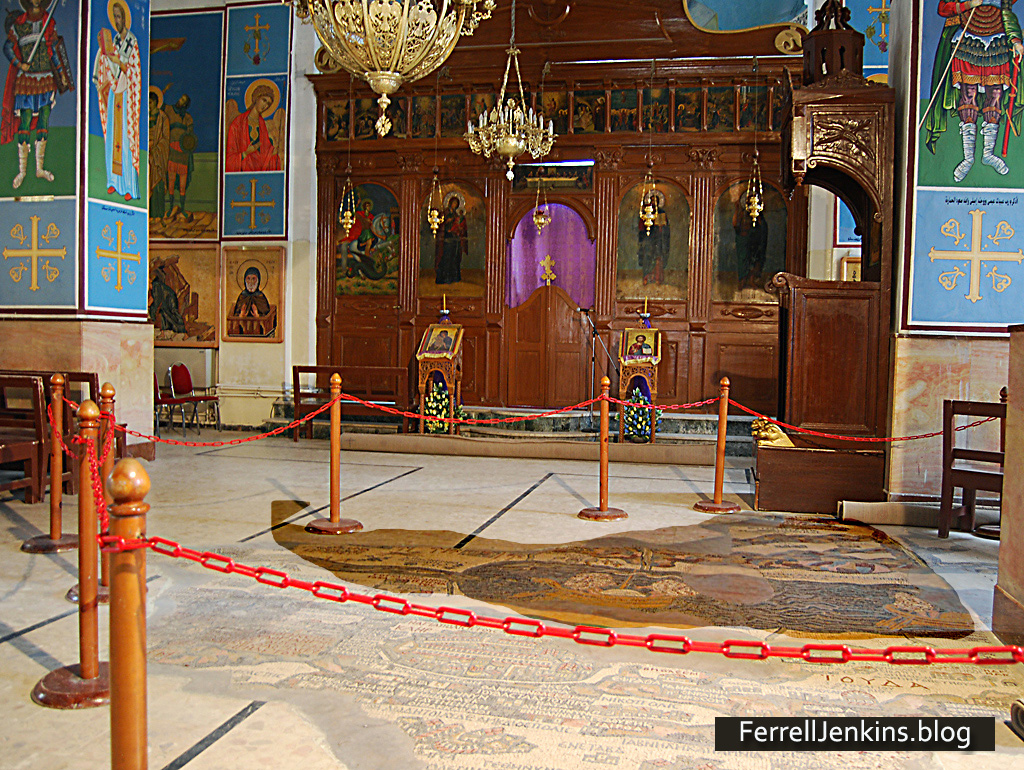
I am including a photo showing the actual size of the map in the church building floor at Madaba, Jordan. I have darkened the portion of the map that has been reconstructed there. We are not seeing all that is known to have existed. I have noted a small portion of the Nile Delta, and coastal towns such as Ashkelon and Ashdod. In my photos I can see mountains of Moab to the east, and Aenon in the northern Jordan Valley.

For the benefit of those who might like to see the size of the map in the Madaba church, I have darkened the map in the area that is cordoned off.

Interior of the Madaba, Jordan, church that protects the map. Photo by Ferrell Jenkins.
The Madaba Map is shown darker in the church floor to allow one to see the size of the map there.

The Madaba Map is an amazing piece of work. It would be nice if we had one in the vestibule where I meet with Christians.

Dead Sea: Fact and Fun

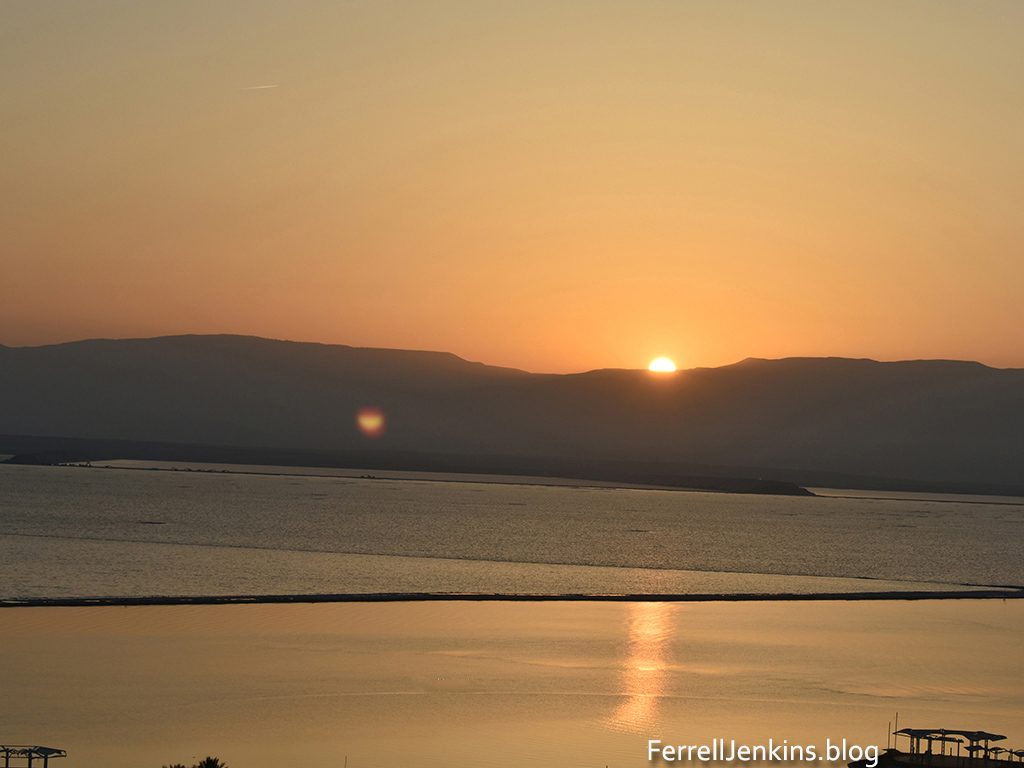
We set the clock to get up in time to see the sunrise across the Dead Sea. I was pleased with the result as the sun rose in the vicinity of Biblical Edom sending a ray across the Dead Sea. The smaller light to the left of center is a reflection from the camera lens.

Now Lot went up out of Zoar and lived in the hills with his two daughters, for he was afraid to live in Zoar. So he lived in a cave with his two daughters. (Gen. 19:30 ESV)

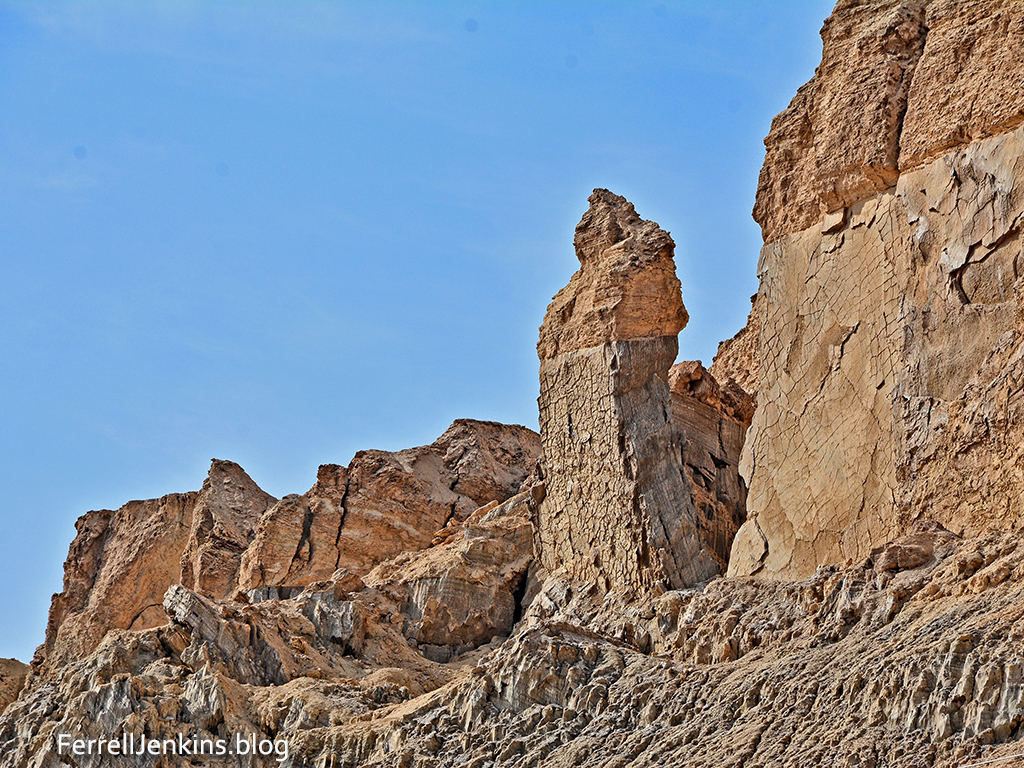
While we were at the southern end of the Dead Sea we drove a little further south to see the formation nicknamed “Lot’s Wife.” This is based on the Biblical story of the destruction of Sodom and Gomorrah (Genesis 19. See especially Genesis 19:26, and the reference by Jesus in Luke 17:32).

As usual, these photos are available for download for use in teaching as long as credit is given to this source. For commercial use see our Photo Permission page.