Category Archives: Photography

The Meeting of the Waters

Thomas Moore (1779-1852) is known as one of Ireland’s best writers. A little south of Dublin, in Wicklow County, the Avonmore and Avonberg rivers meet. Moore made this spot famous in his poem The Meeting of the Waters.
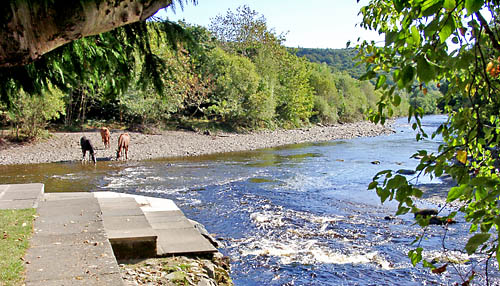
Where the Sweet Waters Meet. Photo by Ferrell Jenkins.

Where the Sweet Waters Meet. Photo by Ferrell Jenkins.

The Meeting of the Waters

There is not in the wide world a valley so sweet
As that vale in whose bosom the bright waters meet
Oh the last rays of feeling and life must depart
Ere the bloom of that valley shall fade from my heart

Yet it was not that nature had shed o’er the scene
Her purest of crystal and brightest of green
‘Twas not her soft magic of streamlet or hill
Oh No ’twas something more exquisite still

‘Twas that friends, the belov’d of my bosom were near
Who made every scene of enchantment more dear
And who felt how the best charms of nature improve
When we see them reflected from looks that we love

Sweet vale of Avoca! How calm could I rest
In thy bosom of shade, with the friends I love best
Where the storms that we feel in this cold world should cease
And our hearts, like thy waters, be mingled in peace

How fortunate is any person to have a special place to recall as a place of peace. I have enjoyed several of these places through the years. First, there is home. My study, when my desk is clean and it’s raining outside, is another. I think also of the Sea of Galilee at sunrise, or sunset. Spiritually we find peace in Christ.

Be anxious for nothing, but in everything by prayer and supplication with thanksgiving let your requests be made known to God. And the peace of God, which surpasses all comprehension, will guard your hearts and your minds in Christ Jesus. (Philippians 4:6-7 NAU)
Prof. Israel Finkelstein visits Khirbet Qeiyafa

Luke Chandler reports here, with photos, that Prof. Israel Finkelstein, Tel Aviv University, paid a visit to Khirbet Qeiyafa (the ElahFortress) on the last day of the dig. He has posted a couple of photos of Finkelstein with Prof. Yossi Garfinkel, director of the Khirbet Qeiyafa excavation.

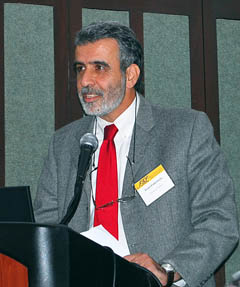
Prof. Finkelstein at the SBL Annual Meeting 2008. Photo by Ferrell Jenkins.

Prof. Finkelstein at the SBL Annual Meeting 2008. Photo by Ferrell Jenkins.

Luke describes Finkelstein as “a leading face of Biblical Minimalism.” He also comments on the evidence from Khirbet Qeiyafa:

The evidence there so far points to an organized, strong, Jerusalem-centered kingdom in the 10th century B.C. – the early Iron Age of David.

It is quite common for archaeologists to visit the excavations throughout the season. In this way they hear first hand from the director of the dig about what has been uncovered.

A unique panorama from Tell es-Safi/Gath

Prof. Aren Maeir has posted a unique panoramic photo by Gal Avraham of Area A at Tell es-Safi/Gath. It appears to be made from at least 7 different photographs. See them here.

Aerial views of Gath

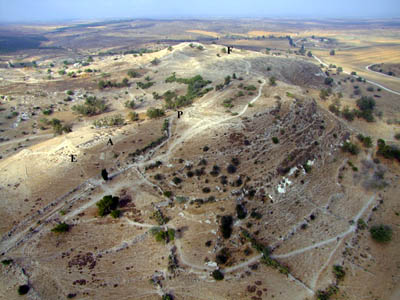
Prof. Aren Maeir has posted a great aerial photo of Tell es-Safi/Gath on his blog here. He also has a photo showing the air balloon with a remote camera used to make the photo. I am taking the liberty to post a small copy of the aerial photo in an effort to encourage you to look at the hi-res one on his blog. In this photo you can see the Mediterranean Sea in the distance. This illustrates clearly the terrain of the Shephelah and the coastal plain (of Philistia). The areas worked this summer are indicated by the letters E, A, P and F.

Aerial view of Tell es-Safi/Gath looking SW.

Aerial view of Tell es-Safi/Gath looking SW. Tell es-Safi/Gath Blog.

Aren promises to offer final reports on the accomplishments of the season shortly. We look forward to those.

Over the years I have encountered people who think ALL of the archaeological work has been done. When you see a large mound like Tell es-Safi/Gath from the air you begin to understand that there is still work to be done.

Here are a few of the interesting things we know about Gath from the Bible:

  • Gath was one of the five major cities of the Philistines (1 Samuel 6:17).
  • The ark of the covenant was brought here by the Philistines after being capture in battle with the Israelites (1 Samuel 5:8).
  • Goliath was from Gath (1 Samuel 17).
  • David once sought refuge from Achish king of Gath (1 Samuel 21).
  • When Saul and Jonathan died, David did not want it to be published among the Philistines. He said, “Tell it not in Gath, Proclaim it not in the streets of Ashkelon, Or the daughters of the Philistines will rejoice, The daughters of the uncircumcised will exult” (2 Samuel 1:20).
  • King Uzziah broke down the wall of Gath, and other Philistine cities, and built Judean cities (2 Chronicles 26:6).

Life at an archaeological dig can be fun

Luke and Royce Chandler, a couple of friends from Tampa, are participating in the dig at Khirbet Qeiyafa, a site above the Valley of Elah. It is also being called the Elah Fortress. The director of the dig, Prof. Yosef Garfinkel, thinks this is the site of Shaaraim (Joshua 15:36; 1 Samuel 17:52; 1 Chronicles 4:31).

Todd Bolen, of BiblePlaces.com has suggested the site should be identified with Ephes-dammim here, here, and here. Both places, Shaaraim and Ephes-dammim (1 Samuel 17:1) are associated with the conflict between David and Goliath. I will leave all of this for you to study as you wish.

Luke sent me a few photos to share with our readers.

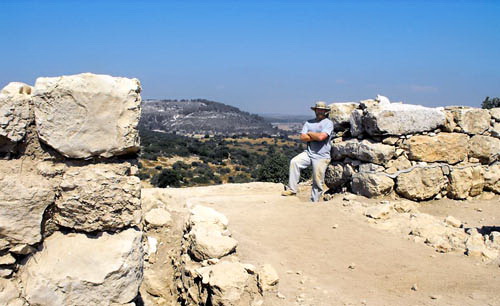
Luke is standing in the "Philistia Gate" with his left foot in the Iron Age threshold. Azekah can be seen in the distance.
Luke is standing in the “Philistia Gate” with his left foot in the Iron Age threshold. Azekah can be seen in the distance.The Valley of Elah is to the left.

Luke reports an interesting incident that happened at the dig last Wednesday.

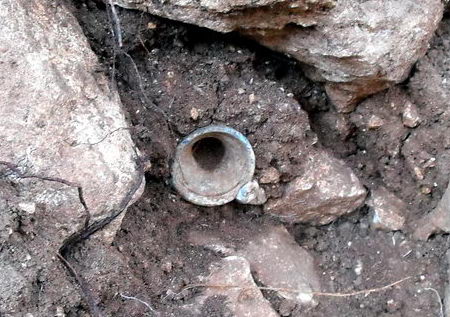
On this final day in the room, my father leaned his hand against the wall and accidentally caused a stone to fall out onto the ground. Behind where the stone had been, Royce saw a shiny turquoise circle. We called Guy Stiebel, the area archaeologist (also the chief excavator at Masada), to see it. When Guy saw the glass he took a keen interest. It turned out to be a complete ancient glass bottle that had been placed on its side into the wall during construction. Glassware such as this is common in burial locations, but very uncommon in this situation.

Read the full account here. Luke has several photos on his site. He received permission to include a photo of the glass bottle “in situ” (the place where it was found). He has given me permission to share it with our readers.

Glass bottle found in a wall at Khirbet Qeiyafa by Royce Chandler. Photo: Luke Chandler.

Glass bottle found in a wall at Khirbet Qeiyafa by Royce Chandler. Photo: Luke Chandler.

In 2008 one of the volunteers uncovered a large potsherd (broken piece of pottery) containing a Hebrew inscription. We are still awaiting a complete translation. We published a photo here.

We appreciate Luke sharing these experiences with us. By the time he and Royce get back home their wives will be expecting them to work in the flower beds!

You might also enjoy reading his account of walking through Hezekiah’s Tunnel (2 Kings 20:20), and seeing his video showing a stone from the Iron Age in the east wall of the Old City of Jerusalem, here.

Padfield’s visit to Explorations In Antiquity Center #2

We actually spent two days at the Explorations In Antiquity Center. We visited the Center on a Thursday morning, when they were not busy, so I could photograph the exhibits without other visitors getting in the way. We returned the following day to meet up with Gene and Sandy Taylor so we could have a guided tour of the Center and enjoy an authentic “Biblical meal” together.

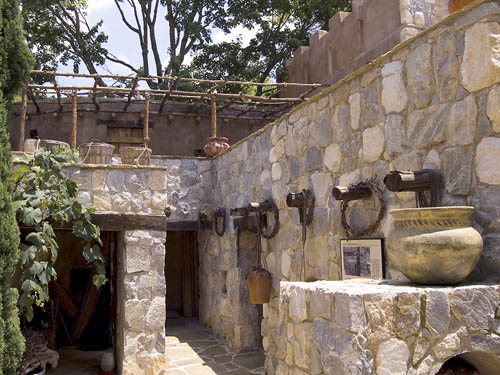
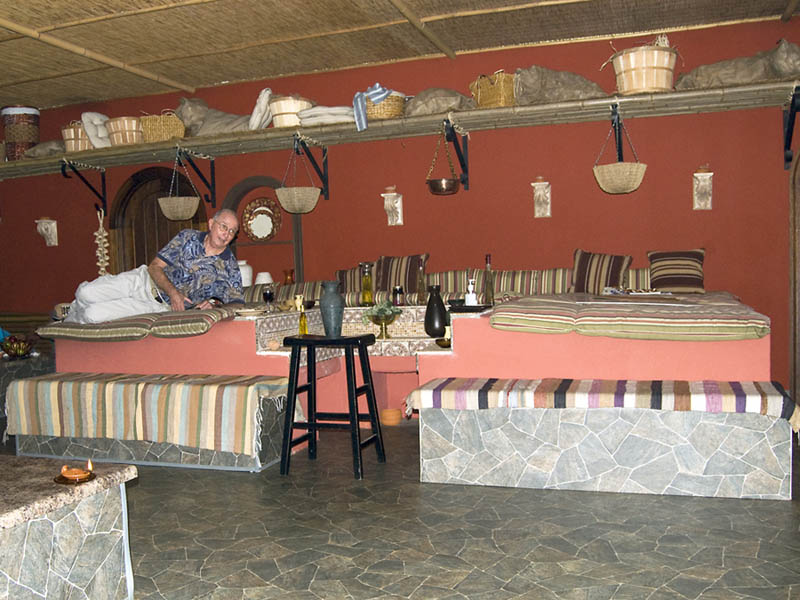
House exterior at Explorations in Antiquity Center. Photo by David Padfield.

House exterior at Explorations In Antiquity Center. Photo by David Padfield.

Our guide for the three-hour tour was Lamar Hamric and he did an excellent job of explaining the exhibits and putting them in a Bible context. The first half of the tour took place in the outside exhibit area and the last half was in a dining area designed to look like a Roman period banquet hall.

In the meal room we enjoyed a four-course meal with fifteen different food items, including unleavened bread, fruit, nuts, hard-boiled eggs, vegetables and bitter herbs. The meal was supposed to represent a Jewish Passover meal, but instead of roasted lamb they served roasted chicken (which, by the way, was excellent).

In the center of the room is a Roman triclinium—a U-shaped table like the one our Lord probably used at the Last Supper (Luke 22:12). During the meal Mr. Hamric discussed the various Passover customs and the social aspects of sharing a meal in the ancient Near East. Hamric gave the best explanation of the events at the Last Supper I have ever heard.

Roman period triclinium. Photo by David Padfield. Click for larger image.

Roman period triclinium. Photo by David Padfield. Click for larger image.

If you are anywhere near LaGrange, Georgia I would highly recommend you visit the Center. In fact, take your whole Bible class! The tour and meal costs $30 per adult and is well worth it. You need to make reservations in advance. They can prepare the Biblical meal for a small group (a minimum of 10) or a larger group of up to 140 people. Reservations can be made by calling the Center at (706) 885-0363.

-o-o-o-o-o-o-

David Padfield has visited the Bible Lands several times and is well qualified to evaluate the Explorations In Antiquity Center. Many of you have used his photographs and other materials that are made available through his web site (padfield.com).

The Explorations In Antiquity Center web site is available here.

I take every step with them

A couple of my friends, Royce and Luke Chandler, are in Israel to participate in the archaeological dig at Khirbet Qeiyafa. The site, overlooking the Valley of Elah, is also called the Elah Fortress. They are spending a few days traveling in Israel prior to joining the dig.

Luke is posting some of his photos and a bit of information about the places on his A Bible, History & Travel Blog. Today he has a great photo of the Jezreel Valley from the Spring of Harod to the Hill of Moreh (Judges 7). Take a look.

Where were you 40 years ago?

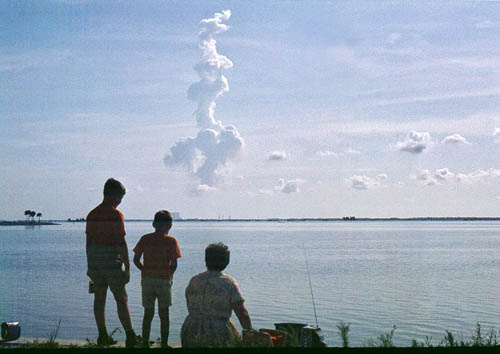
Even if we did not remember the exact day, all of us have heard that today is the 40th anniversary of the Apollo 11 mission to the moon. Our family had moved to Florida the previous December. School was not in session. What a great opportunity to take the boys to Cape Canaveral to see the “moon shot.”

Still in awe after the launch of Apollo 11. Photo by Ferrell Jenkins.

Still in awe after the launch of Apollo 11. Photo by Ferrell Jenkins.

You may notice what appears to be a scratch on the slide running from the ground up into the water. That is the antenna to an little battery-operated TV. Afterwards we had a great picnic lunch mom had prepared.

Flag faux pas

We have been flying our flag since a few days before Memorial Day.

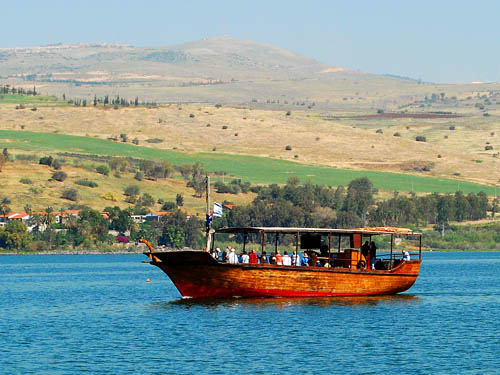
When traveling outside the United States it is fairly common to see the flag of the USA displayed in front of hotels that cater to citizens of the USA. Dozens of boats carry tourists across the Sea of Galilee from one port to another. This is an important part of our tours to give the travelers some sense of the elevation of the sea, and of the quietness of its water.

Tourist boat on Sea of Galilee. View to East. Photo by Ferrell Jenkins.

Tourist boat on Sea of Galilee. View to East. Photo by Ferrell Jenkins.

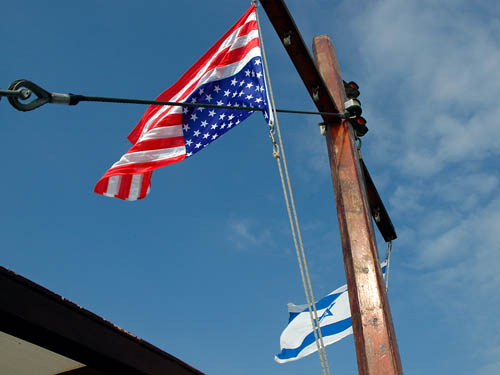
It is fairly typical of these boats to hoist a flag of the country from which its passengers come. In 2006 the boat we were on had inadvertently hoisted the USA flag upside down. The rules of etiquette for the display of the flag say that the flag should be flown upside down only as a distress signal. Fortunately we did not have a storm like the one mentioned in the gospels. Such storms still occur when the strong winds come down upon the sea from the surrounding mountains. In that case I suppose a distress signal might have been helpful.

But as they were sailing along He fell asleep; and a fierce gale of wind descended on the lake, and they began to be swamped and to be in danger. They came to Jesus and woke Him up, saying, “Master, Master, we are perishing!” And He got up and rebuked the wind and the surging waves, and they stopped, and it became calm. (Luke 8:23-24 NAU)

United States flag upside down on Israeli boat. Photo by Ferrell Jenkins.

United States flag upside down on Israeli boat. Photo by Ferrell Jenkins.

Happy fourth of July to my USA friends. Fly your flag proudly, but don’t turn it upside down!

Remembering D-Day

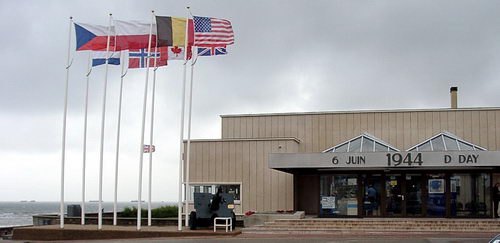
The D Day Museum at Normandy. Photo by Ferrell Jenkins.

The D Day Museum at Normandy. Photo by Ferrell Jenkins.