Category Archives: Photography

Reggio di Calabria is Rhegium of Acts 28:13

Yesterday I mentioned crossing the Strait of Messina by hydrofoil. Here is a rather unusual photo that I made from the stern of the hydrofoil as we left Messina, Sicily, toward Reggio di Calabria in Italy.
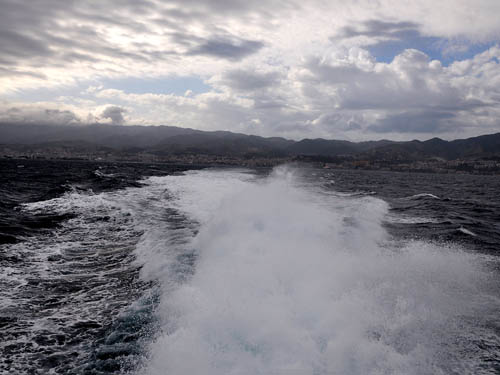
Crossing the Strait of Messina by hydrofoil. Photo by Ferrell Jenkins.

Crossing the Strait of Messina by hydrofoil. Photo by Ferrell Jenkins.

Once we arrived in Reggio we walked a few meters to our 3-star hotel. This little hotel, the Continental, has been recently refurbished. The elevator was new, and everything in the room, including the bathroom, was also new. The biggest disadvantage is that they did not have any Internet connection. I think this is the first hotel on this entire trip that did not provide some kind of access to the Internet. Eventually I paid 5 Euro (about $7.50) for one hour on the Internet at another hotel. But that is a good price compared to the hotel I am in tonight in Rome. The charge for one hour is 10 Euro (about $15.00).

We walked into town to visit the Archaeological museum and find something to eat. The museum, like the one in Syracuse, had nice displays of small items. I did not see anything of great helpfulness.

Reggio is situated along the strait and up the slope of a mountain. Only the main street and the promenade is level. Local advertising says that the area has been described as “the most beautiful kilometer in Italy.” From my limited experience in Italy, I would agree.

According to Luke, the Alexandrian ship Paul was on stayed only one day in Rhegium before a south wind allowed them to sail north through the Strait of Messina. It must have been a good wind. The next stop was Puteoli which is located in the Naples area.

We put in at Syracuse and stayed there three days. From there we cast off and arrived at Rhegium, and after one day a south wind sprang up and on the second day we came to Puteoli. (Acts 28:12-13 NET)

The modern port at Reggio is an artificial one. I tried to get some photos to illustrate where the natural port might have been. Elizabeth made this photo, look north along the Italian coast.
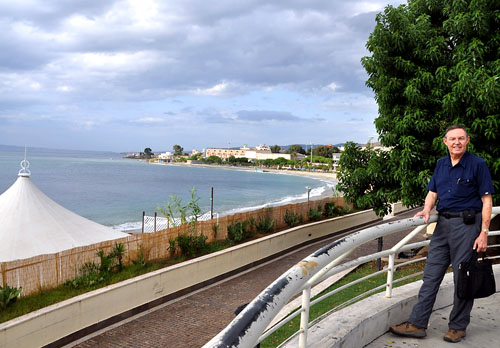
Looking north along the Italian coast at Reggio. Photo by Elizabeth Jenkins.

Looking north along the Italian coast at Reggio. Photo by Elizabeth Jenkins.

This morning we got up early and took the 6:46 a.m. Eurostar train from Reggio to Rome. The trip took a little over 5 and one half hours. We had about 6 brief stops between Reggio and Naples. From there it was non-stop to Rome. Mount Vesuvius was visible from the window of the train. Obviously I wished that time would permit a stop in Naples to visit Puteoli, Pompeii, and Mount Vesuvius.
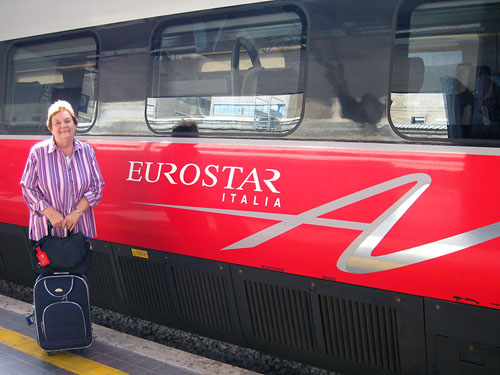
Elizabeth and I enjoyed the Eurostar trip. Photo by Ferrell Jenkins.

Elizabeth and I enjoyed the Eurostar trip. Photo by Ferrell Jenkins.

This afternoon we were able to visit several sites in Rome with good sunshine and clouds. Maybe tomorrow we will be able to share some of those photos.

Thanks for following along with us on this journey.
Visiting Malta

Yesterday we arranged for a car and driver to take us to the places we wanted to go on Malta. It is possible to rent cars, but the driving is after the British style (one the left side of the road), and few roads are straight. Many are not marked. I know we got to a few places were would not have found on our own. Our driver was an older gentleman who was a native of the area. Except for St. Thomas Bay, he seemed to be well aquainted with the area and the good places to stop for photos.

We visited a spot near St. Paul’s Islands for photos. This is the traditional spot of the shipwreck involving Paul and Luke. Poor Luke gets no attention here, but there are churches dedicated to Paul in many places. Then we had a nice view from a high spot to see Mellieha Bay. This is the most northern of the bays and is thought by some to satisfy Luke’s description of the shipwreck being at the place where two seas meet (Acts 27:41). We also vsited St. Thomas Bay and Salina Bay.

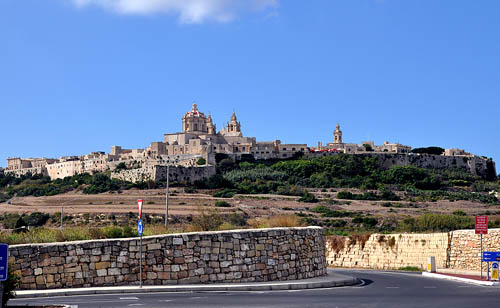
Our driver took us to a few places we would not have gone had we been on our own, but we really enjoyed the short time we had at each one. We could have used more time, of course. The photo below is of Mdina. The Lonely Planet guide for Malta says,

The citadel of Mdina was fortified from as long ago as 1000 BC when the Phoenicians built a protective wall here and called their settlement Malet, meaning ‘place of shelter’. The Romans built a large town here and called it Melita. It was given its present name when the Arabs arrived in the 9th century – medina is Arabic for ‘walled city’. They built strong walls and dug a deep moat between Mdina and its suburbs (known as rabat in Arabic).

Mdina, Malta. Photo by Ferrell Jenkins.

Mdina, Malta. Photo by Ferrell Jenkins.

I think most of the current building in Mdina date from the 18th century. St. Paul’s Cathedral is said to have been built on land belonging to Publius.

Now in the region around that place were fields belonging to the chief official of the island, named Publius, who welcomed us and entertained us hospitably as guests for three days. (Acts 28:7 NET)

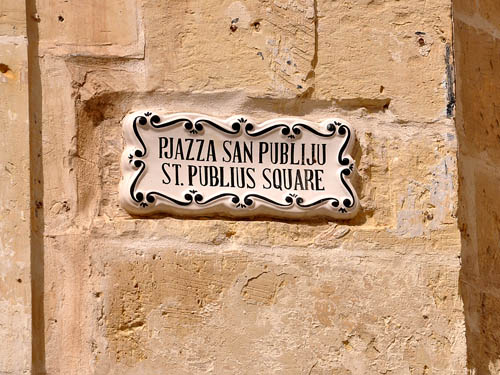
This photo shows the beautiful marker in the Maltese language and in English.

St. Publius Square in Mdina. Photo by Ferrell Jenkins.

St. Publius Square in Mdina. Photo by Ferrell Jenkins.

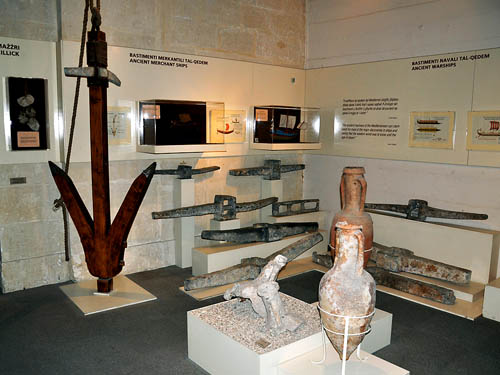
I also made a quick stop at the Maritime Museum in Vittoriosa, on the south side of the Grand Harbor at Valleta, to see the Roman anchors that have been found in Maltese waters.

Because they were afraid that we would run aground on the rocky coast, they threw out four anchors from the stern and wished for day to appear.(Acts 27:29 NET)

Roman Anchors found in Maltese Waters. Photo by Ferrell Jenkins.

Roman Anchors found in Maltese Waters. Photo by Ferrell Jenkins.

St. Paul’s Bay in Malta

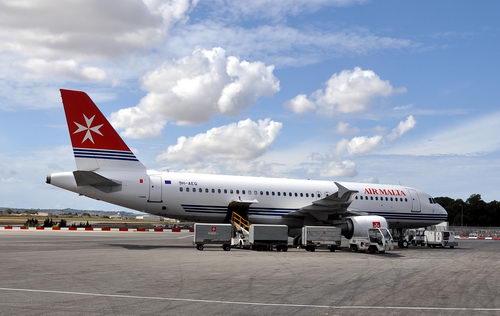
We said goodbye to our group early this morning at the Rome airportas they prepared to depart for the USA. Elizabeth and I went to another terminal to wait for our noon flight to Malta.This was my first time to fly Air Malta. The planes bear the distinctive Maltese Cross on the tail.Malta is renowned for its association with the 12th century Knights of Malta (also know as the Knghts of Rhodes, and the Knights of St. John). They were also called the Hospitalers. I think they built the first hospital in Jerusalem at a site now near the Church of the Holy Sepulcher.

Air Malta planes display the Maltese Cross. Photo by Ferrell Jenkin in Malta.

Air Malta planes display the Maltese Cross. Photo by Ferrell Jenkin in Malta.

Malta is a popular resort and is still in the high season. We are staying at a hotel on the southern side of St. Paul’s Bay. My purpose in coming here is to photograph possible sites associated with Paul’s shipwreck.

After we had safely reached shore, we learned that the island was called Malta.  2 The local inhabitants showed us extraordinary kindness, for they built a fire and welcomed us all because it had started to rain and was cold. (Acts 28:1-2).

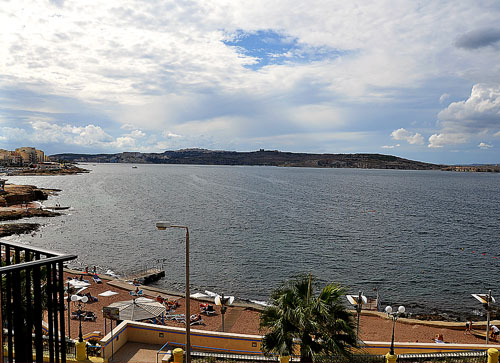
This is one of the first photos I made from our hotel balcony.

View of St. Paul's Bay. Photo by Ferrell Jenkins.

View of St. Paul's Bay. Photo by Ferrell Jenkins.

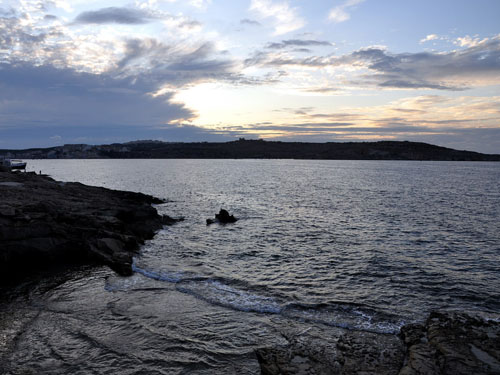
The next photo was made at sunset and shows a portion of the rocky coast even in an area now filled with shops and seaside restaurants.

The rugged coast of St. Paul's Bay at Sunset. Photo by Ferrell Jenkins.

The rugged coast of St. Paul's Bay at Sunset. Photo by Ferrell Jenkins.

Our travel group in Florence, Italy

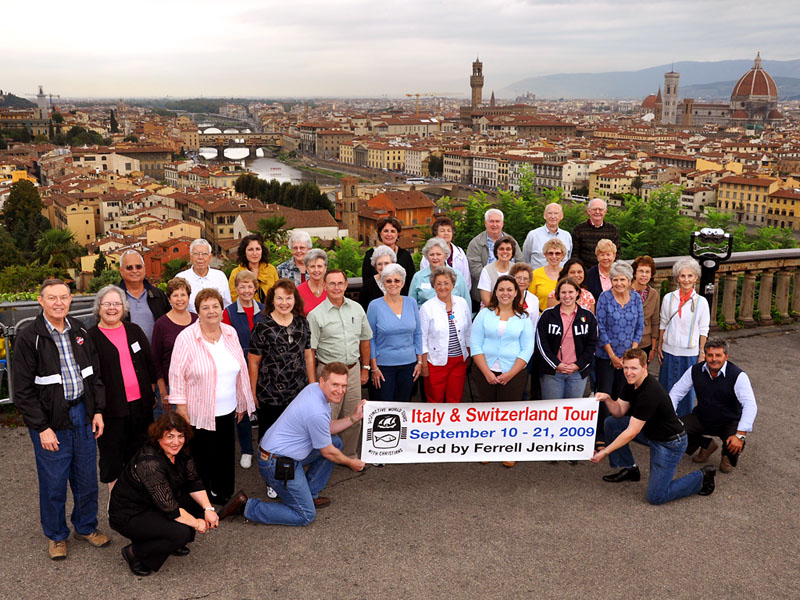
The rain cleared just as we arrived in Florence. Just in time to get a photo of the group from Piazza Michelangelo. This piazza is located on a hill on the south bank of the Arno River and provides a wonderful view of the center of Florence. From here one can see (from right to left) the Santa Croce Church, the Duomo, the tower at the Piazza della Signoria, and the Ponte Vecchio.

From the Middle Ages onward, Florence has been the center of Italian intellectual and artistic life. It was in Florence that Dante, Boccaccio and Petrarch wrote, and Michelangelo, da Vinci and many others worked. In addition to the art treasures, both in and out of the museums, Florence lends itself to leisurely strolling and relaxation.

group-florence-2009

If you know some of these nice folks, you may want to click on the photo for a larger image. All of the fun stuff, and lots of photos, is at Journeys With Jane.

Todd Bolen announces the Jerusalem CD

Todd Bolen has announced the publication of Jerusalem: Volume 2 of The American Colony and Eric Matson Collection. We mentioned this marvelous set of photographs earlier here. For more information on the current CD on Jerusalem click here

Innsbruck to Venice via Verona

Today we traveled from Innsbruck to Venice. This involved driving over the Brenner Pass and through the Dolomite region of the Italian Alps. It rain off and on most of the day, but that did not seem to deter the enjoyment of the experience for the tour members.

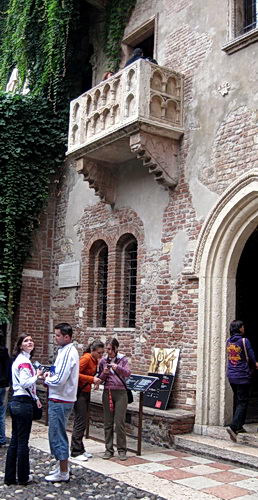
We had some time in Verona, Italy, for a visit of the city. Everyone wants to see the balcony associated with Shakespeare’s Romeo and Juliet. It was impossible to get a good photo because of the large number of tour groups composed of college age young people. Here is a little peak.

Romeo & Juliet Window in Verona. Photo by Ferrell Jenkins.

Romeo & Juliet Window in Verona. Photo by Ferrell Jenkins.

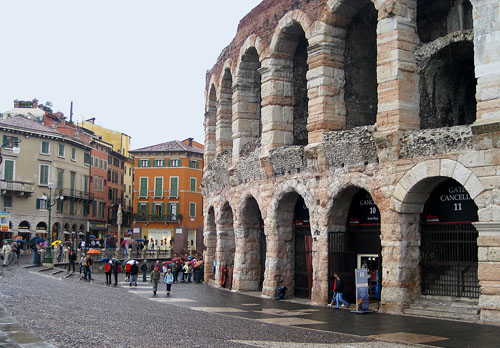
I was more fascinated by the strong Roman fortifications that are still visible around the city. The Colosseum, which was built in the first century B.C. or the first century A.D., is the third largest in the world and is among the best preserved from the ancient world.

The Colosseum is located in the center of the town and is still used for various musical performances.

Roman Colosseum in Verona, Italy. Photo by Ferrell Jenkins.

Roman Colosseum in Verona, Italy. Photo by Ferrell Jenkins.

We look forward to visiting Venice tomorrow. The city is situated more than two miles from the mainland on 118 islands connected by many stone bridges and interlaced by more than 150 canals.

So far as I can detect all of the members of our group are in good health and good spirit.

A beautiful but hazy day in the Bernese Oberland

Today we visited the Bernese Oberland in Switzerland. It was a beautiful sunny day by about 10 a.m., but the distant mountains remained hazy almost all day. We went to Trummelbach Falls. Using an elevator and steps one is able to go inside the mountain to see the falls.  I think everyone in our group saw at least part of the falls, and several went all the way to the top.

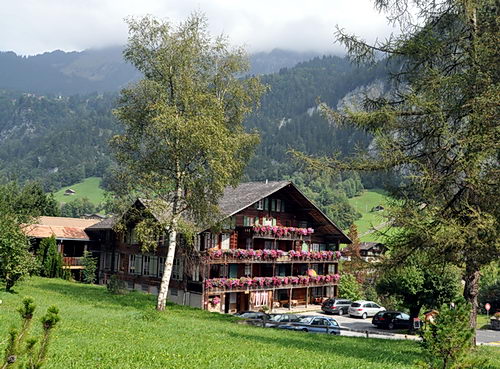
Here is a photo I made of one of the colorful buildings. It is typical here for houses and other buildings to display beautiful flowers under their window”I am my beloved’s and my beloved is mine, He who pastures his flock among the lilies.”s. This provide color for those passing buy as well as for those in the house. This reminds me of the Shunamite (Shulamite) girl’s description of her beloved.

“I am my beloved’s and my beloved is mine, He who pastures his flock among the lilies.” (Song of Solomon 6:3)

A little color adds a lot to life even when one has to deal with difficult earthly problems.

A beautiful house at Lauterbrunen. Photo by Ferrell Jenkins.

A beautiful hotel at Lauterbrunnen. Photo by Ferrell Jenkins.

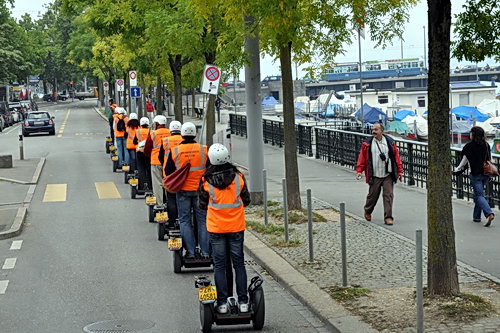
Both in Lucerne and in Interlaken we saw some small tour groups traveling on Segways. This service is offered in the City of David in Jerusalem (click here), but it is the first time I have seen it in action. I think each participtant can hear the leader speaking through the earphones in the helmet.

Segway tour in Lucerne, Switzerland. Photo by Ferrell Jenkins.

Segway tour in Lucerne, Switzerland. Photo by Ferrell Jenkins.

If you know some of the people in our group and wish to read more about the individuals, take a look at Journey’s With Jane.

Group arrives safely in Switzerland

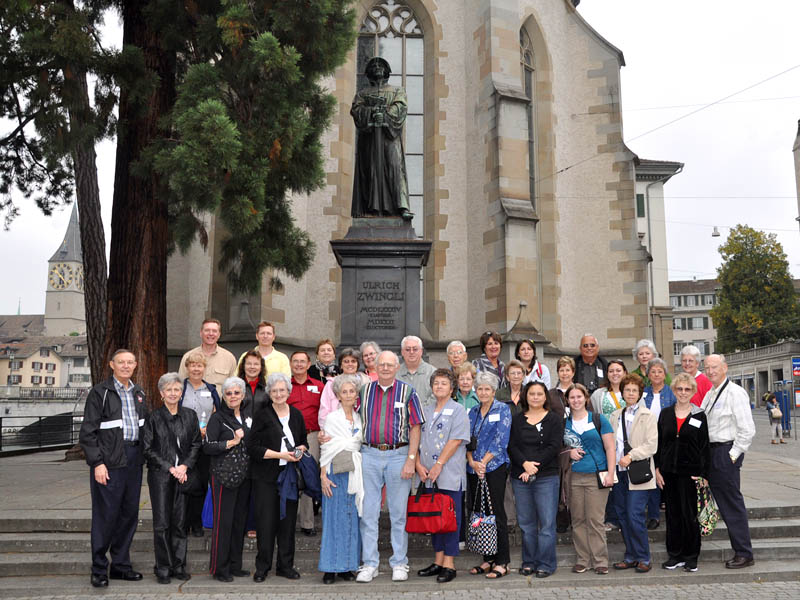
We arrived on time this morning after an all night flight from Atlanta to Zurich. As soon as we got out luggage, with three or four bags missing, we went to downtown Zurich to visit the statue of Ulrich Zwingli at the Wasserkirche (Water Church), the Grossmünster (the great cathedral where Zwingli preached in the early 15th century), and a few other sites in the downtown area of the city.

After our guide presented some of the history of the political and religious conditions in Switzerland in the early 15th century, I took the opportunity to talk about the work and beliefs of Zwingli as an early leader of the Reformation Movement. More in a later post.

Ferrell Jenkins Tour Group at the Zwingli Statue in Zurich.

Ferrell Jenkins Tour Group at the Zwingli Statue in Zurich.

The steps there seemed like a good place to line up the group for a photo. If you think you know someone in the group you may click on the photo for a larger image. This wasn’t our “official” tour photo with banner, etc., and some of the ladies didn’t much like the idea of the photo being posted. I think they look nice after being up all night. How about you?

On the road in Switzerland, Austria and Italy

This afternoon we are ticketed to leave Atlanta for an overnight flight to Zurich, Switzerland. After some brief sightseeing in Zurich we will head for Lucerne for overnight.

Most of our tours are in the Bible Lands (Israel, Jordan, Egypt, Turkey, Greece, et al.), but we have directed other tours since 1967. On this current tour in Switzerland, Austria, and Italy, in addition to the general learning that travel affords, we will give some emphasis to church history, and Paul’s time in Rome.

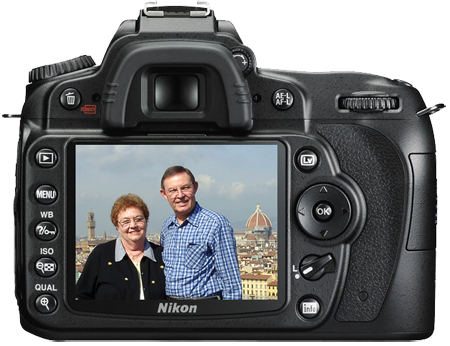
Ferrell and Elizabeth in Florence, Italy, 2001.

Ferrell and Elizabeth in Florence, Italy, 2001.

This time I am using a Nikon D90. It is amazing how much younger the camera makes us look. This will be a great selling point for many.

Todd Bolen’s new collection of old photos

Todd Bolen has produced a new collection of photos. These are not his photos. They are the famous photos of The American Colony and Eric Matson Collection. This set of 8 volumes features 4,000 high-resolution photographs taken by resident photographers in the Holy Land from 1898 to the 1940s.

Every Bible student who has been using Bible study resources for several years has seen the photographs of The American Colony photographers and Eric Matson. When I edited the Truth in Life Bible class literature in the early 1970s we purchased and obtained permission to use several of the photographs in the literature.

The American Colony in Jerusalem was founded in 1881 by Horatio Spafford (author of the famous hymn, It is Well With My Soul). Eric Matson, one of the photographers inherited the collection, added his own work, and later donated his negatives to the Library of Congress. These photos have been available to the public for some time, but it has been difficult to locate a particular photo. And the quality of some of them, after so many years, is not good.

Bolen describes the collection:matson_dvd_front_200

This collection includes more than 4,000 selected photographs of sites and scenes from Palestine, Lebanon, Syria, Jordan, and Egypt. All of the images are included in pre-made PowerPoint® files for quick and easy use, as well as in high-resolution jpg format, suitable for projecting or printing. Quotations from 19th-century travelers give additional context to many of the photographs.

The Collection Includes:

  • Volume 1: Northern Palestine
  • Volume 2: Jerusalem
  • Volume 3: Southern Palestine
  • Volume 4: Lebanon, Syria, and Jordan
  • Volume 5: Egypt and Sinai
  • Volume 6: Traditional Life and Customs
  • Volume 7: Early 20th-Century History
  • Volume 8: People of Palestine

The first volume has been released on CD. Other volumes are being released one CD a month. The complete 8-volume set is available now on 2 DVDs.

In recent weeks Todd has written about Shechem, Samaria, and Beth Shean. Almost every tour group visits Beth Shean, but many are unable to go to the other sites. Take a look here at the way Beth Shean looks now and the way it looked in the 1920s.

Complete information on this set is available at Life in the Holy Land.