Category Archives: Palestine

Back in Print: Middle East Conflict…

My booklet on The Middle East Conflict and the Bible has been available off and on since 1991. I have presented numerous short series of lessons on this topic in past years.

Today Florida College Press has an attractive edition for sale in the bookstore at 119 N. Glen Arven Ave., Temple Terrace, FL 33617. This is just in time for those attending the Florida College lectures next week to pick up a copy. I remind you that the content of this booklet is written from the amillennial perspective. Specifically I have explained it as the Philosophy of History, Preterist, or Historical Background viewpoint.

We had hoped to have The Old Testament in the Book of Revelation available in a new format but still lack a little having that completed. We hope to have it ready soon.

My Studies in the Book of Revelation is available and I suggest it as the book one should choose if he/she wants to gain an understanding of the overall content of the great book of Revelation.

The Middle East Conflict and the Bible discusses the following questions.

Is the return of the Jews to Palestine in the twentieth century a fulfillment of Biblical prophecy?

Why do the Arabs and Israel have so much conflict

Was Saddam Hussein the successor to Nebuchadnezzar, king of Babylon? Will Babylon be rebuilt?

What does Biblical prophecy say about Israel, Babylon and Nineveh?

Does God use Nations to serve His purpose?

When and how will the nations turn their swords into plowshares?

It is difficult to locate these books on the Florida College Bookstore website, but you can ask for them by calling the bookstore at the college switchboard and asking for the Bookstore: 813.988.5131.

Review Comments:

Three persons received a preview copy of the book. Here are their comments.

Don Truex: “As has been the case for decades, Ferrell Jenkins sets the standard for Biblical, practical and applicational knowledge of the events in the Middle East and their relevance to Christians. His firsthand knowledge of the Text, the land and the people combine to bring essential insight into the all-too-common turmoil in this history filled region.”

Leon Mauldin: “Today I read my advance copy of The Middle East Conflict and the Bible. I know of nothing else like it, that packs so much in one small book. This is truly a great resource!”

Brooks Cochran: “The Middle East Conflict and the Bible” is an excellent resource to use in a study of current events in the Middle East as they relate to Bible Prophecy and the Nation of Israel. This updated edition includes a chapter on “Understanding Islam The Moslem Religion”.”
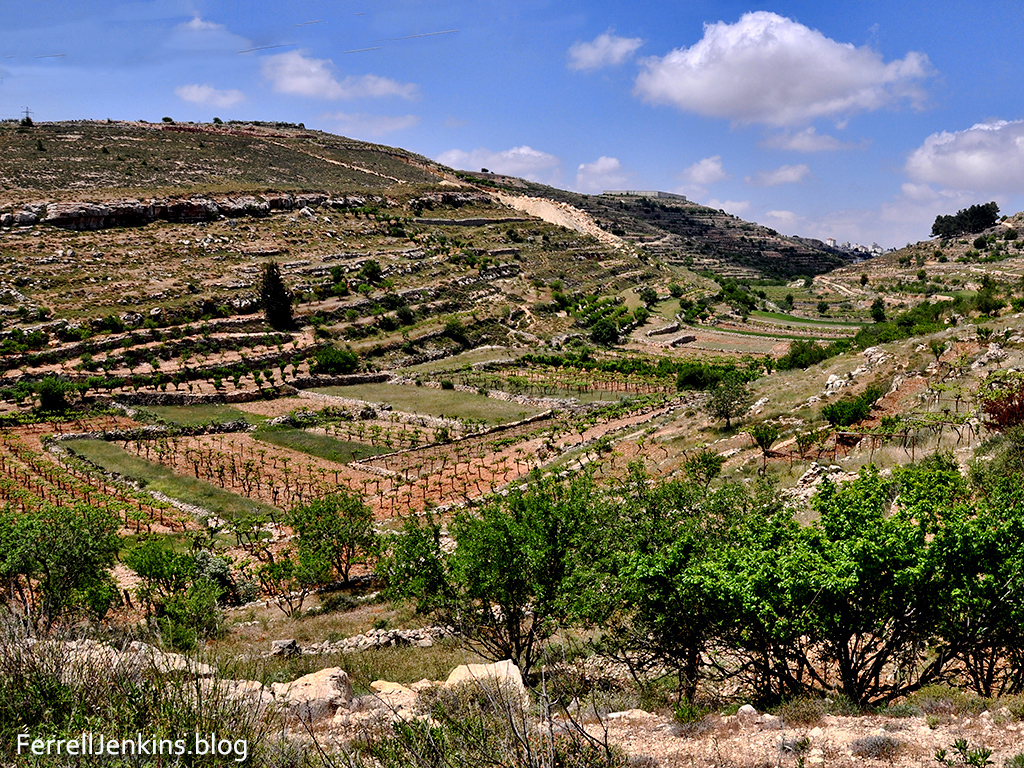
A Beautiful View

Along the central mountain road between Bethlehem and Hebron. There are many beautiful views. This one shows examples of the continued fertility of the land that was promised to the ancient Israelites. It illustrates the use of valleys to collect water during the rain season to provide water for the plants. The hillsides illustrate the terracing used as far back as the Biblical Iron age (around 1000 B.C.).

View of beautiful, fruitful hillsides along the road between Bethlehem and Hebron. Photo by Ferrell Jenkins.
View of hillsides and valleys along road between Bethlehem and Hebron. Photo by Ferrell Jenkins.

Articles on Bethlehem and the birth of Jesus

Recent readers may not have noticed our header having a link on Indexes (Indices). If you go there you will find an Index of articles on Bethlehem and the Birth of Jesus. At this time of the year when many are thinking about the birth of Jesus and it’s meaning for all mankind I thought it would be good to call attention to these articles and photos. There have been several good comments and discussions about the date of the birth of Jesus.

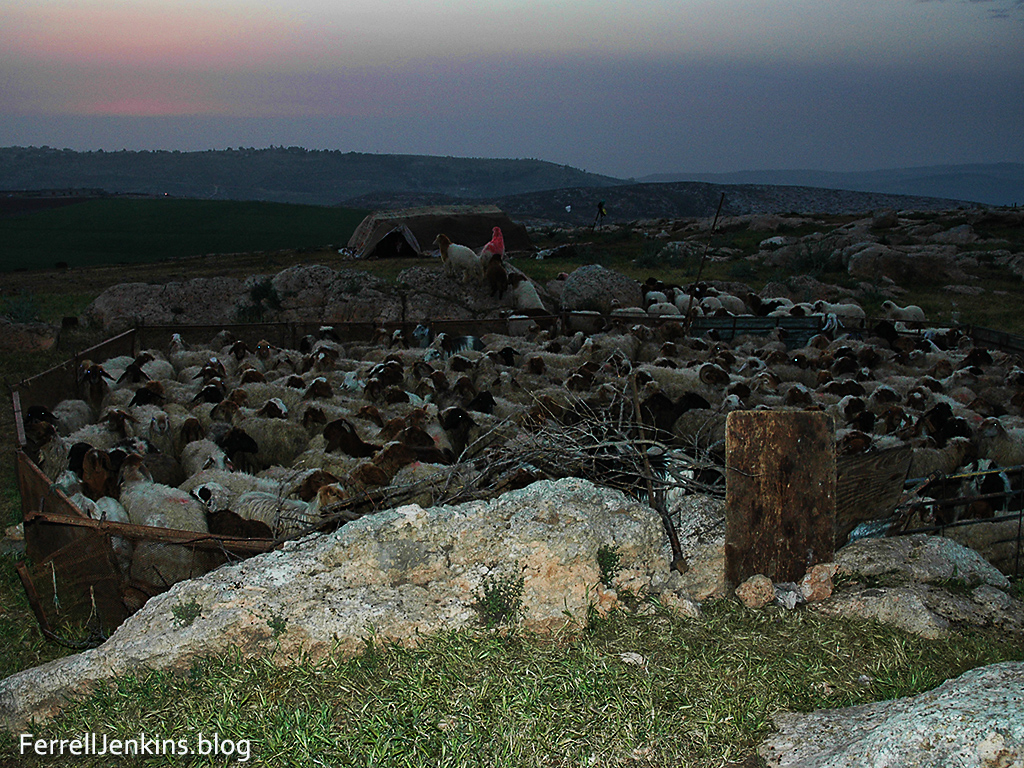
I have many photos of shepherds and sheep, but not one of shepherds watching their sheep by night in the vicinity of Bethlehem. I do have some photos of shepherds with their sheep in the sheepfold at Heshbon in Jordan. I had been at Heshbon one afternoon visiting with the shepherds and making photos. When I saw their makeshift sheepfold I asked if I could come back in the evening and make some photos. The photo here is one made a dusk after the sheep had been gathered into the sheepfold. The shepherd and his family live in the tent. Heshbon was a former Moabite town given to the tribe of Reuben after the Israelites captured the Trans-Jordan tableland (Numbers 32:37).

Shepherds watching their sheep by night at Heshbon in Jordan.
Shepherds at Heshbon watching their flock at night.

To access the articles on Bethlehem click through here.

Like Almond Blossoms

There is emphasis in the Hebrew Bible and in the New Testament that the biblical tabernacle and its furniture were made according to the pattern given by God (Exodus 25:9;

“And on the lampstand itself were four cups made like almond blossoms, with their calyxes [bulbs, knops, cups] and flowers,” (Exodus 37:20; Hebrews 8:5 ESV).

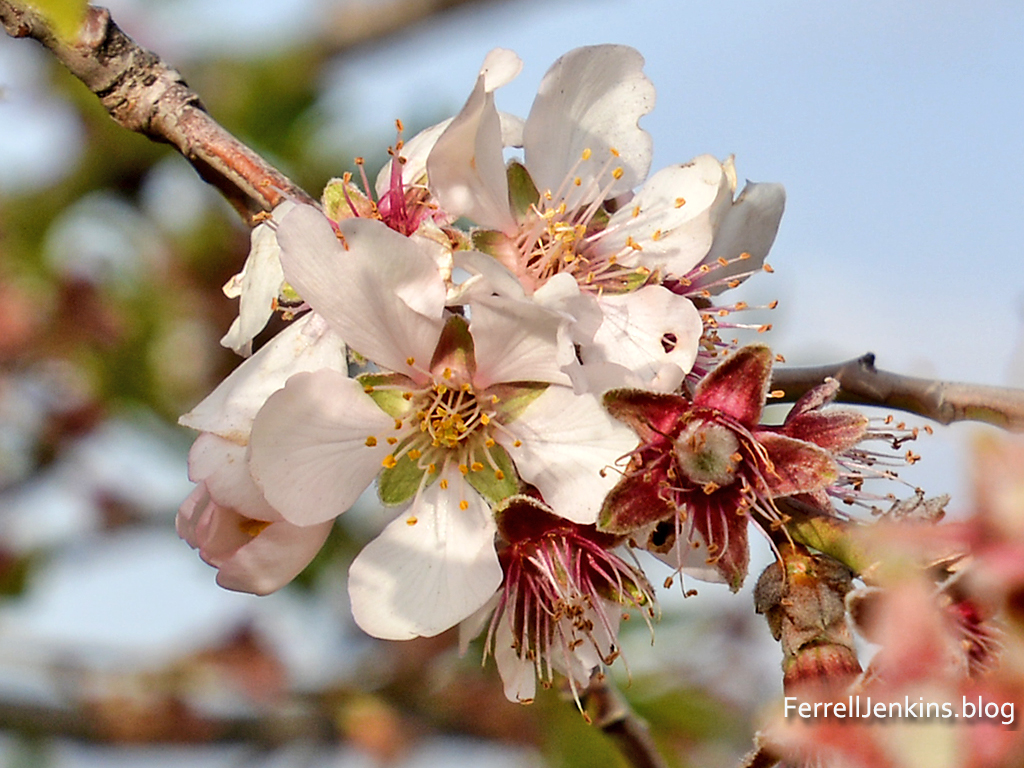
Earlier this year I made some pictures of almond trees in bloom at a site overlooking the Lebonah valley, on the north side of Shiloh. It is, in my judgment, a thing of beauty.

An almond blossom at a site overlooking the Lebonah Valley. Photo by Ferrell Jenkins.
An almond blossom at a site overlooking the Lebonah Valley north of Shiloh.

Tirzah, Israel’s second capital

Tirzah is used in the Bible as the name of one of the daughters of Zelopehad. She and her sisters were married into the clans of the people of Manasseh the son of Joseph (Numbers 36:11; Joshua 12:24). The man in Song of Songs (or Solomon) tells his lady “You are beautiful as Tirzah, my love, lovely as Jerusalem, awesome as an army with banners” (6:4 ESV). The context, including Jerusalem, indicates he is comparing her to a beautiful city.

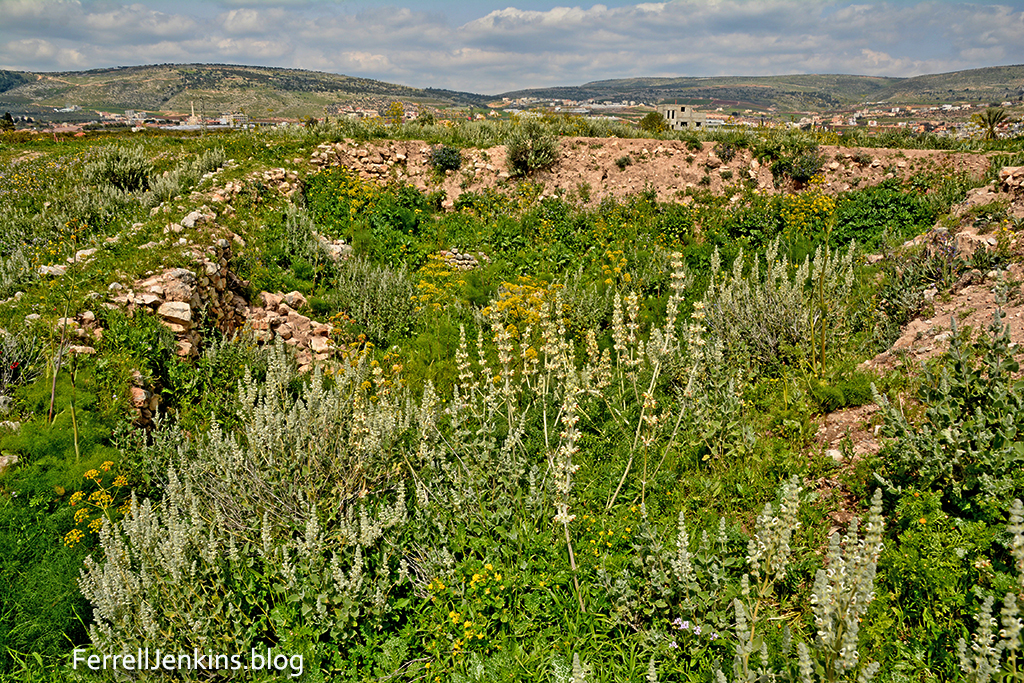
Tel el Farah north in March, 2022. A few stones from the excavations are visible among the weeds. Photo by Ferrell Jenkins.
This photo shows a few of the excavated ruins of Tel el Farah, thought to be the site of Tirzah.

In today’s post we consider the name Tirzah as the name of a place.

  • Joshua captured the king of Tirzah during the conquest of the promised land (Joshua 12:24; 17:3).
  • Earlier when Abraham was at Shechem, the LORD promised him and his descendants the land of Canaan (modern Nablus) (Genesis 12:1-9).
  • About 931 BC after the death of Solomon Jeroboam rebelled and became king over Israel (the northern kingdom) at Shechem (1 Kings 11). Later the capital was moved to Tirzah (1 Kings 14:17).
  • R. K. Harrison describes the importance of Tirzah in the kingdom of Israel: “perhaps as the result of increasing political and economic relationships with Syria. Tirzah was the capital of Israel during the time of Baasha (1 Kings 15:21,33) and Elah (1 Kings 16:8-9). The seven-day reign of Zimri ended when he burned the palace over himself at Tirzah was being besieged by Omri (1 Kings 16:17-18). After ruling from Tirzah for six years, Omri moved the capital of Israel to Samaria (1 Kings 16:23-24) , probably because of his economic and political alignment with Phoenicia. Menahem, a resident of Tirzah, was able to overthrow Shallum (752 B.C.) toward the close of the northern kingdom’s existence and to usurp the throne, ruling for almost eleven years.
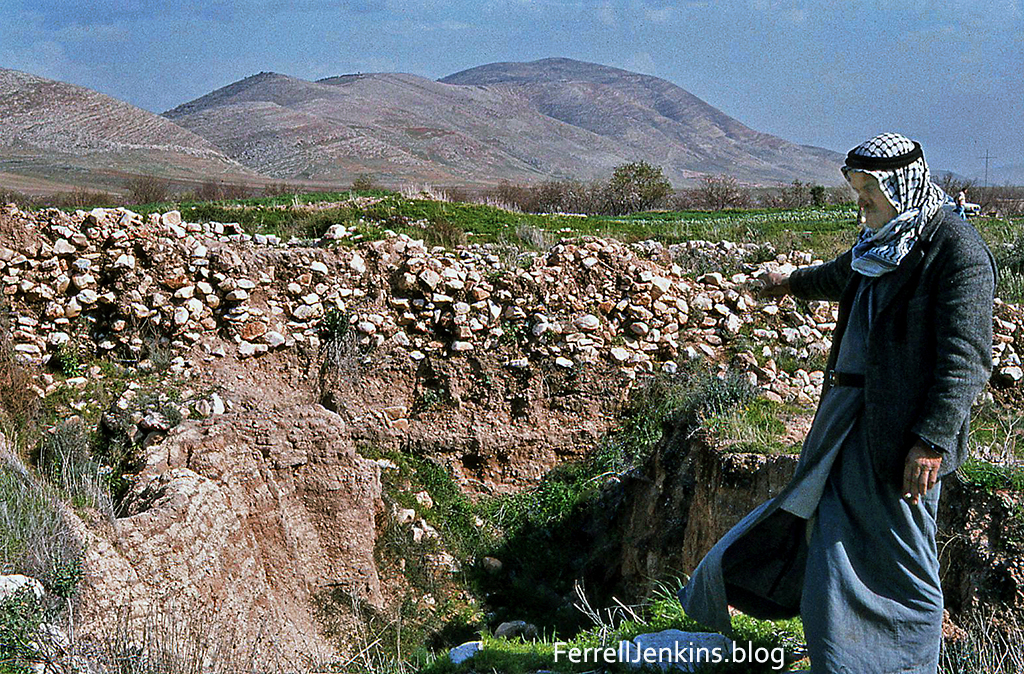
Caretaker at Tel el Farah (Tirzah) in 1982. Photo by Ferrell Jenkins.
In 1982 I first visited Tel el Farah with the late Jimmy Cravens, a photographer friend from Tampa, Florida. The site still showed evidence of excavation. The gentlemen in the photo lived in a little house on the tel and served as the caretaker. I recall that he is showing us some of the walls that indicated a divider between the poor and those better off. He said he had worked with De Vaux during all of the excavations. The image is scanned from a slide that is still in good condition after 40 years.

The location of Tirzah is not certain. W. F. Albright identified it with Tel el Farah, a mound located about seven miles NE of Shechem (at modern Nablus). Roland De Vaux was associated with the Ecole Biblique in Jerusalem and conducted nine seasons of archaeological excavations at Tel el Farah between 1946 and 1960. Most of the tel is currently covered by an orchard.

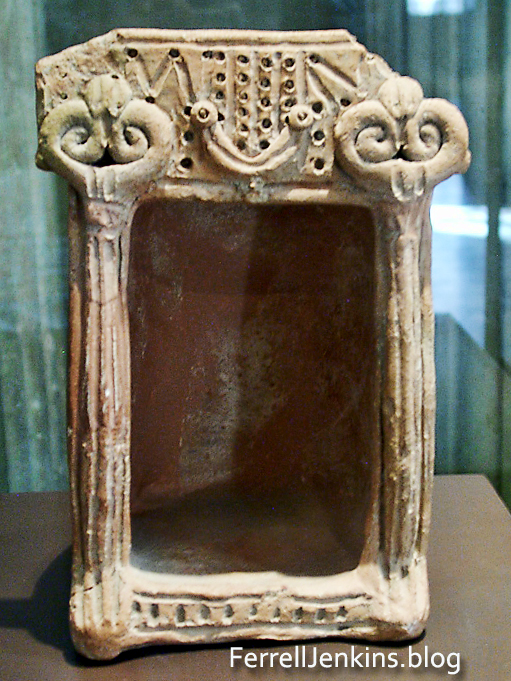
Shrine model from Tel el Farah north from the excavations. Now in the Louvre.
Several archaeological artifacts from Tel el Farah are displayed in the Louvre. This is a shrine or temple model from the site.

Tel el Farah north (likely Tirzah) should not be confused with Tel el-Farah south (likely Besor). See our article about a visit there a few years ago here. Google Earth Pro includes one photo from the south site with the information about the north site. It is easy to make this mistake.

If you wish to look up the site on Google Earth Pro or the maps you will need to search for Tel Fara North. Remember also that the site is in Palestine.