Category Archives: Old Testament

Top archaeological discoveries of 2008

Todd Bolen has posted his “Top 8 of 2008: Archaeological Discoveries Related to the Bible” at the BiblePlaces Blog. Take a look.
Ashkelon and the Seacoast

This has been a busy month for me. It was the month of two cataract surgeries, but I won’t be able to get the needed glasses for reading until about the second week of January. With each surgery it takes about two days to get over the dilation and do any serious reading and computer work.

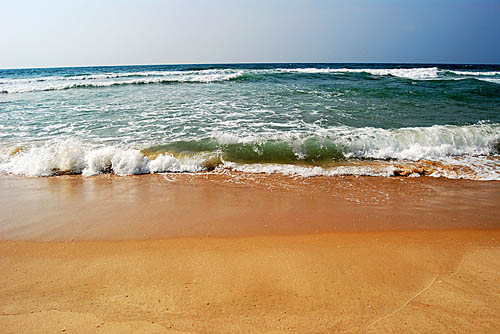
I want to share a photo of the beach and Mediterranean Sea at Ashkelon. The city is in the news this week due to the conflict between Israel and Gaza. Ashkelon is the closest Israeli town to the Gaza Strip.

The Sea at Ashkelon. Photo by Ferrell Jenkins.

The LORD spoke against the Philistine cities through the prophet Jeremiah (ch. 47). These verses caught my attention.

How long will you cry out, ‘Oh, sword of the LORD, how long will it be before you stop killing? Go back into your sheath! Stay there and rest!’ But how can it rest when I, the LORD, have given it orders? I have ordered it to attack the people of Ashkelon and the seacoast. (Jeremiah 47:6-7 NET)

The Wise Woman of Abel-Beth-Maacah

No sooner had King David put down the rebellion of his son Abaslom when a Benjamite by the name of Sheba led a rebellion against him. The men of Israel rebelled against David and followed Sheba, but the men of Judah remained loyal to the king.

Realizing that Sheba was a greater threat than Absalom had been, David called on Abishai to take servants (warriors) and capture Sheba. Joab’s men when out from Jerusalem to capture Sheba. This pursuit took Joab’s men all the way to the north of the Israelite territory, to a town named Abel-Beth-Maacah. Some English versions use Abel Beth Maacah, or a similar variant. In modern Israel this town is almost on the border with Lebanon between Kiryat Shmona and Metulla.

Sheba traveled through all the tribes of Israel to Abel of Beth Maacah and all the Berite region. When they had assembled, they too joined him. So Joab’s men came and laid siege against him in Abel of Beth Maacah. They prepared a siege ramp outside the city which stood against its outer rampart. As all of Joab’s soldiers were trying to break through the wall so that it would collapse, a wise woman called out from the city, “Listen up! Listen up! Tell Joab, ‘Come near so that I may speak to you.” (2 Samuel 20-14-16 NET)

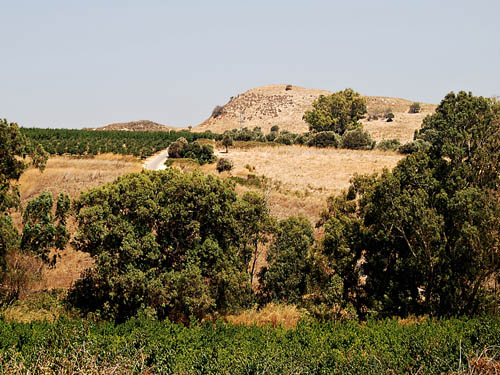
Our photo, looking east, shows the massive mound thought to be the site of Abel-Beth-Maacah. This photo was made the last day of August. The dry tell stands out distincting from the surrounding orchards. Apples are grown in this area. On a clear day one would be able to see the Beka Valley and Mount Hermon beyond the tel.

Abel-Beth-Maacah in northern Israel. Photo by Ferrell Jenkins

Abel-Beth-Maacah in northern Israel. Photo by Ferrell Jenkins

The wise woman reasons with Joab. She tells him that this town formerly was a place where people would ask for advice to end a dispute. She said,

I represent the peaceful and the faithful in Israel. You are attempting to destroy an important city in Israel. Why should you swallow up the LORD’s inheritance? (2 Samuel 20:19 NET)

Joab agreed that he would not destroy the city if she would hand over Sheba. She agreed to throw the head of Sheba over the wall. She did what she promised and the destruction was averted. Joab went back to the king in Jerusalem.

Abel-beth-Maacah is mentioned in at least two other passages.

  1. The city was conquered by Ben-hadad, king of Aram [Syria] (1 Kings 15:20).
  2. The city was captured by Tiglath-pileser, king of Assyria, in the days of Pekah of Israel.

BiblePlaces Newsletter

Todd Bolen’s BiblePlaces Newletter for December is now available. It includes a wonderful aerial photo of the Elah Valley. The main feature is a series of (Google) satellite photos of Jerusalem with the natural features (hills, valleys, springs, quarters of the city, etc.) identified. If you teach any lesson dealing with the city of Jerusalem you need these PowerPoint slides.

You should subscribe to the BiblePlaces Newsletter, but if you have not yet done so you may access the current issue here. The subscription link is at the bottom of the page.

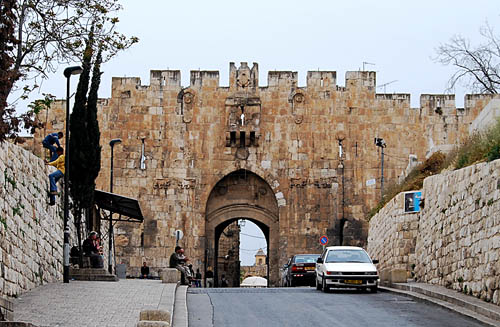
The photo below shows one of the modern gates of Jerusalem. It is labeled Stephen’s Gate on one of the slides mentioned above. Murphy-O’Connor says that Suliman called it the Bab el-Ghor (the Jordan Valley Gate). In Hebrew it is called the Lions’ Gate, but you may notice that the animals to the left of the gate are panthers. Murphy-O’Connor says this was “the heraldic emblem of the Mamluk sultan Baybar (1260-77). This is the only gate of the Old City on the east side that is currently open.

Lions Gate or St. Stephen Gate. Photo by Ferrell Jenkins.

Lions' Gate or St. Stephen's Gate. Photo by Ferrell Jenkins.

Newsweek attacks biblical authority & marriage

Perhaps you have already seen the cover, and cover story, of Newsweek (Dec. 15, 2008). The cover, showing a drawing of a Bible, touts the main article by Lisa Miller, “The Religious Case for Gay Marriage.” Miller is the religion editor of Newsweek.

Rather than write my own reply, I would like to direct you to the Blog by R. Albert Mohler, Jr. Read it here.  Mohler correctly points out that the real issue in this discussion is one of biblical authority.

As always, the bottom line is biblical authority.  Lisa Miller does not mince words.  “Biblical literalists will disagree,” she allows, “but the Bible is a living document, powerful for more than 2,000 years because its truths speak to us even as we change through history.”  This argument means, of course, that we get to decide which truths are and are not binding on us as “we change through history.”

Newsweek editor Jon Meacham says,

No matter what one thinks about gay rights–for, against or somewhere in between–this conservative resort to biblical authority is the worst kind of fundamentalism. Given the history of the making of the Scriptures and the millennia of critical attention scholars and others have given to the stories and injunctions that come to us in the Hebrew Bible is more than intellectually bankrupt–it is unserious, and unworthy of the great Judeo-Christian tradition. (Newsweek, Dec. 15, 2008, p. 4)

Well, there you have it. The editor of Newsweek has resolved this matter with one editorial.

If you are interested in a good study of this subject you might enjoy the video by Dr. Robert Gagnon, author of  several works on Homosexuality and the Bible, here. Or, read Dr. Gagnon’s 26 page response to the Miller article here.

Bethlehem – the Birthplace of Jesus

Years ago we would say that Bethlehem is located in the hill country of Judea about six miles south of Jerusalem. Today, Jerusalem stretches all the way to Bethlehem. It is no longer easy to get to Bethlehem. The massive wall built by Israel (Israelis call it the “fence”) separates Bethlehem from Israel.

During the Patriarchal period the town was called Ephrath (Genesis 48:7; 35:9-27). Later, as part of the territory allotted to the tribe of Judah, it was the home of Ruth and Boaz and became the birthplace and early home of David (1 Samuel 17:12, 15). The town was sometimes called the “city of David” (Luke 2:4, 11), but is most famous as the birthplace of Jesus (Micah 5:2; Luke 2:4-15; Matthew 2:1-16).

When one visits the Bible lands today he must realize that 2,000 years of history, involving both repeated building and the destruction of what has been built, has left nothing to remind one of the original place where Jesus was born. Justin Martyr (ca. A.D. 160) said Joseph “took up his quarters in a certain cave near the village.” Origen (mid-third century) said the cave where Jesus was born was being shown and even the enemies of the faith were talking of it. Jerome, a resident of Bethlehem (A.D. 386-420), tells how the birthplace of Jesus and other places associated with the ministry of Jesus were defiled from the time of Hadrian to the reign of Constantine. The Church of the Nativity now stands at this spot.

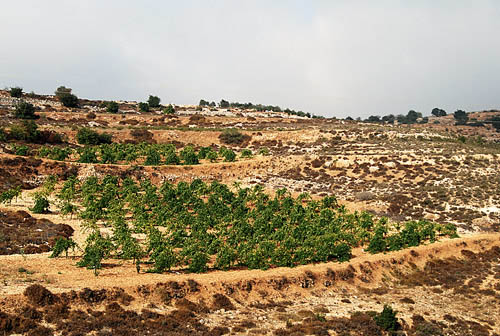
Today I have chosen to include a photograph of vineyards in the hill country immediately to the west of Bethlehem.

Terraces in the hill country of Judea near Bethlehem. Photo by F. Jenkins.

Terraces in the hill country of Judea near Bethlehem. Photo by F. Jenkins.

Gordon Franz has written a good article about Bethlehem which is posted on the ABR web site. Read it here.

Jerome in Bethlehem

Recently I was reading a manuscript written by a friend on the general subject of how we got the Bible. Of course, he mentioned Jerome and his work of translating the ancient Hebrew and Greek manuscripts into what would be called the Latin Vulgate.

The earliest English versions of the Bible were translated from the Latin Vulgate. Even though the translations of today rely mostly on the Hebrew and Greek texts, we are still indebted to the work of Jerome.

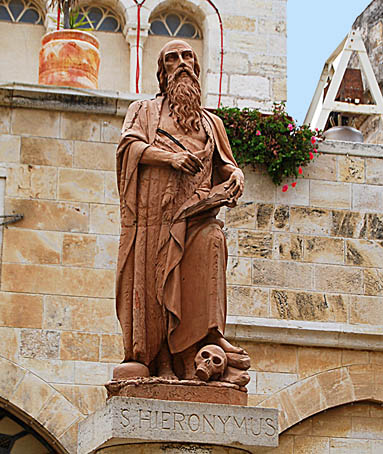
Jerome lived in Bethlehem from about 384 A.D. to 420 A.D. In the front of the Church of St. Catherine in Bethlehem there is a modern statue of Jerome showing him in the act of writing. Everyone always asks about the skull at the foot of the statue. Some have suggested that Jerome kept a skull on his desk to remind him of his mortality. That would do it for me!

Statue of Jerome in front of St. Catherine's Church. Photo by Ferrell Jenkins.

Statue of Jerome in front of the church of St. Catherine in Bethlehem. Photo by Ferrell Jenkins.

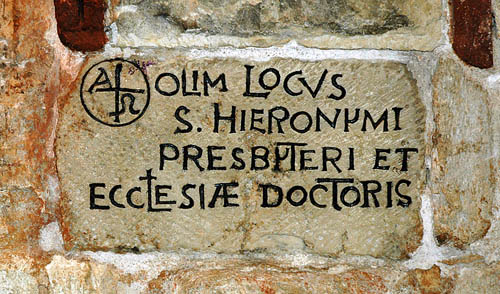
Underneath the Church of the Nativity there are a series of grottoes or caves. One of these is said to have been the place where Jerome did his work of translation and writing. This sign presently marks the place where he once lived.

The place where Jerome once lived. Photo by Ferrell Jenkins.

The place where Jerome once lived. Photo by Ferrell Jenkins.

McGarvey’s Land of the Bible

J. W. McGarvey was one of the best scholars of the 19th century Restoration Movement. He was president of the College of the Bible in Lexington, KY. One of my first books was his practical New Commentary on Acts of Apostles (1892). He had earlier (1868) written A Commentary on Acts of Apostles dealing with some of the critical issues of the book. McGarvey addressed some of the critical questions of the day in The Authorship of Deuteronomy, Jesus and Jonah, and Biblical Criticism.

McGarvey visited Palestine in 1879. His former students paid for the trip [I like that!], with the understanding that he would write a book. They would get their money back from the sale of the book. His book, Lands of the Bible, was published by J. B. Lippincott & Co., London and Philadelphia, in 1881. The title page indicates that 15,000 copies were printed. Impressive for a book on that subject.

J. W. McGarvey’s Lands of the Bible is available at the Restoration Movement pages here. For other works by McGarvey and other Restoration leaders begin with the home page here.

When I led my first group to the Bible Lands in 1967, one friend in the group had studied McGarvey’s book carefully. He took a tape measure with him. When we came to certain sites he took out the tape to take measurements. He wanted to be sure he was at the same place McGarvey visited.

Chapter IX in McGarvey’s book is titled “Argument from the Agreement of the Land and Book.” I have an outline of this material in my Introduction to Christian Evidences [OP], and use some of this material in my Daily Life in Bible Times series. One would be mistaken not to move beyond McGarvey, Thompson, Robertson, and the other early explorers. On the other hand, it would be amiss to dismiss what these scholars wrote.

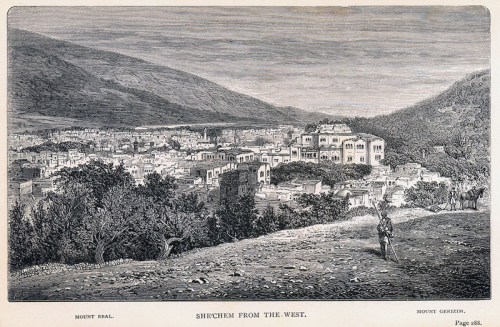
What prompted all of this? Todd Bolen recently wrote a post on The Acoustics of Mounts Gerizim and Ebal in which he quotes from one of McGarvey’s letters here. I urge you read his post now. Also follow the link to the Biblical Studies and Technology Tools post showing the valley between Ebal and Gerizim using digital mapping tools.

I wanted to contribute something to this study by including here a scan of the plate from my original edition of Lands of the Bible (opposite page 288).

Shechem from the West. McGarvey, Land of the Bible.

Shechem from the West. McGarvey, Land of the Bible.

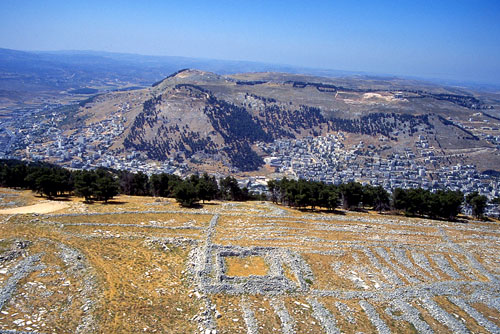
Todd Bolen has a great photo of Mount Ebal from Mount Gerizim. I would like to add the other side of the valley. Here is a photo showing Mount Gerizim from above Mount Ebal. It is an aerial shot made for me by the well known photographer Zev Radovan.

View of Mount Gerizim from above Mount Ebal.

View of Mount Gerizim from above Mount Ebal.

Maybe later we will discuss some of the important biblical events that took place in this area. For not let us note that this is where the blessings and curses of the law were read after the children of Israel entered the promised land (Deuteronomy 11:19). Here is the account of that event:

All Israel with their elders and officers and their judges were standing on both sides of the ark before the Levitical priests who carried the ark of the covenant of the LORD, the stranger as well as the native. Half of them stood in front of Mount Gerizim and half of them in front of Mount Ebal, just as Moses the servant of the LORD had given command at first to bless the people of Israel. Then afterward he read all the words of the law, the blessing and the curse, according to all that is written in the book of the law.  There was not a word of all that Moses had commanded which Joshua did not read before all the assembly of Israel with the women and the little ones and the strangers who were living among them. (Joshua 8:33-35 NASB)

Celebrating 100,000 visitors; a gift for you

Thanks for visiting Ferrell’s Travel Blog. This afternoon our Blog Stats moved above 100,000. I think when we began the blog we only had in mind that families of some of our tour members could follow our route of travel. Then I began to write about other places I had visited. Well, here we are today.

As my wife and I looked at the stats I said, “Well, we have reached a millstone, if not a milestone.” She said, “Yes, it is a millstone.” I must admit it has become addictive. But when I realize that I am reaching a large number of people each day/week/month with something that may be beneficial in Bible study and teaching, I am delighted.

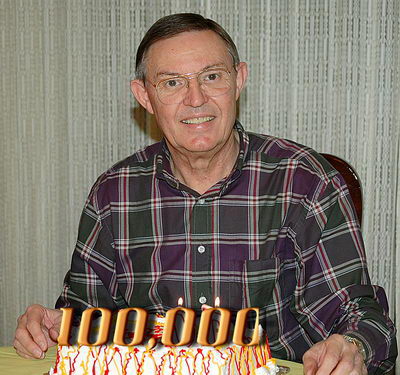
Ferrell Jenkins celebrating 100,000 visitors.

Ferrell Jenkins celebrating 100,000 visitors.

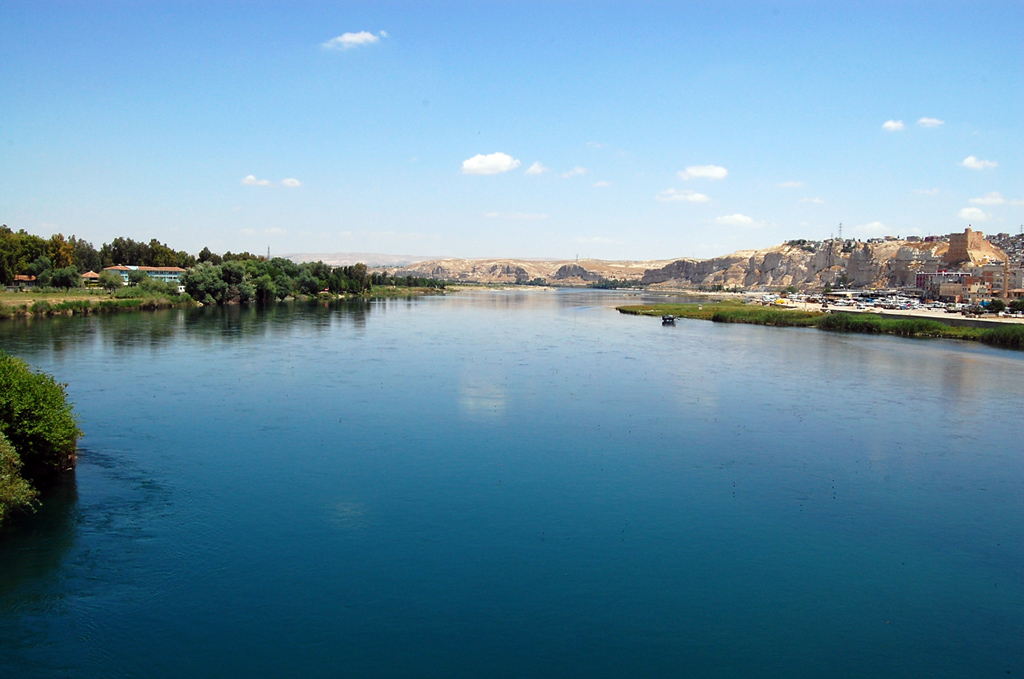
I want to share a gift that may be of benefit to those who use PowerPoint presentations in teaching. During the life of the blog, more people have visited our pages on the Euphrates River than any other. Here is a photo of the Euphrates at Birecik, Turkey. Click on the small photo below and it will take you to a high resolution photo that you may download and use. We request that you not publish the photo without permission. A digital copyright notice is embedded in the image.

The Euphrates River at Birecik, Turkey. Photo by Ferrell Jenkins.

The Euphrates River at Birecik, Turkey. Photo by Ferrell Jenkins.

The Euphrates is the largest, longest and most important river of Western Asia. It is nearly 1800 miles long and was the northeastern boundary of the land promised to Abraham (Gen. 15:18). The empires of Assyria and Babylon, the greatest enemies of Israel, were east of the Euphrates. The Old Testament prophets often put the Euphrates by metonomy for these countries to designate the place from which the punishment of God would come (Isa. 7:20; 8:7; Jer. 46:10). For more information on the Euphrates River read the article here.

Treasures from Assyria

Recently I wrote about the of Assyrian treasures from the British Museum currently exhibited at the Museum of Fine Arts in Boston. See here. Monday afternoon Leon Mauldin and I spent a few hours in the MFA visiting the Assyria exhibit as well as the Roman and Egyptian sections of the Museum. We had a little time to sample some of the other great art treasures there.

I had seen quite a few of the artifacts in the British Museum, but the exhibit was well arranged and certainly worth the time and fee. I urge everyone within a reasonable distance to attend between now and January 4. Check the web site here.

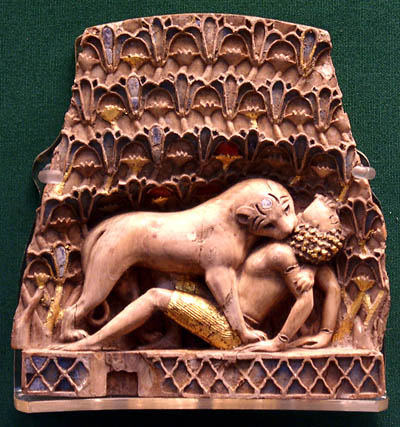
The artifact used on the front of the exhibit catalog and the advertising for the Boston exhibit shows a relief in ivory of a lioness devouring a man with negroid features in a thicket of stylized lotus and papyrus plants. This piece belongs to the Nimrud ivories displayed in the British Museum. Photos are not allowed in the Boston exhibit, but here is a picture I made about five years ago in the BM.

One of the Nimrud Ivories from the British Museum. Photo by Ferrell Jenkins.

One of the Nimrud Ivories from the British Museum. Photo by Ferrell Jenkins.

Both Israel and Judah had contact with the Assyrian Empire. There are numerous historical contacts between the two nations attested in both the Bible and the Assyrian records.

The reliefs on display show the Assyrians at war — always victorious. The kings are shown hunting lions and bulls. This spirit of conquest is mentioned by the prohphet Isaiah.

Woe to Assyria, the rod of My anger And the staff in whose hands is My indignation, I send it against a godless nation And commission it against the people of My fury To capture booty and to seize plunder, And to trample them down like mud in the streets.  Yet it does not so intend, Nor does it plan so in its heart, But rather it is its purpose to destroy And to cut off many nations. (Isaiah 10:5-7)