Category Archives: Old Testament

Where did Peter preach on Pentecost?

A questions comes from a young friend who has traveled to Israel with me, and who is preparing a sermon related to Peter’s sermon on Pentecost (Acts 2). He asks,

Where do you think that Peter spoke from on Pentecost? I ask because I plan on using pictures and visuals in PowerPoint and I want to make sure I’m showing pictures of the right places. From my research, it seems most likely that Peter would have either spoken from the southern steps leading up to the Temple Mount (the double gate) or from the actual Temple Mount. I plan to show just how large the area was, and why there would have been so many people at the Temple that day and at that time (9:00 am).

I have gathered a few comments that express some of my thoughts on this matter.

Some scholars begin with the “one place” where the disciples were gathered (Acts 2:1). It is said to be a “house” (Greek, oikos, Acts 2:2). Kistemaker indicates the place was a house and not in the precincts of the temple. He says we can not be certain, but assumes it was a place near the temple.

Where were the believers? Luke tersely writes that they were “in one place.” If we think of the upper room (1:13), we question whether this room could accommodate a group of 120. Luke, however, indicates that they were sitting in a house (v. 2) and not in the precincts of the temple.3 We admit that we are unable to achieve certainty, but we presume that the meeting place was near the temple, where the apostles stayed continually praising God (compare Luke 24:53). — New Testament Commentary: Exposition of the Acts of the Aposltes, 76.

Longnecker discusses references where the term house is used of the temple. He says,

… in the temple precincts they would have had the best opportunity of addressing a large crowd.

His conclusion is,

Therefore it is likely that Luke meant us to picture that same upper room as the setting for the miracle of the Spirit’s coming and the place from where the disciples first went out to proclaim the gospel.

The view that the preaching of Acts 2 took places in the house (upper room) does not provide suitable explanation for the larger group suggested in the text. About three thousand persons accepted the gospel and were baptized on that day (Acts 2:41). There were obviously many who did not obey.

Acts 2 begins in a house, but closes in the temple (Acts 2:46). Marshall expresses my thoughts.

We must assume that at some point the disciples moved outside from the upper room and came in contact with the crowds assembled in Jerusalem for the feast; dwelling need not necessarily imply permanent residence, although many Jews did return to Jerusalem from the Dispersion to end their days there. (Acts: An Introduction and Commentary, Tyndale New Testament Commentaries)

We should note that the term for temple in Acts 2 is hieros. This is the term used of the “temple courts” (NET) or the “temple complex” (CSB).
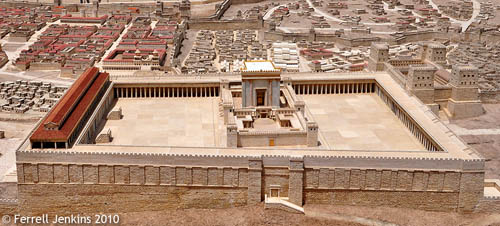
Second Temple model at the Israel Museum. Photo by Ferrell Jenkins.

Second Temple model at the Israel Museum. Photo by Ferrell Jenkins.

The temple precinct or complex is large. I was in Jerusalem one year at the close of the Moslem Ramadan when it was reported that more than 100,000 persons were present in the area. This would have provided adequate space for the activities of Acts 2.

The LORD prophesied through Isaiah about the events of the Pentecost of Acts 2.

And many peoples will come and say, “Come, let us go up to the mountain of the LORD, To the house of the God of Jacob; That He may teach us concerning His ways And that we may walk in His paths.” For the law will go forth from Zion And the word of the LORD from Jerusalem. (Isaiah 2:3 NAU)

It is true that the term Zion was sometimes applied to the entire city of Jerusalem, but it frequently seems to have a more specific reference to the temple area.

The disciples continued to go up to the temple at the hour of prayer (Acts 3:1). Their number soon grew to five thousand men and they met in Solomon’s Portico, thought to be on the east side of the temple platform (Acts 4:4; 5:12).

Where did Peter preach? I can’t be absolutely certain, but I opt for the temple complex. A copy of the photo suitable for presentations is available by clicking on the image.
Attending the Near East Archaeological Society

For the past few days I have been attending the annual meeting of the Near East Archaeological Society and the Evangelical Theological Society. NEAS is a small organization which meets in association with the ETS each year. This gives one the opportunity to attend meetings of either society. ETS has grown tremendously over the years that I have attended — first about 1976, I think. This year more than 2600 persons registered for the meeting. Even though I no longer teach, I like to attend these meetings in order to keep abreast of recent scholarship in areas in which I have special interest.

Among the lectures I heard at NEAS are the following:

Douglas Petrovich (University of Toronto) presented an impressive lecture on “More signs of societal upheaval in Egypt during the days of Joseph.”

Randall Price (Liberty University) was scheduled to make a presentation on Messiah in the Temple: A New 3-D Digital Computer Model of the Second Temple based on historical and archaeological data,” but his co-presenter was not able to make the trip from Germany. Dr. Price gave a presentation in refutation of the recent claims of a Chinese group who claimed they had found Noah’s ark on Mount Ararat.

Mark Wilson (Asia Minor Research Center) and Nadin Burkhardt (University of Frankfurt) spoke about the new excavation of the Priene synagogue (in Western Turkey).

Steven Ortiz (Southwestern Baptist Seminary) spoke about the most recent excavations at Gezer. Dr. Ortiz is one of the directors of the dig where much evidence from the 9th and 10th century B.C. is coming to light.

Eric Mitchell (Southwestern Seminary) told about the landscape archaeology associated with the current excavations at Gezer.

Bryant G. Wood (Associates for Biblical Research) presented the finds from the 2009 and 2010 seasons at Khirbet el-Maqatir. Wood thinks that this site is an excellent candidate to be identified with biblical Ai, rather than the generally accepted site at Et-Tell. Wood is director of this dig in the Palestinian West Bank.

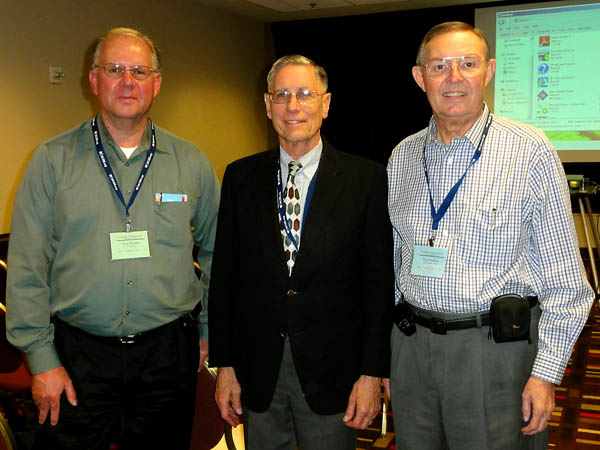
I asked Michael Luddeni, photographer for Bible and Spade and several excavation projects, to make a photo of Leon Mauldin and me with Dr. Bryant Wood.

Leon Mauldin, Dr. Bryant Wood, Ferrell Jenkins at NEAS annual meeting.

Leon Mauldin, Dr. Bryant Wood, Ferrell Jenkins at NEAS annual meeting.

Steven Collins (Trinity Southwestern University) made an excellent presentation on the rise and ruin of a bronze age city-state at Tall el-Hammam, Jordan. Collins is director of this dig.

James H. Charlesworth (Princeton Theological Seminary) was an invited speaker who gave a lecture on two Herodian pools north and south of the Jerusalem temple as they relate to the Gospel of John (chs. 5 and 9). These, of course, were the pools of Bethesda and Siloam. He argued that both pools were mikvaoths (ritual pools) at the time.

There were other good lectures at NEAS. Some of these scholars make similar presentation at the ASOR or SBL meetings.

Among the lectures I heard at ETS, I found these two to be extremely good:

British scholar N. T. Wright (St. Andrews University) spoke on “Justification yesterday, today and tomorrow.”

Eugene H. Merrill (Dallas Theological Seminary) gave the presidential address at the banquet on “Old Testament Scholarship and the man on the street: whence and whither?”

When I was still teaching I attended lectures dealing primarily with the subjects I was actively teaching. Now I attend anything that strikes my fancy. Because I frequently travel to the Middle East I enjoy keeping up with the archaeological excavations in those areas.

Ritmeyer’s Image Library now online

Dr. Leen Ritmeyer is well know for his archaeological drawings of the biblical era buildings, especially the temple. He now has much of his material online for immediate download. The Image Library is described this way:

The Image Library of Ritmeyer Archaeological Design contains authoritative reconstruction drawings and models which you will not find on any other website. The photos of ancient sites in the lands of the Bible have also been taken through the informed lens of an archaeological architect. A treasure-trove for teachers, pastors, lecturers and picture editors, it is the result of years of experience digging and researching in Israel and traveling in the surrounding countries.

The Image Library is arranged in different categories and is fully searchable. The different categories are designed to help you find the picture you are looking for easily. All preview illustrations are watermarked, but these won’t appear on the downloads.

For ease of use, each image comes with a descriptive note and, where applicable, full Scripture references. With the explosion of information coming from excavations, we hope that this will become an ever-expanding resource vital for all who wish to incorporate both beauty and authenticity into their portrayal of the Bible background.

Go here for additional information, and to browse the collection. The architectural drawings are $5 each, and the photographs are $3 each.

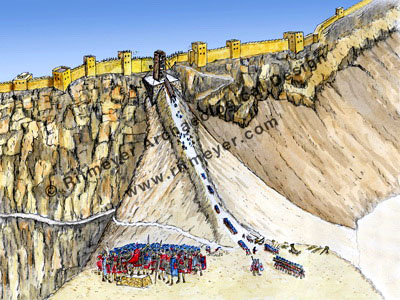
Here is a small sample of one of the drawings. This one shows the siege ramp built by the Romans at Masada in A.D. 72.

Roman siege ramp at Masada. Ritmeyer Image Library.

Roman siege ramp at Masada. Ritmeyer Image Library.

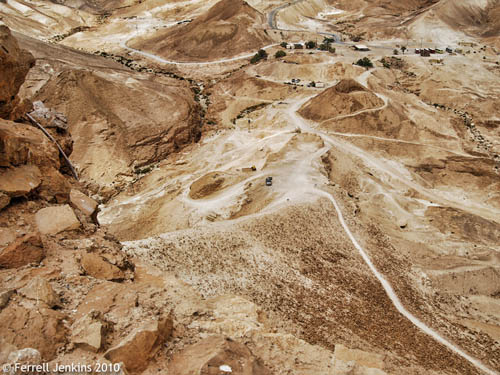
Here is one of my photos showing the siege ramp from above. The wall of Masada is visible in the left of the image.

The siege ramp at Masada. Photo by Ferrell Jenkins.
The Roman siege ramp at Masada from above. Photo by Ferrell Jenkins.

Certainly there is no excuse for presenting a dull, image deprived Bible class lesson or sermon.

Rachel’s tomb?

During the past few weeks there has been controversy over a site immediately on the outskirts of Bethlehem called Rachel’s Tomb. My thought through the years has been that it is at best one of the “traditional” sites that may or may not be the tomb of Rachel.

Some bloggers have presented varying views on the association of the site with Rachel, the mother of Joseph and Benjamin (Genesis 35:24). I am going to direct you to places where you can read to your satisfaction.

  • Todd Bolen says this can not be the tomb of Rachel if we follow the biblical account in Genesis 35:19-20; 48:7, 1 Samuel 10:2, et al.  Read here. He includes a nice color photo of the traditional tomb from the Feinberg collection (probably 1950s or 1960s), and documentation.
  • A response to Bolen by Benj Foreman. Read here.
  • Leen Ritmeyer’s response to Bolen. Read here.

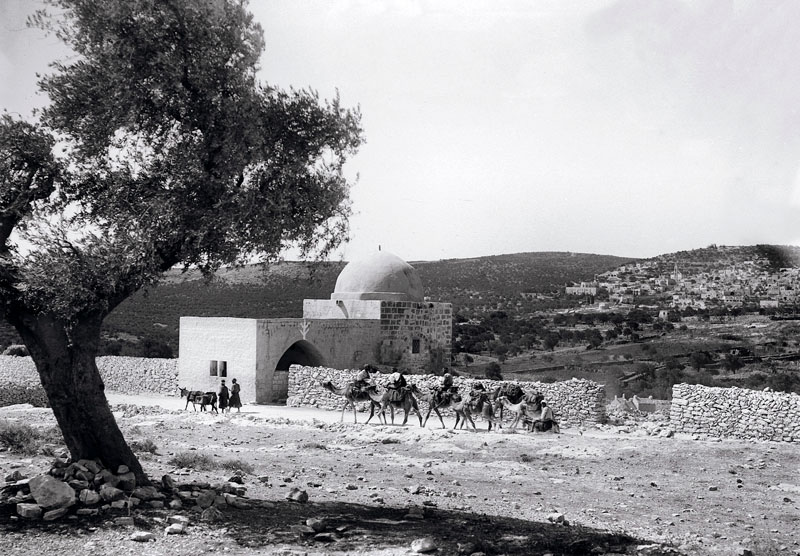
This old photo, which is dated sometime between 1898 and 1946,  is from The American Colony and Eric Matson Collection. Information on ordering is available at Life in the Holy Land.

Rachel's Tomb, American Colony and Eric Matson Collection.

Rachel's Tomb, American Colony and Eric Matson Collection.

Along with the set of historic views of the Holy Land, Todd Bolen has included quotations about the site from scholarly books that discuss the site. The following comment is from Edward Robinson and Eli Smith, Biblical Researches in Palestine, Mount Sinai and Petraea, 1841. The entire book is available at Google Books.

“Someways up the gently acclivity, which here rises towards the N.E. from Wady Ahmed, stands the Kubbet Rahil, or Rachel’s Tomb . . . This is merely an ordinary Muslim Wely, or tomb of a holy person; a small square building of stone with a dome, and within it a tomb in the ordinary Muhammedan form; the whole plastered over with mortar. Of course the building is not ancient; in the seventh century there was here only a pyramid of stones. It is now neglected, and falling to decay; through pilgrimages are sill made to it by the Jews” (Robinson and Smith, Biblical Researches in Palestine, Mount Sinai and Petraea, 1841: 1: 322).

Fascinating article on “Tyre and the Poets”

Joseph P. Duggan writes a fascinating article on “Tyre and the Poets” in The American Spectator. Notice a few excepts. I have added some of the pertinent Scripture references within the article in brackets.

For $50 a family can take a safe, radio-call taxi from the congested heart of Beirut to the uncluttered ancient waterfront of Tyre, a few miles north of the border with Israel. Lush banana plantations line the coastal route.…

The Western literary imagination is attracted to Tyre because it swirls amid the turbulent confluence of Biblical history and prophecy, Homeric and Virgilian epic, Ovidian mythology, and imperial extravagances of luxury and vindictive warfare. Tyre is the birthplace of real or fabulous personages including Cadmus, Europa, and Dido, the latter of whom colonized Carthage as others were to plant the Tyrian standard in Mediterranean ports as far west as Cádiz. The men who sailed with Columbus and colonized the Americas were descendants of long-ago colonists from Tyre.

With its expensive purple dye made from a local mollusk, the murex, Tyre was the center for the Versaces and Givenchys of the ancient world. Paris took Helen of Troy here on a shopping expedition to drape in sumptuous fabric the frame and face that launched a thousand ships.

King Hiram of Tyre was an ally and trading partner of Jerusalem’s King Solomon. Hiram sold Solomon the cedar timber for the great Temple. [1 Kings 9:11]

The Jerusalem-Tyre relationship was rocky then as now. The old Hebrew prophets inveighed against the wealthy city and its neighbor, Sidon, as hotbeds of heathenism and vice. Jezebel, a Tyrian princess (and Dido’s great-aunt) who married Israel’s King Ahab, came to an unhappy end. [Jezebel was the daughter of Ethbaal, king of the Sidonians. 1 Kings 16:31]

Egypt’s pharaohs many times made war against Tyre. Babylon under Nebuchadnezzar battered Tyre in the 6th century B.C. [Ezekiel 26:7; 29:18] Some 250 years later, Alexander the Great already had established effective mastery over the entire Levant when he demanded to offer sacrifice at Tyre to its principal god, Melqart. Alexander maintained that he himself was divine because, he said, he was a descendant of divine Herakles, of whom Melqart was only an avatar. The Tyrians didn’t cotton to that.

When diplomacy failed, Alexander mounted a costly siege whose success resulted in the slaughter of thousands of Tyrians, deportation into slavery for the survivors, and ruin of the splendid city. Modern historians say there was no strategic rationale for Alexander’s destruction of Tyre and its people. The impulse for the genocide was something like the rage of a deranged, spurned lover. Is “education” the answer to war and the world’s other problems? Consider that the Macedonian sociopath had for his personal tutor the serene and rational Stagirite who wrote the Nicomachean Ethics.

When Jesus walked up the short road from Galilee to Tyre, [Matthew 15:21] preaching to the people and driving a demon out of a local woman’s daughter, [Mark 7:26] he saw what Nebuchadnezzar and Alexander had done to the place, fulfilling the prophecies of, inter alia, Amos, Ezekiel [26-28], Zechariah and Jeremiah. He instructed his disciples to say to Galilean towns that rejected them and their preaching: “It shall be more tolerable for Tyre and Sidon at the judgment, than for thee.” [Matthew 11:21-22]

The entire article may be read here.

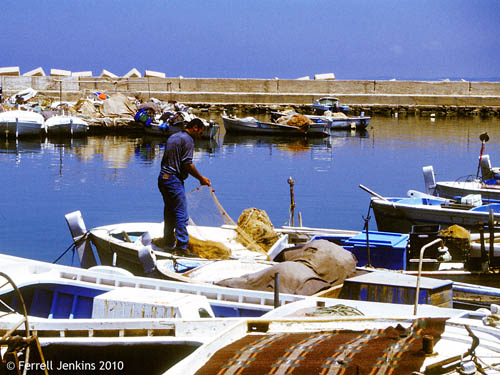
Our photo was made in the harbor of the island city of Tyre in 2002.

Fisherman working with nets at Tyre. Photo by Ferrell Jenkins.

Fisherman working with nets at Tyre. Photo by Ferrell Jenkins.

I will make you a bare rock. You shall be a place for the spreading of nets. You shall never be rebuilt, for I am the LORD; I have spoken, declares the Lord GOD. (Ezekiel 26:14 ESV)

HT: PaleoJudaica

Water in a dry and weary land

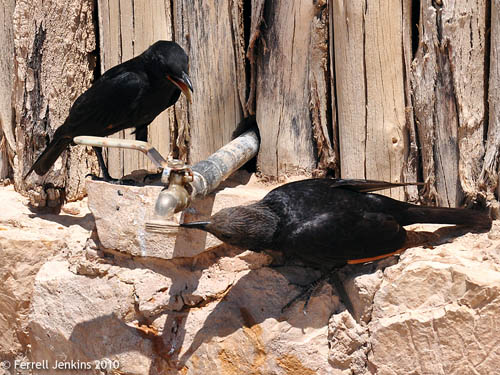
These Tristram’s Grackles, or Tristram’s Starlings, at Masada are trying to get a drop of water from one of the faucets supplying the tourists with lukewarm water during their visit to the site.

Tristram's Grackles at Madada. Photo by Ferrell Jenkins.

Tristram's Grackles at Madada. Photo by Ferrell Jenkins.

Henry B. Tristram wrote The Natural History of the Bible in 1868. In 1884 he wrote Fauna and Flora of Palestine.

A bird commonly seen at Masada, along the shore of the Dead Sea, is named for Tristram. The black bird has some distinctive orange feathers, as you can see in the bird on the right.

Psalm 63 is said to be “A Psalm of David, when he was in the wilderness of Judah.”

O God, you are my God; earnestly I seek you; my soul thirsts for you; my flesh faints for you, as in a dry and weary land where there is no water. (Psalm 63:1 ESV)

View east from the Herodium

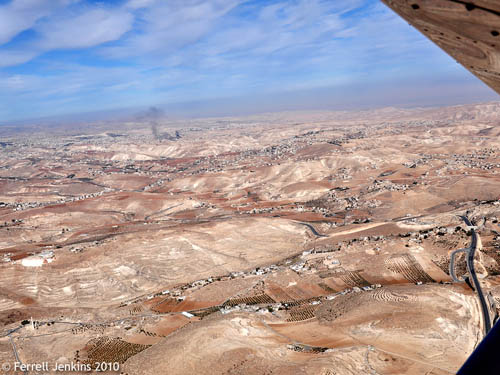
During the past few months we have had considerable interest in our aerial photos of Herodium. Today I will share a photo showing the area east of the Herodium. This area is part of the Wilderness of Judea.

Aerial view east from over the Herodium. Photo by Ferrell Jenkins.

Aerial view east from over the Herodium. Photo by Ferrell Jenkins.

John the Baptist preached in the wilderness of Judea (Matthew 3:3), and Jesus was tempted in the wilderness (Matthew 4:1). This activity was likely in a region to the north of the area shown in this photo.

Jesus spoke to the crowds about John this way:

What did you go out into the wilderness to see? A reed shaken by the wind? (Luke 7:24 ESV)

Bauer describes the wilderness (Greek eremos) of Judea this way:

Of the Judean wilderness, the stony, barren eastern declivity of the Judean mountains toward the Dead Sea and lower Jordan Valley. (BDAG)

The Hebrew word for this wilderness is midbar. Charles F. Pfeiffer said the wilderness of Judea,

is the region of rugged gorges and bad lands in the eastern part of Judah where the land slopes off toward the Jordan Valley. In ancient times this area was infested with wild animals. Except for a brief time during the spring rains the wilderness is arid. (Baker’s Bible Atlas, 201)

Recently I was in a class covering the section of Scripture dealing with the conflict between Saul and David (1 Samuel 23-25).

  • The wilderness of Maon in the Arabah to the south of Jeshimon (1 Samuel 23:24). Jeshimon is another word used to describe the wilderness.
  • The strongholds and wilderness of Engedi (1 Samuel 23:29; 24:1).
  • The stronghold (possibly the area we know as Masada) (1 Samuel 22:4; 25:2).24:22).
  • Ziph, Horesh, Carmel (1 Samuel 23:14-15;

Some of that activity took place within this view, and some took place further to the south. The terrain is much the same. I note that Rainey uses the phrase “steppe land” in several of these references (Sacred Bridge, 148).

Many people who read the Bible in English, without checking into the matter, think of the wilderness as being a place filled with wild growth and underbrush. Jesus’ question to the crowds indicates that no reeds are to be found in the wilderness. In this case a picture really is worth a thousand words.

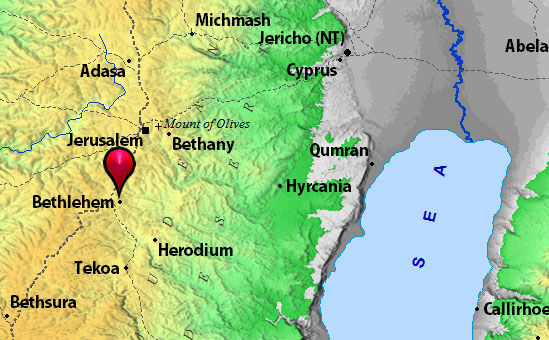
The map from BibleAtlas.org includes the region that we photographed.

Map to show area east of the Herodium. BibleMapper image from BibleAtlas.org.

Map to show area east of the Herodium. BibleMapper image from BibleAtlas.org.

Riblah — important in Old Testament history

Riblah served as a base of operation for the Egyptian Pharaoh Necho and the Babylonian King Nebuchadnezzar. The city is located on a broad plain about 50 miles south of Hamath (modern Hama in Syria), on the main road between Egypt and Mesopotamia. The Orontes River flows past the site on the west side. On a modern map you will locate Riblah in Syria immediately north of the border with Lebanon.

There is little more than a “country store” at the site today, but the name Riblah is preserved as Ribleh, Syria.

  • Pharaoh Necho imprisoned Jehoahaz, king of Judah, at Riblah. He later took him to Egypt where he died. The date was about 609 B.C. (2 Kings 23:31-34).
  • Zedekiah, puppet king of Judah, tried to escape capture by the Babylonians. He fled Jerusalem but was captured on the plains of Jericho and brought to Riblah. There Nebuchadnezzar passed sentence on him. His sons were slaughtered in his sight and he was bound with brass fetters and taken to Babylon. The date was 586 B.C. (2 Kings 25:5-7; see also Jeremiah 39:5-6; 52:9-10).
  • The officials of Zedekiah were taken to Riblah where they were put to death (2 Kings 25:19-21; see also Jeremiah 52:26-27).

In 2002 a colleague and I spent several days visiting sites in Syria. Riblah was the most difficult to locate. Most folks, after seeing the site, would probably say, “What’s the big deal?”  Even though Riblah is mentioned only these few times in the Old Testament, it’s location makes it important in all movement between the south (Egypt and Israel) and Mesopotamia.

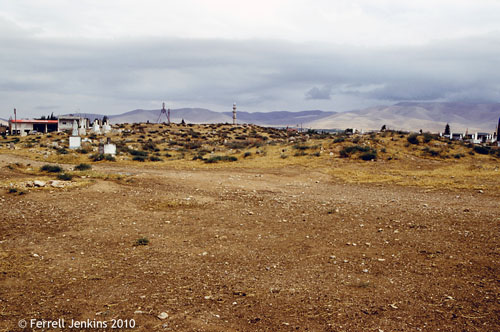
Riblah in the land of Hamath. Photo by Ferrell Jenkins.

Riblah in the land of Hamath. Photo by Ferrell Jenkins.

The slopes of this tell are now used as a cemetery. We know that this would make it difficult to negotiate rights to excavate.

This post was published March 2, 2009, but I had some slides scanned and am able to post a new photo of the tell of Riblah. A photo suitable for use in teaching is available by clicking on the image ago.

“Lands of the Bible” 2011 calendar

Lands of the Bible 2011 CalendarEveryone who has visited Israel, or those who wish they had, enjoy seeing good pictures of the lands of the Bible. Orange Circle Studio, a leading calendar publisher, produced a beautiful calendar for 2011 using the photographs of Todd Bolen.

A friend sent me a copy of the calendar as a gift. I enjoyed it as soon as I browsed through it, and expect to enjoy it for the next 14 months. I thought some of our readers who appreciate good photos of the Bible land would enjoy the calendar. Todd has a few of the calendars available at a discount price (postpaid). For more information go to the Bible Places Blog, or directly to the order page here.

Royal gardens at Ramat Rachel

Archaeologists working at Ramat Rachel, between Jerusalem and Bethlehem, say they have uncovered an ancient royal garden. They say this will be “the first full-scale excavation of this type of [an] archaeological site anywhere in the pre-Hellenistic Levant.”

According to Prof. Oded Lipschits and graduate student Boaz Gross of Tel Aviv University’s Department of Archaeology, this dig is an unparalleled look into the structure and function of ancient gardens. “We have uncovered a very rare find,” says Prof. Lipschits, who believes that this excavation will lead to invaluable archaeological knowledge about ancient royal gardens in the Middle East.

The discovery, which dates back to the 7th century B.C.E., was recently reported in Quadmoniot, the journal of the Israel Exploration Society, and another paper on the dig is forthcoming in Near Eastern Archaeology.

Read the news release in its entirety here.

The identity of Ramat Rachel with a specific Bible city is not known.

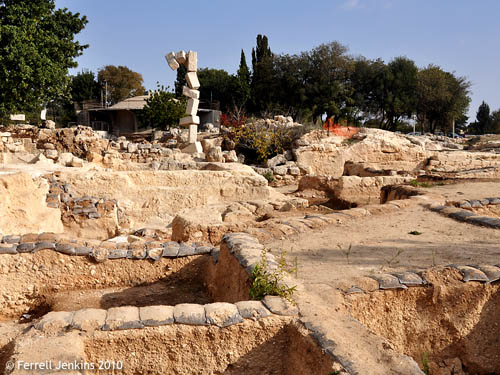
This photo shows some of the excavation area at Ramat Rachel after the 2009 season.

Excavation at Ramat Rachel. Photo by Ferrell Jenkins.

Excavation at Ramat Rachel. Photo by Ferrell Jenkins.

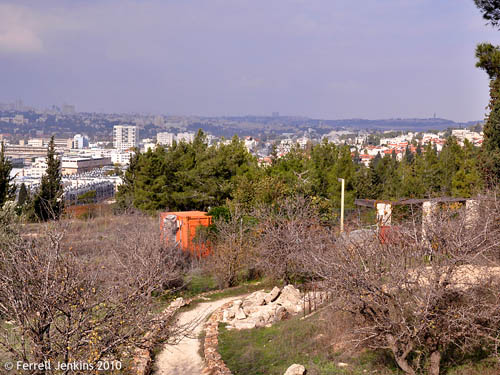
The elevation of Ramat Rachel is about 2684 feet above sea level. This gave the inhabitants a view of the ancient city of Jerusalem which was about 200 feet lower. Even on a less than clear day, you can see the Old City of Jerusalem on the far right of the photo below.

View to north of Jerusalem from Ramat Rachel. Photo by Ferrell Jenkins.

View to the north of the city of Jerusalem from Ramat Rachel. Photo by Ferrell Jenkins.

Ramat Rachel was inhabited from “the last century of the kingdom of Judah (7th century BCE) until the early Muslim reign in Palestine (10th century CE).” The excavators think the royal palace at Ramat Rachel was first built in the days of King Hezekiah (2 Kings 18-20).  More information is available at the excavation web site here.