Category Archives: Old Testament

Acco, Achziv, and Rosh Hanikra in the Plain of Acco

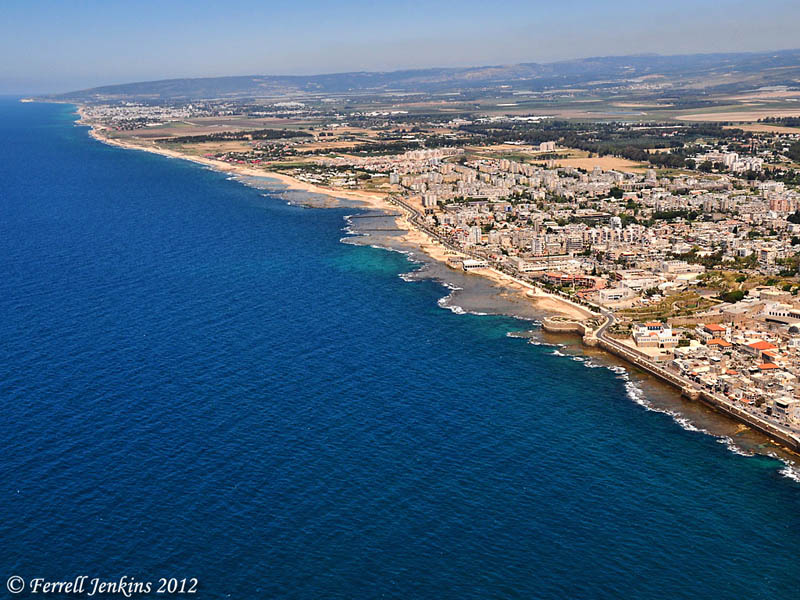
The Plain of Acco runs along the Mediterranean coast from Haifa to Rosh Hanikra and the Ladder of Tyre. The northern portion of the plain is visible in our photo today.

On the right side of the photo you will see the Crusader wall at Acco (Akko, Acre, Ptolemais). Continue along the coast to the north for about 6 miles and you will see a populated area known as Nahariya. Immediately north of Nahariya is the location of Tel Achziv (Achzib, Joshua 19:29; Judges 1:31).

On the left of the photo you see a mountain ridge with a white tip protruding into the sea. That is the Ladder of Tyre and the site of Rosh Hanikra. The Israel/Lebanon border runs along the mountain ridge (West-East).

Click on the photo for a larger image that will allow you to see the features of the plain more clearly.

Aerial View of Plain of Acco (north): from Acco to Achziv to Rosh Hanikra. Photo by Ferrell Jenkins.

The Plain of Acco (north): from Acco to Achziv to Rosh Hanikra. Photo by F. Jenkins.

In ancient times a major international road ran along this coast.

See our previous post about Achziv (here) and the links there to earlier posts about the Plain of Acco.

The 2012 Exploratory Excavation at Tel Achziv “aims to lay the foundation for the understanding of the maritime activity in the site, concentrating on three foci of excavation:”

  1. Excavation of a Roman monumental structure on the coast, connected with an elaborate fish pond (piscina), possibly the remains of a Villa Maritima
  2. An exploration of the possible harbor area, in the vicinity of an artificial rock-cut channel, looking for additional harbor installations
  3. Excavation of the Middle Bronze Age rampart.

Details about the excavation directed by Dr. Gwyn Davies of Florida International University and Assaf Yasur-Landau of the University of Haifa is available here.

Achziv (Achzib) of Asher

The town of Achziv (English Bibles use Achzib) is located on the Mediterranean coast of Western Galilee about 9 miles north of Acco (Akko, Acre = Ptolemais). This is in the northern portion of the Plain of Acco.

Achziv was assigned to the tribe of Asher (Joshua 19:29; Judges 1:31), but Asher was not able to drive out the Canaanite inhabitants of the land.

Asher did not drive out the inhabitants of Acco, or the inhabitants of Sidon or of Ahlab or of Achzib or of Helbah or of Aphik or of Rehob, (Judges 1:31 ESV)

Achziv remained primarily a Canaanite or Phoenician town throughout most of biblical history.

In exchange for cedar and cypress timber and gold, Solomon gave 20 cities in the land of Galilee to Hiram king of Tyre (1 Kings 9:11-13). That portion of western Galilee was called the land of Cabul. This is another indication that this region continued under the influence of the Phoenicians. King Hiram visited the cities but they did not please him.

Sennacherib, king of Assyria (704-681 B.C.), claims in the Taylor and Chicago Prisms to have conquered the cities of Sidon, the mainland city of Tyre, Achziv, and Acco.

In New Testament times Achziv was known as Ecdippa (Ekdippon) (Josephus, JW 1.257).

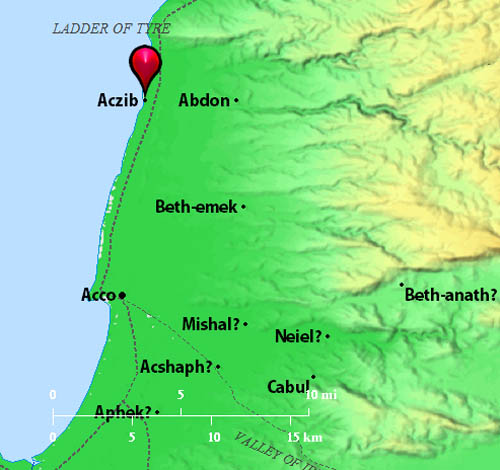
The map below shows the location of Acziv between Acco and the Ladder of Tyre. The Ladder of Tyre is a natural formation that has served as a border between Israel and Lebanon during many historical periods, including the present time.

Aczib on the Mediterranean coast of Western Galilee. BibleAtlas.org.

Achib (Achziv) on the Mediterranean coast of Western Galilee. BibleAtlas.org.

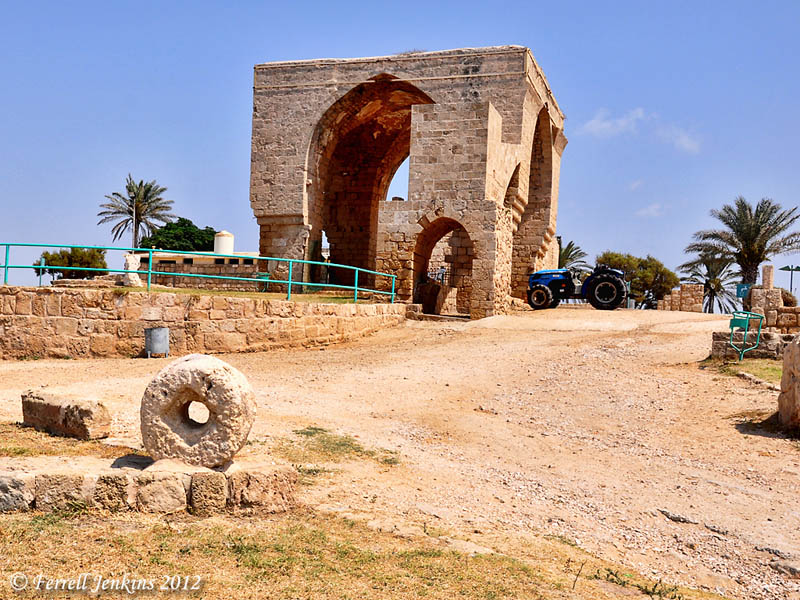
The Crusaders built a fortress at Achzib and named it Casal Imbert. The Mamluk’s captured the site in 1271, and an Arab village remained there until the War of Independence in 1948.

Achziv is built on a sandstone (kurkar) ridge overlooking the Mediterranean Sea. The remaining structures from the Arab period, now part of a National Park, are made from stones of the Crusader fortress.

Arab period structures made from stones of the Crusader fortress at Achziv. Photo by Ferrell Jenkins.

Arab period structures made from stones of the Crusader fortress. The Mediterranean Sea is in view when you reach the top of the tel. Photo by Ferrell Jenkins.

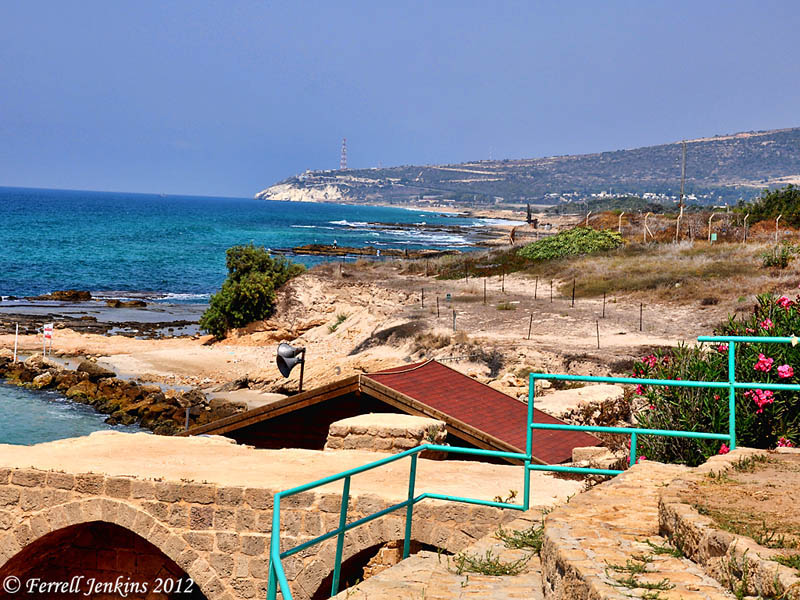
This photo was made from Tel Achziv looking north to Rosh Hanikra and the Ladder of Tyre, a distance of about 4 miles.

The view north from Tel Achziv to Rosh Hanikra. Photo by Ferrell Jenkins.

The view north from Tel Achziv to Rosh Hanikra. Photo by Ferrell Jenkins.

Some artifacts from Achziv are exhibited in the Hecht Museum in Haifa.

For an earlier posts about this region, see here and here.

Satet — the female god of Elephantine

We noted earlier that there were three major gods worshiped on Elephantine Island and the nearby region — Khnum, Satet, and Anqet. Khnum was the river or water god and was considered the god of the Nile. Satet was his female counterpart.

Her most important role was as the goddess of the inundation (yearly flooding of the Nile). According to myth, on the “Night of the Teardrop” would shed a single tear, which was caught by Satet and poured into the Nile, causing the inundation. (Ancient Egypt Online)

Budge says that at one period,

she must have been regarded as the goddess of the inundation, who poured out and spread over the land the life-giving waters of the Nile, and as the goddess of fertility. (The Gods of Egypt, II:55)

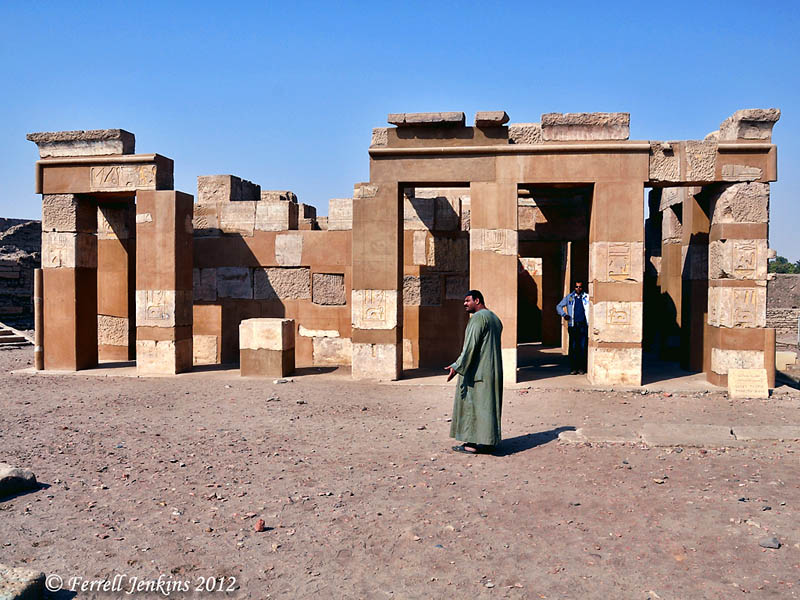
The ruins shown below belong to the Temple of Satet from Egyptian Dynasty XVIII. This was the time of Thutmose III (roughly around 1500 B.C.), during what is designated the New Kingdom Period.

Satet Temple on Elephantine Island. Photo by Ferrell Jenkins.

Satet Temple on Elephantine Island. Photo by Ferrell Jenkins.

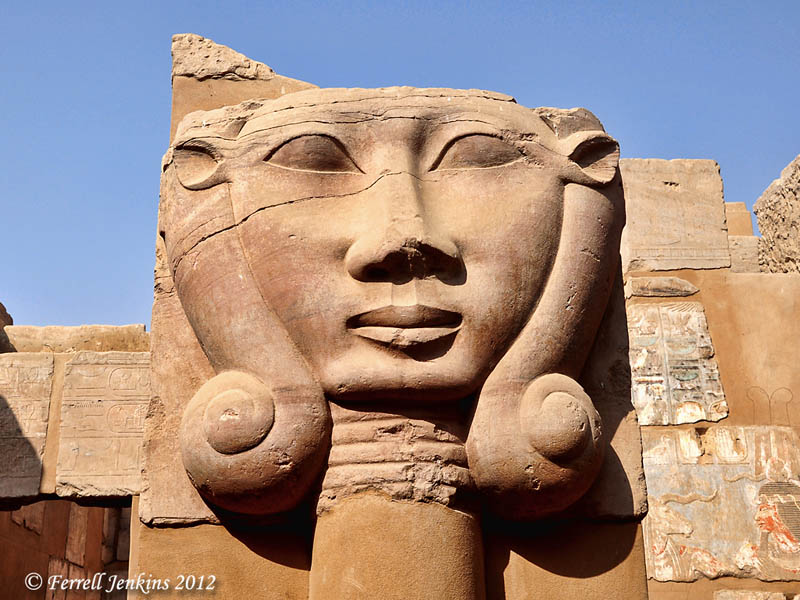
A broken relief of the head of Hathor may be seen in the ruins. Hathor portrayed herself with the head of a cow, with two horns, and a solar disc between the horns. Sometimes she was portrayed in the form of a cow.

Hathor in the Ptolemaic Satet Temple on Elphantine Island. Photo by Ferrell Jenkins.

Hathor in the Satet Temple on Elephantine Island. Photo by Ferrell Jenkins.

Temples honoring Satet continued on the island into the Ptolemaic and Roman periods.

Israel had been warned at the time of the Exodus that they should not return to Egypt.

Only he must not acquire many horses for himself or cause the people to return to Egypt in order to acquire many horses, since the LORD has said to you, ‘You shall never return that way again.’ (Deuteronomy 17:16 ESV)

After the Exile of Judah to Babylon, some of the Judeans who remained in the land of Judah returned to Egypt taking the prophet Jeremiah with them. Jeremiah continued to warn of the dangers of serving the gods of Egypt. In fact, the women of Judah are accused of leading their husbands into worshiping the gods of Egypt (Jeremiah 44).

No Joke: free and nearly free

Todd Bolen, in his Weekend Roundup at the Bible Places Blog, calls attention to a couple of books that I wanted to mention while there is still time.

The first is a free Kindle ebook — Walk the Land: A Journey on Foot Through Israel. This couple in their early 50s followed the 600-mile Israel National Trail from the border of Egypt to the border of Lebanon. It was a 42 day trek. I don’t know how long the book will be available at this price. Act quickly.

The second is one of the Fabulous Friday Specials at Christianbook.com. Through Monday evening you can get the Zondervan Atlas of the Bible, by Carl Rasmussen, for $14.99 (with typical postage and handling, I suppose).

The gods of Elephantine Island

Khnum (also Khnoum and Khnemu) was the chief Egyptian god in a region stretching from Thebes (modern Luxor) to Philae. Philae is a short distance south of Aswan and Elephantine Island.

According to Budge,

… the principal sanctuaries of the god were at the two ends of the First Cataract, i.e., on Elephantine on the north and on Philae and the adjoining islands on the south. He [Khnum] was the god par excellence of the First Cataract, throughout which, with his female counterpart Satet and the local Nubian goddess Anqet, he was worshipped from the earliest dynasties … (The Gods of the Egyptians, II:50).

Recently I learned of Ancient Egypt Online. This well-constructed site describes Khnum:

Khnum was originally a water god who was thought to rule over all water, including the rivers and lakes of the underworld. He was associated with the source of the Nile, and ensured that the inundation deposited enough precious black silt onto the river banks to make them fertile. The silt also formed the clay, the raw material required to make pottery. As a result he was closely associated with the art of pottery. According to one creation myth, Khnum moulded everything on his potters wheel, including both the people and the other gods.

Budge sums up the essence of the god when he says that Khnum “was originally a water or river-god, and that in very early times he was regarded as the god of the Nile and of the annual Nile-flood…”

A courtyard and an impressive granite doorway mark the location of the Late Khnum Temple on Elephantine Island. This gate, belonging to Dynasty XXX,  was constructed in the reign of Nectanebo II (c. 350 B.C.). The Wikipedia entry says he was the last native ruler of ancient Egypt.

Ruins of the Khnoum Temple on Elephantine Island. Photo by Ferrell Jenkins.

Granite doorway of the Khnoum Temple on Elephantine Island. Photo by Ferrell Jenkins.

The Book of Exodus quotes the LORD saying that, in the plagues of Egypt, he would execute judgment on the gods of Egypt.

I will pass through the land of Egypt in the same night, and I will attack all the firstborn in the land of Egypt, both of humans and of animals, and on all the gods of Egypt I will execute judgment. I am the LORD. (Exodus 12:12 NET; cf. Numbers 33:4).

Khnum was the god of the Nile. Not much left today.

Elephantine Island

There are numerous ways to describe the location of Elephantine Island. It is an island in the Nile River at Aswan (= Syene in Ezekiel 29:10 and 30:6). Or we might say that the island is located at the first cataract of the Nile.

According to Budge, the earlier name for Elephantine was Abu. One way of writing the name of the island included the drawing of an elephant (E. A. Wallis Budge, The Gods of the Egyptians, II:51).

Various suggestions have been made regarding the origin of the name Elephantine. Some say the smooth rocks of the first cataract remind one of an elephant back. Others say, the island is shaped like an elephant tusk. Or, the island was the center of ivory trading in the past.

A small granite statue of an elephant has been uncovered on the extreme south end of the island. Aswan, you likely recall, was noted for its granite.

Granite Elephant on Elephantine Island, Aswan, Egypt. Photo by Ferrell Jenkins.

Granite Elephant on Elephantine Island, Aswan, Egypt. Photo by Ferrell Jenkins.

In the Septuagint Old Testament and in the New Testament the word elephantinos is translated ivory. You can think of Samaria’s famous beds of ivory, made from the tusks of elephants (Amos 6:4), or the unsold cargoes of the merchants who could no longer trade with the fallen Babylon [Roman Empire] (Revelation 18:12).

Dr. Bryant Wood’s Lectures on Archaeology and the Conquest

Dr. Bryant G. Wood recently presented three lectures on “Archaeology and the Conquest: New Evidence on an Old Problem” for the 2012 William R. Rice Lecture Series. The lectures, and a fourth lecture on Old Testament Archaeological Discoveries, are available in MP3 here.

The four topics available for listening are:

  • Background and Chronology of the Exodus and Conquest.
  • Digging Up the Truth at Jericho.
  • The Discovery of Joshua’s Ai.
  • Great Archaeological Discoveries Related to the old Testament.

Wood is Director of Research at the Associates for Biblical Research, editor of Bible and Spade, and director of the Excavations at Khirbet el-Maqatir (suggested as a possible site for Biblical Ai).

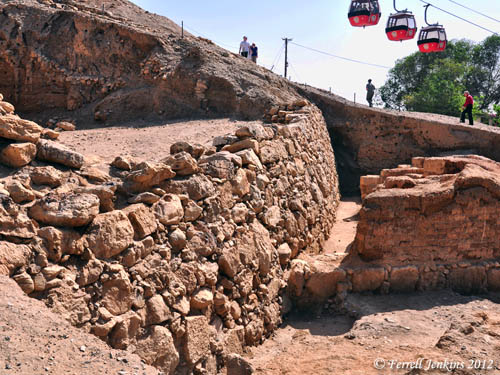
Jericho's Outer Revetment Wall on South End of Tel es-Sultan. Photo by Ferrell Jenkins.

Jericho's Outer Revetment Wall on the South End of Tel es-Sultan. Recent archaeological work at Jericho indicates that mud brick had fallen on houses built against this wall. Wood believes that this evidence fits perfectly with the biblical record in Joshua. Photo by Ferrell Jenkins.

HT: Bible-X

Alexander the Great and the Book of Daniel

Josephus, the late first century Jewish historian, records the visit of Alexander the Great to the city of Jerusalem in the 4th century B.C. He recounts how Alexander “went up into the temple” and “offered sacrifice to God.” He says that the Book of Daniel was shown to Alexander. Alexander assumed, as have many commentators since that time, that Daniel was prophesying of Alexander.

Bust of Alexander in the Istanbul Archaeological Museum. Photo by Ferrell Jenkins.

Bust of Alexander in the Istanbul Archaeological Museum. Photo by Ferrell Jenkins.

Here is a portion of the account from the Antiquities of the Jews. Notice especially section 337.

336 And when he had said this to Parmenion, and had given the high priest his right hand, the priests ran along by him, and he came into the city. And when he went up into the temple, he offered sacrifice to God, according to the high priest’s direction, and magnificently treated both the high priest and the priests.
337 And when the Book of Daniel was showed to him {a} wherein Daniel declared that one of the Greeks should destroy the empire of the Persians, he supposed that himself was the person intended; and as he was then glad, he dismissed the multitude for the present; but the next day he called them to him, and bade them ask what favours they pleased of him;
338 whereupon the high priest desired that they might enjoy the laws of their forefathers, and might pay no tribute on the seventh year. He granted all they desired; and when they entreated him that he would permit the Jews in Babylon and Media to enjoy their own laws also, he willingly promised to do hereafter what they desired:  (Ant 11:336-338)

Read Daniel 8 for more details of the conflict between Alexander, who is compared to a male goat, and the Persian king who is likened to a ram.

As I was considering, behold, a male goat came from the west across the face of the whole earth, without touching the ground. And the goat had a conspicuous horn between his eyes. (Daniel 8:5 ESV)

Monday Meandering — March 19

Greatest Finds. The Israel Ministry of Foreign Affairs has compiled a list of the “Greatest archeological finds in Israel” here with links. Places include Masada, Megiddo, Beit Guvrin-Maresha, Ashkelon, the City of David, Hazor, Dan, Herodion, Khirbet Qeiyafa, and Tel es-Safi (Gath), and others.

The Scale of the Universe 2 here. Fascinating. Requires Flash. Reminds me of two Biblical references.

 When I look at your heavens, the work of your fingers, the moon and the stars, which you have set in place,  4 what is man that you are mindful of him, and the son of man that you care for him? (Psalm 8:3-4 ESV)

For by him all things were created, in heaven and on earth, visible and invisible, whether thrones or dominions or rulers or authorities– all things were created through him and for him.  And he is before all things, and in him all things hold together.  (Colossians 1:16-17 ESV)

Marine Life in the Corinthian Gulf here. Beautiful photos.

The Acrocorinth. Wonderful, clear view of the mountain above ancient Corinth here. Carl Rasmussen has posted several other nice photos of Corinth recently.

A history of the Roman Empire in 75 seconds here.

The Burnt House. The headline in the Jerusalem Post read “House in Old City as Titus left it.” Leen Ritmeyer includes this and another news article, along with his reconstruction of the Burnt House here.

Geopolitics of Israel. Every student of Bible geography will enjoy the analysis of the geopolitics of Israel by the Stratfor Global Intelligence here.

2,000-year-old Israeli date palm. Has it been trumped by a 32,000-year-old Russian flower? Tom Powers provides some links about the palm which is now about 8 feet tall, here.

HT: Aren Maeir; NT Resources Blog; Corinthian Matters; Luke Chandler’s Blog; Bible Places Blog.

James the Lord’s Brother

In anticipation of the “James Ossuary” verdict which is scheduled to be announced March 14, I decided to provide some background material. First, here is a brief discussion of the identity of James, and his relation to Jesus.

— • —

The name James was a common name in New Testament times. Several people bearing that name are mentioned in the New Testament. Two apostles bore that name: James the son of Zebedee (Matthew 4:21; 10:2), and James the son of Alphaeus (Matthew 10:3). James, the son of Zebedee, and brother of the apostle John, was put to death by Herod Agrippa I before A.D. 44 (Acts 12:1-2). There was also James, the brother of Jesus. Paul refers to him, along with Cephas [Peter] and John as men who were reputed to be pillars among the brethren (Galatians 2:9). Paul identifies James as “the Lord’s brother” in Galatians 1:19.

The New Testament mentions the brothers and sisters of Jesus in Mark 6:3 and Matthew 13:55-56. Roman Catholics make every effort to evade the plain meaning of “brother.” Roman Catholics hold the non-biblical doctrine of the perpetual virginity of Mary. They claim that the brothers of Jesus were really half-brothers or cousins. The inscription on the James ossuary has opened this issue anew, but more about that at another time (see Matthew 1:25). The New Testament indicates that James and the others listed were the uterine brothers of Jesus. James, the Lord’s brother, is generally thought to be the author of the Epistle of James. Jude, another brother of Jesus, wrote a short book in which he says that he is “a bond-servant of Jesus Christ, and brother of James.” This last expression indicates that Jude was not as well known as James.

The brothers of Jesus did not believe in him during His public ministry (John 7:5), but after the resurrection they are mentioned among the disciples (Acts 1:14). Paul informs us that Jesus made an appearance to James (1 Corinthians 15:7). At least some of the brothers of Jesus seem to be preachers of the gospel (1 Corinthians 9:5). It appears that the brothers of Jesus were convinced by the resurrection. James proved to be influential among the brethren both in Jerusalem and in other places (Galatians 2:11-13; Acts 15; 21:17-26). We’ll leave this matter for another time.

Josephus, the Jewish historian, makes a reference to “the brother of Jesus, who was called Christ, whose name was James” (Ant. Xx.9.1). Eusebius, the early church historian, records the martyrdom of “James, the brother of the Lord” in his Ecclesiastical History (2.23). He cites the earlier accounts by Hegesippus, Clement of Alexandria, and Josephus. This would have been shortly after the death of Festus, procurator of Judea, in A.D. 61.

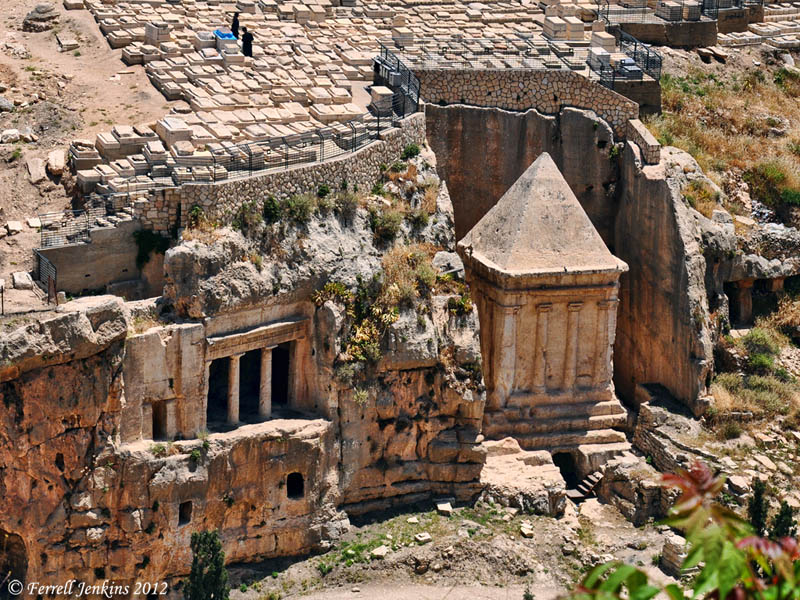
The photo below shows two of the monumental tombs in the Kidron Valley between the Old City of Jerusalem and the Mount of Olives, south of the so-called Tomb of Absalom (see here). Modern Jewish tombs are visible on the slopes of the Mount of Olives above the older monuments.

The tomb on the right is known as the Tomb of Zachariah. The tomb on the left, with a porch and two Doric columns is the Tomb of Beni Hezir from the latter half of the second century B.C. (the Maccabean Period). It is incorrectly identified as the Tomb of James.
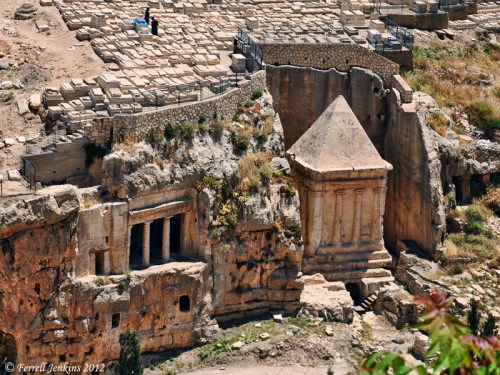
Bene Hezir (traditional James) Tomb and Tomb of Zachariah. Photo by Ferrell Jenkins.

Bene Hezir (traditional James) Tomb and Tomb of Zachariah. Photo by Ferrell Jenkins.

We have pointed out before that many structures have been incorrectly identified with specific biblical characters over the centuries. The tomb identified with James belonged to a priestly family named Hezir. Perhaps this Hezir was a descendant of a priest mentioned in 1 Chronicles 24:15. The name appears again in Nehemiah 10:20. The connection with James was a mistaken idea.