Category Archives: Old Testament

Google Earth helps you see Biblical Sites

About a month ago Wayne Stiles posted an illustrated article about “Google Street View of 7 Biblical Sites.” There is some pretty neat stuff there, especially for those who have stood in these places and looked in all directions. Check all 7 views here.

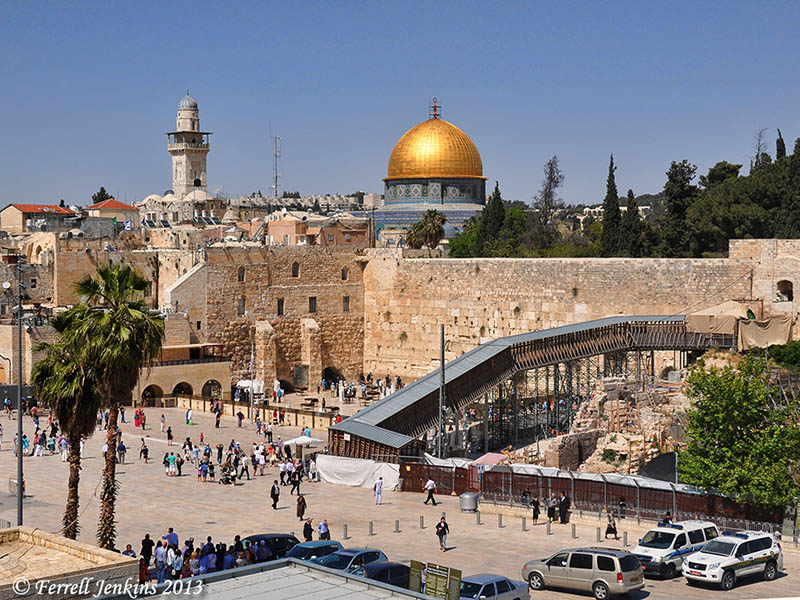
Look at the photo below, and then see the same area in Google Earth.

The Western Wall, the Dome of the Rock, and the Mughrabi Gate are visible in this single photo. Photo by Ferrell Jenkins.

The Western Wall, the Dome of the Rock, and the Mughrabi Gate Bridge are visible in this single photo. Photo by Ferrell Jenkins.

Is Masada mentioned in the Bible?

N.B. This is post number 1500 since our beginning in 2007.

— ♦ —

The Hebrew word masada is generally translated stronghold or fortress in the English Bible. Gordon Franz (lifeandland.org) says King David visited the site of Masada at least three times.

  1. After sending his parents to Moab (1 Samuel 22:1-5). Take a look at the previous post with the photos and map showing the lisan (tongue) of the Dead Sea. I envision this as the place where David could most easily cross to Moab and then return to the stronghold.
  2. After he spared Saul’s life at Engedi (En Gedi) (1 Samuel 24:22).
  3. When the Philistines were searching for him (2 Samuel 5:17).

This photo gives some idea of the fortress-like quality under consideration. Note the Dead Sea, the Lisan, and the mountains of Moab in the distance.

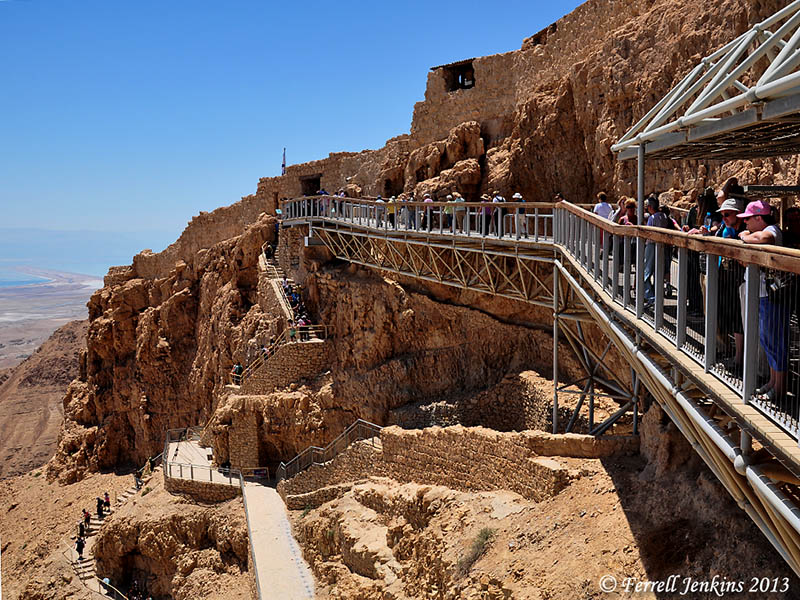
After a cable-car ride, or by walking the snake path for about an hour one reaches the entrance to the rock fortress of Masada. Photo by Ferrell Jenkins.

After a cable-car ride, or by walking the snake path for about an hour one reaches the entrance to the rock fortress of Masada. Photo by Ferrell Jenkins.

At least four of David’s psalms mention masada.

  1. Psalm 18:2 (fortress). — “The LORD is my rock and my fortress and my deliverer, my God, my rock, in whom I take refuge, my shield, and the horn of my salvation, my stronghold.” (ESV)
  2. Psalm 31:2-3 — “Incline your ear to me; rescue me speedily! Be a rock of refuge for me, a strong fortress to save me! For you are my rock and my fortress; and for your name’s sake you lead me and guide me;”  (ESV)
  3. Psalm 71:1, 3 (fortress). — “In you, O LORD, do I take refuge; let me never be put to shame!  2 In your righteousness deliver me and rescue me; incline your ear to me, and save me!  3 Be to me a rock of refuge, to which I may continually come; you have given the command to save me, for you are my rock and my fortress.” (ESV)
  4. Psalm 144:1-2 (fortress). — “Of David. Blessed be the LORD, my rock, who trains my hands for war, and my fingers for battle;  2 he is my steadfast love and my fortress, my stronghold and my deliverer, my shield and he in whom I take refuge, who subdues peoples under me.”  (ESV)

We are uncertain about authorship of Psalm 91:1-2 (fortress). Beitzel, in The New Moody Atlas of the Bible, places David at Masada (p. 151; map 58).

Psalm 66:11 uses the word masada (translated net, trap or prison).

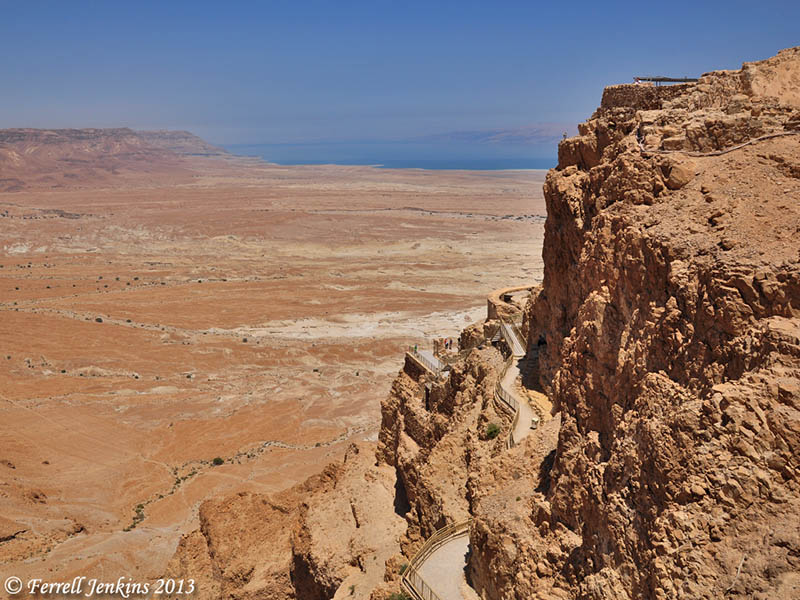
This photo was made from the top of Masada toward the Dead Sea. Photo by Ferrell Jenkins.

This photo was made from the top of Masada with a view toward the Dead Sea. The walk below leads to the site of Herod’s palace. Photo by Ferrell Jenkins.

Understand that we are not referring to the Masada built by Herod the Great and later used by Jewish zealots during the period of A.D. 70-72. The stronghold had already been there for millennia.

The article by Gordon Franz is brief, but well documented. Read it here.

A sunrise few have seen

Trent and Rebekah are “vagabonding” for forty days in Israel between the close of the Ashkelon excavation and the opening of their fall semester at Jerusalem University College (also known as the American Institute of Holy Land Studies). Last Thursday morning they were at Masada for the sunrise. I didn’t ask if they spent the night there.

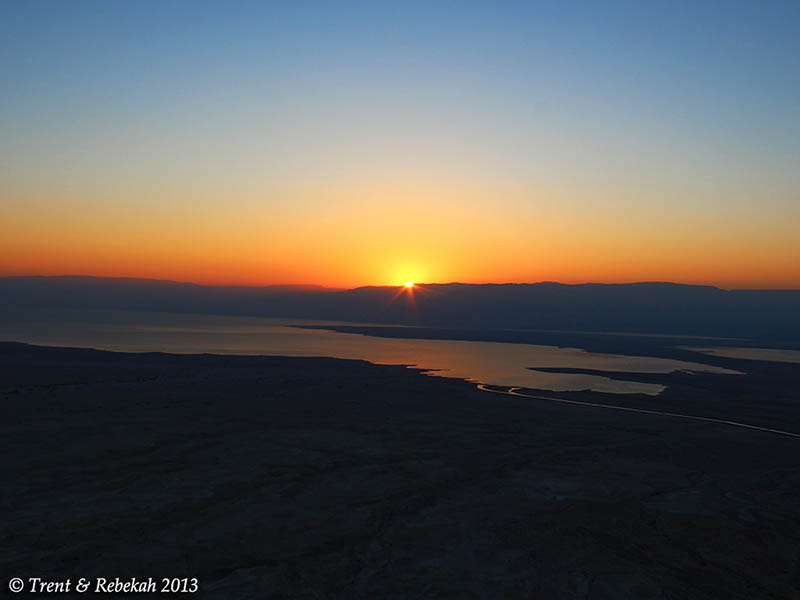
This view from Masada to the east at sunrise is one I have not seen. They graciously allowed me to post it here.

Sunrise from Masada. Photo by Trent and Rebekah, Aug. 01, 2013.

Sunrise from Masada. Photo by Trent and Rebekah, Aug. 01, 2013.

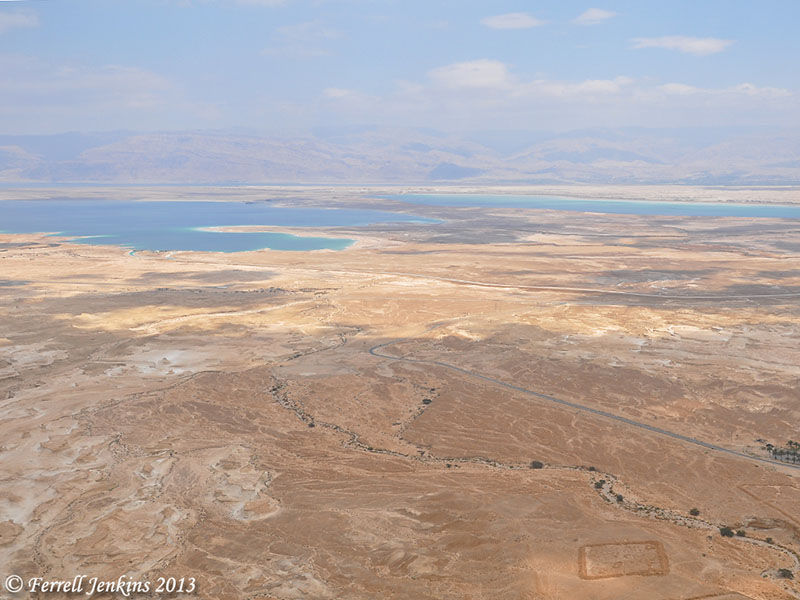
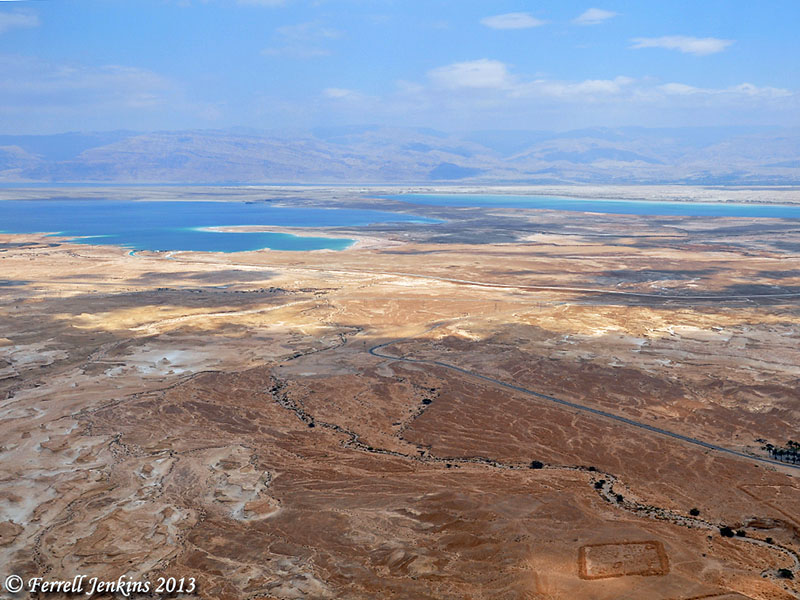
There is more to this photo than just the beauty of it. In their photo you see the Lisan (or Tongue) that extends from the east into the Dead Sea. You may also see the canal through which water is pumped to the southern end of the Sea.

The photo below was made near mid-day from Masada.

View east from Masada near mid-day. Photo by Ferrell Jenkins.

View east from Masada near mid-day. Photo by Ferrell Jenkins.

The same photo below has been enhanced further in Photoshop to reveal the details a little better.

View from Masada (enhanced to show features). Photo by Ferrell Jenkins.

View east from Masada (enhanced to show features). Photo by Ferrell Jenkins.

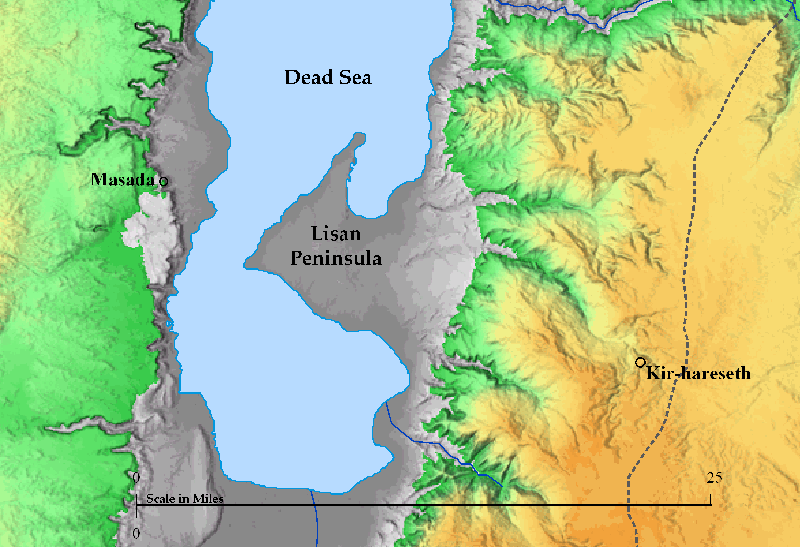
Last month I wrote about “The topography of Kir-hareseth” here. This map shows the valley that goes down from the Transjordan Plateau in a northwesterly direction to the Lisan Peninsula (tongue) of the Dead Sea. Masada is located directly across from that valley. The Lisan now extends completely across the Dead Sea, as the photos above show. Water is pumped to the southern end of the Sea to allow for the chemicals and minerals to be mined.

Map of the southern end of Dead Sea.

Map of the southern end of Dead Sea. Today the Lisan extends completely across the Dead Sea.

Dr. Rasmussen (HolyLandPhotos’Blog) says,

The Dead/Salt Sea can be divided into two unequal sections by a tongue-shaped peninsula that protrudes into it from the eastern shore (= Lisan in Arabic, Lashon in Hebrew). – Zondervan Atlas of the Bible, 49.

Trent and Rebekah continue to post about the places they are visiting in Israel. Take a look at TrentandRebekah.wordpress.com.

The Acacia in the Sinai Wilderness

Most travelers to Israel have probably seen acacia trees growing along the shore of the Dead Sea. Fewer travelers have visited the Sinai Peninsula, now part of Egypt. The term acacia is used in most English versions of the Bible, but the King James version (1611) simply transliterated the Hebrew word shittim.

The Fauna and Flora of the Bible comments on the acacia:

The acacia is a member of the Mimosa family. Four different species are found in Palestine, the most common being the A. raddiana, which grows in the valleys around the Dead Sea. It is an evergreen tree, 3 to 5.5 m high, with spiny branches carrying yellow flowers; its wood is very useful for building purposes.

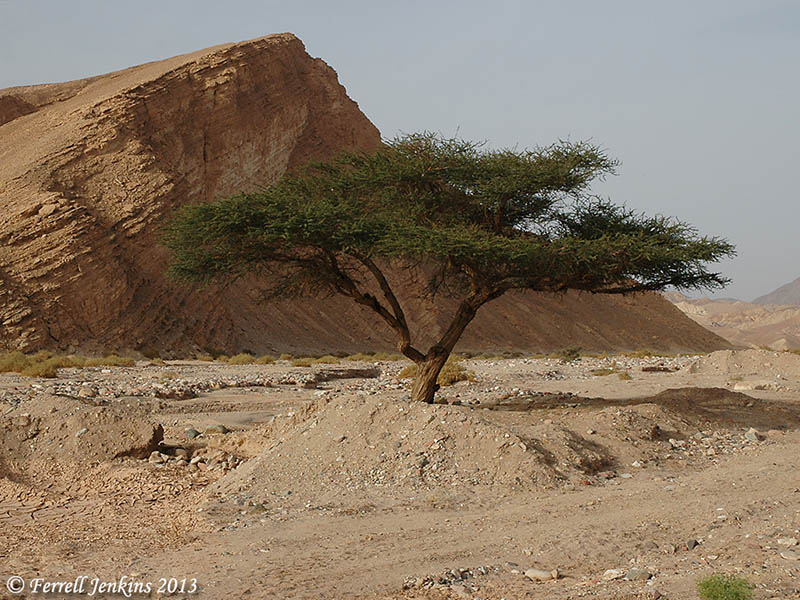
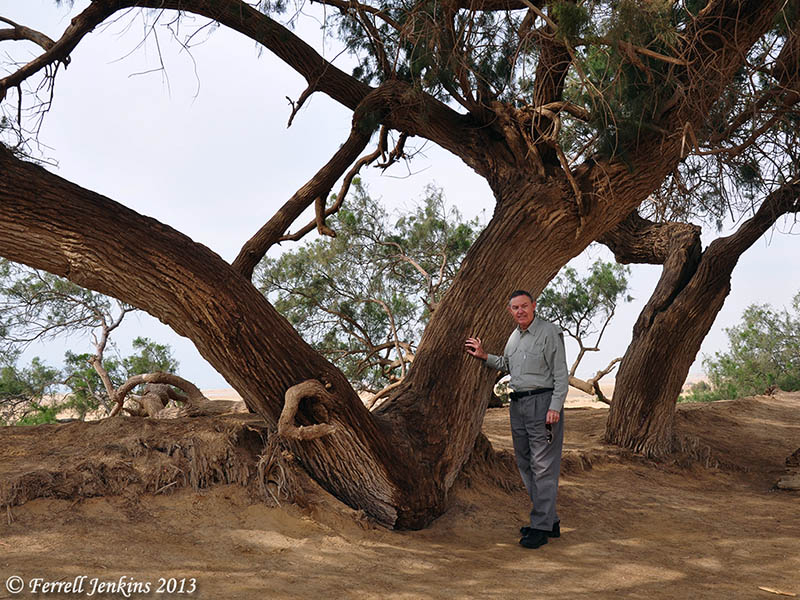
The acacia below is in the Wadi el-Tor in the Sinai Peninsula between the Gulf of Suez and Mount Sinai.

Acacia growing in Wadi el-Tor in the Sinai Peninsula. Photo by Ferrell Jenkins.

Acacia growing in Wadi el-Tor in the Sinai Peninsula. Photo by Ferrell Jenkins.

In the description of the construction of the tabernacle, the book of Exodus uses the word acacia 26 times from chapter 25 to chapter 38. When we see the smaller trees today we may wonder about finding enough wood for the tabernacle. At Ain Musa (Spring of Moses), the traditional place of Marah (Exodus 15:23), there are a few older large Acacia growing. Could it be possible that 3500 years ago there were many this size?

Large acacia at Ain Musa (Spring of Moses) on the east shore of the Gulf of Suez. Photo by Ferrell Jenkins.

Large acacia at Ain Musa (Spring of Moses) on the east shore of the Gulf of Suez.

Seeking the history beneath Solomon’s city at Gezer

Southwestern Baptist Theological Seminary has released information about the most recent season of archaeology at Tel Gezer here.

Aerial view of Tel Gezer toward the coastal plain, SW from the site. Photo by Ferrell Jenkins.

Southwest aerial view of Tel Gezer toward the coastal plain. Photo by Ferrell Jenkins.

This summary of the most recent season was written by Steven Ortiz and Samuel Wolff.

The excavations at Gezer are sponsored by the Tandy Institute of Archaeology at Southwestern Baptist Theological Seminary with several consortium schools. The excavations are directed by Steven Ortiz of the Tandy and Samuel Wolff of the Israel Antiquities Authority.

In this, the sixth season of excavation, one goal was to remove a portion of the city wall built in the Iron IIA period (10th century BCE) in order to investigate a Late Bronze age destruction level (ca. 1400 BCE) that lay below it. To the surprise of the team, in the process of excavating the city wall, an earlier wall system dating to the Iron Age I (1200-1000 BCE) was discovered. This wall was one meter thick with several rooms attached to it. These rooms were filled by a massive destruction, nearly one meter in height,that included Canaanite storage jars, Philistine pottery and other items. A fragment of a Philistine figurine was also found this season. The biblical text record that the king of Gezer organized a Canaanite coalition against Joshua and David had a battle with the Philistines where he chased them “all the way to Gezer.” Perhaps the biblical accounts retain a memory of the importance of Gezer and its close relations to the Philistines during this period.

Beneath this city was an earlier city that was destroyed in a fierce conflagration. This city was functioning during the Egyptian 18th Dynasty’s rule over the southern Levant. Within the destruction debris were several pottery vessels along with a cache of cylinder seals and a large Egyptian scarab with the cartouche of Amenhotep III. This pharaoh was the father of the heretic King Akenaton and grandfather of the famous Tutankhamun (King Tut). This destruction corresponds to other destructions of other cities in the region, a reflection of the internecine warfare that was occurring between the Canaanite cites as reflected in the well-known Tell el-Amarna correspondence.

The archaeology of Solomon has been controversial, fueled by various theories over the dating of the archaeological record. The dating of the Gezer Iron Age Gate is at issue. The Gezer expedition is slowly stripping away layers of public and domestic structures of the 8th and 9th centuries BCE in order to reveal the 10th century city plan adjacent to the City Gate. This summer the tops of the 10th century walls began to poke out, making the archaeologists optimistic that in future seasons more of the Solomonic city will be exposed.

For more information see www.telgezer.com.

Steven Ortiz, professor of archaeology at Southwestern Seminary, is co-director of the archaeological excavations at Tel Gezer, site of one of the famed cities of Solomon located between Jerusalem and Tel Aviv.  Photo by Matt Miller.

Steven Ortiz, professor of archaeology at Southwestern Seminary, is co-director of the archaeological excavations at Tel Gezer, site of one of the famed cities of Solomon located between Jerusalem and Tel Aviv. Photo by Matt Miller.

For earlier posts about Gezer, see the following: aerial photo with a view toward the hill country, boundary stones, and the water system.

HT: Joseph Lauer

Water gushed from the rock

This photo of granite rocks was made at Jebel Musa (traditional Mount Sinai) in the Sinai Peninsula. It reminded me of several Old Testament references to the rock from which the Lord provided water for the Israelites in the wilderness.

Granite rock on Mount Sinai (Jebel Musa). Photo by Ferrell Jenkins.

Granite rock on Mount Sinai (Jebel Musa). Photo by Ferrell Jenkins.

He opened the rock, and water gushed out; it flowed through the desert like a river. (Psalm 105:41 ESV)

He struck the rock so that water gushed out and streams overflowed. Can he also give bread or provide meat for his people?” (Psalm 78:20 ESV)

You may be able to use this photo as an illustration in one of your Bible class lessons or sermons. Click on the photo for a larger image.

Almonds growing in the Jezreel Valley

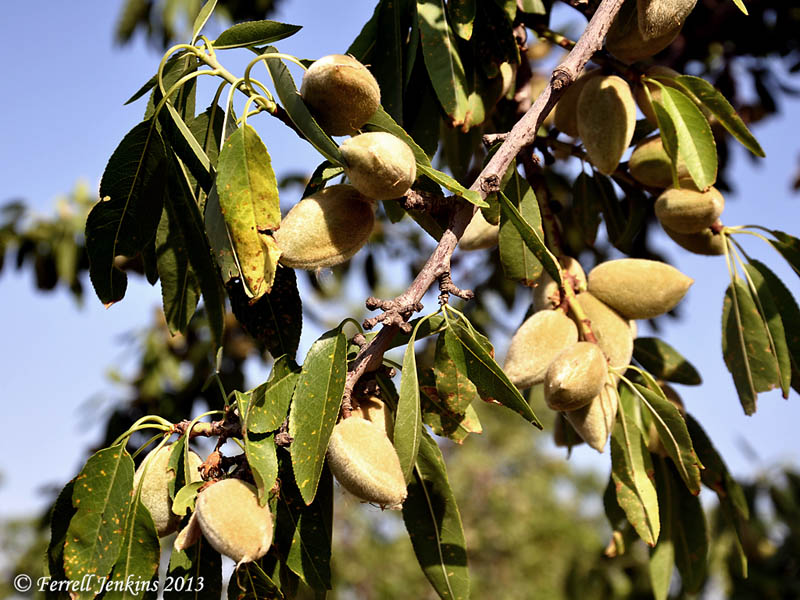
The photo below shows almonds growing in the Jezreel Valley in late April.

Almonds growing in the Jezreel Valley. Photo by Ferrell Jenkins.

Almonds growing in the Jezreel Valley. Photo by Ferrell Jenkins.

During the days of a severe famine in the land of Canaan, Israel (Jacob) agreed to allow his youngest son Benjamin to go to Egypt at the request of the man who was in charge of dispensing food. That man was Joseph, the son of Israel. Jacob agreed to allow Benjamin to go with his older brothers. He also told the boys to take some of “the best products of the land” including almonds.

Then their father Israel said to them, “If it must be so, then do this: take some of the choice fruits of the land in your bags, and carry a present down to the man, a little balm and a little honey, gum, myrrh, pistachio nuts, and almonds. (Genesis 43:11 ESV)

The Sea of Galilee and Mount Arbel from the NW

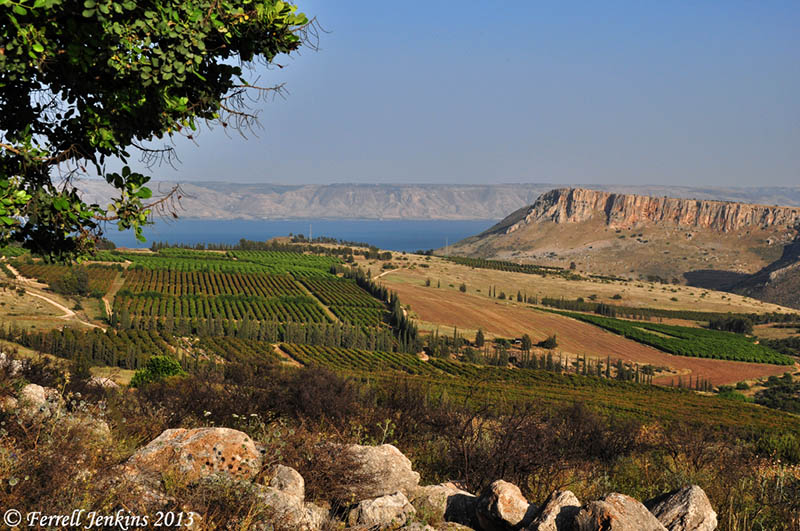
This photograph of the Sea of Galilee and Mount Arbel was made from highway 807.

Sea of Galilee and Mount Arbel from the NW. Photo by Ferrell Jenkins.

The Sea of Galilee and Mount Arbel from the NW. Photo by Ferrell Jenkins.

From this point we can see the east side of the Sea of Galilee. Today we know it as the Golan Heights. In Old Testament times it was known as Bashan (Joshua 21:27). Golan was one of the cities of Refuge located in the area. In New Testament times this was the area of the Decapolis (Mark 7:31), and probably the country of the Gadarenes (Matthew 8:28).

Below Mount Arbel runs the Via Maris, the main road leading from the Turan Valley to Capernaum. This road allowed travel and commerce between Capernaum, Magdala, and Tiberias with the cities of Nazareth, Cana, Sepphoris, and Jotapata.

Painting the eyes

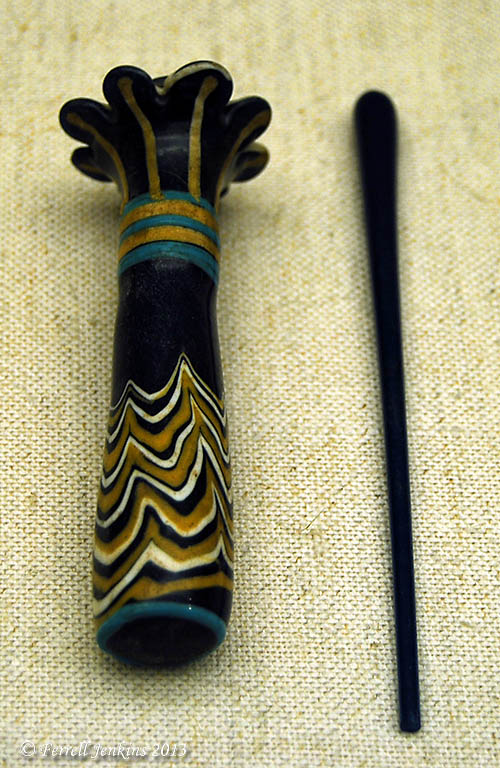
Cosmetics and the painting of one’s eyes is nothing new. The photo below shows a Palm-column flask and kohl stick displayed in Boston’s Museum of Fine Arts. The item is said to date between 1386 and 1212 B.C. Information with the item says,

The palm-column flask is one of the best represented types of glass vessels from the New Kingdom. It served as a container for the cosmetic kohl, or eyepaint, made of ground galena mixed with fat or resin and applied to the lids with the slender glass rod.

Palm-column flask and kohl stick. Museum of Fine Arts, Boston. Photo by Ferrell Jenkins.

Palm-column flask and kohl stick. Museum of Fine Arts, Boston. Photo” Ferrell Jenkins.

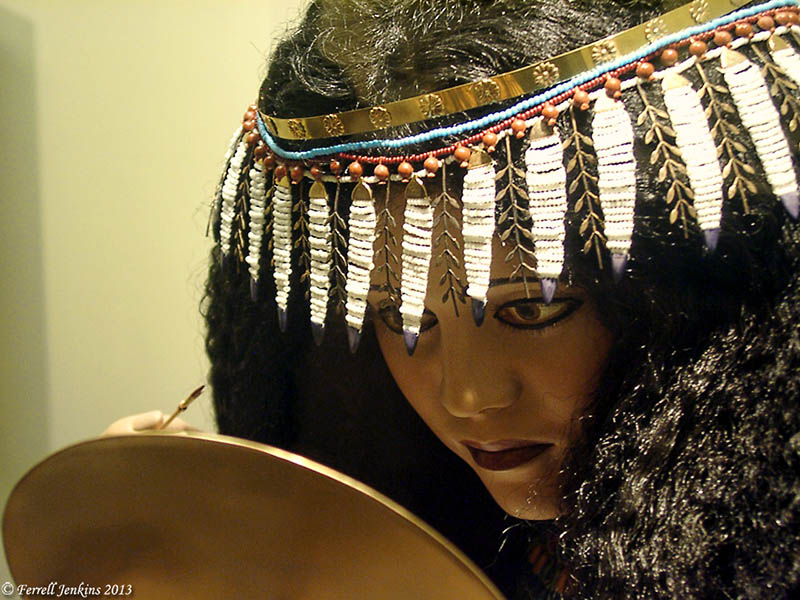
It was centuries later when Jehu came to see Jezebel at Jezreel. Jezebel, the widow of King Ahab, wanted to make a good appearances on Jehu.

When Jehu came to Jezreel, Jezebel heard of it. And she painted her eyes and adorned her head and looked out of the window. (2 Kings 9:30 ESV)

Perhaps Jezebel did not know that she was preparing herself for her death.

Royal Ontario Museum exhibit showing an Egyptian woman painting her eyes. Photo by Ferrell Jenkins.

Royal Ontario Museum exhibit showing an Egyptian woman painting her eyes. Photo by Ferrell Jenkins.

The prophets also spoke of this practice, but not in a complimentary way, in Jeremiah 4:30 and Ezekiel 23:40.

Has “King David’s Palace” been uncovered in the Judean Shephelah

Archaeological digs in Israel are winding down and the maximalists are having a great time. Today’s report comes from the excavation of Khirbet Qeiyafa which is conducted jointly by Professor Yossi Garfinkel of the Hebrew University and Saar Ganor of the Israel Antiquities Authority.

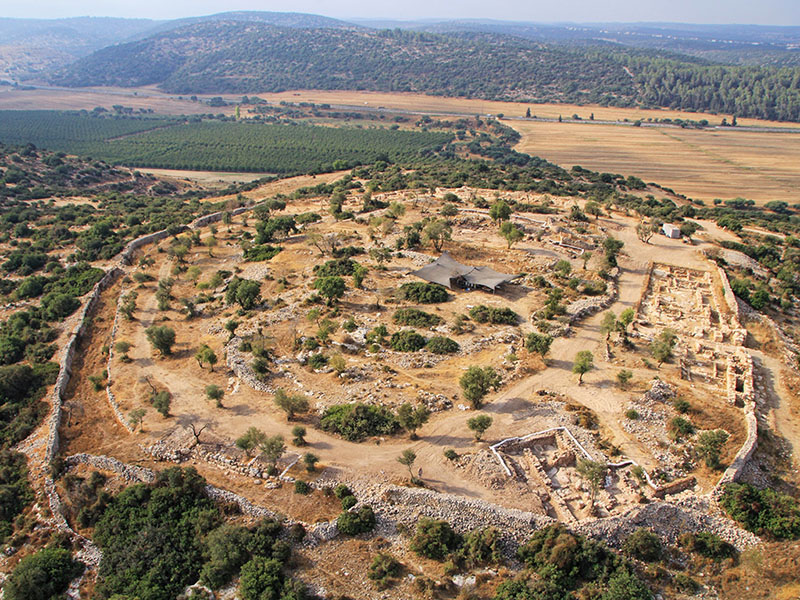
Aerial photo of Khirbet Qeiyafa. Photo: Sky View, courtesy of the Hebrew University and the Israel Antiquities Authority.

Aerial photo of Khirbet Qeiyafa. Photo: Sky View, courtesy of the Hebrew University and the Israel Antiquities Authority.

Here is today’s Press Release from the Israel Antiquities Authority.

King David’s Palace was Uncovered in the Judean Shephelah

Royal storerooms were also revealed in the joint archaeological excavation of the Hebrew University and the Israel Antiquities Authority at Khirbet Qeiyafa ***
These are the two largest buildings known to have existed in the
tenth century BCE in the Kingdom of Judah 

Two royal public buildings, the likes of which have not previously been found in the Kingdom of Judah of the tenth century BCE, were uncovered this past year by researchers of the Hebrew University and the Israel Antiquities Authority at Khirbet Qeiyafa – a fortified city in Judah dating to the time of King David and identified with the biblical city of Shaarayim.

One of the buildings is identified by the researchers, Professor Yossi Garfinkel of the Hebrew University and Saar Ganor of the Israel Antiquities Authority, as David’s palace, and the other structure served as an enormous royal storeroom.

Today (Thursday) the excavation, which was conducted over the past seven years, is drawing to a close. According to Professor Yossi Garfinkel and Sa’ar Ganor, “Khirbet Qeiyafa is the best example exposed to date of a fortified city from the time of King David. The southern part of a large palace that extended across an area of c. 1,000 sq m was revealed at the top of the city. The wall enclosing the palace is c. 30 m long and an impressive entrance is fixed it through which one descended to the southern gate of the city, opposite the Valley of Elah.  Around the palace’s perimeter were rooms in which various installations were found – evidence of a metal industry, special pottery vessels and fragments of alabaster vessels that were imported from Egypt. The palace is located in the center of the site and controls all of the houses lower than it in the city. From here one has an excellent vantage looking out into the distance, from as far as the Mediterranean Sea in the west to the Hebron Mountains and Jerusalem in the east. This is an ideal location from which to send messages by means of fire signals. Unfortunately, much of this palace was destroyed c. 1,400 years later when a fortified farmhouse was built there in the Byzantine period”.

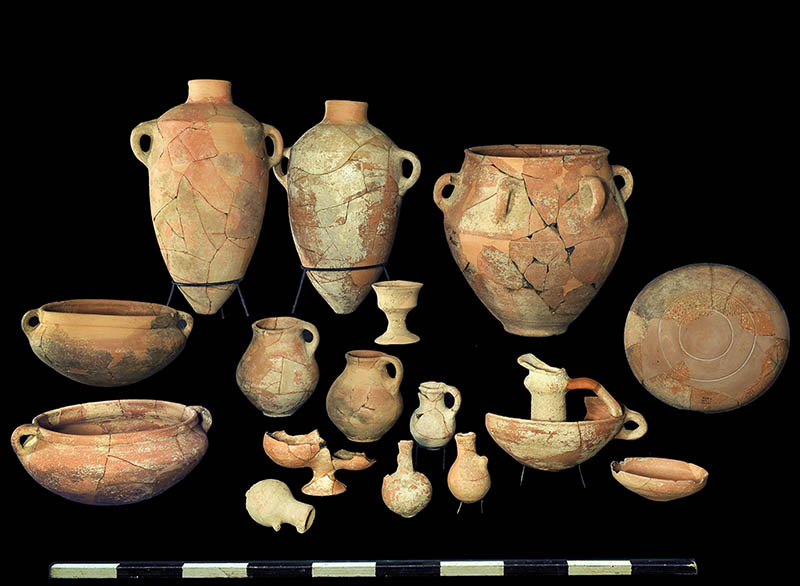
A pillared building c. 15 m long by 6 m wide was exposed in the north of the city, which was used as an administrative storeroom. According to the researchers, “It was in this building the kingdom stored taxes it received in the form of agricultural produce collected from the residents of the different villages in the Judean Shephelah. Hundreds of large store jars were found at the site whose handles were stamped with an official seal as was customary in the Kingdom of Judah for centuries”.
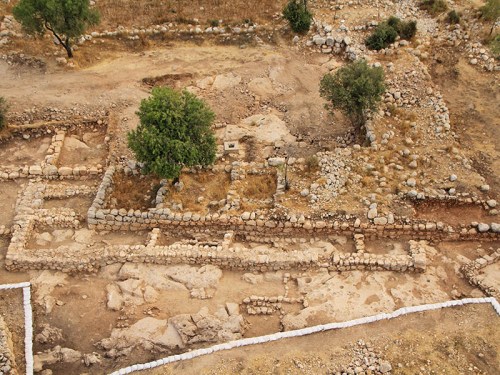
An aerial picture of the "palace" and the Byzantine farmhouse. Photograph: Sky View, courtesy of the Hebrew University and the Israel Antiquities Authority.

An aerial picture of the “palace” and the Byzantine farmhouse. Photograph: Sky View, courtesy of the Hebrew University and the Israel Antiquities Authority.

The palace and storerooms are evidence of state sponsored construction and an administrative organization during King David’s reign. “This is unequivocal evidence of a kingdom’s existence, which knew to establish administrative centers at strategic points”, the archaeologists say. “To date no palaces have been found that can clearly be ascribed to the early tenth century BCE as we can do now. Khirbet Qeiyafa was probably destroyed in one of the battles that were fought against the Philistines circa 980 BCE. The palace that is now being revealed and the fortified city that was uncovered in recent years are another tier in understanding the beginning of the Kingdom of Judah”.
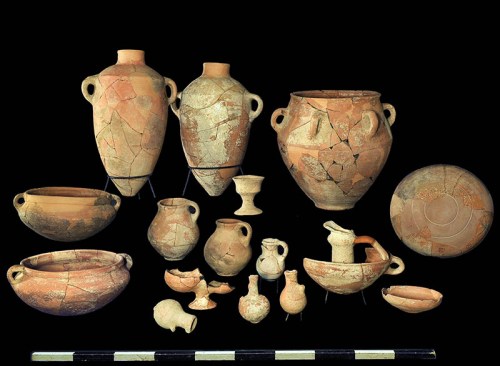
Finds from the site. Photographic Credit: Clara Amit, courtesy of the Israel Antiquities Authority.

Finds from the site. Photo: Clara Amit, courtesy of the Israel Antiquities Authority.

The exposure of the biblical city at Khirbet Qeiyafa and the importance of the finds discovered there have led the Israel Antiquities Authority to act together with the Nature and Parks Authority and the planning agencies to cancel the intended construction of a new neighborhood nearby and to promote declaring the area around the site a national park. This plan stems from the belief that the site will quickly become a place that will attract large numbers of visitors who will be greatly interested in it, and from it one will be able to learn about the culture of the country at the time of King David.

Comments: It is often true in the media that the headlines say more than the article. This seems to be the case here. I understand this Press Release to be saying that a large structure, called a palace (don’t think Buckingham!) has been found. There is evidence of “a metal industry, special pottery vessels and fragments of alabaster vessels that were imported from Egypt.” Whether these things are to be associated directly with the David (1010–970 B.C.) we read about in the Bible is a matter of interpretation.

I note that the aerial photo of the site is an older one; it does not show the structures we see in the recent closeup of the “palace” and Byzantine farmhouse. (Correction: See the correction by Luke Chandler in the comments below.)

Todd Bolen’s comment this morning is worth heeding.

To my conservative friends, I’d urge caution before making any bold claims based on Garfinkel’s work. Or any claims at all. Let’s wait and see how credible archaeologists evaluate his stratigraphy. If he’s correct, we’ve lost nothing by being patient.

I see that Todd has added several updates and links to the Israeli papers also. Take a look here.

Welcome back Todd. We have missed your posts and insightful comments.