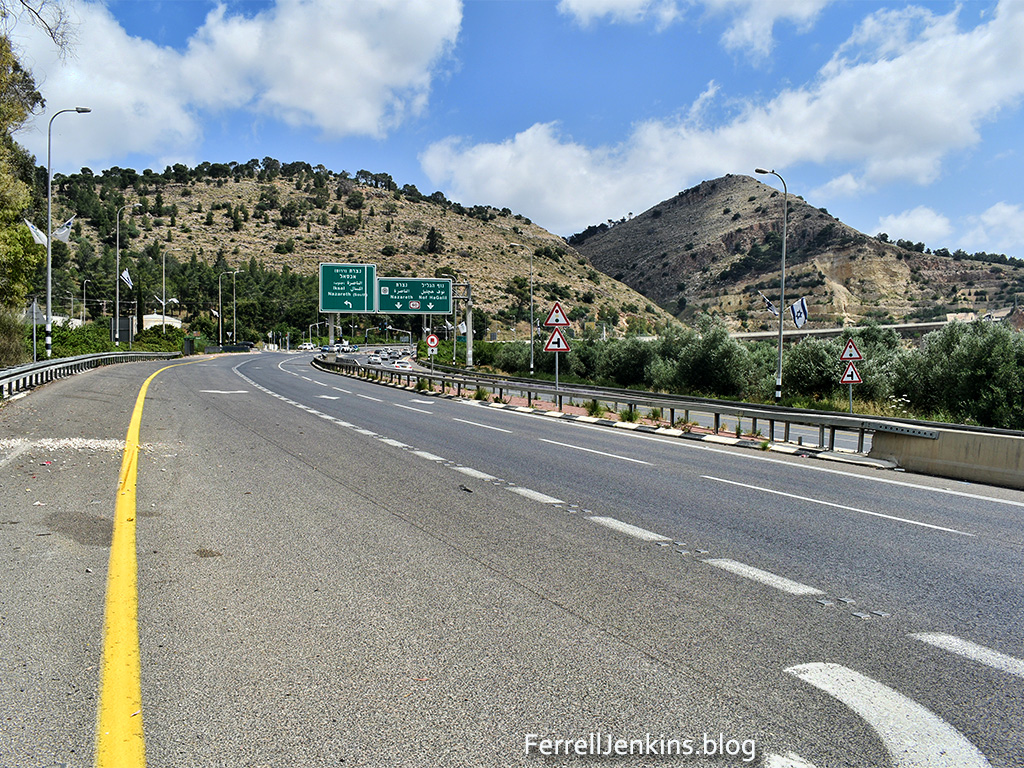
True. It happened more than once. Here I have in mind the event at Nazareth at the beginning of His ministry (Luke 4:16-30). Jesus read a portion of Isaiah 61 in the synagogue and claimed that He fulfilled that scripture. His teaching outraged those present. They took Jesus to the brow of the hill on which their city was built, intending to throw him down the cliff. Jesus passed through the crowd and left Nazareth to go down to Capernaum, a town that would become the headquarters for His earthly ministry.
Nazareth is located in the hills of Lower Galilee, where the elevation is about 2000 feet above sea level. These hills lie on the north side of the Valley of Jezreel (Esdraelon, or Megiddo). The hill of precipitation overlooks the Jezreel valley.
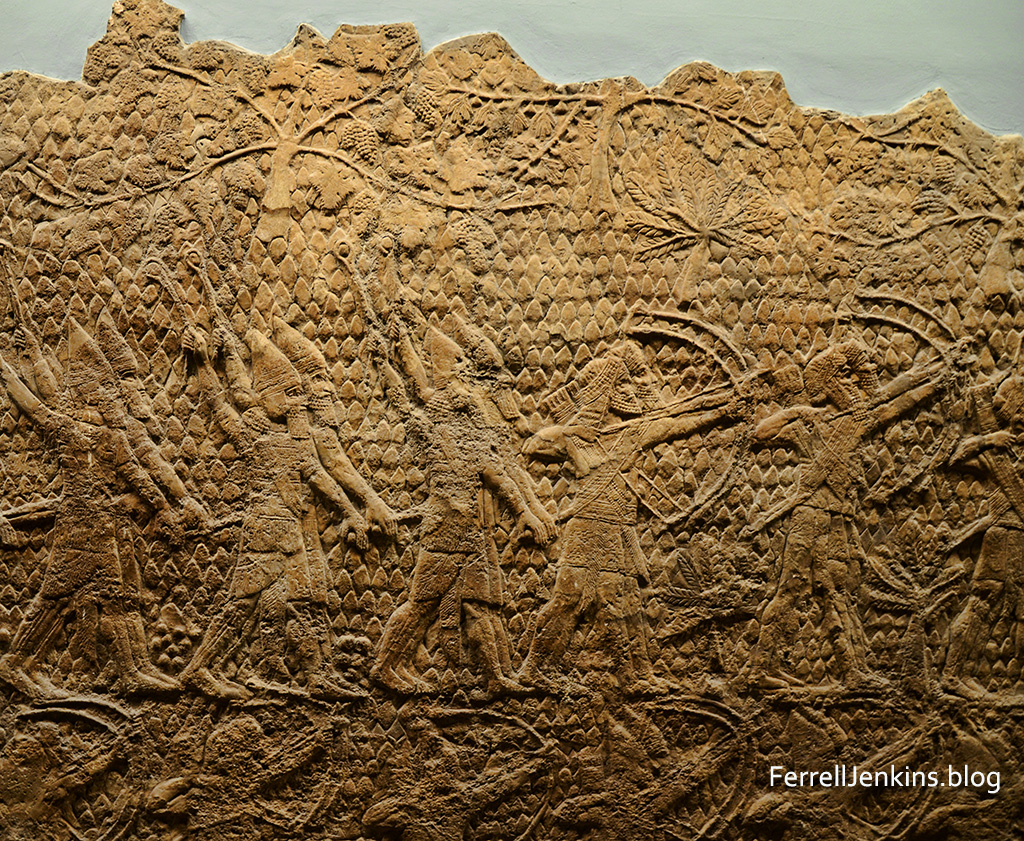
After Sennacherib, king of Assyria (704-681 BC), defeated the Judeans who lived at Lachish he tried to capture Jerusalem but was unsuccessful. Back home in Nineveh the king left a limestone relief of the siege of Lachish on his palace wall. The original is now in the British Museum. There is a replica in the Israel Museum.
The panel below shows the landscape around Lachish with palm trees and vineyards. Here is a small section of the relief. Notice especially the upper left corner of the relief.
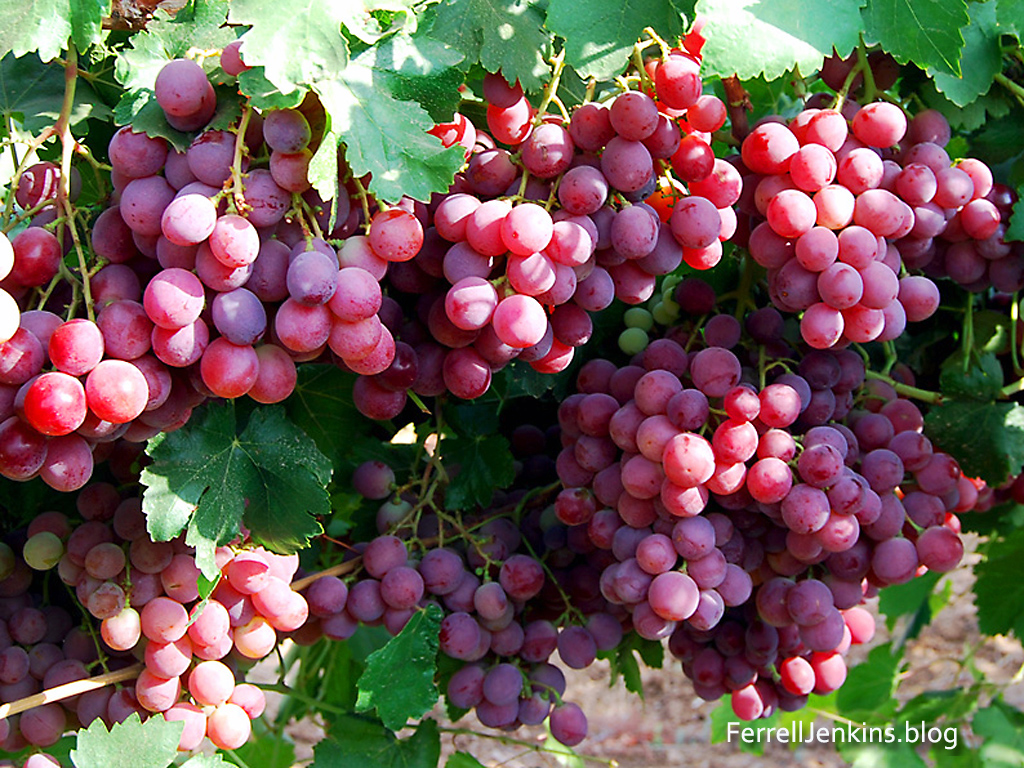
In resettling the land of Biblical Israel, the modern settlers tried to plant the same plants known in Bible times. The Sennacherib relief shows clearly that date palms and vineyards were in abundance in the region. Our next photo which I made in the Lachish area in the month of August shows grapes for eating in abundance.
Click on the images to see a larger photo suitable for use in your teaching.
Only one of the Gospel accounts of the ministry of Jesus records a visit by Jesus to the town of Nain. Strangely it is Luke who wrote two volumes (Luke and Acts of the Apostles) to a man known as Theophilus (Luke 1:3; Acts 1:1).
John, who was a personal eyewitness to the ministry of Jesus, included only seven miraculous signs of Jesus in his gospel. He exaggerated for the sake of emphasis, “Now there are also many other things that Jesus did. Were every one of them to be written, I suppose that the world itself could not contain the books that would be written” (John 21:25 ESV). In addition to the resurrection of Jesus, John included the account of the resurrection of Lazarus in John 11.
I find it intriguing that Luke mentions this account of the resurrection of a young man as his mother was on the way to bury him. Luke was a physician who became what we might call the primary physician of the apostle Paul (Colossians 4:14; 2 Timothy 4:11; see also the “We” sections of Acts where Luke is traveling with Paul.
Scholars have written about the medical language of Luke used in his two volumes.
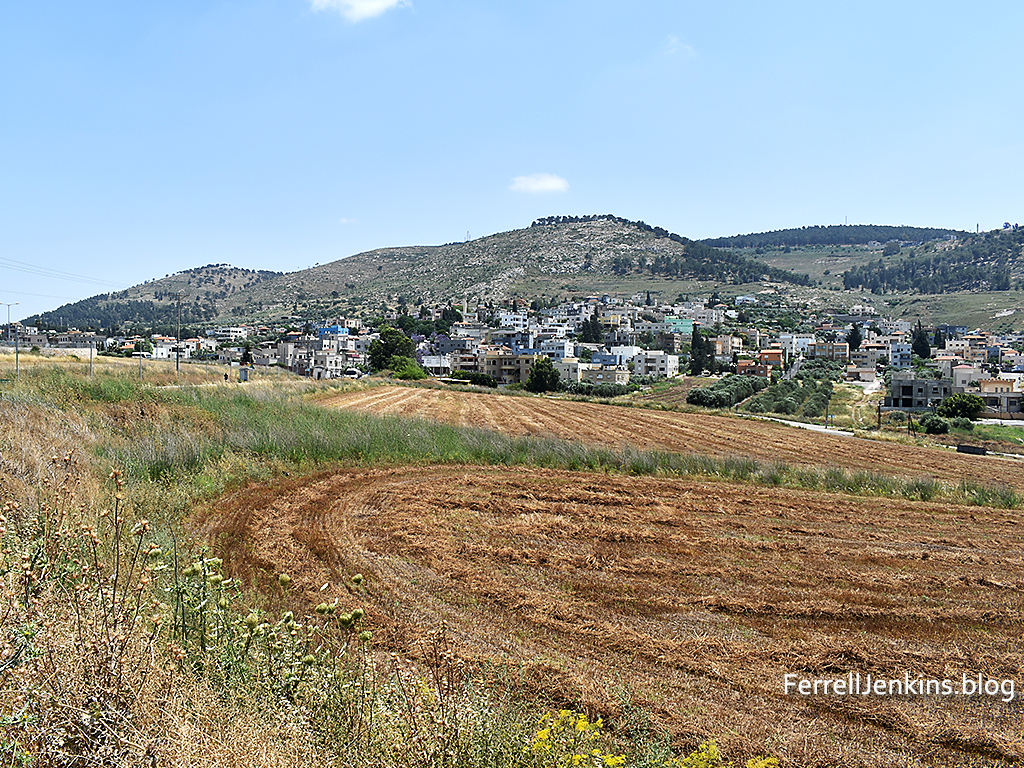
On our visit to Israel earlier this year I stopped to make a new photo of the town of Nain on the north side of the the Hill of Moreh.
The town of Nain on the northern slopes of the Hill of Moreh.
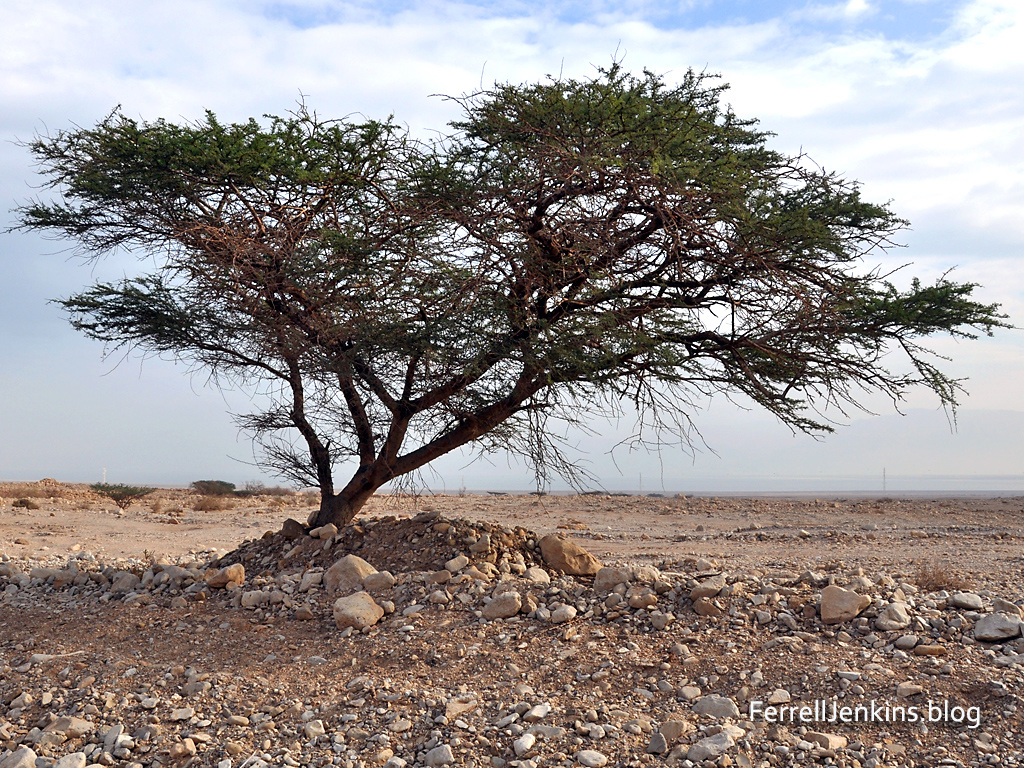
Traveling along the Dead Sea or in the Sinai one sees many Broom trees. Our first picture shows one along the shore of the Dead Sea.
This Broom tree is growing along the shore of the Dead Sea.
The broom tree is mentioned only a few times in the Bible.
After Elijah had traveled a day’s journey he sat down under a broom tree, then he lay down and slept there (1 Kings 19:4-5). The Hebrew word for the tree (rethem) is also translated juniper tree, broom bush, and shrub.
Job 30:4 states that some eat the roots of the broom tree.
Psalm 120:4 mention burning coals of the broom tree.
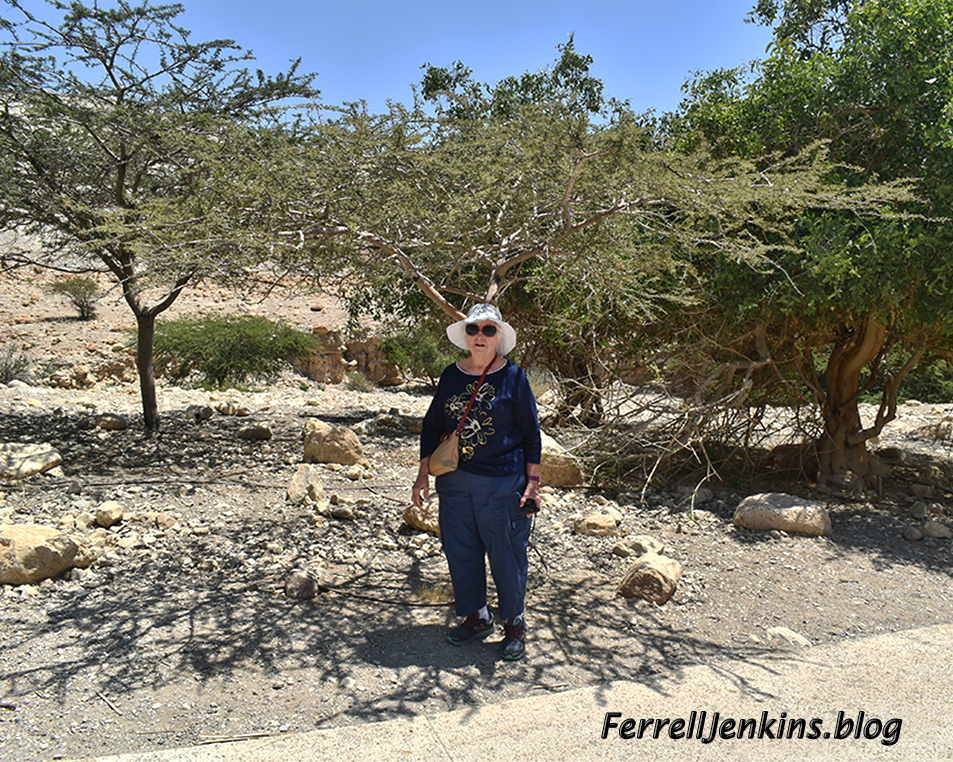
It was hot when we visited EnGedi along the western shore of the Dead Sea. Numerous broom trees may be seen growing in the area. Paulette tried to get a little shade under one of the broom trees,
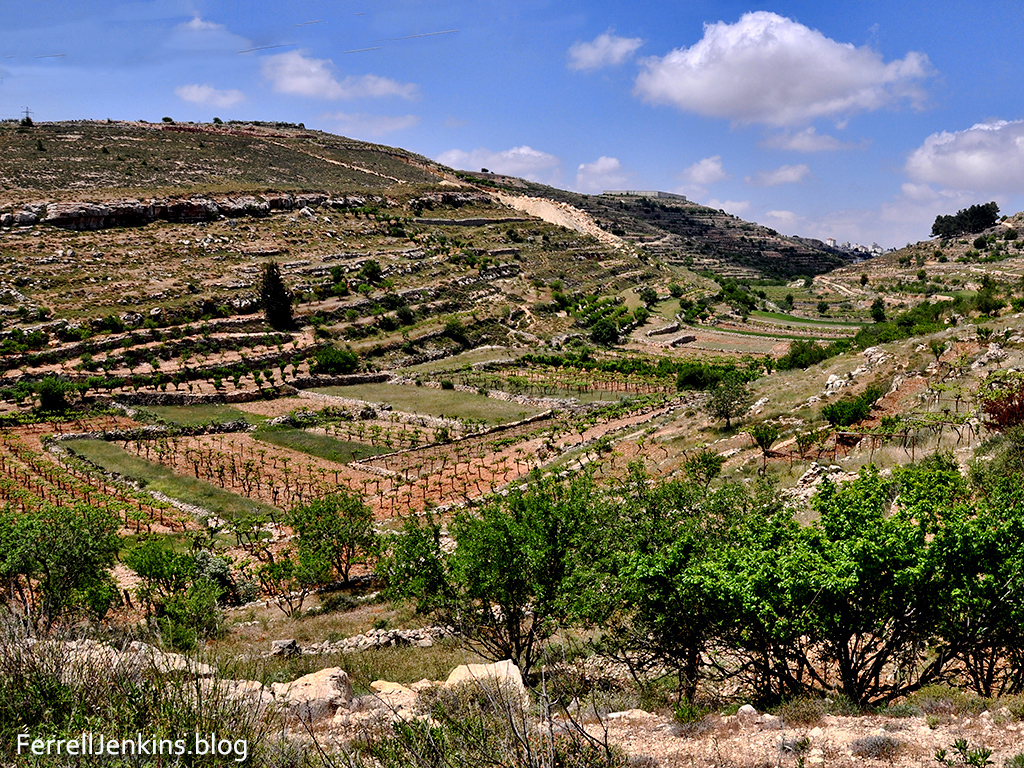
Along the central mountain road between Bethlehem and Hebron. There are many beautiful views. This one shows examples of the continued fertility of the land that was promised to the ancient Israelites. It illustrates the use of valleys to collect water during the rain season to provide water for the plants. The hillsides illustrate the terracing used as far back as the Biblical Iron age (around 1000 B.C.).
View of hillsides and valleys along road between Bethlehem and Hebron. Photo by Ferrell Jenkins.
After the previous post I was ask how far the map extended. I have seen the map several times, but much of my detailed info comes from an article by Victor R. Gold: “The Mosaic Map of Medeba.” This article first appeared in Biblical Archaeologist, XXI.3 (Sept. 1958), pp.59-71. It was included in a 3-volume set called The Biblical Archaeologist Reader, vol. 3.
Here is a section on the extent of the Map:
“Except for the [third century] Tabula Peutingeriana [road map of the world], the Madeba map is the only map of ancient Palestine still in existence. The large remaining section extends from Aenon in the Jordan valley, or near it, in the north, to the Canobic branch of the Nile in the south. Not even this section is complete, however, the footing of one of the columns rests over a section of Judea from Eleutheropolis (Beit Jibin) to Ashdod and Beersheba.” (Campbell, Edward F., and David N. Freedman, editors. The Biblical Archaeologist Reader 3. First ed., vol. 3, Doubleday and Company, 1970, pp. 359-65, 3 vols.
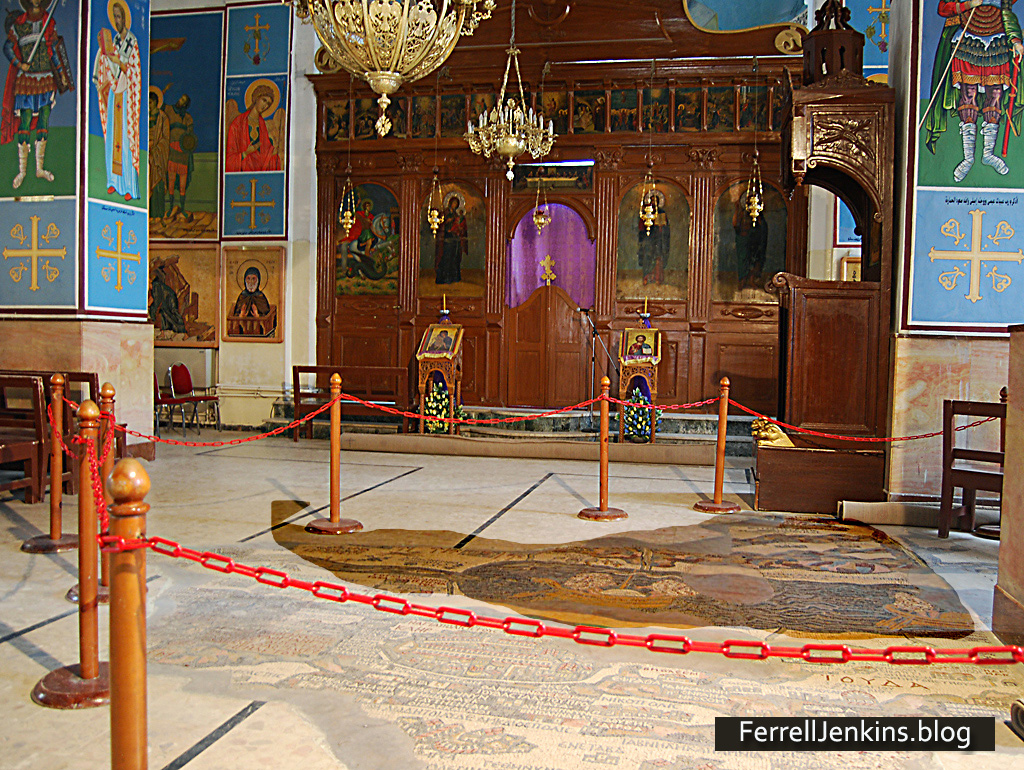
I am including a photo showing the actual size of the map in the church building floor at Madaba, Jordan. I have darkened the portion of the map that has been reconstructed there. We are not seeing all that is known to have existed. I have noted a small portion of the Nile Delta, and coastal towns such as Ashkelon and Ashdod. In my photos I can see mountains of Moab to the east, and Aenon in the northern Jordan Valley.
For the benefit of those who might like to see the size of the map in the Madaba church, I have darkened the map in the area that is cordoned off.
The Madaba Map is shown darker in the church floor to allow one to see the size of the map there.
The Madaba Map is an amazing piece of work. It would be nice if we had one in the vestibule where I meet with Christians.
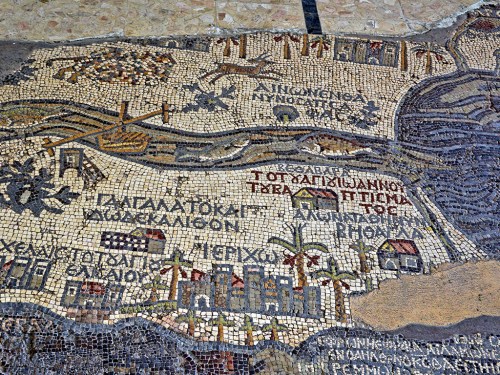
About AD 560 the church at Madaba, now in Jordan, decided they needed a map in their building. They could not order one from their Bible class publisher, so they made a large Mosaic map on the floor of the building. This map was rediscovered in the 1880s.
Madaba was known as the Ammonite city of Medeba in Joshua 13:9,16 and Isaiah 15:2.
For now I wish to share a photo of a surviving portion showing the Jordan River flowing into the Dead Sea.
I understand the designer of the map to be saying that the fish of the Jordan River could not survive in the Salt Sea. This portion of the map also shows Jericho, the city of Palm trees (Deuteronomy 34:3; 2 Chronicles 28:15).
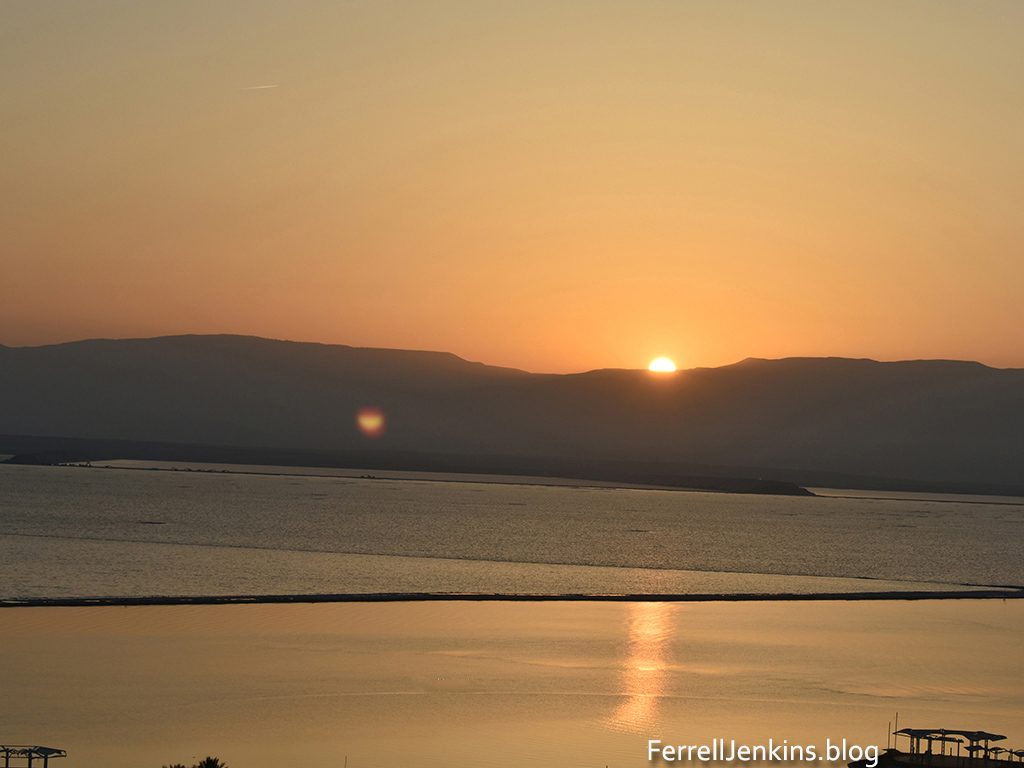
We set the clock to get up in time to see the sunrise across the Dead Sea. I was pleased with the result as the sun rose in the vicinity of Biblical Edom sending a ray across the Dead Sea. The smaller light to the left of center is a reflection from the camera lens.
Now Lot went up out of Zoar and lived in the hills with his two daughters, for he was afraid to live in Zoar. So he lived in a cave with his two daughters. (Gen. 19:30 ESV)
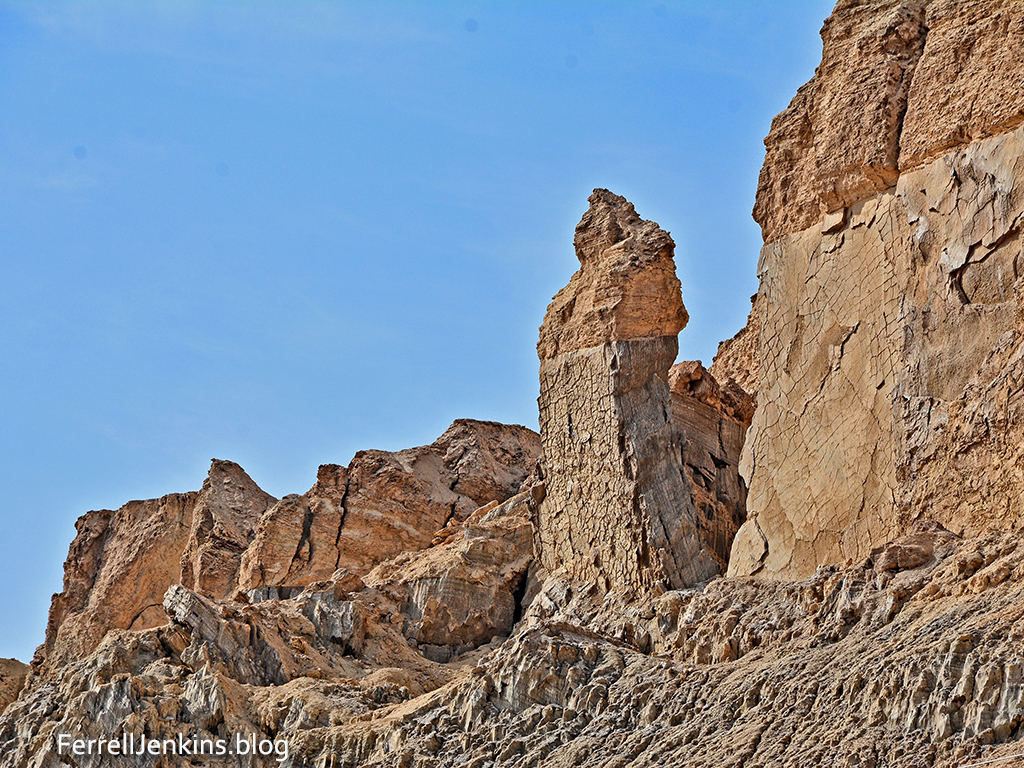
While we were at the southern end of the Dead Sea we drove a little further south to see the formation nicknamed “Lot’s Wife.” This is based on the Biblical story of the destruction of Sodom and Gomorrah (Genesis 19. See especially Genesis 19:26, and the reference by Jesus in Luke 17:32).
As usual, these photos are available for download for use in teaching as long as credit is given to this source. For commercial use see our Photo Permission page.
Aerial view of Tel Ashkelon along the Mediterranean coast in southern Israel. Ashkelon was one of the Philistine cities (Joshua 13:2-3.) Photo by Ferrell Jenkins.
Cupbearers were important servants in the ancient Near East. In the Bible we read about the cupbearer in Egypt in the time of Joseph (Genesis 40-41). Some English translations use the term butler.
The only person mentioned by name in the Bible as a cupbearer is Nehemiah (Nehemiah 1:11).
“O Lord, let your ear be attentive to the prayer of your servant, and to the prayer of your servants who delight to fear your name, and give success to your servant today, and grant him mercy in the sight of this man. “Now I was cupbearer to the king.” (Nehemiah 1:11 ESV)”O Lord, let your ear be attentive to the prayer of your servant, and to the prayer of your servants who delight to fear your name, and give success to your servant today, and grant him mercy in the sight of this man. “Now I was cupbearer to the king.” (Nehemiah 1:11 ESV)
A source that I enjoy and use frequently is the IVP Bible Background Commentary: Old Testament. The comment about the cupbearer is brief but full of significant facts.
“The cupbearer in the ancient Near Eastern court held a very important position. He had direct access to the king and thus had great influence. Texts and reliefs describe cupbearers in Assyrian and Persian courts. The cupbearer was in close proximity to the king’s harem and thus was often a eunuch, although there is no evidence that this was the case with Nehemiah. Later sources identify the cupbearer as the wine taster. In addition he was the bearer of the signet ring and was chief financial officer.”
Have you visited the Bible Land Museum in Jerusalem? The museum is located across the parking lot from the Israel Museum. There is a separate entry fee for this smaller museum. It contains many artifact from a private collection. It is a good place to make photos that are useful in teaching the Bible. This rhyton or cup from the Persian Empire is one good example. This is likely the type of cup used by Nehemiah in his function as cupbearer to the king.
Inscribed just within the rim in cuneiform is “Ampirish, king of Samati, son of Dabala” Silver, gilt bitumen. From Iran, Early 6th century BCE, On loan from Cindy and David Sofer. From the Bible Land Museum, Jerusalem.



 Ferrell's Travel Blog
You must be logged in to post a comment.