Category Archives: New Testament

Manatees and Rock Badgers

Tuesday we took our 5-year-old grandson to the Manatee Viewing Center on Tampa Bay (Gulf of Mexico). Our local electric power company (TECO) has provided excellent walkways that allow visitors to see the Manatees who come during the winter months to enjoy the warm water discharged from the power plant.
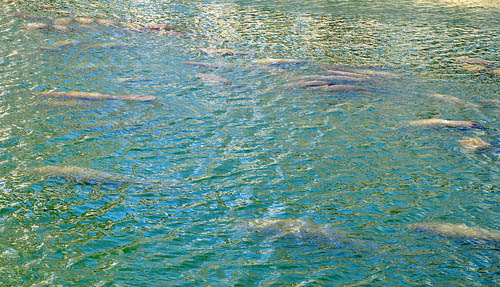
Manatees at the TECO Manatee Viewing Area. Photo by Ferrell Jenkins.

Manatees at the TECO Manatee Viewing Center. Photo by Ferrell Jenkins.

Our grandson enjoyed the visit, especially when he saw a large number of the Manatees moving about in the water. Well, he enjoyed turning $1.53 into three smashed pennies, too. In the learning center there are several exhibits of interest both to children and adults.
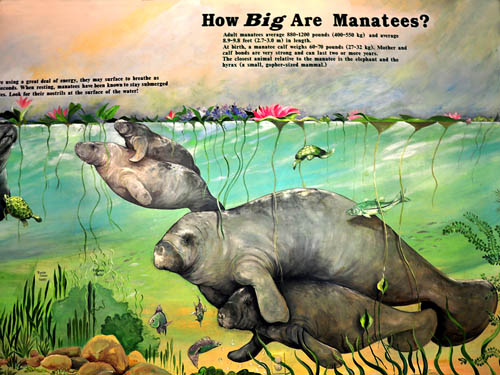
How Big Are Manatees? Photo by Ferrell Jenkins.

How Big Are Manatees? Photo by Ferrell Jenkins.

How Big Are Manatees? The poster says that adult manatees average 880-1220 pounds and are 8-9 feet long. The last statement under the question is this:

“The closest animal relative to the manatee is the elephant and the hydrax (a small gopher-size mammal.”

You may have wondered how I could relate this visit to traveling in the Bible lands. Well, here it is.

The hydrax is identified with the shaphan of the Hebrew Bible. English translations use some of the following terms:

  • hydrax (CSB)
  • shephan (NAU)
  • rock badgers (NET; ESV; NKJ). The NET notes say this is the Syrian Hydrax.
  • badgers (RSV)
  • conies (KJV; ASV); coneys (NIV)

Fauna and Flora of the Bible identifies this animal as the Syrian Coney (Procavia syriacus).

The rock badger lives among rocks from the Dead Sea valley to Mt. Hermon.

One of the best places to see the rock badgers is at En Gedi on the west shore of the Dead Sea.

Rock Badger at EnGedi. Photo by Ferrell Jenkins.

Rock Badger at EnGedi. Photo by Ferrell Jenkins.

The Rock Badger is mentioned in the book of Proverbs among things that are small, but exceedingly wise. There is a great lesson here. Even though they are not mighty, they build their homes in secure places. This is similar to the teaching of Jesus in Matthew 7:24-25. Notice the reading of  Proverbs 30:26 in a few of the English translations:

The shephanim are not mighty people, Yet they make their houses in the rocks; (NAU)

rock badgers are creatures with little power, but they make their homes in the crags; (NET)

the rock badgers are a people not mighty, yet they make their homes in the cliffs; (ESV)

hyraxes are not a mighty people, yet they make their homes in the cliffs; (CSB)
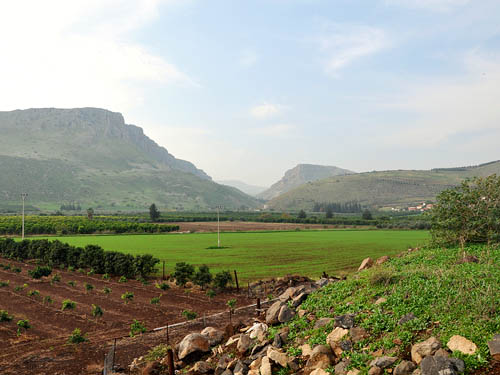
The land of Gennesaret

The Sea of Galilee is called the “lake Gennesaret” by Luke (Luke 5:1). The area on the northwest corner of the Sea of Galilee is called the “land at Gennesaret.” In the view below we see the land of Gennesaret and the Via Maris. The route here leads to the Beit Netofa Valley and the sites of (Khirbet) Cana, Sepphoris, Nazareth, and Yodfat (Jotapata). Yodfat was fortified by Josephus during the Jewish revolt against Rome. Josephus, commander of the Jewish rebels, surrendered to the Roman Emperor Vespasian at Yodfat.

The land of Gennesaret and the Via Maris. Photo by Ferrell Jenkins.

The land of Gennesaret and the Via Maris. Photo by Ferrell Jenkins.

Many of the miracles of Jesus were performed in this area.

When they had crossed over, they came to land at Gennesaret. And when the men of that place recognized Him, they sent word into all that surrounding district and brought to Him all who were sick; and they implored Him that they might just touch the fringe of His cloak; and as many as touched it were cured. (Matthew 14:34-36 NAU)

Fishing ban on the Sea of Galilee

Arutz Sheva reports a two year ban on fishing in the Sea of Galilee and its tributaries.

Minister of Agriculture Shalom Simchon has announced a ban on all fishing in the Sea of Galilee (Kinneret) for two years. The ban also extends to the part of the Jordan River that empties into the Sea of Galilee, and to all the other rivers that empty into the famous lake.

The authority to ban fishing is within the Minister of Agriculture’s authority according to the official Fishing Order, and the ban is set to take effect on March 1, 2010, extending until February 28, 2012. Minister Simchon has asked the Finance Ministry to allot NIS 15 million for enforcing the ban and compensating the fishermen who will be hurt by it.

Simchon explained that according to Agriculture Ministry statistics, the quantity of fish in the Sea of Galilee has plummeted in the past decade, and especially in the last two years, by tens of percentage points annually. It has now reached  a critical level, he said, and these statistics mean that the sea may be facing an ecological disaster in which all its fish would die out.

Simchon added that the ban on fishing is necessary, because it is both in the public’s interest and that of the fishermen that the Sea of Galilee be kept from turning into a fishless sea. However, the Ministry of Agriculture said that it realized that the fishermen would be bound to protest the move.

Read the full account here.

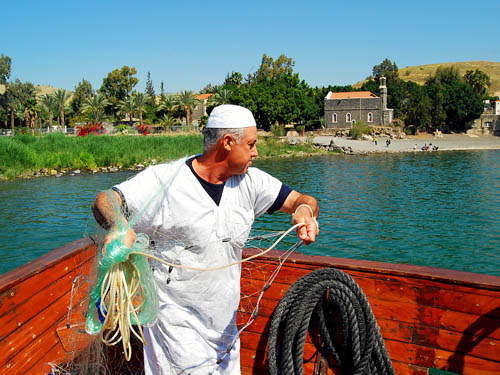
A fisherman readies to cast his net into an area near Taghba where warm water springs flow into the Sea of Galilee. For a photo of the net in the air click here. Commercial fishermen use large draw nets.

Fisherman readies to cast his net into the Sea of Galilee. Photo by Ferrell Jenkins.

Fisherman readies to cast his net into the Sea of Galilee. Photo by Ferrell Jenkins.

While walking by the Sea of Galilee, he saw two brothers, Simon (who is called Peter) and Andrew his brother, casting a net into the sea, for they were fishermen. (Matthew 4:18 ESV)

We wrote about the water level of the lake with photos to illustrate the low level here.

HT: Bible Places Blog.

Worship of Bastet extended to the Ptolemaic Period

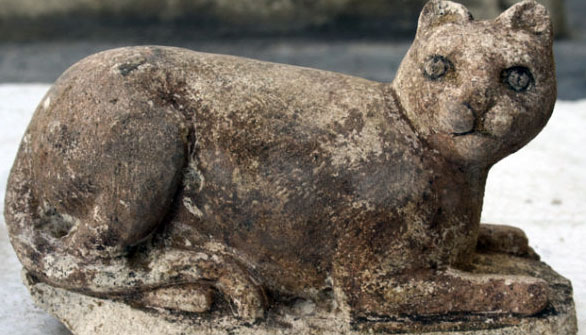
Fox News reported here recently on the discovery of a Greek temple dedicated to the Egyptian cat goddess Bastet.

Egyptian archaeologists unearthed the remains of an ancient Greek temple dedicated to Egyptian cat goddess Bastet in the Mediterranean city of Alexandria, the antiquities department said Tuesday.

The mission, led by Mohamed Abdel Maqsoud, head of Antiquities of Lower Egypt, discovered the remains of a temple of Queen Berenike, the wife of King Ptolemy III who ruled Egypt between 246 and 222 B.C., in the Kom al Dikka area in Alexandria.

“The discovered remains are 196 feet tall and 49 feet in width,” antiquities chief Zahi Hawass said in a statement. He said the temple was “subjected to destruction during later eras when it was used as a quarry, which led to the disappearance of many of its stone blocks.”

A group of 600 Ptolemaic statues were also unearthed during the routine excavations, including a large collection of icons depicting Bastet, goddess of protection and motherhood.

The discovery in Kom al Dikka is the first Ptolemaic temple discovered in Alexandria to be dedicated to the goddess Bastet, Abdel Maqsoud was quoted as saying in the statement.

“It indicates that the worship of the goddess Bastet continued in Egypt after the decline of the ancient Egyptian era,” he said.

The Ptolemaic period marks the Greek rule of Egypt from 305 B.C. until the Roman conquest in 30 B.C.

Alexandria became the capital city of Ptolemaic Egypt and thrived as the center of Greek culture and trade.

Bastet. Discovered at Alexandria. AP photo.

Image of Bastet, the cat goddess of Egypt, discovered at Alexandria. AP.

Egypt was noted for the worship of numerous gods. The plagues of Egypt were a judgment against “all the gods of Egypt” (Exodus 12:12). Later, in the time of the prophet Jeremiah, the LORD again warned of judgment upon the gods of  Egypt (Jeremiah 43:12-13).

Every time I read Paul’s discussion about the condition of the Gentiles I think of the gods of ancient Egypt.

Professing to be wise, they became fools,  and exchanged the glory of the incorruptible God for an image in the form of corruptible man and of birds and four-footed animals and crawling creatures. (Romans 1:22-23 NAU)

Bubastis in ancient Egypt was especially devoted to Bastet. The ruins of the city are now surrounded by the city of Zagazig in the Eastern Delta. It was mentioned by the prophet Ezekiel under the name Pi-beseth (Ezekiel 30:17).

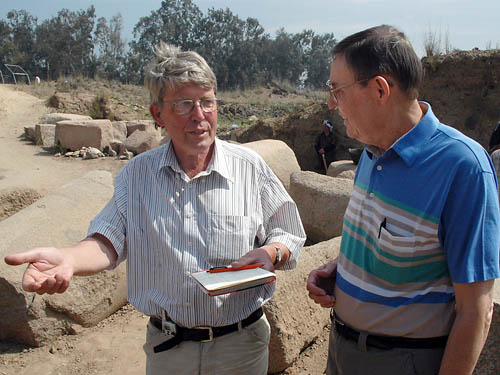
Prof. Christian Tietze and a team of Egyptian archaeologists have been working at Tell Basta (Bubastis).

Prof. Christian Tietze and Ferrell Jenkins at Tell Basta, Egypt, 2005.

Prof. Christian Tietze and Ferrell Jenkins at Tell Basta, Egypt, 2005.

The new discovery from Alexandria in the Ptolemaic period shows that the worship of Bastet continued, and was more wide spread than commonly thought.

Planning for earthquakes in Eastern Turkey

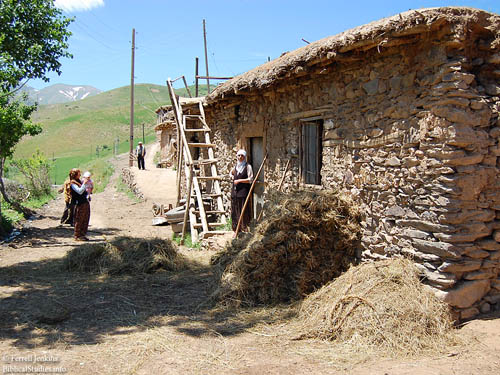
Last week I wrote about references to earthquakes in the Bible. In 2007 I traveled in Eastern Turkey, in the Biblical land of Ararat (Urartu) (2 Kings 19:37). Along the road between Van and Batman we saw a group of men adding a room to a house.

Notice that the house is built of field stones. Above the window there is a lintel of wood. To the right side of the window you may also see a long piece of wood. I will come back to that later. Notice the roof. It is made of timber, straw, and mud.

House between Van and Batman in Eastern Turkey. Photo by Ferrell Jenkins.

House between Van and Batman in Eastern Turkey. Photo by Ferrell Jenkins.

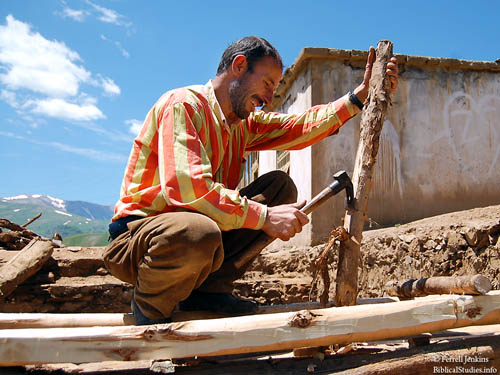
The photo below shows one of the men working on the roof of the new room. Notice the mud roof of the existing room.  The worker is preparing a piece of timber with a simple hand tool similar to those used three to four thousand years ago.

Adding a new room in the land of Ararat. Photo by Ferrell Jenkins.

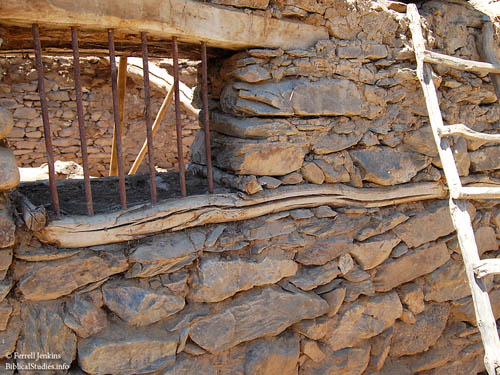
Here we see part of the new wall. Notice the field stone filled with smaller stones. A wooden lintel is used over the window. That might not be unusual to us. Look below the window. The timber is not only under the window, but also extends several feet to the right.

Preparing for an earthquake in Eastern Turkey. Photo by Ferrell Jenkins.

Preparing for an earthquake in Eastern Turkey. Photo by Ferrell Jenkins.

My friends and I spoke only a few words in Turkish. The men building the house spoke no English. I pointed to the wood below the window and did my imitation of the shaking of an earthquake. This evoked a good smile from one of the Turkish men. He nodded to indicate that I had the right idea. The wood helps to absorb the shock of an earthquake.

In our modern housing we use rebar to strengthen our buildings. This, along with metal ties help reinforce our buildings to resist the damage from hurricanes, tornadoes, and earthquakes. If an earthquake similar to the one in Haiti had hit southern California there likely would have been little loss of life. The buildings in Haiti were made of concrete blocks without any reinforcement. Ancient people knew they had to find ways to cushion the shock. The people of Eastern Turkey have learned the same.

In principle, Jesus taught the same thing about building.

“Everyone then who hears these words of mine and does them will be like a wise man who built his house on the rock. And the rain fell, and the floods came, and the winds blew and beat on that house, but it did not fall, because it had been founded on the rock. And everyone who hears these words of mine and does not do them will be like a foolish man who built his house on the sand. And the rain fell, and the floods came, and the winds blew and beat against that house, and it fell, and great was the fall of it.” And when Jesus finished these sayings, the crowds were astonished at his teaching, for he was teaching them as one who had authority, and not as their scribes. (Matthew 7:24-29 ESV)

Are you building on the rock?

Earthquakes common in the Bible world

Earthquakes were, and are, common in the Bible world. Earthquakes are common in Iran (Persia), Turkey (Asia Minor), Syria, Lebanon, Israel, and Jordan.

The Great Rift runs all the way from northern Syria through Lebanon, Israel, the Arabah, and into eastern Africa. In Israel the area is called the Jordan Valley or the Dead Sea Rift, It is not surprising that earthquakes are mentioned frequently in the Bible. The prophet Amos dates his visions to “two years before the earthquake” (Amos 1:1). The earthquake he makes reference to must have been so memorable that everyone would know what he was talking about. Zechariah (14:5) also calls attention to this earthquake in the days of Uzziah king of Judah.

Jesus, in predicting the fall of Jerusalem to the Romans, said, “and in various places there will be famines and earthquakes” (Matthew 24:7; see Luke 21:11).

About a year and a half ago I wrote about Philadelphia with special attention to the danger of earthquakes here. I suggest you read that post. The letter to the church at Philadelphia (Revelation 3:7-13) makes an allusion to the events that occur after an earthquake. In the promise to the overcomers the Lord says “I will make him a pillar in the temple of My God, and he will not go out from it anymore (v 12). In the case of earthquakes people stay outside for several days due to the fear of aftershocks. Those who overcome need not fear being toppled, as a pillar might be toppled in the earthquake.

He who overcomes, I will make him a pillar in the temple of My God, and he will not go out from it anymore; and I will write on him the name of My God, and the name of the city of My God, the new Jerusalem, which comes down out of heaven from My God, and My new name. (Revelation 3:12 NAU)

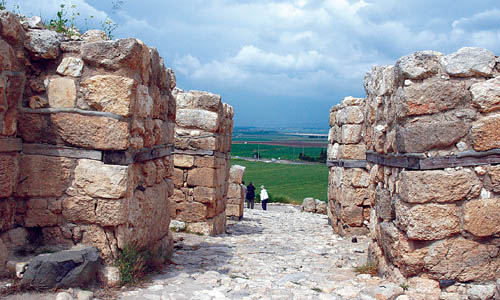
The archaeological excavations of many Biblical cities throughout Asia Minor, and along the Great Rift, reveal evidence of earthquakes. Some of the gates were built with pieces of timber to absorb the shock from the tremors. The reconstructed gate at Megiddo illustrates this practice.

Megiddo Gate with view of Jezreel Valley. Photo by Ferrell Jenkins.

Megiddo Gate with view of Jezreel Valley. Photo by Ferrell Jenkins.

The same practice is reflected in Scripture in the account of the rebuilding of the temple according to the order of the Persian King Cyrus.

In the first year of Cyrus the king, Cyrus the king issued a decree: Concerning the house of God at Jerusalem, let the house be rebuilt, the place where sacrifices were offered, and let its foundations be retained. Its height shall be sixty cubits and its breadth sixty cubits, with three layers of great stones and one layer of timber. Let the cost be paid from the royal treasury. (Ezra 6:3-4 ESV)

For seasons, days, and years

2010. We say it is a New Year. All of this depends on the goodness and lovingkindness of the Lord. Today I will post a few scriptures to remind us of the source of all material blessings.

God created the earth, and the entire universe, as a place for man to dwell. He arranged the sun, moon and stars so we might have seasons, days, and years.

Then God said, “Let there be lights in the expanse of the heavens to separate the day from the night, and let them be for signs and for seasons and for days and years; and let them be for lights in the expanse of the heavens to give light on the earth”; and it was so. (Genesis 1:14-15 NAU)

The New Testament teaches that Jesus, the Word, was active in creation, and that He keeps everything going as it should.

For by Him all things were created, both in the heavens and on earth, visible and invisible, whether thrones or dominions or rulers or authorities– all things have been created through Him and for Him. He is before all things, and in Him all things hold together. (Colossians 1:16-17 NAU)

The words of Psalm 106 express an appropriate thanks to the Lord for His provisions.

Praise the LORD! Oh give thanks to the LORD, for He is good; For His lovingkindness is everlasting. (Psalm 106:1 NAU)

Happy New Year!

A lone fisherman on the Sea of Galilee at sunrise. Photo by Ferrell Jenkins.

A lone fisherman on the Sea of Galilee at sunrise. Photo by Ferrell Jenkins.

A note to my friends: Retiring again

In 2001 I retired from teaching in the Biblical Studies Department at Florida College, but I continued to work with a church on a part-time basis. I had intended to gradually cut back on that work in order to complete some writing that I have been working on over the years. Due to various circumstances, which any preacher understands, I thought it best to continue working with the church. Well, finally, I have decided to make the big move from being partially supported to living off the savings we have been been able to put away over the years. Anyone familiar with independent churches of Christ understands that there is no retirement plan. Perhaps we have begun to build smaller barns (cf. Luke 12:18). Retiring means giving up financial support, not giving up working for the Lord.

It is my plan to continue to lead tours of the Bible Lands, and possibly a few other places, as we have done for the past 42 years. I will continue to conduct a limited number of special lecture series. I am hopeful of being able to maintain the web sites [biblicalstudies.info and BibleWorld.com], and this blog as a by-product of the study and writing that I do. It is difficult to give up things one enjoys doing, but priorities must be set. I try to respond to short questions about specific Bible topics, but I may find it necessary to cut back on that.

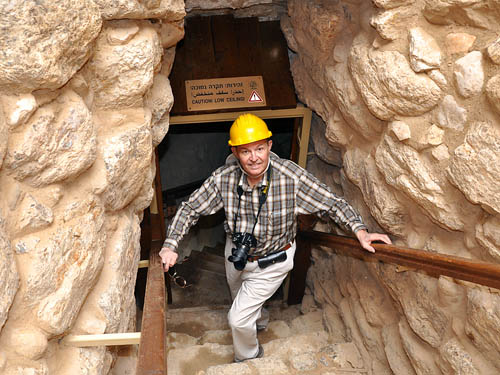
Entry to the Water System at Beersheba. Photo by Leon Mauldin.

The Iron Age Water System at Beersheba. Photo by Leon Mauldin.

“Cracked Pot Archaeology”

If you have not taken a look at Life and Land by Gordon Franz, I suggest you do so now. Gordon is a careful scholar. His material is always well researched and documented. One category that caught my attention at Life and Land is called Cracked Pot Archaeology. Here is how he describes this category.

The Cracked Pot Archaeology category contains articles about popular, contemporary archaeological theories and ideas that, like cracked pots, hold no water! These articles are a review, scholarly analysis and critiques of theories and ideas that have been presented on the Internet or popular books, movies, DVD’s and videos.

Over the past few years Gordon has written a number of articles about the claims of the late Ron Wyatt and Robert Cornuke. Last evening I presented a lesson on “Ports of Paul.” I only had time to talk about Caesarea Maritima and the events of Acts 27-28 (Malta, Syracuse, and Rhegium). I called attention to the claim of Robert Cornuke and the response by Gordon Franz. You will find his response to Cornuke’s book, The Lost Shipwreck of Paul, under the category of Paul and Places. Gordon provides information about the possible places on Malta where the shipwreck may have occurred. I will leave any discussion of that at this time, and let you enjoy working through his material.

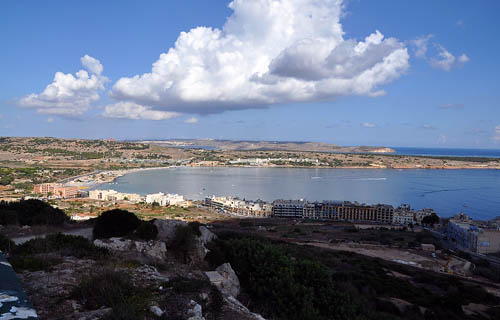
The photo below shows Mellieha Bay on Malta. Beyond the bay you may see the island of Gozo. Mellieha Bay is a few miles north of St. Paul’s Bay, the traditional site of the shipwreck. We discussed several places on Malta back in September here, here, and a few other places (use the Search box to locate places you are studying).

Mellieha Bay, Malta. Photo by Ferrell Jenkins.

Mellieha Bay, Malta. Photo by Ferrell Jenkins.

One of Gordon’s recent articles is a response to Cornuke’s claim to have found an inscription with the name of Yahweh on it. Read it here. The final sentence by Franz sums it up:

The assertion that Mount Sinai is at Jebel al-Lawz in Saudi Arabia still lacks credible and verifiable historical, geographical, archaeological, or biblical evidence.

You will find links to articles dealing with the claim that Jebel al-Lawz in Saudi Arabia is Mount Sinai.

A word of warning. Beware of someone who has discovered something all others have overlooked. Be especially wary if they have found two things no one else knows about. Shall I keep counting?

2010 Five Day Bible Reading Program

Mark Roberts, BibleClassMaterial.com, has a good five day [a week] Bible reading schedule available for 2010 here. A single copy for personal use is free. Churches and study groups may buy a license to print multiple copies. Check the catalog for other good materials currently available.