Category Archives: New Testament

More about Royal Purple

Reader/friend A.D. Riddle has supplied me with a nice photo of some Murex shells that he made in the Beirut National Museum.

Murex Shells in the National Museum of Beirut. Photo by A.D. Riddle.

Murex Shells in the National Museum of Beirut. Photo by A.D. Riddle.

Riddle also sent a copy of a 2004 essay by Joseph Doumet on “Purple Dye” (in Decade: A Decade of Archaeology and History in the Lebanon. Ed. C. Doumet-Serhal. Beirut: Lebanese of the National Museum). This is fascinating for those who may be interested in following up on this subject.

Some of the comments about the process of dyeing by Pliny the Elder impressed me. Pliny wrote his Natural History during the three years preceding his death in the eruption of Mount Vesuvius (A.D. 79). Pliny writes about the Murex Trunculus in Book 1x.

The murex also does this in a similar manner, but it has the famous flower of purple, sought after for dyeing robes, in the middle of its throat: here is a white vein of very scanty fluid from which that precious dye, suffused with a dark rose colour, is drained, but the rest of the body produces nothing. People strive to catch this fish alive, because it discharges this juice with its life; and from the larger purples they get the juice by stripping off the shell, but they crush the smaller ones alive with the shell, as that is the only way to make them disgorge the juice. The best Asiatic purple is at Tyre.

Notice especially these expressions:

  • Sought after for dyeing robes.
  • Precious dye.
  • The best Asiatic purple is at Tyre.

Still not using Logos Bible Software?

From time to time I am requested to spend some time with a younger preacher (intern/trainee). I always ask if he is using Logos Bible Software. But, I find many older preachers who seem to know nothing of the program. A little over a year ago I commented on buying Bible software here. I said,

Every young preacher should stop buying junk, ready-mixed pabulum, and get some real tools. Another advantage is that you will have no books to loan!

The thing that stirred me up today is the eNewsletter I received from Rejoice Christian Software. They are offering the Essential IVP Reference Collection 3.0 for $89.95 through October 23. They say this is a saving of 88% off the print list price.

The collection includes over 12,000 pages including…

  • Dictionary of Jesus and the Gospels
  • Dictionary of Paul and His Letters
  • Dictionary of the later NT and its Developments
  • Dictionary of New Testament Background
  • IVP Bible Background Commentary: Old Testament
  • IVP Bible Background Commentary: New Testament
  • New Bible Dictionary (2nd ed.)
  • New Bible Commentary: 21st Century Ed.
  • Dictionary of Biblical Imagery
  • New Bible Atlas
  • New Dictionary of Biblical Theology
  • New Dictionary of Theology
  • And several other works.

Did I mention that you can buy the Thomas Nelson Bible Study Library for $29.95? I am not saying that any of these books are the best, but I am sure they will be useful.

If you look up the Essential IVP Reference Collection at Rejoice Christian Software it shows a retail price of $190, with their price being $115. The special this week is $89.95, but you must order here. You will probably pay $3 or $4 for shipping. Give up some frivolity for the next few weeks and get this set of books.

Did I mention that you can search the entire collection at one time?

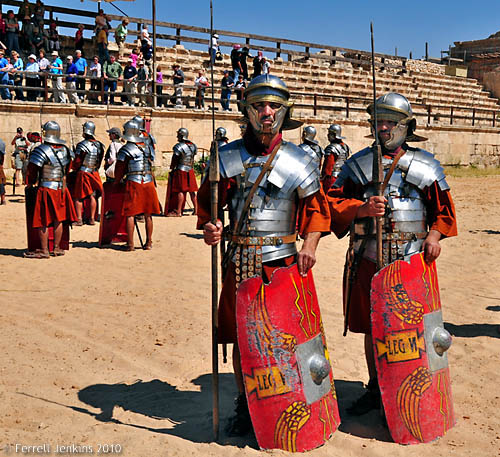
Roman soldiers in Decapolis

The RACE show at Jerash, Jordan, is a must if you have the opportunity to visit the area. RACE stands for Roman Army and Chariot Experience. You will see actors in authentic dress as armed legionaries, gladiators, and a short chariot race. The show takes place in the Roman hippodrome of Jerash. The view of the city ruins in the vicinity make this a wonderful setting for the performance. Full details may be found here. I have seen the program three times. On the last visit, earlier this year, I thought the performers showed less discipline and the show was not quite as good as on my previous visits.

Jerash was the second largest city of the Decapolis (after Damascus) in New Testament times. People from the Decapolis followed Jesus during His ministry in Galilee (Matthew 4:23-25). When Jesus traveled through the Decapolis he possibly visited the area around Jerash (Mark 7:31).

The photo shows the Roman soldiers of the 6th Legion from the time of the Emperor Hadrian (A.D. 117-138). A visit to this show provides several good photographs to illustrate New Testament times.

Roman soldiers at Jerash, Jordan. Photo by Ferrell Jenkins.

Roman soldiers at Jerash, Jordan. Photo by Ferrell Jenkins.

A larger image, suitable for presentations, is available by clicking on the photo.

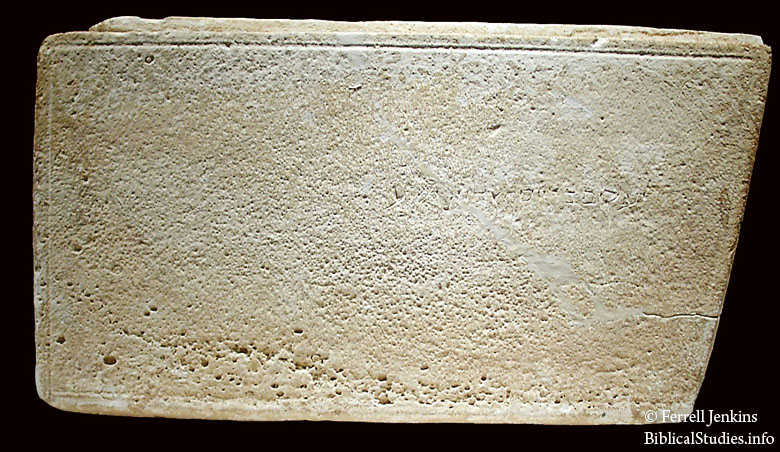
Five year long ossuary forgery trial may be coming to an end

More than five years ago prosecutors in Israel brought charges against Oded Golan for forging the inscription on the ossuary bearing the Aramaic title, “Ya’akov bar Yosef akhui diYeshua” [James the son of Joseph the brother of Jesus].

Matthew Kalman reports that the trial seems to be coming to an end.

The indictment leveled 44 charges of forgery, fraud and deception against Golan and 13 lesser counts against a co-defendant, antiquities dealer Robert Deutsch. The trial of Golan, Deutsch and three other defendants opened at the Jerusalem District Court in September 2005.

Last Sunday, the defense ended its summing up with just two men left in the dock, bringing to an end five years of court proceedings that spanned 116 sessions, 133 witnesses, 200 exhibits and nearly 12,000 pages of witness testimony. The prosecution summation alone ran to 653 pages.

Yet despite the flood of strong scientific testimony, the feeling in the tiny courtroom, where fewer than a dozen people (including only one reporter) have followed the proceedings, was that the prosecution had failed to prove the items were forgeries or that Golan and Deutsch had faked them.

You may read Kalman’s full report here.

The "James" Ossuary. Photo by Ferrell Jenkins.

The "James" Ossuary. Photo by Ferrell Jenkins.

Once the judge issues his decision we still will not have certainty about this artifact.

HT: Joseph I. Lauer

Sarcophagus of the Queen of Adiabene returns to Israel

Haaretz tells the interesting story of the discovery of the return of the sarcophagus of Helena of Adiabene to Jerusalem from Paris.

Nearly 2,000 years passed between the time the coffin of Queen Helena of Adiabene first came to Jerusalem and its recent return there. In an impressive ceremony on September 21, the coffin was put on display in the reopened archaeology wing of the Israel Museum, after having been flown in from France.

In keeping with the customs of the time, the body of the first-century C.E. queen, who was a convert to Judaism, was interred in a stone coffin, a sarcophagus, weighing around 1,200 kilograms. The coffin looks massive, says the French ambassador to Israel, Christophe Bigot, who attended the ceremony, but any careless movement could damage it.

Queen Helena’s sarcophagus wound up in France after it was discovered almost by accident in Jerusalem in 1863, when Louis Felicien de Saulcy was excavating the site called the Tombs of the Kings, in the Sheikh Jarrah neighborhood, not far from the U.S. consulate. On the third day of the dig – which was undertaken after the Ottoman authorities issued a firman, or formal permit, for it — one of the workers stepped on a tile in the floor of a structure. The tile moved, revealing an alcove beneath it that contained the sarcophagus.

De Saulcy, a French military man and the scion of a noble family, turned his attention to archaeological research in the Middle East in the mid-19th century. Hagit Maoz Lin, curator of the Israel Museum exhibition that features the sarcophagus, says that he traveled to Palestine after the death of his first wife, because he was searching for something of interest “in a place fraught with danger.” On de Saulcy’s first trip to Palestine, in 1850, he toured the Dead Sea area and, among other things, falsely identified Sodom and Gomorrah, and drew the first map of Masada and the Roman camps that surrounded it.

The sarcophagus is on loan to the Israel Museum for four months.

Queen Mother Helena of Adiabene came to Jerusalem with her son, King Izates, as a convert to Judaish in A.D. 46. Adiabene was located in northern Mesopotamia east of the Tigris River. During the famine in Judea, mentioned in Acts 11:28-30, the queen sent to Egypt for grain and to Cyprus for dried figs (Josephus, Ant. 20.51).

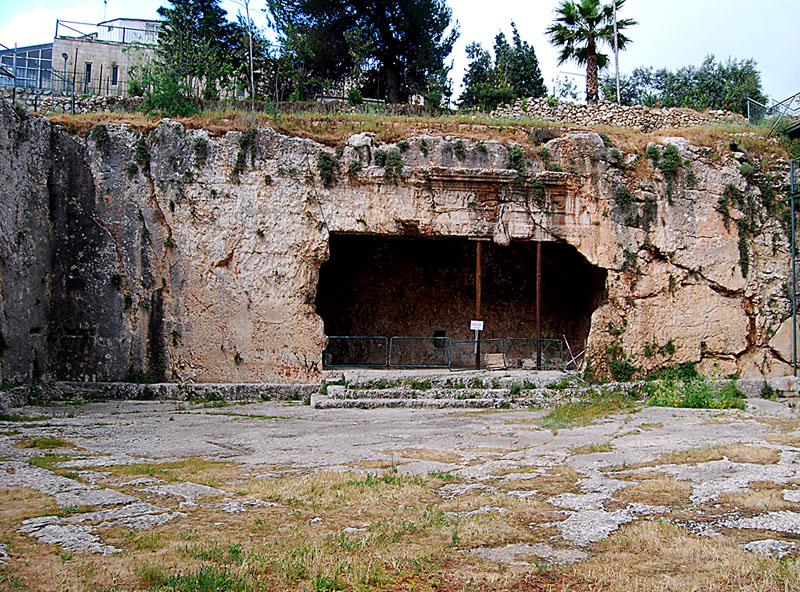
We have written about the Queen of Adiabene and her famous tomb, along with a photo of the rolling stone here. The tomb is no longer open to the public and is badly in need of repair.

The Tomb of the Kings. Photo by Ferrell Jenkins.

The Tomb of the Kings. Photo by Ferrell Jenkins.

You may read the entire article about the sarcophagus and the return of it to Israel here. There is a tiny, poor quality, image with the article.

HT: Joseph Lauer

Explorations in Antiquity Center — change of web site

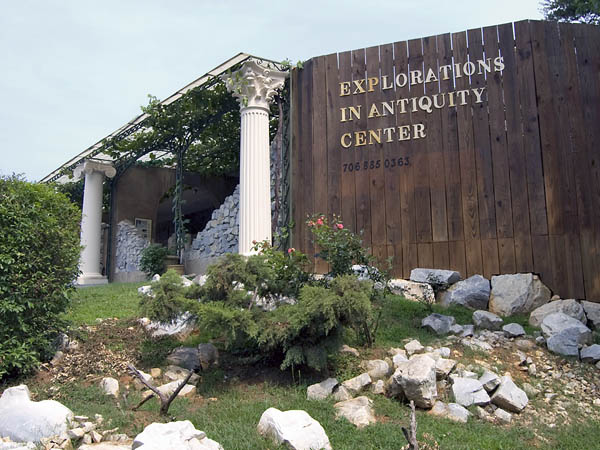
We have called attention to the Explorations in Antiquity Center, LaGrange, Georgia, here, here, here, and here.

Explorations in Antiquity Center. Photo by David Padfield.

Explorations in Antiquity Center. Photo by David Padfield.

Derrick Lewis, manager of EIA, informs us that the website address has changed to http://www.explorationsinantiquity.com. We are pleased to pass along this information.

Temple of Olympian Zeus in Athens

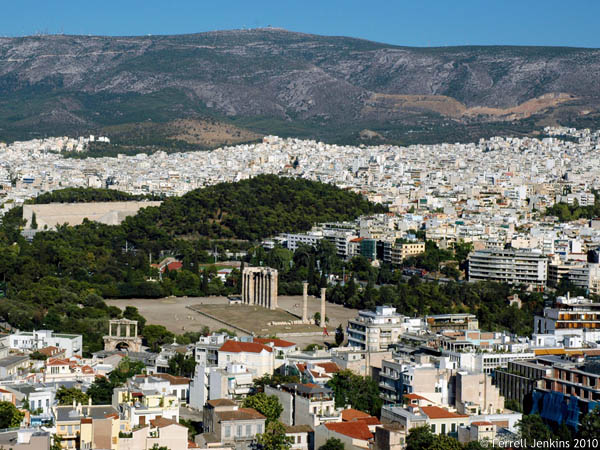
A reader asks about the location of the Arch of Hadrian that we wrote about in the previous post. The Arch is on the busy Leoforos Amalias. If you approach the arch and go through it, it leads to a park where the  Temple of Olympian Zeus, or Olympieion, stands. This is the area east of the Acropolis. The first photo shows the view from the Acropolis. The Temple is clearly visible. On the left you may also see the Olympic Stadium. The Arch of Hadrian is visible near the lower left corner.

The Temple of Olympian Zeus from the Acropolis. Photo by Ferrell Jenkins.

The Temple of Olympian Zeus from the Acropolis. Photo by Ferrell Jenkins.

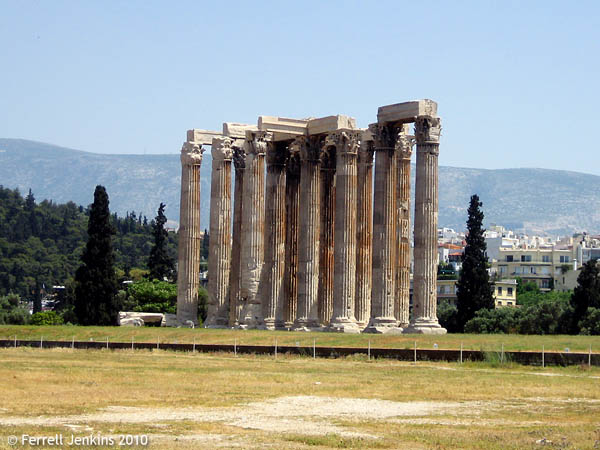
If you enter the park through the Arch of Hadrian you will have a nice view of the what remains of the Temple.

The Temple of Olympian Zeus in Athens. Photo by Ferrell Jenkins.

The Temple of Olympian Zeus in Athens. Photo by Ferrell Jenkins.

The Blue Guide on Athens and Environs says this is “the largest temple in Greece. It took 700 years to complete.” A temple was begun here as early as 550 B.C., but was not completed until the time of Hadrian.

Perhaps Paul saw this temple as he visited the sites of the city while awaiting the coming of Silas and Timothy from Macedonia.

For as I passed along and observed the objects of your worship, I found also an altar with this inscription, ‘To the unknown god.’ What therefore you worship as unknown, this I proclaim to you. (Act 17:23 ESV)

A map of Athens showing the central area, including the Arch of Hadrian, is available here.

The Book of Kells and the Scottish connection

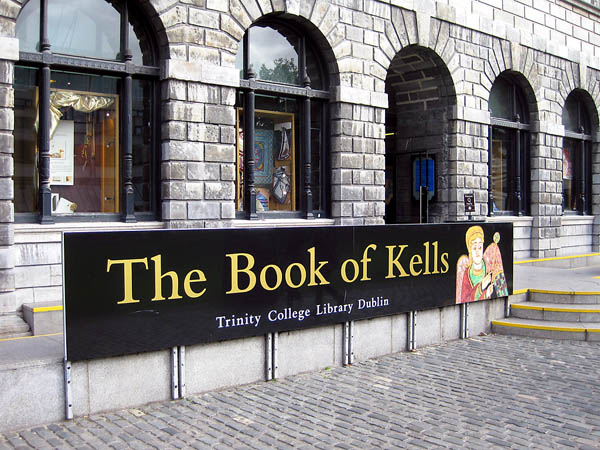
Last week I visited the Trinity College Library in Dublin, Ireland, to take another look at the Book of Kells which dates to about A.D. 800.

Entrance to Trinity College Library. Photo by Ferrell Jenkins.

Entrance to Trinity College Library and the Book of Kells. Photo by Ferrell Jenkins.

Two volumes of the famous illuminated Gospels in Latin were on display in a special case. One showed the first words of Luke 4.
And Jesus, full of the Holy Spirit, returned from the Jordan and was led by the Spirit in the wilderness. (Luke 4:1, ESV)

Two full pages were used for these words and the associated drawings. Another volume was open to John 7:31-40.

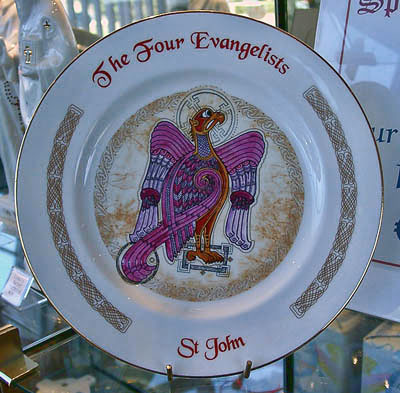
The Book of Kells is famous for its drawings showing the The Four Evangelists, that is, the four writers of the Gospels (Matthew, Mark, Luke, and John). Souvenirs may be seen in shops throughout Ireland with these images imprinted on them. Here is a plate depicting John as an eagle.

John as an Eagle. Photo by Ferrell Jenkins.

John as an Eagle. Photo by Ferrell Jenkins.

In A.D. 597 Saint Columba went from Ireland to Iona, an island near the coast of Scotland, to teach Christianity. The famous Book of Kells, an illuminated Gospels, was likely prepared by the monks of Iona about A.D. 800.

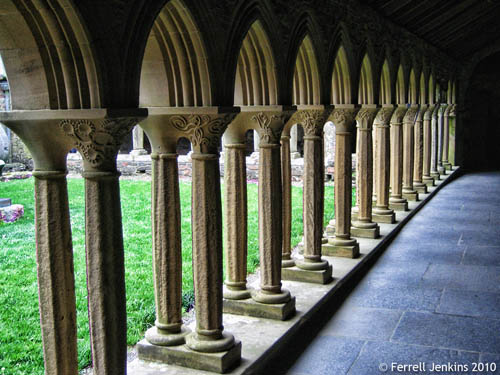
It is not certain that anything remains on the island of Iona from the time of Columba, but there are numerous medieval ruins. Here is a photo I made a couple of years on the island.

Columns on the Isle of Iona, Scotland. Photo by Ferrell Jenkins.

Columns on the Isle of Iona, Scotland. Photo by Ferrell Jenkins.

Eventually the Book of Kells was brought to the Abbey of Kells, a monastery that had been founded by Columba, about 40 miles north of Dublin.

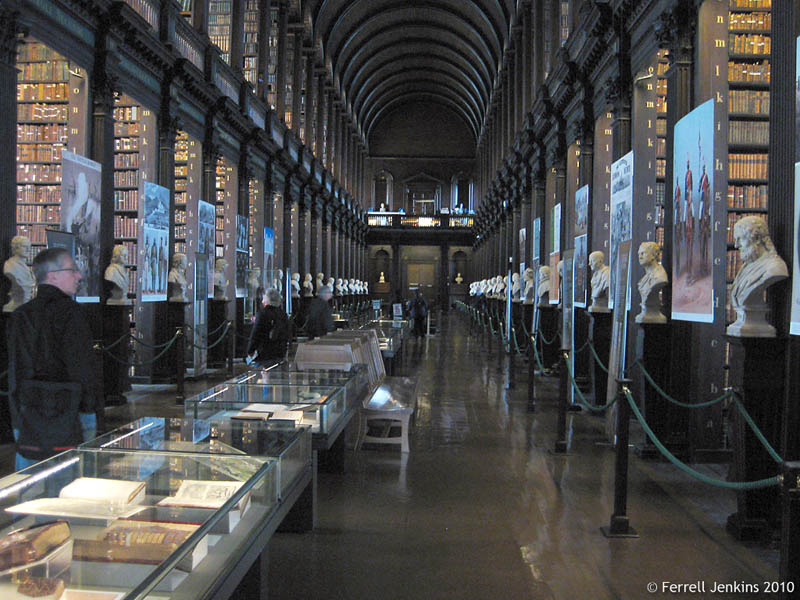
Trinity College was founded in in 1592 under a charter of  Queen Elizabeth. The oldest remaining buildings date to the early 1700s. Visitors are allowed to visit the Long Room of the Old Library. This room, almost 200 feet long, is impressive to anyone who loves books.

The Long Room of Trinity College Library

The Long Room of Trinity College Library. Photo by Ferrell Jenkins.

Samaritan synagogue discovered near Beth-shean

The Israel Antiquities Authority announced the discovery of a 1,500 year old Samaritan synagogue southwest of Beth-shean (Bet She’an).

The remains of a synagogue and farmstead that operated in the Late Byzantine period, which were unknown until now, were exposed in an archaeological excavation conducted on behalf of the Israel Antiquities Authority and underwritten by the Ministry of Construction and Housing, prior to enlarging a residential quarter south of Bet Sheʽan, c. one half kilometer west of the Jordan Valley highway (Route 90).

According to Dr. Walid Atrash and Mr. Ya’aqov Harel, directors of the excavation for the Israel Antiquities Authority, “The discovery of another Samaritan synagogue in the agricultural hinterland south of Bet She’an supplements our existing knowledge about the Samaritan population in this period. It seems that the structures uncovered there were built at the end of the fifth century CE and they continued to exist until the eve of the Muslim conquest in 634 CE, when the Samaritans abandoned the complex. The synagogue that is currently being revealed played an important part in the lives of the farmers who inhabited the surrounding region, and it served as a center of the spiritual, religious and social life there. In the Byzantine period (fourth century CE) Bet She’an became an important Samaritan center under the leadership of Baba Rabbah, at which time the Samaritans were granted national sovereignty and were free to decide their own destiny. This was the case until the end of the reign of Emperor Justinian, when the Samaritans revolted against the government. The rebellion was put down and the Samaritans ceased to exist as a nation.”

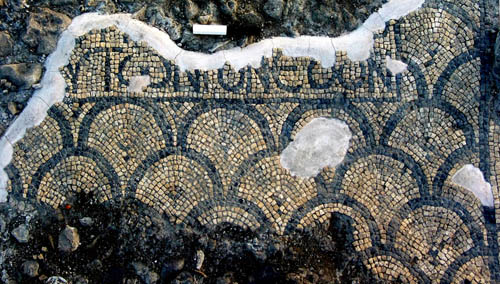
The building, facing Mount Gerizim, had a mosaic floor. The last line of a Greek inscription was revealed. According to the report, the inscription reads,

T[ ]OUTON NEWN — meaning “This is the temple.”

There will likely be other suggestions on the reading of the inscription.

Samaritan Synagogue Inscription. Photo by Tal Rogovski, IAA.

Samaritan Synagogue Inscription. Photo courtesy IAA.

This is the third Samaritan synagogue to be found in the vicinity of Beth-shean.

The full report may be read here.

Bible students know that the Samaritans play an important role in both the Old Testament and the New Testament. Follow these references for some information: 2 Kings 17:29; Luke 9:52; John 4; Acts 8;25.

HT: Joseph Lauer; Todd Bolen, Bible Places Blog.

Royal theater box at the Herodium

Last week reports began to circulate about Herod’s royal theater box at the Herodium. Here are some excepts from the News Release published by the Hebrew University of Jerusalem.

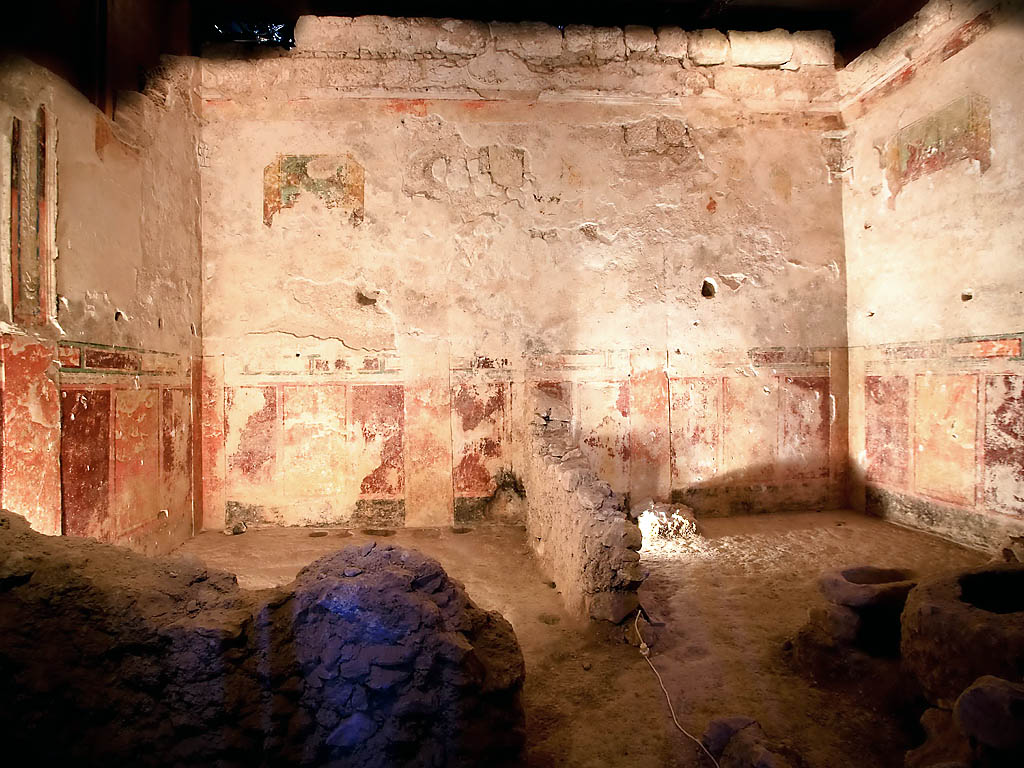
Royal box uncovered at Herodium reveals further evidence of luxurious lifestyle of famed King of Judea

A “royal box” built at the upper level of King Herod’s private theater at Herodium (Herodion in Greek) has been fully exposed in recent excavations at the site, providing a further indication of the luxurious lifestyle favored by the famed Judean monarch.

The excavations, in the frame of Herodium’s National Park at the eastern edge of Gush Etzion, were conducted by Prof. Ehud Netzer under the auspices of the Hebrew University of Jerusalem Institute of Archaeology.

The theater, first revealed during the years 2008-2009, is located halfway up the hill close to Herod’s mausoleum, whose exposure in 2007 aroused worldwide attention. The highly decorated, relatively small theater was built in approximately 15 B.C.E., which was the year of the visit to Judea of Marcus Agrippa, second in the hierarchy of the Roman Empire, said Prof. Netzer, who has been assisted in the excavations by Yakov Kalman, Roi Porath and Rachel Chachy.

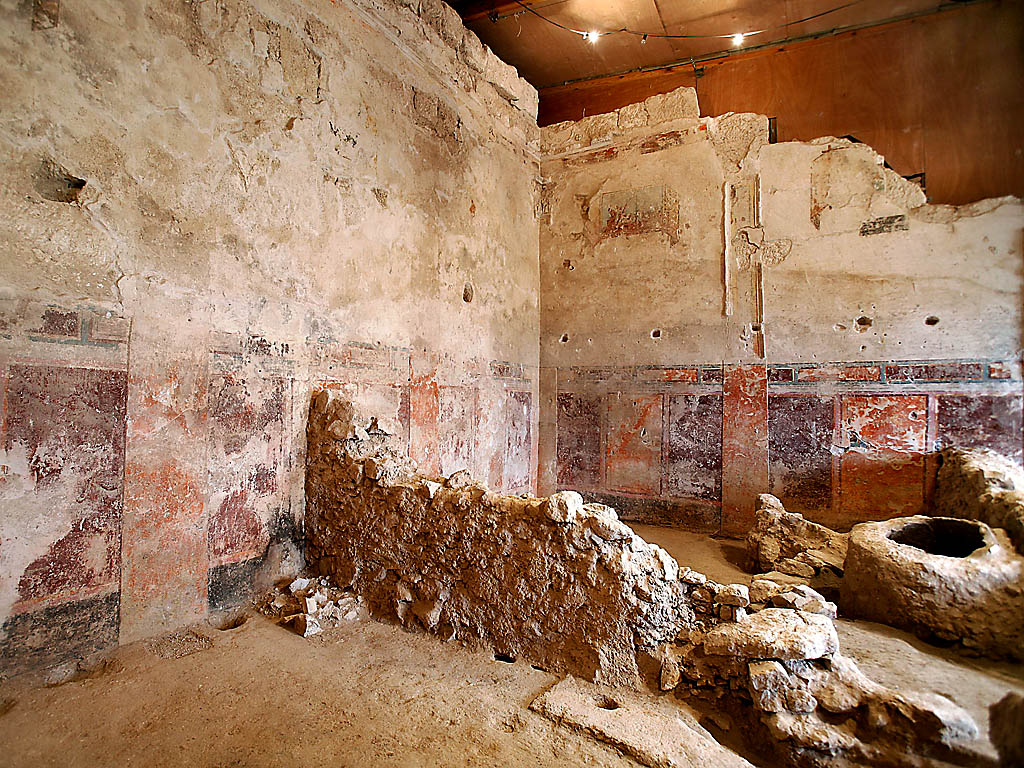
The royal box (measuring eight by seven meters and about six meters high) is the central space among a group of rooms attached to the upper part of the theater’s structure. This impressive room doubtlessly hosted the king, his close friends and family members during performances in the theater and was fully open towards the stage.

Its back and side walls are adorned with an elaborate scheme of wall paintings and plaster moldings in a style that has not been seen thus far in Israel; yet, this style is known to have existed in Rome and Campania in Italy during those years. This work, therefore, was no doubt executed by Italian artists, perhaps sent by Marcus Agrippa, who a year before his visit to Judea met Herod on the famous Greek island of Lesbos said Netzer.

On the upper parts of the walls are the room’s highlights: a series of unique “windows” painted with outfolded shutters on either side and various naturalistic landscapes within. They include scenes of the countryside, the Nile River and a nautical scene featuring a large boat with sails. One can identify features of trees, animals and human beings. Some of these windows have survived intact on the walls, whereas others were found in fragments on the floor and are undergoing restoration in the Israel Museum’s laboratory.

Painted windows with shutters appear in the late Second Pompeian Style in Italy, and mainly depict unrealistic views like theater settings and still-life. The closest parallels for the windows at Herodium are known from the “Villa Imperiale” at Pompeii, dated to the early Third Style, 15 to 10 B.C.E.

The News Release may be read in its entirety here.

Joseph I. Lauer secured the available photos and has been kind enough to share them.
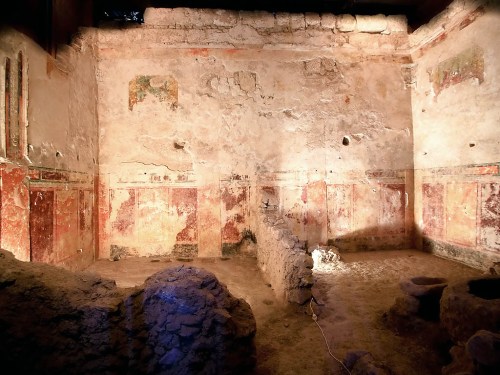
Herodium theater royal box. Photo by Gabi Laron, Hebrew University.

Herodium theater royal box. Photo by Gabi Laron, Hebrew University.

The Hebrew University report says,

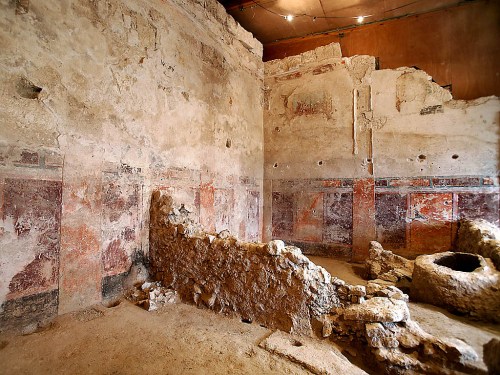
The data accumulated during the excavation proves that the theater’s lifetime was very short, less than ten years. Slightly before Herod’s death, It was deliberately destroyed in order not to disrupt the conic shape of the artificial hill. During the construction of the artificial hill (as well as the famous monumental stairway which begins at the bottom of the hill), parts of the theater, including the “royal box,” were temporarily used by the builders, leaving their footsteps in the form of subdivision walls, cooking installations and graffiti.
Herodium royal box. Photo by Tal Rogovski, Hebrew University.

Herodium theater royal box. Photo by Tal Rogovski, Hebrew University.

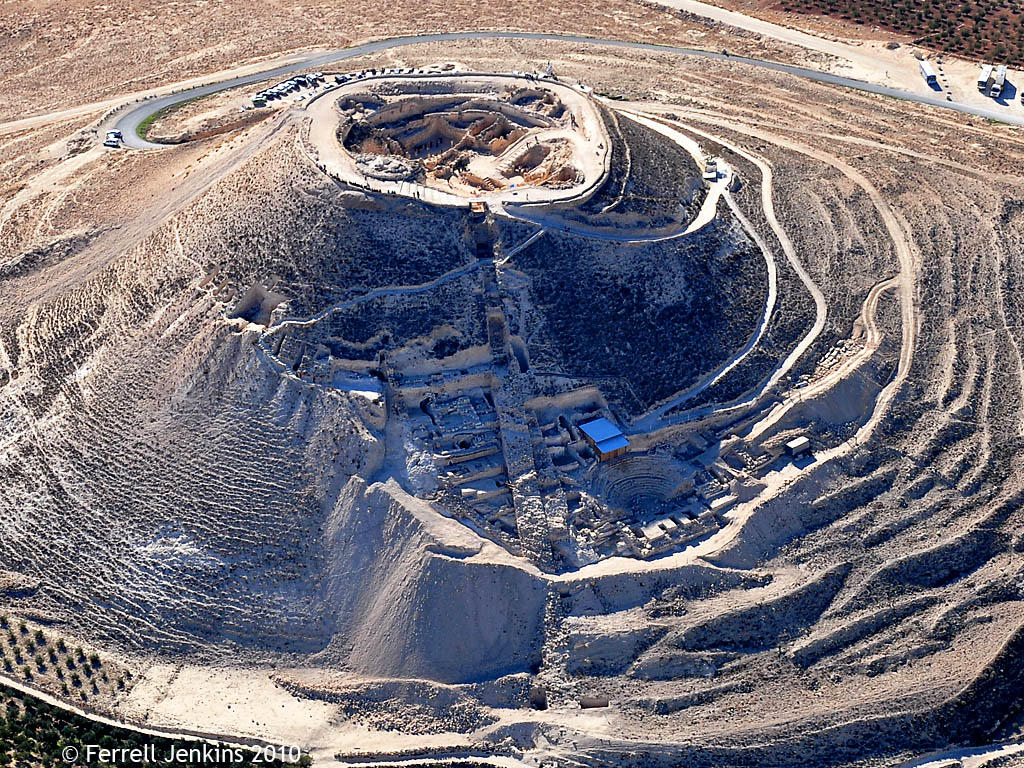
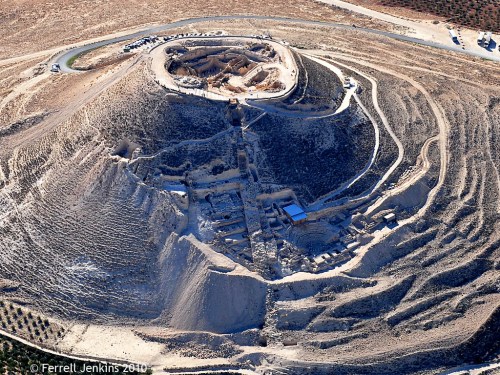
I had the opportunity to make some aerial photos of the Herodium December 15, 2009. Shadows were on the north side of the Herodium, but the massive area of the excavation can be seen. Note especially the theater. I feel certain that the royal box described above is under the blue roof. Click on the image to for a larger photo.
Aerial photo of the Herodium. Photo by Ferrell Jenkins.

Aerial photo of the Herodium. Photo by Ferrell Jenkins.

The Herodium is located about four miles southeast of Bethlehem. When we think of these two places together we recall Herod’s frantic attempt to kill Jesus.

Then Herod, when he saw that he had been tricked by the wise men, became furious, and he sent and killed all the male children in Bethlehem and in all that region who were two years old or under, according to the time that he had ascertained from the wise men. (Matthew 2:16 ESV)

All of the photos are suitable for use in teaching presentations.