Category Archives: New Testament

Ritual bath discovered at biblical Zorah

A report today from the Israel Antiquities Authority announces the discovery of a Second Temple Period ritual bath. This means the Herodian Temple that was standing at the time of the ministry of Jesus. Many Bible students think of the Herodian Temple as the Third Temple.

  1. Solomon’s Temple (built about 966 B.C.). Destroyed in 586 B.C. by the Babylonians.
  2. The post-Babylonian Exile temple built 520-516 B.C. This temple fell into decay and was rebuilt and vastly enlarged by Herod.
  3. Herod’s Temple (begun about 19/20 B.C. Destroyed in A.D. 70 by the Romans.

Archaeologist Pablo Betzer, excavation director on behalf of the Israel Antiquities Authority, said,

“This is the first time that any remains dating to the Second Temple period have been exposed in this region. We knew from the Talmud and from non-Jewish sources that on this ridge, as in most of the Judean Shephelah, there was an extensive Jewish community 2,000 years ago that existed until the destruction of the Temple in 70 CE. Yet despite the many surveys and excavations that have been carried out to date no remains from this period have been discovered so far”. According to Betzer the name of the Jewish settlement that the ritual bath belonged to is still unknown.
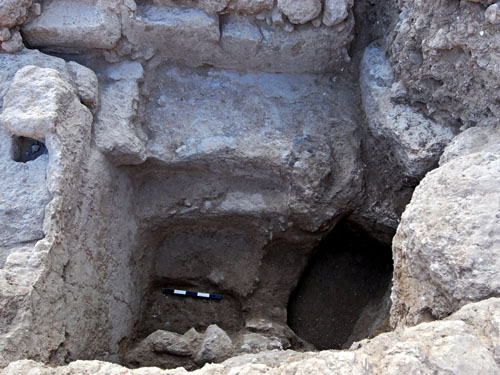
Second Temple Mikveh from Zorah. Photo by Assaf Peretz, courtesy IAA.

Second Temple Mikveh from Zorah. Photo by Assaf Peretz, courtesy IAA.

Zorah is know to Bible students as the area of Samson’s birth and activity (Judges 13-16). Manoah, Samson’s father, was a Danite from Zorah (Judges 13:2).

Questions about purification were common during the ministry of John and Jesus. This is the “Second Temple” period.

Now a discussion arose between some of John’s disciples and a Jew over purification.  (John 3:25 ESV)

The NET Bible uses the phrase “ceremonial washing” instead of “purification.”

The full press release may be read here.

HT: Bible Places Blog.

Monday Meandering — October 10

More about Paul’s Shipwreck on Malta. Gordon Franz reviews Robert Cornuke’s recent video on the claimed evidence for the shipwreck.  The review is available at the Associates for Biblical Research site here, or Gordon’s Life and Land blog here.

Gordon also exposes the photos purporting to show giant human skeletons from Greece here.

Shiloh. Leon Mauldin wrote about our recent visit to Shiloh here, here, here. The tabernacle was located at Shiloh for many years after ancient Israel came into the promised land. See Joshus 18; 1 Samuel 1-4, et al.

Recent excavations at the base of Tel Shiloh. Photo by Ferrell Jenkins.

Recent excavations at the base of Tel Shiloh. Photo by Ferrell Jenkins.

Jezreel Excavation. A well-trained team of archaeologists, headed by Norma Franklin and Jennie Ebeling, announces renewal of excavations at Jezreel. Details here.

The new website describes the importance of the location of Jezreel.

We are returning to Jezreel because it is an amazing site with a long history that reflects the rich cultural heritage of the area

Perched on the foothills of the Gilboa mountain range it commands an unparelled view over the valley below. The famous sentry site of Megiddo, Biblical Armageddon, lies 15 kms to the west and to the east the renowned city of Bet Shean (Scythopolis).

Reliability of the New Testament Manuscripts. Barry Creamer comments on the “debate between Bart Ehrman and Daniel Wallace on whether the text of the New Testament is trustworthy. Both are world class scholars in textual criticism.” Some interesting comments on the different approach taken by the two textual critics to the problem of no original manuscripts. Read here.

HT:  Bible Place Blog; Bible X.

Bible Land Food display to teach children

During a recent series of lessons on Daily Life in Bible Times I presented some material on the foods of Bible times. I emphasized that the foods ancient Israel had were those suitable to the terrain in which they lived — predominantly the mountains. One of the major biblical references about the foods is Deuteronomy 8:7-9.

 For the LORD your God is bringing you into a good land, a land of brooks of water, of fountains and springs, flowing forth in valleys and hills; a land of wheat and barley, of vines and fig trees and pomegranates, a land of olive oil and honey; a land where you will eat food without scarcity, in which you will not lack anything; a land whose stones are iron, and out of whose hills you can dig copper.  (Deuteronomy 8:7-9 NAU)

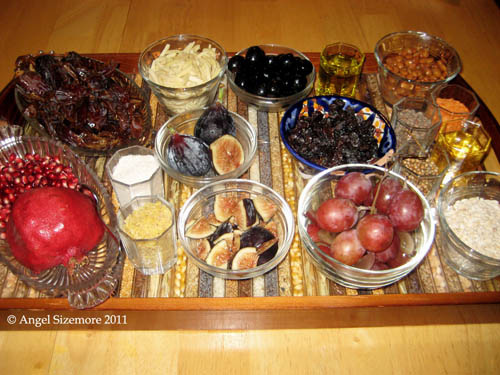
Later I learned that one of the ladies had prepared a Bible Land Food display to show the children during their Bible classes. I requested that Angel Sizemore allow me to use this material here. Here is her brief account.

— • —

After the September weekend lectures you presented at Centreville (Virginia) church of Christ, I had an idea for my class.  (I am teaching the 3rd & 4th graders this quarter). I thought that many of them may not have known what some of the food items you mentioned looked or tasted like. My family already eats most all of the items you mentioned, so I already had them in my kitchen. I had samples of several things cut up so they could taste them.

I showed the food to my own class first; then went over to the 5th & 6th grade class to show them; and finally to the little ones in the 1st & 2nd grade class. It was a HUGE hit with the children of all ages! I have heard from several of their parents that their kids really enjoyed it, and a couple of them had to scour the produce sections looking for their kid’s new favorite foods (like dates and pomegranates!).

Anyway, thank you for helping me to learn so much, and for inspiring me to teach more about it to our own little ones.

Bible Land Foods display by A. Sizemore. Ferrell's Travel Blog.

Bible Land Foods display by A. Sizemore.

Angel provided a list of the foods on the tray. (Click on the photo for a larger image.)

Foods included:
  • Dates — some whole and some cut up so they could taste it
  • Almonds — slivered
  • Black olives
  • Olive oil
  • Lentils — some dry brown and red lentils, and cooked brown lentils to taste
  • Coriander seed — threw that in because of the description of manna
  • Honey
  • Barley
  • Red grapes — some cut up so they could eat them
  • Raisins
  • Figs — some whole and some cut up so they could taste it
  • Cracked wheat [we also spoke of barley]
  • Whole wheat flour
  • Pomegranate — half of a fruit intact, some seeds so they could taste it
  • Cheese — not pictured but added to display — made with mix of goat/sheep milks
The kids enjoyed tasting everything, even stuff I didn’t intend for them to eat (like the raw lentils and olive oil)!
— • —
Note: Most of these foods have been discussed on the Travel Blog. Just use the search box to locate the posts. I have found that the search works best if you use only a single word. Try fig instead of figs. Try wheat instead of cracked. You will find coriander though I did not mention it in the lesson in Virginia.
Thanks to Angel for allowing us to share this wonderful teaching aid with our readers.

Enduring Word Exhibit at the Museum of Biblical History

The Museum of Biblical History in Collierville, Tennessee, announces the Enduring Word Exhibit In Celebration of the King James Bible’s 400th anniversary.

Would you like to know more about Johannes Gutenberg and his famous printed Bible? Gutenberg was the first European to use movable type printing, in around 1439, and the global inventor of the printing press. If you go to the museum named after him in his hometown, Mainz, Germany, you can learn a lot about him. Instead, why not come to the Museum of Biblical History in Collierville, Tennessee, during our “Enduring Word” exhibit, open October 1 through 9, Sundays 1-5 PM, Monday-Saturday 10 AM-7 PM.

In addition to the Bible exhibit, a special feature of the exhibit is the operation of a full-scale working model of Gutenberg’s press.

By special arrangement Dr. Rusty Maisel will operate his full-scale, working model of Gutenberg’s press during this exhibit, in celebration of the King James Bible’s 400th year. He will print page facsimiles from Gutenberg’s famous Latin Bible of 1456 and from the first edition of the King James Bible of 1611. He will also exhibit his collection of ancient biblical manuscripts and early printed Bibles in our main museum gallery. Maisel, an international authority on the history of the Bible, can be with us for nine days only. Don’t miss this wonderful learning opportunity.

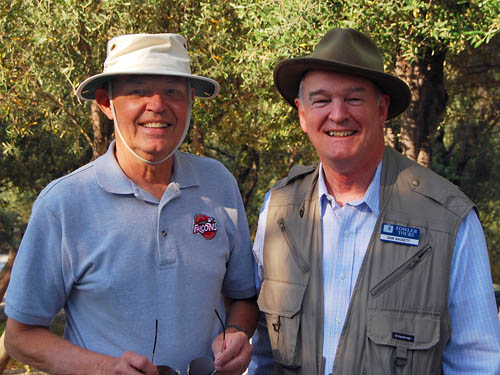
Ferrell Jenkins & Don Bassett at the Acropolis in Athens.

Ferrell Jenkins & Don Bassett at the Acropolis.

Details about the Museum of Biblical History, including this special exhibit, may be found on the Museum website here. Collierville is located a few miles southeast of Memphis, Tennessee.

Don Bassett is Chairman of the Museum of Biblical History. Don is a long time friend. Our tours crossed paths at the Acropolis in Athens, Greece a few years ago.

“Come up in the morning to Mount Sinai”

After the original tables of stone containing the Ten Commandments written by the finger of God were broken, Moses was told to be ready and “come up in the morning to Mount Sinai.”

Be ready by the morning, and come up in the morning to Mount Sinai, and present yourself there to me on the top of the mountain. (Exodus 34:2 ESV)

The Christian martyr Stephen reminded his audience that Moses received living oracles on Mount Sinai.

He received living oracles to give to us. (Acts 7:38 ESV)

Perhaps this is one of the reasons so many persons put forth the effort to approach the top of a mountain presumed to be Mount Sinai.

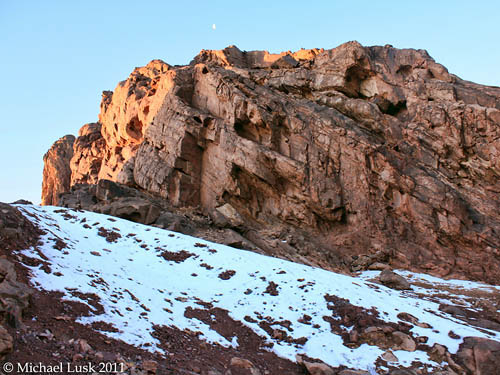
We began telling you about Michael’s trek to the top of the mountain on the morning of January 26, 2011. As he approached the top of the 7,519 feet high Jebel Musa he recorded several instances of snow.

Snow near summit of Jebel Musa, Jan. 26, 2011. Photo by Michael Lusk.

Snow near summit of Jebel Musa, Jan. 26, 2011. Photo by Michael Lusk.

One can never be sure about weather conditions. Reader Beverly Sansom left this comment yesterday:

Yes, we climbed the same mountain in mid-March 2011. Our view of the sunrise was but a sliver due to clouds, but the mountain grandeur was breathtaking. At the top were other Christians singing “How Great Thou Art” in a foreign language. We joined in!

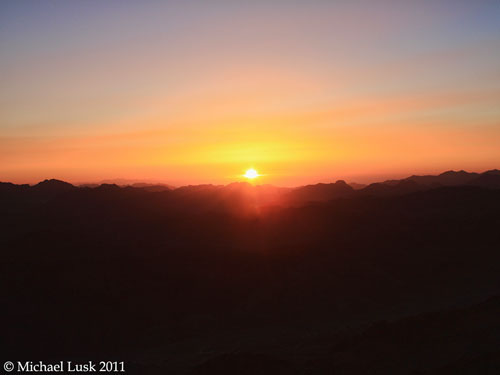
Michael had a good morning from the perspective of a photographer. Here is one of his sunrise photos.

Sunrise from top of Jebel Musa - Traditional Mount Sinai

Sunrise from top of Jebel Musa, January 26, 2011. Photo by Michael Lusk.

Thanks to Michael for sharing these photos with our readers.

A special offer for Baker N.T. Commentary

Baker N.T. Commentary

Baker N.T. Commentary

Rejoice Christian Software makes some of the best offers on software of any seller that I know about. From now until September 22 they are offering the 12 volume Baker New Testament Commentary software program for the incredibly low price of $49.95. I think you will pay $2.95 for shipping in the USA. This means that for $53 you will have the software program covering all 27 books of the New Testament. These book are written by Presbyterian scholars William Hendriksen and Simon Kistemaker.

Read more about the commentary set here. Note that the price there is $79.95 (already a bargain), but you must go to this link to get the $49.95 price.

The Libronix software program needed to access the books is included.

Even if you have a few of the print volumes you can give them to someone who refuses to use a computer and still have a great deal for yourself.

I do not own stock in this company, and I already have the set on my computer. The deal is so good I am tempted to order again. 🙂

Be sure you sign up for the RCS newsletters.

A day in the West Bank

There was a time that it was easy to visit sites in the Palestinian West Bank. That is no longer true. Car rental companies will not permit their cars to be taken into the West Bank. We hired a driver and vehicle (4WD) to take us several places. I think we were fortunate to obtain the services of a tourist bus driver who happened to have a day free. Even for him going into the West Bank was not easy.

First it is necessary to choose the appropriate border crossing. Then instead of taking what formerly was the most direct route drivers must go in circles to avoid running into the fence (or wall). This is especially true near Jerusalem.

Our first stop was Gibeon (Joshua 9-10). The last time I was there to see the excavations by James Pritchard of the University of Pennsylvania I drove directly to the ruins. This time it was extremely difficult to reach the same ruins. We were successful in our efforts and got some good photos that we hope to share later.

We also stopped at Shiloh where the tabernacle was set up after the ancient Israelites entered Canaan  (Joshua 18:1). A team from the Israel Antiquities Authority was excavation in three different areas low on the tel in areas mostly from the Islamic and Byzantine period.

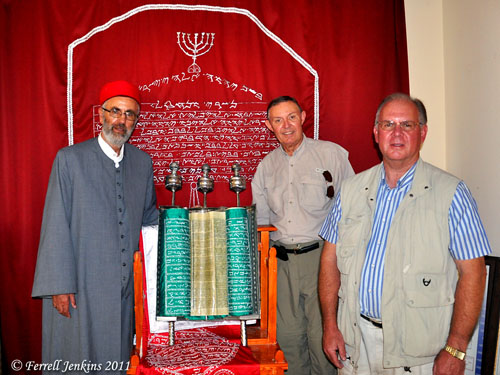
Next we went to Mount Gerizim to visit the Samaritans Museum. Husney W. Cohen, a priest and director of the Museum, was kind to show us around and explain the Samaritan viewpoint about several biblical events. Samaritans believe the temple was to be built on Mount Gerizim rather than Jerusalem. They think Abraham offered Isaac on the mountain. They accept only the first five books (the Pentateuch) of the Old Testament. In this photo you see Cohen, myself, and Leon Mauldin with the ancient scroll. This scrolls look to be much newer, or better preserved, than the old one I photographed many years ago (here).

wSamaritan Scroll at Mount Gerizim

Samaritan Scroll at Mount Gerizim. Husney W. Cohen, Ferrell Jenkins, Leon Mauldin.

I understood Husney W. Cohen to say that he was third in line to become the High Priest of the Samaritans.

We had hoped to visit the archaeological work on Mount Gerizim, but it was closed due to some construction.

We made a short stop at Jacob’s well (John 4). Then we visited the new Tel Balata Archaeological Park. Tel Balata is the site of biblical Shechem (Genesis 12:1). While in Nablus we also made a short stop at the traditional Tomb of Joseph (Joshua 24:32).

We left the central mountain rain through Wadi Farah (now called Wadi Tirza by the Israelis.   We were short on time and did not try to stop at Tirza (1 Kings 15:33). The springs that once flowed through the valley are now practically dry. I understand this is because the water is being piped away by Israel for use by the settlements.

We stopped at Jericho and made a visit to Tell es-Samarat (the site of Herod’s hippodrome) and Herod;s Palace (Matthew 2). New signs have been erected to point to these places, but the roads to them are terrible. The sites are in terrible condition and there are no explanatory signs.

In the future we hope to show some photo of some of these places.

Travel in the Plain of Acco and the Plain of Sharon

We saw most of what we had intended today, but due to a late start from Tiberias it was a long day. We got to Jerusalem a little late, went immediately to the dining room, and then made it to our room about 9:30 p.m.

We drove from Tiberias to Acco (Akko, Acre), a city of the biblical tribe of Asher, is mentioned in Judges 1:31. The city was known as Ptolemais in New Testament times. Paul stopped at Ptolemais and stayed with the brethren for a day on the return from his third journey (Acts 21:7).

We continued north along the Plain of Acco past Achziv (English versions use Achzib) (Joshus 19:29) to the Ladder of Tyre. More explanation latter. This natural formation has served as a natural boundary for centuries.

In the late afternoon we stopped in the Plain of Sharon, a few miles north of Caesarea, at the town of Beit Hananya to see a portion aqueduct that carried water to Caesarea. This portion of the aqueduct was constructed during the reign of the Roman Emperor Hadrian in the early second century A.D.

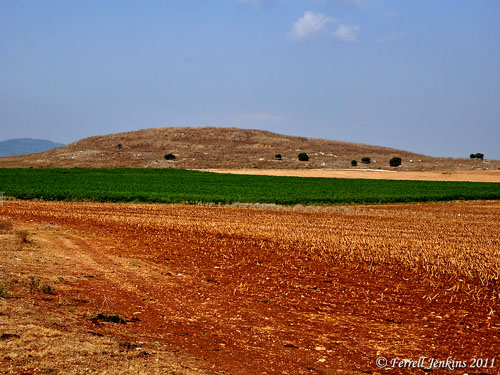
For a photo I want to share Tel Hannathon, the site of a town once belonging to the tribe of Zebulon.

The border circled around it on the north to Hannathon, and it ended at the valley of Iphtahel. (Joshua 19:14 NAU)

Tel Hannathon. Photo by Ferrell Jenkins.

Tel Hannathon. Photo by Ferrell Jenkins.

Hannathon is one of those places mentioned in the Bible that is simply passed over by most readers and teachers. The city was a real place in Bible times, occupied by real people who really did the things recorded in Scripture. Don’t let the details pass you by. Sometimes they can be highly significant.

We have an exciting day planned for tomorrow with a driver who will go with us to visit sites in the West Bank. Most of the rental car companies in Israel do not allow their cars to be driven in the West Bank.

Roman temples and hard to reach cities

Today was a busy day and one of the most productive of this trip. Several of the places we visited are difficult to reach today, but at the time of their glory they were on main routes of travel.

Our first stop was at Omrit in northern Israel, about 4 miles SW of Banias. Two temples have been found here. One of them dates to the late first century B.C. Some scholars suggest that this is the Temple of Augustus built by Herod the Great.

Omrit is not mentioned in the Bible, but may prove to be significant in accounts of the ministry of Jesus. It was located in the region known as Ituraea. Philip, the son of Herod the Great, was “tetrarch of the region of Ituraea and Trachonitis” (Luke 3:1).

Though not new to us, we stopped for a while to make some photos at Hazor.

Next stop was for lunch at McDonald’s.

We stopped at Khirbet (or Horbat) Amudim, site of an ancient synagogue. Our main interest was in seeing the area of travel between Cana and the towns around the Sea of Galilee.

A stop at Hannathon allowed us to get a photo of the tel. This site is mentioned as being in the territory of Zebulon in Joshua 19:14.

Yodfat (or Jotapata) is important because it is where Josephus led Jewish rebels against the invading Romans in 66 A.D.

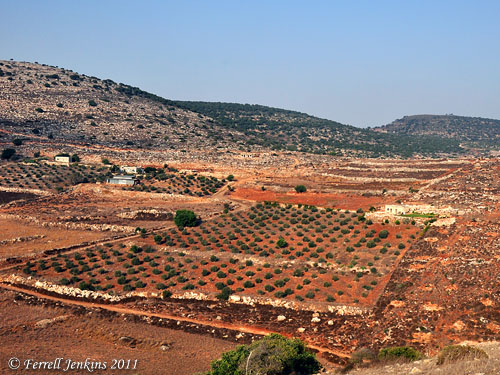
The photo below is of one of the beautiful valleys around Yodfat.

Fertile valley below Yodfat. Photo by Ferrell Jenkins.

Fertile valley below Yodfat. Photo by Ferrell Jenkins.

With the help of a local farmer we were led to an overlook where we could see Khirbet Kana (Cana), likely the site of the events of John 2. We had too little time left to make the full walk to the site. Always a reason for another visit.

We arrived back at the hotel in Tiberias about 7 p.m. In coming weeks we hope to share some of the new photos. with our readers.

A beautiful day in Galilee

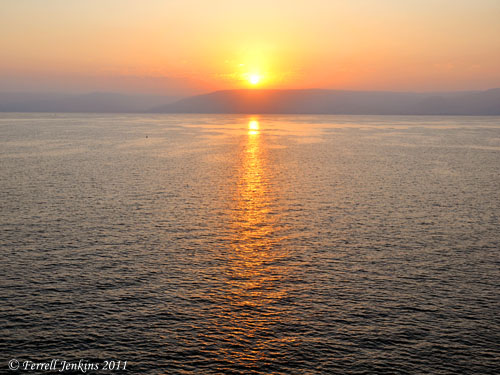
Sunrises on the Sea of Galilee can be extremely beautiful. I know that I have posted several photos of the sunrise, but I wanted to share another one from this morning.

Sunrise on the Sea of Galilee. Photo by Ferrell Jenkins - 09-04-11

Sunrise on the Sea of Galilee. Photo by Ferrell Jenkins - 09-04-11

Much of the ministry of Jesus was conducted on and around the Sea of Galilee. One of the important events recorded in Scripture is the calling of disciples.

Passing alongside the Sea of Galilee, he saw Simon and Andrew the brother of Simon casting a net into the sea, for they were fishermen. (Mark 1:16 ESV)

We went to Nazareth this morning to worship with the church there. Afterwards we spent a good bit of time in Mash’had, a small Arab town between Nazareth and the traditional site of Cana,  trying to locate the tell where the ancient city of Gath Hepher, the home of the prophet Jonah,  is thought to be located. Hopefully we will be able to tell you more about that experience later.

In May I wrote about locating and walking on a portion of the Roman Road near Golani Junction here. I wanted to share this experience with Leon, so we returned there.

There were some other things, but this will be enough for today.

It is hot at this time of the year, and especially when tramping around over hill and vale.