Category Archives: New Testament

Of camels and needles

Jesus warned His disciples about the danger of riches. On one occasion He said,

In fact, it is easier for a camel to go through the eye of a needle than for a rich person to enter the kingdom of God.”  Those who heard this said, “Then who can be saved?”  He replied, “What is impossible for mere humans is possible for God.”  (Luke 18:25-27 NET; cf. Matthew 19:24-26; Mark 10:25-27)

I suppose in the time of Jesus almost everyone had seen a camel and understand what Jesus was talking about. And most of them also had seen a needle.
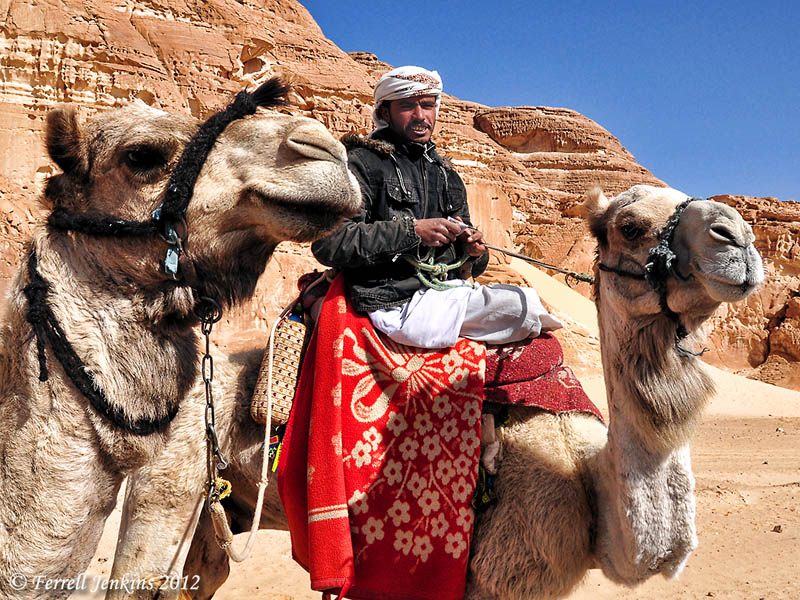
Camels and rider in the Sinai Peninsula. Photo by Ferrell Jenkins.

Camels and rider in the Sinai Peninsula. Photo by Ferrell Jenkins.

The bronze needle below is displayed in the British Museum. The camel above is greatly reduced, and the needle below is greatly enlarged.

Bronze needle from the Roman period. British Museum. Photo by Ferrell Jenkins.

Bronze needle from the Roman period. British Museum. Photo by Ferrell Jenkins.

What did Jesus mean? There is a popular theory that there was a gate in Jerusalem with a smaller gate called the eye of the needle. It is said that the camel could go through the small gate when the burden was unloaded.

Sounds good doesn’t it? But it destroys the teaching of Jesus. Jesus spoke of something that was impossible for mere humans, but possible for God.

Many of the medieval gates we know of in ancient cities had a small gate within the larger gate. There was no need to open a huge gate just for any individual to pass.

Authors of Hard Sayings of the Bible, after mentioning this legend, say,

But this charming explanation is of relatively recent date; there is no evidence that such a subsidiary entrance was called the eye of a needle in biblical times. (438)

They also warn of the temptation to tone down the teaching of Jesus.

There is probably no saying of Jesus which is harder in the Western mind today than the saying about the camel and the needle’s eye, none which carries with it such a strong temptation to tone it down. (439).

The IVP Bible Background Commentary: New Testament comments on the eye of the needle at Mark 10:25.

This image reflects a Jewish figure of speech for doing something impossible (a large animal going through a needle’s eye). The saying, a hyperbole, refers to a literal needle. (Those who think Jesus refers here to a gate in Jerusalem called the “eye of a needle” are mistaken, because that gate was built in medieval times.) A wealthy person could relinquish wealth only by God’s grace (10:26–27).

Millstones work better than concrete shoes

Jesus used the common millstone in one of his teaching illustrations.

And he said to his disciples, “Temptations to sin are sure to come, but woe to the one through whom they come!  It would be better for him if a millstone were hung around his neck and he were cast into the sea than that he should cause one of these little ones to sin. (Luke 17:1-2; cf. Matthew 18:6; Mark 9:42 ESV)

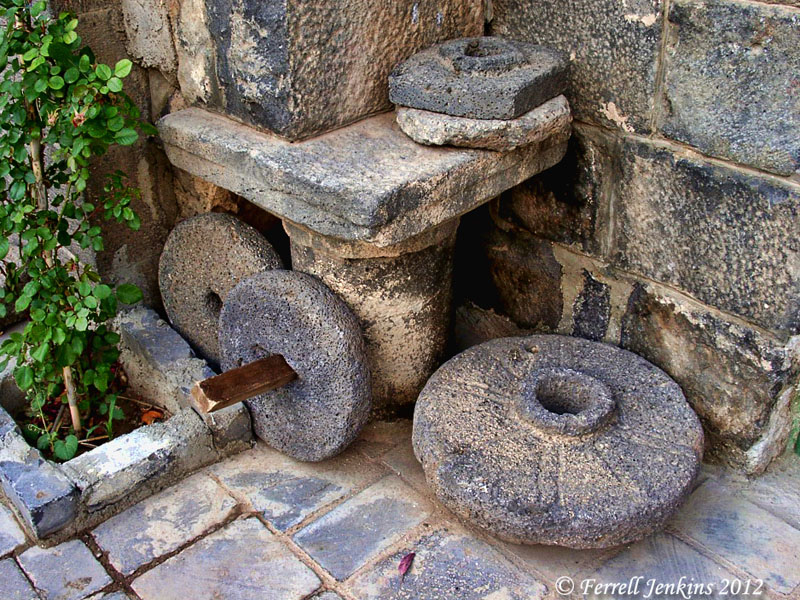
The photo below shows a collection of millstones at the Roman ruins of Bosra in southern Syria, a few miles north of the border with Jordan, in a region known as Hauran. The area has seen much volcanic action in the past. These dark millstones are made of basalt. The region is described by Ulrich Hübner this way.

Bozrah lies on one of the fruitful and water-rich plains of S Haurān at the important intersection of the N–S route, which leads from Damascus through the Transjordan to the Hejaz, with the E–W route, on which one could travel from the Mediterranean to Mesopotamia. (The Anchor Yale Bible Dictionary)

Mill stones at the Roman town of Bosra, Syria. Photo by Ferrell Jenkins.

Mill stones at the Roman town of Bosra, Syria. Photo by Ferrell Jenkins.

This Bosra is not to be confused with Bozrah in Edom (Genesis 36:33) or Bozrah in Moab (Jeremiah 48:21-24).

Millstones were significant in Bible times.

  • Used for grinding grain (even manna) (Numbers 11:8; Isaiah 47:2).
  • The work might be done by a slave girl (Exodus 11:5), or two women working together (Matthew 24:41).
  • Taking a person’s upper millstone as a pledge would deprive the person of his livelihood (Deuteronomy 24:6).
  • A woman at Shechem “threw an upper millstone on Abimelech’s head, crushing his skull” (Judges 9:53; 2 Samuel 11:21).
  • In the LORD’S challenge to Job, He describes Leviathan with a heart as hard as stone, “Even as hard as a lower millstone” (Job 41:24).
  • The sinking of a great millstone is used in the Apocalypse to describe the fall of Babylon (Revelation 18:21).

Santorini sunset

Perhaps like many of you, I have been occupied with working on taxes the past few days. Not much time to write something substantial. I decided to share one of the sunset photos I made of the island of Santorini silhouetted against the sunset.

Santorini at sunset. Photo by Ferrell Jenkins.

Santorini at sunset. Photo by Ferrell Jenkins.

The sun plays a prominent role in the visions of John from the island of Patmos, also in the Aegean. Note just this one reference to the woman who gives birth to the “male child.”

And a great sign appeared in heaven: a woman clothed with the sun, with the moon under her feet, and on her head a crown of twelve stars. She was pregnant and was crying out in birth pains and the agony of giving birth. (Revelation 12:1-2 ESV)

The pods that the pigs were eating

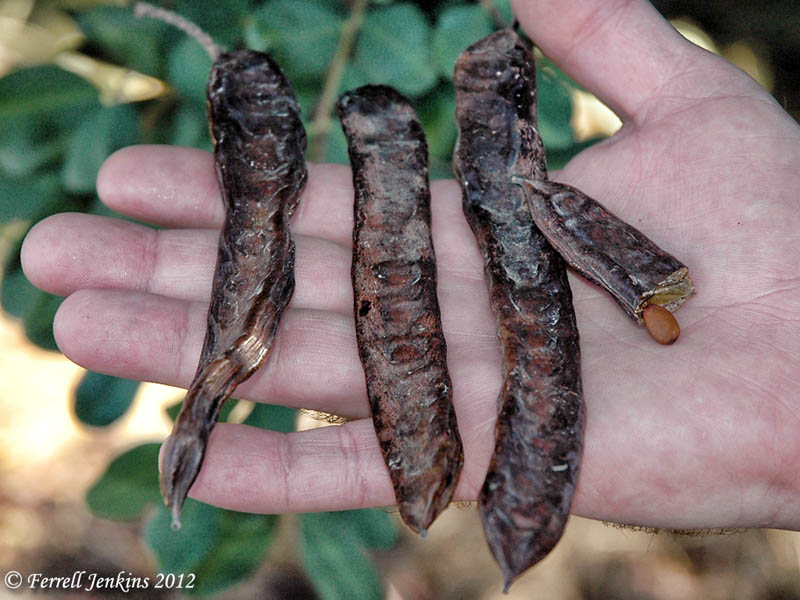
In the parable of the young prodigal and his older brother, Luke says that when the younger brother ran out of money he would gladly have eaten the pods the pigs were eating.

He was longing to eat the carob pods the pigs were eating, but no one gave him anything. (Luke 15:16 NET)

BDAG says that the word keration (translated pod) in used in the plural “of the fruits of the carob tree, carob pods.” Louw-Nida states that the word is “a diminutive derivative of keras which means horn. They add,

the pod of the carob tree (which closely resembles a small horn.…Carob pods were commonly used for fattening swine and were employed as an article of food by poor people.

The first photo shows dried pods from the Carob tree.

Carob pods near the Valley of Aijalon. Photo by Ferrell Jenkins.

Carob pods near the Valley of Aijalon. Photo by Ferrell Jenkins.

Some nutritionists suggest that carob is high in protein content and is a good substitute for chocolate.

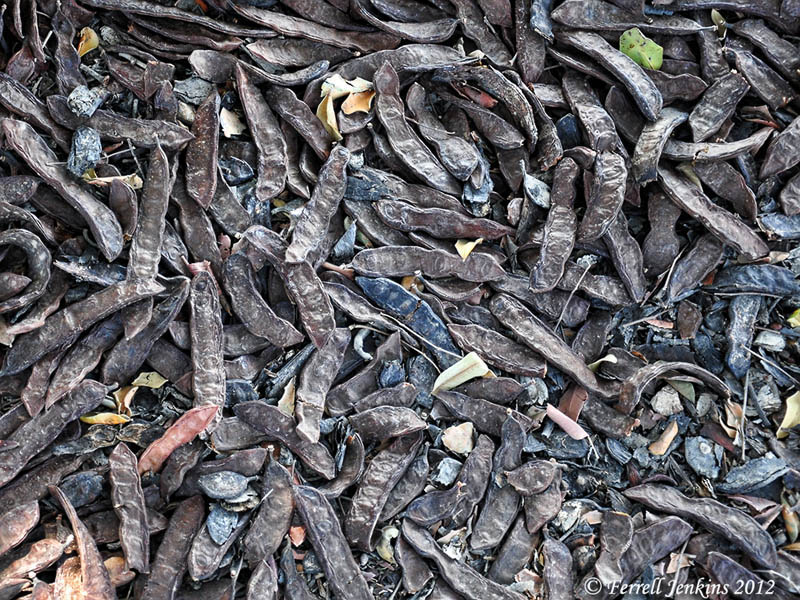
The next photo shows dried pods underneath a Carob tree. Having been brought up on a farm, I can easily image the pigs rooting in these pods to get the best one.

Dried carob pods under a tree at Hazor. Photo by Ferrell Jenkins.

Dried carob pods under a tree at Hazor. Photo by Ferrell Jenkins.

The prodigal son came to himself and headed for home. There is a good lesson in this for each of us when we become too attached to the things of this world (1 John 2:15).

The Empty Tomb

The Gospel of Mark provides a brief account of the events of the first day of the week after the crucifixion of Jesus. The women went to the tomb of Jesus to anoint his body. The approach of the Sabbath did not allow this on Friday.

1 When the Sabbath was past, Mary Magdalene, Mary the mother of James, and Salome bought spices, so that they might go and anoint him.
2 And very early on the first day of the week, when the sun had risen, they went to the tomb.

These grieving women were concerned about the removal of the large stone that had been rolled over the tomb opening and sealed by the Roman authorities. They were surprised when they discovered that the stone had already been removed.

3 And they were saying to one another, “Who will roll away the stone for us from the entrance of the tomb?”
4 And looking up, they saw that the stone had been rolled back–it was very large.

Perhaps they thought that some others, unknown to them, had come to provide the same service. They were alarmed to see the young man in a white robe.

5 And entering the tomb, they saw a young man sitting on the right side, dressed in a white robe, and they were alarmed.

The message was an unexpected one, but one that they were to share with his disciples and Peter and to tell them to update their appointment calendar to include a meeting with Jesus in Galilee.

6 And he said to them, “Do not be alarmed. You seek Jesus of Nazareth, who was crucified. He has risen; he is not here. See the place where they laid him.
7 But go, tell his disciples and Peter that he is going before you to Galilee. There you will see him, just as he told you.”
8 And they went out and fled from the tomb, for trembling and astonishment had seized them, and they said nothing to anyone, for they were afraid. (Mark 16:1-8 ESV)

The message that these women took with them was that the tomb was empty and that Jesus had risen from the grave. From this time forward He would be acknowledged by believers as Lord and Christ (Acts 2:36).

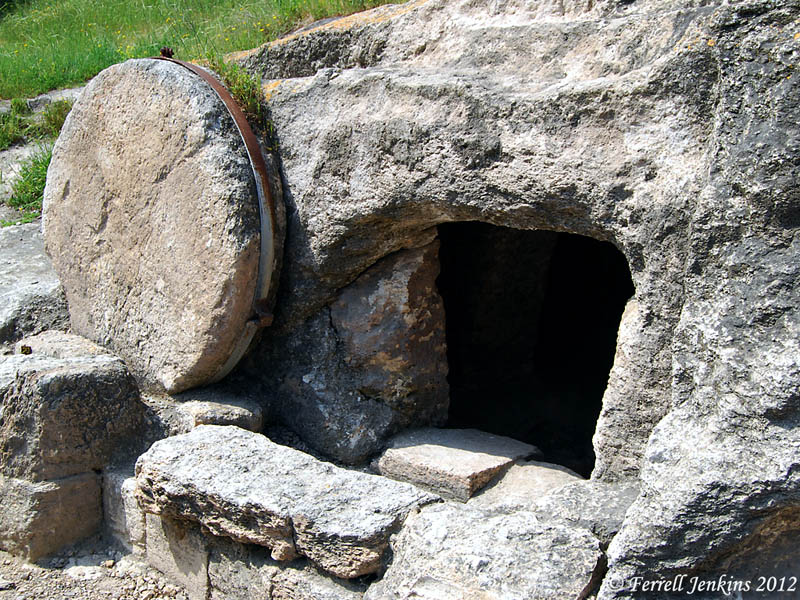
An empty Roman period tomb with a rolling stone. Photo by Ferrell Jenkins.

The Via Dolorosa – the way of suffering

The day of the crucifixion of Jesus was an incredible day in history. Early in the morning Jesus was transferred from Caiaphas, the Jewish High Priest, to Pontius Pilate, the Roman military governor. When Pilate learned that Jesus was from Galilee, he sent Him to Herod Antipas. Herod quickly sent Him back to Pilate. Under pressure from the religious leaders, Pilate delivered Jesus to be crucified. The numerous events from the last day prior to the crucifixion of Jesus are recorded in the New Testament (Matthew 26-27; Mark 14-15; Luke 22-23; John 18-19).

As early as Byzantine times Christians began to follow the final steps of Jesus on specified days. Over the centuries many changes were made in the route and the stops. The traditional Via Dolorosa, as known today, was fixed in the 18th century.

Jerome Murphy-O’Connor says,

The Via Dolorosa is defined by faith, not by history. (The Holy Land, 5th edition, 37)

He continues,

The present Way of the Cross has little chance of corresponding to historical reality… (38)

According to tradition, the fifth station of the cross is where Simon of Cyrene (modern Libya) was compelled to bear the cross of Jesus. Some of the stations of the cross are not mentioned in the New Testament, but this one is.

As they led him away, they seized Simon of Cyrene, who was coming in from the country. They placed the cross on his back and made him carry it behind Jesus. (Luke 23:26 NET; cf. Matthew 27:32; Mark 15:21)

Via Dolorosa in Jerusalem. Station V. Simon of Cyrene is compelled to carry the cross of Jesus. Photo by Ferrell Jenkins.

The Via Dolorosa in Jerusalem. Station V. Simon of Cyrene is compelled to carry the cross of Jesus to Golgotha. Photo by Ferrell Jenkins.

Reclining in the Upper Room

Each of the Gospels tell us something about the last supper Jesus ate with His disciples prior to the crucifixion. Matthew says,

Now on the first day of Unleavened Bread the disciples came to Jesus, saying, “Where will you have us prepare for you to eat the Passover?” said, “Go into the city to a certain man and say to him, ‘The Teacher says, My time is at hand. I will keep the Passover at your house with my disciples.'”  And the disciples did as Jesus had directed them, and they prepared the Passover.  When it was evening, he reclined at table with the twelve. (Matthew 26:17-20 ESV)

Both Mark and Luke inform us that the room was a “large upper room furnished” (Mark 14:15; Luke 22:12). Leon Morris comments on these arrangements.

The householder would show them a large upper room furnished. This last word is literally ‘spread’ and probably means that there would be couches ready with coverings spread over them (Moffatt translates ‘with couches spread’). They followed instructions and prepared the meal. (Morris, Luke: An Introduction and Commentary. Tyndale New Testament Commentaries, 323.)

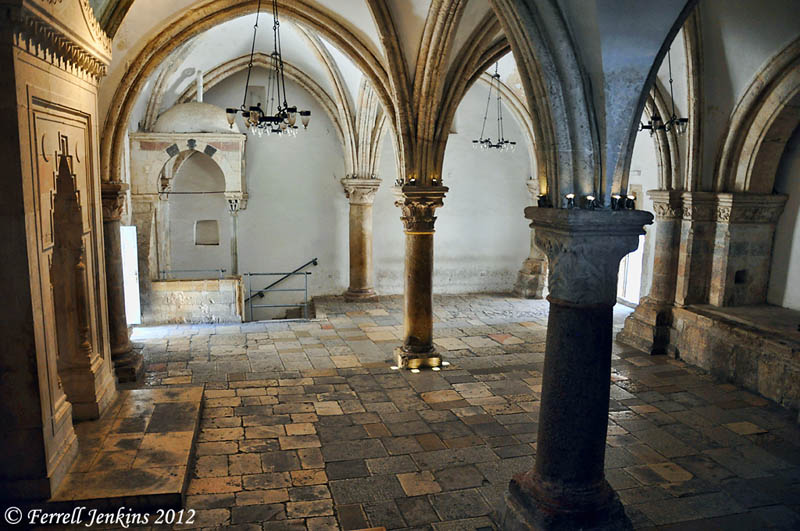
There is in the portion of the Old City of Jerusalem called Mount Zion (which really isn’t) a room known as the Cenacle (Latin) or the Room of the Last Supper. The tradition goes back further, but the building as we see it today dates back to the time of the Franciscans in 1335 A.D. (Murphy-O’Connor, The Holy Land).

The traditional room of the Last Supper (the Cenacle) on Mount Zion, Jerusalem. Photo by Ferrell Jenkins.

The traditional room of the Last Supper on Mount Zion. Photo by Ferrell Jenkins.

Jim Fleming has specialized in recreating the world of the Bible for modern students. He says,

Rather than picturing small round or rectangular standing tables, these words would have called to mind a room with a large U-shaped triclinium dining table with cushions.

Persons lying down to eat would recline around the outside of the table with the upper body supported on their left elbow. At large tricliniums the food was served from the center of the U-shaped table. (The World of the Bible Replicas)

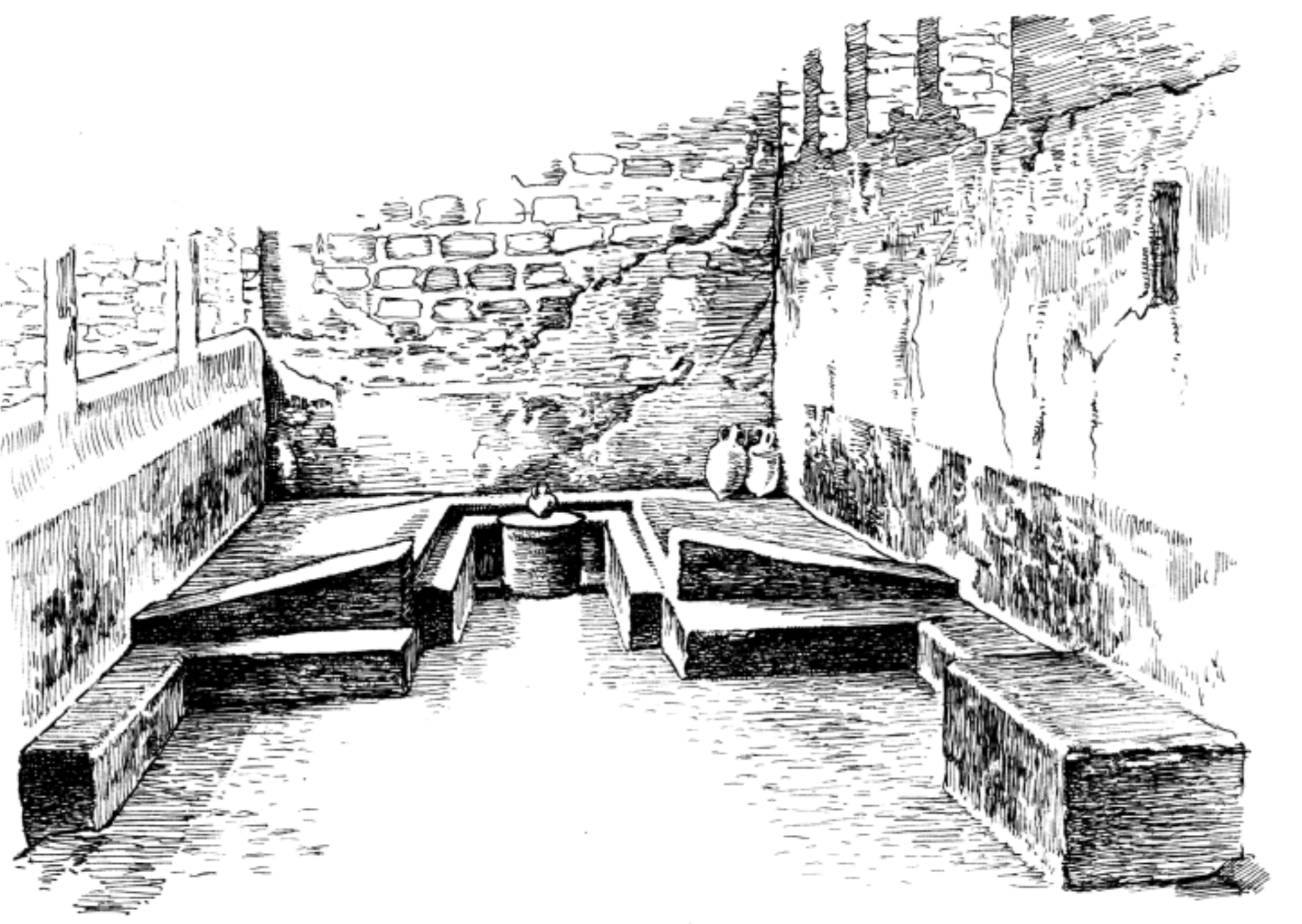
Here is a drawing of a typical Roman triclinium.

Triclinium (1000 Bible Images).

Triclinium. Credit: 1000 Bible Images.

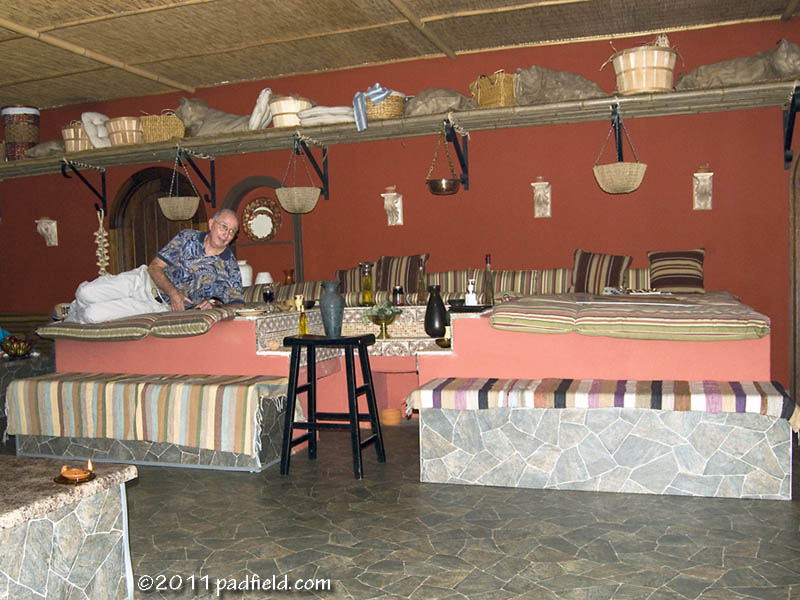
And here is a photo of a reconstructed triclinium at the Explorations in Antiquity Center in LaGrange, Georgia [Take the kids with you.]. The photo is courtesy of David Padfield.

Triclinium at Explorations in Antiquity Center. Photo by David Padfield.

Triclinium at Explorations in Antiquity Center. Photo by David Padfield.

Some of our English versions correctly use the term recline, reclined, or reclining, in the passages relating to eating meals in New Testament times. The KJV and the NKJV use “sat down” or similar terminology. Knowing that the concept of reclining is not understood by modern readers, some translations use a dynamic equivalent such as “took his place at the table” (CEB; NET, with a note of explanation).

Remember what you have learned here the next time you come across one of these references in your reading of the New Testament.

For a summary of the last week of the ministry of Jesus prior to the crucifixion, see here.

No Joke: free and nearly free

Todd Bolen, in his Weekend Roundup at the Bible Places Blog, calls attention to a couple of books that I wanted to mention while there is still time.

The first is a free Kindle ebook — Walk the Land: A Journey on Foot Through Israel. This couple in their early 50s followed the 600-mile Israel National Trail from the border of Egypt to the border of Lebanon. It was a 42 day trek. I don’t know how long the book will be available at this price. Act quickly.

The second is one of the Fabulous Friday Specials at Christianbook.com. Through Monday evening you can get the Zondervan Atlas of the Bible, by Carl Rasmussen, for $14.99 (with typical postage and handling, I suppose).

Elephantine Island

There are numerous ways to describe the location of Elephantine Island. It is an island in the Nile River at Aswan (= Syene in Ezekiel 29:10 and 30:6). Or we might say that the island is located at the first cataract of the Nile.

According to Budge, the earlier name for Elephantine was Abu. One way of writing the name of the island included the drawing of an elephant (E. A. Wallis Budge, The Gods of the Egyptians, II:51).

Various suggestions have been made regarding the origin of the name Elephantine. Some say the smooth rocks of the first cataract remind one of an elephant back. Others say, the island is shaped like an elephant tusk. Or, the island was the center of ivory trading in the past.

A small granite statue of an elephant has been uncovered on the extreme south end of the island. Aswan, you likely recall, was noted for its granite.

Granite Elephant on Elephantine Island, Aswan, Egypt. Photo by Ferrell Jenkins.

Granite Elephant on Elephantine Island, Aswan, Egypt. Photo by Ferrell Jenkins.

In the Septuagint Old Testament and in the New Testament the word elephantinos is translated ivory. You can think of Samaria’s famous beds of ivory, made from the tusks of elephants (Amos 6:4), or the unsold cargoes of the merchants who could no longer trade with the fallen Babylon [Roman Empire] (Revelation 18:12).

Paul spent a night at Cos (Kos)

Paul and his companions, including the physician Luke, made their way from Miletus to Cos (Kos).

And when we had parted from them and set sail, we came by a straight course to Cos, and the next day to Rhodes, and from there to Patara. (Acts 21:1 ESV)

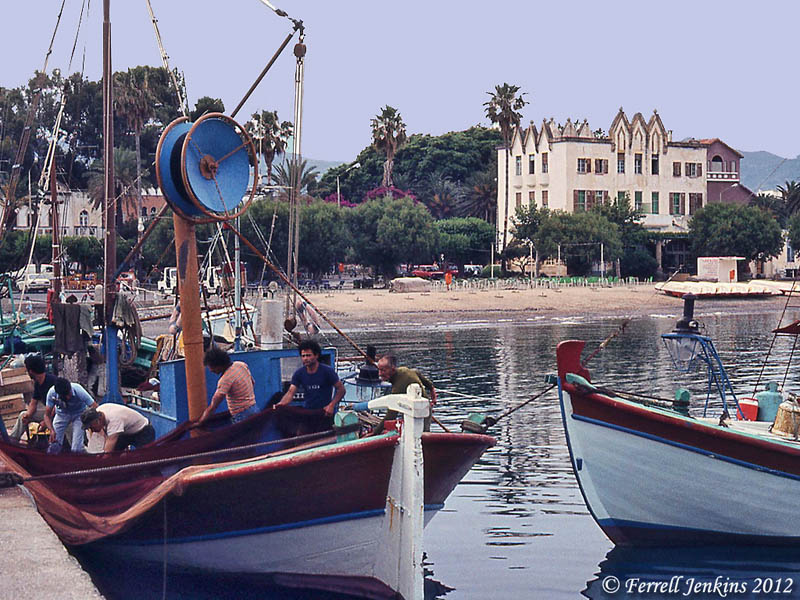
Cos is one of the islands belonging to a group of 12 called the Dodecanese. Patmos is also an island of this group. The Mycenaeans settled Cos in the 15th century B.C. In the centuries to follow the island came under the control of the Persians, the Greeks, and the Romans. In modern times the island has been under Turkish and Italian control, and German occupation. Since 1948 it has been part of Greece. My only visit to Cos was a brief stop en route from Patmos to Rhodes in 1984. Here is one of the photos I made.

The harbor on the Island of Cos in 1984. Photo by Ferrell Jenkins.

The harbor on the Island of Cos in 1984. Photo by Ferrell Jenkins.

In the time of Paul, Cos was noted as the birthplace of Hippocrates, the “father of medicine.” Hippocrates was associated with the Asclepium, ruins of which can still be seen. A Hellenistic gymnasium and some Roman ruins, including portions of a Roman road, may also be seen. There is also an archaeological museum.

Howard F. Vos describes the island with these words:

One of the most beautiful ports of the ancient world, Cos not doubt was most famous as a health resort. It was the site of the first school of scientific medicine and the sanctuary of Asclepius (Esculapius). The island had a healthful climate and hot ferrous and sulfurous springs, which the great Hippocrates (ca 460–377 b.c.), the father of medicine, first used to cure his patients. (The International Standard Bible Encyclopedia, revised.)

James Strahan, in the old Hasting’s Dictionary of the Apostolic Church, says,

It was renowned for its vines and looms, its literature and art, and above all for its temple of Æsculapius and school of medicine, which must have made it especially interesting to St. Luke.

According to Josephus, Herod the Great assisted the people of Cos with grain and other goods. (JW 1:424).

Two Other Good Sources:

Fant, C. E. and M. G. Reddish, A Guide to Biblical Sites in Greece and Turkey.

Wilson, Mark. Biblical Turkey: A Guide to Jewish and Christian Sites of Asia Minor. This book deals with Turkey, but devotes ½ page to Cos as a Sidetrip.