Category Archives: New Testament

Limited time bargain on a great Bible atlas

Christianbook.com is offering Carl Rasmussen’s Zondervan Atlas of the Bible for a limited time at the unusual price of $14.99. Click here.

zondervanatlascover01

I can’t promise that it will still be available by the time I get this posted, but you can try.

Update Noon  12-04-12:  I see the price is now $19.99. If you have a a Prime account with Amazon (postage free), or wish to add another item, the price may be better at $22.73 for Zondervan Atlas of the Bible.

This Atlas is an extremely good one. It is well written, accurate, colorful, filled with great photos and helpful maps. Earlier this evening I emailed a notice to folks who have traveled with me recently, or who plan to, with this note:

This is an excellent book for anyone planning a tour to Israel, or anyone who has been. It should be one of your most helpful Bible study tools.

One of the ladies who traveled to Israel earlier this year replied with this note:

That is a great price. I got one before we went. I use it daily as I read and it sure brings the scriptures alive. It is much more so now that we have seen the country.

Acts 25 — Photo Illustrations — Coins of the Rulers

We continue our look at the three chapters describing Paul’s stay at Caesarea Maritima — Acts 24-26. Three civil rulers are mentioned in these chapters. They are known not only from Luke’s account, but in the writings of Josephus.

Rapske says that Caesarea “was the administrative seat of the Roman procurators of Palestine.” He adds that in the time of the Flavians it became a Roman Colony (The Book of Acts in its First Century Setting; Vol. 3, The Book of Acts and Paul in Roman Custody, 155).

After the Romans occupied “Palestine” the Jews had both a religious and a secular tax to pay. The procurators (prefects) were responsible for collecting the taxes for Rome. Coins were minted by various procurators, including Felix and Festus. I have chosen one example from each to show the type of coin current in their time.

Antonius Felix — A.D. 52-59.

Felix is described as a hegemon in the Greek New Testament. Major English versions use the term governor (Acts 23:24, 26; 24:2, 22, 24, 25, 27; 25:14). Hemer says that hegemon is a general word to describe a ruler, “the formal Latin title of these governors of Judaea being procurator or praefectus” (The Book of Acts, 128).

The obverse (head) of the coin of Felix shows two oblong shields and two spears. The inscription is translated “Nero Claudius Caesar–son of Claudius. The reverse (tail) shows a “six-branched palm tree bearing two bunches of dates” with a Greek inscription above and below (Hendin, Guide to Biblical Coins (1987), 117).
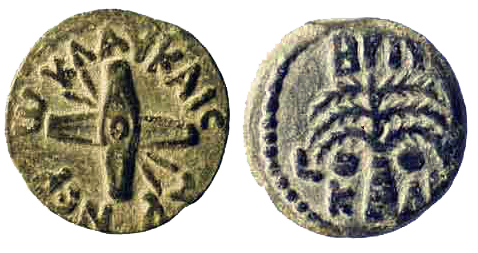
Coin of Roman Procurator Felix.

Coin of Roman Procurator Felix.

Porcius Festus — A.D. 59-61.

Porcius Festus followed Felix as governor or procurator. He is mentioned in each of the three chapters we are discussing. Paul had been left in custody by Felix, and Festus seems to be pleased to get the advice of King Agrippa when he visited Caesarea.

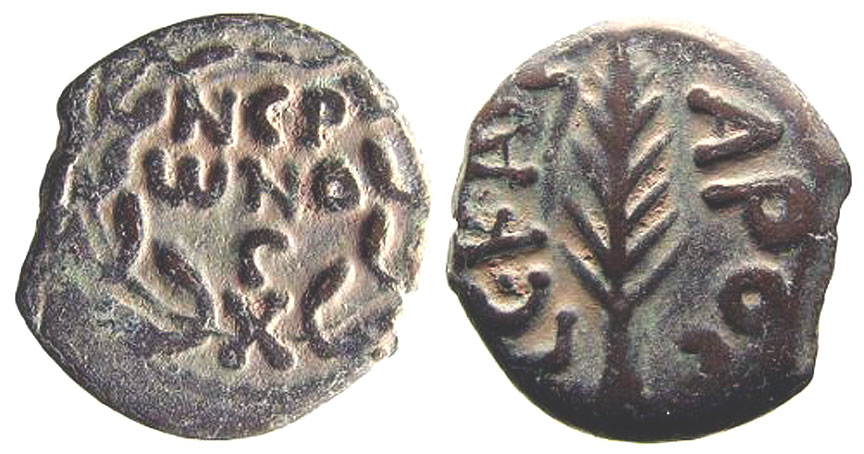
The coin of Festus, struck in A.D. 58, bears a Greek inscription within a wreath on the obverse. At the bottom is an X. The inscription reads NER ONO C (Nero). The reverse shows a palm branch with a Greek inscripton KAIC APOC (Caesar). The date LE means year five (Hendin, 118).
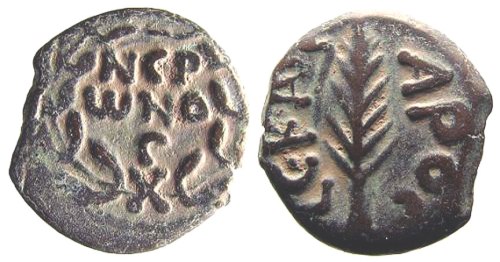
Coin of Porcius Festus.

Coin of Roman Procurator Porcius Festus.

Herod Agrippa II — A.D. 48-70.

Herod Agrippa II was the son of Herod Agrippa I, the grandson of Herod the Great (Acts 12:1, et al.). Agrippa II was the tetrarch of Chalcis and of northern territories. Chalcis was the small but beautiful territory between the Lebanon and Antilebanon mountains. Later he was granted the territories that had been controlled by Philip and Lysanias. Agrippa lived until the end of the first century, and minted coins even to the time of the Roman Emperor Domitian (A.D. 81-96).

According to Hendin, the obverse shows a laureate bust of Domitian facing right. The inscription around it reads DOMITIAMOC KAICAP (Domitian Caesar). The reverse shows Nike standing right. One foot is resting on a helmet. She is writing on a shield that is resting on her knee. The inscription reads ETO KZBA AΓPIΠΠA (Year 27 of King Agrippa). The coin was struck in A.D. 83. (I do not know how best to harmonize the dates associated with the reign of Agrippa II.)
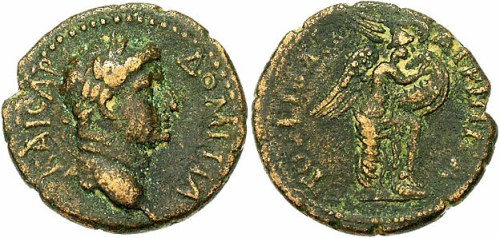
Coin of Herod Agrippa II with image of Domitian. Struck A.D. 83.

The coin above is copied from FORVM ANCIENT COINS.


I have only the original edition of Hendin’s Guide to Biblical Coins, but recommend the newer fifth edition of his book in the event that you have a genuine interest in Biblical coins. From my limited collecting experience, I can say that it is both fascinating and educational.

Maintaining control of a tour group

Occasionally I am asked if I ever have any trouble with individual tour members during a tour. The same might be asked about students in a class. After 45 years of directing tours I would have to say that there have been a few people who have given some problems for me or other tour participants. If they give trouble to others, that becomes a problem for me.

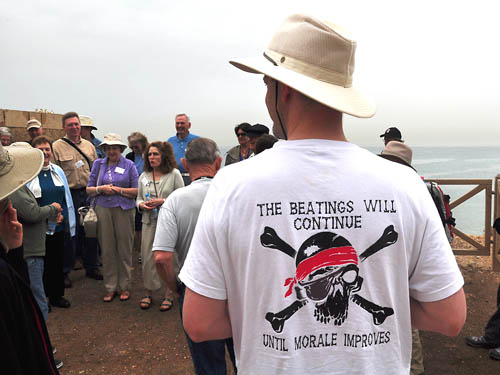
Mark, one of my friends, showed up on the first full day of touring with a T-shirt that I suppose he thought might help.

Dealing with trouble during a tour.

One tour member wanted everyone to improve their behavior. Photo by Ferrell Jenkins.

Really, the serious problems have been few and far between. I have become friends with some wonderful people through the years.

The advice of wisdom always works.

A soft answer turns away wrath, but a harsh word stirs up anger. (Proverbs 15:1 ESV)

Acts 24 — Photo Illustrations — Caesarea

The events of Acts 24-26 take place at Caesarea Maritima. Paul was protected by the Romans in Herod’s Praetorium (Palace) for more than two years.

And he [Felix] commanded him to be guarded in Herod’s praetorium. (Acts 23:35b ESV)

When two years had elapsed, Felix was succeeded by Porcius Festus. And desiring to do the Jews a favor, Felix left Paul in prison. (Acts 24:27 ESV)

Caesarea Maritima was a first century Roman capital and seaport. The gospel was first preached to the Gentiles here when Peter came from Joppa to Caesarea to tell Cornelius words by which he could be saved (Acts 10, 11).

Herod the Great built a city on the site of Strato’s Tower and named it Caesarea in honor of Caesar Augustus. It became a center of Roman provincial government in Judea. The city had a harbor and was located on the main caravan route between Tyre and Egypt. This city is called Caesarea Maritima (on the sea) to distinguish it from Caesarea Philippi.

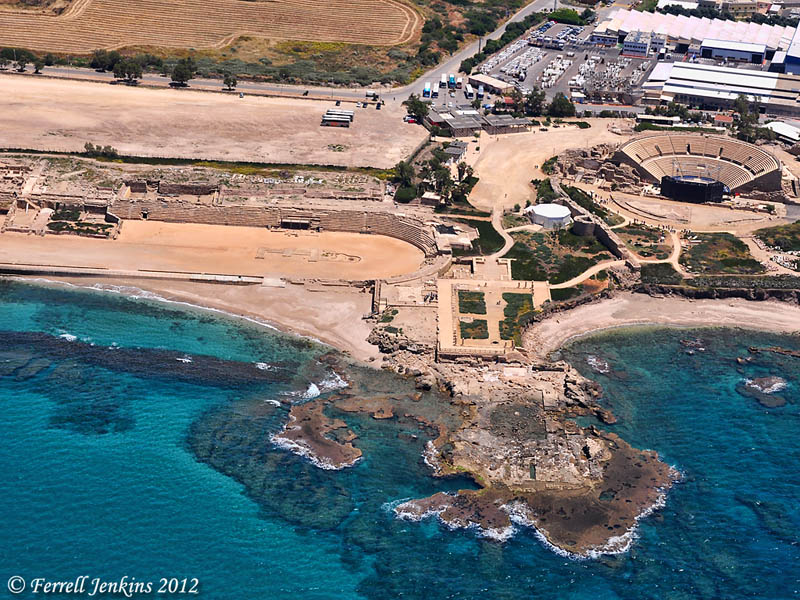
Our aerial photo below shows the Roman theater on the right of the photo. The southern portion of the hippodrome is on the left. The Palace of the Procurators is in the center, extending out into the sea.

Aerial view of Caesarea theater, hippodrome, and Palace of the Procurators. Photo by Ferrell Jenkins.

Aerial view of Caesarea theater (right), hippodrome (left), and Palace of the Procurators (center foreground). Photo by Ferrell Jenkins.

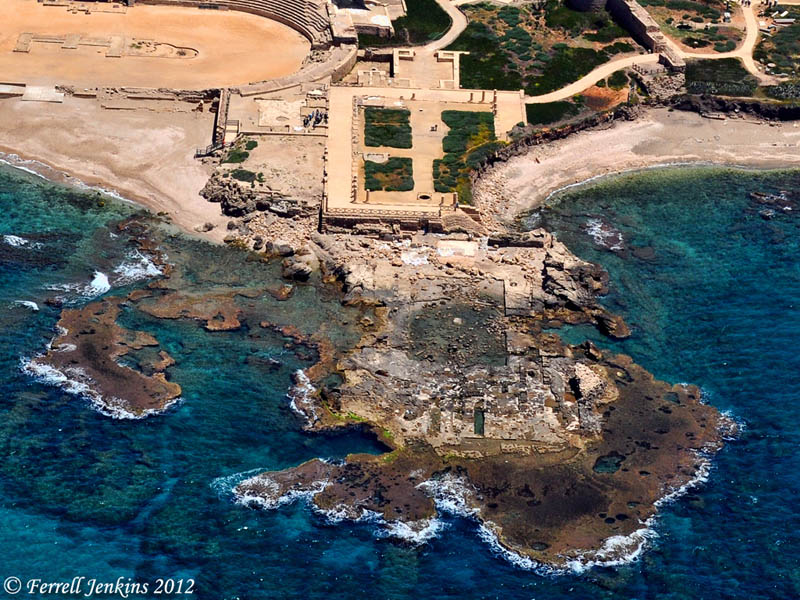
Jerome Murphy-O’Connor explains the rock-cut pool you see in the photos above and below.

From the west colonnade one can look down to the sea shore at a point where its dominant feature is a rectangular rock-cut pool (35 x 18 [meters]). There are channels to the sea on both sides. A square statue base can be discerned in the middle. The colonnades pool was originally the centrepiece of a two-storey building (83 x 51 m) which surrounded it on all sides. Presumably it was here that the Roman procurators lived. Wave action and the activities of stone robbers have ensured that virtually nothing remains. A staircase in the north-east corner gave access to the upper level. (The Holy Land, 5th ed., 243).

Aerial view of the Palace of the Procurators at Caesarea. Photo by Ferrell Jenkins.

Aerial view of the Palace of the Procurators at Caesarea. Photo by Ferrell Jenkins.

Acts 23 — Photo Illustrations — Antipatris

The site of Antipatris was known as Aphek in Old Testament times. It it is the place where the Philistines were encamped when they took the ark of the covenant from the Israelites who had camped at nearby Ebenezer (1 Samuel 4:1).

Antipatris was built by Herod the Great and named in honor of his father.

Herod was also a lover of his father, if any other person ever was so; for he made a monument for his father, even that city which he built in the finest plain that was in his kingdom, and which had rivers and trees in abundance, and named it Antipatris. He also built a wall around a citadel that lay above Jericho, and was a very strong and very fine building, and dedicated it to his mother, and called it Cypros. (Jewish Wars 1:417)

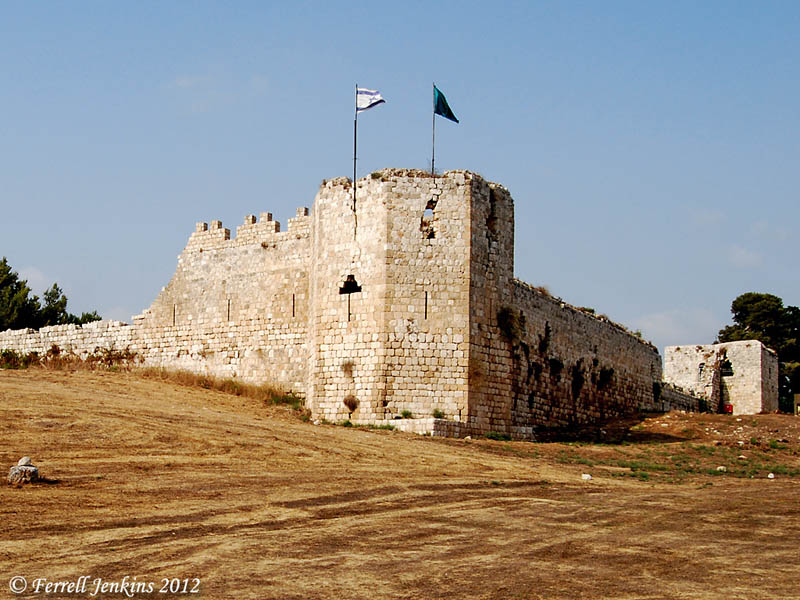
Because Aphek/Antipatris sat on a major south-north and west-east routes, it was dominated by many nations. The dominant feature of the site today is the Turkish fort. Inside are the excavated ruins of buildings from Canaanite to Herodian/Roman times.

Turkish fort at Aphek-Antipatris. Photo by Ferrell Jenkins.

Turkish fort at Aphek/Antipatris. Photo by Ferrell Jenkins.

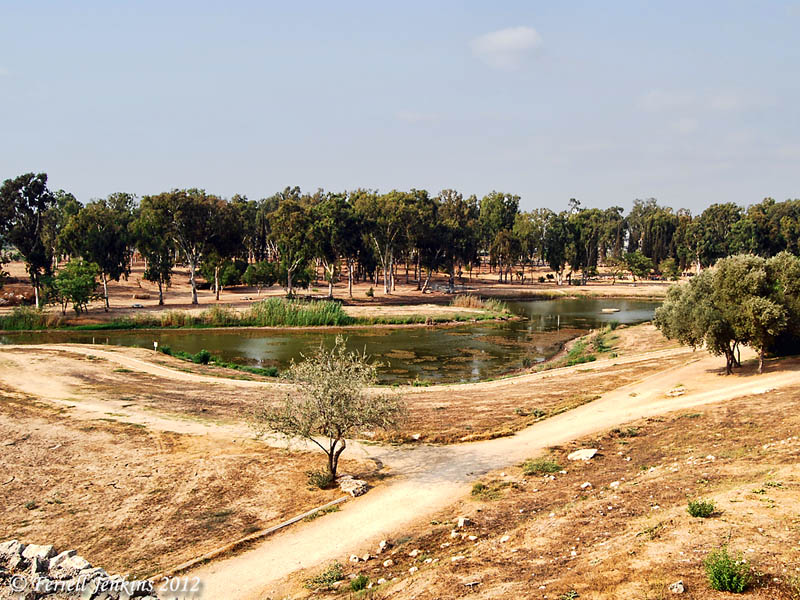
Aphek/Antipatris is known by the modern name Ras el-Ain because it is located at the source of the Yarkon River which flows a few miles into the Mediterranean.

Source of the Yarkon River at Aphek-Antipatris. Photo by Ferrell Jenkins.

Source of the Yarkon River at Aphek-Antipatris. Photo by Ferrell Jenkins.

When a plot was raised against Paul while he was in the Fortress of Antonia in Jerusalem, he was sent by night to Antipatris. The next day he was escorted to Caesarea.

So the soldiers, according to their instructions, took Paul and brought him by night to Antipatris.  And on the next day they returned to the barracks, letting the horsemen go on with him.  When they had come to Caesarea and delivered the letter to the governor, they presented Paul also before him. (Acts 23:31-33 ESV)

From Jerusalem to Antipatris is about 30 miles. From there to Caesarea is an additional 27 miles.

Paul would remain in custody at Caesarea for two years.

Reading the Blogs

Charles Savelle (Bible X) tells about his enjoyable afternoon at Southwestern Baptist Theological Seminary to visit the Dead Sea Scrolls and the Bible Exhibit (Fort Worth).  He describes the entire visit, step by step, including a list of “the scroll fragments and other manuscripts and Bibles” including a list of the Biblical verses included in the scroll fragments. A Qumran simulated dig is part of the exhibit. Charles includes a a hi-res photo of himself standing in a nice replica of a mikvah (ritual bath) at Qumran. Read the complete report here. The exhibit runs through January 13, 2013.

I enjoyed lunch with Charles one day at the recent ETS annual meeting. I find his Bible X blog helpful.

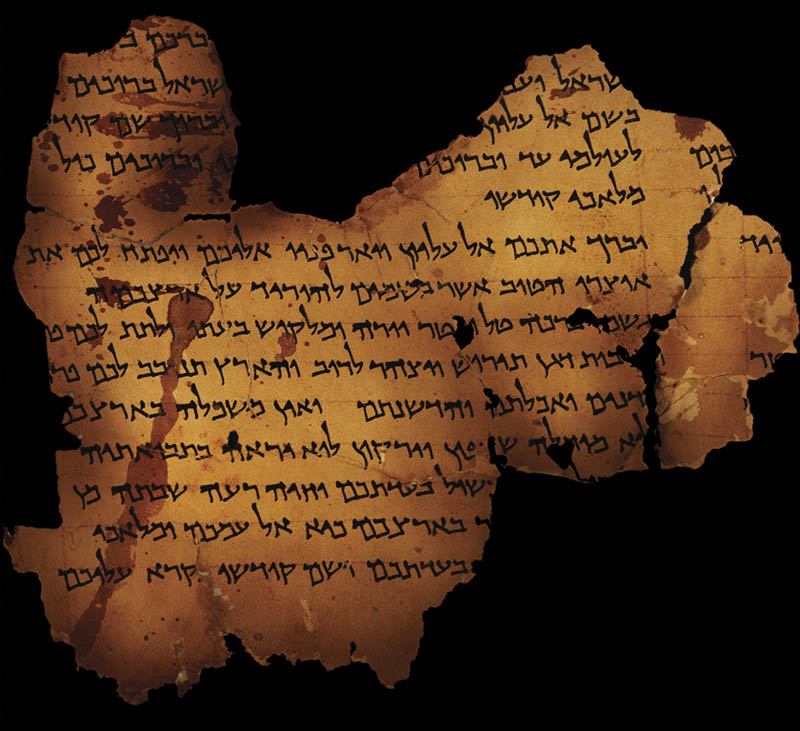
Luke Chandler reports here that a different Dead Sea Scrolls Exhibit is now open at the Cincinnati Museum Center. This exhibit includes about “600 biblically-related artifacts on loan from the Israel[i] Antiquities Authority.” Read more here. This exhibit which runs through April, 2013, has already been in New York and Philadelphia. Check our link to the New York exhibition here. The 39 page guide to the exhibit by Gordon Franz is still available.

The War Scroll displayed at the Cincinnati Museum.

The War Scroll displayed at the Cincinnati Museum Center.

Luke also comments on a recent comment by Dr. William Dever regarding the lack of evidence for the “Low Chronologyhere.

It was only yesterday that I came caught up with a post by Seth Rodriquez (Wild Olive Shoot)  written the day after the U.S. presidential election. He has some important words for those who may have been disappointed in the outcome of the election. See here.

Thanksgiving today and everyday

Paul’s letter to the saints at Colossae emphasizes that thanksgiving should be a part of continual prayer to God.

Continue steadfastly in prayer, being watchful in it with thanksgiving. At the same time, pray also for us, that God may open to us a door for the word, to declare the mystery of Christ, on account of which I am in prison– that I may make it clear, which is how I ought to speak. (Colossians 4:2-4 ESV)

The wonderful thing about our national day of Thanksgiving is that it is an 0pportunity for families to be together and reflect on the blessings of life. I trust that your day will be a good one.

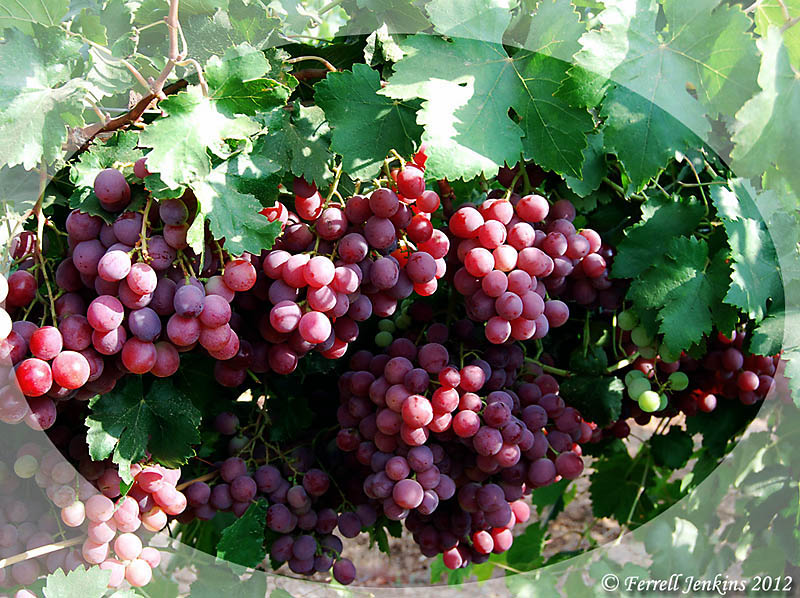
Abundance of the Vineyards at Lachish. Photo by Ferrell Jenkins.

The Abundance of the Vineyards at Lachish. Photo by Ferrell Jenkins.

The Annual Meetings # 3 (SBL)

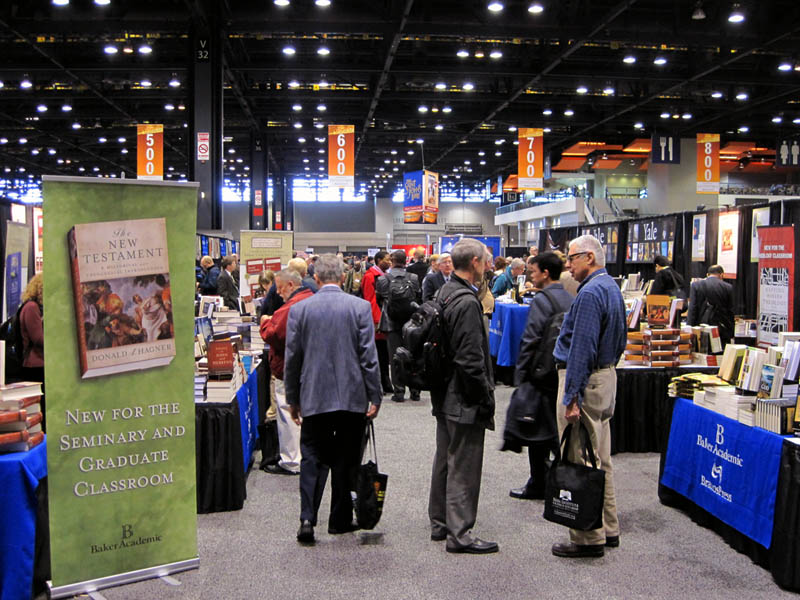
The annual meetings of the American Academy of Religion and the Society of Biblical Literature were held this year at the McCormick Place Convention Center in Chicago. I think McCormick Place is the largest facility of this type that I have ever been in. Much walking was required to move between sessions. Fortunately there is a good system of escalators to move between levels of the facility.

With the two scholarly organizations meeting together the book exhibit is extremely large. It is impossible to show it all from floor level. Here is a little glimpse of the Baker Academic section.

The AAR/SBL book exhibit, Chicago, 2012. Photo by Ferrell Jenkins.

The AAR/SBL book exhibit, Chicago, 2012. Photo by Ferrell Jenkins.

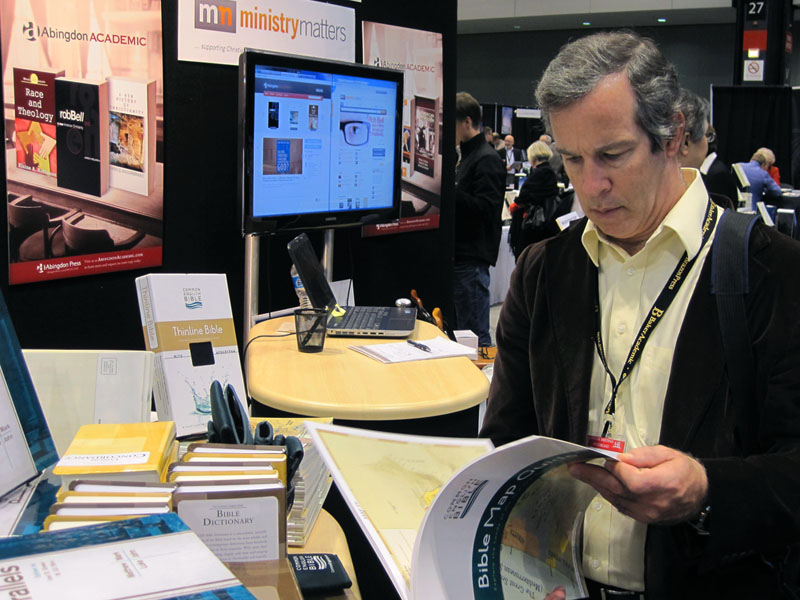
David McClister, my former student and colleague at Florida College, looks over one of the map books on display in the exhibit hall.

Dr. David McClister looks over a map book at AAR/SBL 2012. Photo by Ferrell Jenkins.

Dr. David McClister looks over a map book at AAR/SBL 2012. Photo by Ferrell Jenkins.

I spent my time at the SBL sessions dealing with Places in the Bible World. I attended the session on Polis and Ekklesia: Investigations of Urban Christianity Consultation. The theme for the five speakers this year was Roman Corinth.

The Biblical Lands and Peoples in Archaeology and Text Section covered a number of subjects including Moab, Ammon, the Philistines, first century priestly house in Jerusalem (Shimon Gibson), the possibility of a priestly order at Migdal-Gennesar (Richard Notley), et al.

One session consisted of archaeological reports on the new excavations at Azekah (Oded Lipschits, Yuval Gadot), the ongoing work at Khirbet Qeiyafa (Michael Hasel, Yosef Garfinkel, and Madeleine Mumcuoglu), and the new work at Jezreel (Norma Franklin).

Another session featured studies on the Egyptian invasion of the Sea Peoples (James Hoffmeier), Tell Tayinat (Tim Harrison), Tel Dor (Elizabeth Bloch-Smith), Ashkelon (Daniel Master), and Gath (Aren Maeir). There were a couple of other reports on the Philistines that I did not hear. It is always good to hear these reports first hand, long before the reports find their way into journals and books.

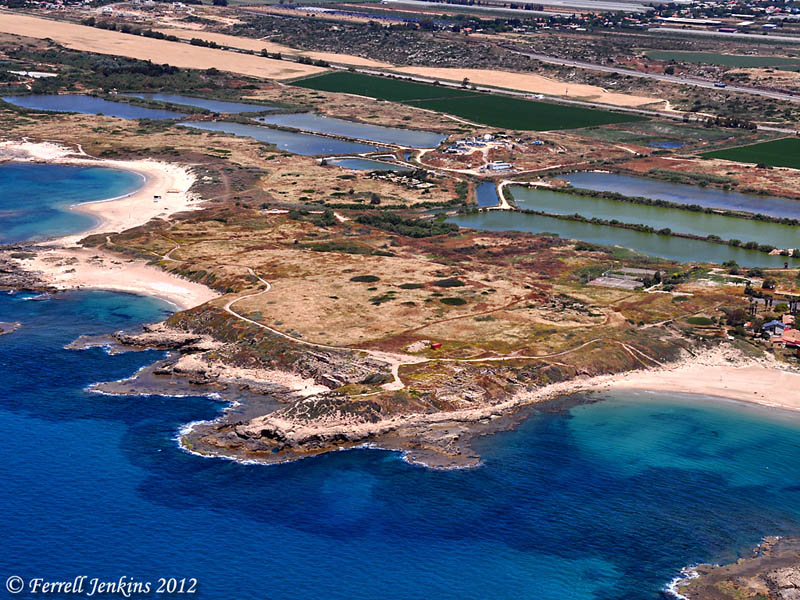
Aerial view of Tel Dor. Photo by Ferrell Jenkins.

Aerial view of Tel Dor on the Mediterranean Coast. Photo by Ferrell Jenkins.

Dor has a long history extending from the Canaanite period around the 20th century B.C. It was also controlled by the Phoenicians, the Sea People, the Israelites, the Assyrians, the Babylonians, the Persians, the Greeks, and the Romans. Dor was abandoned in the third century A.D. (Biblical Archaeology Review, Nov./Dec. 2002).

For Biblical references to Dor, see here.

It is nice to be back home with on time flights.

The Annual Meetings # 2 (NEAS)

Attending the annual meetings of professional organizations allows one to keep up with the latest scholarly efforts of various scholars. When I was teaching I attended sessions dealing with the subjects I was teaching. I have always attended sessions dealing with archaeology because these help be to keep abreast of the field. On my tours, I am often able to tell the guides about discoveries that they have not yet learned about.

Some affiliated smaller organizations meet under the auspices of the larger one. The NEAS (Near East Archaeological Society) meets with ETS. I attended most of the sessions of the NEAS. Let me give you some idea about what I heard.

Charles Ailing, Did Moses Learn His Monotheism From Akhenaten? Mostly likely not. According to the Biblical chronology, Moses was earlier than Akhenaten.

Douglas Petrovich, Identifying the Tower of Babel and (Re-)Locating the Site of Its Construction. He suggested Eridu. Doug began his paper with a prayer in which he said, “Thank you for the thrill of learning, and thank you for the truth.”

Randall Price reported on “the Final Season of Excavation on the Qumran Plateau.” I did not hear his presentation about the search for Noah’s Ark. Seth Rodriquez looked at how archaeology provides insights into Psalm 144.

Morten Jensen, from Denmark, spoke about “Religious Motivation in the Archaeological Record of First-century Israel.” A paper on Metallurgy was read for a scholar who was unable to arrive from Germany.

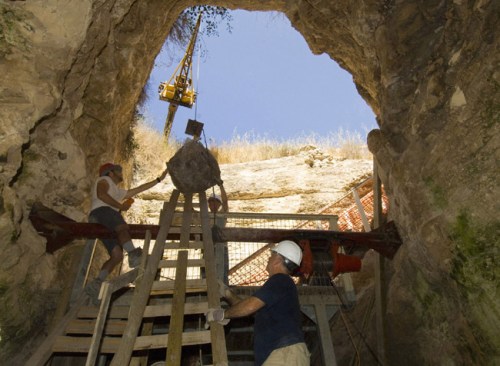
We had two presentations by excavators at Gezer. Steven Ortiz spoke about the recent excavations. Daniel Warner spoke about the fabulous new find of the Gezer Water System. See our earlier report on this water system here.

Gezer Water System

Excavating Gezer Water System. Photo: Art Beaulieu. Courtesy BP & NOBTS.

The sessions last about three hours and have at least five presenters in each. One session was devoted to Wheaton College’s Contribution to Biblical Archaeology from Joseph P. Free to the Present. Alfred J. Hoerth, who served as chair of the department of archaeology, spoke of the contributions from Free to the present. Other speakers, all of whom attended and/or taught at Wheaton included Daniel Master (Ashkelon), John Monson, and Tom Davis. This was an extremely worthwhile session.

Free is known for his book about archaeology, but also for his excavation of the biblical site of Dothan. One interesting tidbit: Free purchased the tell of Dothan from the Jordanian landowner. I think this would be impossible today.

Dothan is known as the place where Joseph’s brothers sold him into slavery (Genesis 37:12-36).

Perhaps I can get to a few comments about the SBL meeting after I return home.

ETS Plenary Sessions Online

Charles Savelle reports that the video of the plenary sessions at the recent ETS meeting are available online here Individual links are listed below. Zondervan Academic, the provider of the videos, includes advertising that you may skip to get directly to the lecture.

The general theme of the 2012 annual meeting was Caring for Creation. In these four lectures you will find four competent scholars presenting differing views on a subject that is important to each of us.

Calvin Beisner “Creation Care and Godly Dominion: The Search for a Genuinely Biblical Earth Stewardship”

Russell Moore “Heaven and Nature Sing: How Evangelical Theology Can Inform the Task of Environmental Protection, and Vice-Versa”

Richard Bauckham “Reading the Bible in the Context of the Ecological Threats of our Time”

Douglas J. Moo “Biblical Theology and Creation Care”

HT: Charles Savelle @ Bible X