Category Archives: New Testament

The real story about Saint Nicholas on Amazon Prime

You have read on this blog and other places about the Saint Nicholas of Myra, a town on the southern Mediterranean coast of Turkey. Recently I learned of the video featuring Dr. Mark Wilson and Dr. Adam English now available free for those who have access to Amazon Prime. The 55-minute video is high quality.

The video provides information about the priest by the name of Nicholas and his work in and around Myra. As Bishop of Myra, Nicholas defended the doctrine of the trinity at the Council of Nicea (Nicaea) in A.D. 325. There is a strong claim that he is buried in Bari, Italy.

I think you might enjoy the film and learn something about Church History in the process.

If you have Amazon Prime you can search for Saint Nicholas: the Real Story, or use this link: Saint Nicholas: the Real Story.

The town of Myra is known to students of the New Testament as a place where the apostle Paul transferred ships while he was being taken to Rome for trial before Caesar (Acts 27:5). My most recent post about the city is available here.

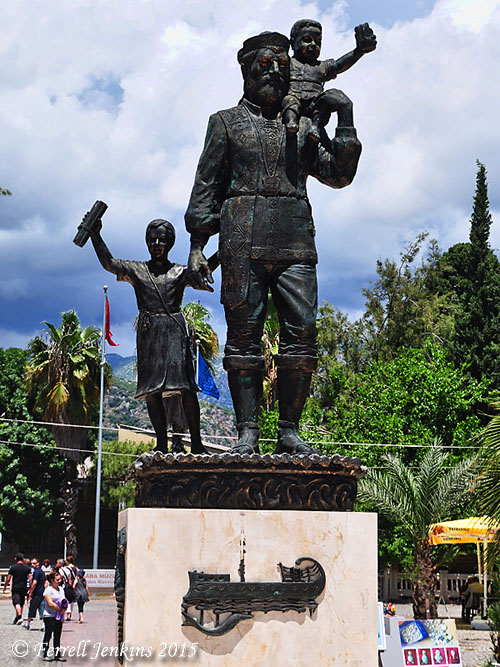
Modern statue of Saint Nicholas at Myra. Photo by Ferrell Jenkins.

Modern statue of Saint Nicholas at Myra. Photo by Ferrell Jenkins.

Index of articles on Bethlehem and the Birth of Jesus

Bethlehem and the Birth of Jesus.  Our total number of posts has now grown to more than 1800 and this makes it difficult to locate a post you may need. This index is prepared to assist you in your study of the birth of Jesus in ancient Bethlehem. Most, if not all, of the posts include at least one photo illustrating the lesson.

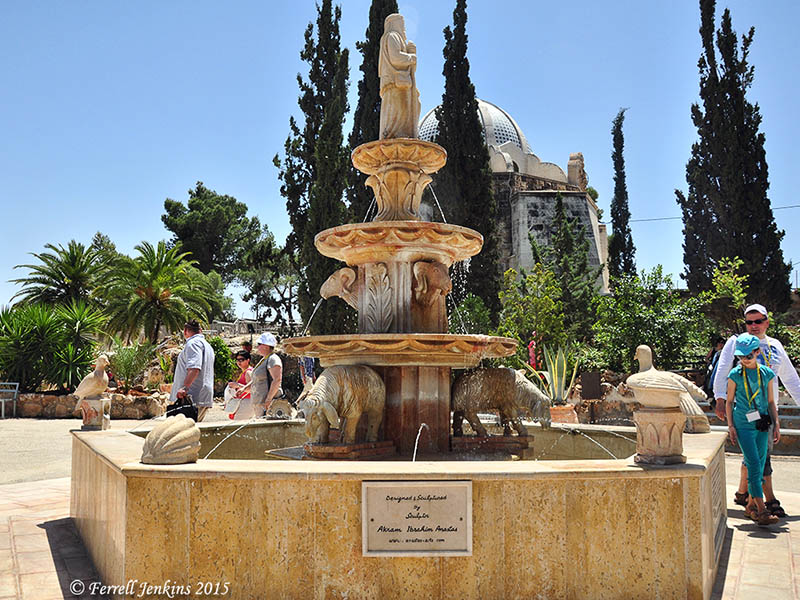
Fountain at Franciscian Custody Shepherd's Field near Bethlehem. Photo by Ferrell Jenkins.

Fountain at Franciscan Custody Shepherd’s Field near Bethlehem.

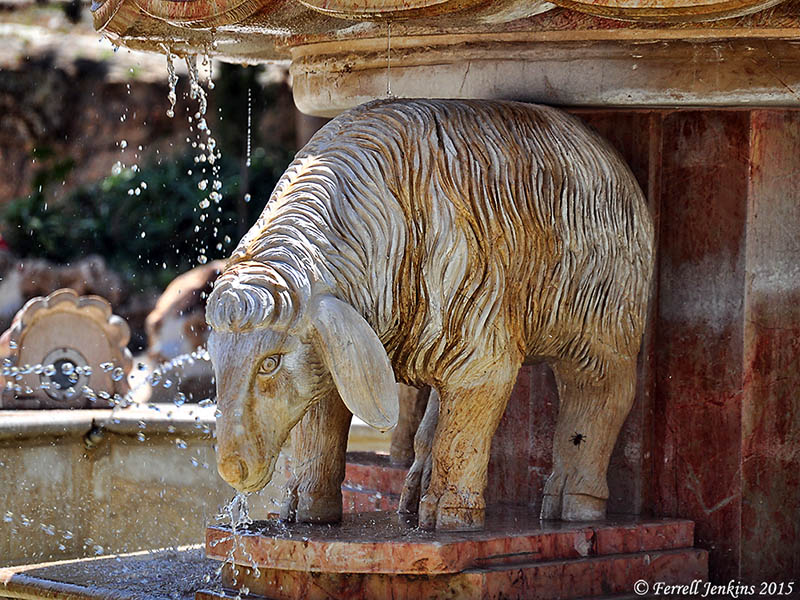
Sheep at fountain of Franciscan custody Shepherd's Field near Bethlehem. Photo by Ferrell Jenkins.

Sheep at fountain of Franciscan custody Shepherd’s Field near Bethlehem.

Other places near Bethlehem. Most of the links below are related to Herod the Great and the fortress he built near Bethlehem. I see that I have normally used the spelling Herodium, but sometime Herodion.

Historical Connections to Modern Christmas Celebrations. These post are post-biblical, historical references to customs associated with Christmas.

When other posts on this subject are written I will try to remember to update the list.

Note: This post is a repeat from Dec. 12, 2014

Books for self and others #3 – books by David E. Graves

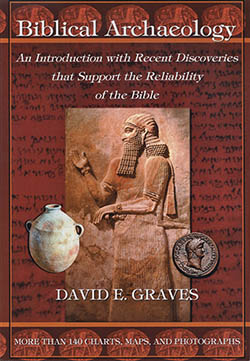
David E. Graves sent me two of his recent books. The first to mention is Biblical Archaeology: An Introduction with Recent Discoveries that Support the Reliability of the Bible. I like the subtitle: An Introduction with Recent Discoveries that Support the Reliability of the Bible. This is a large paperback of 375 pages, published in 2014.

  1. Introduction to Biblical Archaeology
  2. Archaeology and Biblical Manuscripts
  3. Genesis
  4. Exodus and Conquest
  5. United and Divided Monarchy
  6. The Gospels
  7. Acts and Epistles
  8. Revelation

Graves, Biblical ArchaeologyBiblical Archaeology includes more than 140 charts, maps and photographs (all in black and white), a glossary, extensive bibliography and index.

Dr. Graves holds a Ph.D. from the University of Aberdeen, has been involved in teaching the Bible and archaeology for more than 30 years. He has participated in archaeological digs for several years.

This book will not please the person who wants a slick paper, large print book filled with color photos. It will be extremely helpful to the person who would like to have a thorough survey of Biblical Archaeology.

Key Themes of the New Testament: A Survey of Major Theological Themes is a 2014 paperback of 441 pages. Here are the chapters:

  1. Kinds of Literature
  2. Birth and Early Years of Jesus
  3. Ministry of Jesus
  4. The Death of Jesus
  5. Resurrection and Ascension
  6. The Founding of the Church
  7. The Formation of the Church
  8. The Development of the Church
  9. The Future of the Church
  10. Conclusion

This book covers so comprehensive that one is bound to disagree with a point here and there. Points that I observed gave me opportunity to think and expand my thinking. The book is available in Kindle format for about half the price. Graves also has a similar book dealing with the Old Testament themes.

David maintains Deus Artefacta, a blog about issues like those discussed in these books.

I provided five photos for this book, and two for the book on archaeology.

Books for self and others # 2 – four from Carta Jerusalem

Recently I received two packages of books from Shay Hausman, president & CEO of Carta Jerusalem. Each package included two books I needed or wanted. Far back I have called attention to some of the excellent Carta publications. I will make a list to those posts at the bottom of this one.

R. Steven Notley wrote the New Testament portion of The Sacred Bridge, an excellent book too comprehensive and expensive for the average non-trained Bible student. The material was published in an abridged edition without all of the scholarly notes in a work entitled Carta’s New Century Handbook and Atlas of the Bible.

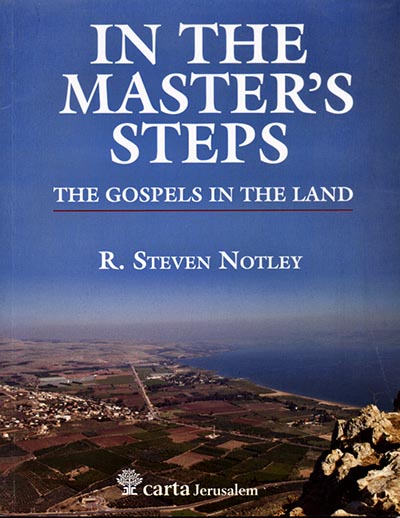
Now Carta has published some of the New Testament material is a new format. This book by R. Steven Notley is entitled In the Master’s Steps: The Gospels in the Land (The Carta New Testament Atlas). The book of 9 chapters plus preface and index covers the ministry of Jesus from His Birth to the Resurrection and Ascension. It has lavish drawings, photos, and maps to assist the Bible student. And it has print large enough for older readers to enjoy. (Just ask me!) Those who have visited the proposed site of Bethsaida may already know that Notley has taken exception to the identification of the site of et-Tell with the home of Peter, Andrew, and Philip (John 1:44). In this new work you will be able to examine his evidence and draw your own conclusions.  I am pleased to recommend this excellent paperback.

Notley, In the Master's Steps.

Notley, In the Master’s Steps: The Gospels in the Land.

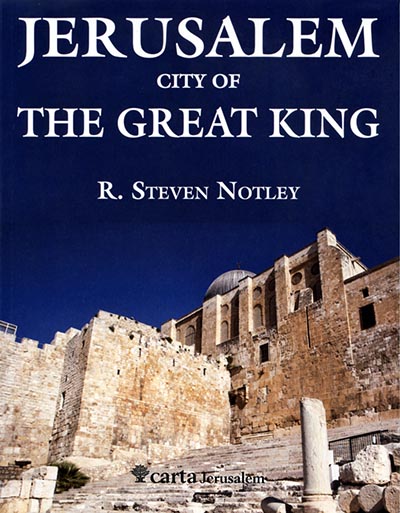
The second new book by R. Steven Notley is Jerusalem: City of the Great King. This book of 112 pages has 10 chapters. The work begins with the Pre-Herodian History and develops the history of the city with the greater portion of the material being devoted to Jerusalem at the time of Christ. A short section that caught my attention deals with “The Myth of an Essene Quarter.”

I saw Prof. Notley browsing the book exhibits at the Society of Biblical Literature meeting in Atlanta a few weeks ago. Having met him at a previous annual meeting I spoke. He pulled a copy of this next book from his briefcase and showed it to me. When I asked if this was mostly the content of the larger atlas he said that they were criticized for not including enough material on Jerusalem. This book, he said, was to remedy that situation. He stated that there are more books to come.

This book is a good one for most anyone studying portions of the Bible with their setting in Jerusalem. It is especially helpful for those studying the ministry of Jesus.

Notely, Jerusalem City of the Great King

Notely, Jerusalem City of the Great King

The next book is smaller, being only 40 pages. Understanding the Boat from the Time of Jesus: Galilean Seafaring is written by Shelley Wachsmann. Those who have seen the Roman-era boat uncovered from the Sea of Galilee in 1986 will revel in the story told by Wachsmann who directed the excavation of the 2000 year old fishing boat. The story of this discovery, the excavation, and preparation of this boat for display at Nof Ginnosar is a fascinating one.

Understanding the Boat from the Time of Jesus

Understanding the Boat from the Time of Jesus

Understanding the Alphabet

Understanding the Alphabet


The final of these four books is Understanding the Alphabet of the Dead Sea Scrolls by Ada Yardeni. This is a valuable book for those interested in the Dead Sea Scrolls, the Hebrew Bible, and the Hebrew language. It occurs to me that anyone involved in calligraphy might find the book interesting. The book is filled with illustrations showing how to draw the alphabet of various scrolls and inscriptions.

Earlier references to Carta Jerusalem books.

Ritmeyer, The Temple Mount – a Carta Guide Book

Carta’s New Century Handbook and Atlas of the Bible

The links I have provided go to Amazon. The books are not as easily located in the United States as some other books, but you may be able to locate them elsewhere.

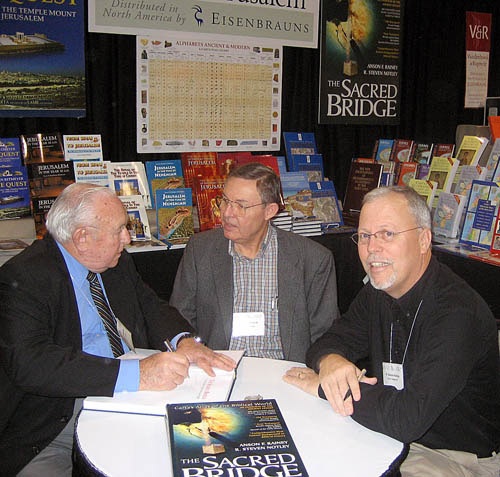
Anson Rainey, Ferrell Jenkins, and R. Steven Notley at SBL in 2006.

Anson Rainey (1930-2011), Ferrell Jenkins, and R. Steven Notley at SBL in 2006.

As mentioned above, these books were sent to me by the publisher. The comments represent my own opinion. Books purchased from Amazon through these links will net me a few cents per book. Nothing I think of as substantial. Happy reading.

Jesus in Jerusalem during Hanukkah

The Gospel of John records more visits to Jerusalem by Jesus than any other of the Gospels. John is the only one to record the visit during the Feast of Dedication.

At that time the Feast of Dedication took place at Jerusalem. It was winter,  and Jesus was walking in the temple, in the colonnade of Solomon. (John 10:22-23 ESV)

BDAG translates the Greek term egkainia as “festival of rededication.” The feast is also known as Hanukkah and the Feast of Lights.

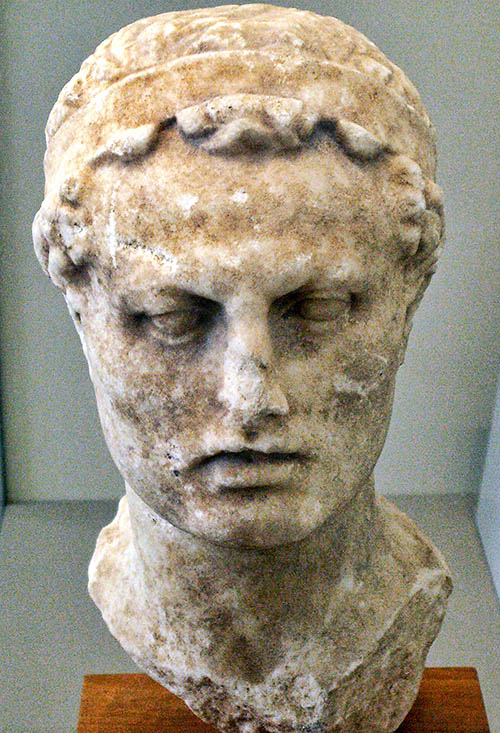
What is the Feast of Dedication? This feast, observed on the 25th of Kislev (roughly our December), had its origin in the period between the testaments. The desecration of the temple by the Seleucid ruler Antiochus Epiphanes took place in 168 B.C. The climax of the Maccabean revolt was the removal of all evidences of pagan worship from the temple. An eight-day feast of dedication was observed in 165 B.C., and continued to be observed annually by the Jews.

"Antiokhos IV" by Jniemenmaa (talk) 08:46, 20 July 2009 (UTC), own work. Licensed under CC BY-SA 3.0 via Commons - https://commons.wikimedia.org/wiki/File:Antiokhos_IV.jpg#/media/File:Antiokhos_IV.jpg

“Antiokhos IV” by Jniemenmaa (talk) 08:46, 20 July 2009 (UTC), own work. Licensed under CC BY-SA 3.0 via Commons – https://commons.wikimedia.org/wiki/File:Antiokhos_IV.jpg#/media/File:Antiokhos_IV.jpg

At Modin, a village north-west of Jerusalem, on the way from Jerusalem to Lod, the Syrians tried to force an old priest by the name of Mattathias to offer a pagan sacrifice. The priest refused but another Jew volunteered to offer the sacrifice. Mattathias killed his fellow Jew and the Syrian officer. As word spread, Mattathias became a national hero. He was of the family of Hasmon (or Asmoneus). Thus began the Hasmoneans.

Archaeologists working  with the Israel Antiquities Authority have been searching for the tomb of the Maccabeans at Modin in recent years. See the report here.

Sunset from the eastern shore of Galilee

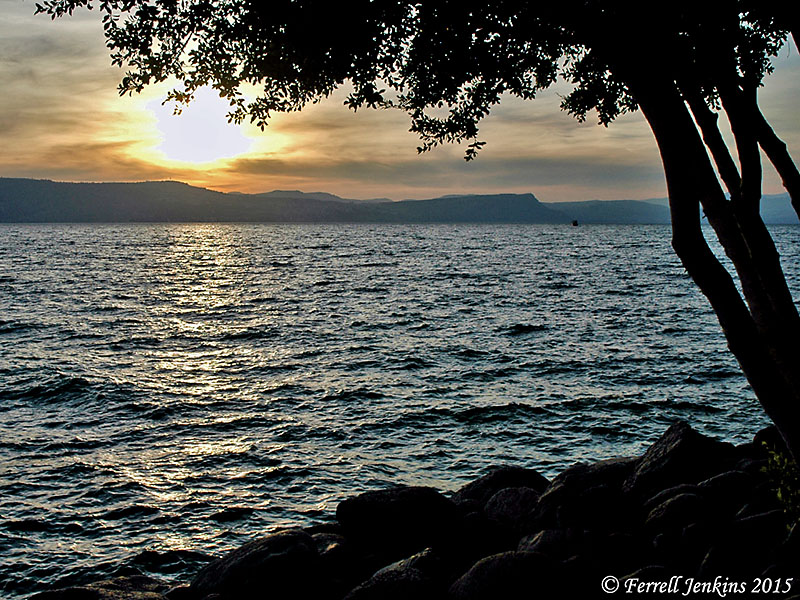
Over the past years I have posted several sunrise photos made from the western shore of the Sea of Galilee, but only a few sunsets from the eastern shore. I want to share this beautiful sunset view from En Gev.

Sunset from En Gev on the eastern shore of the Sea of Galilee. Photo by Ferrell Jenkins.

Sunset from En Gev on the eastern shore of the Sea of Galilee. Photo by Ferrell Jenkins.

If you look carefully you may see the Horns of Hattin and Mount Arbel on the western side. The sea is a little rough in this photo due to the afternoon wind that  comes in from the northwest.

Another mosaic uncovered at Lod

In the Old Testament Lod is listed as a town of the tribe of Benjamin (1 Chronicles 8:12), but it seems significant only after the return of the Jews from Babylonian exile (Nehemiah 11:25; Ezra 2:33).

In the New Testament the town is known as Lydda and the place where the Apostle Peter preached and healed a paralytic named Aeneas (Acts 9:31-35).

In modern times Lod is the location of Tel Aviv’s Ben Gurion International Airport.

You might enjoy this account by the Israel Antiquities Authority about the discovery of another impressive mosaic in Lod.

While building the visitor center for the Lod Mosaic, which was exposed in the past and is considered one of the most spectacular in the country, another impressive mosaic was discovered at the site

This week the Israel Antiquities Authority, in cooperation with the Lod municipality, invites the public for a unique opportunity to come see the new mosaic

An impressive mosaic revealed in archaeological excavations by the Israel Antiquities Authority in Lod will be open for the first time this week, specifically for visits by the public, in cooperation with the Lod municipality.

In June–November 2014 a team of archaeologists from the Israel Antiquities Authority directed a large excavation in the Neve Yerek neighborhood of Lod, in an area where a breathtaking mosaic that served as the living room floor in a villa some 1,700 years ago was previously exposed. The aim of the excavation was to prepare the ground for construction of a visitor center, to which the beautiful mosaic will be returned when it completes a series of exhibitions in museums around the world. Important artifacts were discovered in the new excavation, the most notable of which is another colorful mosaic (11 × 13 m) that was the courtyard pavement of the magnificent villa that had the famous mosaic in its living room.
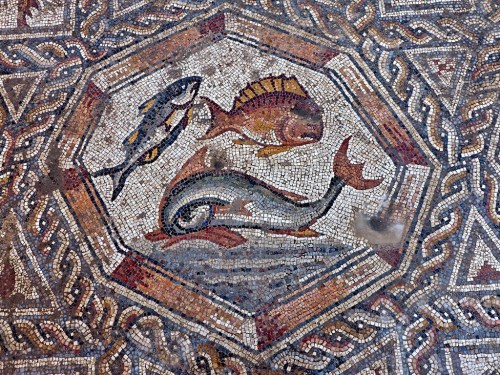
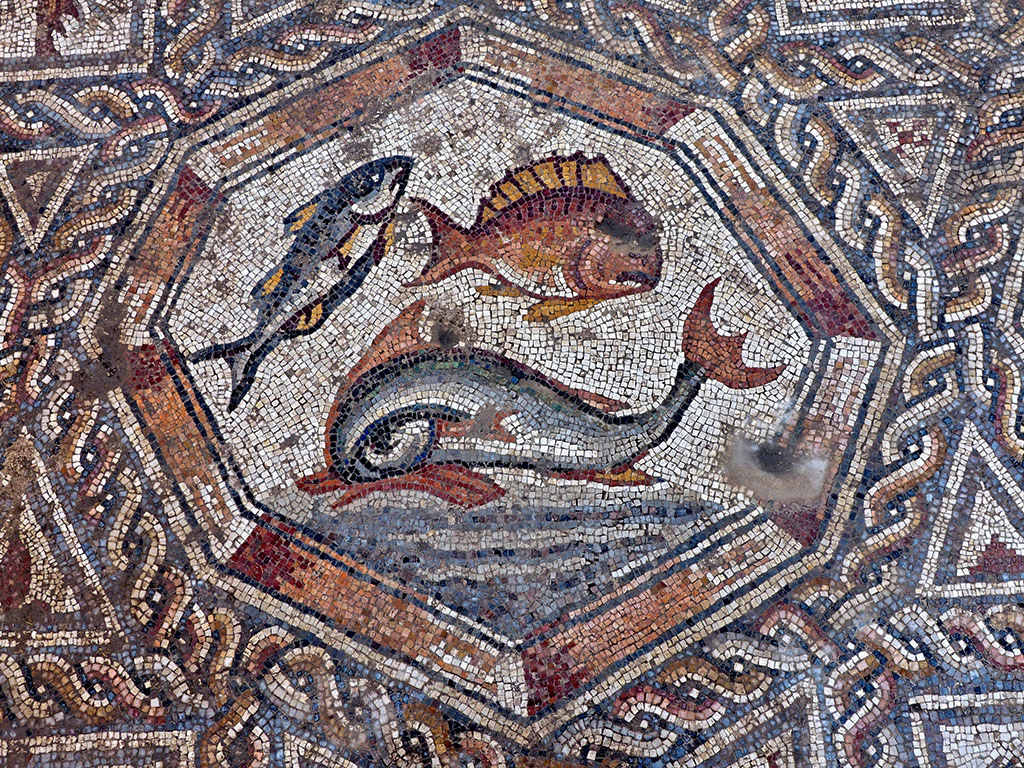
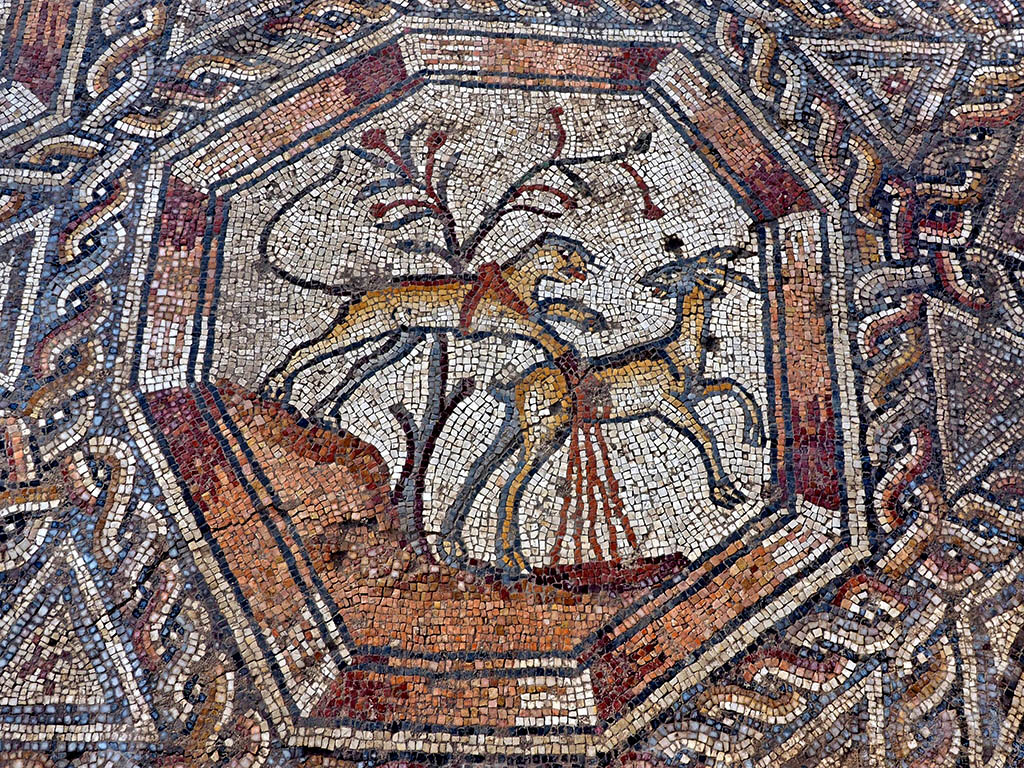
A portion of the newly discovered Lod mosaic showing fish. Photo by Assaf Peretz, Israel Antiquities Authority.

A portion of the newly discovered Lod mosaic showing fish. Photo by Assaf Peretz, Israel Antiquities Authority

According to Dr. Amir Gorzalczany, excavation director on behalf of the Israel Antiquities Authority, “The villa we found was part of a neighborhood of affluent houses that stood here during the Roman and Byzantine periods. At that time Lod was called Diospolis and was the district capital, until it was replaced by Ramla after the Muslim conquest. The building was used for a very long time”.

The northern part of the complex, where the “Shelby White and Leon Levy Lod Mosaic Center” will be constructed, was exposed when the Israel Antiquities Authority was inspecting development work being carried out in the early 1990s prior to the construction of Highway 90. The mosaic, which was discovered and excavated at that time by the late Miriam Avissar, is among the most beautiful in the country, and has been exhibited in recent years in some of the world’s leading museums, including the Metropolitan, the Louvre and the State Hermitage etc. It is currently on display at the Cini Gallery in Venice, Italy, and in the future it will be housed in the main building to be erected in Lod.
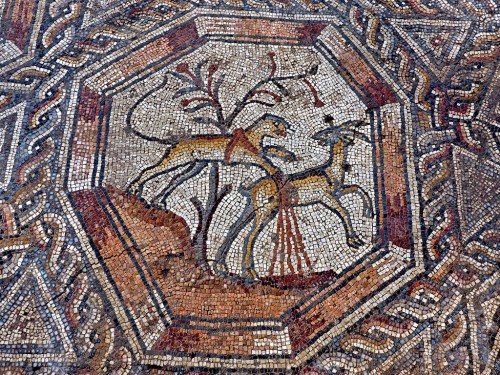
A portion of the newly discovered Lod mosaic showing fanimals. Photo by Assaf Peretz, Israel Antiquities Authority

A portion of the newly discovered Lod mosaic showing fanimals. Photo by Assaf Peretz, Israel Antiquities Authority

The southern part of the complex was exposed in the current excavations. Among other things, it includes a large magnificent courtyard that is paved with a mosaic and surrounded by porticos (stoas–covered galleries open to the courtyard) whose ceiling was supported by columns. According to Dr. Gorzalczany, “The eastern part of the complex could not be completely exposed because it extends beneath modern buildings in the neighborhood”. The scenes in this mosaic depict hunting and hunted animals, fish, flowers in baskets, vases and birds. Dr. Gorzalczany added, “The quality of the images portrayed in the mosaic indicates a highly developed artistic ability”. Numerous fragments of frescoes (wall paintings prepared on wet plaster) reflect the decoration and the meticulous and luxurious design, which are in the best tradition of the well-born of the period. In light of the new discoveries, this part of the villa will also be incorporated in the visitor center.

Archaeologists Hagit Torgë, Uzi ‘Ad, Eriola Jakoel and Yossi Elisha of the Israel Antiquities Authority participated in the excavation.

According to the press release: “Visiting hours: Tuesday–Wednesday, November 17–18: 8:00 to 16:00. Friday, November 20: 8:00 to 13:00. Driving directions: Come to Ha-Halutz Street in Lod, by way of Ginnaton Junction.”

HT: Joseph Lauer

Lesbos, Syrian refugees, and “Come before winter”

A recent evening news report on the Syrian refugees trying to reach some semblance of safety in Europe shows the dangers they face trying to get from Turkey to the Greek island of Lesbos. Some of the heavily loaded rafts and small boats have overturned in the rough sea. Why is that? It is because of the approach of winter. Keep that thought in mind and we will return to it.

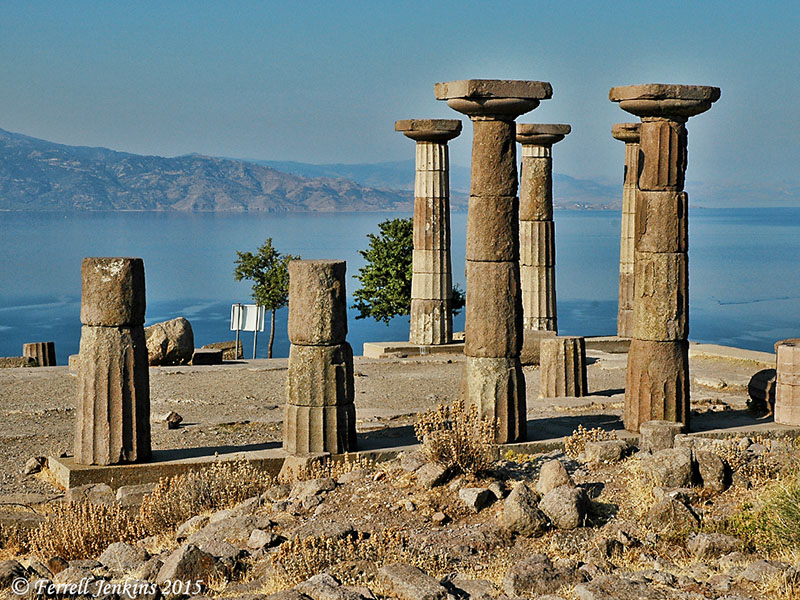
Our first photo shows the ruins of the temple of Athena at Assos. The Aegean island of Lesbos is visible across the strait.

A view of Lesbos across the strait from Assos and the temple of Apollo. Photo by Ferrell Jenkins.

A view of Lesbos across the strait from Assos and the ruins of the temple of Athena. Photo by Ferrell Jenkins.

The apostle Paul undoubtedly saw the temple of Athena when he traveled the approximate 20 miles from Alexandria Troas to Assos by land. His companions had traveled by boat from Troas to Assos. The historical account reads this way:

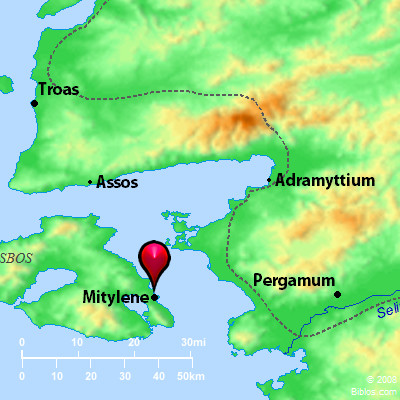
But going ahead to the ship, we set sail for Assos, intending to take Paul aboard there, for so he had arranged, intending himself to go by land. And when he met us at Assos, we took him on board and went to Mitylene. (Acts 20:13-14 ESV)

The island across the strait is Lesbos. Follow the island coastline south and you will come to the town of Mitylene.

The island of Lesbos is close to modern Turkey. Credit: biblos.com.

The Greek island of Lesbos is close to modern Turkey. Credit: biblos.com.

Now, back to the danger of the sea in winter. There is a valid reason why Paul would encourage Timothy, after picking up his cloak and parchments at Troas [see the map] to come to him in Rome “before winter.”

Do your best to come before winter.  (2 Timothy 4:21 ESV)

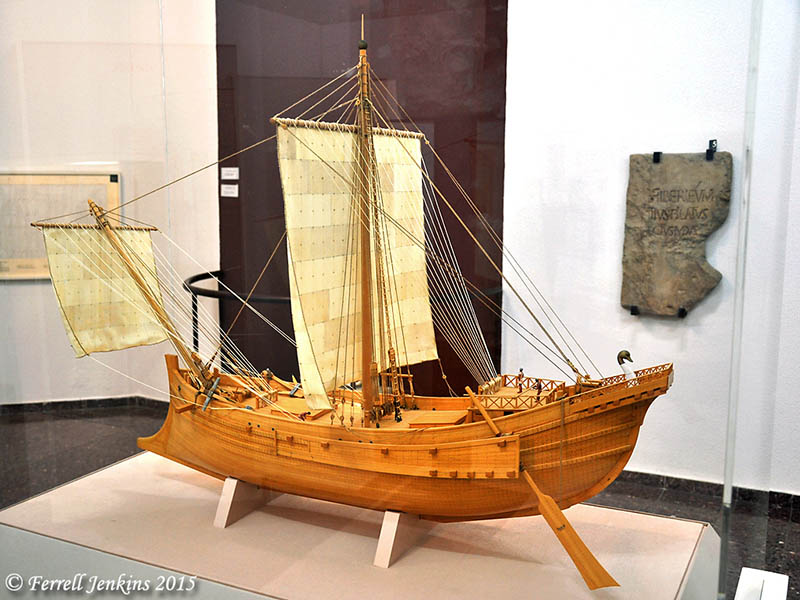
Paul, having experienced his own shipwreck on the way to Rome, knew of the danger of traveling too late in the year. We are told that there were 276 persons aboard the ship that wrecked on Malta (Acts 27:37).

Model of ship like Paul would have used on his voyage to Rome. Rali Museum, Caesarea, Israel. Photo by Ferrell Jenkins.

Model of ship like Paul would have used on his voyage to Rome. Rali Museum, Caesarea, Israel. Photo by Ferrell Jenkins.

The ships that regularly cruise the Aegean Sea are only about half the size of those we are accustomed to in the Caribbean. They sail from April through mid-November. After that the sea is too rough.

Imagine the horror of taking one’s family out on the sea in a small raft during the winter season?

Tithing anise and overlooking weighty matters

Jesus used illustrations His hearers understood from their daily activities. In announcing woes on the religious leaders of His time, he spoke of spices that were used in cooking.

“Woe to you, teachers of the law and Pharisees, you hypocrites! You give a tenth of your spices– mint, dill and cumin. But you have neglected the more important matters of the law– justice, mercy and faithfulness. You should have practiced the latter, without neglecting the former. (Matthew 23:23 NIV)

Instead of dill, the KJV and NKJV versions have used the term anise.

The Illustrated Manners and Customs of the Bible has a brief explanation about anise.

The term anise mentioned in Matthew 23:23 is derived from the Greek word It refers either to the dill or to the true anise. Both plants are similar and of the same plant family. Both grow about 91 cm. (3 ft.) high with clusters of yellow flowers. The seeds, leaves, and stem are used for medicine and cooking, and were a part of the ancient temple tithe. (Jesus denounced the Jews of His day for carefully obeying small laws, such as the spice tithe, and forgetting the more important ones.) Anise was cultivated in ancient Egypt and other Mediterranean countries, and still grows there today. (Packer and Tenney, Eds. Illustrated Manners and Customs of the Bible, p. 249.)

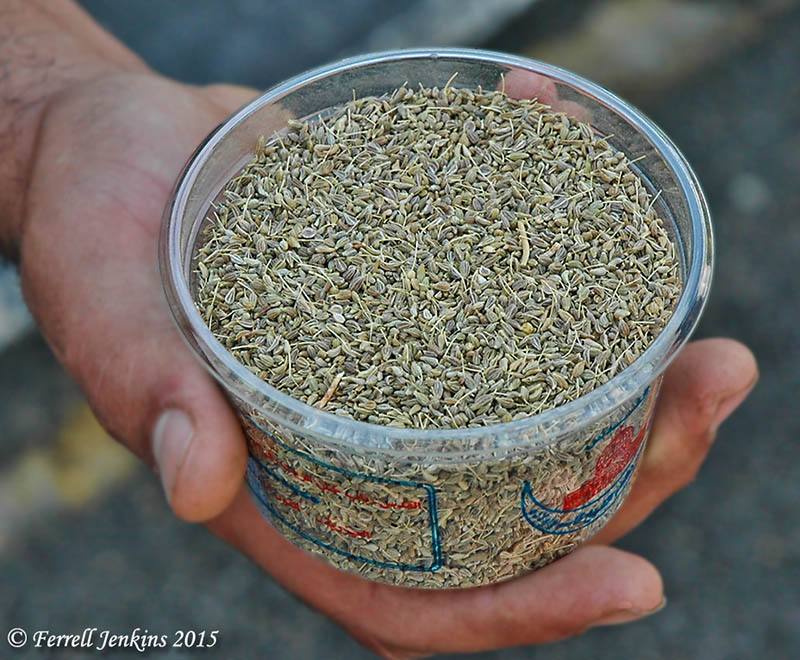
Many of the stores in the Old City of Jerusalem and other cities in Israel and the West Bank sell spices. The photo of anise (dill) below was made at Jericho.

A salesman at Jericho shows anise. Photo by Ferrell Jenkins.

A salesman at Jericho shows anise. Photo by Ferrell Jenkins.

Imagine counting out one of every 10 seed but overlooking justice, mercy, and faithfulness. Jesus told the experts in the law and the religious leaders,

You should have practiced the latter, without neglecting the former.

I think there is a lesson here for many of us today.

Sheepfolds are still in use in the Bible World

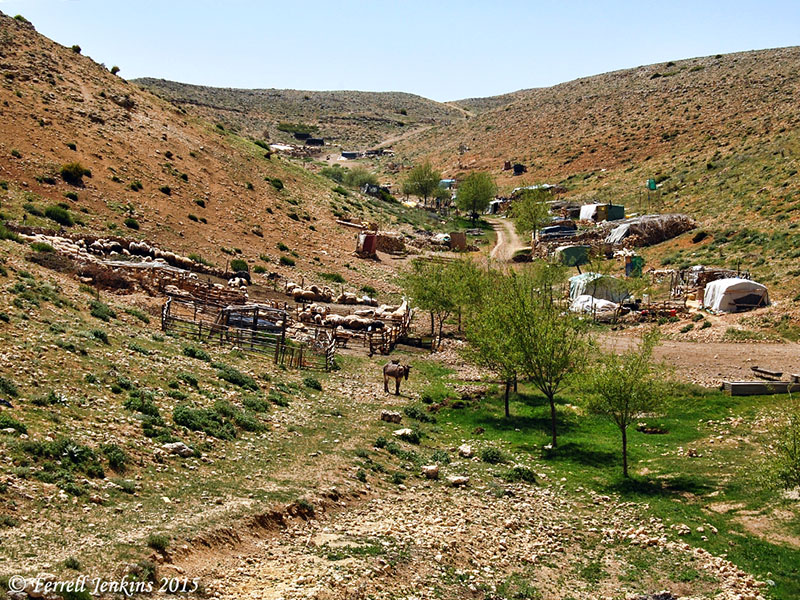
Recently we had a request from a person publishing a Bible class book for a photo of a sheepfold. We did not have exactly what the person requested but we did satisfy their need. At the time I commented that I had seen sheepfolds of all sorts in various parts of the Bible World. Tonight I was looking through some photos made in the Tarus mountains of Turkey. The location is a few miles south of Karaman, Turkey. These shepherds move about from place to place in order to find food for their animals.

The sheepfold in this photo is on the left side of the valley.

Shepherds and sheepfold near Karaman, Turkey. Photo by Ferrell Jenkins.

Shepherds and sheepfold near Karaman, Turkey. Photo by Ferrell Jenkins.

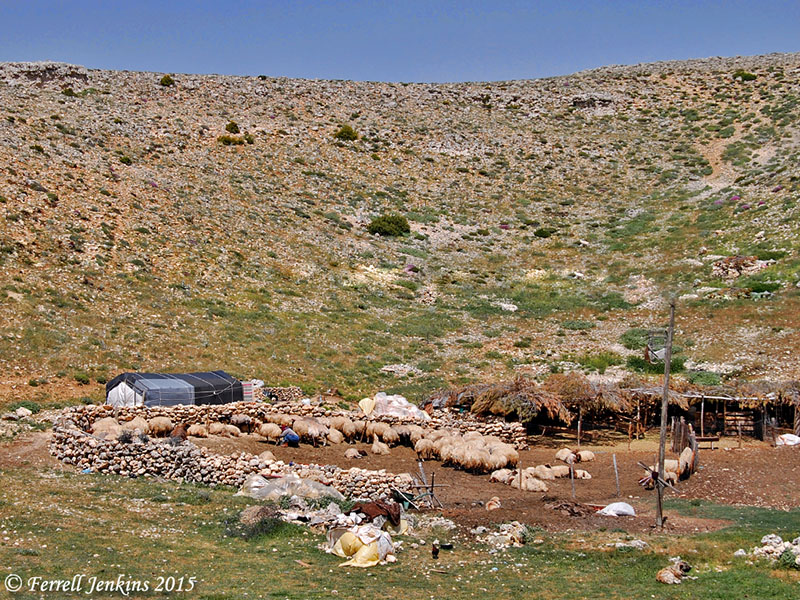
A short distance away is a different sheepfold. If you click on the photo, in the larger image you will see at least two dogs keeping watch and a woman milking a sheep.

A sheepfold near Karaman, Turkey. Photo by Ferrell Jenkins.

A sheepfold near Karaman, Turkey. Photo by Ferrell Jenkins.

Scenes such as these remind us of the Biblical patriarchs who moved about from place to place with their flocks. Abraham and Lot provide an example.

And Lot, who went with Abram, also had flocks and herds and tents, (Genesis 13:5 ESV)

There are several biblical references to the sheepfold, or the fold of the sheep (Jeremiah 50:6; Micah 2:12; John 10:1, 16). Jesus used an illustration involving the sheepfold:

Truly, truly, I say to you, he who does not enter the sheepfold by the door but climbs in by another way, that man is a thief and a robber. But he who enters by the door is the shepherd of the sheep. (John 10:1-2 ESV)