Category Archives: New Testament

The Corinth Canal

The city of Corinth is located about two miles south of the narrow isthmus which forms the land bridge, and controlled access, between the main land mass of Greece and the Peloponnesus.

The isthmus is less than five miles wide. In ancient times small ships were dragged across the isthmus on a paved road called the diolkos. Small portions of the diolkos may still be seen. Larger ships unloaded their cargo which was carried across and reloaded. This avoided the long 200 mile journey around the Peloponnesus. Nero abandoned his attempts to dig a canal across the isthmus (A. D. 67).

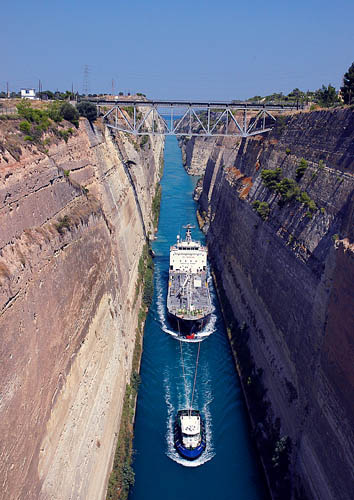
A canal was constructed between 1881 and 1893. Here is a photo of that canal with a tug boat pulling a ship through the canal.

Corinth Canal. Photo by Ferrell Jenkins.

The apostle Paul likely came to Corinth about A.D. 51, during the reign of the Roman Emperor Claudius, and remained there for eighteen months (Acts 18). The book of Acts records the success of that work:

Crispus, the leader of the synagogue, believed in the Lord with all his household, and many of the Corinthians when they heard were believing and being baptized. (Acts 18:8).

Archaeological excavations have been conducted at the ancient city of Corinth since 1896 by the American School of Classical Studies in Athens.

Is there a “third Jesus”?

If you have been impressed by seeing Deepak Chopra on TV telling about his new book, The Third Jesus (the Christ we cannot ignore), I suggest you read this post by Ben Witherington. Click here.

Postmodern man is unwilling to accept the Jesus of the Bible, but he still needs to believe, and wants to believe. This is what makes all of the cable TV programs about the mysteries of Jesus, the unknown years, and those dealing with the claims of the Gnostic literature so popular.

Here are a few Scriptures that might be helpful as you think of Jesus.

In the beginning was the Word, and the Word was with God, and the Word was God. (John 1:1)

And the Word became flesh, and dwelt among us, and we saw His glory, glory as of the only begotten from the Father, full of grace and truth. (John 1:14)

For many deceivers have gone out into the world, those who do not acknowledge Jesus Christ as coming in the flesh. This is the deceiver and the antichrist. (2 John 1:7)

… concerning His Son, who was born of a descendant of David according to the flesh, 4 who was declared the Son of God with power by the resurrection from the dead, according to the Spirit of holiness, Jesus Christ our Lord… (Romans 1:3-4)

“Therefore let all the house of Israel know for certain that God has made Him both Lord and Christ– this Jesus whom you crucified.” (Acts 2:36)

Peter’s great confession of Jesus took place at Caesarea Philippi.

Simon Peter answered, “You are the Christ, the Son of the living God.” (Matthew 16:16)

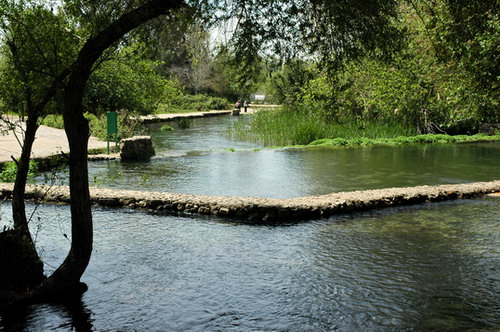
The photo below was made at Caesarea Philippi, one of the major sources of the Jordan River. This was the site of Peter’s great confession.

Source of the Jordan River at Caesarea Philippi. Photo by Ferrell Jenkins.

Senator McCain visits the Western Wall

USA Today reports that Senator John McCain visited the Western Wall during his visit in Israel. This is not uncommon for political figures. Travelers to Israel want to see the Western Wall, or as many of them call it, “The Wailing Wall.”

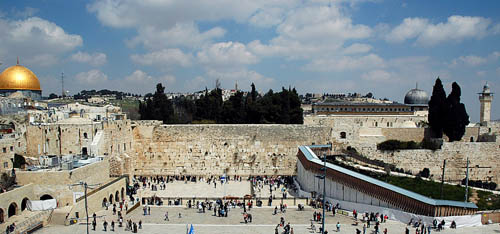
The Western Wall is the western side of the enclosure wall built around the temple mount by Herod the Great. Herod’s wall would have been seen by Jesus and His disciples on their many visits to Jerusalem. Since 1967, after Israel took control of the Old City of Jerusalem, a large portion of the Western Wall has been exposed. The portion we see in our photograph now serves as a place for prayer. It is divided into two portions, one for men, and one for women.

The temple platform is where Solomon’s temple (966-586 B.C.), the temple of Zerubbabel (built 520-516 B.C.), and Herod’s temple (building began about 19 B.C.), once stood. According to the Gospel of John, work continued on Herod’s temple for 46 years.

Then the Jewish leaders said to him, “This temple has been under construction for forty-six years, and are you going to raise it up in three days?” (John 2:20, NET Bible).

The Western Wall in Jerusalem. Photo by Ferrell Jenkins.
The temple platform, now the location of the Mosque of Omar (the Dome of the Rock with the gold dome), and the Al-Aqsa mosque with the silver dome, is now administered by a Muslim group called the Waqf. Currently it is not possible for tourists to visit the temple platform.

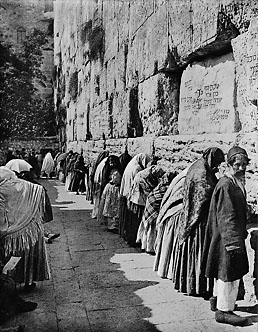
The Wailing Wall between 1900 and 1920. Matson Photograph Collection.

This old photo from the Matson Collection shows the Wailing Wall sometime between 1900 and 1920. This is the way the wall looked when I first saw it in May, 1967. At that time the area was under Jordanian control and no worshipers were present. Notice how small the area is, and how few rows of stone are visible.

Honoring Dr. Jack P. Lewis

Dr. Jack P. Lewis was honored March 6 at a dinner hosted by Faulkner University, Montgomery, Alabama, during their annual Bible lectureship. I was pleased that I could attend the lectures one day and be present for the dinner honoring Dr. Lewis.

Lewis is Professor Emeritus at the Harding Graduate School of Religion in Memphis. Among several good teachers that I had, Lewis was unique. He holds two earned doctorates, a Ph.D. in New Testament from Harvard, and a Ph.D. in Old Testament from Hebrew Union. He was the most demanding teacher I had, and one of a few from whom I learned the most.

After the high school years at Athens Bible School, and four years of Bible at Florida Christian College (now Florida College), with teachers such as Homer Hailey, I had a good general knowledge of the Bible. I think I had about 60 hours of Bible at FCC. The graduate work was not too difficult, it was just on a higher level.

It was part of the graduate program generally, but Lewis taught the importance of using primary sources where possible and the importance of thorough preparation. He entered the class room, called the roll, and began lecturing. As a student I made notes the best I could, then spent hours after each class verifying the names, dates, and facts presented. Different from the students I had in college, we would never imagine asking “How do you spell that?” He taught us the importance of using up-to-date sources in our research.

Jack Lewis was my first teacher who had spent a considerable amount of time studying the land of the Bible. He had worked in the archaeological excavation at Arad, and had spent a year as a fellow at the American Schools of Oriental Research in Jerusalem (now the Albright Institute).

In one of the classes with Dr. Lewis I did a paper on “Authentic First Century Remains in Palestine.” Soon afterward I began to prepare for my own visit to the Bible lands. I might have gone anyway, but I must credit Dr. Lewis, and his unique insight into the land of the Bible, for spurring my interest in traveling to this part of the world. The other day, as we visited, he said something like this: “There is nothing as valuable as seeing the places you study about.” So, now you know one of the major motivations in my travels to Bible lands over all these years since the first trip in 1967. I still learn on every trip, and in the preparation for the trip.

Dr. Lewis is a prolific writer. His many books included The History of the English Bible from the KJV to the NIV, The Interpretation of Noah and the Flood in Jewish and Christian Literature, Historical Backgrounds to Bible People, a two volume commentary on the Gospel of Matthew. There are also books on the prophets and other areas of biblical studies.

Several Faulkner faculty members spoke of what Lewis had meant to them. These included Dr. Cecil May, Jr., Dr. Carl Cheatham, and Dr. Ed Hicks. Dr. Jim Howard, from Memphis, was also on the program. Carl and Jim were at HGSR when I was there. Cecil and I spoke on the same topic at both the Nashville and Dallas meetings of institutional and non-institutional brethren a few years back. It was a pleasure to see them.

In the afternoon, Dr. Lewis had presented a lecture on “The Battle for the Integrity of the Bible.” In his typical rapid-fire manner, he surveyed the battles that have been won in demonstrating the integrity of the Bible. It was just a survey, but he seemed as sharp as in those classes on The History of the English Bible and on Archaeology and the Bible from which I profited so much.

Today Dr. Jack Pearl Lewis is 89 years old. Happy birthday, Dr. Lewis.
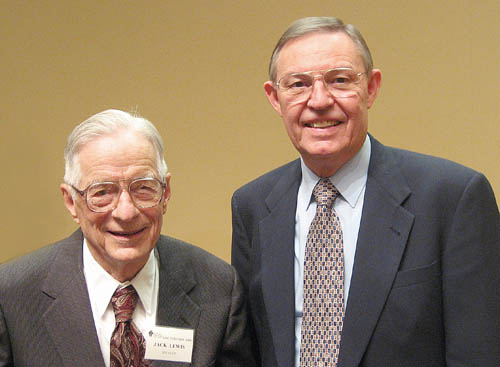
Dr. Jack P. Lewis and Ferrell Jenkins. Photo by Leon Mauldin.

This photo was made March 6 after the lecture on “The Battle for the Integrity of the Bible.”

A Day in Capernaum

I just ran across the third edition of A Day in Capernum by Franz Delitzsch. Yes, the Delitzsch of the famous Keil and Delitzsch 19th century commentaries on the Old Testament. The book was written in 1870, but the third edition was published in 1892. In the days before motorized vehicles, visitors had to travel by foot or horseback. This had a distinct value in allowing more time to meditate and understand the importance of the travel routes, etc. The writer visits some of the other places around the Sea of Galilee and tells how long it took to move from one place to another.

Works of this kind are of value because they reflect the scholarship and understanding of the time. You may read the work online, or download it in PDF from Google Book Search. Here is the directly link to A Day in Capernaum.

Google Book Search is a wonderful place to find many older works in their entirety. Some pages of many newer works are also availalbe.

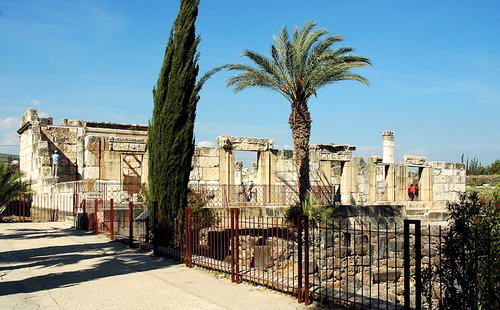
Things have changed a lot at Capernaum since Delitzsch was there. We believe the foundation of the synagogue from the time of Jesus is known. The synagogue from the late 4th or early 5th century A.D. has been partially reconstructed mainly by the late archaeologist Stanislao Loffreda. The photo shows how it looks today.

Reconstructed Capernaum synagogue from 4th or 5th century A.D. Photo by Ferrell Jenkins.

The most important thing about Capernaum is that Jesus came and settled in the city and that it was the scene of much of His ministry and miracles (Matthew 4:13; 11:23).

The Queen of Adiabene and a Rolling Stone

Queen Mother Helena of Adiabene came to Jerusalem with her son, King Izates, as a convert to Judaish in A.D. 46. Adiabene was located in northern Mesopotamia east of the Tigris River. During the famine in Judea, mentioned in Acts 11:28-30, the queen sent to Egypt for grain and to Cyprus for dried figs (Josephus, Ant. 20.51).

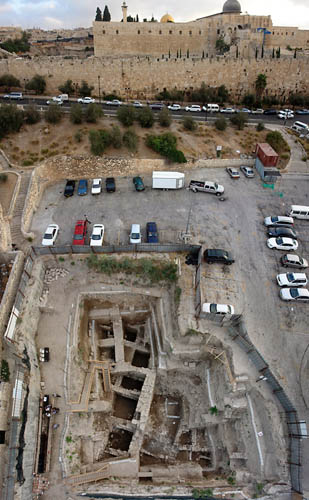
A recent excavation south of the Dung Gate, called the Givati garage area, has revealed a massive building which is being suggested as the palace of Queen Helena. So far there is no absolute proof that the Queen is to be identified with the structures, but it is a good suggestion. The reference in Josephus to the palace of the Queen in the lower city is helpful (Jewish Wars 6.355).

The press release of the Israel Antiquities Authority, December 3, 2007, says:

In the excavations the Israel Antiquities Authority is carrying out with the Nature and Parks Authority and the Ir David Foundation, an impressive architectural complex is being uncovered that includes massive foundations; walls, some of which are preserved to a height in excess of five meters and built of stones that weigh hundreds of kilograms; halls that are preserved to a height of at least two stories; a basement level that was covered with vaults; remains of polychrome frescoes; water installations and ritual baths (miqve’ot).

This photo shows the excavation at the bottom and the south wall of the old city of Jerusalem at the top. The City of David is directly to the right of the excavation.

Skyview of the excavation thought to be a palace belonging to Queen Adiabene. Photo supplied by the Israel Antiquities Authority.

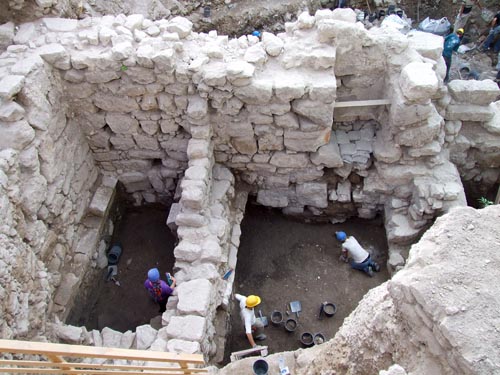
The photo below shows details of one portion of the excavation.

Excavation thought to be palace of Queen Adiabene. Photo provided by Israel Antiquities Authority.

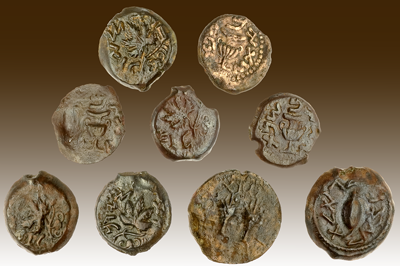
The excavation turned up stone vessels, pottery, and coins belonging to the end of the Herodian Temple [Israelis call this the Second Temple] period. This means prior to A.D. 70 when the Romans destroyed the temple. These coins bear images of, among other things, a vine leaf, a chalice, and an amphora with handles.

Coins found in the Givati excavation. Photo supplied by the Israel Antiquities Authority.

A large burial complex was dug north of the city for the burial of the Queen and her family. This is the tomb referred to in modern times as the Tomb of the Kings. It is a good place to see a rolling stone and a tomb hewn from solid rock. The property is under French control and the last three or more times I have been there it has been closed, and I was unable to rouse anyone by ringing the bell.

Tomb of the Kings, Jerusalem. The tomb of Queen Adiabene. Photo by Ferrell Jenkins.
This rolling stone is of the same type that covered the tomb of Jesus. When Joseph of Arimathea was granted permission from Pilate to bury Jesus, the historical record says,
And Joseph took the body and wrapped it in a clean linen cloth, and laid it in his own new tomb, which he had hewn out in the rock; and he rolled a large stone against the entrance of the tomb and went away. (Matthew 27:59-60)

March/April edition of BAR online

Biblical Archaeology Review announced today that the entire March/April edition is available online. Certainly this is to gain subscribers. Nonetheless it is a good opportunity for those who have not read the magazine to take a look.

Subjects include an article about a seal bearing the name Jezebel. Does it belong to the wicked Phoenician Queen, wife of Ahab?

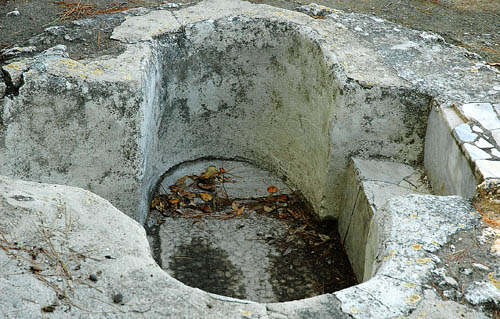
Another article is about Emmaus, or Emmaus-Nicopolis, where Jesus met with some disciples after his resurrection (Luke 24:13ff.). Here is a photo I made of the fifth century baptistry at Emmaus in 2005.

Baptistry in 5th century church at Emmaus. Photo by Ferrell Jenkins.

BAR has a photo of this baptistry, but calls it a “baptismal font.” The article says,

Two steps lead down into the basin where the penitent would stand when the priest poured water over him (the basin is not large enough for total immersion).

Of course, I must disagree with BAR. Many a preacher has baptized in a bathtub or some other small vessel when nothing else was available. In New Testament times baptism was immersion, as the word indicates, and as history records. The first known instance of the pouring of water as a substitute for immersion is the case of Novation in A.D. 251. It may well have been that pouring was practiced by the 5th century at Emmaus, but it is a departure from the New Testament (Romans 6:3-4). Baptism is commonly called a washing in the New Testament (Acts 22:16; 1 Corinthians 6:11; Ephesians 5:26; Titus 3:5; Hebrews 10:22).

Anyway, go online and read these and other articles from the current issue of BAR. Here is the link.

Book of Enoch on Display

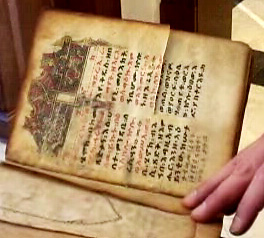
The book of Enoch has received some attention in the news today. The Courier-Journal reports that a printed copy of Enoch was recently purchased by a collector, and is being placed on display at the Remnant Trust in Jeffersonville, Indiana. The article includes a nice video with good images of the book.
Book of Enoch at Remnant Trust, Jeffersonville, Indiana.

Enoch was originally written in Hebrew or Aramaic by Jews, and some ancient fragments of it have been found near the Dead Sea. But the oldest complete versions are in the ancient Ethiopian language of Ge’ez because Ethiopian Christians are the only enduring church group that revered the book as Scripture.

James C. VanderKam, a professor of Hebrew Scriptures at Notre Dame University and a leading expert on the Book of Enoch, has inspected the book on loan to the trust and estimates that it’s probably one of the five oldest manuscripts of the work.

“We don’t have very many that go back that far,” said VanderKam, who is co-author of an English translation of Enoch and is working on a commentary. VanderKam estimated that the text was about 500 years old because its script and contents are similar to a manuscript of that age in the British Museum. Specialists in Ethiopian script could make a more specific determination, he said.

Enoch is mentioned in Luke’s genealogy of Jesus (Luke 3:37). The writer of the epistles to the Hebrews says,

By faith Enoch was taken up so that he would not see death; AND HE WAS NOT FOUND BECAUSE GOD TOOK HIM UP; for he obtained the witness that before his being taken up he was pleasing to God (Hebrews 11:5 NASB).

The most interesting mention of Enoch in the New Testament is the quotation from the book in the little letter of Jude. In the midst of a litany of charges against “certain persons” who had crept in unnoticed among the Christians to whom he writes, he says,

It was also about these men that Enoch, in the seventh generation from Adam, prophesied, saying, “Behold, the Lord came with many thousands of His holy ones, to execute judgment upon all, and to convict all the ungodly of all their ungodly deeds which they have done in an ungodly way, and of all the harsh things which ungodly sinners have spoken against Him.” (Jude 1:14-15 NASB).

The book of Enoch was not considered one of the canonical books of the Hebrew Bible (Old Testament) by the Jews, but Jude seems to think it expressed the truth about what will happen to false teachers. In the same way, Paul quoted pagan poets whose work expressed the truth he was seeking to express (Acts 17:28).

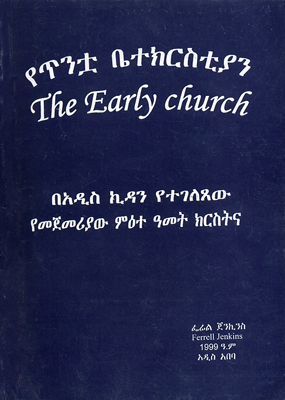
For several weeks I have been looking for an excuse to mention that my book, The Early Church, is now available in the Amharic language. All distribution is being done by Christians in Ethiopia, and I have no copies for distribution.

The Early Church by Ferrell Jenkins in Amharic, used by Christian in Ethiopia.

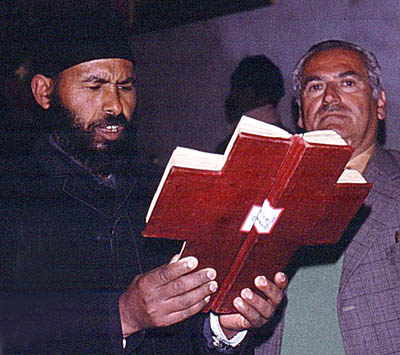
Ethiopians, sometimes called Abyssinians, have a small chapel adjoining the Church of the Holy Sepulcher in Jerusalem. There they sometimes show a portion of the Gospels prepared in the shape of a cross. One of my guides used to ask the Ethiopian to read to us from Amharic. This photo was made in 1977.

Ethiopian reading the gospel in Jerusalem. Photo by Ferrell Jenkins, 1977.

New Excavation Planned for Magdala

The town of Magdala is not mentioned in the Bible, but Mary Magdalene is mentioned a total of 12 times in the four gospels. This place may have been her birthplace or her home. A few late manuscripts mention Magdala (Matthew 15:39 KJV), but earlier manuscripts read Magadan. Magdala is located about 4 miles north of Tiberias on the western shore of the Sea of Galilee.

The Hebrew word Magdala means tower. In New Testament times the city had become Hellenized and bore the Greek name Tarichea because of the importance of the salted-fish industry there. Mendel Nun located a harbor at the site. He says,

“In ancient times, pickled sardines were an important element of diet throughout the countryespecially for those who lived near the lake” (BAR, Nov/Dec 1993).

Josephus had his headquarters at Magdala during the first Jewish Revolt against Rome (A.D. 66-70). He was able to get a group of at least 230 boats to go from Magdala to Tiberias (Jewish Wars 2.635-637). Vespasian attacked the town from the sea and destroyed it.

Archaeological excavations were conducted at Magdala in the early 1970s, on the plot owned by the Franciscan fathers, by Corbo and Loffreda. Biblical Archaeology Review announced (Sept/Oct 2007) that a new excavation will begin under the direction of Franciscan scholar Michele Piccirillo. In recent years entry to the site has been closed. The new excavations are welcomed.

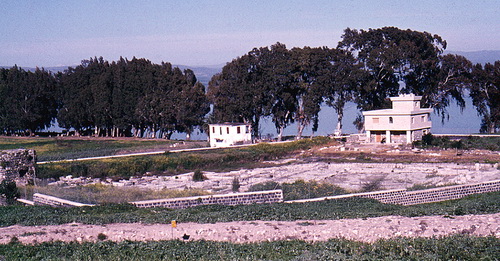
The photo below is one that I made in 1977 of the area overlooking the earlier excavations. A first century mosaic from Magdala showing a boat is on display at Capernaum. Moments after posting this blog I noticed that a report had been issued on new finds at Magdala. You may read the report and see new photos here. It will be exciting over the next few years to watch this ancient town give up its secrets.

Site of Magdala on the western shore of the Sea of Galilee. Photo by Ferrell Jenkins in 1977.

Israel Issues a New 2-Shekel Coin

A new 2-shekel coin entered circulation recently in Israel. This might be of interest to people who plan to travel to Israel. The Israeli New Shekel is worth about 27 cents in US money, so the 2-shekel (NIS 2) will be roughly equivalent to our half-dollar. Most American tourists who are in travel groups have prepaid their arrangements and have little need to exchange funds. Dollars are widely accepted in Israel.

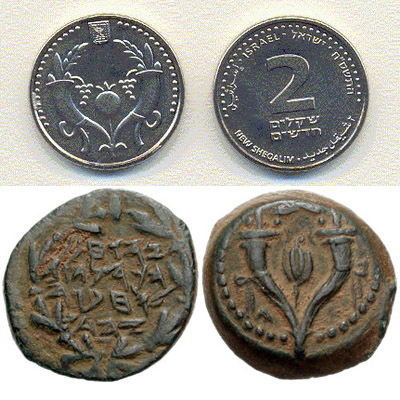
The new coin has an interesting historical association on the reverse side. It is a design of a cornucopia, a horn of plenty, and a pomegranate. This design is from an historical coin minted in the days of John Hyrcanus. Hyrcanus was one of the Maccabeans who successed Judas. He became high priest, and then ruler of the Hasmonean Dynasty from 135-104 B.C. During his reign we have the first reference to the Jewish parties, Pharisees and Sadducees, that are prominent in New Testament times.

John Hyrcanus extended the territory of the Maccabeans by seizing Idumaea (enter Herod!) and compelling the Idumaeans to be circumcised. He seized Samaritan territory and destroyed the temple of the Samaritans on Mount Gerizim. This is the temple alluded to by the woman of Samaria when she said to Jesus, “Our fathers worshiped in this mountain [Gerizim], and you people say that in Jerusalem is the place where men ought to worship” (John 4:20).

History is interesting, isn’t it? Here is a photo of the new 2-shekel and the bronze Prutah minted in the time of Hyrcanus. The photo is from Wikimedia Commons. Glancing through Hendin and Meshorer, I see that this design was fairly common during the period of the Maccabees.

Israel 2-shekel and coin from time of John Hyrcanus.

The pomegranate can be eaten fresh, used for fresh juice, or processed into an alcoholic drink for future use. Writers say the pomegranate,

“is a beautiful, symmetrical fruit, scarlet in color. Filled with small seeds surrounded by juicy pulp, the fruit became an obvious symbol of fertility” (King and Stager, Life in Biblical Israel, 104).

Another source says,

“The pulp is divided into 9 or 10 partitions which hold the numerous seeds. The pulp is delicious and very refreshing to eat because of its copious juice. the seeds yield a syrup called grenadine. The flowers are used in the treatment of dysentery” (Fauna and Flora of the Bible, 169).

Saul stayed on the outskirts of Gibeah “under the pomegranate tree” (1 Samuel 14:2). The girl of the Song of Solomon is told twice that her “temples are like a slice of a pomegranate behind your veil” (Song 4:3; 6:7). She also says, “I would give you spiced wine to drink from the juice of my pomegranates” (Song 8:2). The fruit was used as the design for decoration on the hem of the garment of the high priest (Exodus 28:33).

This beautiful pomegranate was growing at the site of ancient Aphrodisias in Turkey. The photo is better than some I have from Israel. Enjoy.

Pomegranate growing at Aphrodisias in Turkey.